CBSE Class 12 Question Paper 2025 Graphics
Finished viewing? Save it for later —
Download CBSE Class 12 Question Paper 2025 Graphics (PDF · 12 pages)About CBSE Class 12 Question Paper 2025 Graphics
CBSE Class 12 Question Paper 2025 Graphics is available here for free download. Published by CBSE for Class 12, this question paper can be viewed online or downloaded as a PDF (12 pages). Candidates preparing for Class 12 can use CBSE Class 12 Question Paper 2025 Graphics to understand the exam pattern, the type of questions asked, and the overall difficulty level.
Frequently Asked Questions
How can I download CBSE Class 12 Question Paper 2025 Graphics?
Open this page and click the Download button to save CBSE Class 12 Question Paper 2025 Graphics as a PDF. It is completely free on AglaSem Docs.
Is CBSE Class 12 Question Paper 2025 Graphics free to download?
Yes. CBSE Class 12 Question Paper 2025 Graphics can be viewed online and downloaded as a PDF free of cost on AglaSem Docs.
How many pages does CBSE Class 12 Question Paper 2025 Graphics have?
CBSE Class 12 Question Paper 2025 Graphics contains 12 pages, which you can read online or download together as a single PDF.
Where can I find more Class 12 study material?
You can find more Class 12 question papers, sample papers, syllabus, and answer keys on AglaSem Docs.
CBSE Class 12 Question Paper 2025 Graphics – Text
Read the full text of this question paper below — useful to quickly search, copy and reference the content online without downloading the PDF.
📄 View text version (12 pages)
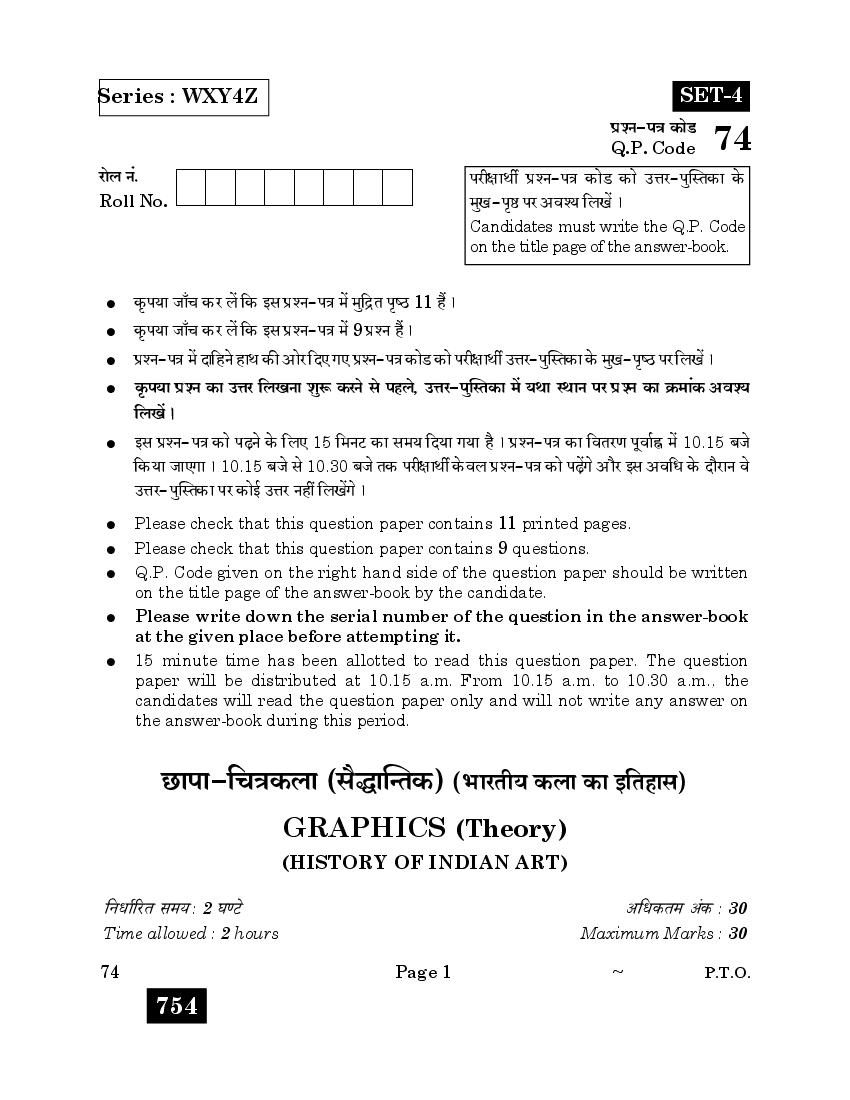
Page 1
-
Q.P. Code 74
. - -
Roll No. -
Candidates must write the Q.P. Code
on the title page of the answer-book.
- 11
- 9
- - - -
, -
- 15 - 10.15
10.15 10.30 -
-
Please check that this question paper contains 11 printed pages.
Please check that this question paper contains 9 questions.
Q.P. Code given on the right hand side of the question paper should be written
on the title page of the answer-book by the candidate.
Please write down the serial number of the question in the answer-book
at the given place before attempting it.
15 minute time has been allotted to read this question paper. The question
paper will be distributed at 10.15 a.m. From 10.15 a.m. to 10.30 a.m., the
candidates will read the question paper only and will not write any answer on
the answer-book during this period.
- () ( )
GRAPHICS (Theory)
(HISTORY OF INDIAN ART)
{ZYm©[aV g‘¶ : 2 KÊQ>o A{YH$V‘ A§H$ : 30
Time allowed : 2 hours Maximum Marks : 30
74 Page 1 ~ P.T.O.
754
Page 2
– ( 1 )
– ( 2 )
– ( 6 )
–
1. :
(i)
1
(A)
(B) ()
(C)
(D)
(ii) (A) : “ ” -
- 1
(R) : “ ”
(A) (A) (R) (R), (A)
(B) (A) (R) (R), (A)
(C) (A) (R)
(D) (A) (R)
74 Page 2 ~
Page 3
Section – A Attempt all questions (Each Question carries 1 mark)
Section – B Attempt all questions (Each Question carries 2 marks)
Section – C Attempt any two questions (Each Question carries 6 marks)
SECTION – A
1. Select the right answer from the given options :
(i) The sculptor has given a completely unusual treatment to this
traditional figure of Ganesha. Mention the name of medium used in
this sculpture. 1
(A) Brass and bamboo
(B) Copper (oxidized), wire and tin
(C) Aluminium and wood
(D) Iron and wood
(ii) Assertion (A) : The painting “Chand Bibi Playing Polo” depicts
women mounted on beautifully decorated horses of
different colours. 1
Reason (R) : The different bright colours are due to the use of
‘oil on canvas’ as a medium for this painting.
(A) Both (A) and (R) are true and (R) is the correct explanation of
(A).
(B) Both (A) and (R) are true, but (R) is not the correct explanation
of (A).
(C) (A) is true, but (R) is false.
(D) (A) is false and (R) is true.
74 Page 3 ~ P.T.O.
Page 4
? 1
(A) (B)
(C) (D)
(iv) - ? 1
(A) (B)
(C) (D)
(v)
? 1
(A) (B)
(C) (D)
(vi)
? 1
(A) - (B)
(C) (D)
(vii) (A) :
(R) : , , , , -
1
(A) (A) (R) (R), (A)
(B) (A) (R) , (R), (A)
(C) (A) , (R)
(D) (A) , (R)
(viii)
? 1
(A) (B)
(C) (D)
74 Page 4 ~
Page 5
devotion of Royal couple is painted by 1
(A) Dana (B) Sahibdin
(C) Guman (D) Nuruddin
(iv) The painting is a depiction of two great Sufi personalities belong to
which Deccan Sub School ? 1
(A) Golconda (B) Hyderabad
(C) Ahmad Nagar (D) Kangra
(v) Which artist from your syllabus has shown the fondness of emperor
for his pet Falcon beautifully ? 1
(A) Haji Madni (B) Ustad Faquirullah Khan
(C) Ustad Mansoor (D) Miskin
(vi) The artist tried to show a reflection of human life through a camel in
which piece of artwork ? 1
(A) Shiv-Sati (B) Meghdoot
(C) Radhika (D) Journey’s End
(vii) Assertion (A) : Rajasthani Art was refined and purified form of
Indian Traditional Art. 1
Reason (R) : Painting based on Hindi Literature, Music,
Poetry, Religion, Rag-Ragini, etc. were made
under Rajput rulers.
(A) Both (A) and (R) are true and (R) is the correct explanation of
(A).
(B) Both (A) and (R) are true, but (R) is not the correct explanation
of (A).
(C) (A) is true, but (R) is false.
(D) (A) is false and (R) is true.
(viii) Which print maker has shown the power of worship and the hidden
power of Kundalini in a print from your syllabus ? 1
(A) Krishna Reddy (B) Anupam Sud
(C) Jyoti Bhatt (D) Somnath Hore
74 Page 5 ~ P.T.O.
Page 6
( )
100
2. (a)
2
(b) “ ”
2
3. (a) 2
( )
(b) - ?
2
4. (a) (-)
? 2
(b) 2
-
74 Page 6 ~
Page 7
(Short Answer Type Questions)
Answer for these questions is expected in around 100 words.
2. (a) This painting from your syllabus beautifully shows a group of rural
women involved in grinding a common spice used in Indian food. 2
Identify and mention the name of the artist and painting.
On the basis of above statement, describe 2 aesthetic features
of this painting.
OR
(b) Identify and appreciate the emotions which are dominant in the
sculpture made by “Amar Nath Sehgal” from your syllabus with
special reference to the name of the sculpture. 2
3. (a) Theme of this Mughal Miniature painting from Akbar period has
been taken from Harivamsa Puran. 2
Mention the name of artist and painting from your syllabus.
Explain the compositional arrangement.
OR
(b) Mughal miniature flourished most during the rule of Jahangir.
Elaborate with your point of view by describing one painting
belonging to his period from your course of study. 2
4. (a) Appreciate the painting Radha (Bani Thani). How successful have
been the artist in showcasing the beauty of woman ? 2
OR
(b) This Rajasthani School painting depicts a scene from Ramayana
where various episodes have been shown in a single scene. 2
Identify and name the painting, also mention its artist.
Write its subject matter.
74 Page 7 ~ P.T.O.
Page 8
2
(b) ‘, , ’
2
6. (a)
, ? 2
(b) “, ”
: 2
-
–
( )
:
200
7. ‘’
:
2
2
2
74 Page 8 ~
Page 9
Lord Krishna is surrounded by a group of women. In your answer,
include the title and the name of artist, from your syllabus. 2
OR
(b) On the basis of compositional arrangements, explain the painting,
‘Nand, Yashoda and Krishna with kinsmen going to Vrindavan’. 2
6. (a) Write a brief note on the use of colours and the symbolic meaning
of chakra in our National Flag, and how they inspire a sense of
pride, unity and dedication among all Indians. 2
OR
(b) Analyze the graphic print “Man, Woman and Tree” from your
syllabus and answer the following : 2
The name of its print maker and the subject matter.
Highlight any 2 aesthetic features of this print.
SECTION – C
(Long Answer Type Questions)
Attempt any two questions from the given options :
Answer for these questions is expected in around 200 words.
7. It is an intricately detailed artwork belonging to ‘Rasikapriya’ poetry of
Keshavdasa from Rajasthani school. The painting is divided into two
parts, showcasing Krishna in both upper and lower part.
Identify this miniature from your syllabus and answer the following :
What is the title and artist of this artwork ? 2
Describe the compositional arrangement in detail along with the
aesthetic application of colours. 2
Highlight any 2 main features of Rajasthani school. 2
74 Page 9 ~ P.T.O.
Page 10
:
3
3
9.
:
2
2
2
____________
74 Page 10 ~
Page 11
royal marriage procession, featuring richly decorated figures and bright
fireworks in the background. Identify the painting and answer the
following :
Provide a detailed description of this painting, including its title
and the artist name. 3
Describe in detail three characteristics of the Mughal School of
painting with example. 3
9. Carefully observe the below print and answer the following questions
based on your course of study :
Express in brief the feelings and emotions you derive after
observing this graphic print. 2
Identify the print and name its printmaker and the title. 2
Elaborate on the compositional arrangement and use of figures in
this print. 2
____________
74 Page 11 ~ P.T.O.
Page 12
Document Details
| Board / Org | CBSE |
| Exam | Class 12 |
| Type | Question Paper |
| Pages | 12 |
| Updated | 24 Sep 2026 |