Karnataka 2nd PUC Question Paper 2026 Answer Key Home Science
Finished viewing? Save it for later —
Download Karnataka 2nd PUC Question Paper 2026 Answer Key Home Science (PDF · 5 pages)About Karnataka 2nd PUC Question Paper 2026 Answer Key Home Science
Karnataka 2nd PUC Question Paper 2026 Answer Key Home Science is available here for free download. Published by Karnataka Board for Class 12, this question paper can be viewed online or downloaded as a PDF (5 pages). Candidates preparing for Class 12 can use Karnataka 2nd PUC Question Paper 2026 Answer Key Home Science to understand the exam pattern, the type of questions asked, and the overall difficulty level.
Frequently Asked Questions
How can I download Karnataka 2nd PUC Question Paper 2026 Answer Key Home Science?
Open this page and click the Download button to save Karnataka 2nd PUC Question Paper 2026 Answer Key Home Science as a PDF. It is completely free on AglaSem Docs.
Is Karnataka 2nd PUC Question Paper 2026 Answer Key Home Science free to download?
Yes. Karnataka 2nd PUC Question Paper 2026 Answer Key Home Science can be viewed online and downloaded as a PDF free of cost on AglaSem Docs.
How many pages does Karnataka 2nd PUC Question Paper 2026 Answer Key Home Science have?
Karnataka 2nd PUC Question Paper 2026 Answer Key Home Science contains 5 pages, which you can read online or download together as a single PDF.
Where can I find more Class 12 study material?
You can find more Class 12 question papers, sample papers, syllabus, and answer keys on AglaSem Docs.
Karnataka 2nd PUC Question Paper 2026 Answer Key Home Science – Text
Read the full text of this question paper below — useful to quickly search, copy and reference the content online without downloading the PDF.
📄 View text version (5 pages)
Page 1
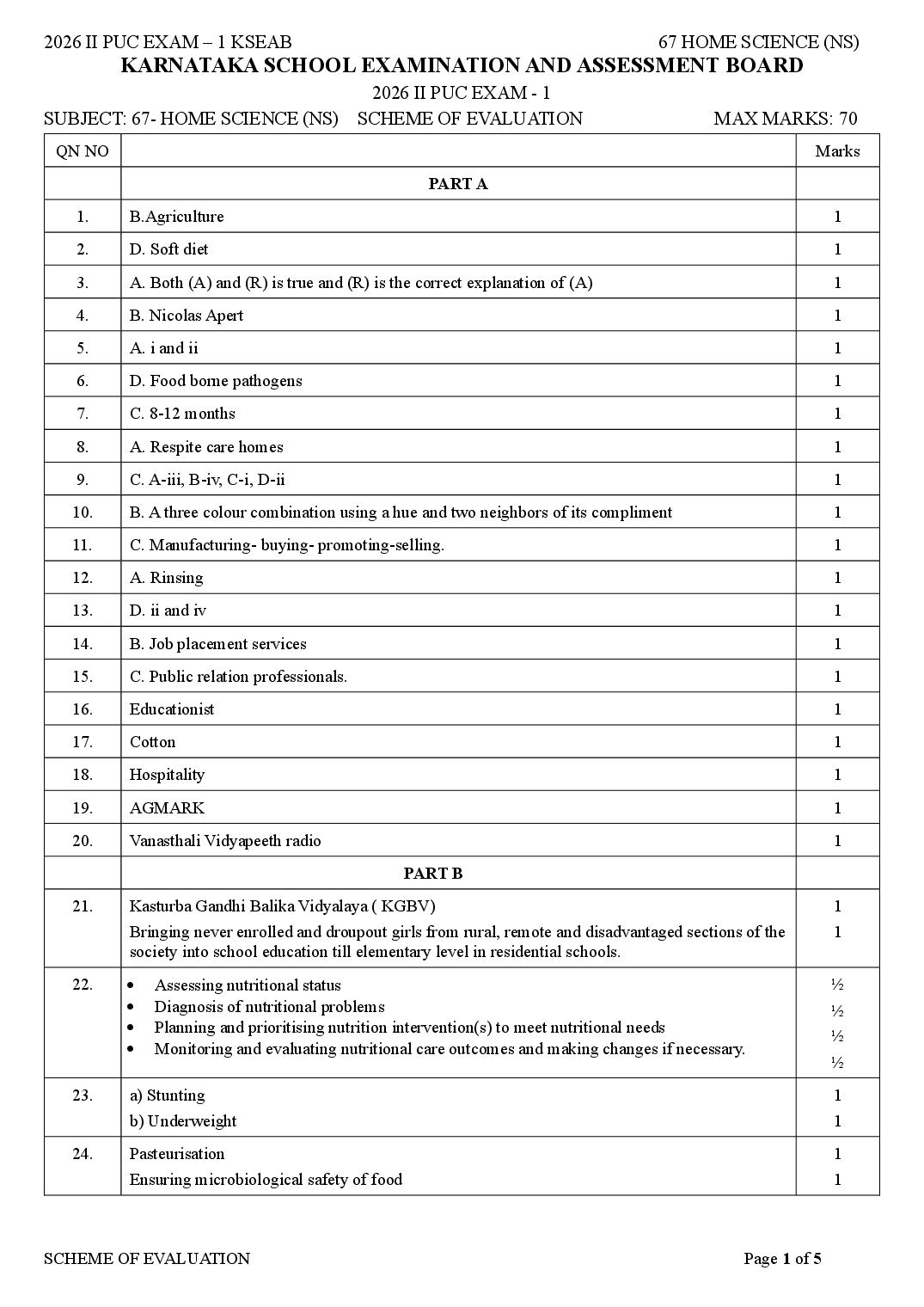
KARNATAKA SCHOOL EXAMINATION AND ASSESSMENT BOARD
2026 II PUC EXAM - 1
SUBJECT: 67- HOME SCIENCE (NS) SCHEME OF EVALUATION MAX MARKS: 70
QN NO Marks
PART A
1. B.Agriculture 1
2. D. Soft diet 1
3. A. Both (A) and (R) is true and (R) is the correct explanation of (A) 1
4. B. Nicolas Apert 1
5. A. i and ii 1
6. D. Food borne pathogens 1
7. C. 8-12 months 1
8. A. Respite care homes 1
9. C. A-iii, B-iv, C-i, D-ii 1
10. B. A three colour combination using a hue and two neighbors of its compliment 1
11. C. Manufacturing- buying- promoting-selling. 1
12. A. Rinsing 1
13. D. ii and iv 1
14. B. Job placement services 1
15. C. Public relation professionals. 1
16. Educationist 1
17. Cotton 1
18. Hospitality 1
19. AGMARK 1
20. Vanasthali Vidyapeeth radio 1
PART B
21. Kasturba Gandhi Balika Vidyalaya ( KGBV) 1
Bringing never enrolled and droupout girls from rural, remote and disadvantaged sections of the 1
society into school education till elementary level in residential schools.
22. • Assessing nutritional status ½
• Diagnosis of nutritional problems ½
• Planning and prioritising nutrition intervention(s) to meet nutritional needs
½
• Monitoring and evaluating nutritional care outcomes and making changes if necessary.
½
23. a) Stunting 1
b) Underweight 1
24. Pasteurisation 1
Ensuring microbiological safety of food 1
SCHEME OF EVALUATION Page 1 of 5
Page 2
25. a) Juvenile/children’s home 1
b) Special homes 1
26.
½ mark
each for
the
labelling
27. Hydro extraction 1
60%-70% 1
28. Either the weights and scales are altered by the retailers or correct measures are incorrectly used. 1
Measures are often deceptive and exploit consumers of their money. Weights and measures
without seal or verification stamp are not genuine. 1
PART C
29. Explain any 3: 1 mark each 1 mark
Working productively — The worker applies effective work habits and attitudes in his/her job each
and tasks. This requires sufficient knowledge, skills and expertise as well as experience.
Productivity is also influenced by enthusiasm, zeal and dynamism. Involvement with the job and
sense of belonging to the organisation are important factors.
Learning effectively — Every individual requires some necessary skills in reading, writing, and
computing as well as skills in acquiring information within the field, and ability to use learning
tools and strategies. Equally essential is the motivation to work hard and update oneself to keep
pace with advances/ developments in one’s field in order to be acclaimed/ renowned in the field.
Communicating clearly — Apply appropriate writing, speaking, and listening skills so that one
can precisely convey information, ideas, and opinions.
Working cooperatively — Every individual must work with others to complete tasks, solve
problems, resolve conflicts, provide information, and offer support. Cultivate a sense of
belonging to the organisation
Thinking critically and creatively — Every successful person applies the principles and
strategies of analytical thinking, critical evaluation, being innovative and creative.
Other skills required — Concentration, alertness, presence of mind, tactfulness, empathy, soft
skills, abilities to train, to delegate and to get others to do their work, forethought and vision, and
the ability to multitask
30. a) Intravenous feeding 1
b) Clear liquid diet 1
c) soft diet 1
SCHEME OF EVALUATION Page 2 of 5
Page 3
31. The main objective of WTO is 1 mark
• To help trade flow smoothly, freely, fairly and predictably, each
• By administering trade agreements, ( any 3)
• Settling trade disputes,
• Assisting countries in trade policy issues.
32. • Teacher in Nursery schools 1 mark
• Caregiver in day care centres and crèches each
• Team members for programmes for young children ( any 3)
• Professionals to plan and promote campaigns or services for young children organised by
Governments or NGOs
• Entrepreneur in child related activities: Camps, edu-picnics, activity clubs, preschool
education centres
• Higher studies: a post-graduate diploma or degree in early childhood education, later doctoral
degrees with research in the field.
33. a) The National Service Scheme (NSS) 1
b) construction and repair of roads, school buildings, village ponds, tanks, activities related to (½ mark
environmental and ecological improvement like tree plantation, removal of weeds from lakes, each –
digging pits, activities related to hygiene and sanitation, family welfare, child-care, mass any 4 = 2
immunisation, vocational training in craft, tailoring, knitting, and organising co-operatives. M)
34. • Natural shapes are those that copy nature or common shapes of man-made objects. 1 mark
• Stylised shapes are simplified or modified natural shapes. They may have some part distorted each
or exaggerated. ( any 3)
• Geometric shapes are those that can be mathematically formed, or gives a similar impression.
They can be formed by using rulers, compasses, or other measuring instruments.
• Abstract shapes are free-form. They do not resemble any specific object but, may represent
different things to different people because of personal association.
35. Air of relatively low temperature is circulated at high velocity. Room air enters the drier from 1½
under the front panel, passes over the source of heat and then through the clothes and leaves
through an exhaust. Thus the temperature and humidity of the room stays normal.
Air of high temperature is circulated slowly. In this after the air enters the drier and passes over
the heat source, it is drawn by a small fan through perforations at the top of the drier, then
downwards through the clothes and out through the exhaust. Since the movement of the air in this 1½
drier is slow, the relative humidity of the exhausted air is high.
36. a) Information and Communication technologies 1
b) The Sustainable Access in Rural India (SARI) 1
Empowering Women at the Grassroots: SEWA and ICTS 1
PART D
37. • Sustainable- Preventing Micronutrient deficiency. 1
1
• Long term stratergies
1
• Cost effective
1
• Adapated to different cultural and dietary traditions 1
• Do not carry risk of overdose or toxicity
38. The oldest methods were sun drying, controlled fermentation, salting/pickling, candying, 1 mark
roasting, smoking, baking and using spices as preservatives. each
( any 5)
SCHEME OF EVALUATION Page 3 of 5
Page 4
39. Rhythm is repeating of lines, colours, other elements of design or details to create a pattern by 1
which the eye can flow through the material or article/garment.
• Repetition of embroidery laces, buttons piping, colour, etc. at necklines, sleeves and 1
hemlines.
• Cordation by gradual increase or decrease in size of motifs, lines, buttons, colours and
textures. 1
• Radiation where eyes move in an organised way from a central point e.g., gathers in waist, 1
yolk or cuffs, etc.
• Parallelism where elements lie parallel to each other e.g., tucks in a yoke or knife pleats in
a skirt. Bands of colour also create a rhythm effect in a dress. 1
40. Market segmentation is a strategy that involves dividing a larger market into subsets of consumers 1
who have common needs and applications for the goods and services offered in the market.
Demographic Segmentation is on the basis of Population, Age, Sex, Occupation, Education and 1
Income.
Geographic Segmentation is on the basis of cities, states and regions. Climate of various places
may vary and it plays an important role as choice of merchandise, especially as selection of 1
clothes is climate dependent.
Psychographic Segmentation is on the basis of lifestyle like social activities, interests, leisure
pursuits, needs and wants. People having similar lifestyles can make up a target market group. 1
Behavioural Segmentation is on the basis of opinion on specific products or services. Many
times rating of usage of products and services is done. This helps in improving the service/product
and make it different from others. 1
41.
1 mark
each
42. 1. Consumers should have responsibility towards regularly updating their knowledge of various 1
laws and legislative provisions made by the government.
2. Consumers should be honest in all their dealings and must pay for all their purchases.\
3.Before making a purchase, consumers should do a market survey to find out the different 1
brands, features etc. of items available in different shops and different markets and should
compare the prices. This will help them make a wise choice.
4. Consumers should feel free to choose from the variety available as per their needs and
requirements.
5. While making a purchase, s/he should read all the information given on the label/ brochure. 1
6. To be assured of quality he should buy products with standardisation marks. 7. Consumer
should keep receipts and other relevant documents of purchase. These may be needed as proof of
purchase for filing complaints in case of problems/defective/malfunctioning products.
1
8. In case of purchase of services like insurance, credit cards, bank deposits etc., s/he should read
and understand all terms and conditions, liabilities, service charges etc. and make an effort to get
the representative to clarify points that are not clearly written.
9. S/he must have increasing awareness about various national and international consumer 1
organisations in terms of their activities, work and understand the benefits of becoming a member
of such organisations.
SCHEME OF EVALUATION Page 4 of 5
Page 5
43. 1. Public Relations Policy: Develop and recommend corporate public relations policy and share 1
it with top management and all departments. This is truer for PR agencies.
2. Statements and Press Releases: Preparation of corporate statements, sometimes speeches for
executives and press releases are to be prepared by the PR personnel. In the process, they are in
a position to articulate and project positive image of the company or product or policies. 1
3. Publicity: Issuing announcements of company activities and products to media and
community. Planning promotional campaign using media is also a vital function. Handling 1
inquiries from press and people at large is a part of the function.
4. Maintaining Relations: The PR personnel are expected to maintain liaisons with Government
units at local, national and international levels. They are expected to uphold good relations with
the community as ‘good neighbours’. This includes compliance with environment protection 1
standards, giving employment opportunities to locals, and cooperating and participating in
locality development programmes. Communication between company and shareholders and with
other investors is also an important part of maintaining relations. Sometimes the PR agency may
have to prepare annual/quarterly reports and planning meetings of stockholders.
1
5. Publications: Preparing and publishing in-house magazines is also sometimes the function of
a PR agency
PART E
44. a) Codex Alimentarius Commission (CAC) 1
International Organisation for Standardisation 1
World Trade Organisation 1
b) Food Inspection and Analytical capability. 2
45. a) Proportion 1
b) golden mean 1
c)3:5:8 to 5:8:13 1
d) In a skirt and blouse dress, the blouse represents 3, the skirt should represent 5, and 2
combined effect represents 8; similarly, in a shirt-pant dress, the shirt should represent 5 and
pant should represent 8 and combined effect created is 13.
SCHEME OF EVALUATION Page 5 of 5
Document Details
| Board / Org | Karnataka Board |
| Exam | Class 12 |
| Type | Question Paper |
| Pages | 5 |
| Language | english |
| Updated | 24 Sep 2026 |