WBCHSE Class 11 Syllabus 2024 Health and Physical Education
Finished viewing? Save it for later —
Download WBCHSE Class 11 Syllabus 2024 Health and Physical Education (PDF · 31 pages)About WBCHSE Class 11 Syllabus 2024 Health and Physical Education
WBCHSE Class 11 Syllabus 2024 Health and Physical Education is available here for free download. Published by West Bengal Board for Class 11, this syllabus can be viewed online or downloaded as a PDF (31 pages). Candidates preparing for Class 11 can use WBCHSE Class 11 Syllabus 2024 Health and Physical Education to understand the exam pattern, the type of questions asked, and the overall difficulty level.
Frequently Asked Questions
How can I download WBCHSE Class 11 Syllabus 2024 Health and Physical Education?
Open this page and click the Download button to save WBCHSE Class 11 Syllabus 2024 Health and Physical Education as a PDF. It is completely free on AglaSem Docs.
Is WBCHSE Class 11 Syllabus 2024 Health and Physical Education free to download?
Yes. WBCHSE Class 11 Syllabus 2024 Health and Physical Education can be viewed online and downloaded as a PDF free of cost on AglaSem Docs.
How many pages does WBCHSE Class 11 Syllabus 2024 Health and Physical Education have?
WBCHSE Class 11 Syllabus 2024 Health and Physical Education contains 31 pages, which you can read online or download together as a single PDF.
Where can I find more Class 11 study material?
You can find more Class 11 question papers, sample papers, syllabus, and answer keys on AglaSem Docs.
WBCHSE Class 11 Syllabus 2024 Health and Physical Education – Text
Read the full text of this syllabus below — useful to quickly search, copy and reference the content online without downloading the PDF.
📄 View text version (31 pages)
Page 1
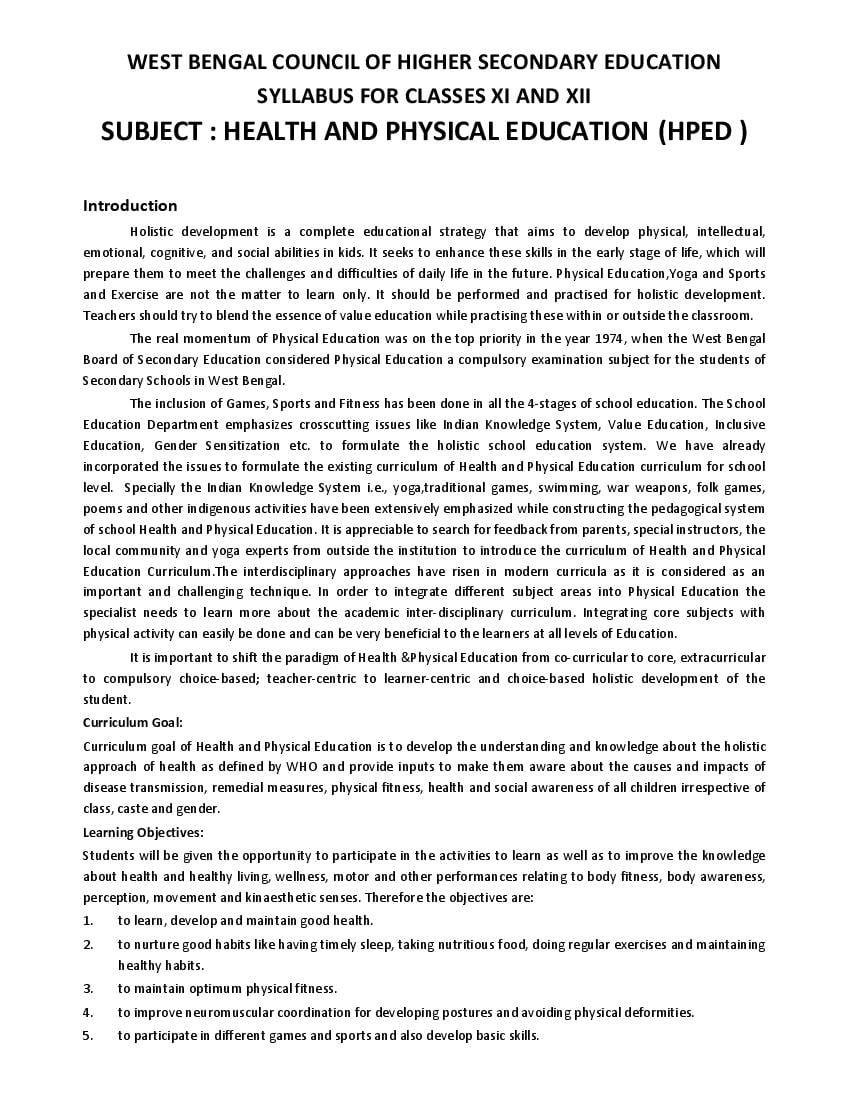
SYLLABUS FOR CLASSES XI AND XII
SUBJECT : HEALTH AND PHYSICAL EDUCATION (HPED )
Introduction
Holistic development is a complete educational strategy that aims to develop physical, intellectual,
emotional, cognitive, and social abilities in kids. It seeks to enhance these skills in the early stage of life, which will
prepare them to meet the challenges and difficulties of daily life in the future. Physical Education,Yoga and Sports
and Exercise are not the matter to learn only. It should be performed and practised for holistic development.
Teachers should try to blend the essence of value education while practising these within or outside the classroom.
The real momentum of Physical Education was on the top priority in the year 1974, when the West Bengal
Board of Secondary Education considered Physical Education a compulsory examination subject for the students of
Secondary Schools in West Bengal.
The inclusion of Games, Sports and Fitness has been done in all the 4-stages of school education. The School
Education Department emphasizes crosscutting issues like Indian Knowledge System, Value Education, Inclusive
Education, Gender Sensitization etc. to formulate the holistic school education system. We have already
incorporated the issues to formulate the existing curriculum of Health and Physical Education curriculum for school
level. Specially the Indian Knowledge System i.e., yoga,traditional games, swimming, war weapons, folk games,
poems and other indigenous activities have been extensively emphasized while constructing the pedagogical system
of school Health and Physical Education. It is appreciable to search for feedback from parents, special instructors, the
local community and yoga experts from outside the institution to introduce the curriculum of Health and Physical
Education Curriculum.The interdisciplinary approaches have risen in modern curricula as it is considered as an
important and challenging technique. In order to integrate different subject areas into Physical Education the
specialist needs to learn more about the academic inter-disciplinary curriculum. Integrating core subjects with
physical activity can easily be done and can be very beneficial to the learners at all levels of Education.
It is important to shift the paradigm of Health &Physical Education from co-curricular to core, extracurricular
to compulsory choice-based; teacher-centric to learner-centric and choice-based holistic development of the
student.
Curriculum Goal:
Curriculum goal of Health and Physical Education is to develop the understanding and knowledge about the holistic
approach of health as defined by WHO and provide inputs to make them aware about the causes and impacts of
disease transmission, remedial measures, physical fitness, health and social awareness of all children irrespective of
class, caste and gender.
Learning Objectives:
Students will be given the opportunity to participate in the activities to learn as well as to improve the knowledge
about health and healthy living, wellness, motor and other performances relating to body fitness, body awareness,
perception, movement and kinaesthetic senses. Therefore the objectives are:
1. to learn, develop and maintain good health.
2. to nurture good habits like having timely sleep, taking nutritious food, doing regular exercises and maintaining
healthy habits.
3. to maintain optimum physical fitness.
4. to improve neuromuscular coordination for developing postures and avoiding physical deformities.
5. to participate in different games and sports and also develop basic skills.
Page 2
7. to develop essential life skills like obedience, discipline, courage, self-control, self-confidence, selflessness etc.
8. to develop integrity and balanced personality.
9. to inculcate patriotic feelings among the learners.
10. to make appropriate use of leisure time.
11. to show due reverence to local culture and custom.
12. to bring the differently abled children into the periphery of integrated learning by addressing their psycho-
social needs.
13. to realize the process of growing up in the adolescence stage.
14. to develop awareness among the learners about road safety for avoiding road accidents.
15. to manage common injuries of sports like muscle cramps, sprain or pull.
16. to develop students’ responsibility in peace education.
17. to develop the concept of values, duties and responsibilities of the students.
18. to manage anxiety and depression through relaxation, meditation, yoga and recreational activities.
19. to grow up as active, responsible, and reflective members of society.
20. to learn and respect differences of opinion, lifestyle, and cultural practices.
21. to receive ideas, institutions, and practices.
22. to promote joyful learning that enable learners acquiring knowledge with pleasure.
23. to appreciate the values enshrined in the Constitution of India such as justice, liberty, equality and fraternity
and the unity and integrity of the nation and making of a socialist, secular and democratic society.
24. to develop the knowledge about the concept and history of Physical Education.
25. to know the recent concept of health-wellbeing, fitness, yoga and physical literacy.
26. to gain the knowledge about the scientific basis of Physical Education.
27. to gain the knowledge about hypokinetic diseases, active lifestyle and control of obesity, high blood pressure,
arthritis and diabetes.
28. to gain the knowledge about Bratachari.
29. to gain the competency about applied aspects of yoga such as remedial postural deformities.
30. to gain the knowledge about the management of various Games and Sports.
31. to learn about the evaluation of different Physical Fitness components and different other factors related with
Physical Education.
32. to know about the national ideals and Leadership Development Activities.
SPECIFIC OBJECTIVES :
The specific objectives are,
1. to help the learners to understand about the holistic approach of Health, to develop a positive attitude
towards health and to nurture good practices in developing their physical and mental abilities to its fullest
extent.
2. to help the learners to know and accept individual and collective responsibility for healthy living in school, at
home and in community setting.
3. to help learners to be acquainted with nutritional requirements, personal hygiene, environmental sanitation,
hazards due to pollution, disease transmission, prevention and control.
4. to help learners developing appropriate postural habits in standing, walking, running, sitting and other basic
movements so as to avoid the postural defects and physical deformities.
Page 3
varied physical activities resulted to maintain their physical fitness to its fullest extent for providing maximum
outputs.
6. to help learners developing their personality, leadership qualities and team spirit and maintain good health.
7. to enable learners in improving the essential life skills like obedience, discipline, courage, self-control, self-
confidence, selflessness etc.
8. to help developing an inclusive system for all children to participate in joyful activities and thereby learn
through exploration and discovery.
9. to help learners understanding about the physical and emotional changes during adolescence and to acquire
desired growth, vitality and vigour by reducing the micronutrient deficiency and inclusive hygiene practices.
10. to help the learners to understand about the safety education.
11. to enable learners for developing good understanding and knowledge about the social values, duties and
responsibilities.
12. to address the physical, psycho-social needs of differently abled children.
13. to develop awareness regarding the importance of physical fitness in individual and social life including Life
Skills.
14 . to bring the overall awareness of values with regard to personal health and fitness, and to inculcate among
students the desired habits and attitudes towards health to raise their health status.
15. to make the pupils physically, mentally and emotionally fit and to develop such personal and social qualities
that will help them to be good human beings.
16. to take action individually and collectively to protect and promote (i) own health (ii) health of family members
and (iii) health of the surrounding community and seeking help when required from available community
resources.
17. to enable an individual to display a sense of responsibility, patriotism, self-sacrifice and service to the
community.
18. to develop awareness of the importance of self-defense.
19. to create awareness among children about rules of safety in appropriate hazardous situations to avoid
accidents and injuries. To acquaint them with first-aid measures about common sickness and injuries.
20. to help children learn correct postural habits in standing, walking, running, sitting and other basic movements
so as to avoid postural defects and physical deformities.
21. to help children grow as responsible citizens by inculcating in them certain social and moral values through
games, sports, Red Cross, Jay Hind Bahini etc.
22. to inculcate values and skills in children in order to promote self-control, concentration, peace and relaxation
to avoid the ill effects of stress, strain and fatigue of routine everyday life.
23. to address the physical, psycho-social needs of CWSN (Children with Special Needs) in an integrated fashion.
24. to help release of emotional stress, anxiety and tension, leading to a reduced risk of depression.
25. to develop more positive attitude towards challenges, winning and losing, thus preparing students for life and
for the workplace. Values Integrated across HPED.
Page 4
After completing the unit, the students will be able to :
• Recognize the concept, aim, and objectives in the field of Physical Education.
• Identify the Post-independence development in Physical Education.
• Categorize Changing Trends in Sports- playing surface, wearable gear, sports equipment, technologies
• Explore different career options in the field of Physical Education.
• Make out the development of Fitness for all the Students Program.
• Incorporate values of Olympism in your life.
• Differentiate between Modern and Ancient Olympic Games.
• Identity the Olympic Symbol and Ideals.
• Describe the structure of the Olympic movement & Olympic Value Education Programme structure.
• Recognize the concept of yoga and be aware of the importance of it.
• Identify the elements of yoga.
• Identify the Asanas, Pranayama’s, meditation.
• Classify various yogic activities for the enhancement of concentration.
• Know about relaxation techniques for improving concentration.
• Identify the concept of Disability and Disorder.
• Outline types of disability and describe their causes and nature.
• Adhere to and respect children with special needs by following etiquettes.
• Define the terms test, measurement, and evaluation.
• Differentiate norm and criterion referenced standards.
• Discuss the importance of measurement and evaluation processes.
• Understand BMI: A popular clinical standard and its computation.
• Identify the importance of anatomy and physiology.
• Recognize the functions of the Food and Nutrition.
• Understand the functions of bones and identify various types of joints.
• Figure out the properties and functions of muscles and understand how they work.
• Understand the anatomy of the respiratory system and describe its working.
• Identify and analyse the layout and functions of Circulatory System.
• Understand Kinesiology and Biomechanics with their application in sports.
• Explain biomechanical principles and their utilization in sports and physical education.
• Illustrate fundamental body movements and their basic patterns.
• Learn about the Axis and Planes and their application with body movements.
• Identify the role of Psychology in Physical Education and Sports.
• Differentiate characteristics of growth and development at different stages.
• Explain the issues related to adolescent behavior and Team Cohesion in Sports.
• Correlate the psychological concepts with the sports and athlete specific situations.
• Understand the concept and principles of sports training.
• Summarise training load and its concept.
• Understand the concept of warming up & limbering down in sports training and their types, method &
importance.
• Acquire the ability to differentiate between the skill, technique, tactics & strategies in sports training.
Page 5
SEMESTER – I
SUBJECT : HEALTH AND PHYSICAL EDUCATION (HPED )
FULL MARKS : 35 CREDIT : 04 CONTACT HOURS : 100 Hours
COURSE CODE : THEORY
CONTACT
UNIT NO. UNIT NAME MARKS
HOURS
Unit -1 HISTORY OF ANCIANT OLYMPIC GAMES 20 7×1=7
Unit -2 ROLE OF YOGA IN MODERN SOCIETY 20 7×1=7
Unit -3 MANAGEMENT OF PHYSICAL EDUCATION PROGRAMME 20 7×1=7
Unit -4 RULES OF THE GAMES AND SPORTS 20 7×1=7
Unit -5 HISTORY OF SPORTS ORGANIZATION OF WEST BENGAL 20 7×1=7
Total 100 35
Page 6
SEMESTER – I
SUBJECT : HEALTH AND PHYSICAL EDUCATION (HPED )
FULL MARKS : 35 CREDIT : 04 CONTACT HOURS : 100 Hours
COURSE CODE : THEORY
CONTACT
UNIT NO. TOPICS MARKS
HOURS
Unit -1 HISTORY OF ANCIANT OLYMPIC GAMES 20 7×1=7
1.1.1 History of the Ancient Olympic Games
Sub- Topic 1.1.2 Objectives of the Ancient Olympic Games
1.1.3 Rules and Events of the Ancient Olympic Games
1.1.4 Oath of the Ancient Olympic Games
1.1.5 Ceremony of the Ancient Olympic Games
1.1.6 Awards of the Ancient Olympic Games
1.1.7 Decline of the Ancient Olympic Games
Unit -2 ROLE OF YOGA IN MODERN SOCIETY 20 7×1=7
2.1.1 Introduction and History of Yoga
Sub- Topic 2.1.2 Types of Yoga
2.1,3 Concept of Karma Yoga, Jnana Yoga, Hatha Yoga,
Raj Yoga, Mantra Yoga, Laya Yoga, Bhakti Yoga.
2.1.4 Concept and types of Asana
2.1.5 Practice Procedure & Benefits of Some Yogaasana-
Pavanmuktasana,Halasana,Dhanurasana, Bhujasana, Salvasana.
2.1.6 Practice Procedure & Benefits of Some Pranayama-Kapalbhati,
Anulom-Vilom, Sitali pranayama.
2.1.7 Influences of Yogic Practices on Human Body
Unit -3 MANAGEMENT OF PHYSICAL EDUCATION PROGRAMME 20 7×1=7
Sub- Topic 3.1.1 Introduction of Tournament
3.1.2 Meaning, objectives and importance of tournament
3.1.3 Types of Tournaments– League, Knockout and Combination
3.1.4 Characteristics of Tournament
3.1.5 Concept of Fixture
3.1.6 Preparation of Fixtures- League, Knockout and Combination
3.1.7 Contemporary Fixtures of different sporting events
Page 7
UNIT NO. TOPICS MARKS
HOURS
Unit -4 RULES OF THE GAMES AND SPORTS 20 7×1=7
Sub- Topic 4.1.1 Rules of Athletic Sprint Event
4.1.2 Rules of Middle Distance and Long-distance Running
4.1.3 Rules of Shot-put
4.1.4 Rules of Discus Throw
4.1.5 Rules of Long Jump
4.1.6 Rules of Kabaddi
4.1.7 Organization of Sports Programme in school
Unit -5 HISTORY OF SPORTS ORGANIZATION OF WEST BENGAL 20 7×1=7
Sub- Topic 5.1.1 History of Sports Organization of West Bengal- IFA, CAB
5.1.2 History of National and International Sports Organization
5.1.3 Bengal and Indian Olympic Association
5.1.4 East Bengal FC,
5.1.5 MohunBagan AC,
5.1.6 Mohammedan SC,
5.1.7 W.B. State Council For Games & Sports & SGFI
Page 8
SEMESTER – II
SUBJECT : HEALTH AND PHYSICAL EDUCATION (HPED )
FULL MARKS : 35 CONTACT HOURS : 120 Hours
COURSE CODE : THEORY
CONTACT
UNIT NO. UNIT NAME MARKS
HOURS
Unit -1 INTRODUCTION TO PHYSICAL EDUCATION AND PHYSICAL LITERACY 10 1×6=6
OR
Unit -2 FOLK GAMES CULTURE OF WEST BENGAL 10 1×6=6
Unit -3 SCIENTIFIC BASIS OF PHYSICAL EDUCATION 10 1×6=6
OR
Unit -4 MENTAL HEALTH AND STRESS MANAGEMENT 10 1×6=6
Unit -5 HEALTH EDUCATION & SCHOOL HEALTH PROGRAMME 10 1×6=6
OR
Unit -6 BIOLOGICAL FOUNDATION OF PHYSICAL EDUCATION 10 1×6=6
Unit -7 ADOLESCENCE AND PROBLEMS OF ADOLESCENCE 10 1×6=6
OR
Unit -8 LIFE SKILLS EDUCATION 10 1×6=6
Unit -9 HEALTH RELATED FITNESS TEST 10 1×5=5
OR
Unit -10 PERFORMANCE RELATED FITNESS TEST 10 1×5=5
Unit -11 CONCEPT OF WELLNESS 10 2×3=6
OR
Unit -12 DEVELOPMENT OF LEADERSHIP QUALITIES 10 2×3=6
Total 120
Page 9
SEMESTER – II
SUBJECT : HEALTH AND PHYSICAL EDUCATION (HPED )
FULL MARKS : 35 CONTACT HOURS : 120 Hours
COURSE CODE : THEORY
CONTACT DESCRIPTIVE TYPES
UNIT NO. TOPICS HOURS QUESTIONS &
MARKS
Unit -1 INTRODUCTION TO PHYSICAL EDUCATION AND PHYSICAL 10 1×6=6
LITERACY
1.1.1 Concept of Physical Education
Sub- Topic 1.1.2 Meaning of Physical Education
1.1.3 Definition of Physical Education
1.1.4 Scope of Physical Education
1.2.1 Concept of Physical Literacy.
1.2.2 Components of Physical Literacy.
1.2.3 Relationship of Physical Literacy with Physical
Education.
1.2.4 Need and Importance of physical literacy in our
Modern Society. Answer
1.2.5 Physical literacy progressions as per the cognitive and one
affective domains. Question
1.2.6 Challenges and barriers in people adopting Physical
Literacy and Methods of Improving it.
1.2.7 Body and mind connection: role of monism in physical
literacy.
1.3.1 Concept and Nature of Fundamental Movement Skills.
1.3.2 Relationship of the other Discipline with Physical
Education-Sports& Science, Sports Medicine, Bio-
Mechanics, Kinesiology, Kinanthropometry, Sports
sociology
Unit -2 FOLK GAMES CULTURE OF WEST BENGAL 10 1×6=6
Sub- Topic 2.1.1 Introduction of Folk Games
2.1.2 Characteristics of Folk Games
2.1.3 Nature of Folk Games
2.1.4 Types of Folk Games and their Rules
2.1.5 Benefits of Folk Games
2.1.6 List of popular Folk Games of Various districts of
West Bengal.
Page 10
UNIT NO. TOPICS HOURS QUESTIONS &
MARKS
Unit -3 SCIENTIFIC BASIS OF PHYSICAL EDUCATION 10 1×6=6
Sub- Topic 3.1.1 Concept of Exercise
3.1.2 Types of exercise
3.1.3 Effect of Aerobic & Anaerobic Exercise on Health
Concept of Body Mass Index
3.1.4 Assessment of Body Mass Index
3.1.5 Interpretation of Body Mass Index
3.2.1 Introduction of Newton’s Law of Motion Answer
3.2.2 Newton’s First Law of Motion one
3.2.3 Newton’s Second Law of Motion Question
3.2.4 Newton’s Third Law of Motion
3.3.1 Application of First Law of Motion in Games & Sports
3.3.2 Application of the Second Law of Motion in Games &
Sports
3.3.3 Application of Third Law of Motion in Games &
Sports
Unit -4 MENTAL HEALTH AND STRESS MANAGEMENT 10 1×6=6
Sub- Topic 4.1.1 Concept of Mental Health
4.1.2 Characteristics of Good Mental Health
4.1.3 Concept of Maladjustment
4.1.4 Causes of Maladjustment
4.1.5 Causes of Maladjustment of Students
4.1.6 Maladjustment Behaviour in School Students
4.1.7 Remedies of Maladjustment Behaviour
4.2.1 Concept of Stress
4.2.2 Types of Stress
4.2.3 Signs and Symptoms of Stress
4.2.4 Causes and effect of Stress
4.3.1 Eustress Vs Distress
4.3.2 Benefits of Positive stress
4.3.3 Effect of Distress
4.4.1 Stress Management
4.4.2 Types of Stress Management
4.4.3 Causes of Stress Management
4.4.4 Advantages of Stress Management
4.4.5 Relief from Stress
Page 11
UNIT NO. TOPICS HOURS QUESTIONS &
MARKS
Unit -5 HEALTH EDUCATION & SCHOOL HEALTH PROGRAMME 10 1×6=6
Sub- Topic 5.1.1 Recent Concept of Health
5.1.2 Different dimension of Health
5.2.1 Concept of School Health Programme
5.2.2 School Health Supervision
5.2.3 School Health Service
5.2.4 School Health Instruction
5.3.1 Introduction of Hypo- kinetic disease Answer
5.3.2 Causes of Hypo- kinetic disease one
5.3.3 Hypo-kinetic disease- Arthritis Question
5.3.4 Types, Causes, Symptoms and Remedial
5.4.1 Concept of Drugs
5.4.2 Types of Drugs
5.4.3 Negative consequence of drug abuse
5.4.4 Negative impact of alcohol on health
5.4.5 Negative impact of smoking on health
Unit -6 BIOLOGICAL FOUNDATION OF PHYSICAL EDUCATION 10 1×6=6
Sub- Topic 6.1.1 Meaning & Definition of Growth &Development
6.1.2 Relationship between Growth and Development
6.1.3 Role of Education in Development
6.2.1 Defference between Growth and Development
6.2.2 General Characteristics of Growth
6.2.3 General Characteristics of Development
6.3.1 Diverse Development of Children
6.4.1 Factors affecting Growth & Development
Unit -7 ADOLESCENCE AND PROBLEMS OF ADOLESCENCE 10 1×6=6
Sub- Topic 7.1.1 Introduction to Adolescence- Overview of the
adolescent stage, Key characteristics and features
7.1.2 Classification of Adolescence- Various stages and
phases of adolescence, Developmental milestones
7.1.3 Behavioral Aspects in Adolescence- Exploration of
typical behaviours during adolescence, Psychosocial
challenges and adjustments Answer
7.1.4 Distinguishing Factors of Desire in Adolescence- one
Understanding the factors influencing desires and Question
aspirations
7.1.5 Identifying individual differences
7.1.6 Problems faced by Adolescent Boys & Girls- Common
issues and challenges in adolescent boys and girls
social, emotional, and academic difficulties
7.1.7 Solutions to Problems in Adolescent Boys & Girls
Page 12
UNIT NO. TOPICS HOURS QUESTIONS &
MARKS
Unit -8 LIFE SKILLS EDUCATION 10 1×6=6
Sub- Topic 8.1.1 Concept of Life Skills
8.1.2 Characteristics of Life Skills
8.1.3 Necessity of Learning Life Skills
8.1.4 Concept of Ten Core Life Skills
8.2.1 Concept, Characteristics and Importance of
Emotional Skills
8.2.2 Concept, Characteristics and Importance of
Social or Interpersonal Skills
8.2.3 Concept, Characteristics and Importance of
Cognitive or Thinking Skills
8.3.1 Life Skills used by The Monkey and The Crocodile
8.3.2 Case Study Based Life Skills
COMPETENCY BASED & SKILL BASED QUESTION
Unit -9 ASSESSMENT OF HEALTH-RELATED FITNESS 10 5×1=5
(3 + 2)
Sub- Topic 9.1.1 Concept of Test, Measurement & Assessment
Answer
9.2.1 Assessment of Health Related Fitness Components-
one
BMI
Question
9.2.2 Assessment of Waist-hip- Hip Ratio Test,
from two
9.2.3 Assessment of Endurance Harvard Steps Test,
Questions
9.2.4 Assessment of Muscular Strength & Endurance Sit–
[one from
Up Test
each unit]
9.2.5 Assessment of Flexibility
Unit -10 ASSESSMENT OF PERFORMANCE RELATED FITNESS TEST 10 5×1=5
(3 + 2)
Sub- Topic 10.1.1 Assessment of Performance Related Fitness
Components-Reaction Time
10.1.2 Assessment of Speed -50 Metres Run Test,
10.1.3 Assessment of Agility -4X10 Metres Shuttle Run
Test,
10.1.4 Assessment of Balance -Single Leg Stance Test.
Page 13
UNIT NO. TOPICS HOURS TYPES QUESTIONS
& MARKS
Unit -11 CONCEPT OF WELLNESS 10 SAQ
3×2=6
Sub- Topic 11.1.1 Concept of Wellness
11.1.2 Objectives of Wellness
11.1.3 Importance of Wellness Answer two
11.1.4 Methods of Improving Wellness Questions
11.2.1 Component of Fitness and Wellness from four
11.2.2 Factors Affecting Physical Fitness and Wellness Questions
11.2.3 Principles of Physical Fitness Development
11.2.4 Dimension of Wellness and Lifestyle
Unit -12 DEVELOPMENT OF LEADERSHIP QUALITIES 10 SAQ
3×2=6
Sub- Topic 12.1.1 Meaning of Leadership
12.1.2 Definition of Leadership
12.1.3 Qualities of an Ideal Leader
12.2.1 Importance of leadership
12.2.2 Types of Leadership & their Characteristics
12.2.3 Function of a Leader
12.2.4 Problems in Developing Leadership
12.2.5 Ways to Solve the Problems of Developing
Leadership
12.3.1 Development of Leadership Qualities through
Physical Education Activities
Page 14
SEMESTER-I & SEMESTER-II
SUBJECT : HEALTH AND PHYSICAL EDUCATION (HPED )
FULL MARKS : 30 CONTACT HOURS : 100 Hours
COURSE CODE : PRACTICAL
Group-A : Formal activities : Marching, Bratachari and Callisthenics (any one) 5Marks/20 Hours
1) Marching: Stand at ease, Attention, Left, Right Turn and About Turn,
2) Bratachari:
3) Callisthenics: Neck, Arm and Trunk and Leg Exercises
4) Brotachari Song, Folk Song
5) Song: State song of West Bengal, Banglar Mati Banglar Jal, Bhawaiya song of Uttar Bangla
Group-B : Athletics (any one) 5Marks/20 Hours
1) Running (Block start, Techniques of Running and Finishing)
2) Throwing Event (Putting the Shot and Discus Throw)
a) Putting the Shot: Holding the Shot, Placement, Initial Stance, Glide, Release Action and Recovery
b) Discus Throw: Holding the Discus, Initial Stance, Preliminary Swing, Release
and Recovery
3) Jumping Event (Running Broad Jump / High Jump)
a) Running Broad Jump : Approach run, Take off, Flight-in-Air and landing
b) High jump: Approach Run, Take off, Clearing the Bar and Landing
Group-C :Yogasana / Gymnastics / Chhow Dance / Self Defense / Chess (any one) 5Marks/20 Hours
1) (a) Yogasana: (any two)
(i) Paschimottasana, Gomukhasana, Dhanurasana, Bhadrasana, Vakrasana
(ii) Surya Namaskara
(iii) Pranayama: Anulom-Vilom and Kapalabhati
(iv) Meditation
2) Gymnastics : (any two)
Forward and Backward Roll, Cart Wheel, T. Balance, Hand Stand and Arch
3) Chhow Dance : One Leg 360Turn,Track Jump 360 Turn, Chart Wheel, From both leg Forward hand Spring, Back
Hand Spring, Tamaro Jump.
Group-D : Team Game (Any one) 5 Marks/20 Hours
Handball, Football, Volleyball, Kabaddi, KhoKho and Badminton
Group-E Project work/ Seminar/ Record book on Games and sports: 10 Marks/20 Hours
1) Seminar : Students may prepare a PowerPoint Presentation for the seminar based on any one of the given
topics.Total time: 10 min. (Presentation time: 6 min + Interaction: 4 min.)
Page 15
a. Title page (title, name of the student, roll no., name of the student, date and year)
b. Introduction: Description of title, cause of selecting such topic and related matter
c. Previous resources: Any documents of previous such type of work (if possible)
d. Method of Data Collection: Place and Design of Study, Types etc. (How he/she prepare this
presentation)
e. Discussion, analysis and interpretation: Main course/ Result/ matter and Description
f. Conclusion: Summary of findings
g. References:
2) Project work: They may prepare a project exercise book for the project work based on any one of the given
topics.
The Structure of the Project:
a. Title Page: Name of the project, School name, Name of the student and teacher, date and year
b. Acknowledgment
c. Introduction: Objectives, Importance, significance, Sampling (if any), Limitation, Social Acceptance
c. Previous resources: Any documents of previous such type of work (if possible)
d. Method of data collection: Sample age, Sex, Sample size, Method of data collection (How he/she
prepare this project)
e. Discussion, analysis and interpretation: Main course/ Result/ matter and Description
f. Conclusion: Summary of findings
g. References:
3) Record book: They may prepare a Record book based on any one of the Local, School, National and
International events.
Structure of the Record book Preparation :
a. Title page: Name of the Event, School name, Name of the student and teacher
b. Introduction of the event: Importance, Place, Social Acceptance
c. Keeping the records: Number of events, Matches, Competitions, Goals, Medals etc.
d. Conclusion: Summary of findings
e. References:
4) CONTEMPORY ISSUES : They may prepare a project exercise book for the project work based on any one of
the given topics.
The Structure of the Project:
a. Title Page: Name of the project, School name, Name of the student and teacher, date and year
b. Acknowledgment
c. Introduction: Objectives, Importance, Significance, Sampling (if any), Limitation, Social Acceptance
d. Previous resources: Any documents of previous such type of work (if possible)
e. Method of data collection: Sample age, Sex, Sample size, Method of data collection (How he/she
prepare this project)
f. Discussion, analysis and interpretation: Main course/ Result/ Matter and Description
g. Conclusion: Summary of findings
h. References:
Page 16
Mark distribution: 10 marks will be distributed for Project/Seminar/ Record book preparation
Interaction with the audience/examiner/ guide/supervisor
Evaluation Process: 5 parts x 2marks=10marks
a. Novelty of the topic
b. Contemporary importance
c. Explanation/description
d. Interaction
e. Overall presentation
a) Project Topics :
1) Kanyashree - Women Empowerment
2) Olympic Movement
3) Olympic Value Education
4) Astanga Yoga
5) Yoga Education
6) Types of Yoga
7) Organization of a Sports meet
8) Tournament
9) Mohunbagan
10) East Bengal
11) Mohamedan Sporting
12) Kabaddi Play Field
13) Kho-kho Play Field
14) Football Play Field
15) Volleyball Play Field
16) 400 mt. Track marking
17) Intramural and Extramural Competition
18) Project on Physical Fitness Test
19) Analysis of the Fitness of the Students
20) Analysis of the Physical Literacy Project
21) Computation of BMI and Waist- Hip Ratio Test of 5 Elderly People
22) Take Harvard Steps Test of your 5 Friends and Analyse.
b) Seminar Topics :
1) Folk & Traditional Games of West Bengal
2) School Health Programme
3) Problems of Adolescent Boys & Girls
4) Body Mass Index
5) Aerobic and Anaerobic Exercises
6) Newton Laws of Motion
7) Hypokinetic Diseases
8) Drug Abuse
9) Life Skill
10) Role of Education in Development
11) Stress Management
Page 17
13) Care of Ear, Teeth, Skin and Eye
14) Infectious Diseases
15) Balanced diet & Nutrition
16) Long Distance Run / Marathon Run.
c) Record Book Topics :
1) National School Games
2) IPL
3) ISL
4) Summer Olympics
5) Annual School Sports
6) Intramural Competition
7) Health Records of School Boys/Girls
d) CONTEMPORY ISSUES :
1) POCSO
2) The Prohibition of Child marriage Act, 2006
3) Stay Safe Online
4) HIV and AIDS Prevention &Control Programme
5) Awareness Regarding the Right to Vote
6) Awareness Regarding the Organ Donation and Organ Transplant
7) Empowered Women –Empowered Nation.
8) Awareness Campaign on Financial Literacy
9) Awareness Campaign on Kanyashree
10) Awareness Campaign on Safe Drive Save Life.
11) Awareness Campaign on Healthy Lifestyle
12) Awareness Campaign on Mid-Day Meal
13) Awareness Campaign on Health Literacy
14) Awareness Campaign on Drug Abuse
15) Awareness Campaign on Right To Play
e) CREATIVE WRITING :
1) Yoga for Health,
2) Nutrition For Healthy Living
3) Gender Sensitivity
4) Safety Outside School
5) Food Poisoning
6) Fire And Stampede
f) Leadership Development Activities organized by Government Organizations (Duration not less than 5 days)
1) Participation in Adventure Sports
2) Participation in Boys Scouts and Girl’s Guides
3) Participation in NSS Special Camping, NCC, Leadership Camp and Sports Camp
4) Completion of Bratachari Madhyamik Course
5) Nature Camp
6) First Aid Camp-St. John Ambulance / India Red Cross Society
7) Community Service Programme
8) Awareness on Community Development Project work
Page 18
Physical Education Project Format :
Nature of Presentation : Written
Title page : 1 Influenza, a Infectious Disease
Name of the student :
Roll no. :
Name of the School :
Date & Year :
Title page : 2 Contents with the topic and the respective page no.
Introduction: Aim of the study, Importance, Social Acceptance,Significance of the topic,
Provide a brief overview of influenza. Define influenza and its classification as an infectious disease.
Highlight its historical significance and impact on public health.
Method of data collection:Epidemiology, Explore the global prevalence and distribution of influenza.
Include statistics on affected populations, mortality rates, and affected regions.
Discuss the seasonal nature of influenza outbreaks, Etiology and Transmission,
Explain the causative agents of influenza, focusing on influenza viruses (types A, B, and C).
Describe the modes of transmission and how the virus spreads.
Discuss the susceptibility of different age groups., Clinical Features,
Outline the symptoms associated with influenza and differentiate between common flu symptoms and
severe complications. Discuss the potential impact on vulnerable populations,
Prevention and Control, Explore vaccination strategies and the importance of annual flu shots.
Discuss antiviral medications and their role in treatment.
Highlight preventive measures like hygiene practices, social distancing, and wearing masks
Discussion, analysis and Interpretation: Global Efforts and Research,
Provide an overview of international collaborations in influenza research.
Discuss ongoing studies, vaccine development, and advancements in treatment.
Highlight the importance of surveillance and early detection.
Impact on Public Health; Analyze the societal and economic impact of influenza outbreaks.
Discuss strategies for mitigating the impact on healthcare systems.
Explore the psychological aspects and public perception during outbreaks.
Future Trends; Discuss emerging trends in influenza research. Explore potential challenges and innovations in
disease prevention and control.
Conclusion:Summarize key findings and insights.
Emphasize the ongoing importance of influenza research and public health measures.
References:Cite all sources used in your project.
Page 19
SEMESTER – III
SUBJECT : HEALTH AND PHYSICAL EDUCATION (HPED )
FULL MARKS : 35 CONTACT HOURS : 100 Hours
COURSE CODE : THEORY
CONTACT
UNIT NO. UNIT NAME MARKS
HOURS
Unit -1 OLYMPIC VALUE EDUCATION PROGRAMME 20 7×1=7
Unit -2 BIOLOGICAL BASIS OF PHYSICAL EDUCATION 20 7×1=7
Unit -3 MODERN CONCEPT OF HEALTH & HYGIENE 20 7×1=7
Unit -4 PREVENTION OF CONTROL OF COMMUNICABLE DISEASES 20 7×1=7
Unit -5 SPORTS AND NUTRITION 20 7×1=7
Total 100 35
Page 20
SEMESTER – III
SUBJECT : HEALTH AND PHYSICAL EDUCATION (HPED )
FULL MARKS : 35 CONTACT HOURS : 100 Hours
COURSE CODE : THEORY
CONTACT
UNIT NO. TOPICS MARKS
HOURS
Unit -1 OLYMPIC VALUE EDUCATION PROGRAMME 20 7×1=7
1.1.1 Introduction of Olympism
Sub- Topic 1.1.2 Fundamental Principles of Olympism
1.1.3 Core Olympic Value
1.1.4 Educational Theme of Olympism
1.1.5 Olympic Symbol- Five Rings
1.1.6 Olympic Identity-Flame & Touch Relay
1.1.7 Olympic Motto & Maxim
1.1.8 Olympic Anthem & Oath
1.2.1 Olympic Games opening ceremony
1.2.2 Olympic Games closing ceremony
1.2.3 The Olympic Truce in ancient and modern times
1.2.4 Sport and Art in Ancient Greece
1.2.5 Language of Peace
1.2.6 Symbols of peace
1.2.7 Logos and Mascots
1.2.8 Olympic Value Education & Community
Unit -2 BIOLOGICAL BASIS OF PHYSICAL EDUCATION 20 7×1=7
2.1.1 Concept of Body Mass Index
Sub- Topic 2.1.2 Assessment of Body Mass Index
2.1.3 Interpretation of Body Mass Index
2.2.1 Concept of Blood
2.2.2 Primary function of the Circulatory system
2.2.3 Immediate effects of Exercise on circulatory system
2.2.4 Effects of long –term training /Exercise on circulatory system
Unit -3 MODERN CONCEPT OF HEALTH & HYGIENE 20 7×1=7
Sub- Topic 3.1.1 Concept of Health
3.1.2 Definition of Health
3.1.3 Different dimensions of Health
3.1.4 Concept of Health Education
3.1.5 Objective of Health Education
3.2.1 Concept of Hygiene
3.2.2 Aim of hygiene
3.2.3 Care of Eye
3.2.4 Care of Teeth
3.2.5 Care of Skin
3.2.6 Care of Ear
Page 21
UNIT NO. TOPICS MARKS
HOURS
Unit -4 PREVENTION AND CONTROL OF COMMUNICABLE DISEASE 20 7×1=7
Sub- Topic 4.1.1 Concept and Types of Diseases
4.1.2 Concept of Infectious Diseases
4.1.3 Different conditions of disease transmission
4.1.4 Ways for Control of Infectious Diseases
4.1.5 Prevention & control of diseases
4.2.1 Prevention & control of HIV-AIDS
4.2.2 Prevention & control of Dengue
4.2.3 Prevention & control of Novel Corona Virus
4.2.4 Prevention & control of Malaria
4.3.1 Prevention & control of Non-Communicable Diseases through
Yoga & Physical Activities.
Unit -5 SPORTS AND NUTRITION 20 7×1=7
Sub- Topic 5.1.1 Concept of Balanced diet & Nutrition
5.1.2 Definition of Nutrient, malnutrition, Undernutrition
5.1.3 Essential components of balanced diet
5.1.4 Various works of nutrition
5.1.5 Sources of nutrition
5.2.1 Balanced diet and distribution of calorie intake.
5.3.1 Sports Diet- Pre, During, Post-competition Diets
Page 22
SEMESTER – IV
SUBJECT : HEALTH AND PHYSICAL EDUCATION (HPED )
FULL MARKS : 35 CONTACT HOURS :
COURSE CODE : THEORY
QUESTIONS & CONTACT
UNIT NO. UNIT NAME QUESTION PATTERN
MARKS HOURS
DESCRIPTIVE TYPE
QUESTIONS
Unit -1 PHYSICAL EUCATION IN MODERN SOCIETY 1x6=6 Answer one
OR 1x6=6 Question
Unit -2 CAREER ASPECT OF PHYSICAL EDUCATION (2+4=6/2+1+3
=6, 2+4=6)
Unit -3 MODERN CONCEPT OF FITNESS 1x6=6 Answer one
OR 1x6=6 Question
Unit -4 PREVENTIVE MEASURE FOR LIFE STYLE DISEASE (2+4=6/2+1+3
=6, 2+4=6)
Unit -5 MODERN OLYMPIC GAMES 1x6=6 Answer one
OR 1x6=6 Question
Unit -6 POSTURE & POSTURAL DEFORMITIES 2+4=6/2+1+3=
6,2+4=6
Unit -7 APPLICATION OF YOGA IN DAILY LIFE 1x6=6 Answer one
OR 1x6=6 Question
Unit -8 MODERN CONCEPTS OF SPORTS TRAINING 2+4=6/2+1+3=
6, 2+4=6
OSTQ
OBSRVATION SKILLS
1x5=5
TYPE QUESTIONS
(3+2)
Unit -9 ORGANISATION OF PHYSICAL
EDUCATION 1x5=5 Answer one
PROGRAMME (3+2) Question
Unit -10 OR 1x5=5
MANAGEMENT OF ATHLETIC ARENA (3+2)
SAQ SHORT ANSWER
2X3= 6 TYPE QUESTIONS
Unit -11 SPORTS INJURIES & EMERGENCY CARE SAQ Answer Two
OR 3X2 Questions
Unit -12 SCIENTIFIC BASIS OF PHYSICAL EDUCATION SAQ
3X2
Page 23
SEMESTER – IV
SUBJECT : HEALTH AND PHYSICAL EDUCATION (HPED )
FULL MARKS : 35 CONTACT HOURS : 120 Hours
COURSE CODE : THEORY
CONTACT DESCRIPTIVE TYPES
UNIT NO. TOPICS HOURS QUESTIONS &
MARKS
Unit -1 PHYSICAL EUCATION IN MODERN SOCIETY 10 1×6=6
1.1.1 Modern concept of physical education
Sub- Topic 1.1.2 Definition of Physical Education
1.1.3 Importance of Physical Education in modern
Answer one
society.
Question
1.1.4 Explanation of Play Theory
out of two
1.1.5 Relationship with Play, Games and Sports.
1.1.6 Development of Peace and Value through Physical
Education activities.
Unit -2 CAREER ASPECT OF PHYSICAL EDUCATION 10 1×6=6
Sub- Topic 2.1.1 Concept of Career
2.1.2 Career Aspect of Physical Education ,Sports,
Yoga and Fitness
2.1.3 Types of Careers in Physical Education , Sports,
Yoga and Fitness
Unit -3 MODERN CONCEPT OF FITNESS 10 1×6=6
Sub- Topic 3.1.1 Recent Concept of Physical Fitness.
3.1.2 Definition of Physical Fitness.
3.1.3 Types of Physical Fitness Answer one
Question
3.1.4 Components of Health-related Fitness
out of two
3.1.5 Components of Skills Related Fitness
3.2.1 Ways to gain Physical Fitness.
Page 24
UNIT NO. TOPICS HOURS QUESTIONS &
MARKS
Unit -4 PREVENTIVE MEASURE FOR LIFESTYLE DISEASE 10 1×6=6
Sub- Topic 4.1.1 Concept of Hypokinetic Disease
4.1.2 List of Various Hypokinetic Diseases
4.1.3 Causes of Hypokinetic Disease
4.2.1 Concept and Causes of Obesity
4.2.2 Weight control and active lifestyle
4.2.3 Measurement of BMI
4.2.4 Asana as preventive measures for obesity –
Tadasana, Pabanmuktasana, Halasana
4.3.1 Concept of Hypertension
4.3.2 Causes of Hypertension
4.3.3 Steps to be followed to avoid Hypertension
4.3.4 Measurement of Blood Pressure
4.3.5 Asana as preventive measures for Hypertension-
Bhujagasana, Gomukhasana,Shalavasana.
4.4.1 Concept of Diabetes
4.4.2 Types of Diabetes
4.4.3 Control & prevention of Diabetes
4.4.4 Asana as preventive measures for – Diabetes –
Dhanurasana, Supta -Vajrasana, and Kapalbhati
Unit -5 MODERN OLYMPIC GAMES 10 1×6=6
Sub- Topic 5.1.1 History of Modern Olympic Games
5.1.2 Objectives of Modern Olympic Games
5.1.3 Olympic ideals Answer
5.1.4 Olympic Flag one
5.1.5 Olympic Motto Question
5.1.6 Olympic Emblem out of two
5.1.7 Olympic Oath
5.1.8 Olympic Organization
Page 25
UNIT NO. TOPICS HOURS TYPES QUESTIONS
& MARKS
Unit -6 POSTURE & POSTURAL DEFORMITIES 10 1×6=6
Sub- Topic 6.1.1 Concept of Posture.
6.1.2 Types of Good Posture
6.1.3 Importance of Good Posture
6.1.4 Causes of a Poor Posture.
6.2.1 Postural deformities -Flat foot-Cause,
Preventive & Remedial Measures
6.2.2 Postural deformities -Bow leg -Cause,
Preventive & Remedial Measures
6.2.3 Postural deformities - Knock Knee -Cause,
Preventive & Remedial Measures
6.2.4 Postural deformities - Kyphosis -Cause,
Preventive & Remedial Measures
6.2.5 Postural deformities -Lordosis -Cause,
Preventive & Remedial Measures
6.2.6 Postural deformities - Scoliosis -Cause,
Preventive & Remedial Measures
Unit -7 APPLICATION OF YOGA IN DAILY LIFE 10 1×6=6
Sub- Topic 7.1.1 Introduction to Yoga
7.1.2 History of Yoga
7.1.3 Types of yoga
7.1.4 Eight stages of Astanga yoga to Unite the body
mind and soul.
7.1.5 Principles of yoga practices Answer
7.1.6 Benefit of yoga in daily life. one
7.2.1 Concept of Asana Question
7.2.2 Types of Asana out of two
7.2.3 Importance of Asana
7.3.1 Meaning of Pranayama
7.3.2 Objectives of Pranayama
7.3.3 Types of Pranayama
7.3.4 Benefits of Pramayama in daily life
Page 26
UNIT NO. TOPICS HOURS TYPES QUESTIONS
& MARKS
Unit -8 MODERN CONCEPTS OF SPORTS TRAINING 10 1×6=6
Sub- Topic 8.1.1 Introduction of Sports Training
8.1.2 Meaning of Sports Training
8.1.3 Importance of Sports training
8.1.4 Characteristics of Sports training
8.2.1 Concept of warming up
8.2.2 Types of Warming up
8.2.3 Importance of warming up
8.3.1 Concept of Conditioning
8.3.2 Objectives of Conditioning
8.3.3 Types of Conditioning
8.4.1 Concept of Limbering Down Exercises
8.4.2 Methods of Limbering Down Exercises
8.4.3 Physiological requirements of Cooling down
Exercises
8.5.1 Methods of Sports Training-Interval &
Continuous Methods, and Fartlek, Circuit Training
Unit -9 ORGANISATION OF PHYSICAL EDUCATION PROGRAMME 10 1×5=5
Sub- Topic 9.1.1 Layout & Measurement of Play Field Team
Game of –Football Ground
9.1.2 Layout & Measurement of Play Field of
Badminton Court Answer one
Question
9.1.3 Layout & Measurement of Play Field of out of two
Kabaddi Jr. Boys & Girls. Court
9.1.4 Layout and Measurement of Play Field Team
Game of – Volleyball Court
Page 27
UNIT NO. TOPICS HOURS TYPES QUESTIONS
& MARKS
Unit -10 MAMAGEMENT OF ATHLETIC ARENA 10 1×5=5
Sub- Topic 10.2.1 Layout & Measurement of Shot-put Sector.
10.2.2 Layout & Measurement of Discus Sector.
10.2.3 Layout & Measurement of Longjump Sector.
10.2.4 Layout & Measurement of 200mt Track
Unit -11 SPORTS INJURYES & EMERGENCY CARE SAQ
10
2×3=6
Sub- Topic 11.1.1 Concept of Sports injuries
11.1.2 Causes of Sports injuries
11.1.3 Types of Sports injuries –Acute & Chronic
Injuries.
11.2.1 Symptoms of Sports injuries
11.2.2 Most Common Sports Injuries
Answer two
11.2.3 Amputation and its Management
Questions
11.3.1 Sports Injury Management & Prevision-CPR,
from four
Heimlich Maneuver Technique, Prone
Questions
Breathing Method.
11.3.2 Concept of Pain & Types of Pain
11.3.3 Use the R.I.C.E. method to relieve pain &
Inflammation and to speed healing
11.3.4 Guideline for the Protection of Good
Samaritan
Unit -12 EXERCISE PHYSIOLOGY 10 2×3=6
Sub- Topic 12.1.1 Concept of related terms of Respiration.
12.1.2 Changes in the Respiratory System during exercise
12.1.3 Long-term changes in the Respiratory System due to
continued Exercises
Page 28
SEMESTER-III & SEMESTER-IV
SUBJECT : HEALTH AND PHYSICAL EDUCATION (HPED )
FULL MARKS : 30 CONTACT HOURS : 100 Hours
COURSE CODE : PRACTICAL
Group-A: Formal activities: Marching, Bratachari and Callisthenics
(any one activity may be chosen by the student ) 5Marks/20 Hours
1) Marching: Stand at ease, Attention, Left, Right Turn and About Turn, Mark Time Mark, Quick March and Halt
2) Bratachari:Tarun Dal and Kathi
3) Callisthenics: Neck, Arm, Trunk, and Leg Exercises
4) Bratachari Song, Folk Song
5) Song: State song of West Bengal, Banglar Mati Banglar Jal, Bhawaiya song of Uttar Bangla,
Group-B:Athletics (any one activity may be chosen by the student) 5Marks/20 Hours
1) Running (Block start, Techniques of Running and Finishing)
2) Throwing Event (Putting the Shot and Discus Throw)
a) Putting the Shot: Holding the Shot, Placement, Initial Stance, Glide, Release Action and Recovery
b) Discus Throw: Holding the Discus, Initial Stance, Preliminary Swing, Release and Recovery
3) Jumping Event (Running Broad Jump / High Jump)
a) Running Broad Jump: Approach run, Take off, Flight-in-Air and landing
b) High jump: Approach Run, Take off, Clearing the Bar and Landing
Group-C: Yogasana / Gymnastics / Chhow Dance/Self Defense skills/ Chess
(any one activity may be chosen by the student ) 5 Marks/ 20 Hours
1) (a) Yogasana: (any two)
(i) Paschimottasana, Gomukhasana, Dhanurasana, Bhadrasana, Vakrasana
(ii) Surya Namaskara
(iii) Pranayama: Anulom-Vilom and Kapalbhati
(iv) Meditation
2) Gymnastics: (any two)
Forward and Backward Roll, Cart Wheel, ‘T’ Balance, Hand Stand and Arch
3) Chhow Dance : One Leg 360Turn,Track Jump 360 Turn, Chart Wheel, From both leg Forward hand Spring, Back
Hand Spring, Tamaro Jump .
Group-D : Team Game (any one activity may be chosen by the student ) 5 Marks /20 Hours
Handball, Football, Volleyball, Kabaddi, KhoKho and Badminton
Group-E: Project work/ Seminar/ Workbook/on Games and sports: 10 Marks/20 Hours
1) Seminar:Students may prepare a PowerPoint Presentation for the seminar (on any one of the given topics).
Total time: 10 min. (Presentation time: 5 min + Interaction: 2 min.)
The structure of the PowerPoint:
a. Title page (title, name of the student, roll no., name of the student, date and year)
b. Introduction: Description of title, cause of selecting such topic and related matter
c. Previous resources: Any documents of previous such type of work (if possible)
d. Method of Data Collection: Place and Design of Study, Types etc. (How he/she prepare this
presentation)
e. Discussion, analysis and interpretation: Main course/ Result/ Matter and Description
f. Conclusion: Summary of findings
g. References:
Page 29
The Structure of the Project:
a. Title Page: Name of the project, School name, Name of the student and teacher, date and year
b. Acknowledgment
c. Introduction: Objectives, Importance, Significance, Sampling (if any), Limitation, Social Acceptance
c. Previous resources: Any documents of previous such type of work (if possible)
d. Method of data collection: Sample age, sex, Sample size, Method of data collection (How he/she
prepare this project)
e. Discussion, analysis and interpretation: Main course/ Result/ matter and Description
f. Conclusion: Summary of findings
g. References:
3) Record book:
They may prepare a Record book based on any one of the Local, School, National and International events.
Structure of the Record book Preparation:
a. Title page: Name of the Event, School name, Name of the student and teacher
b. Introduction of the event: Importance, Place, Social Acceptance
c. Keeping the records: Number of events, Matches, Competitions, Goals, Medals etc.
d. Conclusion: Summary of findings
e. References:
4) Mark distribution: 10 marks will be distributed for Project/Seminar/Record book preparation and
Interaction with the audience/examiner/ guide/supervisor
Evaluation Process: 5 parts x 2marks for each parts =10marks
a. Novelty of the topic
b. Contemporary importance
c. Explanation/description
d. Interaction
e. Overall presentation
5) In case of Seminar/Project/record book maximum 5 students may consider a single topic, from the list of
following topics that has been given by the WBCHSE.
Project Topics
1. Ancient Olympics
2. Olympic Movement
3. Olympic Value Education
4. Astanga Yoga
5. Yoga Education
6. Types of Yoga
7. Organization of a Sports meet
8. Tournament
9. Mohunbagan
10. East Bengal
11. Mohammedan Sporting
12. Kabaddi Court Sector
13. Kho-kho Court
14. Football Field
15. Volleyball Court
16. 400 mt. Track marking
17. Intramural and Extramural Competition
18. Case study about individual food habit, exercise program, daily routine for 7/10/15 days
Seminar Topics:
1. Folk & Traditional Games of West Bengal
2. School Health Programme
3. Problems of Adolescent Boys & Girls
4. Body Mass Index
Page 30
6. Newton's Laws of Motion
7. Hypokinetic Diseases
8. Drug Abuse
9. Life Skill
10. Role of Education in Development
11. Stress Management
12. Sports and Nutrition
13. Care of Ear, Teeth, Skin and Eye
14. Infectious Diseases
15. Balanced diet & Nutrition
Record Book Topics :
1. National School Games
2. IPL
3. ISL
4. Summer Olympics
5. Annual School Sports
6. Intramural Competition
7. Health Records of School Boys/Girls
8. Report about National Day celebration in your own school
9. Report about health environment of your own
10. Individual performance record
CONTEMPORY ISSUES :
16) POCSO
17) The Prohibition of Child marriage Act, 2006
18) Stay Safe Online
19) HIV and AIDS Prevention &Control Programme
20) Awareness Regarding the Right to Vote
21) Awareness Regarding the Organ Donation and Organ Transplant
22) Empowered Women –Empowered Nation.
23) Awareness Campaign on Financial Literacy
24) Awareness Campaign on Kanyashree
25) Awareness Campaign on Safe Drive Save Life.
26) Awareness Campaign on Healthy Lifestyle
27) Awareness Campaign on Mid-Day Meal
28) Awareness Campaign on Health Literacy
29) Awareness Campaign on Drug Abuse
30) Awareness Campaign on Right To Play
CREATIVE WRITING :
1. Yoga for Health
2. Nutrition For Healthy Living
3. Gender Sensitivity
4. Safety Outside the School
5. Food Poisoning
6. Fire and Stampede
Leadership Development Activities organized by Government Organizations (Duration not less than 5 days)
1) Participation in Adventure Sports
2) Participation in Boys Scouts and Girl’s Guides
3) Participation in NSS Special Camping, NCC, Leadership Camp and Sports Camp
4) Completion of Bratachari Madhyamik Course
5) Nature Camp
6) First Aid Camp-St. John Ambulance / India Red Cross Society
7) Community Service Programme
8) Awareness on Community Development Project work
Page 31
Nature of Presentation : Written
Page 1: Title page Influenza, a Infectious Disease
Name of the student :
Roll no. :
Name of the School :
Date & Year :
Page 2 : Contents with the topic and the respective page no.
Page 3 and onwards :
Introduction: Aim of the study, Importance, Social Acceptance, Significance of the topic (Provide a
brief overview of influenza. Define influenza and its classification as an infectious disease.Highlight
its historical significance and impact on public health).
Method of data collection:
Epidemiology, Explore the global prevalence and distribution of influenza.
Include statistics on affected populations, mortality rates, and affected regions.
Discuss the seasonal nature of influenza outbreaks, Etiology and Transmission.
Explain the causative agents of influenza, focusing on influenza viruses (types A, B, and C).
Describe the modes of transmission and how the virus spreads.
Discuss the susceptibility of different age groups. Clinical Features.
Outline the symptoms associated with influenza and differentiate between common flu symptoms and
Severe complications. Discuss the potential impact on vulnerable populations,
Prevention and Control, Explore vaccination strategies and the importance of annual flu shots.
Discuss antiviral medications and their role in treatment.
Highlight preventive measures like hygiene practices, social distancing, and wearing masks
Discussion, analysis and Interpretation:
Global Efforts and Research,
Provide an overview of international collaborations in influenza research.
Discuss ongoing studies, vaccine development and advancements in treatment.
Highlight the importance of surveillance and early detection.
Impact on Public Health; Analyze the societal and economic impact of influenza outbreaks.
Discuss strategies for mitigating the impact on healthcare systems.
Explore the psychological aspects and public perception during outbreaks.
Future Trends :
a. Discuss emerging trends in influenza research.
b. Explore potential challenges and innovations in disease prevention and control.
Conclusion : Summarize key findings and insights.
Emphasize the ongoing importance of influenza research and public health measures.
References : Cite all sources used in your project.
Document Details
| Board / Org | West Bengal Board |
| Exam | Class 11 |
| Type | Syllabus |
| Pages | 31 |
| Updated | 22 Jul 2026 |