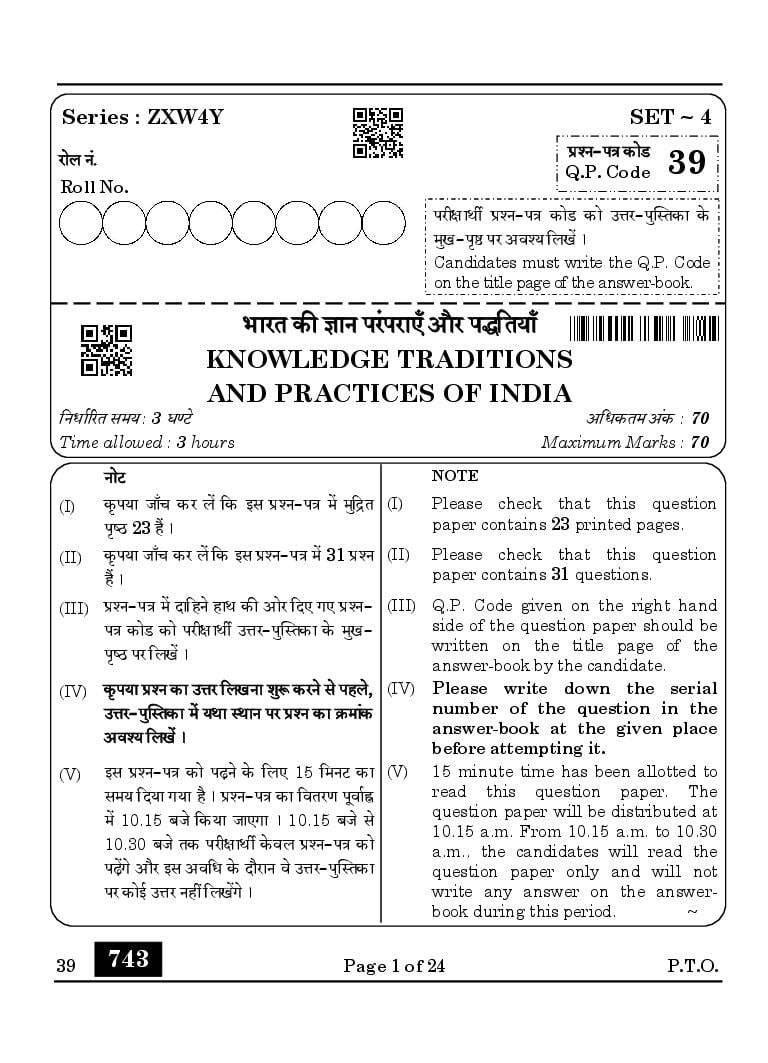
CBSE Class 12 Question Paper 2025 Knowledge Traditions Practices of India
Finished viewing? Save it for later —
Download CBSE Class 12 Question Paper 2025 Knowledge Traditions Practices of India (PDF · 24 pages)About CBSE Class 12 Question Paper 2025 Knowledge Traditions Practices of India
CBSE Class 12 Question Paper 2025 Knowledge Traditions Practices of India is available here for free download. Published by CBSE for Class 12, this question paper can be viewed online or downloaded as a PDF (24 pages). Candidates preparing for Class 12 can use CBSE Class 12 Question Paper 2025 Knowledge Traditions Practices of India to understand the exam pattern, the type of questions asked, and the overall difficulty level.
Frequently Asked Questions
How can I download CBSE Class 12 Question Paper 2025 Knowledge Traditions Practices of India?
Open this page and click the Download button to save CBSE Class 12 Question Paper 2025 Knowledge Traditions Practices of India as a PDF. It is completely free on AglaSem Docs.
Is CBSE Class 12 Question Paper 2025 Knowledge Traditions Practices of India free to download?
Yes. CBSE Class 12 Question Paper 2025 Knowledge Traditions Practices of India can be viewed online and downloaded as a PDF free of cost on AglaSem Docs.
How many pages does CBSE Class 12 Question Paper 2025 Knowledge Traditions Practices of India have?
CBSE Class 12 Question Paper 2025 Knowledge Traditions Practices of India contains 24 pages, which you can read online or download together as a single PDF.
Where can I find more Class 12 study material?
You can find more Class 12 question papers, sample papers, syllabus, and answer keys on AglaSem Docs.
CBSE Class 12 Question Paper 2025 Knowledge Traditions Practices of India – Text
Read the full text of this question paper below — useful to quickly search, copy and reference the content online without downloading the PDF.
📄 View text version (24 pages)
Page 1
-
.
Q.P. Code 39
Roll No.
- -
-
Candidates must write the Q.P. Code
on the title page of the answer-book.
KNOWLEDGE TRADITIONS
AND PRACTICES OF INDIA
: 3 : 70
Time allowed : 3 hours Maximum Marks : 70
NOTE
(I) - (I) Please check that this question
23 paper contains 23 printed pages.
(II) - 31 (II) Please check that this question
paper contains 31 questions.
(III) - - (III) Q.P. Code given on the right hand
- - side of the question paper should be
written on the title page of the
answer-book by the candidate.
(IV) , (IV) Please write down the serial
- number of the question in the
answer-book at the given place
before attempting it.
(V) - 15 (V) 15 minute time has been allotted to
- read this question paper. The
question paper will be distributed at
10.15 10.15
10.15 a.m. From 10.15 a.m. to 10.30
10.30 - a.m., the candidates will read the
- question paper only and will not
write any answer on the answer-
book during this period. ~
39 743 Page 1 of 24 P.T.O.
Page 2
- I IV
– I ( 1 )
– II ( 2 )
– III ( 5 )
– IV ( 5 )
15
- I
-I 16 01
1. : 1
?
(A)
(B)
(C)
(D)
2. 1
, , , , , , , , ,
________
(A)
(B) ()
(C)
(D)
39 Page 2 of 24
~
Page 3
This question paper contains four sections, Section I to IV.
Section – I Attempt all questions (Each Question carries 1 mark)
Section – II Attempt all questions (Each Question carries 2 marks)
Section – III Attempt all questions (Each Question carries 5 marks)
Section – IV Attempt all questions (Each Question carries 5 marks)
One internal choice is given in Q. 15.
SECTION – I
There are 16 questions in Section-I. Each question carries 01 mark.
1. Study the picture and answer the question that follows : 1
Which of the following option best describes the given picture ?
(A) A partial view of the university of Taxila.
(B) Traditional educational institute in India.
(C) An ancient structure for Buddhists in India.
(D) A series of interconnected residences at Dholavira.
2. Choose the correct option. 1
Kulls, kunds, ahars, pokhars, khadins, arakere, kolas, surangam,
tadagams, eris. This set of vocabulary is related to _____.
(A) a variety of water structures
(B) intercropping methods
(C) a variety of manures
(D) a variety of seed storage methods
39 Page 3 of 24 P.T.O.
~
Page 4
-A -B
1. i.
2. ii.
3. iii.
4. iv.
:
1 2 3 4
(A) ii i iv iii
(B) iii ii iv i
(C) iv i ii iii
(D) iv iii i ii
4. : 1
( ) ‘’
?
(A)
(B) , ,
(C)
(D)
39 Page 4 of 24
~
Page 5
Column A Column B
1. First stage of āśramas i. Cosmic order
2. Buddhist Ethics ii. Hundred verses on ethics
3. Rigveda iii. Eight fold path
– iv. Brahmacarya
4. N i ti Śatakam
Options :
1 2 3 4
(A) ii i iv iii
(B) iii ii iv i
(C) iv i ii iii
(D) iv iii i ii
4. Study the picture and answer the question that follows : 1
Which of the following options best signifies this particular martial art
called Gadka ?
(A) It is a training in remote resistance of or attack on an enemy.
(B) The practice of this martial art form requires training with
dangerous weapons dagger, mace, sword.
(C) The training involved encircling the pillar with twisting movements.
(D) A wooden stick and a shield are usually used in the match.
39 Page 5 of 24 P.T.O.
~
Page 6
a. b.
c. d. ()
:
(A) b c (B) b d
(C) a b (D) a c
: 6 13 (A) (R)
:
6. (A) : 1
(R) :
(A) (A) (R) (R), (A)
(B) (A) (R) , (R), (A)
(C) (A) , (R)
(D) (A) , (R)
7. (A) : , , 1
(R) :
(A) (A) (R) (R), (A)
(B) (A) (R) , (R), (A)
(C) (A) , (R)
(D) (A) , (R)
39 Page 6 of 24
~
Page 7
a. palm leaves b. stone slates
c. –
bhurjapattra d. wood panels
Options :
(A) b and c (B) b and d
(C) a and b (D) a and c
Note : In questions 6 – 13, there are two statements marked as Assertion (A)
and Reason (R). Mark your answer as per the codes provided below :
6. Assertion (A) : Uniform seeds produce excellent results. 1
Reason (R) : One should (therefore) put in maximum effort to
procure and preserve these seeds. The origin of
plentiful yield is the seed.
(A) Both (A) and (R) are true and (R) is the correct explanation of (A).
(B) Both (A) and (R) are true, but (R) is not the correct explanation of (A).
(C) (A) is true, (R) is false.
(D) (A) is false, (R) is true.
7. Assertion (A) : The teacher, the guru, the acarya, was highly
honoured. 1
Reason (R) : The teacher was seen as the guide who helped
students escape the darkness of ignorance and attain
the light of knowledge.
(A) Both (A) and (R) are true and (R) is the correct explanation of (A).
(B) Both (A) and (R) are true, but (R) is not the correct explanation of (A).
(C) (A) is true, (R) is false.
(D) (A) is false, (R) is true.
39 Page 7 of 24 P.T.O.
~
Page 8
1
(A) : ,
(R) :
(A) (A) (R) (R), (A)
(B) (A) (R) , (R), (A)
(C) (A) , (R)
(D) (A) , (R)
9. (A):
1
(R) : ,
(A) (A) (R) (R), (A)
(B) (A) (R) , (R), (A)
(C) (A) , (R)
(D) (A) , (R)
10. (A) : 1
(R) : -
(A) (A) (R) (R), (A)
(B) (A) (R) , (R), (A)
(C) (A) , (R)
(D) (A) , (R)
39 Page 8 of 24
~
Page 9
of warfare, enumerates the rules of archery, rules of bow- and
arrow-making and describes the uses of weapons and the training of the army. 1
Assertion (A) : The Dhanurveda, an ancient treatise on the science of
archery and the art of warfare.
Reason (R) : It praises those who are well versed in it.
(A) Both (A) and (R) are true and (R) is the correct explanation of (A).
(B) Both (A) and (R) are true, but (R) is not the correct explanation of (A).
(C) (A) is true, (R) is false.
(D) (A) is false, (R) is true.
9. Assertion (A) : India is blessed with a large network of perennial
rivers that over ages have created vast stretches of
highly productive alluvial soil. 1
Reason (R) : The Amarakosa, describes twelve types of lands
according to the fertility of the soil, irrigation and
physical characteristics.
(A) Both (A) and (R) are true and (R) is the correct explanation of (A).
(B) Both (A) and (R) are true, but (R) is not the correct explanation of (A).
(C) (A) is true, (R) is false.
(D) (A) is false, (R) is true.
10. Assertion (A) : Examinations had a different form in the ancient
Indian education system. 1
Reason (R) : Sometimes advanced students were often called upon
to teach beginners and written exams were conducted
at the end of the session.
(A) Both (A) and (R) are true and (R) is the correct explanation of (A).
(B) Both (A) and (R) are true, but (R) is not the correct explanation of (A).
(C) (A) is true, (R) is false.
(D) (A) is false, (R) is true.
39 Page 9 of 24 P.T.O.
~
Page 10
1
(R) :
(A) (A) (R) (R), (A)
(B) (A) (R) , (R), (A)
(C) (A) , (R)
(D) (A) , (R)
12. ,
18 1
(A) : ,
(R) :
(A) (A) (R) (R), (A)
(B) (A) (R) , (R), (A)
(C) (A) , (R)
(D) (A) , (R)
13. (A) : 1 × 2 × 4 (
; ) 1
(R) :
(A) (A) (R) (R), (A)
(B) (A) (R) , (R), (A)
(C) (A) , (R)
(D) (A) , (R)
39 Page 10 of 24
~
Page 11
social order and harmony. 1
Reason (R) : Social ethics has its origin in its democratic thinking.
(A) Both (A) and (R) are true and (R) is the correct explanation of (A).
(B) Both (A) and (R) are true, but (R) is not the correct explanation of (A).
(C) (A) is true, (R) is false.
(D) (A) is false, (R) is true.
12. Valari vicu uses a kind of boomerang made of wood, ivory or iron. It is a
training in remote resistance of or attack on an enemy. It was very
popular in the medieval period in the southern districts of Tamil Nadu
and continued to be practiced till the late 18th century. 1
Assertion (A) : Valari vicu uses a kind of boomerang made of wood,
ivory or iron.
Reason (R) : It is also used for defense.
(A) Both (A) and (R) are true and (R) is the correct explanation of (A).
(B) Both (A) and (R) are true, but (R) is not the correct explanation of (A).
(C) (A) is true, (R) is false.
(D) (A) is false, (R) is true.
13. Assertion (A) : Harappan fired bricks had proportions of 1 × 2 × 4
(width equals two heights; length equals two widths). 1
Reason (R) : The walls made with these bricks were stronger and
the least quantity of bricks were used.
(A) Both (A) and (R) are true and (R) is the correct explanation of (A).
(B) Both (A) and (R) are true, but (R) is not the correct explanation of (A).
(C) (A) is true, (R) is false.
(D) (A) is false, (R) is true.
39 Page 11 of 24 P.T.O.
~
Page 12
? 1
(A)
(B)
(C)
(D) , ,
15. (I) 1
: – , , –
,
, ,
-
-
(a) (b)
(c) - (d)
:
(A) (a) (d) (B) (a) (b)
(C) (b) (c) (D) (c) (d)
39 Page 12 of 24
~
Page 13
and the lower knowledge. To whom should the teacher impart higher
knowledge, the knowledge of Brahman ? 1
(A) Whose mind is completely serene and whose senses are controlled.
(B) Who would work exactly as the teacher says.
(C) Who is stable and can follow guidelines of the discipline.
–
(D) Who is a master in Vedas, the Yajurveda, the Samaveda and the
Atharvaveda.
15. (I) Study the following picture and the textual description given below
and answer the question. Choose the most appropriate option. 1
Text material : Wells have been made in many shapes – circular,
square, vertical or horizontal – and sizes, and with bricks, stone or
terracotta rings. There is a long way from Dholavira’s modest step
well to those of classical times, especially in Gujarat and Rajasthan,
which are not only engineering marvels but works of art.
We can infer that wells in Gujarat and Rajasthan were
(a) poorly designed (b) engineering marvels
(c) works of art (d) modest
Options :
(A) (a) and (d) (B) (a) and (b)
(C) (b) and (c) (D) (c) and (d)
OR
39 Page 13 of 24 P.T.O.
~
Page 14
1
:
- ( ) , ,
,
- ( ,
) ,
, - -
(a) /
(b) -
(c) -
(d) -
:
(A) (a) (d) (B) (a) (b)
(C) (b) (c) (D) (c) (d)
16. ? 1
(A)
(B) -
(C)
(D)
39 Page 14 of 24
~
Page 15
most appropriate option. 1
Text Material :
–
Kautilya’s Arthaśastra pays great attention to water management
and irrigation techniques. Anyone leasing, hiring, sharing or
accepting a water-work as a pledge, with the right to use them, shall
keep them in good condition. Owners may give water to others (in
return for a share of the produce grown in the fields, parks or
gardens). In the absence of the owner, either charitable individuals
or the people of a village acting together, shall maintain water-
works.
We can infer that :
(a) sharing of water was done by building suitable structures /
channels.
(b) barter system was prevalent.
(c) under certain circumstance management of water-work was
done by community
(d) water-works was free.
Options :
(A) (a) and (d) (B) (a) and (b)
(C) (b) and (c) (D) (c) and (d)
16. Which of the following options related to Buddhist Ethics is correct ? 1
(A) It is composed by Vidura.
(B) It has a rich discourse on polity.
(C) It has a rich discourse on darśanaśāstra.
(D) It is based on four Noble truths.
39 Page 15 of 24 P.T.O.
~
Page 16
17.
2
18.
? 2
19. “ ”
2
20.
2
21. ? 2
22. -
2
23.
? 2
39 Page 16 of 24
~
Page 17
17. Every religious and every philosophical system of India has a prominent
ethical component. Comment on the statement highlighting the ethical
component in Buddhism. 2
–
18. What were the techniques developed by Paraśara’s and Var–ahamihira to
predict rainfall based on ? 2
19. “India even now possesses a wealth of manuscripts running into many
millions.” Comment on this statement by providing details about
preserving of manuscripts. 2
20. There were popular martial exercises that were practised such as
–
śastraśrama. Give details of any four śastr–aśramas. 2
21. Define individual and social ethics. How does it impact the society ? 2
22. State two features of guru-śis. yaparamparā that you would like to integrate
in your school system. 2
23. If you were to introduce any one Indian traditional martial art form in
your school, which one would that be and why ? 2
39 Page 17 of 24 P.T.O.
~
Page 18
24.
,
()
– ?
5
25. (i) “
”
2
(ii) ()
? 2
(iii) - ? 1
26. (i) “ –
” ?
3
(ii) / ? 2
39 Page 18 of 24
~
Page 19
24. The accounts of classical Greek and Roman geographers and historians
have some useful information on Indian textiles and dress styles.
They cover their persons down to the feet with fine muslin, are shod with
sandals and coil round their heads clothes of linen (cotton). They hang
precious stones as pendants from their ears and persons of high social rank
or of great wealth, deck their wrist and upper arm with bracelets of gold.
Based on this textual material - What can we infer about Indian
dressing ? Draw a comparison with today’s sense of dressing. 5
25. (i) “Teaching was in the oral mode and students were also expected to
gain firsthand experience of what they were taught in the class.”
Based on your experience, draw a comparison with current day
learning methodology. 2
(ii) Education in India was supported by the community. What role did
the community play ? 2
(iii) How do games and recreational activities impact the student’s
development ? 1
26. (i) “A wise man should do good – that is the treasure which will not
leave him.” How far do you agree with this statement ? Reflect on life
experiences and comment. 3
(ii) If you were to hone / acquire one value, what would that be and why ? 2
39 Page 19 of 24 P.T.O.
~
Page 20
5
– IV
28. (i) - :
? 3
(ii) - () ( ) 7
? 2
29. ?
? 5
30.
?
? 5
39 Page 20 of 24
~
Page 21
enemy through various wielding techniques, steps and positioning.
Presenting an overview of the use of stick, express your views why this
weapon had been so popular all over India. 5
SECTION – IV
28. (i) The Indian concept of education was not focused on the intellect
alone : it focused on the students’ inner as well as outer development.
What aspects of inner and outer development are being referred to ? 3
(ii) The Chinese scholars I-tsing (Yijing) and Hsüan-tsang (Xuanzang)
visited Nālandā in the 7th century CE. What were their impressions of
the Indian education system and the university ? 2
29. Explain the concept of r.ta and what does it do to the human society ? How
is it relevant in the present time ? 5
30. Apart from wrestling there were other exercises that were recommended
in order to increase physical strength as a preparation to the mastering of
martial arts. What are the other exercises recommended ? If you were to
take up any form, what would that and why ? 5
39 Page 21 of 24 P.T.O.
~
Page 22
,
;
(i)
3
:
,
-
, , ,
-
(ii) – 2
_______________
39 Page 22 of 24
~
Page 23
Agricultural practices often involve some technique of irrigation. Wholly
or partly irrigated crops were raised thanks to canals, smaller channels or
reservoirs such as village tanks. Reservoirs also served the purpose of
water harvesting to cope with the dry seasons or prolonged droughts. The
simplest form of irrigation consisted in having a pair of bullocks pull a
leather bag out of a well; the bag would tilt over the edge of the well and
empty its content into a small channel.
(i) Based on the text extract given above – Comment on the irrigation
methods practiced in ancient and contemporary India. 3
Text Material :
India has been an agricultural economy and civilization and has evolved a
long, rich and diverse tradition of agricultural practices. In India as in
every country, agriculture was an integral part of popular culture and
gave rise to annual fairs, cattle melas, festivals and rituals, all of which
were occasions for celebration. Almost every part of India had its own
dates and customs for the purpose.
(ii) Based on the text given above – Evaluate the role of agriculture in
our culture. 2
_______________
39 Page 23 of 24 P.T.O.
~
Page 24
~
Document Details
| Board / Org | CBSE |
| Exam | Class 12 |
| Type | Question Paper |
| Pages | 24 |
| Updated | 24 Sep 2026 |