CBSE Class 12 Textile Design Question Paper 2020
Finished viewing? Save it for later —
Download CBSE Class 12 Textile Design Question Paper 2020 (PDF · 7 pages)About CBSE Class 12 Textile Design Question Paper 2020
CBSE Class 12 Textile Design Question Paper 2020 is available here for free download. Published by CBSE for Class 12, this question paper can be viewed online or downloaded as a PDF (7 pages). Candidates preparing for Class 12 can use CBSE Class 12 Textile Design Question Paper 2020 to understand the exam pattern, the type of questions asked, and the overall difficulty level.
Frequently Asked Questions
How can I download CBSE Class 12 Textile Design Question Paper 2020?
Open this page and click the Download button to save CBSE Class 12 Textile Design Question Paper 2020 as a PDF. It is completely free on AglaSem Docs.
Is CBSE Class 12 Textile Design Question Paper 2020 free to download?
Yes. CBSE Class 12 Textile Design Question Paper 2020 can be viewed online and downloaded as a PDF free of cost on AglaSem Docs.
How many pages does CBSE Class 12 Textile Design Question Paper 2020 have?
CBSE Class 12 Textile Design Question Paper 2020 contains 7 pages, which you can read online or download together as a single PDF.
Where can I find more Class 12 study material?
You can find more Class 12 question papers, sample papers, syllabus, and answer keys on AglaSem Docs.
CBSE Class 12 Textile Design Question Paper 2020 – Text
Read the full text of this question paper below — useful to quickly search, copy and reference the content online without downloading the PDF.
📄 View text version (7 pages)
Page 1
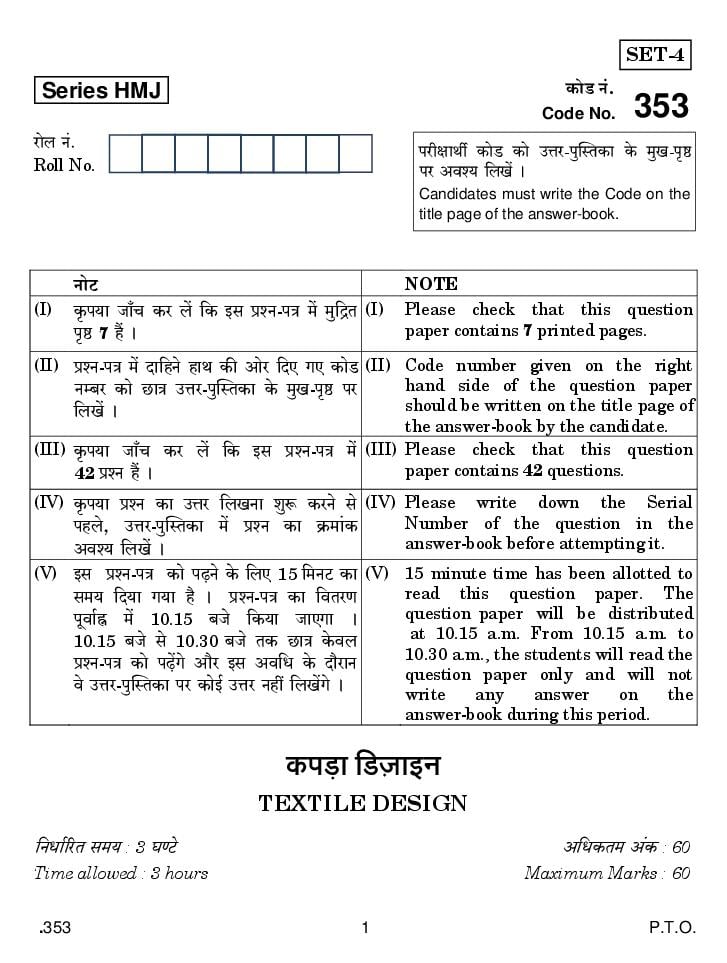
Series HMJ H$moS> Z§.
Code No. 353
amob Z§. narjmWu H$moS >H$mo CÎma-nwpñVH$m Ho$ _wI-n¥ð
Roll No. >na Adí` {bIo§ &
Candidates must write the Code on the
title page of the answer-book.
ZmoQ> NOTE
(I) H¥$n`m Om±M H$a b| {H$ Bg àíZ-nÌ _o§ _w{ÐV (I) Please check that this question
n¥ð> 7 h¢ & paper contains 7 printed pages.
(II) àíZ-nÌ _| Xm{hZo hmW H$s Amoa {XE JE H$moS (II) Code number given on the right
>Zå~a H$mo N>mÌ CÎma-nwpñVH$m Ho$ _wI-n¥ð> na hand side of the question paper
{bI| & should be written on the title page of
the answer-book by the candidate.
(III) H¥$n`m Om±M H$a b| {H$ Bg àíZ-nÌ _| (III) Please check that this question
>42 àíZ h¢ & paper contains 42 questions.
(IV) H¥$n`m àíZ H$m CÎma {bIZm ewê$ H$aZo go (IV) Please write down the Serial
nhbo, CÎma-nwpñVH$m _| àíZ H$m H«$_m§H$ Number of the question in the
Adí` {bI| & answer-book before attempting it.
(V) Bg àíZ-nÌ H$mo n‹T>Zo Ho$ {bE 15 {_ZQ >H$m (V) 15 minute time has been allotted to
g_` {X`m J`m h¡ & àíZ-nÌ H$m {dVaU read this question paper. The
nydm©• _| 10.15 ~Oo {H$`m OmEJm & question paper will be distributed
10.15 ~Oo go 10.30 ~Oo VH$ N>mÌ Ho$db at 10.15 a.m. From 10.15 a.m. to
10.30 a.m., the students will read the
àíZ-nÌ H$mo n‹T>|Jo Am¡a Bg Ad{Y Ho$ Xm¡amZ question paper only and will not
do CÎma-nwpñVH$m na H$moB© CÎma Zht {bI|Jo & write any answer on the
answer-book during this period.
H$n‹S>m {S>µOmBZ
TEXTILE DESIGN
{ZYm©[aV g_` : 3 KÊQ>o A{YH$V_ A§H$ : 60
Time allowed : 3 hours Maximum Marks : 60
.353 1 P.T.O.
Page 2
{ZåZ{b{IV {ZX}em| H$mo ~hþV gmdYmZr go n{‹T>E Am¡a CZH$m g™Vr go nmbZ H$s{OE :
(a) Bg àíZ-nÌ _| Xmo IÊS> h¢ IÊS> H$ … amoOJma H$m¡eb Am¡a IÊS> I … {df` H$m¡eb &
(b) IÊS> H$ … amoOJma H$m¡eb (10 A§H$)
(i) {XE JE 6 àíZm| _| go {H$Ýht 4 àíZm| Ho$ CÎma Xr{OE & àË`oH$ àíZ 1 A§H$ H$m h¡ &
(ii) {XE JE 5 àíZm| _| go {H$Ýht 3 àíZm| Ho$ CÎma Xr{OE & àË`oH$ àíZ 2 A§H$ H$m h¡ &
(c) IÊS> I … {df` H$m¡eb (50 A§H$)
(i) {XE JE 12 àíZm| _| go {H$Ýht 10 àíZm| Ho$ CÎma Xr{OE & àË`oH$ àíZ 1 A§H$ H$m h¡ &
(ii) {XE JE 7 àíZm| _| go {H$Ýht 5 àíZm| Ho$ CÎma Xr{OE & àË`oH$ àíZ 2 A§H$ H$m h¡ &
(iii) {XE JE 7 àíZm| _| go {H$Ýht 5 àíZm| Ho$ CÎma Xr{OE & àË`oH$ àíZ 3 A§H$ H$m h¡ &
(iv) {XE JE 5 àíZm| _| go {H$Ýht 3 àíZm| Ho$ CÎma Xr{OE & àË`oH$ àíZ 5 A§H$ H$m h¡ &
(d) Bg àíZ-nÌ _| 42 àíZ em{_b h¢ {OZ_| go 30 àíZm| Ho$ CÎma XoZo h¢ &
(e) g^r àíZm| Ho$ {deof ^mJ /IÊS> H$mo ghr H«$_ _| H$s{OE &
(f) A{YH$V_ g_` 3 K§Q>o h¡ &
IÊS> H$
(amoOJma H$m¡eb) (10 A§H$)
{XE JE 6 àíZm| _| go {H$Ýht 4 àíZm| Ho$ CÎma Xr{OE & àË`oH$ 1 A§H$ H$m h¡ & 14=4
[aº$ ñWmZm| H$s ny{V© H$s{OE &
1. eãXm| H$m Cn`moJ H$aHo$ OmZH$mar gmPm H$aZo H$mo ________ g§Mma H$hVo h¢ & 1
2. ì`{ŠVJV ñdÀN>Vm Bg{bE _hÎdnyU© h¡ Š`m|{H$ `h h_| ________ ahZo _| _XX H$aVr h¡ & 1
3. _________ BZnwQ> {S>dmBg H$m EH$ CXmhaU h¡ {OgH$m Cn`moJ H$åß`yQ>a _| Ajam|,
g§»`mAm| Am¡a {Z`§ÌU H$m`m] (H$ÝQ´>mob \§$ŠeZm|) H$mo XO© H$aZo Ho$ {bE {H$`m OmVm h¡ & 1
4. {Og {~OZog _| CËnmX Am¡a g{d©g XmoZm| hr ~oMo OmVo h¢, Cgo _________ {~OZog H$hVo h¢ & 1
5. _________ H$mo {H$gr ^r àmH¥${VH$ `m H¥${Ì_ nXmW©, D$Om© `m Ord Ho$ ê$n _| n[a^m{fV
{H$`m Om gH$Vm h¡, {OgH$m Cn`moJ _mZd AnZo H$ë`mU Ho$ {bE H$aVo h¢ & 1
6. _________ ñd`§ H$s j_VmAm| Am¡a ñd`§ na ^amogm H$aZo H$s ^mdZm h¡ & 1
{XE JE 5 àíZm| _| go {H$Ýht 3 àíZm| Ho$ CÎma Xr{OE & àË`oH$ 2 A§H$ H$m h¡ & 23=6
7. g§Mma H$mo n[a^m{fV H$s{OE & 2
8. B§Q>aZoQ> Ho$ H$moB© Xmo gm_mÝ` Cn`moJ ~VmBE & 2
9. CÚ{_Vm H$mo n[a^m{fV H$s{OE & 2
10. Aj` (ZdrH$aUr`) g§gmYZ {H$go H$hVo h¢ ? 2
11. AmË_-à~§YZ H$mo n[a^m{fV H$s{OE & 2
.353 2
Page 3
Read the following instructions very carefully and strictly follow them :
(a) This question paper consists of two parts viz. Section A : Employability
Skills and Section B : Subject Skills.
(b) Section A : Employability Skills (10 Marks)
(i) Answer any 4 questions out of the given 6 questions of 1 mark each.
(ii) Answer any 3 questions out of the given 5 questions of 2 marks each.
(c) Section B : Subject Skills (50 Marks)
(i) Answer any 10 questions out of the given 12 questions of 1 mark each.
(ii) Answer any 5 questions from the given 7 questions of 2 marks each.
(iii) Answer any 5 questions from the given 7 questions of 3 marks each.
(iv) Answer any 3 questions from the given 5 questions of 5 marks each.
(d) This question paper contains 42 questions out of which 30 questions are to
be answered.
(e) All questions of a particular part/section must be attempted in the correct
order.
(f) The maximum time allowed is 3 hours.
SECTION A
(Employability Skills) (10 Marks)
Answer any 4 questions out of the given 6 questions of 1 mark each. 14=4
Fill in the blanks.
1. _________ communication is the sharing of information using words. 1
2. Personal hygiene is important because it helps us to stay _________. 1
3. A _________ is an example of input device used to enter letters, numbers
and control functions in the computer. 1
4. A _________ business is one where the business is doing both, selling
products and selling services. 1
5. A _________ can be defined as any natural or artificial substance, energy
or organism which is used by human beings for their welfare. 1
6. _________ is a sense of trusting one’s own abilities and oneself. 1
Answer any 3 questions out of the given 5 questions of 2 marks each. 23=6
7. Define communication. 2
8. Give any two common uses of internet. 2
9. Define entrepreneurship. 2
10. What are renewable resources ? 2
11. Define self-management. 2
.353 3 P.T.O.
Page 4
({df` H$m¡eb) (50 A§H$)
{XE JE 12 àíZm| _| go {H$Ýht 10 àíZm| Ho$ CÎma Xr{OE & àË`oH$ 1 A§H$ H$m h¡ & 110=10
[aº$ ñWmZm| H$s ny{V© H$s{OE &
12. _________ H$m _w»` CÔoí` H$n‹S>o Ho$ XmoZm| Amoa go C^ao hþE aoem| H$mo {ZH$mbZm h¡ & 1
13. _________ H$mo ñWmZrH¥$V S>mB§J ^r H$hm OmVm h¡ & 1
14. {H$gr ^r MrµO H$mo ~ZmZo Ho$ {bE `moOZm ~ZmZm Am¡a CgH$s {dñV¥V S´>mB§J ~ZmZo H$s à{H«$`m
Am¡a H$bm H$mo _________ Ho$ ê$n _| n[a^m{fV {H$`m J`m h¡ & 1
15. _________ S>mB`m| H$mo ~µ\©$ H$m a§J ^r H$hm OmVm h¡ & 1
16. _________ {MH$ZH$mar Ho$ àË`oH$ H$n‹S>o _| _m¡OyX EH$ gm_mÝ` e¡br h¡ & 1
17. _________ H$mo ‘`y{Zdg©b ãbrqMJ EO|Q>’ ^r H$hm OmVm h¡ & 1
18. _________ qàQ> _| H$n‹S>o XmoZm| Va\$ _w{ÐV hmoVo h¢ & 1
19. Cƒ Vmn_mZ na {S>ñng© S>mB`m| Ho$ _________ JwUm| H$m Cn`moJ Q´>m§g\$a qàqQ>J Am¡a a¡{nS>
S>mB§J à{H«$`m _| {H$`m OmVm h¡ & 1
20. {S>ñMmO© qàQ> _|, _________ _w{ÐV {hñgo _| a§J H$mo ZîQ> H$a XoVo h¢ & 1
21. gã`gmMr _wIOu O¡go {S>µOmBZa AnZo g§J«h _| ~hþV gmao _________ qàQ> H$m Cn`moJ H$aVo
h¢ & 1
22. _________ _| CËnm{XV Q>mB©-S>mB© dñÌm| H$mo ~§YoO Ho$ ê$n _| OmZm OmVm h¡ & 1
23. \w$bH$mar H$mo {Zînm{XV H$aZo Ho$ {bE AmYma gm_J«r __________ h¡ & 1
{XE JE 7 àíZm| _| go {H$Ýht 5 àíZm| Ho$ CÎma Xr{OE & àË`oH$ 2 A§H$ H$m h¡ & 25=10
24. {H$Ýht Xmo Am°pßQ>H$b ìhmBQ>qZJ EO|Q>m| Am¡a ãbyB§J EO|Q>m| Ho$ Zm_ {b{IE & 2
25. ‘BH$V’ eãX H$mo n[a^m{fV H$s{OE & 2
26. Á`m{_Vr` qàQ> {H$go H$hVo h¢ ? Á`m{_Vr` qàQ> Ho$ {bE Am_Vm¡a na {H$g Vah Ho$ bo-AmCQ>m|
H$m Cn`moJ {H$`m OmVm h¡ ? 2
27. {S>ñMmO© qàQ> H$m ì`mnH$ ê$n go Cn`moJ Š`m| Zht {H$`m OmVm h¡ ? 2
.353 4
Page 5
(Subject Skills) (50 Marks)
Answer any 10 questions out of the given 12 questions of 1 mark each. 110=10
Fill in the blanks.
12. The main objective of _________ is removal of protruding fibres from both
sides of fabric. 1
13. _________ is also called localised dyeing. 1
14. _________ is defined as the process and art of creating, planning and
making a detailed drawing of something to be made. 1
15. _________ dyes are also called ice colours. 1
16. A common style present in each piece of Chikankari is the _________. 1
17. _________ is also called a ‘Universal bleaching agent’. 1
18. In _________ prints, fabrics are printed on both the sides. 1
19. The _________ properties of disperse dyes at high temperature is used in
transfer printing and rapid dyeing process. 1
20. In discharge prints, _________ will destroy the colour in the printed
portion. 1
21. Designers like Sabyasachi Mukherjee use a lot of _________ prints in
their collections. 1
22. The tie-dyed textiles produced in _________ are known as Bandhej. 1
23. The base material to execute Phulkari is _________. 1
Answer any 5 questions out of the given 7 questions of 2 marks each. 25=10
24. Name any two optical whitening agents and blueing agents. 2
25. Define the term ‘ikat’. 2
26. What are geometric prints ? What kind of layouts are commonly used for
geometric prints ? 2
27. Discharge prints are not widely used. Why ? 2
.353 5 P.T.O.
Page 6
{H$E OmVo h¢ ? 2
29. _g©amBµOoeZ {H$go H$hVo h¢ ? 2
30. \w$bH$mar H$‹T>mB© Ho$ {bE {Z`mo{OV _w»` Q>mH± $m| Ho$ Zm_ {b{IE & 2
{XE JE 7 àíZm| _| go {H$Ýht 5 àíZm| Ho$ CÎma Xr{OE & àË`oH$ 3 A§H$ H$m h¡ & 35=15
31. H$n‹S>m gm_J«r Ho$ àma§{^H$ CnMma Ho$ VrZ _w»` CÔoí` Š`m h¢ ? 3
32. nQ>mobm dñÌm| H$s H$moB© VrZ {deofVmE± {b{IE & 3
33. ãbm°H$ qàqQ>J Ho$ H$moB© Xmo \$m`Xo Am¡a ZwH$gmZ {b{IE & 3
34. new qàQ> na EH$ {Q>ßnUr {b{IE & 3
35. H$n‹S>o Ho$ {bE S>mB© Ho$ M`Z Ho$ _w»` _mZX§S>m| H$mo gyMr~Õ H$s{OE & 3
36. H$m±Wm H$‹T>mB© _| à`wŠV ê$nm§H$Zm| (_mo{Q>\$) H$s gyMr ~ZmBE & 3
37. H$mobmO àH$ma Ho$ qàQ> ~ZmZo Ho$ MaUm| H$mo gyMr~Õ H$s{OE & 3
{XE JE 5 àíZm| _| go {H$Ýht 3 àíZm| Ho$ CÎma Xr{OE & àË`oH$ 5 A§H$ H$m h¡ & 53=15
38. {S>n a§JmB© (S>mB§J) H$s _hÎdnyU© {deofVmAm| na àH$me S>mbVo hþE EH$ {Q>ßnUr {b{IE & 5
39. hrQ> Q´>m§g\$a qàqQ>J H$s à{H«$`m H$mo g_PmBE Am¡a CgH$s gr_mE± {b{IE & 5
40. {ZåZ{b{IV _| go {H$gr EH$ na CZH$s CËnmXZ VH$ZrH$, ê$nm§H$Zm| (_mo{Q>\$) VWm a§Jm| H$m
Cn`moJ Am¡a A§V Cn`moJm| H$mo ~VmVo hþE {Q>ßnUr {b{IE : 5
(i) Vo{b`m ê$_mb
(ii) boho[a`m
(iii) ~m±Ym
41. {ZåZ{b{IV _| go {H$gr EH$ na {Q>ßnUr {b{IE : 5
(i) VmZm qàQ>
(ii) ao{gñQ> qàQ>
42. H$erXm H$m dU©Z CgH$s VH$ZrH$, ê$nm§H$Zm| (_mo{Q>\$), Q>m±Ho$ Am¡a A§V Cn`moJm| na àH$me
S>mbVo hþE H$s{OE & 5
.353 6
Page 7
technique ? 2
29. What is mercerization ? 2
30. Name the main stitches employed for Phulkari embroidery. 2
Answer any 5 questions out of the given 7 questions of 3 marks each. 35=15
31. What are the three main objectives of preparatory treatments of textile
materials ? 3
32. Write any three characteristics of Patola textiles. 3
33. Write any two advantages and limitations of block printing. 3
34. Write a note on animal prints. 3
35. List the main criteria for selection of dyes for a fabric. 3
36. List the motifs used in Kantha embroidery. 3
37. List down the steps for creating collage kind of prints. 3
Answer any 3 questions out of the given 5 questions of 5 marks each. 35=15
38. Write a note on dip dyeing, highlighting its important features. 5
39. Explain the process of heat transfer printing and write its limitations. 5
40. Write a note on any one of the following, highlighting their production
technique, motifs and colours used and end uses : 5
(i) Telia Rumal
(ii) Leheriya
(iii) Bandha
41. Write a note on any one of the following : 5
(i) Warp prints
(ii) Resist prints
42. Describe Kashida, highlighting its technique, motifs, stitches and end
uses. 5
.353 7 P.T.O.
Document Details
| Board / Org | CBSE |
| Exam | Class 12 |
| Type | Question Paper |
| Pages | 7 |
| Updated | 22 Jul 2026 |