HBSE Class 12 Sample Paper 2027 Economics Marking Scheme
Finished viewing? Save it for later —
Download HBSE Class 12 Sample Paper 2027 Economics Marking Scheme (PDF · 12 pages)About HBSE Class 12 Sample Paper 2027 Economics Marking Scheme
HBSE Class 12 Sample Paper 2027 Economics Marking Scheme is available here for free download. Published by Haryana Board for Class 12, this answer key can be viewed online or downloaded as a PDF (12 pages). Candidates preparing for Class 12 can use HBSE Class 12 Sample Paper 2027 Economics Marking Scheme to understand the exam pattern, the type of questions asked, and the overall difficulty level.
Frequently Asked Questions
How can I download HBSE Class 12 Sample Paper 2027 Economics Marking Scheme?
Open this page and click the Download button to save HBSE Class 12 Sample Paper 2027 Economics Marking Scheme as a PDF. It is completely free on AglaSem Docs.
Is HBSE Class 12 Sample Paper 2027 Economics Marking Scheme free to download?
Yes. HBSE Class 12 Sample Paper 2027 Economics Marking Scheme can be viewed online and downloaded as a PDF free of cost on AglaSem Docs.
How many pages does HBSE Class 12 Sample Paper 2027 Economics Marking Scheme have?
HBSE Class 12 Sample Paper 2027 Economics Marking Scheme contains 12 pages, which you can read online or download together as a single PDF.
Where can I find more Class 12 study material?
You can find more Class 12 question papers, sample papers, syllabus, and answer keys on AglaSem Docs.
HBSE Class 12 Sample Paper 2027 Economics Marking Scheme – Text
Read the full text of this answer key below — useful to quickly search, copy and reference the content online without downloading the PDF.
📄 View text version (13 pages)
Page 1
HBSE Class 12 Sample
Paper 2027 Economics
Marking Scheme
EXAM YEAR TYPE SUBJECT
Haryana Class 12 2027 Answer Key Economics
Notes · Sample Papers · Previous Year Papers · Mock Tests
Page 2
.co s e m
s em l a
a ag
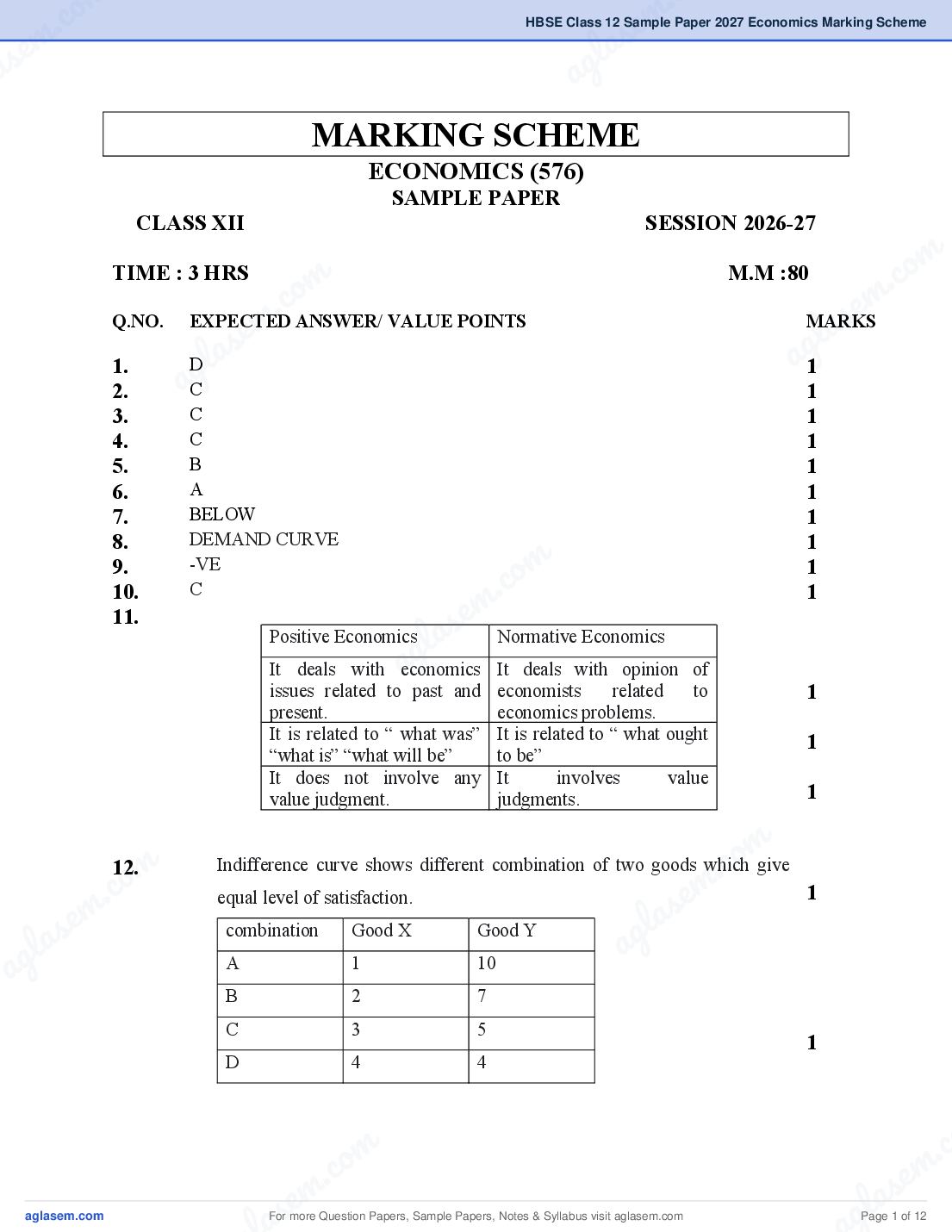
MARKING SCHEME
ECONOMICS (576)
SAMPLE PAPER
CLASS XII SESSION 2026-27
m
TIME : 3 HRS
om
M.M :80
. co
. c em
Q.NO.
em
EXPECTED ANSWER/ VALUE POINTS
a
MARKS
l s
Dl as g
a1
aCg
1.
2. 1
3. C 1
4. C 1
5. B 1
6. A 1
7. BELOW 1
8. DEMAND CURVE 1
m
.co
9. -VE 1
10. C 1
e m
Positive Economics as
11.
g l Normative Economics
It deals with a economics It deals with opinion of
issues related to past and economists related to 1
present. economics problems.
It is related to “ what was” It is related to “ what ought 1
“what is” “what will be” to be”
It does not involve any It involves value
value judgment. judgments. 1
m
12.m Indifference curve shows different combination of two goods which give
.co
m .co equal level of satisfaction.
s e m 1
s e g la
la
combination Good X Good Y
g a
a A 1 10
B 2 7
C 3 5
1
D 4 4
m . c
c. o s e m
s em
For more Question Papers, Sample Papers, Notes & Syllabus visit
gl a
Page 1 of 12
Page 3
OR
Budget Line shows different combination of two goods that a consumer can
purchased given his money income and prices of goods.
1
PxX + PyY = M
Let money income is 100 and Px is 20 and Py is 10.
Combination Good X Good Y
A 0 10
B 1 8
C 2 6
D 3 4
E 4 2
1
F 5 0
1
For more Question Papers, Sample Papers, Notes & Syllabus visit Page 2 of 12
Page 4
.co s e m
s em l a
a ag
13.
Increasing Return to Factor : In the short run with fixed factors if we 1
increase variable factors then total products increase at increasing rate and in
this situation marginal product will increase and cost will decrease.
Labours 1 2 3 4 5
Capitals 10 10 10 10 10 m
TP 5
om
12 22 34 50
. co
MP
. c
5 7 10 12 16 1
em
e m l as
l as ag
ag
2
m
m .co
e
s :
14. Average Cost curve is “U” shapela
because
ag
1. Law of Variable Proportions 1.5
2. AC is combination of AFC and AVC
1.5
3. economies and diseconomies of scale
1
Explain above points.
OR
Output 1 2 3 4 5 6
m
m .co
m .co MC 9 7 2 4 8 12
s e m
s e TFC 10 10 10 10 10
g la
10
g la TVC 9 16 18 22 30 a 42
a TC 19 26 28 32 40 52 2
AC 19 13 9.33 8 8 8.67
2
m . c
c. o s e m
s em
For more Question Papers, Sample Papers, Notes & Syllabus visit
gl a
Page 3 of 12
Page 5
Revenue (MR) curves are represented by a single, horizontal straight line. 2
Because the firm is a "price taker," it can sell any quantity at the constant market
price, making AR, MR, and Price exactly equal.
2
Explain diagram.
OR
Qd= 200 -10 P and Qs= 50 + 15P
Qd=Qs
200-10P =50+15P
200-50 = 15P+10P
150 = 25P
150/25 =P
6=P 2
Putting P=6 in any above Equations
Q = 200-10 (6)
Q = 200-60
Q = 140 2
Hence, equilibrium price is 6 and equilibrium quantity is 140.
16.
It shows how much total expenditure of a good change and in which direction 1
due to change in the price of a good.
1) If price ↑ or ↓ and TE remain constant then Ed= 1
2) If price ↑ and TE ↓ or price ↓ and TE ↑ then Ed > 1
For more Question Papers, Sample Papers, Notes & Syllabus visit Page 4 of 12
Page 6
.co s e m
s em l a
a ag
3) If price ↑ and TE ↑ or price ↓ and TE↓ then Ed < 1 2
Price Quantity Total Exp. Ed
1 10 10 Unitary
2 05 10
1 10 10 Greater than m
2
om
04 08 unit
. co
1
. c 10 10 Less than unit
em
2
e m 06 12 2
l as
l as ag
ag
1
o m
Explain table and diagram.
OR. c
e m
Law of Demand: Law of demand
l asstates that other things being equal, there is
inverse relation between price g 1
a and quantity demanded.
The main causes of –ve law of demand are given below:
1. Law of Diminishing Marginal Utilities. 1
2. Income Effects 1
3. Substitution effects
1
4. Size of consumers
5. Different Uses. 1
1
Explain above points in details.
m
c.17.o
m .co
m
Meaning of Perfect competition: -
s em
s e g lalarge number of
g la Perfect competition is a market situation where
a at equal price. 1
buyers and sellers are buying and selling homogenous products
a
Main features:-
1. Large no. of buyers and sellers
2. Homogenous products
3. AR=MR
4. Firms is price taker and industry is price maker
5. Perfect knowledge
m . c
c. o s e m
s em
For more Question Papers, Sample Papers, Notes & Syllabus visit
gl a
Page 5 of 12
Page 7
7. Lack of transportation cost
8. Lack of advertisement cost
Explain any above 5 points which carry one marks each. 5
OR
Normal Profit under PC:
A firm will be in the equilibrium if
1. MC =MR
2. MC curve cut MR curve from below.
2
A firm will earned normal Profit if average revenue is equal to average cost. i.e.
AR = AC. 2
2
SECTION - B
18 C 1
19 A 1
20 D 1
21 B 1
22 D 1
23 B 1
24 INDIRECT 1
25 M1 1
26 PROBEM OF DOUBLE COUNTING 1
27 B 1
28 BOP is a systematic record of all economic transactions between residence of
one country and rest of the word during a given time period.
Features:-
1
1. systematic record
2. economic transactions 1
3. time period. 1
For more Question Papers, Sample Papers, Notes & Syllabus visit Page 6 of 12
Page 8
.co s e m
s em l a
a ag
4. double entry system
Explain any three points.
29 Determinants of aggregate demand
AD= C+I+G+NX
Consumption (C):- The expenditure made on goods and services for direct
1
satisfaction by household is called consumption.
m
om
C = f (Y)
. co
. c
Investment (I):- Increase in stock of capital goods is called Investment.
em
e m 1
l as
l as
Government Exp. (G):- The expenditures made by government on welfare
and security are called Government Expenditure. ag
g
aNet Export (NX) :- The difference between Export and Import is called net 1
export .
Net Export (NX)= Export - Import
OR
Aggregate Demand: AD is the total value of final goods and services
demanded in an economy in a year.
m
.co
AD= C+I
1
em
As autonomous investment increase AD curve shift upward parallel to
previous AD1 curve.
l as
ag
m
m .co
m .co s e m 2
s e g la
g la a
a
30
MICRO ECONOMICS MACRO ECONOMICS
It studies with individual economics It studies national economy as well
m . c
c. o s e m
s em
For more Question Papers, Sample Papers, Notes & Syllabus visit
gl a
Page 7 of 12
Page 9
It primary deals with individual It is the study of aggregates such as
income , output, price of goods etc. national income , output and general
price level.
It covers several issues like demand, It covers several issues like
1
supply, factor pricing, product distribution, national income,
pricing, economic welfare, employment, money, general price 1
production, consumption, and more. level, and more.
Its central issue is price Its central issue is determination of
determination. income, employment and output.
1
31
Investment Multiplier:- Investment multiplier is the ratio of an increase of
income to given increase in investment.
K= change in income / change in investment
1
Multiplier process :-
Increase in Increase in Increase in Increase in
investment income consumption saving
2000 2000 1000 1000
1000 500 500
500 250 250
- - - 3
- - -
4000 2000 2000
K=1/1-MPC =1/1-0.5 =1/0.5 =2
K=∆Y/∆I =∆Y/2000 =2
∆Y=2000*2 =4000 crores
OR
Consumption equation is given as C = 500 + 0.75Y
(A) MPS = 1-0.75 =0.25
1
(B) Autonomous Consumption =500 1
(C) Multiplier = 1/1-MPC=1/.25 = 4 1
For more Question Papers, Sample Papers, Notes & Syllabus visit Page 8 of 12
Page 10
.co s e m
s em l a
a ag
1
(D) Saving Function = -500 + 0.25Y
32 Fiscal Deficit is the equal to the excess of total expenditure (capital and revenue)
over the sum of revenue and capital receipts excluding borrowings.
1
FD = (Revenue Expenditure + Capital Expenditure) – (Revenue Receipts + Capital
m
om
Expenditure except Borrowings.
. co
. c em
e m
Importance ;
1gl as
l s
1. barometer of a nation's financial health
a
2. Inflationary Pressure
a1
ag
3. Higher Public Debt
1
Explain above three points.
OR
Direct Tax Indirect Tax
m
.co
1. These taxes are imposed 1. These taxes are imposed
on income and wealth. on goods and services. 1
2. These taxes can not be
s em 2. These taxes can be shifted
shifted on others. l a on others. 1
3. These taxes ag
are 3. These taxes are often non-
progressive in nature. progressive in nature. 1
4. Examples:- Income Tax, 4. Examples:- Sales Tax (GST) 1
Wealth Tax Excises Duty
33.
Money : A medium of exchange that is centralized, generally accepted,
m
m recognized, and facilitates transactions of goods and services, is known as
.co
.co em
money.
1
e m Functions of Money:
la s
las i) Medium of exchange: a g
ag ● It means that money can be used to make payments for all the transactions
of goods and services.
● A buyer can buy goods through money, and a seller can sell goods for
money. 1
● It is an essential function of money.
m . c
c. o s e m
s em
For more Question Papers, Sample Papers, Notes & Syllabus visit
gl a
Page 9 of 12
Page 11
● Money serves as a measure of value.
1
● The value of all goods and services is expressed in terms of money.
iii) Standard of deferred payments:
● It means that money acts as a ‘standard’ for making future payments.
● It has made deferred payments much easier than before.
1
● Example: When we borrow money from somebody, we have to return both
the principal as well as the interest amount in the future.
● Money is a convenient mode of calculation and payment of interest amount
to be paid in the future.
● This function has facilitated borrowing and lending.
● It has also led to the creation of financial institutions.
iv) Store of value:
● A store of value implies a store of wealth.
● Money can be easily stored for future use. 1
● It is the most convenient and economical means to store earnings and
wealth.
v) Transfer of value:
● Money also serves for transfer of value.
● It facilitates buying and selling of goods not only in the domestic country 1
but also in other parts of the world.
“ Money is a matter of functions four .
A medium, a measure, standard and store.
It does not clear the picture,
We may add transferability more ”
OR
Function of Commercial Banks:-
1. Primary Functions
Accepting Deposits:
2
Advancing Loans and Credit:
2. Secondary (Utility) Functions
Payment and Transfer Services:
2
For more Question Papers, Sample Papers, Notes & Syllabus visit Page 10 of 12
Page 12
.co s e m
s em l a
a ag
Foreign Exchange
Safe Custody:
3. Agency and Advisory Functions
Collection and Payments:
m
om
Portfolio Management: 2 . co
. c em
e m
Wealth & Tax Consultancy:
l as
l as ag
34. g
aProduct method primary objective is to calculate the national income by taking the
value added to a product during the various stages of production into account.
1. CLASSIFICATION OF PRODUCTIVE ENTERPRISES
i) Primary Sector
ii) Secondary Sector
iii) Tertiary Sector
2. ESTIMATION OF VALUE ADDED 2
m
Value Added (GDP at MP)= Value of Output - Intermediate Consumption
o
. c
m
Here, Value Of Output = Sales + Change In Stocks
e- Opening Stocks
l as
Change In Stocks = Closing Stocks
Intermediate Consumption: a
g
It refers to value of all non-factors inputs. Mainly, it includes value of raw
material used in production process. 2
3. ESTIMATION OF NATION INCOME
Value Added (GDP at MP)= Value of Output - Intermediate Consumption
- Depreciation
- Net Indirect Tax
m
.co
+ Net Factor Income from Abroad(NFIA) 2
. c om National Income (NNP at FC)
e m
e m las
las ag
ag OR
(ii) Wages and salaries 1,800
(x) Social security contribution by 200
employers
COMPENSATION OF EMPLOYEES 2000
(i) Rent and interest 6000
m . c
c. o s e m
s em
For more Question Papers, Sample Papers, Notes & Syllabus visit
gl a
Page 11 of 12
Page 13
(iii) Undistributed profit 400
(vi) Corporation tax 120
OPERATING PROFITS 6600
(xi) MIXED INCOME 1000
(vii) NET FACTOR INCOME FROM 70
ABROAD
NET NATIONAL PRODUCT AT 9670
FACTOR COST
+ (iv) Net indirect taxes 100
(a) NET NATIONAL PRODUCT AT 9770 Cr.
MARKET PRICE 3
NET NATIONAL PRODUCT AT FACTOR 9670
COST
+(ix) Consumption of fixed capital +50
-(vii) NET FACTOR INCOME FROM ABROAD -70
(b) GROSS DOMESTIC PRODUCT AT 9650 Cr.
FACTOR COST 3
For more Question Papers, Sample Papers, Notes & Syllabus visit Page 12 of 12
Document Details
| Board / Org | Haryana Board |
| Exam | Class 12 |
| Type | Answer Key |
| Pages | 12 |
| Updated | 03 Nov 2026 |