CBSE Class 12 Question Paper 2025 Legal Studies
Finished viewing? Save it for later —
Download CBSE Class 12 Question Paper 2025 Legal Studies (PDF · 24 pages)About CBSE Class 12 Question Paper 2025 Legal Studies
CBSE Class 12 Question Paper 2025 Legal Studies is available here for free download. Published by CBSE for Class 12, this question paper can be viewed online or downloaded as a PDF (24 pages). Candidates preparing for Class 12 can use CBSE Class 12 Question Paper 2025 Legal Studies to understand the exam pattern, the type of questions asked, and the overall difficulty level.
Frequently Asked Questions
How can I download CBSE Class 12 Question Paper 2025 Legal Studies?
Open this page and click the Download button to save CBSE Class 12 Question Paper 2025 Legal Studies as a PDF. It is completely free on AglaSem Docs.
Is CBSE Class 12 Question Paper 2025 Legal Studies free to download?
Yes. CBSE Class 12 Question Paper 2025 Legal Studies can be viewed online and downloaded as a PDF free of cost on AglaSem Docs.
How many pages does CBSE Class 12 Question Paper 2025 Legal Studies have?
CBSE Class 12 Question Paper 2025 Legal Studies contains 24 pages, which you can read online or download together as a single PDF.
Where can I find more Class 12 study material?
You can find more Class 12 question papers, sample papers, syllabus, and answer keys on AglaSem Docs.
CBSE Class 12 Question Paper 2025 Legal Studies – Text
Read the full text of this question paper below — useful to quickly search, copy and reference the content online without downloading the PDF.
📄 View text version (24 pages)
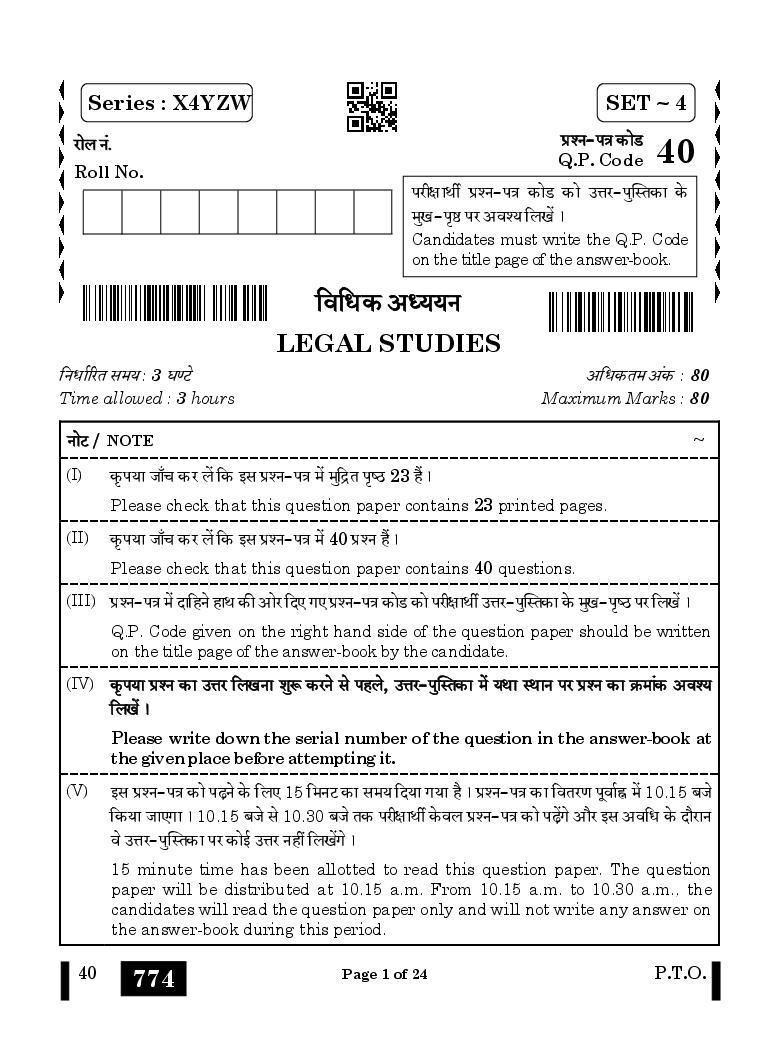
Page 1
. -
Roll No.
Q.P. Code 40
- -
-
Candidates must write the Q.P. Code
on the title page of the answer-book.
LEGAL STUDIES
: 3 : 80
Time allowed : 3 hours Maximum Marks : 80
/ NOTE ~
(I) - 23
Please check that this question paper contains 23 printed pages.
(II) - 40
Please check that this question paper contains 40 questions.
(III) - - - -
Q.P. Code given on the right hand side of the question paper should be written
on the title page of the answer-book by the candidate.
(IV) , -
Please write down the serial number of the question in the answer-book at
the given place before attempting it.
(V) - 15 - 10.15
10.15 10.30 -
-
15 minute time has been allotted to read this question paper. The question
paper will be distributed at 10.15 a.m. From 10.15 a.m. to 10.30 a.m., the
candidates will read the question paper only and will not write any answer on
the answer-book during this period.
40 774 Page 1 of 24 P.T.O.
Page 2
1. - 4 – , ,
1.1 – 20 20
1.2 – 2 8
1.3 – 3 8
1.4 – 5 4
2. - ,
–
1. ,
(stakeholders)
,
(amicus curiae)
? 1
(A)
(B)
(C) ,
(D)
2. ,
136 ,
: 1
(A) (B)
(C) (D) (tribunals)
40 Page 2 of 24
Page 3
General Instructions :
1. The Question Paper contains 4 sections – A, B, C and D.
1.1 Section-A contains 20 Multiple Choice Questions for 20 marks.
1.2 Section-B contains 8 Short Answer Type Questions for 2 marks each.
1.3 Section-C contains 8 questions for 3 marks each.
1.4 Section-D contains 4 Long Answer Type Questions for 5 marks each.
2. Internal choice is given in the paper. There is no overall choice.
SECTION – A
1. In a landmark case, the Supreme Court was handling a highly technical
environmental dispute involving multiple stakeholders and scientific
complexities. Given the intricate details of environmental policies and
scientific evidence, the Court appointed an amicus curiae, an expert in
environmental law and science, to assist by providing impartial
information and insights on the matter. The amicus curiae made
recommendations based on international standards, which helped the
Court in reaching its final decision. 1
Based on the concept of amicus curiae, which of the following statements
is correct ?
(A) The amicus curiae advocates for the interests of the public and acts
as a representative for the government.
(B) The amicus curiae serves as the legal advisor to the party that
requests their assistance in the case.
(C) The amicus curiae assists the Court by providing impartial expertise
on complex issues, without representing any party in the case.
(D) The amicus curiae is only allowed to assist in cases related to
constitutional matters.
2. A High Court in India issues a verdict in a complex property dispute,
which left one party dissatisfied with the decision. The aggrieved party
now seeks to approach the Supreme Court for special leave to appeal.
Under Article 136, the Supreme Court can grant special leave to appeal
against any judgement, decree or order in any matter passed by : 1
(A) any court or tribunal in India (B) only High Court
(C) only subordinate court (D) only tribunals
40 Page 3 of 24 P.T.O.
Page 4
3. (A) :
1
(R) : (PILs) (
) (locus standi)
(A) (A) (R) (A) (R)
(B) (A) (R) , (A) (R)
(C) (A) , (R)
(D) (A) , (R)
4.
- (Snack Vendor)
10%
? 1
(A)
(B) - ( )
(C)
(D)
40 Page 4 of 24
Page 5
3. Assertion : (A) : Any public-spirited person can file petition or write
letters to court on behalf of aggrieved persons. 1
Reasoning (R) : Courts have liberalized the doctrine of locus standi of
the enforcement of fundamental rights through
Public Interest Litigations (PILs).
(A) Both (A) and (R) are true and (R) is the correct explanation of (A).
(B) Both (A) and (R) are true, but (R) is not the correct explanation of (A).
(C) (A) is true, but (R) is false.
(D) (A) is false, but (R) is true.
4. Arjun, at the request of the local community leader, builds a playground
for the children in his neighborhood, spending a considerable amount of
his own money. Later, Ravi, a local snack vendor, sets up a stall near the
playground to sell snacks to children and promises to give Arjun 10% of
his profits from all sales as a token of appreciation for building the
playground. However, Ravi fails to pay Arjun the promised percentage,
and Arjun decides to take legal action to recover it. Based on contract law
principles, which of the following is correct ? 1
(A) Arjun is entitled to the percentage of profits as Ravi benefited from
his efforts in building the playground.
(B) Arjun cannot claim the percentage of profits, as the playground was
built at the request of the community leader and not Ravi.
(C) Ravi must pay Arjun the promised percentage since he made a
verbal commitment to do so.
(D) Ravi has to pay Arjun only if Arjun can prove the playground was
built specifically for his benefit.
40 Page 5 of 24 P.T.O.
Page 6
5.
-
? 1
(A)
(B)
(C) ,
(D) - ,
6.
? 1
(A)
(B) :
(C)
(D)
7.
-
? 1
(A) (credit)
(B)
(C)
(D)
40 Page 6 of 24
Page 7
5. Ravi, at a local market, was involved in an argument with Mohan over a
disputed transaction. In the heat of the argument, Ravi suddenly pushed
Mohan forcefully, causing Mohan to stumble backward and fall. Mohan
suffered a minor injury to his back as a result of the fall. Mohan believes
that Ravi’s action was an intentional physical contact that resulted in
harm, and he is considering suing Ravi for the tort of battery. 1
Which of the following statements is correct regarding the tort of battery
in this case ?
(A) Ravi’s action of pushing Mohan constitutes battery, as it was an
intentional and direct application of physical force.
(B) Ravi is not liable for battery because the physical contact was not
severe enough to cause significant injury.
(C) The tort of battery requires that the defendant’s action must cause
permanent injury, which is not the case here.
(D) Ravi is not liable for battery because his action was a part of self-
defense act, even if there was no immediate threat to his safety.
6. Raj signs a contract to perform at a music festival. A few days before the
festival, Raj develops a severe illness and doctors advise him complete
rest. He misses the performance. Organisers of the event had to cut a
sorry figure as Raj’s performance was the highlight of the music festival.
Which of the given statements best describes Raj’s inability to perform at
the festival ? 1
(A) It is breach of contract as Raj failed to fulfill his obligation.
(B) It is discharge due to impossibility of performance because the illness
makes performance impossible.
(C) It is discharge by performance as Raj was willing to perform if he
hadn’t been ill.
(D) It is breach of contract as a health issue does not discharge a contract.
7. Neha, a photographer, takes a beautiful photograph of a sunset and posts it
on her personal blog. A local travel magazine uses the image without Neha’s
permission. The publishers credit Neha as the photographer but do not pay
her or seek her consent. Neha considers taking legal action against the
magazine. In this context which of the following options is correct ? 1
(A) Neha cannot take legal action because the magazine credited her as
the photographer.
(B) Neha can take legal action because her photograph is protected by
copyright and the magazine used it without permission.
(C) Neha cannot take legal action because the photograph was available
for the general public on her blog.
(D) Neha can only take legal action if she had registered the photograph
with a copyright office.
40 Page 7 of 24 P.T.O.
Page 8
8. XYZ
? 1
(A)
(B)
(C)
(D)
9. () (rate-antique vase)
? 1
(A) - (trespass to chattels)
(B) -
(C) (claim for conversion)
(D)
10. - (Property Registration)
? 1
(A) -
(B) (seal) (deed)
(C) (legal documentation)
(D) ,
40 Page 8 of 24
Page 9
8. A company, XYZ Corp., operates a large dam to generate electricity. Due
to an unforeseen design flaw the dam suddenly bursts, causing massive
flooding in a nearby town. The company had taken all standard safety
measures and had no knowledge of the design flaw. The affected residents
sue the company for damages. 1
Which of the following is applicable in this instance ?
(A) The company is not liable because the flaw was unforeseen.
(B) The company is absolutely liable because the operation of the dam is
inherently dangerous and the damages occurred regardless of the
fault.
(C) The company is liable only if it is proven that they ignored warning
signs of the flaw.
(D) The company is not liable because it followed all safety protocols.
9. Mohan lends his rare antique vase to his friend Sumit for a week. Instead
of returning it, Sumit accidentally drops and shatters the vase while
showing it to another friend. When Mohan asks for his vase to be
returned, Sumit apologizes but says there is nothing he can do now that
the vase is destroyed. Mohan decides to take legal action. Identify the
legal claim he should pursue ? 1
(A) He should file a claim for trespass to chattels because Sumit
damaged the vase while it was in his possession.
(B) He should file a claim for trespass to chattels because Sumit used the
vase without permission.
(C) He should file a claim for conversion because Sumit destroyed the
vase, depriving him of its use permanently.
(D) He should file a claim for conversion because Sumit delayed
returning the vase.
10. From the options given below, which statement accurately describes the
process of property registration in India ? 1
(A) The buyer and seller exchange property documents without involving
any government authority.
(B) The property is officially transferred from the seller to the buyer
through a government-authorised deed, affixed by a seal of the
Registrar’s office.
(C) The buyer must pay property taxes before the sale is completed –
without the need for any legal documentation.
(D) The property ownership is verified by a local official but no formal
record is kept.
40 Page 9 of 24 P.T.O.
Page 10
11. -
,
(Forensic Test)
-
,
(Justice dispensation system)
1
(A)
(B)
(C) (neutral)
(D) (cross-examination)
12. _________
1
(A) (Mediation)
(B)
(C) (Conciliation)
(D) (Tribunal)
13.
,
. . -
: ? 1
(A)
(B) (custody)
(C)
(D)
14. 1 : (opinio juris)
1
2 :
:
(A) (B)
(C) 1 , 2 (D) 2 , 1
40 Page 10 of 24
Page 11
11. In a criminal trial in a country in continental Europe, the judge, Judge
Helena plays an active role in investigating the case. She questions the
witnesses, evaluates the evidences presented by the parties and orders
additional forensic test. The defense lawyer, Mr. Jameson, expresses
concern that the judge’s active involvement in the investigation may
undermine the fairness of the trial.
In the given content, identify the probable disadvantage of the justice
dispensation system that is concerning for the defense lawyer. 1
(A) The active role of judge would prevent delays and prolonged trials.
(B) Stronger party in the case, with more resources and expert lawyers
may not be able to influence the judges.
(C) The judge can no longer remain neutral to evaluate the case with an
open mind.
(D) Less reliance is placed on cross examination and other techniques
used by lawyers.
12. An advantage of _________ is that there is no strict application of the
procedural laws and the disputing parties can directly interact with the
judges. 1
(A) Mediation (B) Lok Adalat
(C) Conciliation (D) Tribunal
13. Omega Builders and Delta Constructions have a dispute over project
delays. The court suggest mediation, but Omega Builders is unsure if
their case qualifies. According to the Afcons Infrastructure Ltd. vs.
Cherian Varley Construction Co. ruling, which disputes are generally
excluded from mediation ? 1
(A) Commercial contracts
(B) Matrimonial and Custody issues
(C) Criminal offenses
(D) Consumer disputes
14. Statement 1 : Opinio juris prevents unwanted general practice from
becoming customary law. 1
Statement 2 : Opinio juris is the belief that an action was carried out as
a legal obligation.
Choose the correct option :
(A) Both statements are correct.
(B) Both statements are incorrect.
(C) Statement 1 is correct but Statement 2 is not correct.
(D) Statement 2 is correct but Statement 1 is not correct.
40 Page 11 of 24 P.T.O.
Page 12
15. (A) : (SRA)
:
( ) 1
(R) :
(A) (A) (R) (A) (R)
(B) (A) (R) , (A) (R)
(C) (A) , (R)
(D) (A) , (R)
16. - ()
? 1
(A)
(B) (print media)
(C) ,
(D) -
17. (A) : -- (Advocate-on-record)
1
(R) : -- (AOR)
(A) (A) (R) (A) (R)
(B) (A) (R) , (A) (R)
(C) (A) , (R)
(D) (A) , (R)
40 Page 12 of 24
Page 13
15. Assertion : (A) : The Solicitor Regulation Authority (SRA) does not
impose any formal experience requirement for
requalifying as solicitor in England and Wales. 1
Reasoning (R) : It is not possible to be a barrister and solicitor.
(A) Both (A) and (R) are true and (R) is the correct explanation of (A).
(B) Both (A) and (R) are true but (R) is not the correct explanation of (A).
(C) (A) is true, (R) is false.
(D) (A) is false, (R) is true.
16. Mei Ling is a practicing lawyer in Hong Kong. She is considering
launching a marketing campaign to attract more clients. Which of the
following is a feasible option for her ? 1
(A) Proceed with the campaign on all media, since lawyers are free to
advertise without restrictions.
(B) Proceed with the campaign on print media.
(C) Launch the campaign but exclude testimonials, success rates and
any comparative statements.
(D) Avoid all forms of advertising as it is entirely prohibited in Hong
Kong.
17. Assertion : (A) : A Senior Advocate is not entitled to appear in the
Supreme Court without an Advocate-on-record. 1
Reasoning (R) : Advocates-on-record are entitled to file an appearance
or act for a party in the Supreme Court.
(A) Both (A) and (R) are true and (R) is the correct explanation of (A).
(B) Both (A) and (R) are true, but (R) is not the correct explanation of (A).
(C) (A) is true, (R) is false.
(D) (A) is false, (R) is true.
40 Page 13 of 24 P.T.O.
Page 14
18. 39-
: ? 1
(A)
(B)
(C) (marginalized person)
(D) -
19. “ ”
1
(A) (prosecution)
(B)
(C) ,
(D) (trial)
20. 1 : , “ ” 1
2 :
(A)
(B)
(C) 1 , 2
(D) 2 , 1
40 Page 14 of 24
Page 15
18. In light of the principles enshrined in Article 39A, which of the following
circumstances contradicts its core objective of equal justice and free legal
aid ? 1
(A) The state provides legal aid to economically disadvantages citizens
facing criminal prosecution.
(B) A wealthy individual is given legal aid despite having adequate
resources to access private legal counsel.
(C) A marginalized person is granted legal representation in a civil
matter by the state.
(D) The state facilities access to justice for those affected by socio-
economic disabilities.
19. “Most accused persons do not lead defence evidence in India.”
Identify the reason for this from the options given below. 1
(A) The burden to prove the offence beyond reasonable doubt is on the
prosecution.
(B) The judge decides the case on its merit according to the evidences
presented by the defence.
(C) The assertion that the accused has committed offence is sufficient to
prove the guilt by prosecution.
(D) The accused is presumed guilty at the first instance when the trial
begins.
20. Statement 1 : The Evidence Law helps the judges to separate the ‘Wheat
from the Chaff ’. 1
Statement 2 : The function of the law of evidence is to provide a
mechanism for the investigation and trial of offenders.
Choose the correct option :
(A) Both statements are correct.
(B) Both statements are incorrect.
(C) Statement 1 is correct, but Statement 2 is not correct.
(D) Statement 2 is correct, but Statement 1 is not correct.
40 Page 15 of 24 P.T.O.
Page 16
–
21. 2
22. (Tech-startup) -
,
2
(i)
(ii) -
23.
, 2
24. (a)
2
(b)
? 2
25. (a) () , 2002 2
(b)
2
26. ,
` 10
2
27. ( )
,
?
51- ? 2
28. (a) 2
(b) 2
40 Page 16 of 24
Page 17
SECTION – B
21. Explain the principle of judicial review. 2
22. Sunil and Asha are co-founders of a tech-startup. Recently they had a
contractual disagreement with their software vendor regarding the
delivery timeline of a critical project. Sunil insisted on filing a lawsuit,
whereas Asha suggested resolution by appointing a neutral third party
who could facilitate the parties in achieving an acceptable, voluntary
agreement. Sunil agreed and their matter was resolved within two weeks. 2
(i) Identify the method of dispute resolution adopted by Sunil and Asha.
(ii) Give any two advantages of adopting alternate dispute resolution
mechanism by the parties.
23. A nation engages in human rights violations within its own borders,
including acts of genocide against a specific ethnic group. Under ergaomnes
obligations, what are the legal responsibilities of the international
community, even if there is no direct threat to neighbouring states ? 2
24. (a) Describe, citing any two examples, how the rules of advertising by
lawyers differs from country to country. 2
OR
(b) During a court proceeding, an advocate finds out that their client
intends to provide false evidence. What should the advocate do in
this situation to adhere to their professional duty toward the court
and uphold ethical standards ? 2
25. (a) State the purpose of the Legal Services Authorities (Amendment) Act
2002. 2
OR
(b) Enlist any four legal services given to any beneficiary under the
provision of free legal aid. 2
26. Jai, a business owner, enters into an agreement with Sana, a government
official. Jai promises to pay Sana ` 10 lakhs in exchange for her influence
in securing a lucrative government contract for his company. Both parties
sign the agreement and begin to execute it. Identify the nature of this
agreement and discuss the legal consequences for both parties involved. 2
27. A group of citizens in a city regularly engages in public protests against
government policies. During one protest, some individuals damage public
property, disrupt traffic, and use offensive language. The protestors claim
that they are exercising their right to freedom of speech and expression.
Is the claim by the protestors justified ? How do the Fundamental Duties
under Article 51A of the Constitution of India apply in this situation ? 2
28. (a) State any two key features of the Directive Principles of State Policy
in the Indian Constitution. 2
OR
(b) Give any two differences between fundamental rights and human
rights. 2
40 Page 17 of 24 P.T.O.
Page 18
–
29. (a) “ ”
3
(b) “ 50
”
50
50 ()
3
30. (a) (arbitral award)
? 3
(b) 3
31.
3
32. - ` 20
(incharge)
, 1882
?
3
33. (a) ( )
, 1974
3
(b) -, 1972 -, 1972
-, 1992 3
40 Page 18 of 24
Page 19
SECTION – C
29. (a) “Independence of judiciary is vital for the respect of due process of
law.” Elaborate. 3
OR
(b) “Article 50 of the Constitution of India directs the State to take steps
to separate the judiciary from the executive.”
In light of Article 50, discuss the importance of the separation of
powers between the judiciary and the executive. State any two
provisions enumerated in Article 50 that contribute to the
independence of the judiciary in India. 3
30. (a) How is an arbitral award both similar and different from a court
pronounced judgement or order ? 3
OR
(b) State the features of ad-hoc arbitration. 3
31. Riya, a law graduate in India, is exploring career options in Law beyond
court room practice. Explain any three such opportunities available to
Riya. How can she apply her legal skills in these fields ? 3
32. Mrs. Kapoor, an elderly landowner, verbally expressed her wish to
transfer her agricultural land worth ` 20 Lakhs to her son Raj without
any legal documentation.
Her other son Aman, who has been managing the land wants it to be
transferred in his name as had been incharge of the land.
Additionally, a neighbour, Mr. Sharma, offers Aman money to buy the
land directly.
In the given situations, who has the right to Transfer the Property under
the provisions of Transfer of Property Act (TPA) 1882 ? State any two
essentials for a valid transfer based on the scenario given above. 3
33. (a) Name the statutory body that was constituted under the Water
(Prevention and Control of Pollution) Act, 1974. State the two
principal functions to be performed by this body. 3
OR
(b) State the significance of the Stockholm Declaration, 1972. Establish
the relationship between Stockholm Declaration, 1972 and Earth
Summit, 1992. 3
40 Page 19 of 24 P.T.O.
Page 20
34. - (UDHR)
, ? 3
35.
-
?1 + 2
36. “ (Glow Essence)”
(ingredients)
“Glow Essence” () ( )
3
(i)
(ii) “Glow Essence”
–
37. (a) (Trade Secrets)
(duration) (scope)
? 5
(b) :
5
38. (a) (NALSA) , 2010 -
:
(i)
?
(ii)
(composition)
(iii) ?
(iv) ?
(2+1+1+1)
(b) ‘ ’
?
(1+1+3)
40 Page 20 of 24
Page 21
34. What are the key principles outlined in the Universal Declaration of
Human Rights (UDHR) and how do they reflect the foundational values of
human dignity, freedom and equality ? 3
35. In a juveniles custodial home, several juveniles report being subject to
harsh disciplinary measures, including excessive physical punishment
and prolonged isolation. Some also mentioned that their complaints about
inadequate food and unsanitary living conditions are being ignored by the
school administration. Identify the national body which can be
approached. How can this body address the violation of the rights of
juveniles ? 1+2
36. Sneha started a beauty care brand called “Glow Essence”, offering organic
skin care products. Within a year her brand gained popularity for its
quality and natural ingredients. However, Sneha discovered that another
company was selling low quality skin care products under the similar
name leading to confusion among customers. This damaged her brand’s
reputation.
On consulting a legal expert Sneha learned that “Glow Essence” is a trade
name and not a trade mark. She initiated the registration process. 3
(i) Differentiate between a trade name and a trade mark.
(ii) Explain, how registration of “Glow Essence” benefit Sneha.
SECTION – D
37. (a) Explain the concept of ‘trade secrets’ in intellectual property law.
Discuss the legal protection provided to trade secrets under Indian
law. How do these protections differ from patents and copyrights in
terms of duration and scope ? 5
OR
(b) All agreements per se are not contracts. They must meet certain
criteria to qualify as such. Elaborate. 5
38. (a) With regards to the selection of panel lawyers under the NALSA
Regulations, 2010, answer the questions given below;
(i) Mention the basic requirement an advocate must fulfil to be
considered for empanelment.
(ii) State the composition of the selection board for empanelling
advocates for High Court Legal Services Committee.
(iii) Under what circumstances can a panel lawyer be removed from
any case ?
(iv) When can the services of a Senior Advocate be availed by the
legal services authorities ? (2+1+1+1)
OR
(b) Explain the term ‘legal aid’. Why is it important for every legal
system to provide for legal aid ? Discuss the provisions in the Indian
Constitution that have paved way for the various provisions of legal
aid in India. (1+1+3)
40 Page 21 of 24 P.T.O.
Page 22
39.
(ICJ)
,
- 59, 38
38(1) ?
5
40.
(OPC)
(Sole Proprietorship)
(One Person Company) (business
entity) ? 5
_____________
40 Page 22 of 24
Page 23
39. The countries of Novara and Elderia are in a dispute over the construction
of a dam on the river Nelara – with Elderia bringing the case to the
International Court of Justice (ICJ). Novara argues that past ICJ rulings
in similar cases should guide the decision, while Elderia insists on a fresh
interpretation of the law. Analyze how Articles 59, 38 and 38(1) of the
Statute of ICJ would influence the court’s decision-making in this case. 5
40. Vikram, a skilled graphic designer, has been running his design studio as
a sole proprietorship. Over time, his business has grown, and he started
handling larger projects with higher risks. While he enjoys the simplicity
of managing his sole proprietorship, he is worried about his personal
liability if something goes wrong. On the advice of his friend, Vikram is
considering converting his business into a One Person Company (OPC) to
limit his liability and improve his business’s credibility.
Based on the above case, compare Sole proprietorship and One Person
Company (OPC). Which form of business entity would be better for
Vikram and why ? 5
______________
40 Page 23 of 24 P.T.O.
Page 24
40 774 Page 24 of 24
Document Details
| Board / Org | CBSE |
| Exam | Class 12 |
| Type | Question Paper |
| Pages | 24 |
| Updated | 24 Sep 2026 |