CBSE Class 12 Shorthand English Question Paper 2020
Finished viewing? Save it for later —
Download CBSE Class 12 Shorthand English Question Paper 2020 (PDF · 3 pages)About CBSE Class 12 Shorthand English Question Paper 2020
CBSE Class 12 Shorthand English Question Paper 2020 is available here for free download. Published by CBSE for Class 12, this question paper can be viewed online or downloaded as a PDF (3 pages). Candidates preparing for Class 12 can use CBSE Class 12 Shorthand English Question Paper 2020 to understand the exam pattern, the type of questions asked, and the overall difficulty level.
Frequently Asked Questions
How can I download CBSE Class 12 Shorthand English Question Paper 2020?
Open this page and click the Download button to save CBSE Class 12 Shorthand English Question Paper 2020 as a PDF. It is completely free on AglaSem Docs.
Is CBSE Class 12 Shorthand English Question Paper 2020 free to download?
Yes. CBSE Class 12 Shorthand English Question Paper 2020 can be viewed online and downloaded as a PDF free of cost on AglaSem Docs.
How many pages does CBSE Class 12 Shorthand English Question Paper 2020 have?
CBSE Class 12 Shorthand English Question Paper 2020 contains 3 pages, which you can read online or download together as a single PDF.
Where can I find more Class 12 study material?
You can find more Class 12 question papers, sample papers, syllabus, and answer keys on AglaSem Docs.
CBSE Class 12 Shorthand English Question Paper 2020 – Text
Read the full text of this question paper below — useful to quickly search, copy and reference the content online without downloading the PDF.
📄 View text version (3 pages)
Page 1
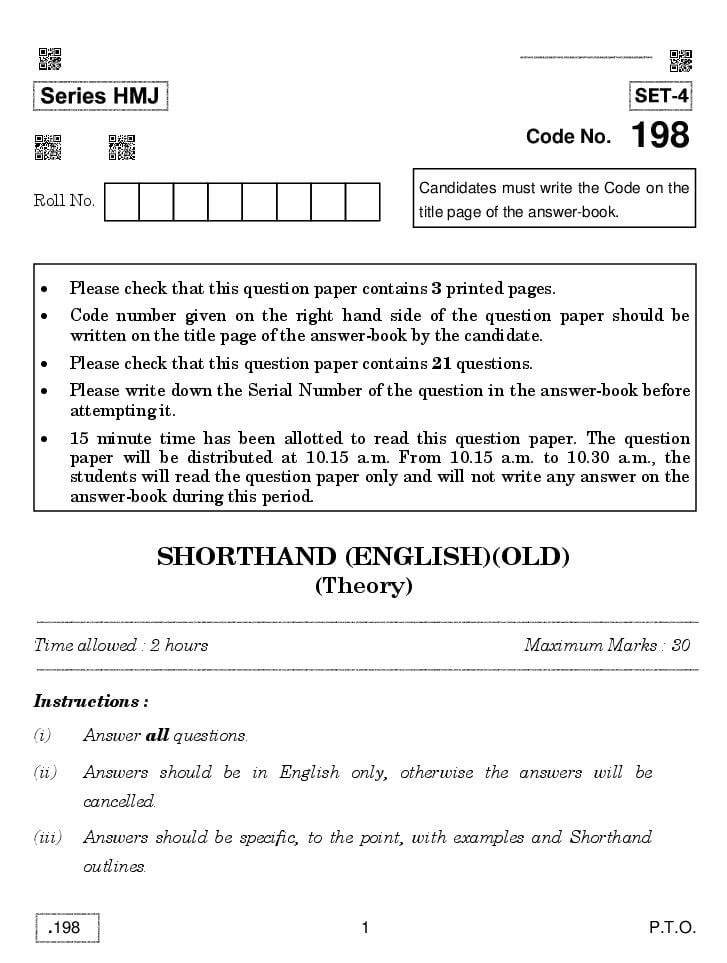
Candidates must write the Code on the
Roll No.
title page of the answer-book.
Please check that this question paper contains 3 printed pages.
Code number given on the right hand side of the question paper should be
written on the title page of the answer-book by the candidate.
Please check that this question paper contains 21 questions.
Please write down the Serial Number of the question in the answer-book before
attempting it.
15 minute time has been allotted to read this question paper. The question
paper will be distributed at 10.15 a.m. From 10.15 a.m. to 10.30 a.m., the
students will read the question paper only and will not write any answer on the
answer-book during this period.
SHORTHAND (ENGLISH)(OLD)
(Theory)
Time allowed : 2 hours Maximum Marks : 30
Instructions :
(i) Answer all questions.
(ii) Answers should be in English only, otherwise the answers will be
cancelled.
(iii) Answers should be specific, to the point, with examples and Shorthand
outlines.
.198 1 P.T.O.
Page 2
Answer any 10 questions out of the following (Q. 1 12). Each question carries
one mark : 110=10
Fill in the blanks with suitable words in the following questions :
1. Diphone is a union of two vowel sounds pronounced __________ .
2. Sometimes the syllable con-com is also written in __________ for the sake
of legibility.
3. ‘‘-ings’’ : is represented by a _______ _______.
4. The stroke __________ represents Rupees in Shorthand.
5. In the short form of phrase ‘for a time’ __________ is omitted.
6. Advanced phrases may be formed by omission of __________ .
Answer the following questions in not more than 25 words each :
7. Write down the outlines of ‘Gaiety’ and ‘India’.
8. How many places are there for the semicircle ?
(i) Three
(ii) Two
(iii) One
9. Give two shorthand outlines illustrating that after a down curved stroke,
‘SH’ should be written according to its motion.
10. Initial com-, con- is represented by a dot. Where is the dot placed ? Give
example.
11. Write down three outlines where ‘In’ before str, skr and ‘H’ (up) is
represented by a small hook, written in the direction of ‘S’ circle.
12. Write down two outlines where stroke Pr. is employed to represent
Professor in intersections.
.198 2
Page 3
50 words each. Each question carries 3 marks : 35=15
13. Explain the use of medial semicircle with examples.
14. Write down any four outlines where insertion of a final vowel is essential.
15. Form outlines for the following by omitting the ‘k’ or ‘kt’ sound strokes :
(i) Production
(ii) Objection
(iii) Introduction
(iv) Prospective
(v) Objective
(vi) Destructive
16. Explain how Monetary units are represented in shorthand giving six
examples.
17. What is represented by ‘T’ and ‘D’ in intersections ? Give examples.
18. How will Trans- be contracted in prefixes ? Give examples.
19. What is contraction ? Explain with examples.
SECTION B
Answer any 1 question out of the following (Q. 20 21) in not more than
150 words. Each question carries 5 marks : 51=5
20. What is the difference between a prefix and a suffix ? Explain giving three
examples of each.
21. What is a Phraseogram ? Can you omit logograms from a phraseogram ? If
so, which are the common logograms which can be omitted ? Give five
examples.
.198 3 P.T.O.
Document Details
| Board / Org | CBSE |
| Exam | Class 12 |
| Type | Question Paper |
| Pages | 3 |
| Updated | 22 Jul 2026 |