WBCHSE Class 11 Syllabus 2024 Philosophy
Finished viewing? Save it for later —
Download WBCHSE Class 11 Syllabus 2024 Philosophy (PDF · 8 pages)About WBCHSE Class 11 Syllabus 2024 Philosophy
WBCHSE Class 11 Syllabus 2024 Philosophy is available here for free download. Published by West Bengal Board for Class 11, this syllabus can be viewed online or downloaded as a PDF (8 pages). Candidates preparing for Class 11 can use WBCHSE Class 11 Syllabus 2024 Philosophy to understand the exam pattern, the type of questions asked, and the overall difficulty level.
Frequently Asked Questions
How can I download WBCHSE Class 11 Syllabus 2024 Philosophy?
Open this page and click the Download button to save WBCHSE Class 11 Syllabus 2024 Philosophy as a PDF. It is completely free on AglaSem Docs.
Is WBCHSE Class 11 Syllabus 2024 Philosophy free to download?
Yes. WBCHSE Class 11 Syllabus 2024 Philosophy can be viewed online and downloaded as a PDF free of cost on AglaSem Docs.
How many pages does WBCHSE Class 11 Syllabus 2024 Philosophy have?
WBCHSE Class 11 Syllabus 2024 Philosophy contains 8 pages, which you can read online or download together as a single PDF.
Where can I find more Class 11 study material?
You can find more Class 11 question papers, sample papers, syllabus, and answer keys on AglaSem Docs.
WBCHSE Class 11 Syllabus 2024 Philosophy – Text
Read the full text of this syllabus below — useful to quickly search, copy and reference the content online without downloading the PDF.
📄 View text version (8 pages)
Page 1
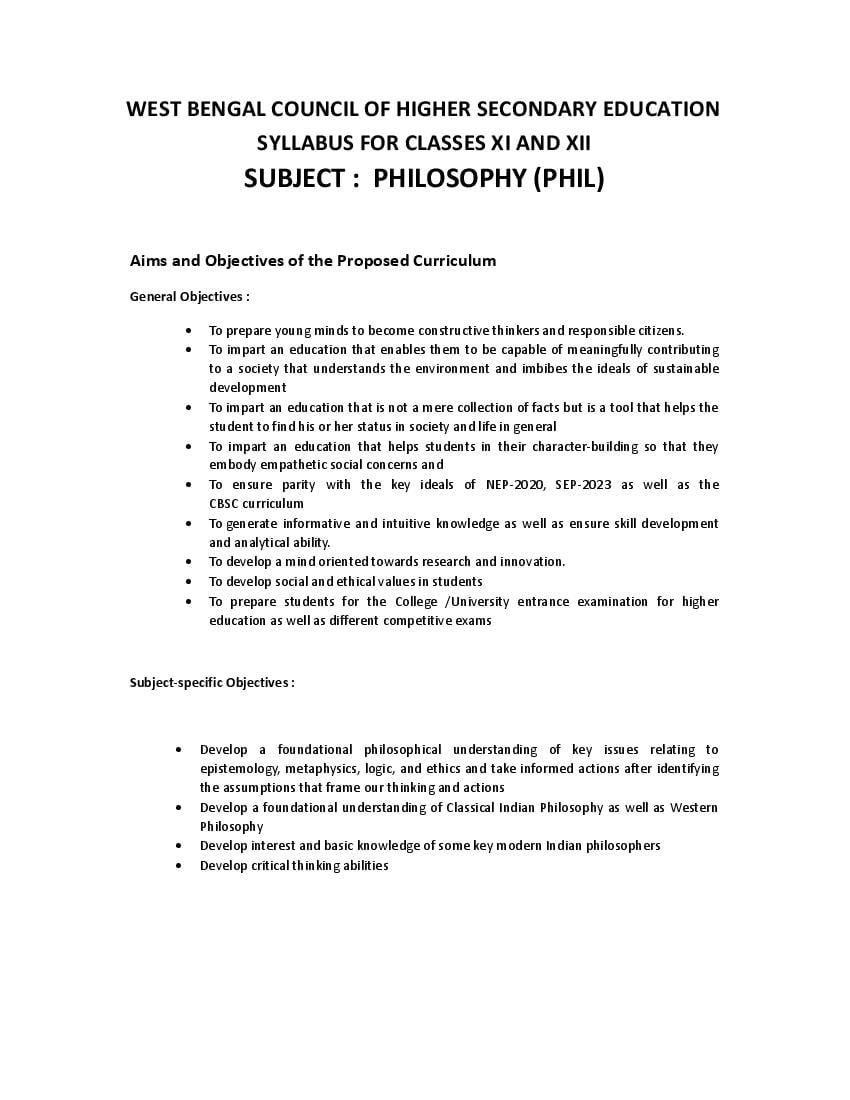
SYLLABUS FOR CLASSES XI AND XII
Aims and Objectives of the Proposed Curriculum
General Objectives :
To prepare young minds to become constructive thinkers and responsible citizens.
To impart an education that enables them to be capable of meaningfully contributing
to a society that understands the environment and imbibes the ideals of sustainable
development
To impart an education that is not a mere collection of facts but is a tool that helps the
student to find his or her status in society and life in general
To impart an education that helps students in their character-building so that they
embody empathetic social concerns and
To ensure parity with the key ideals of NEP-2020, SEP-2023 as well as the
CBSC curriculum
To generate informative and intuitive knowledge as well as ensure skill development
and analytical ability.
To develop a mind oriented towards research and innovation.
To develop social and ethical values in students
To prepare students for the College /University entrance examination for higher
education as well as different competitive exams
Subject-specific Objectives :
Develop a foundational philosophical understanding of key issues relating to
epistemology, metaphysics, logic, and ethics and take informed actions after identifying
the assumptions that frame our thinking and actions
Develop a foundational understanding of Classical Indian Philosophy as well as Western
Philosophy
Develop interest and basic knowledge of some key modern Indian philosophers
Develop critical thinking abilities
Page 2
SEMESTER – I
FULL MARKS : 40 CONTACT HOURS : 100 Hours
UNIT No. TOPICS CONTACT MARKS
Unit – 1 1. দশন শে র অথ (The meaning of the term Darśana) 3 2
Introduction to
Indian
Philosophy 2. ভারতীয় দশন স দায় িলর ণীিবভাগঃ সংে েপ
(Classification of Indian Philosophical System: in 8 3
brief)
3. ানলােভর ছয়িট প িত – মাণ স েক ভারতীয়
10 3
ত সমূ হ (Six ways of knowing – Indian theories of
pramāna) 5 3
4. চাবাক কতৃক অনু মান মাণ খ ন (Refutation of
inference by Cārvāka) 3
6
5. ন ায়স ত ত ে র ল ণ (Nyāya definition of
pratyakṣa or perception) 6 3
6. িনিবক ক ও সিবক ক ত ে র পাথক (Distinction
2
between determinate & indeterminate perception) 5
2
9
7. ন ায় দশেনর অনু মান স েক ব ব (Nyāya theory of
inference): 3
6
অনু িমিতর ল ণ (Definition of anumiti)
প , সাধ ও হতুর ধারণা (The concepts of
pakṣa, sādhya, hetu)
ব াি র প (The nature of vyāpti)
Page 3
Unit – 2 1. দশেনর প ও শাখাসমূ হ (Nature and branches of 10 6
Introduction to
Western Philosophy)
Philosophy 2. ােনর উৎসসমূ হ (Sources of Knowledge)
16 5
a. অিভ তাবাদ -লক, বাকেল, িহউম (Empiricism --
Locke, Berkeley, Hume)
16 5
b. বুি বাদ – ডকাট, ি েনাজা, লাইবিনজ
(Rationalism -- Descartes, Leibnitz, Spinoza)
CLASS - XI
SEMESTER – II
FULL MARKS : 40 CONTACT HOURS : 80 Hours
UNIT No. TOPICS CONTACT MARKS
Unit – 1 1. যু ি িব ােনর কৃিত – অবেরাহ এবং আেরাহ (The nature
Introduction to 4 2
Logic of Logic – Deductive and Inductive)
2. পদ, বাক , বচন, পেদর ব াপ তা, সত তা ও বধতা (Terms, 6 4
sentences, propositions, distribution of terms, truth &
validity)
8 4
3. বাক থেক বচেন পা র (Changing sentences into
logical forms)
4 3
4. বচেনর িবেরািধতা (Opposition of proposition)
8 4
5. অমাধ ম অনু মান – আবতন, িববতন, সমিববতন
(Immediate Inferences: Conversion, Obversion,
10 4
Contraposition)
6. িনরেপ ন ায় – মূ িত ও সং ান এবং বধতা িবচার
6 3
(Categorical Syllogism: Figure & Mood)& validity testing
Page 4
7. যৗিগক যু ি ঃ াকি ক ও বকি ক (Compound
arguments: Hypothetical and Disjunctive)
Unit – 2 1. ভারতীয় নীিতিবদ া (Indian Ethics):
Introduction to 4 2
Ethics a. পু ষাথ (Purusartha)
4 2
b. ম ভগবৎ গীতা – িন াম কেমর ধারণা
6 2
(Srimadbhagavad Gita – The concept of Niskama
Karma)
4
2
c. বৗ েদর অ াি ক মােগর ধারণা (Buddhist concept
of Eight-fold Margas)
8 4
d. চাবাক সু খবাদ (Carvaka Hedonism)
2. পা াত নীিতিবদ া (Western Ethics):
4
a. নিতক ত য়সমূ হ – নিতক, অৈনিতক, নীিত- 8
বিহভূ ত; উে শ ও অিভ ায়; িঠক ও ভুল; ভাল ও
ম ; ন ায়িবচার (Ethical concepts: moral, immoral,
non-moral; motive and intention; right and wrong;
good and bad; justice)
Page 5
b. নিতক ত সমূ হ (Theories of Ethics):
Teleological & deontological
Theories
PROJECT
Suggested Topics:
1. Distinction between Ordinary and Extra-ordinary Contact ( Laukika
and Alaukika Sannikarsa)
2. Svarthanumiti and Pararthanumiti
3. Realism and Its Different Forms
4. Idealism – Subjective Idealism of Berkeley
Project Guideline:
Project is a piece of planned work or an activity that is finished over a period and intended to
achieve a particular purpose following some steps.
1. Topic or Title of the study
2. Purpose of the study
3. Method of the study
4. Analysis and findings of the study
5. Conclusions
Reference
Preliminary pages should contain-
i. Acknowledgement ii. Certificate iii. Content page
Page 6
SEMESTER – III
FULL MARKS : 40 CONTACT HOURS : 100 Hours
UNIT No. TOPICS CONTACT MARKS
Unit – 1 1. Western Metaphysics:
Introduction to Substance: Descartes, Spinoza 16
Metaphysics & Leibnitz – Locke, Berkeley & 1x12=12
Hume
Causality: Regularity Theory & 12
Entailment Theory
Mind-Body Problem: 10
Interactionism & Parallelism
2. Indian Metaphysics:
Vedanta 15
1. Dvaita and Advaita Vedanta
1x8=8
2. Brahman and Maya
Unit – 2 Ethics
Ethics & Social 1. Kant, Mill, Bentham 15 1x10=10
and Political 2. Environmental Ethics 12
Philosophy Social and Political Philosophy
Basic Concept: Society, Community,
Association, Institutions, State, Law 20 1x10 =10
Page 7
SEMESTER – IV
FULL MARKS : 40 CONTACT HOURS : 80 Hours
UNIT No. TOPICS CONTACT MARKS
Unit – 1 1. Symbolic Logic
Western Logic Truth-functions – Variables, 6 3
Constants, Truth-functional
propositions: Negation,
Conjunction, Disjunction, Material
Implication, Material Equivalence
Boolean Interpretation of 6 2
categorical propositions
Venn Diagram of categorical 8
7
propositions
Truth-Table method of determining
forms of proposition : Tautology, 8
4
Self-Contradictory, Contingent
2. Inductive Logic
Nature of Induction 6
Causality 6
Mill’s Method of Experimental
Enquiry 10 6
Unit – 2 Rabindranath Tagore’s Humanism 10 6
Contemporary Swami Vivekananda’s Karma yoga 10 6
Indian Thoughts Mahatma Gandhi’s Ahimsa 10 6
PROJECT
Project Topics:
1. Vaisesika Categories (padarthas)
2. Ontological Arguments for the Existence of God (Western Philosophy)
3. The Idea of Democracy
4. Science and Hypothesis
Page 8
Project is a piece of planned work or an activity that is finished over a period and intended
to achieve a particular purpose following some steps.
1. Topic or Title of the study
2. Purpose of the study
3. Method of the study
4. Analysis and findings of the study
5. Conclusions
Reference
Preliminary pages should contain-
i. Acknowledgement ii. Certificate iii. Content page
Document Details
| Board / Org | West Bengal Board |
| Exam | Class 11 |
| Type | Syllabus |
| Pages | 8 |
| Updated | 22 Jul 2026 |