NIOS Class 12 April 2024 Question Paper Economics
Finished viewing? Save it for later —
Download NIOS Class 12 April 2024 Question Paper Economics (PDF · 24 pages)About NIOS Class 12 April 2024 Question Paper Economics
NIOS Class 12 April 2024 Question Paper Economics is available here for free download. Published by NIOS for National Institute of Open Schooling Class 12, this question paper can be viewed online or downloaded as a PDF (24 pages). Candidates preparing for National Institute of Open Schooling Class 12 can use NIOS Class 12 April 2024 Question Paper Economics to understand the exam pattern, the type of questions asked, and the overall difficulty level.
Frequently Asked Questions
How can I download NIOS Class 12 April 2024 Question Paper Economics?
Open this page and click the Download button to save NIOS Class 12 April 2024 Question Paper Economics as a PDF. It is completely free on AglaSem Docs.
Is NIOS Class 12 April 2024 Question Paper Economics free to download?
Yes. NIOS Class 12 April 2024 Question Paper Economics can be viewed online and downloaded as a PDF free of cost on AglaSem Docs.
How many pages does NIOS Class 12 April 2024 Question Paper Economics have?
NIOS Class 12 April 2024 Question Paper Economics contains 24 pages, which you can read online or download together as a single PDF.
Where can I find more National Institute of Open Schooling Class 12 study material?
You can find more National Institute of Open Schooling Class 12 question papers, sample papers, syllabus, and answer keys on AglaSem Docs.
NIOS Class 12 April 2024 Question Paper Economics – Text
Read the full text of this question paper below — useful to quickly search, copy and reference the content online without downloading the PDF.
📄 View text version (24 pages)
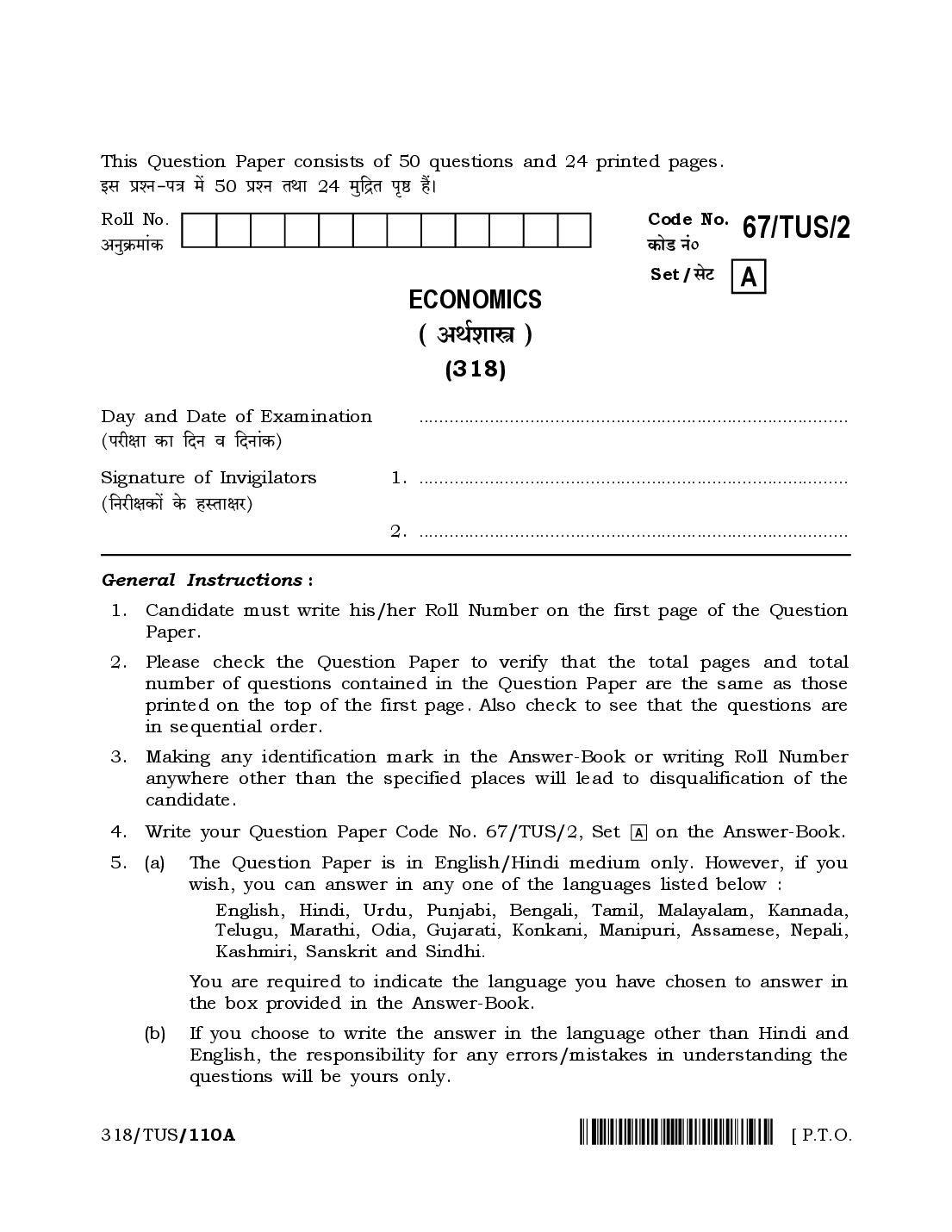
Page 1
Bg àíZ-nÌ ‘| 50 àíZ VWm 24 ‘w{ÐV n¥ð> h¢&
Roll No. Code No.
67/TUS/2
u
AZwH$« ‘m§H$ H$moS> Z§0
Set / goQ>
ECONOMICS
( AW©emó )
(318)
Day and Date of Examination .....................................................................................
(narjm H$m {XZ d {XZm§H$)
Signature of Invigilators 1. .....................................................................................
({ZarjH$m| Ho$ hñVmja)
2. .....................................................................................
General Instructions :
1. Candidate must write his/her Roll Number on the first page of the Question
Paper.
2. Please check the Question Paper to verify that the total pages and total
number of questions contained in the Question Paper are the same as those
printed on the top of the first page. Also check to see that the questions are
in sequential order.
3. Making any identification mark in the Answer-Book or writing Roll Number
anywhere other than the specified places will lead to disqualification of the
candidate.
4. Write your Question Paper Code No. 67/TUS/2, Set u on the Answer-Book.
5. (a) The Question Paper is in English/Hindi medium only. However, if you
wish, you can answer in any one of the languages listed below :
English, Hindi, Urdu, Punjabi, Bengali, Tamil, Malayalam, Kannada,
Telugu, Marathi, Odia, Gujarati, Konkani, Manipuri, Assamese, Nepali,
Kashmiri, Sanskrit and Sindhi.
You are required to indicate the language you have chosen to answer in
the box provided in the Answer-Book.
(b) If you choose to write the answer in the language other than Hindi and
English, the responsibility for any errors/mistakes in understanding the
questions will be yours only.
318/TUS/110A [ P.T.O.
Page 2
1. narjmWu àíZ-nÌ Ho$ nhbo n¥ð> na AnZm AZwH«$‘m§H$ Adí¶ {bI|&
2. H¥$n¶m àíZ-nÌ H$mo Om±M b| {H$ àíZ-nÌ Ho$ Hw$b n¥ð>m| VWm àíZm| H$s CVZr hr g§»¶m h¡ {OVZr àW‘ n¥ð> Ho$ g~go
D$na N>nr h¡& Bg ~mV H$s Om±M ^r H$a b| {H$ àíZ H«${‘H$ ê$n ‘| h¢&
3. CÎma-nwpñVH$m ‘| nhMmZ-{M• ~ZmZo AWdm {Z{X©ï> ñWmZm| Ho$ A{V[aº$ H$ht ^r AZwH«$‘m§H$ {bIZo na narjmWu H$mo
A¶mo½¶ R>ham¶m OmEJm&
4. AnZr CÎma-nwpñVH$m na àíZ-nÌ H$m H$moS> Z§0 67/TUS/2, goQ u {bI|&
5. (H$) n«íZ-nÌ Ho$db {hÝXr/A§J«oOr ‘| h¡& {’$a ^r, ¶{X Amn Mmh| Vmo ZrMo Xr JB© {H$gr EH$ ^mfm ‘| CÎma Xo
gH$Vo h¢ …
A§J«oOr, {hÝXr, CXÿ©, n§Om~r, ~§Jbm, V{‘b, ‘b¶mb‘, H$Þ‹S>, VobwJy, ‘amR>r, C{‹S>¶m, JwOamVr, H$m|H$Ur,
‘{Unwar, Ag{‘¶m, Zonmbr, H$í‘rar, g§ñH¥$V Am¡a {gÝYr&
H¥$n¶m CÎma-nwpñVH$m ‘| {XE JE ~m°³g ‘| {bI| {H$ Amn {H$g ^mfm ‘| CÎma {bI aho h¢&
(I) ¶{X Amn {hÝXr Ed§ A§J«oOr Ho$ A{V[aº$ {H$gr Aݶ ^mfm ‘| CÎma {bIVo h¢, Vmo àíZm| H$mo g‘PZo ‘| hmoZo dmbr
Ìw{Q>¶m|/Jb{V¶m| H$s {Oå‘oXmar Ho$db AmnH$s hmoJr&
318/TUS/110A 2
Page 3
AW©emó
(318)
Time : 3 Hours ] [ Maximum Marks : 100
g‘¶ … 3 KÊQ>o ] [ nyUmªH$ … 100
Note : (i) This question paper consists of 50 questions in all.
(ii) All questions are compulsory.
(iii) Marks are given against each question.
(iv) Section—A consists of
(a) Question Nos. 1 to 20—Multiple Choice-type Questions (MCQs)
carrying 1 mark each. Select and write the most appropriate option
out of the four options given in each of these questions. An internal
choice has been provided in some of these questions. You have to
attempt only one of the given choices in such questions.
(b) Question Nos. 21 to 35—Objective-type Questions carrying 2 marks
each (with 2 sub-parts of 1 mark each). Attempt these questions as
per the instructions given for each of the questions.
(v) Section—B consists of
(a) Question Nos. 36 to 42—Very Short Answer-type Questions carrying
2 marks each to be answered in the range of 30 to 50 words.
(b) Question Nos. 43 to 48—Short Answer-type Questions carrying
4 marks each to be answered in the range of 50 to 80 words.
(c) Question Nos. 49 and 50—Long Answer-type Questions carrying
6 marks each to be answered in the range of 80 to 120 words.
{ZX}e … (i) Bg àíZ-nÌ ‘| Hw$b 50 àíZ h¢&
(ii) g^r àíZ A{Zdm¶© h¢&
(iii) à˶oH$ àíZ Ho$ gm‘Zo CgHo$ A§H$ h¢&
(iv) IÊS>—H$ ‘| em{‘b h¡
(H$) àíZ g§»¶m 1 go 20 VH$ ~hþ-{dH$ënr¶ àíZ h¢& à˶oH$ àíZ H$m 1 A§H$ h¡& {XE JE {dH$ënm|
‘| go g~go Cn¶wº$ {dH$ën H$mo MwZH$a {bI|& Hw$N> àíZm| ‘| Am§V[aH$ {dH$ën {X¶m J¶m h¡;
AmnH$mo Eogo àíZm| ‘| {XE JE {dH$ënm| ‘| go Ho$db EH$ hb H$aZm h¡&
(I) àíZ g§»¶m 21 go 35 VH$ dñVw{Zð> àíZ h¢& à˶oH$ Ho$ 2 A§H$ h¢ (1 A§H$ dmbo
2 Cn-^mJm| g{hV)& {ZX}e AZwgma àíZ hb H$a|&
318/TUS/110A 3 [ P.T.O.
Page 4
(H$) àíZ g§»¶m 36 go 42 VH$ A{V bKy-CÎmar¶ àíZ h¢& à˶oH$ àíZ Ho$ 2 A§H$ h¢& à˶oH$
H$m CÎma 30 go 50 eãXm| ‘| X|&
(I) àíZ g§»¶m 43 go 48 VH$ bKy-CÎmar¶ àíZ h¢& à˶oH$ àíZ Ho$ 4 A§H$ h¢& à˶oH$ H$m CÎma
50 go 80 eãXm| ‘| X|&
(J) àíZ g§»¶m 49 Ed§ 50 XrK©-CÎmar¶ àíZ h¢& à˶oH$ àíZ Ho$ 6 A§H$ h¢& à˶oH$ H$m CÎma
80 go 120 eãXm| ‘| X|&
(1) Answers of all questions are to be given in the Answer-Book given to you.
g^r àíZm| Ho$ CÎma AmnH$mo Xr JB© CÎma-nwpñVH$m ‘| hr {bI|&
(2) 15 minutes time has been allotted to read this question paper. The question
paper will be distributed at 2:15 p.m. From 2:15 p.m. to 2:30 p.m., the
students will read the question paper only and will not write any answer on
the Answer-Book during this period.
Bg àíZ-nÌ H$mo n‹T>Zo Ho$ {bE 15 {‘ZQ> H$m g‘¶ {X¶m J¶m h¡& àíZ-nÌ H$m {dVaU Xmonha ‘|
2:15 ~Oo {H$¶m OmEJm& Xmonha 2:15 ~Oo go 2:30 ~Oo VH$ N>mÌ Ho$db àíZ-nÌ H$mo n‹T>|Jo Am¡a
Bg Ad{Y Ho$ Xm¡amZ do CÎma-nwpñVH$m na H$moB© CÎma Zht {bI|Jo&
SECTION—A
IÊS>—H$
1. Which of the following is not a characteristic of arithmetic mean? 1
(A) It is easy to calculate
(B) It is not affected by extreme items
(C) It cannot be calculated in the open-ended frequency distribution
(D) All values in the series are used in its calculation
{ZåZ{b{IV ‘| go H$m¡Z-gr A§H$J{UVr¶ ‘mܶ H$s {deofVm Zht h¡?
(A) BgH$s JUZm H$aZm gab h¡
(B) ¶h gr‘mÝV ‘yë¶m| go à^m{dV Zht hmoVr
(C) Amd¥{Îm¶m| Ho$ Iwbo {gao dmbo {dVaU ‘| BgH$s JUZm Zht H$s Om gH$Vr
(D) BgH$m AmH$bZ {garµO Ho$ g^r ‘yë¶m| na AmYm[aV hmoVm h¡
2. The value that is repeated the highest number of times in a series is called
(A) median (B) mode
(C) mean (D) None of the above 1
dh ‘yë¶, {OgH$s ûm¥§Ibm ‘| g~go A{YH$ Amd¥{Îm hmoVr h¡, Cgo ³¶m H$hVo h¢?
(A) ‘mpܶH$m (B) ~hþbH$
(C) A§H$J{UVr¶ ‘mܶ (D) Cn¶w©º$ ‘| go H$moB© Zht
318/TUS/110A 4
Page 5
(A) better utilisation of resources (B) growth of resources
(C) fuller utilisation of resources (D) None of the above 1
CËnmXZ g§^mdZm dH«$ H$m D$na H$s Amoa {IgH$Zm Xem©Vm h¡
(A) g§gmYZm| H$m ~ohVa Cn¶moJ (B) g§gmYZm| ‘| g§d¥{Õ
(C) g§gmYZm| H$m nyU© Cn¶moJ (D) Cn¶w©º$ ‘| go H$moB© Zht
As we move to the right on a production possibility curve, the marginal
rate of transformation
(A) increases (B) decreases
(C) remains constant (D) first increases then decreases
O¡go-O¡go h‘ CËnmXZ g§^mdZm dH«$ na XmBª Amoa OmVo h¢, ê$nm§VaU H$s gr‘mÝV Xa
(A) ~‹T>Vr h¡ (B) KQ>Vr h¡
(C) pñWa ahVr h¡ (D) nhbo ~‹T>Vr h¡ {’$a KQ>Vr h¡
4. Economic problems are faced by
(A) only poor economies (B) developing economies
(C) all economies (D) small economies 1
Am{W©H$ g‘ñ¶mAm| H$m gm‘Zm H$aZm n‹S>Vm h¡
(A) Ho$db Jar~ AW©ì¶dñWmAm| H$mo (B) {dH$mgerb AW©ì¶dñWmAm| H$mo
(C) g^r AW©ì¶dñWmAm| H$mo (D) N>moQ>r AW©ì¶dñWmAm| H$mo
5. Which of the following statements about demand is correct? 1
(A) Ram wants 1 kg of apples.
(B) Ram purchased 2 kg of apples last week.
(C) Ram purchased 2 kg of apples at a price of R 10 per kg.
(D) Last week Ram purchased 2 kg of apples at a price of R 10 per kg.
{ZåZ{b{IV ‘| go ‘m±J Ho$ ~mao ‘| H$m¡Z-gm H$WZ ghr h¡?
(A) am‘ H$mo 1 {H$0 J«m0 go~ Mm{hE&
(B) am‘ Zo {nN>bo gámh 2 {H$0 J«m0 go~ IarXo&
(C) am‘ Zo R 10 à{V {H$0 J«m0 H$s‘V na 2 {H$0 J«m0 go~ IarXo&
(D) {nN>bo gámh am‘ Zo R 10 à{V {H$0 J«m0 H$s‘V na 2 {H$0 J«m0 go~ IarXo&
318/TUS/110A 5 [ P.T.O.
Page 6
(A) change in income of its buyer
(B) change in price of the commodity
(C) change in price of substitute goods
(D) All of the above 1
‘m±J dH«$ na g§MbZ H$m H$maU
(A) BgHo$ H«o$Vm H$s Am¶ ‘| n[adV©Z h¡
(B) dñVw H$s H$s‘V ‘| n[adV©Z h¡
(C) à{VñWmnZ dñVwAm| H$s H$s‘V ‘| n[adV©Z h¡
(D) Cn¶w©º$ g^r
7. On a straight-line demand curve, elasticity of demand of its mid-point is
(A) zero (B) greater than 1
(C) less than 1 (D) equal to 1 1
EH$ grYr aoIm dmbo ‘m±J dH«$ Ho$ ‘ܶ-{~ÝXþ na ‘m±J H$s bmoM
(A) eyݶ hmoVr h¡ (B) 1 go A{YH$ hmoVr h¡
(C) 1 go H$‘ hmoVr h¡ (D) 1 Ho$ ~am~a hmoVr h¡
8. Which of the following is a flow? 1
(A) National Income (B) Wealth
(C) Money supply (D) All of the above
{ZåZ{b{IV ‘| go H$m¡Z-gm àdmh h¡?
(A) amï´>r¶ Am¶ (B) gån{Îm
(C) ‘wÐm Amny{V© (D) Cn¶w©º$ g^r
Which of the following is a factor income?
(A) Bonus (B) Wages
(C) Gifts (D) Both (A) and (B)
{ZåZ{b{IV ‘| go H$m¡Z-gr gmYZ Am¶ h¡?
(A) ~moZg (B) ‘OXÿar
(C) Cnhma (D) (A) Am¡a (B) XmoZm|
318/TUS/110A 6
Page 7
(A) Household (B) Firm
(C) Rest of the world (D) All of the above
EH$ AW©ì¶dñWm ‘|, {ZåZ{b{IV ‘| go H$m¡Z-gm Cn^moJ joÌ h¡?
(A) n[adma (B) ’$‘©
(C) eof {díd (D) Cn¶w©º$ g^r
Which of the following is called marginal propensity to consume?
C C
(A) (B)
Y Y
Y C
(C) (D)
C Y
{ZåZ{b{IV ‘| go {H$go gr‘mÝV Cn^moJ-àd¥{Îm H$hVo h¢?
C C
(A) (B)
Y Y
Y C
(C) (D)
C Y
10. Which of the following affects propensity to consume? 1
(A) Rate of interest (B) Wealth
(C) Distribution of income (D) All of the above
{ZåZ{b{IV ‘| go Cn^moJ-àd¥{Îm H$mo ³¶m à^m{dV H$aVm h¡?
(A) ã¶mO H$s Xa (B) gån{Îm
(C) Am¶ H$m {dVaU (D) Cn¶w©º$ g^r
Which of the following is a correct measure of average propensity to save?
S S
(A) (B)
Y Y
S
(C) (D) None of the above
Y
318/TUS/110A 7 [ P.T.O.
Page 8
S S
(A) (B)
Y Y
S
(C) (D) Cn¶w©º$ ‘| go H$moB© Zht
Y
11. A movement to the right on a production possibility curve shows
(A) better utilisation of resources
(B) underutilisation of resources
(C) fall in marginal rate of transformation
(D) arise in marginal rate of transformation 1
EH$ CËnmXZ g§^mdZm dH«$ na XmBª Amoa OmZm Xem©Vm h¡
(A) g§gmYZm| H$m ~ohVa Cn¶moJ
(B) g§gmYZm| H$m Aën-Cn¶moJ
(C) ê$nm§VaU H$s gr‘mÝV Xa H$m KQ>Zm
(D) ê$nm§VaU H$s gr‘mÝV Xa H$m ~‹T>Zm
12. Market demand of a commodity is affected by
(A) price of good (B) number of its buyers
(C) distribution of income and wealth (D) All of the above 1
EH$ dñVw H$s ~mOma ‘m±J à^m{dV hmoVr h¡
(A) dñVw H$s H$s‘V go (B) BgHo$ H«o$VmAm| H$s g§»¶m go
(C) Am¶ Am¡a gån{Îm Ho$ {dVaU go (D) Cn¶w©º$ g^r
Which of the following is an assumption of law of demand?
(A) Price of other goods change (B) Income of the buyers does not change
(C) Tastes of buyers change (D) Preferences of buyers change
{ZåZ{b{IV ‘| go H$m¡Z-gr ‘m±J Ho$ {Z¶‘ H$s ‘mݶVm h¡?
(A) Aݶ dñVwAm| H$s H$s‘V ~XbVr h¡ (B) H«o$VmAm| H$s Am¶ Zht ~XbVr h¡
(C) H«o$VmAm| H$s é{M¶m± ~XbVr h¢ (D) H«o$VmAm| H$s àmW{‘H$VmE± ~XbVr h¢
318/TUS/110A 8
Page 9
(A) income of its buyers change (B) price of the commodity changes
(C) number of its buyers change (D) tastes of its consumers change 1
EH$ ‘m±J dH«$ na g§MbZ V~ hmoVm h¡, O~
(A) BgHo$ H«o$VmAm| H$s Am¶ ~XbVr h¡ (B) dñVw H$s H$s‘V ~XbVr h¡
(C) BgHo$ H«o$VmAm| H$s g§»¶m ~XbVr h¡ (D) BgHo$ H«o$VmAm| H$s A{^é{M¶m± ~XbVr h¢
When price of a commodity and total expenditure on it are inversely
related, then the demand for that commodity is
(A) inelastic (B) more than unit elastic
(C) less than unit elastic (D) having to infinity
O~ EH$ dñVw H$s H$s‘V Am¡a Cg na {H$E OmZo dmbo Hw$b 춶 ‘| {dnarV gå~ÝY hmo, Vmo Cg dñVw
H$s ‘m±J
(A) ~obmoMXma hmoJr (B) BH$mB© go A{YH$ bmoMXma hmoJr
(C) BH$mB© go H$‘ bmoMXma hmoJr (D) AZÝV bmoM dmbr hmoJr
14. Which of the following is an exception of law of demand? 1
(A) Giffen goods (B) Status symbol goods
(C) Necessities (D) All of the above
{ZåZ{b{IV ‘| go H$m¡Z-gm ‘m±J Ho$ {Z¶‘ H$m AndmX h¡?
(A) {J{’$Z dñVw (B) à{Vð>mgyMH$ dñVw
(C) A{Zdm¶©Vm (D) Cn¶w©º$ g^r
Which of the following will cause a rightward shift of demand curve?
(A) Rise in income of its buyer (B) Fall in price of the good
(C) Fall in price of substitute good (D) None of the above
{ZåZ{b{IV ‘| go {H$gHo$ H$maU ‘m±J dH«$ ~mBª Amoa {IgH$Vm h¡?
(A) BgHo$ H«o$Vm H$s Am¶ ‘| d¥{Õ (B) dñVw H$s H$s‘V ‘| H$‘r
(C) à{VñWmnZ dñVw H$s H$s‘V ‘| H$‘r (D) Cn¶w©º$ ‘| go H$moB© Zht
318/TUS/110A 9 [ P.T.O.
Page 10
(A) Purchase of raw meterial (B) Excise duty
(C) Transport charges (D) All of the above
{ZåZ{b{IV ‘| go H$m¡Z-gr pñWa bmJV Zht h¡?
(A) H$ƒo ‘mb H$m H«$¶ (B) CËnmXZ ewëH$
(C) n[adhZ 춶 (D) Cn¶w©º$ g^r
Average variable cost curve is
(A) parallel to OX-axis (B) parallel to OY-axis
(C) negatively sloped (D) U-shaped
Am¡gV n[adVu bmJV dH«$
(A) OX-Aj Ho$ g‘mZmÝVa hmoVm h¡ (B) OY-Aj Ho$ g‘mZmÝVa hmoVm h¡
(C) F$UmË‘H$ T>bmZ dmbm hmoVm h¡ (D) U-AmH$ma H$m hmoVm h¡
16. Average cost rises when
(A) marginal cost rises
(B) variable cost rises
(C) marginal cost is greater than average cost
(D) average fixed cost rises 1
Am¡gV bmJV V~ ~‹T>Vr h¡, O~
(A) gr‘mÝV bmJV ~‹T>Vr h¡
(B) n[adVu bmJV ~‹T>Vr h¡
(C) gr‘mÝV bmJV, Am¡gV bmJV go A{YH$ hmoVr h¡
(D) Am¡gV pñWa bmJV ~‹T>Vr h¡
318/TUS/110A 10
Page 11
(A) Quantity of a commodity that a firm wants to sell
(B) Quantity of a commodity that a firm wants to sell at a given price
(C) Quantity of a commodity that a firm wants to sell during a given period
(D) Quantity of a commodity that a seller is willing to sell at a given price
during a given period
dñVw H$s Amny{V© H$s n[a^mfm {ZåZ{b{IV ‘| go H$m¡Z-gr h¡?
(A) dñVw H$s dh ‘mÌm, Omo EH$ ’$‘© ~oMZm MmhVr h¡
(B) dñVw H$s dh ‘mÌm, Omo EH$ ’$‘© Xr hþB© H$s‘V na ~oMZm MmhVr h¡
(C) dñVw H$s dh ‘mÌm, Omo EH$ ’$‘© EH$ g‘¶md{Y ‘| ~oMZm MmhVr h¡
(D) dñVw H$s dh ‘mÌm, Omo EH$ ’$‘© Xr hþB© H$s‘V na Am¡a Xr hþB© g‘¶md{Y ‘| ~oMZm MmhVr h¡
17. Which of the following is not a cause of shift in supply curve to the
right? 1
(A) Increase in excise duty
(B) Fall in prices of inputs
(C) Use of better technology in production
(D) Fall in the price of other related goods
Amny{V© dH«$ H$mo XmBª Amoa {IgH$mZo dmbm H$maH$ {ZåZ{b{IV ‘| go H$m¡Z-gm Zht h¡?
(A) CËnmXZ ewëH$ H$m ~‹T>Zm
(B) AmJVm| H$s H$s‘V H$‘ hmoZm
(C) CËnmXZ ‘| ~ohVa VH$ZrH$ H$m à¶moJ
(D) Aݶ gå~pÝYV dñVwAm| H$s H$s‘V ‘| {JamdQ>
18. Which of the following factors affects the elasticity of supply of a
commodity? 1
(A) Nature of the good
(B) Cost of production of additional unit of a good
(C) Time period
(D) All of the above
318/TUS/110A 11 [ P.T.O.
Page 12
(A) dñVw H$s àH¥${V
(B) dñVw H$s A{V[aº$ BH$mB© H$s CËnmXZ bmJV
(C) gԦ Ad{Y
(D) Cn¶w©º$ g^r
19. A supply curve is parallel to OX-axis. The elasticity of supply on a point
on it is
(A) infinity (B) less than 1
(C) zero (D) more than 1 1
OX-Aj Ho$ g‘mZmÝVa EH$ ny{V© dH«$ h¡& BgHo$ {H$gr {~ÝXþ na ny{V© H$s bmoM
(A) AZÝV hmoJr (B) 1 go H$‘ hmoJr
(C) eyݶ hmoJr (D) 1 go A{YH$ hmoJr
20. Equilibrium price is the price at which
(A) firms get maximum profit
(B) buyers buy maximum quantity
(C) demand and supply of the good are equal
(D) maximum number of firms exists in the market 1
g§VwbZ H$s‘V dh H$s‘V hmoVr h¡ {Og na
(A) ’$‘© H$mo A{YH$V‘ bm^ àmá hmoVm h¡
(B) H«o$Vm A{YH$V‘ ‘mÌm ‘| H«$¶ H$aVo h¢
(C) dñVw H$s ‘m±J Am¡a ny{V© ~am~a hmoVr h¢
(D) ~mOma ‘| ’$‘m] H$s g§»¶m A{YH$V‘ hmoVr h¡
21. Fill in the blanks with appropriate word : 2
(a) Index number measures _____ changes.
( relative, absolute )
(b) In a weighted index number, weights are assigned to _____ items in
the series.
( all, selected )
318/TUS/110A 12
Page 13
(H$) gyMH$m§H$ _____ n[adV©Z ‘mnVm h¡&
( gmnoj, {Zanoj )
(I) ^m[aV gyMH$m§H$ ‘| ûm§¥Ibm ‘| _____ ‘Xm| H$mo ^ma {X¶m OmVm h¡&
( g^r, MwZr )
22. Fill in the blanks with appropriate word(s) : 2
(a) The measure of dispersion that is most influenced by _____ is called
the range.
( extreme values, low values )
(b) Median is _____ on all the values of a distribution.
( based, not based )
[aº$ ñWmZm| H$mo Cn¶wº$ eãX (eãXm|) go ^[aE :
(H$) An{H$aU ({dMbZ) H$s ‘mn, Omo _____ go A{V à^m{dV hmoVr h¡ Cgo {dñVma H$hVo h¢&
( Ma‘ ‘yë¶m| go, H$‘ ‘yë¶m| go )
(I) ‘mpܶH$m {dVaU Ho$ g^r ‘yë¶m| na _____ hmoVr h¡&
( AmYm[aV, AmYm[aV Zht )
23. Fill in the blanks with appropriate word(s) : 2
(a) When the demand of a commodity is _____, then its demand curve is
rectangular hyperbola.
( inelastic, unit elastic )
(b) A fall in the price of good X results in a fall in demand of good Y.
X and Y are _____.
( substitute goods, complementary goods )
[aº$ ñWmZm| H$mo Cn¶wº$ eãX (eãXm|) go ^[aE :
(H$) O~ EH$ dñVw H$s ‘m±J _____ hmo, Vmo CgH$m ‘m±J dH«$ Am¶VmH$ma A{Vnadb¶ hmoVm h¡&
( ~obmoMXma, BH$mB© Ho$ ~am~a bmoM dmbr )
(I) X dñVw H$s H$s‘V H$‘ hmoZo na, Y dñVw H$s ‘m±J H$‘ hmo OmVr h¡& X Am¡a Y _____ h¢&
( à{VñWmnZ dñVwE±, nyaH$ dñVwE± )
318/TUS/110A 13 [ P.T.O.
Page 14
(a) Demand curve of a good shifts to the right when the price of the good
falls.
(b) When a fall in the price of a goods results in fall in total expenditure
on it, then its elasticity of demand is less than one.
~VmBE {H$ {ZåZ{b{IV H$WZ ghr h¡§ ¶m JbV :
(H$) EH$ dñVw H$m ‘m±J dH«$ XmBª Amoa {IgH$Vm h¡ O~ CgH$s H$s‘V KQ>Vr h¡&
(I) O~ EH$ dñVw H$s H$s‘V H$‘ hmoZo na Cg na {H$¶m OmZo dmbm Hw$b 춶 H$‘ hmo OmVm h¡,
Vmo Cg dñVw H$s ‘m±J H$s bmoM EH$ go H$‘ hmoVr h¡&
25. State whether the following statements are True or False : 2
(a) TC curve and TFC curve start from the same point of OY-axis.
(b) When MC becomes equal to AC, then AC becomes constant and
minimum.
~VmBE {H$ {ZåZ{b{IV H$WZ ghr h¡§ ¶m JbV :
(H$) Hw$b bmJV dH«$ Am¡a Hw$b pñWa bmJV dH«$ OY-Aj na EH$ hr {~ÝXþ go ewê$ hmoVo h¢&
(I) O~ gr‘mÝV bmJV, Am¡gV bmJV Ho$ ~am~a hmo OmVr h¡, Vmo Am¡gV bmJV pñWa Am¡a ݶyZV‘
hmo OmVr h¡&
26. Fill in the blanks with appropriate word(s) : 2
(a) If two supply curves intersect each other, then the elasticity of supply
at a _____ supply curve is more.
( steeper, flatter )
(b) When supply of the commodity rises without a change in its price,
then it is called _____.
( expansion of supply, increase in supply )
[aº$ ñWmZm| H$mo Cn¶wº$ eãX (eãXm|) go ^[aE :
(H$) ¶{X Xmo ny{V© dH«$ EH$-Xÿgao H$mo H$mQ>Vo h¢, Vmo _____ ny{V© dH«$ na ny{V© H$s bmoM A{YH$ hmoJr&
( A{YH$ T>bmZ dmbo, H$‘ T>bmZ dmbo )
(I) O~ {H$gr dñVw H$s H$s‘V ‘| n[adV©Z hþE {~Zm CgH$s ny{V© ~‹T> OmVr h¡, Vmo Cgo _____
H$hVo h¢&
( ny{V© H$m {dñVma, ny{V© H$s d¥{Õ )
318/TUS/110A 14
Page 15
(a) Supply curve of a commodity can never be negatively sloped.
(b) Expansion of supply means a rightward shift of supply curve.
{ZåZ{b{IV H$WZm| H$mo ghr Am¡a JbV ‘| dJuH¥$V H$s{OE :
(H$) EH$ dñVw H$m ny{V© dH«$ H$^r ^r F$UmË‘H$ T>bmZ dmbm Zht hmo gH$Vm&
(I) ny{V© Ho$ {dñVma H$m AW© h¡ ny{V© dH«$ H$m XmBª Amoa {IgH$Zm&
27. Fill in the blanks with appropriate word : 2
(a) Expenditure on defence is _____ expenditure.
( revenue, capital )
(b) Repayment of loans is _____ expenditure.
( revenue, capital )
[aº$ ñWmZm| H$mo Cn¶wº$ eãX go ^[aE :
(H$) gwajm na 춶 _____ 춶 h¡&
( amOñd, ny±OrJV )
(I) F$Um| H$s AXm¶Jr _____ 춶 h¡&
( amOñd, ny±OrJV )
Fill in the blanks with appropriate word(s) :
(a) Bank rate is determined by _____.
( Central Bank, Commercial Bank )
(b) _____ in LRR reduces the credit creation capacity of banks.
( Increase, Decrease )
[aº$ ñWmZm| H$mo Cn¶wº$ eãX (eãXm|) go ^[aE :
(H$) ~¢H$ Xa _____ Ûmam {ZYm©[aV H$s OmVr h¡&
( Ho$ÝÐr¶ ~¢H$, dm{UpÁ¶H$ ~¢H$ )
(I) d¡Ym{ZH$ O‘m AZwnmV ‘| _____ ~¢H$m| H$s gmI-{Z‘m©U j‘Vm H$mo KQ>m XoVr h¡&
( d¥{Õ, H$‘r )
318/TUS/110A 15 [ P.T.O.
Page 16
(a) Fiscal deficit equals total budgeted expenditure less total budgeted
receipts.
(b) Primary deficit equals revenue deficit in interest payments.
~VmBE {H$ {ZåZ{b{IV H$WZ ghr h¢ ¶m JbV :
(H$) Hw$b ~OQ>r¶ 춶 Am¡a Hw$b ~OQ>r¶ àm{á¶m| H$m AÝVa amOH$mofr¶ KmQ>m hmoVm h¡&
(I) amOñd KmQ>m Am¡a ã¶mO ^wJVmZ H$m AÝVa àmW{‘H$ KmQ>m H$hbmVm h¡&
Classify the following statements into True or False :
(a) Commercial banks are controlled by the government.
(b) An increase in bank rate reduces money supply.
{ZåZ{b{IV H$WZm| H$mo ghr Am¡a JbV ‘| dJuH¥$V H$s{OE :
(H$) dm{UpÁ¶H$ ~¢H$ gaH$ma Ûmam {Z¶§{ÌV {H$E OmVo h¢&
(I) ~¢H$ Xa ~‹T>Zo go ‘wÐm Amny{V© KQ> OmVr h¡&
29. State whether the following statements are True or False : 2
(a) Difference between National Income and Domestic Income is called
factor income from abroad.
(b) National Income is the sum of factor incomes and non-factor incomes.
~VmBE {H$ {ZåZ{b{IV H$WZ ghr h¢ ¶m JbV :
(H$) amï´>r¶ Am¶ Am¡a Kaoby Am¶ H$m AÝVa {dXoem| go gmYZ Am¶ H$hbmVm h¡&
(I) amï´>r¶ Am¶ gmYZ Am¶ Am¡a J¡a-gmYZ Am¶ H$m ¶moJ hmoVm h¡&
Fill in the blanks with appropriate word :
(a) Expenditure on purchase of furniture by household is _____
expenditure.
( consumption, investment )
(b) Taxes are _____ payments.
( factor, transfer )
318/TUS/110A 16
Page 17
(H$) EH$ n[adma Ûmam ’$ZuMa na {H$¶m J¶m 춶 _____ 춶 H$hbmVm h¡&
( Cn^mooJ, {Zdoe )
(I) H$a _____ ^wJVmZ h¢&
( gmYZ, hñVm§VaU )
30. Write for each of the following whether it is included or not included in the
calculation of National Income : 2
(a) Purchase of sewing machine by a household
(b) Sale of old newspapers
{ZåZ{b{IV ‘| go à˶oH$ Ho$ ~mao ‘| ¶h {b{IE {H$ Cgo amï´>r¶ Am¶ ‘| em{‘b {H$¶m OmVm h¡ ¶m Zht
em{‘b {H$¶m OmVm h¡ :
(H$) EH$ n[adma Ûmam {gbmB© H$s ‘erZ IarXZm
(I) nwamZo AI~mam| H$m {dH«$¶
State whether the following statements are True or False :
(a) Salary by a foreigner working in India is treated as factor income to
abroad.
(b) Salary of an Indian working in a branch of Foreign Bank in India is
a part of domestic income.
~VmBE {H$ {ZåZ{b{IV H$WZ ghr h¢ ¶m JbV :
(H$) ^maV ‘| H$m¶©aV EH$ {dXoer H$m doVZ {dXoem| H$s gmYZ Am¶ ‘| em{‘b {H$¶m OmVm h¡&
(I) ^maV ‘| EH$ {dXoer ~¢H$ H$s emIm ‘| H$m¶©aV EH$ ^maVr¶ Ho$ doVZ H$mo ^maV H$s Kaoby Am¶
‘| em{‘b {H$¶m OmEJm&
31. Fill in the blanks with appropriate word(s) : 2
(a) Whether a good is a final good or an intermediate good depends on
its _____.
( quality, use )
(b) Value added = Value of output – _____ .
( Depreciation, Intermediate consumption expenditure )
318/TUS/110A 17 [ P.T.O.
Page 18
(H$) H$moB© dñVw ApÝV‘ ¶m ‘ܶdVu h¡ ¶h CgH$s/CgHo$ _____ na {Z^©a H$aVm h¡&
( JwUdÎmm, Cn¶moJ )
(I) ‘yë¶ d¥{Õ = CËnmXZ H$m ‘yë¶ – _____ &
( ‘yë¶õmg, ‘ܶdVu Cn^moJ 춶 )
State whether the following equations are correct or wrong :
(a) Net factor income from abroad = Foreign income – Domestic income
(b) Net value added at market tax = Gross value added at market price
– Indirect taxes
~VmBE {H$ {ZåZ{b{IV g‘rH$aU ghr h¢ ¶m JbV :
(H$) {dXoem| go {Zdb gmYZ Am¶ = {dXoer Am¶ – Kaoby Am¶
(I) ~mOma ‘yë¶ na {Zdb ‘yë¶ d¥{Õ = ~mOma ‘yë¶ na gH$b ‘yë¶ d¥{Õ – Aà˶j H$a
32. Which of the following should be included in calculation of National
Income? 2
(a) Commission paid to the broker for purchase and sale of second-hand
goods
(b) Production for self-consumption
{ZåZ{b{IV ‘| go {H$go amï´>r¶ Am¶ H$s JUZm ‘| em{‘b {H$¶m OmZm Mm{hE?
(H$) Xbmbm| H$mo nwamZr dñVwAm| Ho$ H«$¶-{dH«$¶ na {X¶m J¶m H$‘reZ
(I) ñd-Cn^moJ Ho$ {bE CËnmXZ
Fill in the blanks with appropriate word(s) :
(a) Expenditure on intermediate goods _____ included in National Income.
( should be, should not be )
(b) Employing a domestic servant is a part of _____ sector.
( secondary, tertiary )
318/TUS/110A 18
Page 19
(H$) ‘ܶdVu dñVwAm| na 춶 H$mo amï´>r¶ Am¶ ‘| _____ {H$¶m OmZm Mm{hE&
( em{‘b, em{‘b Zht )
(I) Kaoby Zm¡H$a aIZm _____ joÌH$ H$m A§J h¡&
( {ÛVr¶H$, V¥Vr¶H$ )
33. Fill in the blanks with appropriate word : 2
(a) Under _____, demand curve of a firm is perfectly elastic.
(b) Under _____, sellers are interdependent.
[aº$ ñWmZm| H$mo Cn¶wº$ eãX go ^[aE :
(H$) _____ Ho$ AÝVJ©V, ’$‘© H$m ‘m±J dH«$ nyU©V¶m bmoMXma hmoVm h¡&
(I) _____ Ho$ AÝVJ©V, {dH«o$VmAm| H$s EH$-Xÿgao na {Z^©aVm hmoVr h¡&
Classify the following statements into True and False :
(a) Product is homogenous under all types of markets.
(b) Demand curve of a firm is negatively sloped under all types of markets.
{ZåZ{b{IV H$WZm| H$mo ghr Am¡a JbV ‘| dJuH¥$V H$s{OE :
(H$) g^r àH$ma Ho$ ~mOmam| ‘| dñVw g‘ê$n hmoVr h¡&
(I) g^r àH$ma Ho$ ~mOmam| ‘| ’$‘© Ho$ ‘m±J dH«$ H$s T>bmZ F$UmË‘H$ hmoVr h¡&
34. Fill in the blanks with appropriate word(s)/number : 2
(a) If 50% of additional income is spent on consumption, MPC equals
_____.
( 1, 0·5 )
(b) If both income and savings increase by 100%, then APC _____.
( remains constant, changes )
318/TUS/110A 19 [ P.T.O.
Page 20
(H$) ¶{X A{V[aº$ Am¶ H$m 50% Cn^moJ na 춶 {H$¶m OmVm h¡, Vmo E‘0 nr0 gr0 _____ Ho$
~am~a hmoJr&
( 1, 0·5 )
(I) ¶{X Am¶ Am¡a ~MV XmoZm| ‘| 100% H$s d¥{Õ hmo, Vmo E0 nr0 gr0 _____ ahoJr/hmoJr&
( pñWa, n[ad{V©V )
35. Classify the following statements into True or False : 2
(a) When Y is zero, C is also zero.
(b) Savings can never be negative.
{ZåZ{b{IV H$WZm| H$mo ghr Am¡a JbV ‘| dJuH¥$V H$s{OE :
(H$) O~ Y (Am¶) eyݶ hmoVr h¡, Vmo C (Cn^moJ 춶) ^r eyݶ hmoVm h¡&
(I) ~MV H$^r F$UmˑH$ Zht hmo gH$Vr&
SECTION—B
IÊS>—I
36. Why does an economic problem arise in an economy? Explain. 2
AW©ì¶dñWm ‘| Am{W©H$ g‘ñ¶m ³¶m| CËnÞ hmoVr h¡? g‘PmBE&
What happens to the production possibility curve when there is growth of
resources in an economy? Explain.
EH$ AW©ì¶dñWm ‘| gmYZm| H$s g§d¥{Õ H$m CËnmXZ g§^mdZm dH«$ na ³¶m à^md n‹S>Vm h¡? g‘PmBE&
37. Explain any two properties of production possibility curve. 2
CËnmXZ g§^mdZm dH«$ H$s {H$Ýht Xmo {deofVmAm| H$s ì¶m»¶m H$s{OE&
Explain the problem of ‘what to produce’.
"³¶m CËnmXZ H$a|' H$s g‘ñ¶m g‘PmBE&
38. Under perfect competition, who determines the price of the product and
what is the shape of the demand curve? 2
nyU© à{V¶mo{JVm ‘| dñVw H$s H$s‘V H$m¡Z {ZYm©[aV H$aVm h¡ Am¡a ‘m±J dH«$ H$s e³b ³¶m hmoVr h¡?
318/TUS/110A 20
Page 21
What is its effect on price of a commodity? 2
~mOma ‘| EH$ dñVw H$s ny{V© Am{Y³¶ H$s pñW{V H$~ CËnÞ hmoVr h¡? BgH$m dñVw H$s H$s‘V na ³¶m
à^md hmoVm h¡?
How an equilibrium price of a commodity determined under perfect
competition?
g‘PmBE {H$ nyU© à{V¶mo{JVm ‘| EH$ dñVw H$s gmå¶ H$s‘V H¡$go {ZYm©[aV hmoVr h¡&
40. State any two factors that influence the elasticity of supply of a commodity. 2
EH$ dñVw H$s ny{V© H$s bmoM H$mo à^m{dV H$aZo dmbo H$moB© Xmo H$maH$ ~VmBE&
State any two causes of a rightward shift of supply curve of a commodity.
Eogo Xmo H$maU ~VmBE, {OZgo EH$ dñVw H$m ny{V© dH«$ XmBª Amoa {IgH$Vm h¡&
41. There are two Sections A and B of Class X in a school. In Section A has 20
students and their average age is 15 years. Section B also has 20 students
and their average age is 17 years. These two Sections are merged into one.
What is the average age of students in the combined Section? 2
EH$ nmR>embm ‘| H$jm X Ho$ Xmo go³eZ A Am¡a B h¢& go³eZ A ‘| 20 {dÚmWu h¢ Am¡a CZH$s Am¡gV
Am¶w 15 df© h¡& go³eZ B ‘| ^r 20 {dÚmWu h¢ Am¡a CZH$s Am¡gV Am¶w 17 df© h¡& BZ XmoZm|
H$mo {‘bmH$a EH$ go³eZ ~Zm {X¶m J¶m& ZE go³eZ ‘| {dÚm{W©¶m| H$s Am¡gV Am¶w H$s JUZm H$s{OE&
42. Find the mode of 12, 15, 18, 17, 18, 19, 18, 9. 2
12, 15, 18, 17, 18, 19, 18, 9 H$m ~hþbH$ kmV H$s{OE&
43. State the relationship between total expenditure and price elasticity of
demand. 4
Hw$b 춶 Am¡a ‘m±J H$s H$s‘V bmoM Ho$ ~rM gå~ÝY ~VmBE&
State the law of demand and three reasons for its operation.
‘m±J H$m {Z¶‘ ~VmBE Am¡a BgH$s {H«$¶merbVm Ho$ H$moB© VrZ H$maU ~VmBE&
318/TUS/110A 21 [ P.T.O.
Page 22
system. 4
dñVw-{d{Z¶‘ àUmbr ³¶m Wr? Bg àUmbr H$s H$moB© VrZ H${R>ZmB¶m± ~VmBE&
State the difference between quantitative and qualitative methods of credit
control. State any two instruments of each of these methods.
gmI {Z¶§ÌU H$s n[a‘mUmË‘H$ Am¡a JwUmË‘H$ {d{Y¶m| ‘| AÝVa ~VmBE& BZ {d{Y¶m| Ho$ AÝVJ©V à¶moJ
{H$E OmZo dmbo Xmo-Xmo VarHo$ ~VmBE&
45. Explain any four factors that determine supply of a commodity. 4
EH$ dñVw H$s ny{V© H$mo {ZYm©[aV H$aZo dmbo {H$Ýht Mma H$maH$m| H$s ì¶m»¶m H$s{OE&
A supply curve of a commodity passes through the origin. Prepare a supply
schedule of such a commodity.
EH$ dñVw H$m ny{V© dH«$ CX²J‘-{~ÝXþ go JwOaVm h¡& Eogr dñVw H$s EH$ ny{V© gyMr ~ZmBE&
46. What is fiscal policy? Explain any two fiscal measures. 4
amOH$mofr¶ Zr{V ³¶m hmoVr h¡? {H$Ýht Xmo amOH$mofr¶ Cnm¶m| H$s ì¶m»¶m H$s{OE&
47. In an economy, minimum consumption expenditure R 500 crores and
MPS = 0·2. If the income in this economy is R 5,000 crores, what will be the
consumption expenditure? 4
EH$ AW©ì¶dñWm ‘|, ݶyZV‘ Cn^moJ 춶 R 500 H$amo‹S> Am¡a gr‘mÝV ~MV-àd¥{Îm 0·2 h¡& ¶{X Bg
AW©ì¶dñWm ‘| Am¶ R 5,000 H$amo‹S> hmo, Vmo Cn^moJ 춶 ³¶m hmoJm?
48. From the following data, calculate Paasche’s index number : 4
{ZåZ{b{IV Am±H$‹S>m| go nmíMo Ho$ gyMH$m§H$ H$s JUZm H$s{OE :
p1q 0 200 , p0q 0 80 , p1q1 192 , p0q1 60
318/TUS/110A 22
Page 23
R
(in ’00 crore)
(i) Compensation of employees 2,000
(ii) Profits 400
(iii) Rent 75
(iv) Interest 90
(v) Dividends 50
(vi) Mixed income of self-employed 3,000
(vii) Net factor income from abroad – 80
(viii) Net indirect taxes 60
{ZåZ{b{IV Am±H$‹S>m| go amï´>r¶ Am¶ H$m n[aH$bZ H$s{OE …
R
(’00 H$amo‹S> ‘| )
(i) H$‘©Mm[a¶m| H$m nm[al{‘H$ 2,000
(ii) bm^ 400
(iii) {H$am¶m 75
(iv) ã¶mO 90
(v) bm^m§e 50
(vi) ñd-{Z¶mo{OVm| H$s {‘{lV Am¶ 3,000
(vii) {dXoem| go ewÕ gmYZ Am¶ – 80
(viii) ewÕ Aà˶j H$a 60
318/TUS/110A 23 [ P.T.O.
Page 24
R
(in crore)
(i) Private income 3,000
(ii) Net factor income from abroad – 100
(iii) Corporation tax 70
(iv) Savings of private corporate sector 50
(v) Direct taxes paid by household 60
(vi) Other miscellaneous receipts of the Government
Administrative Departments 10
{ZåZ{b{IV Am±H$‹S>m| go ì¶{º$JV à¶moÁ¶ Am¶ H$s JUZm H$s{OE …
R
( H$amo‹S> ‘| )
(i) {ZOr Am¶ 3,000
(ii) {dXoem| go {Zdb gmYZ Am¶ – 100
(iii) {ZJ‘ H$a 70
(iv) {ZOr {ZJ‘ joÌ H$s ~MV 50
(v) J¥hñWm| Ûmam {XE JE à˶j H$a 60
(vi) gaH$mar àemg{ZH$ {d^mJm| Ûmam Aݶ {d{dY àm{á¶m± 10
50. Calculate Arithmetic Mean from the following data : 6
{ZåZ{b{IV Am±H$‹S>m| go A§H$J{UVr¶ ‘mܶ H$m n[aH$bZ H$s{OE :
Marks Number of Students
A§H$ {dÚm{W©¶m| H$s g§»¶m
0–20 30
20–40 36
40–60 45
60–80 27
80–100 12
318/TUS/110A [24V—500×3] 24
Document Details
| Board / Org | NIOS |
| Exam | National Institute of Open Schooling Class 12 |
| Type | Question Paper |
| Pages | 24 |
| Language | english |
| Updated | 24 Sep 2026 |