WBCHSE Class 11 Syllabus 2024 Psychology
Finished viewing? Save it for later —
Download WBCHSE Class 11 Syllabus 2024 Psychology (PDF · 13 pages)About WBCHSE Class 11 Syllabus 2024 Psychology
WBCHSE Class 11 Syllabus 2024 Psychology is available here for free download. Published by West Bengal Board for Class 11, this syllabus can be viewed online or downloaded as a PDF (13 pages). Candidates preparing for Class 11 can use WBCHSE Class 11 Syllabus 2024 Psychology to understand the exam pattern, the type of questions asked, and the overall difficulty level.
Frequently Asked Questions
How can I download WBCHSE Class 11 Syllabus 2024 Psychology?
Open this page and click the Download button to save WBCHSE Class 11 Syllabus 2024 Psychology as a PDF. It is completely free on AglaSem Docs.
Is WBCHSE Class 11 Syllabus 2024 Psychology free to download?
Yes. WBCHSE Class 11 Syllabus 2024 Psychology can be viewed online and downloaded as a PDF free of cost on AglaSem Docs.
How many pages does WBCHSE Class 11 Syllabus 2024 Psychology have?
WBCHSE Class 11 Syllabus 2024 Psychology contains 13 pages, which you can read online or download together as a single PDF.
Where can I find more Class 11 study material?
You can find more Class 11 question papers, sample papers, syllabus, and answer keys on AglaSem Docs.
WBCHSE Class 11 Syllabus 2024 Psychology – Text
Read the full text of this syllabus below — useful to quickly search, copy and reference the content online without downloading the PDF.
📄 View text version (13 pages)
Page 1
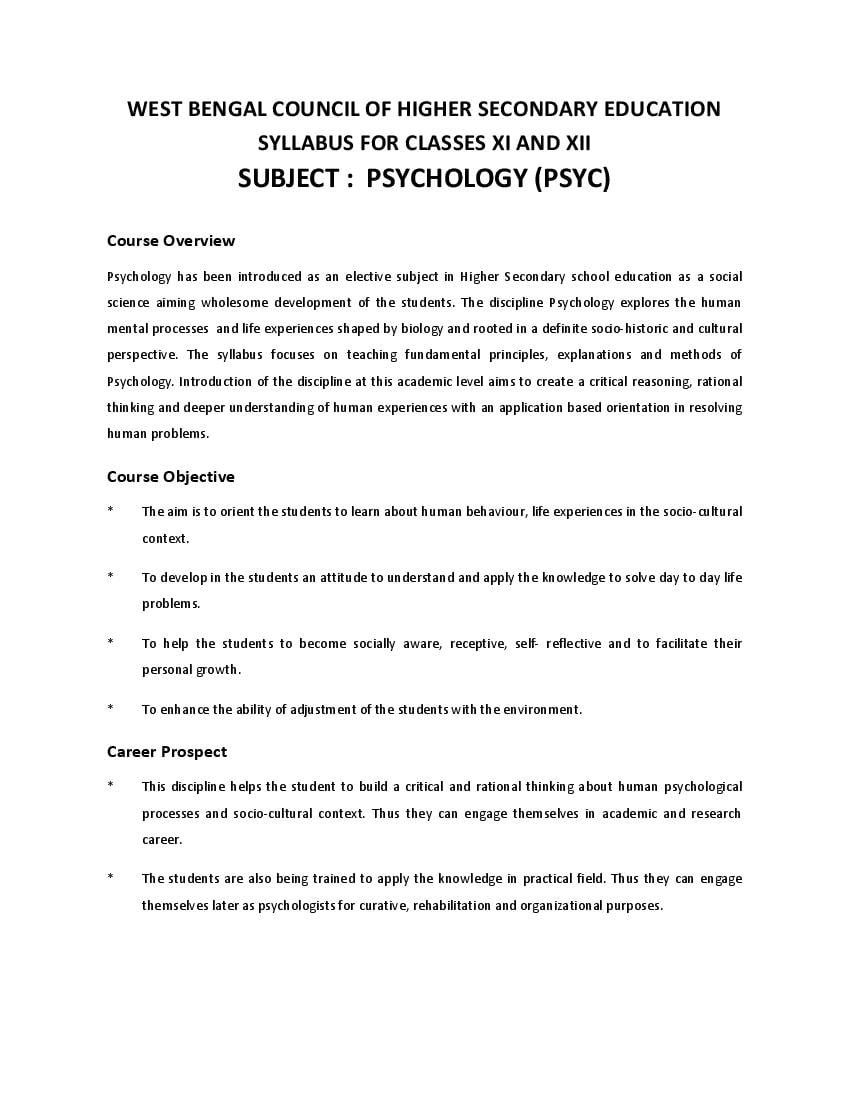
SYLLABUS FOR CLASSES XI AND XII
Course Overview
Psychology has been introduced as an elective subject in Higher Secondary school education as a social
science aiming wholesome development of the students. The discipline Psychology explores the human
mental processes and life experiences shaped by biology and rooted in a definite socio-historic and cultural
perspective. The syllabus focuses on teaching fundamental principles, explanations and methods of
Psychology. Introduction of the discipline at this academic level aims to create a critical reasoning, rational
thinking and deeper understanding of human experiences with an application based orientation in resolving
human problems.
Course Objective
* The aim is to orient the students to learn about human behaviour, life experiences in the socio-cultural
context.
* To develop in the students an attitude to understand and apply the knowledge to solve day to day life
problems.
* To help the students to become socially aware, receptive, self- reflective and to facilitate their
personal growth.
* To enhance the ability of adjustment of the students with the environment.
Career Prospect
* This discipline helps the student to build a critical and rational thinking about human psychological
processes and socio-cultural context. Thus they can engage themselves in academic and research
career.
* The students are also being trained to apply the knowledge in practical field. Thus they can engage
themselves later as psychologists for curative, rehabilitation and organizational purposes.
Page 2
SEMESTER – I
FULL MARKS : 35 CONTACT HOURS : 70 Hours
COURSE CODE : THEORY
Sub-topics
UNIT TOPICS CONTACT HOURS MARKS
No.
Unit – 1 What is Psychology 10 hours 07
i) Introduction contact hours for sub-topics
ii) Definition and scope of Psychology ( 1+1 + 3+ 2+2+1)
Psychology as a discipline and its evolution
Psychology as natural and social science
iii) Understanding mind and behaviour
iv) Psychology in India
v) Branches in Psychology
vi) Relevance of psychology in everyday life
Unit – 2 Methods of enquiry in Psychology 10 hours 07
i) Introduction contact hours for sub-topics
ii) Steps in conducting scientific research ( 1+1+4+2+2)
iii) Methods of Psychology with advantages and
limitations, Quantitative and qualitative methods,
Observation,
. Experimentation,
. Correlational research,
. Survey research,
. Interview
. Case study
iv) Psychological testing,
v) Ethical Issues
Unit – 3 Bases of Human Behaviour 20 hours 07
i) Introduction contact hours for sub-topics
ii) Evolutionary perspective (1+2+3+8+6 )
iii) Biological bases of behaviour,
Structure and functions of neuron
iv) Classification of Nervous system - Structure and
functions
v) Endocrine system and its relation with behaviour
and experience
Page 3
No.
Unit – 4 Sensory, Attentional and Perceptual processes 20 hours 07
i) Introduction contact hours for sub-topics
ii) Types of senses - Visual, auditory, olfactory, ( 1+6+2+7+2+2)
tactual, gustatory
Special senses
Organic senses - visceral, motor
Other senses - kinaesthetic, vestibular
iii) Attentional process
Determinants of attention, shift, fluctuation,
oscillation, selective and sustained attention
iv) Perception
Perceptual Process, Principles of perception,
. Perception of space, depth, distance, motion,
. monocular and binocular cues
v) Illusion, types of illusions
vi) Social and cultural influences on perception
Unit – 5 Thinking 10 hours 07
i) Introduction contact hours for sub-topics
ii) Nature of thinking ( 1+1+1+3+2+2)
Building blocks of thought
iii) Culture and thinking
iv) The process of thinking
Problem solving, Reasoning, Decision making
v) Nature and process of creative thinking
vi) Thought and language
Page 4
SEMESTER – II
FULL MARKS : 35 CONTACT HOURS : 70 Hours
COURSE CODE : THEORY
Sub-topics
UNIT TOPICS CONTACT HOURS MARKS
No.
Unit – 6 Human Development 15 hours Consult
i) Introduction contact hours for sub-topics Question
ii) Meaning of development (1+2+1+3+6+2 ) Pattern to be
Concept of growth, maturation and evolution published by the
iii) Lifespan perspective on development Council
iv) Factors influencing development(Heredity &
Environment)
v) Overview of developmental stages -
. Prenatal development,
. Infancy( Motor, Cognitive, Socio-emotional),
. Childhood, ( Motor, Cognitive,
Socio-emotional)
. Adolescence and its challenges, ( Physical,
Moral, Cognitive)
vi) Adulthood and Old age
Unit – 7 Learning 20 hours
i) Introduction contact hours for sub-topics
ii) Nature of Learning ( 1+2+12+2+2+1)
iii) Paradigms of learning
. Classical conditioning - Pavlov
. Instrumental conditioning - Skinner
. Observational learning
. Cognitive learning
. Verbal learning
Skill learning
iv) Transfer of learning
v) Factors facilitating learning
vi) Learning disabilities
Page 5
No.
Unit – 8 Human Memory 15 hours
i) Introduction contact hours for sub-topics
ii) Nature of memory (1+1+2+2+2+1+2+3+1)
iii) Information processing approach: the stage
model
iv) Memory systems: Sensory, short term and
long term memories
v) Types of long term memory - declarative,
procedural, episodic and semantic
vi) Levels of processing
vii) Forgetting - concept, nature, causes
viii) Theories of forgetting - .Trace,
. decay,
. Interference and retrieval failure
ix) Enhancing memory
Unit – 9 Motivation 10 hours
i) Introduction contact hours for sub-topics
ii) Nature of motivation ( 1+1+3+3+2)
iii) Types of motives -
Biological, psychological, social
iv) Maslow’s hierarchy of needs
v) Extrinsic and intrinsic motivation –
Differences with examples
Unit – 10 Emotion 10 hours
i) Introduction contact hours for sub-topics
ii) Nature of emotions (1+1+4+2+2)
iii) Expression of emotion -
Emotional expression and labelling
Culture and emotion
iv) Managing negative emotions
vi) Enhancing positive emotions
Page 6
SEMESTER – II
FULL MARKS : 30 CONTACT HOURS : 40 Hours
COURSE CODE : PRACTICAL
Sub-topics
1 Compare the rate of perceptual reversibility 7 hours
between two respondents using visual stimulus
( Rubin’s Cross/human profile-Flower vase) and
interpret the result.
2 Compare the responses of three respondents to 7 hours
optical illusory figures (Muller- Lyer) and interpret
the result
3 Compare the rate of learning of two respondents 8 hours
varying modality (auditory & visuals) and interpret
the result
4 Determine the effect of meaning on memorization 8 hours
capacity of the respondent
PROJECT 10 hours
1) Biological bases of Behaviour (Neuron, spinal
cord, Brain and endocrine glands) - File work
on above mentioned topic explaining structure
and functions with diagrams.
[ Note : 20 Hours reserved for Remedial classes, Tutorials and Home Assignments.]
Page 7
Topics Marks
Practical Problem 10
Project 10
Practical File 5
Viva voce 5
Distribution of Marks in Theory (Total 35+35=70)
Semester I
Type of Question Allotted Marks Marks Pattern
MCQ 35 1 x 35
Total = 35
Semester II
Types of Question Allotted Marks Marks Pattern
SAQ 6 2x3
LAQ 9 3x3
LAQ 8 4x2
LAQ 12 6X2
Total = 35
Page 8
SEMESTER – III
FULL MARKS : 35 CONTACT HOURS : 70 Hours
COURSE CODE : THEORY
Sub-topics
UNIT TOPICS CONTACT HOURS MARKS
No.
Unit – 1 Variations in Psychological attributes 20 hours 09
i) Introduction contact hours for sub-topics
ii) Individual differences in human functioning ( 1+1+3+4+2+4+2+2+1)
iii) Assessment of psychological attributes - different
domains- intelligence, aptitude, interest,
personality, values
iv) Methods of assessments - Psychological test,
interview, observetion, case study, self report
v) Intelligence - Concept
vi) Theories of intelligence - .Spearman’s two-factor
theory,
. Guilford’s structure of intellect model,
. Gardner’s Multiple intelligences, .
. Sternberg’s Triarchic theory of intelligence,
. Pass Model by Das
vii) . Individual difference in intelligence with special
reference to normal probability curve -
. Concept of IQ and categories of intellectual
ability with special reference to Weschler.
viii) Classification of Intelligence test
ix) . Emotional intelligence - Concept by Salovey and
Mayer, Goleman
x) Creativity
Page 9
No.
Unit – 2 Social Influence and Group Processes 15 hours 09
i) Introduction contact hours for sub-topics
ii) Group - Concept and characteristics ( 1+2+2+1+2+4+3)
iii) Types of groups
iv) Why do people join groups
v) Formation of group - Factors and stages of group
formation
vi) Influence of group on individual behaviour -
. Social Facilitation, .social Loafing,
. Group Polarization
vii) Process of social influences - .Conformity,
. Compliance, .Obedience
Unit – 3 Identity Development 10 hours 08
i) Introduction contact hours for sub-topics
ii) Identity - concept ( 1+1 + 3+ 2+2+1)
iii) Identity development - Erikson’s theory of psycho-
social development.
iv) Identity crisis - Theory of Erikson and Marcia
v) Factors influencing identity development
Unit – 4 Meeting life challenges 25 hours 09
i) Introduction contact hours for sub topics
ii) Nature, types and sources of Stress ( 2+6+6+2+4)
iii) Effect of Stress
. General adaptation syndrome
. Stress and immune system
. Lifestyle
iv) Coping with stress -
. Stress management techniques
v) Promoting positive health and wellbeing -
. Life skills,
. positive health
Page 10
SEMESTER – IV
FULL MARKS : 35 CONTACT HOURS : 70 Hours
COURSE CODE : THEORY
Sub Topics
UNIT TOPICS CONTACT MARKS
No. HOURS
Unit – 5 Attitude and Social Cognition 12 hours Consult
i) Introduction contact hours for Question
ii) Explaining social behaviour - .Social Cognition, sub-topics Pattern to be
. Schemas and ( 1+3+2+4+3+1) published by
. Different pro-social behaviour the Council
iii) Nature and components of attitude: A-B-C
components
iv) Attitude formation and change -
. Attitude formation, .Attitude change,
. Attitude -behaviour relationship
v) Prejudice,Stereotype and Discrimination
vi) Strategies for handling prejudice
Unit – 6 Self and Personality 15 hours
i) Introduction contact hours for
ii) Self and Personality - .concepts of Self - Personal and sub-topics
Social self ( 1+2+3+1+2+4+2)
iii) Cognitive and Behavioural aspects of self -
. Self concept, . Self esteem, .Self efficacy,
. Self regulation
iv) Culture and Self
v) Concept and characteristics of personality
vi) Major approaches to the study of personality -
. Type approaches, .Trait approaches,
. Psychodynamic approach,
. Behavioural approach,
. Humanistic approach
vii) Assessment of Personality - .Self report Measures,
Projective Techniques,
Behavioural Analysis
Page 11
No. HOURS
Unit – 7 Psychological Disorders 25 hours
i) Introduction contact hours for
ii) Concept of Abnormality and Psychological Disorder sub-topics
. Classification of Psychological Disorders ( 1+3+6+15)
(ICD 11 & DSM V)
iii) Factors underlying abnormal behaviour -
. Biological,
. Psychological and
. Socio-economic
iv) Major Psychological Disorders -
. Anxiety Disorders,
. Obsessive -compulsive and Related Disorders,
. Somatic symptoms and related disorders,
. Dissociative disorders,
. Depressive disorders,
. Bipolar and related disorders,
. Schizophrenia spectrum and other psychotic
disorders,
. Neuro-developmental disorders,
. Disruptive, Impulse control and Conduct disorders
. Substance related and Addictive disorders
Unit – 8 Therapeutic approaches 18 hours
i) Introduction contact hours for
ii) Nature and process of Psychotherapy sub-topics
iii) Therapeutic Relationship ( 1+2 + 2+ 10+2+1)
iv) Types of Therapies -
. Psychodynamic Therapy
. Behaviour Therapy
. Cognitive Therapy
. Humanistic - Existential Therapy
. Alternative Therapies - Kriya Yoga
v) Ethics in Psychotherapy
vi) Rehabilitation
Page 12
SEMESTER – IV
FULL MARKS : 30 CONTACT HOURS : 40 Hours
COURSE CODE : PRACTICAL
Sub-topic
1 Students will administer and interpret any one Intelligence Test from the 10 hours
following.
. Intelligence Tests -Alexander Pass along test/ Dearborn Form Board Test
2 Students will administer and interpret Academic Stress Scale [Educational 10 hours
Stress Scale for Adolescents -(ESSA ) by Sun, Dunne, Xiang-yu Hou and Xu]
This test should be administered on two participants to compare and
interpret the results.
3 Students will administer and interpret any one Personality Test from the 10 hours
following.
Personality tests - Kundu Neurotic Personality Inventory-KNPI/ Kundu
Introversion Extroversion Inventory -KIEI
PROJECT 10 hours
Development of a comparative case study using General health
questionnaire of male and female participants.
[ Note : 20 Hours reserved for Remedial classes, Tutorials and Home Assignments.]
Page 13
Topics Marks
Practical Problem 10
Project 10
Practical File 5
Viva Voce 5
Distribution of Marks in Theory (Total 35+35=70)
Semester III
Type of Question Allotted Marks Marks Pattern
MCQ 35 1 x 35
Total = 35
Semester IV
Types of Question Allotted Marks Marks Pattern
SAQ 6 2x3
LAQ 9 3x3
LAQ 8 4x2
LAQ 12 6X2
Total = 35
Document Details
| Board / Org | West Bengal Board |
| Exam | Class 11 |
| Type | Syllabus |
| Pages | 13 |
| Updated | 22 Jul 2026 |