ACET 2021 Answer Key (Jan)
Finished viewing? Save it for later —
Download ACET 2021 Answer Key (Jan) (PDF · 11 pages)About ACET 2021 Answer Key (Jan)
ACET 2021 Answer Key (Jan) is available here for free download. Published by Actuaries India for ACET, this answer key can be viewed online or downloaded as a PDF (11 pages). Candidates preparing for ACET can use ACET 2021 Answer Key (Jan) to understand the exam pattern, the type of questions asked, and the overall difficulty level.
Frequently Asked Questions
How can I download ACET 2021 Answer Key (Jan)?
Open this page and click the Download button to save ACET 2021 Answer Key (Jan) as a PDF. It is completely free on AglaSem Docs.
Is ACET 2021 Answer Key (Jan) free to download?
Yes. ACET 2021 Answer Key (Jan) can be viewed online and downloaded as a PDF free of cost on AglaSem Docs.
How many pages does ACET 2021 Answer Key (Jan) have?
ACET 2021 Answer Key (Jan) contains 11 pages, which you can read online or download together as a single PDF.
Where can I find more ACET study material?
You can find more ACET question papers, sample papers, syllabus, and answer keys on AglaSem Docs.
ACET 2021 Answer Key (Jan) – Text
Read the full text of this answer key below — useful to quickly search, copy and reference the content online without downloading the PDF.
📄 View text version (11 pages)
Page 1
ACET January 2021 Solutions
Mathematics
×
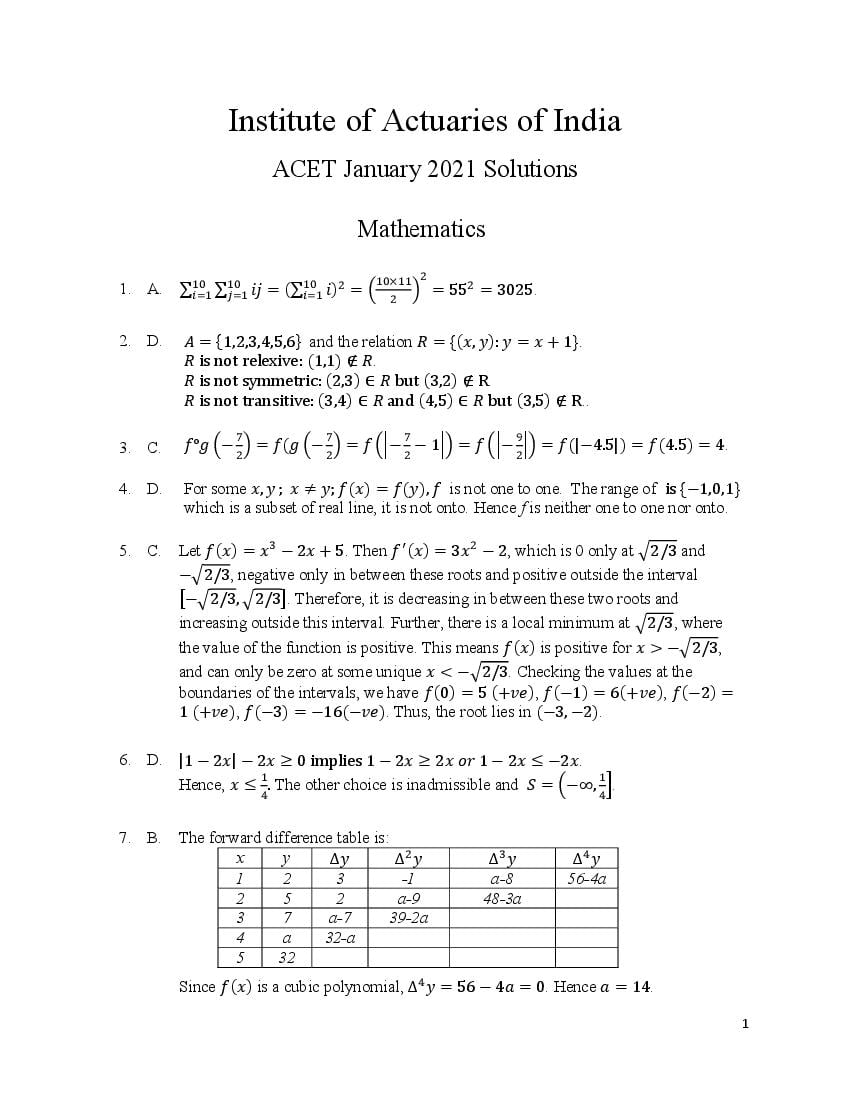
1. A. ∑ ∑ 𝑖𝑗 = (∑ 𝑖) = = 55 = 3025.
2. D. 𝐴 = {1,2,3,4,5,6} and the relation 𝑅 = {(𝑥, 𝑦): 𝑦 = 𝑥 + 1}.
𝑅 is not relexive: (1,1) ∉ 𝑅.
𝑅 is not symmetric: (2,3) ∈ 𝑅 but (3,2) ∉ R.
𝑅 is not transitive: (3,4) ∈ 𝑅 and (4,5) ∈ 𝑅 but (3,5) ∉ R..
3. C. 𝑓°𝑔 − = 𝑓(𝑔 − =𝑓 − −1 =𝑓 − = 𝑓(|−4.5|) = 𝑓(4.5) = 4.
4. D. For some 𝑥, 𝑦 ; 𝑥 ≠ 𝑦; 𝑓(𝑥) = 𝑓(𝑦), 𝑓 is not one to one. The range of is {−1,0,1}
which is a subset of real line, it is not onto. Hence f is neither one to one nor onto.
5. C. Let 𝑓(𝑥) = 𝑥 − 2𝑥 + 5. Then 𝑓 (𝑥) = 3𝑥 − 2, which is 0 only at 2/3 and
− 2/3, negative only in between these roots and positive outside the interval
− 2/3, 2/3 . Therefore, it is decreasing in between these two roots and
increasing outside this interval. Further, there is a local minimum at 2/3, where
the value of the function is positive. This means 𝑓(𝑥) is positive for 𝑥 > − 2/3,
and can only be zero at some unique 𝑥 < − 2/3. Checking the values at the
boundaries of the intervals, we have 𝑓(0) = 5 (+𝑣𝑒), 𝑓(−1) = 6(+𝑣𝑒), 𝑓(−2) =
1 (+𝑣𝑒), 𝑓(−3) = −16(−𝑣𝑒). Thus, the root lies in (−3, −2).
6. D. |1 − 2𝑥| − 2𝑥 ≥ 0 implies 1 − 2𝑥 ≥ 2𝑥 𝑜𝑟 1 − 2𝑥 ≤ −2𝑥.
Hence, 𝑥 ≤ . The other choice is inadmissible and 𝑆 = −∞, .
7. B. The forward difference table is:
x y ∆𝑦 ∆ 𝑦 ∆ 𝑦 ∆ 𝑦
1 2 3 -1 a-8 56-4a
2 5 2 a-9 48-3a
3 7 a-7 39-2a
4 a 32-a
5 32
Since 𝑓(𝑥) is a cubic polynomial, ∆ 𝑦 = 56 − 4𝑎 = 0. Hence 𝑎 = 14.
1
Page 2
𝛼 + 𝛽 = 5 (given). Further, 𝛼 + 𝛽 = −𝑏, 𝛼𝛽 = −2.
𝛼 + 𝛽 = (𝛼 + 𝛽) − 2𝛼𝛽 = 5; Hence 𝑏 = ±1.
9. B. 𝑇 = − = − 𝑥 .
When 3𝑟 − 9 = 0, or 𝑟 = 3 in 𝑇 , we get the constant term,
which is − .
10. D. Let 𝑦 = 16 . Then 𝑦 + = 10, i.e., 𝑦 − 10𝑦 + 16 = 0, i.e., 𝑦 = 2 or 8.
Therefore, log 𝑦 = 4 sin 𝑥 = 1 or 3. Since sin 𝑥 cannot be negative in the range
√
0 < 𝑥 < 𝜋, it follows that sin 𝑥 = or . The solutions in the given range are 𝑥 =
and 𝑥 = . Hence tan 𝑥 = or √3.
√
11. B. Put = , then as 𝑥 → ∞, 𝑦 → 0.
Hence, lim , which has the form.
→
By L Hopital′s rule, lim = −2.
→
12. A. 𝑦 = (log x) implies log y = cos 𝑥 log (log 𝑥).
= cos 𝑥 + log ( log 𝑥) (− sin 𝑥).
Hence, = (log x) cos 𝑥 − sin 𝑥 log (log 𝑥) .
13. C. 𝑓 (𝑥) = 2𝑥 − 1. Hence, 𝑓 (𝑥) = 0 => 𝑥 = .
It is seen that for 𝑥 ∈ −1, , 𝑓 (𝑥) < 0 and 𝑥 ∈ , 1 , 𝑓 (𝑥) > 0 .
Hence, 𝑓(x) is neither increasing nor decreasing in(−1,1) .
14. B. = + ⇒ 𝑥 = 𝑀(𝑥 + 2) + 𝑁(𝑥 + 1).
( )( )
⇒ 𝑀 = −1 and 𝑁 = 2.
( )
∫( )( )
𝑑𝑥 = ∫ 𝑑𝑥 + ∫ 𝑑𝑥
( )
= − log |𝑥 + 1| + 2 log |𝑥 + 2| + 𝐶 = log | |
+𝐶 .
2
Page 3
−1 2
𝑦2 𝑦2 5
=∫ 𝑑𝑥 + ∫ 𝑑𝑥 = ∫ −𝑦𝑑𝑦 + ∫ 𝑦𝑑𝑦 = + = .
2 0 2 0 2
16. D. 𝑎⃗ + 𝑏⃗ − 𝑎⃗ − 𝑏⃗ = 4𝑎.⃗ 𝑏⃗ implies 29 − 𝑎⃗ − 𝑏⃗ = 20.
Thus 𝑎⃗ − 𝑏⃗ = 9, giving 𝑎⃗ − 𝑏⃗ = 3.
17. A. The area of the parallelogram is the magnitude of the vector
𝑖⃗ 𝑗⃗ 𝑘⃗
𝑎⃗ × 𝑏⃗ = 1 −1 3 = (−1 + 21)𝑖⃗ − (1 − 6)𝑗⃗ + (−7 + 2)𝑘⃗ = 20𝑖⃗ + 5𝑗⃗ − 5𝑘⃗.
2 −7 1
𝑎⃗ × 𝑏⃗ = 20 + 5 + (−5) = √450 = 15√2 sq. units.
18. C. When 𝑃 is multiplied by 𝑘, every summand in the expression of the determinant
gets multiplied by 𝑘 .
19. B. Since |𝑀| ≠ 0 , 𝑀 exits, Hence 𝑀 − 𝑀 + 𝐼 = 0 implies
𝑀 − 𝑀 + 𝑀𝑀 = 0.
Thus, 𝑀(𝑀 − 𝐼 + 𝑀 ) = 0 giving 𝑀 = 𝐼 − 𝑀.
cos 𝑥 − sin 𝑥 0 cos 𝑦 − sin 𝑦 0
20. C. 𝑃(𝑥)𝑃(𝑦) = sin 𝑥 cos 𝑥 0 sin 𝑦 cos 𝑦 0
0 0 1 0 0 1
cos 𝑥 cos 𝑦 − sin 𝑥 sin 𝑦 – cos 𝑥 sin 𝑦 − sin 𝑥 cos 𝑦 0
= sin 𝑥 cos 𝑦 + cos 𝑥 sin 𝑦 – sin 𝑥 sin 𝑦 + cos 𝑥 cos 𝑦 0
0 0 1
cos(𝑥 + 𝑦) − sin( 𝑥 + 𝑦) 0
= sin(𝑥 + 𝑦) cos(𝑥 + 𝑦) 0 = 𝑃(𝑥 + 𝑦).
0 0 1
3
Page 4
21. B. Number of students opted Mathematics only = 28 − 22 = 6.
Number of students opted Biology only = 30 − 22 = 8.
Number of students opted neither Mathematics nor Biology
= 56 – (6 + 8 + 22) = 20.
The required probability = 20/56 = 5/14.
22. A. The number of ways, the man can visit the cities is 4! = 24.
The possible cases that the man visits 𝐶 before 𝐶 and 𝐶 before 𝐶 are 𝐶 𝐶 𝐶 𝐶 ,
𝐶 𝐶 𝐶 𝐶 ,𝐶 𝐶 𝐶 𝐶 ,𝐶 𝐶 𝐶 𝐶 .
The number of cases favourable to the event is 4.
The required probability = 4/24 = 1/6.
23. C. 𝑃(𝐴 ∪ 𝐵 ) = 1 − 𝑃(𝐴 ∩ 𝐵) = 1 − 𝑃(𝐵) − 𝑃(𝐴 ∩ 𝐵 ) = 1 − − = .
24. D. 𝑃(𝐸|𝐹) > 𝑃(𝐸)
( ∩ )
⇒ > 𝑃(𝐸) ⇒ 𝑃(𝐸 ∩ 𝐹) > 𝑃(𝐸)𝑃(𝐹) ⇒ 𝑃(𝐹|𝐸) > 𝑃(𝐹).
( )
25. B. 𝑃(𝐴 ∪ 𝐴 ∪ 𝐴 ) = 1- 𝑃(𝐴 ∩ 𝐴 ∩ 𝐴 )
Since 𝐴 , 𝐴 , 𝐴 are independent, 𝐴 , 𝐴 , 𝐴 are also independent.
𝑃(𝐴 ∩ 𝐴 ∩ 𝐴 ) = 𝑃(𝐴 )𝑃(𝐴 )𝑃(𝐴 ) = 1 − 1− 1− = .
𝑃(𝐴 ∪ 𝐴 ∪ 𝐴 ) = 1 − = .
26. C. The probability that the man speaks truth is 0.80.
Let 𝐸 be the event that the man reports that the number occur is more than 4 in the
throwing of the die.
𝐸 = the event that the number occurs is more than 4.
𝐸 = number occurs is less than or equal to 4.
𝑃(𝐸 ) = = . 𝑃(𝐸 ) = = .
𝑃(𝐸|𝐸 ) = 0.80, 𝑃(𝐸|𝐸 ) = 0.20.
𝐸𝐸 ( )
𝑃(𝐸 |𝐸) = .
𝐸𝐸 ( ) ( ) 𝐸𝐸
𝑃(𝐸|𝐸 )𝑃(𝐸! ) + 𝑃(𝐸|𝐸 )𝑃(𝐸 ) = 0.80 × + 0.20 × = 0.4.
. ×
So 𝑃(𝐸! |𝐸) = = .
.
27. D. Median = (20th observation + 21st observation)/2 = (50+53)/2 = 51.5.
4
Page 5
𝑉𝑎𝑟(𝑦) = 𝑉𝑎𝑟(𝑥) = ∑ 𝑥 − ∑ 𝑥 = ∑ 𝑥 − ∑ 𝑥 = − .
29. B. The mean earning per worker of the whole organization is
× × ×
= = 16250.
(Alternatively, average salary of 100 employees in 𝐷 and 𝐷 is =
14000. Therefore, average salary of 200 employees in the whole organization is
= 16250.)
30. D. Weights in Kg Number of Cumulative
persons frequency
35.5 – 40.5 8 8
40.5 – 45.5 12 20
45.5 – 50.5 25 45
50.5 – 55.5 40 85
55.5 – 60.5 45 130
60.5 – 65.5 60 190
65.5 – 70.5 46 236
70.5 – 75.5 12 248
75.5 – 80.5 2 250
From the frequency distribution, it is clear that = 125, and the median class is
55.5 – 60.5.
Modal class is 60.5 – 65.5. The mode is not 60.5.
The values on the left side are more spread out than those on the right side, and
hence the distribution is negatively skewed. So the coefficient of skewness would
be negative.
5
Page 6
measurement.
If each observation is increased by 5, range remains same, that is 20.
If each observation is multiplied by -3, then the new maximum value is -3 times the
earlier minimum value and the new minimum value is -3 times the earlier maximum
value. Therefore, range becomes 3 × 20 = 60.
If each observation is multiplied by 3 and then 5 added to it, then range becomes
3 × 20 = 60.
If each observation is multiplied by 5 and then 3 subtracted from it, then range
becomes 5× 20 = 100.
32. A. The probability mass function of 𝑋 is 𝑃(𝑋 = 𝑥) = , 𝑥=
7, 12, 15, 20, 23, 25, 30.
( )
𝑃(𝑋 > 18|𝑋 < 26) = =
( )
( ) ( ) ( )
( ) ( ) ( ) ( ) ( ) ( )
= = .
33. D. 𝑝 = probability that an item is defective = 5/25 = 1/5 = 0.2
Let 𝑋 be the number of defective items in a sample of 4 items selected from a lot.
𝑋 ∼ Binomial(4, 0.2).
Probability that he accepts a lot is 𝑃(𝑋 = 0) = 0.8 = 0.4096.
34. C. 𝑋 ∼ Poisson(𝜆). 𝑃(𝑋 = 1) = 𝑃(𝑋 = 2) ⇒ 𝜆𝑒 = 𝑒 ⇒ 𝜆 = 2.
𝑝 = Probability that a page contains at most one misprint is
𝑃(𝑋 ≤ 1) = 𝑃(𝑋 = 0) + 𝑃(𝑋 = 1) = 𝑒 + 2𝑒 = 3𝑒 .
Let 𝑌 be the number of pages containing at most one misprint. 𝑌 ∼
Binomial(500, 𝑝).
Expected number of pages with at most one misprint is 500 × 3𝑒 = 1500𝑒 .
( )
35. B. 𝑓(𝑥) = 𝜆𝑒 , 𝑥 ≥ 𝛼 Therefore 𝐸(𝑋) =
∫ 𝑥 𝜆𝑒 ( )
𝑑𝑥 = ∫ 𝜆(𝑢 +
0, 𝑥 < 𝛼
𝛼)𝑒 𝑑𝑢 = ∫ 𝜆𝑢𝑒 𝑑𝑢 + 𝛼 ∫ 𝜆𝑒 𝑑𝑢 = + 𝛼 = .
36. B. 𝑋 ∼ 𝑁(20, 2 ). 90th percentile of 𝑋 is 𝑥 . .
𝑃(𝑋 ≤ 𝑥 . ) = 0.90 ⇒ 𝑃 ≤ . = 0.90 ⇒ 𝑃 𝑍 ≤ .
= 0.90,
𝑍 ∼ 𝑁(0, 1). Given 90th percentile of 𝑍 is 1.65. So .
= 1.65. ⇒ 𝑥 . =
23.3. Thus, 90th percentile of 𝑋 is 23.3.
6
Page 7
( √ )
𝐸(𝑋) = ∫ 𝑑𝑥 = 0. 𝜇 = 𝐸 𝑋 − 𝐸(𝑋) = 𝐸(𝑋 ) = ∫ 𝑑𝑥 = 0
Skewness = 0.
(Alternatively, since the density is symmetric about 0, the skewness is 0.)
38. A. x 1 2 Total
y
0 0.4 + 𝑝 0.3 − 𝑝 0.7
1 0.3 − 𝑝 𝑝 0.3
Total 0.7 0.3 1
𝐸(𝑋) = 1 × 0.7 + 2 × 0.3 = 1.3.
𝐸(𝑌) = 0 × 0.7 + 1 × 0.3 = 0.3 .
𝐸(𝑋𝑌) = 1 × 0 × (0.4 + 𝑝) + 2 × 0 × (0.3 − 𝑝) + 1 × 1 × (0.3 − 𝑝) + 2 × 1 ×
𝑝 = 0.3 + 𝑝.
Cov(X, Y) = 0.3 + 𝑝 − 1.3 × 0.3 = 𝑝 − 0.09.
𝑉𝑎𝑟(𝑋) = 𝑉𝑎𝑟(𝑋 − 1) = 0.7 × 0.3 = 0.21.
𝑉𝑎𝑟(𝑌) = 0.7 × 0.3 = 0.21.
. .
Correlation Corr(X, Y)= = .
√ . × . .
Corr(X, Y) =0.1 ⇒ 𝑝 = 0.111.
39. A. 𝑈 = 𝑎𝑋 + 𝑏 and 𝑉 = 𝑐𝑌 + 𝑑. Correlation coefficient between 𝑋 and 𝑉 𝑖𝑠 𝜌 =
( , )
.
( ) ( )
𝐶𝑜𝑣(𝑋, 𝑉) = 𝐶𝑜𝑣(𝑋, 𝑐𝑌 + 𝑑) = 𝑐 𝐶𝑜𝑣(𝑋, 𝑌), 𝑉𝑎𝑟(𝑉) = 𝑐 𝑉𝑎𝑟(𝑌)
( , )
So 𝜌 = = 𝜌 If 𝑐 > 0, 𝜌 = 𝜌 .
( ) ( ) | |
40. C. Two regression lines are 4𝑥 − 5𝑦 + 𝑐 = 0 and 20𝑥 − 9𝑦 − 𝑑 = 0.
First identify the regression of 𝑦 on x and the regression of 𝑥 on 𝑦.
The product of the slopes of the regression lines is 𝑟 , which should be less than 1.
Hence, the identification of regression lines with both the slopes greater than 1 must
be incorrect, and the one with both the slopes less than 1 must be correct. Therefore,
first equation is regression of 𝑦 on 𝑥. 𝑦 = 𝑥 + ;
second equation is regression of 𝑥 on y. 𝑥 = 𝑦+ .
𝑏 = . 𝑏 = .
𝑟 = × = . So 𝑟 =
( ) ( ) ( )
Now 𝑏 =𝑟× ⇒ = × ⇒ ( )
= .
( ) ( )
7
Page 8
41. C. Number of candidates obtained marks 60 and above is 120.
Total number of candidates is 250
So the number of candidates who have scored less than 60 is 250 − 120 = 130.
42. D. The number of candidates passed the examination is 200.
Percentage of candidates passed of the examination is (200/250) × 100 = 80.
43. D. The annual percentage increase is the largest when the ratio of numbers of
candidates in consecutive years is the largest. These ratios for the successive years
. . . . . .
are = 1.015, = 1.022, = 1.029, = 1.021, = 1.035, =
. . . . . .
. .
1.034, = 1.045, = 1.019.
. .
.
The largest of the ratios is = 1.045, which occurs in 2017-18.
.
44. C. Male Female Total Percentage of Female
Year
(in lakhs) (in lakhs) (lakhs) candidates
2011 3.40 3.20 6.60 (3.20/6.60)*100 = 48.5
2012 3.38 3.32 6.70 (3.32/6.70)*100 = 49.6
2013 3.45 3.40 6.85 (3.40/6.85)*100 = 49.6
2014 3.53 3.52 7.05 (3.52/7.05)*100 = 49.9
2015 3.55 3.65 7.20 (3.65/7.20)*100 = 50.7
2016 3.60 3.85 7.45 (3.85/7.45)*100 = 51.7
2017 3.70 4.00 7.70 (4/7.7)*100 = 51.9
2018 3.85 4.20 8.05 (4.20/8.05)*100 = 52.2
2019 3.95 4.25 8.20 (4.25/8.20)*100 = 51.8
No need to calculate percentages for 2011-2014, where the number of male
candidates is more than that of female candidates. Percentages to be calculated from
2015 to 2019.
45. A. From 2011 -2014: number of male candidates is more than that of female
candidates. Annual difference of female and male candidates for the years 2015 -
2019 are as follows.
2015: 10000
2016: 25000
2017: 30000
2018: 35000
2019: 30000
8
Page 9
𝐹 𝐹 𝐹 𝐹
𝐼𝑉 𝐼𝐼 5 4
𝐼 6
𝑉𝐼𝐼 7
𝑉 3
𝑉𝐼 4
𝑉𝐼𝐼𝐼 𝐼𝐼𝐼 12 5
𝐹 𝐹
46. D. The number of students who liked exactly one type of food is 𝐼 + 𝐼𝐼 + 𝐼𝐼𝐼 =
6 + 4 + 5 = 15.
47. A. The number of students who liked 𝐹 and 𝐹 but not 𝐹 is the region 𝐼𝑉 = 5.
48. B. The number of students who liked 𝐹 or 𝐹 is 𝐼 + 𝐼𝐼𝐼 + 𝐼𝑉 + 𝑉 + 𝑉𝐼 +
𝑉𝐼𝐼𝐼 = 6 + 5 + 5 + 3 + 4 + 7 = 30.
49. B. (All calculations are in crores of rupees.)
Total export in 2010-11 is 5000.
Total export in 2011-12 is 5000 × 1.07 = 5350.
Export of P3 and P4 in 2010-11 is 5000(0.15 + 0.10) = 1250.
Export of P3 and P4 in 2011-12 is 5350(0.16 + 0.12) = 1498.
Total export of P3 and P4 in two years is 1250 + 1498 = 2748.
50. A. (All calculations are in crores of rupees.)
Total export of P1 and P2 in 2010-11 is 5000 − 1250 = 3750.
Total export of P1 and P2 in 2011-12 is 5350 − 1498 = 3852.
From 2010-11 to 2011-12, total export of the commodities P1 and P2 is increased
by (3852 − 3750) × 100/3750 = 102 × 100/3750 = 2.72%.
51. D. Sales decreased:
From 2007 to 2008,
From 2008 to 2009,
From 2010 to 2011,
From 2014 to 2015,
From 2017 to 2018.
9
Page 10
52. B.
53. A.
54. B.
55. D.
56. D.
57. A.
58. C.
59. C.
60. A.
61. C.
62. B.
10
Page 11
63. C.
64. B. The substitution code is:
R-7
U-5
B-8
B-8
E-9
R-7
Thus, RUBBER would be coded as 758897.
65. B.
66. D.
67. C. The cubes cut out from the corners will have three of their faces brown. Since there
are 8 corners for a cube, there will be 8 such cubes.
68. B. 1895 is not a leap year. So it will have 1 odd day.
Since 1896 is a leap year, it will add 2 odd days.
Similarly 1987, 1898, 1899, 1900 will add 1,1,1,1 odd days.
These odd days add up to 7.
So the following year (1901) will have the same calendar as 1895.
69. D. The original circular arrangement in clockwise manner is SDARPY. After the
exchanges, the arrangement is SYAPRD, in which S is to the left of D.
70. A. Suppose Aaquib is a Jhoota. Then the first statement means that Wasim is either a
Sachha or a Badla, and the second statement means that Imran is either a Badla or a
Sachha (but not the same as Wasim). There is no contradiction.
Suppose Wasim is a Jhoota. The first statement means that Aaquib is a Badla,
which means Imran must be a Sachha, and this contradicts the second statement.
Suppose Imran is a Jhoota. Then the second statement means that Wasim must be a
Sachha. Therefore Aaquib has to be a Badla, which contradicts the first statement.
Since only Aaqib can logically be a Jhoota, the correct option is A.
11
Document Details
| Board / Org | Actuaries India |
| Exam | ACET |
| Type | Answer Key |
| Pages | 11 |
| Updated | 09 Jun 2026 |