WBCHSE Class 11 Syllabus 2024 Science of Wellbeing
Finished viewing? Save it for later —
Download WBCHSE Class 11 Syllabus 2024 Science of Wellbeing (PDF · 8 pages)About WBCHSE Class 11 Syllabus 2024 Science of Wellbeing
WBCHSE Class 11 Syllabus 2024 Science of Wellbeing is available here for free download. Published by West Bengal Board for Class 11, this syllabus can be viewed online or downloaded as a PDF (8 pages). Candidates preparing for Class 11 can use WBCHSE Class 11 Syllabus 2024 Science of Wellbeing to understand the exam pattern, the type of questions asked, and the overall difficulty level.
Frequently Asked Questions
How can I download WBCHSE Class 11 Syllabus 2024 Science of Wellbeing?
Open this page and click the Download button to save WBCHSE Class 11 Syllabus 2024 Science of Wellbeing as a PDF. It is completely free on AglaSem Docs.
Is WBCHSE Class 11 Syllabus 2024 Science of Wellbeing free to download?
Yes. WBCHSE Class 11 Syllabus 2024 Science of Wellbeing can be viewed online and downloaded as a PDF free of cost on AglaSem Docs.
How many pages does WBCHSE Class 11 Syllabus 2024 Science of Wellbeing have?
WBCHSE Class 11 Syllabus 2024 Science of Wellbeing contains 8 pages, which you can read online or download together as a single PDF.
Where can I find more Class 11 study material?
You can find more Class 11 question papers, sample papers, syllabus, and answer keys on AglaSem Docs.
WBCHSE Class 11 Syllabus 2024 Science of Wellbeing – Text
Read the full text of this syllabus below — useful to quickly search, copy and reference the content online without downloading the PDF.
📄 View text version (8 pages)
Page 1
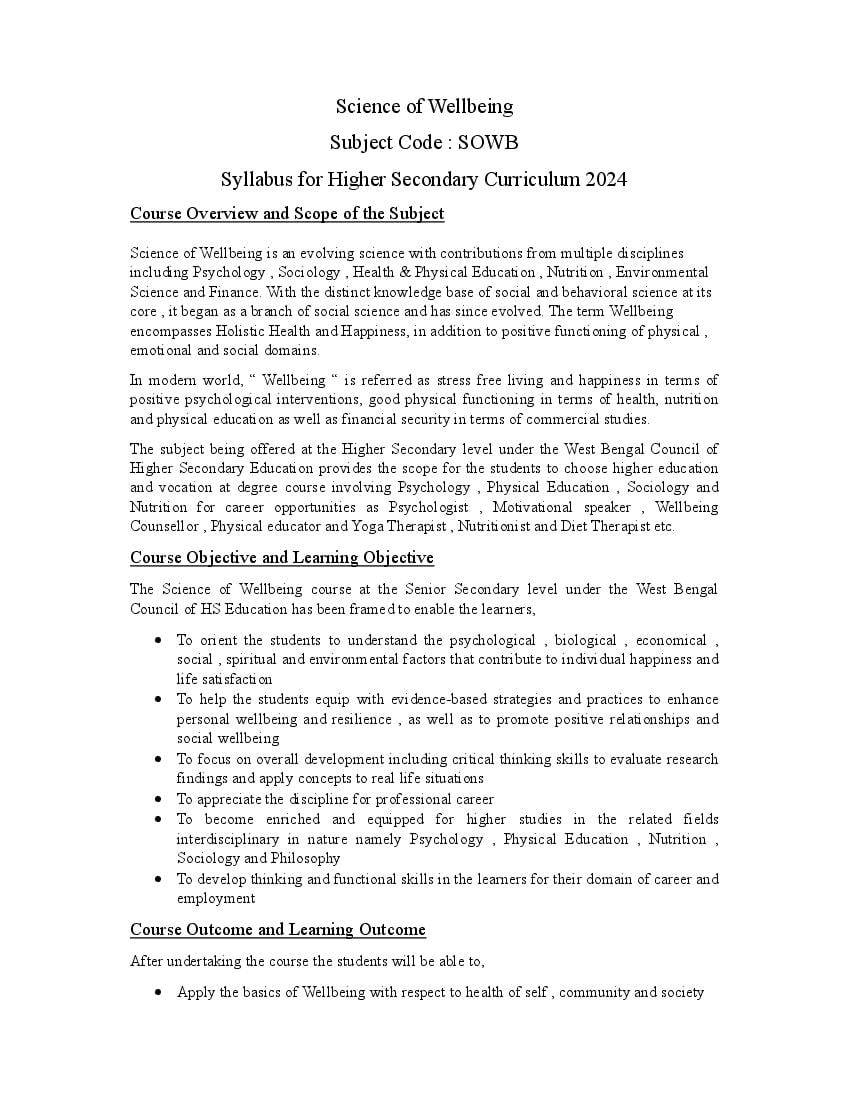
Subject Code : SOWB
Syllabus for Higher Secondary Curriculum 2024
Course Overview and Scope of the Subject
Science of Wellbeing is an evolving science with contributions from multiple disciplines
including Psychology , Sociology , Health & Physical Education , Nutrition , Environmental
Science and Finance. With the distinct knowledge base of social and behavioral science at its
core , it began as a branch of social science and has since evolved. The term Wellbeing
encompasses Holistic Health and Happiness, in addition to positive functioning of physical ,
emotional and social domains.
In modern world, “ Wellbeing “ is referred as stress free living and happiness in terms of
positive psychological interventions, good physical functioning in terms of health, nutrition
and physical education as well as financial security in terms of commercial studies.
The subject being offered at the Higher Secondary level under the West Bengal Council of
Higher Secondary Education provides the scope for the students to choose higher education
and vocation at degree course involving Psychology , Physical Education , Sociology and
Nutrition for career opportunities as Psychologist , Motivational speaker , Wellbeing
Counsellor , Physical educator and Yoga Therapist , Nutritionist and Diet Therapist etc.
Course Objective and Learning Objective
The Science of Wellbeing course at the Senior Secondary level under the West Bengal
Council of HS Education has been framed to enable the learners,
To orient the students to understand the psychological , biological , economical ,
social , spiritual and environmental factors that contribute to individual happiness and
life satisfaction
To help the students equip with evidence-based strategies and practices to enhance
personal wellbeing and resilience , as well as to promote positive relationships and
social wellbeing
To focus on overall development including critical thinking skills to evaluate research
findings and apply concepts to real life situations
To appreciate the discipline for professional career
To become enriched and equipped for higher studies in the related fields
interdisciplinary in nature namely Psychology , Physical Education , Nutrition ,
Sociology and Philosophy
To develop thinking and functional skills in the learners for their domain of career and
employment
Course Outcome and Learning Outcome
After undertaking the course the students will be able to,
Apply the basics of Wellbeing with respect to health of self , community and society
Page 2
Be satisfied to the different aspects of the subject and take informed career choices
related to it
Inculcate healthy life style and enable prevention of and management of diseases /
disorders
Relate to various topics of other interdisciplinary subjects like psychology , Health &
Physical Education , Nutrition and Sociology
Analyze and practice strategies and skills for Holistic Health , happiness , life
satisfaction and reduction in stress level.
Page 3
Contact Hours : 80
Sl Topics Marks Contact
No allotted Hours
Unit 1 : Concept of Holistic Health and Wellbeing in Education
1 What is the meaning of Holistic Health and Wellbeing. 10 3
Definition of Health and Wellbeing
2 What are the holistic ways of Wellbeing 3
3 Seven Components of Wellbeing ( Physical , Mental , Emotional , Social , 4
Spiritual , Financial , Environmental )
4 What is the difference between Holistic Health and Wellbeing 2
5 Implication od Wellbeing for the youth in the coming decade 2
6 Importance of Wellbeing in school ( Increasing academic achievement and 4
decreasing disciplinary problems )
7 Scope of vocationalization , internet and network , Artificial Intelligence for 4
enhancing Wellbeing
8 Wellbeing for restoring peace and equity in Education 2
Unit 2 : Concept of Physical Wellbeing
1 Indicators of Physical Wellbeing : Height , Weight . Muscle .Bone . Eye sight , 30 5
Heart , Kidney , Appetite , Gut health , BMI , Brocas Index
2 Food and Wellbeing - 12
Introduction to food , nutrients and Nutrition
Role of Nutrients in Physical Wellbeing
Basic food group for planning a balanced diet ( ICMR 4 food groups )
Healthy food pyramid guide , meal planning and pattern
3 Sleep and Wellbeing – Significance and problems related to sleep deprivation 4
4 Physical activity and Wellbeing - 6
Physical exercise ( Warming up , limbering down , conditioning ,
calisthenics , walking , Running , Aerobic and Anaerobic exercise )
Massage and Physiotherapy
5 Avioding risky behaviors – 8
Alarm Phase
Injury and first aid management
Dietary patterns affecting health ( Binging , snacking on fast food and
junk food , crash dieting , intermittent fasting and keto dieting )
6 Improving Physical Wellbeing through management – 21
Dietary Management : Role of high fiber and fermented food in gut
health , good fats for healthy heart and brain , supplements- Prebiotic ,
Probiotic , antioxidants and neutraceuticals , food for immunity , Role
of water and staying hydrated
Activity Management : Proper posture for physical exercises ,
recreations through physical movement and remedies for postural
deformities
Page 4
Contact Hours : 70
Sl Topics Marks Contact
No allotted Hours
Unit 3 : Concept of Mental Wellbeing
1 Indicators of Mental Wellbeing : Hope , Self-care , personal 20 9
responsibility , Positive relationship with others , Purpose in life ,
Productivity , Clarity of thinking , emotion , cognition
2 Stress and Wellbeing : Problems of depression , anxiety , burn-out , 8
cardiac dysfunction , muscle fatigue , insomnia
3 Risk factors in Mental illness : Genetic predispositions , homelessness 9
and unemployment , alcohol and other drug use , discrimination and
other racial injustice , family conflict and domestic violence , stressful
life events
4 Techniques for improving mental wellbeing : Effective , affordable and 9
feasible strategies to promote , protect and restore mental wellbeing-
Counselling , Psychotherapy , Assertiveness training , Relaxation
technique , Biofeedback
Unit 4 : Concept of Social Wellbeing
1 Indicators of SocialWellbeing :Poverty , Hunger , Quality Education , 20 8
Gender Equality , Equitable distribution of resources , clean water and
sanitation , Affordable clean energy , work opportunity
2 Life Skills :Self awareness , Interpersonal relationship , Interpersonal 9
communication , empathy and Quality of life.
Enhancing healthy social life style by developing life skills
3 Health Issues , Different life style disorders and related problems due to 9
poor social wellbeing : Heart ailment , mobility issues , high blood
pressure , raised stress hormone leading to inflammation , obesity ,
DiabetisMelitus , Cancer , Anxiety and Depression , poor immune
system
4 Ways of improving Social Wellbeing : Approaching friends and family 9
for support , Treating others with respect , Balancing own social and
personal time , Engaging in conflict resolution and softening barriers
Page 5
Total Marks – 20 [ 2 X 10 marks ]
Contact Hours :30
Project Report to be prepared on any two topics of your choice from the topics given below :
Body Mass Index (BMI) or Aerobic and Anaerobic Exercise ( 10 samples )
Food and Wellbeing or Importance of Balanced Diet
Behavioral Pattern of a well adjusted person based on the indicators of mental wellbeing
Socio – Economic factors affecting Wellbeing
Project topic may also be decided by the Subject teacher , not mentioned above
Extra 20 Hours would be kept aside for remedial classes and
practice sessions
Page 6
Contact Hours : 80
Sl Topics Marks Contact
No allotted Hours
Unit 1 : Concept of Environmental Wellbeing
1 Indicators of Environmental Wellbeing : Clean Air , Adequate water , 20 16
stable climate , healthy and safe workplace , protection from radiation
hazards , safe use of carcinogenic chemicals , health supportive
agricultural and industrial practices , conserving energy , Recycling and
reducing waste , checking soil erosion , pest and disease control
2 7 R’s for Environmental Wellness – Rethink , Refuse , Reduce , Repair , 8
Reuse , Recycle , Replace
3 Life Skills to ensure Environmental Wellbeing 16
By developing critical thinking , analytical thinking , decision
making , problem solving
By reducing emission of polluting gases , staying safe in the face
of global warming , reducing allergies , making home healthier
by using eco-friendly products , lowering screentime , replacing
chemicals with nature
Unit 2 : Concept of Financial Wellbeing
1 Indicators of Financial Wellbeing :Income , Networth , consumption , 20 8
Cash Management , Emergency savings , Credit Management , Loan
and Debt , Risk management , Estate Planning , Payment of loan ,
Money Diversification , Retirement plan , Purchasing and Selling bonds
, Profit and Loss , time , value of Money , Inflation , Planned expense
and G.D.P
2 Concept of budgeting , saving , investing , risk and debt management 8
with the help of separate case study
3 Steps to manage financial load : Lowering monthly expenses, paying off 8
debt , creating and utilizing a budget plan , creating an emergency fund ,
lowering use of credit card , planning for retirement savings
4 Problems associated with financial crisis : steep decline in value of asset 8
prices , failures of business companies and individual consumer to repay
loans and debts , shortage of liquidity , price hiking of consumable
goods , devaluation of currency , anxiety , depression , behavioral
changes , physical symptoms
5 Financial stress and coping skills : create extra sources of income , 8
decluttering budget , Resource Management , Reaching out for support
Page 7
Contact Hours : 70
Sl Topics Marks Contact
No allotted Hours
Unit 3 : Concept of Spiritual Wellbeing
1 Indicators of SpiritualWellbeing :Acceptance , Faith , Happiness , 20 10
Courage , Honesty , Patience , Humility , Willingness , Love , Integrity ,
Self-discipline , Service
2 Morals , Ethics and Spiritual Wellbeing : citing different stories , events 7
, case study
3 Behaviors associated with Spiritual Wellbeing : Volunteering with 9
examples , contributing to society with examples , connecting with
others , practicing self-care and feeling a sense of belonging
4 Ways of nurturing Spiritual Wellbeing : know your intention and its 9
regular reinforcement , Avoiding traps of selfishness , irresistible urge to
cheat others and delusions , revering holy things words of a saint or sage
, resisting temptations , learning to Let Go , Embracing the unknown
and new
Unit 4 : Concept of Emotional Wellbeing
1 Indicators of EmotionalWellbeing : Eliminating negative emotions , 20 10
bouncing back from difficulties , saying ‘NO’ without feeling guilty ,
feeling content , developing a strong supportive network , being able to
relax , talking with someone about emotional concerns , sharing feelings
with others
2 Mood Meter and Emotional Wellbeing : Measuring emotional state , 7
low energy ↔ high energy , knowing where you are on the Mood Meter
at any given time
3 Emotional Intelligence and its relationship with Emotional Wellbeing 4
4 Factors supporting or challenging Emotional Wellbeing : Stress and 14
Resilience , Daily activities and habits , communication and
assertiveness , Mindfulness and Meditation , Biofeedback , Medical
Care , Events and Workshops on enhancing Emotional Wellbeing ,
counselling and Coaching , Habit Formation , Art Therapy
Page 8
Total Marks – 20 [ 2 X 10 marks ]
Contact Hours :30
Project Report to be prepared on any two topics of your choice from the topics given below :
Different Pollutants affecting Positive Environmental Wellbeing and suggest their
remedial measures.
5 steps of Financial Wellbeing – gaining financial literacy , budgeting , managing
debt , savings , investing.
Technique of managing stress in Adolescence.
Practical ways to enhance Spiritual Wellbeing in daily life like ,
1. Concept with your faith and acceptance
2. Volunteering or helping others
3. Practice of Yoga
4. Meditation
5. Keeping a journal
6. Spending time in nature
7. Focusing on hobbies
8. Speaking with some one you trust
Project topic may also be decided by the Subject teacher , not mentioned above
Extra 20 Hours would be kept aside for remedial classes and
practice sessions
Document Details
| Board / Org | West Bengal Board |
| Exam | Class 11 |
| Type | Syllabus |
| Pages | 8 |
| Updated | 22 Jul 2026 |