WBCHSE Class 11 Syllabus 2024 Sociology
Finished viewing? Save it for later —
Download WBCHSE Class 11 Syllabus 2024 Sociology (PDF · 8 pages)About WBCHSE Class 11 Syllabus 2024 Sociology
WBCHSE Class 11 Syllabus 2024 Sociology is available here for free download. Published by West Bengal Board for Class 11, this syllabus can be viewed online or downloaded as a PDF (8 pages). Candidates preparing for Class 11 can use WBCHSE Class 11 Syllabus 2024 Sociology to understand the exam pattern, the type of questions asked, and the overall difficulty level.
Frequently Asked Questions
How can I download WBCHSE Class 11 Syllabus 2024 Sociology?
Open this page and click the Download button to save WBCHSE Class 11 Syllabus 2024 Sociology as a PDF. It is completely free on AglaSem Docs.
Is WBCHSE Class 11 Syllabus 2024 Sociology free to download?
Yes. WBCHSE Class 11 Syllabus 2024 Sociology can be viewed online and downloaded as a PDF free of cost on AglaSem Docs.
How many pages does WBCHSE Class 11 Syllabus 2024 Sociology have?
WBCHSE Class 11 Syllabus 2024 Sociology contains 8 pages, which you can read online or download together as a single PDF.
Where can I find more Class 11 study material?
You can find more Class 11 question papers, sample papers, syllabus, and answer keys on AglaSem Docs.
WBCHSE Class 11 Syllabus 2024 Sociology – Text
Read the full text of this syllabus below — useful to quickly search, copy and reference the content online without downloading the PDF.
📄 View text version (8 pages)
Page 1
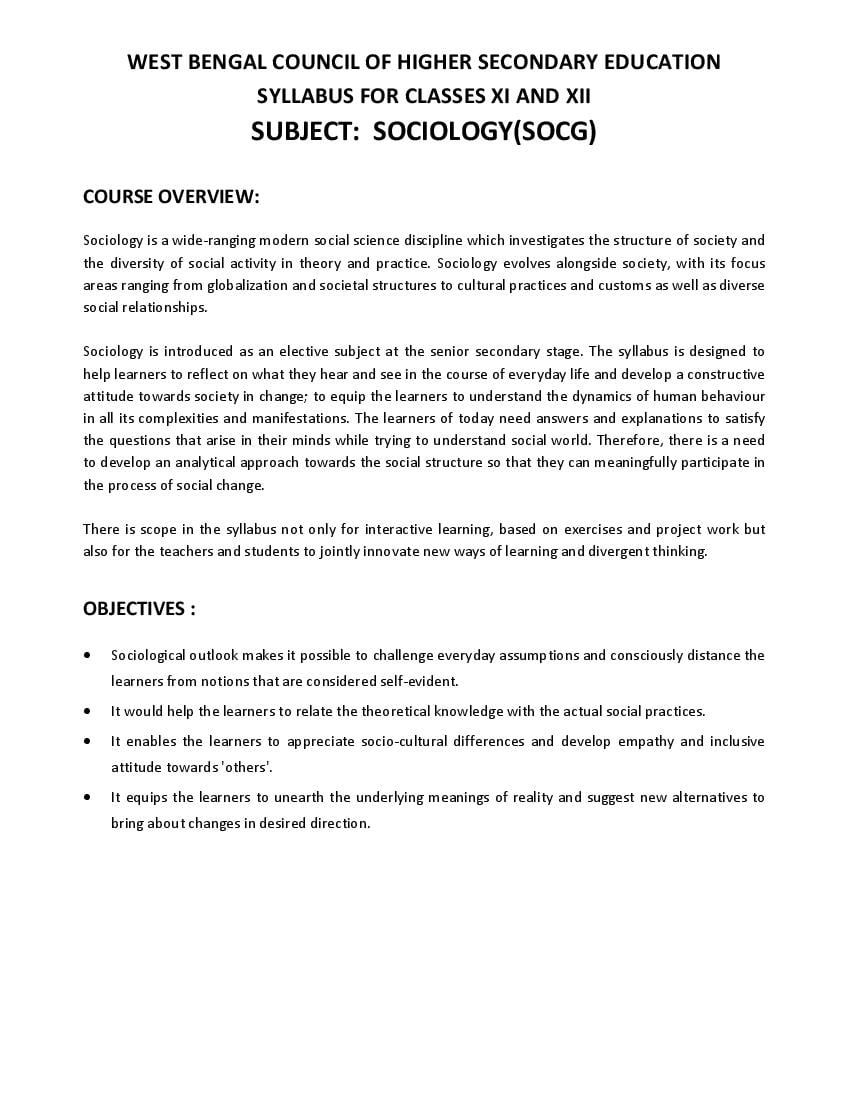
SYLLABUS FOR CLASSES XI AND XII
SUBJECT: SOCIOLOGY(SOCG)
COURSE OVERVIEW:
Sociology is a wide-ranging modern social science discipline which investigates the structure of society and
the diversity of social activity in theory and practice. Sociology evolves alongside society, with its focus
areas ranging from globalization and societal structures to cultural practices and customs as well as diverse
social relationships.
Sociology is introduced as an elective subject at the senior secondary stage. The syllabus is designed to
help learners to reflect on what they hear and see in the course of everyday life and develop a constructive
attitude towards society in change; to equip the learners to understand the dynamics of human behaviour
in all its complexities and manifestations. The learners of today need answers and explanations to satisfy
the questions that arise in their minds while trying to understand social world. Therefore, there is a need
to develop an analytical approach towards the social structure so that they can meaningfully participate in
the process of social change.
There is scope in the syllabus not only for interactive learning, based on exercises and project work but
also for the teachers and students to jointly innovate new ways of learning and divergent thinking.
OBJECTIVES :
Sociological outlook makes it possible to challenge everyday assumptions and consciously distance the
learners from notions that are considered self-evident.
It would help the learners to relate the theoretical knowledge with the actual social practices.
It enables the learners to appreciate socio-cultural differences and develop empathy and inclusive
attitude towards 'others'.
It equips the learners to unearth the underlying meanings of reality and suggest new alternatives to
bring about changes in desired direction.
Page 2
SEMESTER – I
(Type:MCQ)
FULL MARKS: 40 CONTACT HOURS: 100 Hours
UNIT NO. TOPICS SUB TOPICS MARKS
Unit 1 What is sociology- ‘Sociological
Imagination’; C.W.Mills- Sociology and
its relationship with other social
sciences (Anthropology, History,
Political Science, Economics, Philosophy
and Psychology)
Emergence of sociology: French
Revolution, Industrial Revolution,
Introducing Enlightenment (a very brief outline) 30 06
Sociology
Founding fathers of sociology:
a) Auguste Comte- Law of Three Stages
b) Emile Durkheim- Division of Labour
c) Max Weber- The Protestant Ethic
and the Spirit of Capitalism
Is Sociology a science- the debate
Unit 2 Basic Society- structure, process
Sociological Community and Association
Concepts Social Institutions
Social Organization
(only Social Groups
conceptual Social Stratification
outlines to be Social Change 25 15
discussed) Social Investigations-
a) Definition and Stages
b) Methods:
i) Field Studies with special
reference to Participant
Page 3
Observation
ii)Social Survey
c) Tools: Questionnaire and Interview
Schedule
Unit 3 Culture and Meaning and Importance
Society Material and Non-material Culture
(e.g. Technology and Language)
Culture as a Normative System-
Institutions, Values, Norms, Beliefs,
Folkways, Mores and Laws
Cultural Lag, Sub-culture, Counter 25 15
Culture, Mass Culture, Folk Culture,
Consumer Culture, Multiculturalism,
Ethnocentrism, Xenocentrism (only
conceptual understanding of each
topic)
Culture, Personality and Society
Unit 4 Socialization Concept and Importance
Socialization and Social Interaction
(verbal and non verbal)
Agencies- Family, Peer, Educational
Institutions, Work Place and Media 20 04
Formation of ‘Self’- stages
Social Reproduction and Social
Transformation
Page 4
SEMESTER – II
(Type: SAQ & LAQ)
FULL MARKS: 40 CONTACT HOURS: 80 HOURS
UNIT NO. TOPICS SUB TOPICS MARKS
Unit 5 Social Institutions Kinship, Family and Marriage- forms
and functions; changing trends like
single parent family, same sex
marriage etc.
Economic Institutions- Work,
Market, Online Transaction
Political Institutions- Power and
Authority (concept), State (concept);
Government (Democratic,
60 30
Dictatorship, Parliamentary,
Presidential); Non-State Institution
(UN- in brief)
Cultural Institution- Religion,
Education, Fashion (cultural
variation)
Health and Illness – concept
(physical and mental health); Health
Scare- Pandemic (e.g. COVID 19)
Unit 6 Social Control and Concept and meaning
Crime Conformity and Non conformity
Deviance and Delinquency
20 10
Types of Crime (White-Collar Crime,
Cyber Crime, Organized Crime-
Terrorism)
Page 5
A. Written Internal Assessment- Any topic of social relevance can 15 Marks
be investigated applying social science research methods and
tools
1.Introduction-
2.Research Question- 2 Marks
3. Research Objectives- 2 Marks
4. Method of Data Collection and its Rationale-3 Marks
5. Data Analysis- 3 Marks
6. Conclusion-
7. Reference and Bibliography- 2 Marks
Report Writing- 3 Marks
B.Viva-voce- on the basis of the assigned work 05 Marks
Project to be submitted during the second semester or within the guideline as directed by the
Council.
For Remedial Classes, Tutorials and Home Assignments no. of periods allotted- 15
Page 6
SEMESTER – III
(Type: MCQ)
FULL MARKS: 40 CONTACT HOURS: 100 HOURS
UNIT NO. TOPICS SUB TOPICS MARKS
Pioneers of Indian Sociology
Unit 1 Sociology in India 1. G.S. Ghurye- Caste and Race
2. R.K. Mukherjee- Social Ecology 30 8
3. M.N. Srinivas – Sanskritization
and Westernization
Colonialism, Nationalism
Unit 2 Social Change in
Post-Colonial India- Liberalization
India: Continuity and Globalization 20 7
and Change
Unit 3 Change in Social Family: Changes in structure and
Structure functions, factors of change, recent
trends (family disorganization)
Rural and Urban Communities:
Difference between City and Village,
emerging Agrarian Society in the
21st century, Panchayat,
Municipality, Smart City
Caste and Tribe: Pollution and
Purity, Caste Association – SC, ST,
OBC, Tribal Absorption, Tribal 50 25
movements
Religion: Communalism, Secularism
Education: Education Policy
perspective in Independent India,
SarvaShikshaAbhiyan (SSA), Right To
Education (RTE),State Education
Policy of West Bengal (2023)in the
context of National Education Policy
(NEP- from foundation to senior
secondary level, in brief)
Page 7
SEMESTER – IV
(Type : SAQ & LAQ )
FULL MARKS: 40 CONTACT HOURS: 80 HOURS
UNIT NO. TOPICS SUB TOPICS MARKS
Unit 4 Contemporary Population Explosion, Poverty,
Social Issues Illiteracy and Unemployment,
Mobility and Migration,
Consequences and Remedies
Corruption: Concept, Recent
Legislations
Gender and Sexuality: Concept of
Sex and Gender, Women and
Different forms of Sexuality
(LGBTQ), Different forms of
gender violence 80 40
Environment: Crisis and Responses
(State and Non- State Initiatives)
Mass Media: Print and Tele
Media, Social Media- Facebook,
Instagram, Reddit, Linkedln,
Vloggs, Reels and their impact in
social life
Social Movements: Women’s
movement and Environment
movement
Page 8
A. Written Internal Assessment- Any topic of social relevance 15 Marks
can be investigated applying social science research methods
and tools
1.Introduction- 2 Marks
2.Objectives- 2 Marks
3. Research Question- 2 Marks
4. Methodology and its Rationale- 2 Marks
5. Data Analysis- 3 Marks
6. Conclusion- 2 Marks
7. Reference and Bibliography- 2 Marks
B. Viva-voce- on the basis of the assigned work 05 Marks
Project to be submitted during the fourth semester or within the guideline as directed by the
Council.
For Remedial Classes, Tutorials and Home Assignments no. of periods allotted- 15
Document Details
| Board / Org | West Bengal Board |
| Exam | Class 11 |
| Type | Syllabus |
| Pages | 8 |
| Updated | 22 Jul 2026 |