APTET Question Paper with Answers 18 Jun 2018 Paper 2 Tamil (Shift 2)
Finished viewing? Save it for later —
Download APTET Question Paper with Answers 18 Jun 2018 Paper 2 Tamil (Shift 2) (PDF · 61 pages)About APTET Question Paper with Answers 18 Jun 2018 Paper 2 Tamil (Shift 2)
APTET Question Paper with Answers 18 Jun 2018 Paper 2 Tamil (Shift 2) is available here for free download. Published by Andhra Pradesh Exams for Andhra Pradesh Teacher Eligibility Test, this question paper can be viewed online or downloaded as a PDF (61 pages). Candidates preparing for Andhra Pradesh Teacher Eligibility Test can use APTET Question Paper with Answers 18 Jun 2018 Paper 2 Tamil (Shift 2) to understand the exam pattern, the type of questions asked, and the overall difficulty level.
Frequently Asked Questions
How can I download APTET Question Paper with Answers 18 Jun 2018 Paper 2 Tamil (Shift 2)?
Open this page and click the Download button to save APTET Question Paper with Answers 18 Jun 2018 Paper 2 Tamil (Shift 2) as a PDF. It is completely free on AglaSem Docs.
Is APTET Question Paper with Answers 18 Jun 2018 Paper 2 Tamil (Shift 2) free to download?
Yes. APTET Question Paper with Answers 18 Jun 2018 Paper 2 Tamil (Shift 2) can be viewed online and downloaded as a PDF free of cost on AglaSem Docs.
How many pages does APTET Question Paper with Answers 18 Jun 2018 Paper 2 Tamil (Shift 2) have?
APTET Question Paper with Answers 18 Jun 2018 Paper 2 Tamil (Shift 2) contains 61 pages, which you can read online or download together as a single PDF.
Where can I find more Andhra Pradesh Teacher Eligibility Test study material?
You can find more Andhra Pradesh Teacher Eligibility Test question papers, sample papers, syllabus, and answer keys on AglaSem Docs.
APTET Question Paper with Answers 18 Jun 2018 Paper 2 Tamil (Shift 2) – Text
Read the full text of this question paper below — useful to quickly search, copy and reference the content online without downloading the PDF.
📄 View text version (60 pages)
Page 1
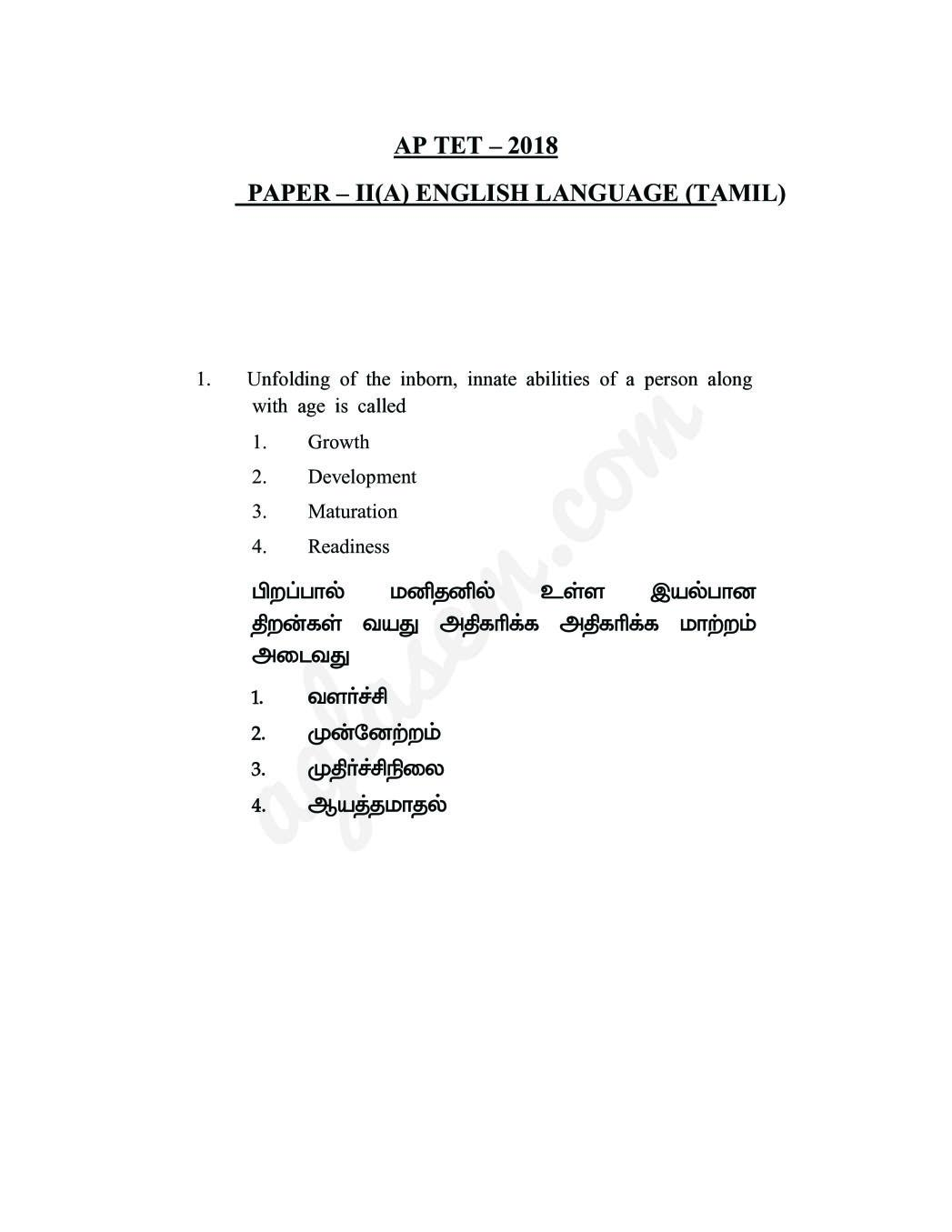
PAPER – II(A) ENGLISH LANGUAGE (TAMIL)
1. Unfolding of the inborn, innate abilities of a person along
with age is called
1. Growth
2. Development
3. Maturation
4. Readiness
♦[κΣôο Τ±Θ±ο ∆ρΖ ΒΥοΣô∴
ƒ[τΚρ ΞΥÕ ≅ƒΚ↔χΚ ≅ƒΚ↔χΚ Τôσ[λ
≅ûΟΞÕ
1. ΞΖνε′
2. Øτú∴σ[λ
3. ؃νε′♣ûΩ
4. ΑΥιΘΤôΘο
Page 2
1. Growth
2. Development
3. Heredity
4. Maturation
ùΘôΟνε′Υô∴ Τσßλ ƒςΖχá⁄Υ Τôσ[λ
1. ΞΖνε′
2. Øτú∴σ[λ
3. Τς×♣ûΩ
4. ؃νε′♣ûΩ
3. Quantitative change is …
1. Growth
2. Development
3. Maturation
4. Heredity
≅ΖÅγÓ Τôσ[λ...
1. ΞΖνε′
2. Øτú∴σ[λ
3. ؃νε′♣ûΩ
4. Τς×♣ûΩ
Page 3
1. Babyhood
2. Childhood
3. Adolescence
4. Old age
υΟôτ ôο ΒϕΘ Σ⁄♣ûΩûΥ
‘Τ∴ùΞÝε′ÙΟτ á⁄Υ ∆߃Υσ[ΘτûΤ’
Φτß ΚηΟ°ϕΘôν−
1. ÏΨ↑κ ΣÚΞλ
2. ♦ρûΖκ ΣÚΞλ
3. ÏΤςκ ΣÚΞλ
4. ؃νϕΘ ΣÚΞλ
5. The psychologist who explained about incorporation,
accommodation and schemata
1. Vygotsky
2. Chomsky
3. Jean Piaget
4. Kohlberg
ΙÚδ€ûΠιΘο+ ΘΚúΞσ× Τσßλ υ•úΤγΟô
Σσ° ↑Ζχ€Υ ∆Ζ↑ΥΩ°Νν
1. ûΞúΚôγυ€
2. Μôλυ€
3. Ëτ ♦Υôú⊥
4. úΚôοΣνχ
Page 4
physical punishment
1. Pre-conventional
2. Conventional
3. Post-conventional
4. Democratic morality
ÏΨϕûΘΚρ ΒϕΘ ♣ûΩ♠ο ≅[ùΡ°ûΥ
∆ΟοΜôν ΘηΟû∴ΥôΚ Κ∞κΣν
1. Øτ Τς×
2. Τς×
3. ♦τ Τς×
4. ΤχΚΖôγ′ Øû[♠Ωô∴ ≅[ùΡ°
7. Name the psychologist who proposed that children by birth
have the ability to grasp universal language principles
1. Piaget
2. Vygotsky
3. Chomsky
4. Skinner
♦[ϕΘÕ ØΘúΩ ÏΨϕûΘΚρ ùΣôÕΞô∴
ùΤô→ ↑ƒØû[ΚûΖ ×↔ϕÕχùΚôρÞλ ƒ[τ
ùΣσ°Úχ€τ[∴ν Φτß ØτùΤô→ϕΘ
∆Ζ↑ΥΩ°Νν
1. ♦Υôú⊥
2. ûΞúΚôγυ€
3. Μôλυ€
4. υ€τ∴ν
Page 5
developmental stages is
1. Trust Vs Mistrust
2. Initiative Vs Guilt
3. Industry Vs Inferiority
4. Autonomy Vs Shame
Φ↔χΜ±τ ΦγÓ ∆Ζ↑ΥοΜôν ΜêΚ
Øτú∴σ[κ Σ⁄♣ûΩΚ↓ο ØΘο Σ⁄♣ûΩ
1. Ρλ♦χûΚ Vs ≅ΞΡλ♦χûΚ
2. ùΘôΟδσ[τ Vs Ïσ[ ∆ΠνÜ
3. ÑßÑßκ×ιΘτûΤ Vs ΘôθÜ Τ∴κΣôτûΤ
4. Θτ∴ƒΚôςλ Vs ùΞγΚλ
9. The concept of ‘Emotional intelligence’ was proposed by ....
1. Alfred Binet
2. Daniel Golman
3. Howard Gardner
4. Spearman
»Τ∴ùΞÝε′ ÖηΠ°Üµ Φτàλ ΚÚιÕÚûΞ
ØτùΤô→ϕΘΞν
1. Αο?κςγ ♦ú∴
2. úΟ±Υο úΚôοΤτ
3. ôΞνγ ΚôνΟ∴ν
4. υ♦ΥνΤτ
Page 6
by ………
1. Binet
2. Simon
3. William Stern
4. Terman
‘ÖηΠ°Ü ΧÜ’ Φτàλ ΚÚιƒû∴
≅°ØΚκΣÓιƒΥΞν
1. ♦ú∴
2. ûΜΤτ
3. ↑οΥλ υùΟντ
4. ùΟνΤτ
11. The ability of an individual to develop satisfactory
relationship with the environment is ….
1. Personality
2. Adjustment
3. Intelligence
4. Attitude
ΙÚ Θ±Τ±Θτ Ñσßκ×[ιÕΟτ ♣û[Ξô∴
ùΘôΟν♦û∴ ΓσΣÓιƒχùΚôρÞλ ƒ[û∴
ΒπΞôß ≅ûΨκΣν
1. ΑÞûΤ
2. ùΣôÚιΘκΣôÓ
3. ÖηΠ°Ü
4. Τ∴κΣôτûΤ
Page 7
1. J.L. Moreno
2. Sheldon
3. Kreshmer
4. Erickson
Φτàλ ΚÚ↑ûΥ
‘Sociometry’ ØΘτØΘο
ΣΥτΣÓιƒΥΞν
1. ù⊥−Φο−ùΤô↔ú∴ô
2. ù_οΟτ
3. χςωΤν
4. Φ↔χ]τ
13. The change in behaviour in an organism due to
experience and training is …..
1. Development
2. Maturation
3. Motivation
4. Learning
≅àΣΞιΘôÛλ Σ♠σ′ΥôÛλ ΙÚ ΡΣ↔τ
ΡΟιûΘ♠ο ΡûΟùΣßλ Τôσ[λ
1. Øτú∴σ[λ
2. ؃νε′♣ûΩ
3. ΕχΚλ
4. Κσ[ο
Page 8
1. Learning styles
2. Aspiration
3. Readiness
4. Achievement motivation
ΒΩχÏΚ↓τ ∆Υν♣ûΩûΥ ≅ûΟΞΘτ
úΡôχΚλ ΒΘàΟτ ùΘôΟν×ûΟΥÕ
1. ΚσÏλ Ξ→Øû[Κρ
2. ΑνΞλ
3. ΑΥιΘλ
4. ≅ûΟÜ ΕχΚλ
15. Name the theorist who proposed when the number of Trials
increases the number of errors decrease and thus learning
happens -
1. Pavlov
2. Skinner
3. Thorndike
4. Kohler
ØΥσ′Κ↓τ Φη∞χûΚ ≅ƒΚ↔κΣΘôο
ΘΞßΚ↓τ Φη∞χûΚχ Ïû[ϕÕ Κσ[ο
ΡûΟùΣ߀[Õ Φτß á°Υ úΚôγΣôγΟôΖν
1. ΣôπΩôπ
2. υ€τ∴ν
3. ΘôνηûΟχ
4. úΚôΩν
Page 9
is called ____________
1. Conditioned response
2. Natural response
3. Higher order conditioning
4. Unconditioned response
ΣôπΩô↑τ Σ↔úΜôΘû∴♠ο ♣ûΩ♠ßιΘκΣγΟ
♦τ∴ν Ρô♠τ ∆♥θ¿ν ΒπΞôß
≅ûΨχΚκΣÓλ−
1. ♣ûΩ♠ßιΘκΣγΟ ÕΩδΚο
2. ΒΥοΣô∴ ÕΩδΚο
3. ∆Υν ΙÝδÏ ♣ûΩ♠ßιΘλ
4. ♣ûΩ♠ßιΘκΣΟô ÕΩδΚο
17. "Instrumental conditioning" is also called as …….
1. ‘S’ type conditioning
2. Classical conditioning
3. Higher order conditioning
4. Operant conditioning
»»ΚÚ↑Μôν ♣ûΩ♠ßιΘλµµ ΒπΞôß
≅ûΨχΚκΣÓλ−
1. ‘S’ ΞûΚ ♣ûΩ♠ßιΘλ
2. ΑχΚ ♣ûΩ♠ßιΘλ
3. ∆Υν ΙÝδÏ ♣ûΩ♠ßιΘλ
4. ùΜΥΩôχΚ ♣ûΩ♠ßιΘλ
Page 10
Development”
1. Hurlock
2. Bandura
3. Chomsky
4. Vygotsky
“≅ÔχΚ Øτú∴σ[κ Σσ” Σσ° á°Υ
∆Ζ↑ΥΩôΖν
1. νΩôχ
2. Σôηåςô
3. Μôλυ€
4. ûΞúΚôγυ€
19. A student is drawing a picture to satisfy himself. This is an
example of
1. Intrinsic motivation
2. Extrinsic motivation
3. Achievement motivation
4. Social motivation
ΙÚ ΤôΠΞτ Θτ±û[ûΞ ≅ûΟΥ ΣΟλ
Ξûς€[ôτ− ΒÕ ≅ΞàûΟΥ ΒϕΘ
ΕχΚιûΘχ Ï°χÏλ−
1. ∆ρΖôνϕΘ ΕχΚλ
2. ùΞ↓κΣûΟΥô∴ ΕχΚλ
3. ≅ûΟÜ ΕχΚλ
4. ΜêΚ ΕχΚλ
Page 11
brain and recall them into his consciousness whenever required is
1. Memory
2. Recognition
3. Retention
4. Learning
ΙÚ Τ±Θτ êûΖ♠ο Θτ ≅àΣΞδΚûΖε
úΜ♥ιÕ ÁηÓλ úΘûΞκΣÓλúΣôÕ Θτ
Ρ∴Ü♣ûΩχÏ ÁγÓχùΚôΠÚλ Ασ[ο
1. ♣û∴Ü
2. ≅δ•Κôςλ
3. Τ∴ιƒÚιΘλ
4. Κσ[ο
21. When a learnt material ‘A’ interferes with present learning of
material ‘B’, then the interference is called
1. Retro active inhibition
2. Passive decay
3. Repression
4. Pro active inhibition
ΚΟϕΘ Κσ[ο áßΚρ ‘A’, ΘσúΣôûΘΥ Κσ[ο
áßΚΖô∴ ‘B’ ûΥ ♣û∴ÜáνΘο ∆ρΖ ΘûΟ
1. ♦τùΜΥÄγÓι ΘûΟ
2. ùΜΥοΣΟô ≅→Ü
3. ΙÓχÏΘο
4. Øτ ùΜΥÄγÓι ΘûΟ
Page 12
motor cycle. It is
1. Positive transfer
2. Negative transfer
3. Bilateral transfer
4. Zero transfer
ûΜχ€ρ ♥ƒχΚ ΚσßχùΚôηΟ ΙÚ ΡΣν
úΤôγΟôν ûΜχ€ûΖ ΡΟιΘ ΚσßχùΚôρ€[ôτ−
ΒÕ
1. úΡνØΚ Τôσ[λ
2. ΦƒνΤû[ Τôσ[λ
3. ΒÚ×[ Τôσ[λ
4. éϖ≥Υ Τôσ[λ
23. The field of vision of blind persons is
1. below 20o
2. between 20o to 40o
3. between 40o to 60o
4. 60o to 90o
ΙÚ ÏÚΟ±τ ΣôνûΞκ ×Ω úΚôΠλ
1. 20+ Η ↑Ο Ïû[Ü
2. 20+ ØΘο 40+ χÏ ΒûΟ♠ο
3. 40+ ØΘο 60+ χÏ ΒûΟ♠ο
4. 60+ ØΘο 90+ Ξûς
Page 13
‘Construction of Knowledge’
1. J.B. Watson
2. Bandura
3. Bruner
4. W.C. Bagley
‘Κσ[ο ΦτΣÕ ≅°Ü ∆ÚΞôχΚúΤ’ Φτß
ΚÚƒΥ ∆Ζ↑ΥΩôΖν
1. ú⊥−♦−Ξôγ]τ
2. ΣôηÓςô
3. ×ìΠν
4. Ο×ρÙ−′−ΣôχúΩ
25. Name the programme / project that was intended to give
qualitative education to children between the age group
of 14 - 18 years
14 ØΘο 18 ΞΥÕ Ξûς ∆ρΖ ÏΨϕûΘΚρ
≅û∴ΞÚχÏλ ΘςΤô∴ Κο↑ûΥ
ΞΨδÏΞûΘ úΡôχΚΤôΚχ ùΚôηΟ
ƒγΟλ / ùΜΥοƒγΟλ
1. DPEP
2. SSA
3. RMSA
4. DIET
Page 14
Compulsory Education
1. Jammu-Kashmir
2. Bihar
3. Uttaranchal
4. Kerala
ΒΩΞΜχ ΚγΟôΥχ Κο↑ ∆↔ûΤε ΜγΟιƒÚϕÕ
•θχΚôÔλ Τô♣ΩιƒσÏ ↑ƒ↑ΩχÏ ∆ρΖÕ
1. ⊥λØ ` ΚôωÁν
2. ÀΚôν
3. ∆ιΘςôφΜο
4. úΚςΖô
27. The classes included in ‘Elementary Education’ are ……
1. classes 1 to 5
2. classes 1 to 8
3. classes 1 to 10
4. classes 1 to 12
»»ΑςλΣχΚο↑ µµ (Elementary Education) ♠τ •θΞÚλ
ΞÏκ×Κρ
1. 1 ØΘο 5Αλ ΞÏκ× Ξûς
2. 1 ØΘο 8Αλ ΞÏκ× Ξûς
3. 1 ØΘο 10Αλ ΞÏκ× Ξûς
4. 1 ØΘο 12Αλ ΞÏκ× Ξûς
Page 16
is
1. Diagnostic evaluation
2. Qualitative evaluation
3. Quantitative evaluation
4. Formative evaluation
ùΘôΟνε′Υô∴ Τσßλ ØÝûΤΥô∴ ΤƒκÀγ⁄ο
ùΘôÏκ×♣ûΩ ΤƒκÀÓ Ιτß Φ±ο Τσù[ôÚ
ΤƒκÀÓ
1. Ïû[Υ° ΤƒκÀÓ
2. ΘςΤô∴ ΤƒκÀÓ
3. ≅ΖÅγÓ ΤƒκÀÓ
4. ΞΖν♣ûΩ ΤƒκÀÓ
Page 17
Ρôσ°ûΜÙλ ùΜôοΩôΘ Ρô⁄οûΩ: ≅ϕΡôÓ
úΞσßΡôÓ ΑΚô: ΘΤúΞΥôλ: Α♠∴ôο
ΑσßΠô úΞηÓΞÕ Βο−
, ΒκΣôΟο ΒιΘûΩκ♦τ •θ ΒΟλùΣßλ−
1. ƒûΜ♠τ ′[κ×
2. Κο↑♠τ ′[κ×
3. ≅ΥοΡôγ⁄τ ′[κ×
4. ΚοΩôν ′[κ×
32. ΤûΨúΥ ΤûΨúΥ Ξô Ξô , ΡοΩ
Ξô∴κ ×∴úΩ Ξô Ξô , ΒκΣôΟûΩκ Σô⁄Υ
Κ↑Νν
1. ΣôςƒΥôν
2. Κ↑Τ∞
3. ΣôςƒΘôΜτ
4. ùΞ− ΒςôΤ←δΚ∴ôν
Page 18
1. ΜûΟ
2. ãΩλ
3. ΣϕÕ
4. ΞôγΣûΟ
34. ΣγΟôÑ ùΞ⁄χΚôΘ €ςôΤλ
1. ≅ο←χÏΖλ
2. ΑςλΣôχΚλ
3. ΕςκΣôχΚλ
4. áϕΘτÏΖλ
35. Ρ− ♦εΜêνιƒ ΒΥσ°Υ !ùΣôδΚο Ξ→ΣôÓ&
Φàλ ΣôΟο Ξ←ÙßιÕλ ΚÚιÕ
1. ΒΥσûΚûΥκ úΣôσßΘο
2. ΡΚςιûΘκ úΣôσßΘο
3. úΣôχÏΞςιûΘκ úΣôσßΘο
4. Κο↑ûΥκ úΣôσßΘο
Page 19
1. ΚλΣΘôΜτ
2. ΞηΠΘôΜτ
3. ΚηΠΘôΜτ
4. Ξô∞ΘôΜτ
37. Φτú∴+ ΒϕΘ ϑ↑Υιƒτ ≅ΨÏ , ΒÕ
ΦπΞûΚι ùΘôΟςôÏλ
1. ΚγΟûΖι ùΘôΟν
2. ∆Πνε′ι ùΘôΟν
3. ↑∴ôιùΘôΟν
4. ΦƒνΤû[ι ùΘôΟν
Page 20
↑↔ιÕχ Κôη
1. Ï°φ′+ ØοûΩ+ ΤÚΘλ+ ùΡµΘο+ΣôûΩ
2. ΦÝιÕ+ ùΜôο+ ùΣôÚρ+ Υôκ×+ ≅∞
3. Κη+ Ξôµ+ ùΤµ+ êχÏ+ ùΜ↑
4. ΑηΣôο+ ùΣηΣôο+ ΣΩνΣôο+
Ιτ[τΣôο+ ΣΩ↑τΣôο
39. !∆ΣΥλ& Βκ♦[ùΤô→ε ùΜôο←σÏ ♣Κςô∴
Θ♥θεùΜôο
1. ∆ΩΚ ΞΨχÏ
2. ↑ÚϕúΘôλΣο
3. ƒÚκΣ∞ΥôΖν ùΚôûΟ
4. ùΘôΟχΚλ
Page 21
≅ûΨχΚκΣÓΣΞν
1. Σ↔ƒΤôσ ΚûΩΝν
2. ΣλΤο ΜλΤϕΘ∴ôν
3. ΜηØΚλ
4. ΜδΚςΘôÑ ÑΞô♥Κρ
41. !ΡΖùΞηΣô& èûΩκ Σô⁄ΥΞν
1. ΜΥδùΚôηΟôν
2. ×ΚúΨϕƒ
3. ΚλΣν
4. ΙγΟχáιΘτ
42. !Υôû∴& ΒΘτ ΒΖûΤκ ùΣΥν
1. Κτß
2. Ïγ⁄
3. ♦ρûΖ
4. ÏÚûΖ
Page 22
1. ùΤµ Øτ ùΤµ
2. ùΤµ Øτ ∆♠ν
3. ∆♠ν Øτ ùΤµ
4. ∆♠ν Øτ ∆♠ν
44. !ΒϕƒΥô↑τ ùΣκ♦Ñ& Φ∴ ΒΞûςκ
úΣôσ߀τ[∴ν
1. ΟôχΟν− Ø−Ξ
2. Α∴ϕΘςδΚν
3. Κο€
4. ù⊥Κ′σ♦
45. Α♠ςχΚΠχΚô∴ Υôû∴ΚûΖΚκ úΣô↔ο
ùΞτ[ Åςû∴κ ×ΚθϕÕ ΣôÓλ ΒΩχ€Υλ
1. ♦ρûΖιΘ♥θ
2. ∆Ωô
3. ΣρÞ
4. Σς∞
Page 23
1. ↑û∴ιùΘôûΚ
2. úΞσßûΤιùΘôûΚ
3. Ση×ιùΘôûΚ
4. ∆ΞûΤιùΘôûΚ
47. »ΒςχΚλµ ΒκùΣôÚρ ΘÚλ ΣΩùΜôσΚρ
1. ΚÚûΠ+ ùΣôÚκ×+ ûΜΩλ
2. ≅Úρ+ Σ↔Ü+ ΚÚûΠ
3. ùΞσ×+ Φ→ο+ ΚÚûΠ
4. ΚÚûΠ+ ′Ωκ×+ ≅∴ο
48. »ΚϕΘÚΞλµ Βε ùΜôο←τ ΒÚùΣôÚρ
1. σûς+ ΣϕÕ
2. σûς+ ΤôΤςλ
3. σûς+ ãΩλ
4. σûς+ ΒûΜ
Page 24
×Πνε′ΥôÏλ
1. ΒΥο×
2. ùΚÓΘο ↑Κôςλ
3. ƒ↔Θο ↑Κôςλ
4. úΘôτ[ο ↑Κôςλ
50. ≅⁄úΘôßλ ΡôτÏ ≠νΚûΖκ ùΣσß ΞÚΞÕ
1. ≅ΖΞ⁄
2. ′ϕΘ⁄
3. Ï[Ζ⁄
4. ùΡ⁄Ω⁄
Page 25
¿δ€τ ≅Θû∴κ ♦[−
, Βχ Ï[γΣô↑ο ≅ûΤϕÕρΖ ≅∞
1. ♦°ÕùΤô→Θο ≅∞
2. ΘσÏ°κúΣσ[ ≅∞
3. ΒοùΣôÚÞΞûΤ ≅∞
4. úΞσßûΤ ≅∞
52. !Κô∴ο ¿ν& ΒλΤς×ι ùΘôΟÚχÏκ ùΣôÚρ
1. ≅ûΩϕÕ ƒ↔Θο
2. ΣΥ±τ° ΒÚιΘο
3. ♥σΥôΚκ úΣÑΘο
4. ΒÚκΣÕ úΣôο úΘôτßλ Α∴ôο ΒςôÕ
53. ΙÚΞν ≅οΩÕ ΣΩ↔τ ∆ûςΥôΟοΚûΖ
≅ΥΩôν áßΞÕ úΣôο ≅ûκΣÕ
1. úΡνáσßιùΘôΟν
2. ≅ΥσáσßιùΘôΟν
3. ∆ΟτΣôγÓιùΘôΟν
4. ΦƒνΤû[ιùΘôΟν
Page 26
ΒπΞûΚ ↑û∴ΥôÏλ
1. ùΜµ↑û∴
2. ♦[↑û∴
3. ùΜΥκΣôγÓ↑û∴
4. Θτ↑û∴
55. ΚôΤςôΜν ♦[ϕΘ ΡôûΖ Θ♥ΨΚ ≅ςÑ ΒπΞôß
≅°↑ιÕρΖÕ
1. úΘ′Υ ΙÚûΤκΣôγÓ Ρôρ
2. çµûΤ Ρôρ
3. Κο↑ ΞΖνε′ Ρôρ
4. ΘûΩΞνΚρ Ρôρ
56. !ΦρÞΞν& Βε≠↔ο ≅ûΤϕÕρΖ ≅ûΜΚρ
1. ♣ûς+ ♣ûς
2. ♣ûς+ úΡν
3. úΡν+ úΡν
4. úΡν+ ♣ûς
Page 27
↑∴ôχΚÞχÏ ↑ûΟΥ↓−
Α↔Υν ≅°ΥôΘÕ Υôû∴: ≅Θ∴ôο
Υôû∴ ♥Κκ ΣûΨΥ úΞΘùΤô→♠ο
ΒΟλùΣ[↑οûΩ ΦτΣν− Α∴ôο Υôû∴Κρ
Θ♥θ Ρôγ⁄←ÚϕÕ €−Ø− 616 , 611 Βο
≅Μ↔Υ ΡôγÓ Ττ∴∴ô€Υ _ôοΤú∴ΜÚχÏ
ΡτùΚôûΟΥôΚ ≅↓χΚκΣγΟ∴− Θ♥θ ΡôγÓ
≅ς′ Σô♦úΩô±ΥôÜχÏ €−Ø− Α[ôλ
èσ[ôη⁄ο ≅àκΣκΣγΟÕ− ΜϕΘ∴Øλ
≅àκΣκΣγΟÕ− ≅↔′+ ΜϕΘ∴λ Φτ[ Θ♥θε
ùΜôσΚÞλ ≅ϕΡôγÓ ùΤô→♠ο ΒΟλùΣσ[∴−
57. Α↔Υςôο ≅°ΥôΘ ↑ΩδÏ
1. ′δΚλ
2. Υôû∴
3. ΦÚûΤ
4. ΙγΟΚλ
58. Θ♥θΡôγ⁄ο ΒÚϕÕ Σô♦úΩô±Υô ùΤô→♠ο
ΒΟλùΣσ[ Θ♥θεùΜôσΚρ
1. ΜϕΘ∴λ+ ≅↔′
2. ≅€Ûλ+Õ€ο
3. Τ♠οúΘôûΚ+ Õ€ο
4. Υôû∴
Page 28
↑∴ôχΚÞχÏ ↑ûΟΥ↓−
↑û∴ε ùΜôοúΣôµ úΞσßûΤûΥ
ΓσΣƒοûΩ ùΞηΣôκ úΣôµκ
♦[ΘûΖûΥ ΤΠκΣƒοûΩ ♣û∴ÜΥνϕΘ
Θ♥θ ùΡφΜϕ Θ∴Õ Τô∴λ ¿χΚΞÚφ
′ßùΜΥûΩ ♣û∴κΣ ƒοûΩ
59. ↑û∴εùΜôο ΒûΘ ΓσΣƒοûΩ
1. ΘûΖûΥ
2. ùΞηΣô
3. úΞσßûΤ
4. ùΡφΜλ
60. ′ßûΤΥô∴ ùΜΥοΚûΖ ΒΞνΚρ
♣û∴κΣƒοûΩ
1. ùΘÛδΚν
2. Θ♥Ψν
3. ÕÞΞν
4. Κτ∴Ον
Page 29
Choose the meaning of the word, ‘passage’;
1. A lengthy text
2. A long narrow way
3. A paragraph with sentences
4. A journey
62. Choose the word that refers to ‘a number of players’.
1. Play
2. Class
3. Team
4. Bench
63. Choose the word with a ‘suffix’.
1. Child
2. Childhood
3. Discourage
4. Illegal
Page 30
1. Whispering
2. Scater
3. addresing
4. Gaint
65. Choose the word that can be used as a noun and a verb.
1. Truth
2. Great
3. Mind
4. Faith
66. His disability came as rare occurrence.
Choose the antonym of the word ‘rare’.
1. Common
2. Special
3. Particular
4. Desired
Page 31
Identify the meaning of ‘came across’.
1. Talked to someone.
2. Helped by chance.
3. Met by chance.
4. Met purposefully.
68. It may be true.
This sentence means;
1. It is possibly true.
2. It is certainly true.
3. It is undoubtedly true.
4. It is not true.
69. Yesterday I saw ………….. one eyed man.
Choose the article that fits the blank.
1. a
2. an
3. the
4. No article is needed.
Page 32
Choose the correct preposition that fits in the blank.
1. on
2. by
3. at
4. with
71. Mohan who is my English teacher always buys new books.
This sentence has;
1. A defining relative clause.
2. A non-defining relative clause.
3. A noun clause.
4. A conditional clause.
72. I did everything I could do.
In the above sentence ‘could’
1. indicates politeness.
2. indicates submissiveness.
3. is the past tense of ‘can’.
4. is the present tense.
Page 33
Choose the correct question tag for this sentence.
1. didn’t they ?
2. doesn’t they ?
3. do they ?
4. don’t they ?
74. It is quite near
This sentence ends with;
1. a full stop
2. a question mark
3. a comma
4. an exclamatory mark.
75. “What’s your name, boy ?” said the gentleman.
Choose the reported speech of this sentence.
1. The boy said that he was a gentleman.
2. The boy asked the gentleman what was your name.
3. The gentleman said that what is your name.
4. The gentleman asked the boy what his name was.
Page 34
Choose the correct form of verb that fits the blank.
1. will
2. are
3. is
4. have
77. It was raining when we ……………. the station.
Choose the correct tense form that fits the blank.
1. reach
2. reached
3. reaches
4. had reached
78. Let me tell you the story.
The part of speech of the word ‘me’ is;
1. a noun
2. a pronoun
3. a preposition
4. a conjunction
Page 35
1. Equally
2. To sum up
3. Therefore
4. Furthermore
80. Choose the subordinate conjunction from the following.
1. neither … nor
2. since
3. yet
4. and
81. Choose the grammatically correct sentence.
1. Neela has eaten the mango yesterday.
2. Neela ate the mango yesterday.
3. Neela has been eating the mango yesterday.
4. Neela had eaten the mango yesterday.
Page 36
1. she said I am hungry.
2. She said, I am hungry.
3. She said ‘I am hungry’.
4. She said, “I am hungry.”
83. Choose the sentence in passive voice.
1. Trespassers will be prosecuted.
2. What are you doing here ?
3. My own garden is my own garden.
4. We can play on the road.
84. Chitra is …………. singers in Tollywood.
Choose the correct expression that fits grammatically.
1. one of the greater
2. one of the greatest
3. greater than
4. as great as
Page 37
friend is;
1. Lovingly your
2. Yours lovingly
3. Your’s lovingly
4. Your lovingly
86. Choose the list with correct alphabetical order.
1. tool, tooth, too, to
2. tooth, too, to, tool
3. to, too, tool, tooth
4. too, to, tool, tooth
87. He looked at me frantically.
Choose the synonym of the word, ‘frantically’.
1. Skillfully
2. Anxiously
3. Steadily
4. Softly
Page 38
Choose the correct preposition that fits the blank.
1. on
2. in
3. into
4. over
89. Read the following passage and choose the correct
answer to the question.
One day a guru foresaw in a flash of vision what he would be
in his next life, so he called his favourite disciple and asked
him what he would do for his guru in return for all he had
received. The disciple said he would do whatever his guru
asked him to do.
The guru was able;
1. to create a disciple
2. to foresee his next life
3. to see his favourite disciple in a dream
4. to foresee what his disciple would be in his next life
Page 39
answer to the question.
One day a guru foresaw in a flash of vision what he would be
in his next life, so he called his favourite disciple and asked
him what he would do for his guru in return for all he had
received. The disciple said he would do whatever his guru
asked him to do.
Choose the true statement from the following.
1. The guru would become a disciple in his next life.
2. The disciple would become a guru in his next life.
3. The guru gave a great gift before dying.
4. The disciple was an obedient person.
Page 40
Choose the synonym of the word, ‘ushered.’
1. Controlled
2. Escorted
3. Continued
4. Retorted
92. There are many delightful things in the park.
Choose the opposite word of ‘delightful.’
1. Adequate
2. Meaningful
3. Unpleasant
4. Appropriate
93. Choose the word with correct spelling.
1. Simultanious
2. Presense
3. Moustache
4. Persistance
Page 41
1. a mercenary
2. an agnostic
3. an honorary
4. a theist
95. I can get along with all my classmates.
Choose the meaning of the phrasal verb, ‘get along’.
1. Have competition
2. Have friendly relationship
3. Have rivalry
4. Have no competition
96. I will never set foot in your house.
Choose the meaning of the expression, ‘set foot’.
1. Sit
2. Work
3. Spend
4. Enter
97. Choose the incorrect expression with respect to the
collocation of words.
1. Thatched roof
2. Unsafe roof
3. Young roof
4. Slippery roof
Page 42
Choose the meaning of ‘viva voce’ in the above sentence.
1. A meeting
2. A spoken exam
3. A talk with a classmate
4. A competition in essay writing
99. I like reading ………. poetry.
Choose the article that fits the blank.
1. a
2. an
3. the
4. No article is needed
100. We should abstain ……. evil and do good.
Choose the correct preposition that fits the blank
1. from
2. with
3. to
4. an
Page 43
Choose the word that fits the blank.
1. whose
2. who
3. whom
4. which
102. ‘You are bigger than …….. animal in the forest,’ said the fox
to the elephant.
Choose the correct expression that fits the blank.
1. most other
2. many other
3. any other
4. one another
103. May I go out now?
This sentence indicates.
1. granting permission
2. giving permission
3. taking permission
4. sanctioning permission
Page 44
Choose the correct question tag for this sentence.
1. didn’t she ?
2. did she ?
3. doesn’t she ?
4. isn’t it ?
105. “I’ll tell you the whole story,” said the man.
The reported speech of this sentence is;
1. The man asked to tell him the whole story.
2. The man said that he would tell them the whole story.
3. The man will tell the whole story to the boy.
4. The man said if he would tell them the whole story.
106. Choose the sentence in passive voice.
1. I have to distribute food.
2. She had food to distribute.
3. Food was distributed free of charge.
4. He has fought as good fight.
107. Look ! The crow……… on the tree.
Choose the correct tense form of the verb that fits the blank.
1. sat
2. was sitting
3. is sitting
4. sitting
Page 45
ago.
The verb that fits the blank is;
1. attended
2. attends
3. will attend
4. does attend
109. The police ………….. caught the criminal.
Choose the correct verb that fits the blank.
1. have
2. has
3. are
4. is
110. Choose the expression with the correct order of adjectives.
1. Beautiful a red umbrella.
2. A umbrella red beautiful.
3. A beautiful red umbrella.
4. A umbrella beautiful red.
Page 46
This is ;
1. a simple sentence
2. a compound sentence
3. a complex sentence
4. a compound complex sentence
112. Your love for her will save her.
Choose the part of speech of the word, ‘love’.
1. An adverb of time
2. An adverb of manner
3. An abstract noun
4. A proper noun
113. Choose the grammatically correct sentence.
1. When you saw the movie?
2. When did you saw the movie?
3. When do you saw the movie?
4. When did you see the movie?
Page 47
punctuation.
1. Who did Gopi marry, she said.
2. Who did Gopi marry, “She said.”
3. “Who did Gopi marry,” she said.
4. “Who did Gopi marry?” she said.
115. A news report begins with;
1. a heading
2. a signature
3. a date
4. an image
116. Choose the list of words with correct alphabetical order.
1. cannon, canopy, can, cot
2. cap, capital, canvas, canteen
3. block, bloat, ball, bull
4. bag, baggy, ball, bull
Page 48
1. /ez/
2. /iz/
3. /s/
4. /is/
118. Choose the odd word with respect to pronunciation.
1. Change
2. Chance
3. Cheap
4. Character
119. Choose the word with two syllables.
1. quite
2. monsoon
3. remarkable
4. relative
Page 49
1. by a single voice
2. by collectively by many people
3. by only musicians
4. by a male voice and a female voice
121. ‘The masque’ is a dramatic entertainment in which plot,
character, an even to a great extent dialogue, are subordinated
on the one hand to spectacular illustration, and on the other to
musical accompaniment.
This is said by;
1. Henry- VIII
2. Kyd
3. Saintsbury
4. Charley
122. F. Marion Crawford described ‘the Novel’ as;
1. a pocket theatre
2. a feast of feelings
3. a narration with colour
4. a narration with entertainment
Page 50
1. War and Peace
2. Paradise Lost
3. Beowulf
4. Divine Comedy
124. ‘Point of view’ signifies;
1. The number of characters in a novel.
2. The number of lines in a poem.
3. The way a story gets told.
4. The likes and dislikes of the audience
Page 51
answer to the question given after.
OUR three red champak trees
had done it again,
meaning they have done it before.
The champak trees:
1. prevented people entering the house.
2. bloomed and released the fragrance of pollen.
3. stopped the fog entering the house.
4. spread their branches widely.
126. Read the following lines of poetry and choose the correct
answer to the question given after.
Took the face-cloth from the face;
Yet she neither moved nor wept
These lines say that;
1. The woman refuses to grieve.
2. The women removed cloth from her face.
3. The women gave her face cloth to somebody.
4. The women took the face-cloth to wipe her tears.
Page 52
question given after.
He said it expanded his lungs (How to Live to Be 200)
In the above line, the word, ‘it’ refers to;
1. taking a cold plunge every morning.
2. lying on stomach.
3. standing and breathing at an open window.
4. lifting iron bars.
128. Read the following and choose the correct answer to the
question given after.
It is by no means uncommon to find men whose knowledge is
wide but whose feelings are narrow. Such men lack what I
call wisdom. (Knowledge and Wisdom)
This passage says that;
1. all people in the word have wisdom
2. only people with no knowledge have wisdom
3. people with narrow feelings have lack of wisdom
4. wisdom is not needed for anybody.
Page 53
1. one single line
2. a poem of fourteen lines
3. one single sentence
4. only five sentences
130. In the poem, ‘The Word from a Railway Carriage’, the poet
doesn’t see this from the railway carriage.
1. the beauty of the area
2. the beauty of the train
3. a child climbing up steeply ground
4. a homeless person
131. In the essay, “How to Live to Be 200” the writer tries;
1. to highlight the importance of exercises
2. to correct the follies and thoughts of people having
health mania
3. to say that he wants to live upto 200 years
4. to highlight the nature of disease.
Page 54
1. can be taught as a goal of education
2. cannot be cultivated
3. develops our ego
4. stops us from thinking
133. The animal that voluntarily left the farm was; (Animal Farm)
1. Mollie
2. Boxer
3. Squealer
4. Napoleon
134. The title that Napoleon eventfully assume for himself was;
(Animal Farm)
1. King of the animals
2. Lord of Manor Farm
3. President of the Republic
4. God of beasts
Page 55
the silver casket was; (The Merchant of Venice)
1. The Jew of Malta
2. The Prince of Arragon
3. The Duke of Venice
4. Bassanio
136. After accepting the court’s sentence, Shylock said; (The
Merchant of Venice)
1. Antonio cheated me.
2. These are most unlawful laws.
3. Forgive my sins.
4. I am not well.
137. In ‘Under the Banyan Tree’, Nambi was;
1. a temple priest
2. a village farmer
3. a tailor in a village
4. a short story writer
Page 56
Tree)
1. to collect money from the villagers
2. to give a signal to villagers to assemble and hear his
story
3. to give flowers to the villagers
4. to check the health of the villagers
139. Choose the correct statement regarding a language.
1. Language is systematic
2. Language cannot exhibit duality of structure
3. Language is static
4. Language is unextendible
140. Acquisition is not usually associated with.
1. first language
2. mother tongue
3. language at home
4. third language
Page 57
1. G-B. Shaw
2. M.K. Gandhi
3. Jawaharlal Nehru
4. Rabindranadh Tagore
142. Choose the wrong statement regarding the English language.
1. It is the major language of media and broad cost
2. Education from pre-primary to the highest level is
available in English
3. It is a library language
4. It is the first language in India.
143. “Language Acquisition Device is an inborn trait.” This is
believed by:
1. Cognitivists
2. Psycho-linguists
3. Behaviourists
4. Realists
Page 58
This feature of language is:
1. Systematicity
2. Arbitrariness
3. Extendibility
4. Creativity
145. The following is not the sub skill of speaking.
1. Articulation of sounds in isolation.
2. Articulation of sounds in connected speech.
3. Articulating stress patterns within words.
4. Decoding sounds.
146. Understanding the summary of a book by reading the preface
involves:
1. extensive reading
2. intensive reading
3. skimming
4. scanning
Page 59
practice of language teaching.
1. A method
2. A technique
3. An approach
4. A strategy
148. The method that can be used to teach classical languages in
India is;
1. Direct method
2. Grammar Translation method
3. Dr. West’s method
4. Bilingual method
149. Translation from one language to the other language is
completely avoided in.
1. Bilingual method
2. Direct method
3. Situational method
4. Structural method
Page 60
is the belief of;
1. Spiral Approach
2. Cyclic Approach
3. Collaborative Approach
4. Eclectic Approach
Page 61
Paper-II(A) - English Language(Tamil) - Set-O 18.06.2018 Afternoon Session
Q.Nos CDP Q.Nos Tamil Q.Nos English Q.Nos English Q.Nos Egnlish
1 3 31 2 61 2 91 2 121 3
2 2 32 3 62 3 92 3 122 1
3 1 33 1 63 2 93 3 123 2
4 3 34 4 64 1 94 2 124 3
5 3 35 1 65 3 95 2 125 2
6 1 36 4 66 1 96 4 126 1
7 3 37 2 67 3 97 3 127 3
8 1 38 2 68 1 98 2 128 3
9 2 39 3 69 1 99 4 129 3
10 3 40 4 70 3 100 1 130 2
11 2 41 2 71 1 101 2 131 2
12 1 42 1 72 3 102 3 132 1
13 4 43 3 73 4 103 3 133 1
14 4 44 2 74 1 104 2 134 3
15 3 45 4 75 4 105 2 135 2
16 1 46 3 76 3 106 3 136 4
17 4 47 2 77 2 107 3 137 1
18 4 48 4 78 2 108 1 138 2
19 1 49 3 79 3 109 1 139 1
20 1 50 1 80 2 110 3 140 4
21 4 51 1 81 2 111 1 141 3
22 1 52 4 82 4 112 3 142 4
23 1 53 2 83 1 113 4 143 2
24 3 54 3 84 2 114 4 144 2
25 3 55 3 85 2 115 1 145 4
26 1 56 4 86 3 116 4 146 3
27 2 57 2 87 2 117 2 147 3
28 4 58 1 88 2 118 4 148 2
29 3 59 3 89 2 119 2 149 2
30 4 60 2 90 4 120 1 150 3
Document Details
| Board / Org | Andhra Pradesh Exams |
| Exam | Andhra Pradesh Teacher Eligibility Test |
| Type | Question Paper |
| Pages | 61 |
| Updated | 30 Apr 2026 |