Karnataka 2nd PUC Question Paper 2026 Answer Key Physics
Finished viewing? Save it for later —
Download Karnataka 2nd PUC Question Paper 2026 Answer Key Physics (PDF · 12 pages)About Karnataka 2nd PUC Question Paper 2026 Answer Key Physics
Karnataka 2nd PUC Question Paper 2026 Answer Key Physics is available here for free download. Published by Karnataka Board for Class 12, this question paper can be viewed online or downloaded as a PDF (12 pages). Candidates preparing for Class 12 can use Karnataka 2nd PUC Question Paper 2026 Answer Key Physics to understand the exam pattern, the type of questions asked, and the overall difficulty level.
Frequently Asked Questions
How can I download Karnataka 2nd PUC Question Paper 2026 Answer Key Physics?
Open this page and click the Download button to save Karnataka 2nd PUC Question Paper 2026 Answer Key Physics as a PDF. It is completely free on AglaSem Docs.
Is Karnataka 2nd PUC Question Paper 2026 Answer Key Physics free to download?
Yes. Karnataka 2nd PUC Question Paper 2026 Answer Key Physics can be viewed online and downloaded as a PDF free of cost on AglaSem Docs.
How many pages does Karnataka 2nd PUC Question Paper 2026 Answer Key Physics have?
Karnataka 2nd PUC Question Paper 2026 Answer Key Physics contains 12 pages, which you can read online or download together as a single PDF.
Where can I find more Class 12 study material?
You can find more Class 12 question papers, sample papers, syllabus, and answer keys on AglaSem Docs.
Karnataka 2nd PUC Question Paper 2026 Answer Key Physics – Text
Read the full text of this question paper below — useful to quickly search, copy and reference the content online without downloading the PDF.
📄 View text version (12 pages)
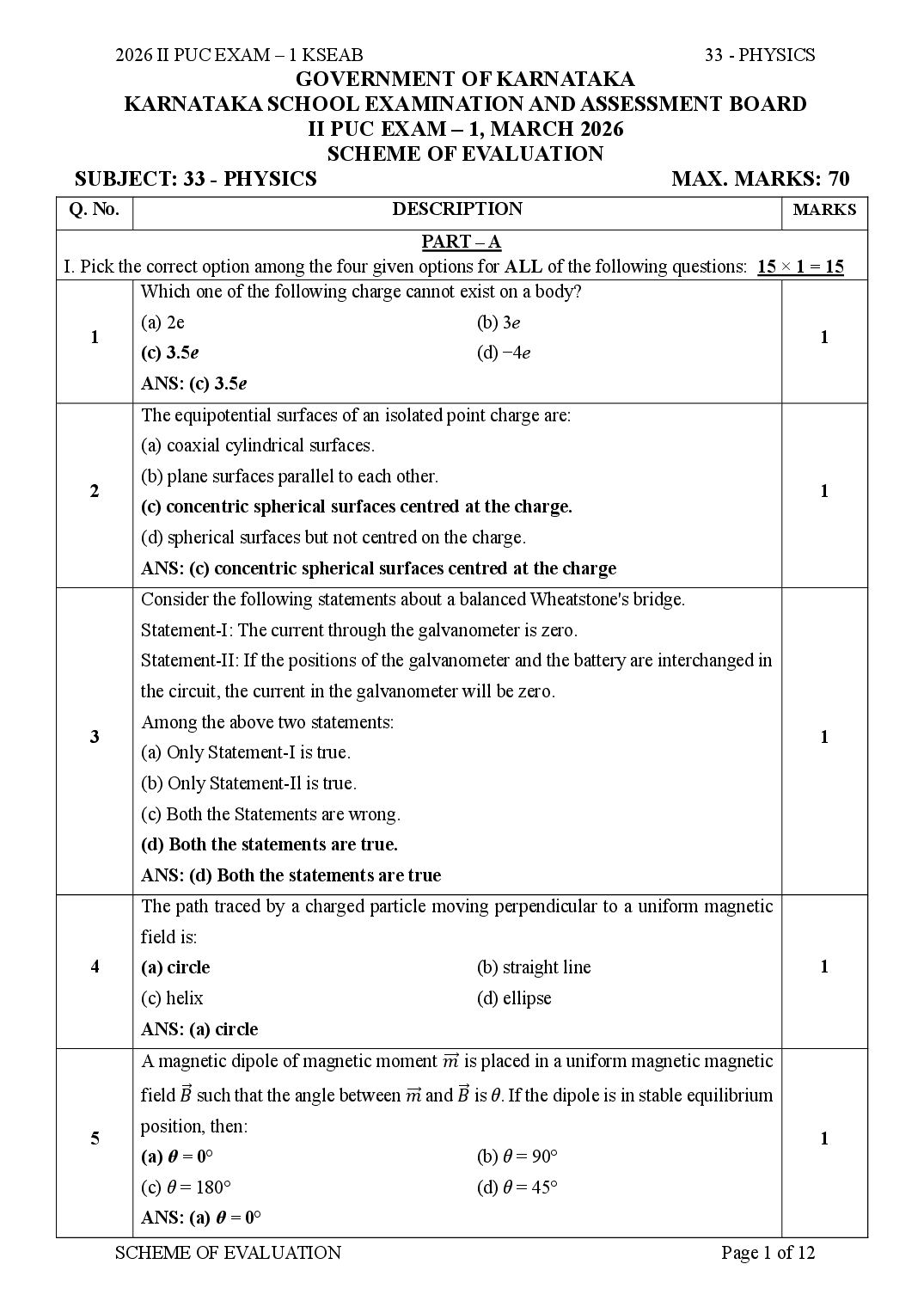
Page 1
GOVERNMENT OF KARNATAKA
KARNATAKA SCHOOL EXAMINATION AND ASSESSMENT BOARD
II PUC EXAM – 1, MARCH 2026
SCHEME OF EVALUATION
SUBJECT: 33 - PHYSICS MAX. MARKS: 70
Q. No. DESCRIPTION MARKS
PART – A
I. Pick the correct option among the four given options for ALL of the following questions: 15 × 1 = 15
Which one of the following charge cannot exist on a body?
(a) 2e (b) 3e
1 1
(c) 3.5e (d) −4e
ANS: (c) 3.5e
The equipotential surfaces of an isolated point charge are:
(a) coaxial cylindrical surfaces.
(b) plane surfaces parallel to each other.
2 1
(c) concentric spherical surfaces centred at the charge.
(d) spherical surfaces but not centred on the charge.
ANS: (c) concentric spherical surfaces centred at the charge
Consider the following statements about a balanced Wheatstone's bridge.
Statement-I: The current through the galvanometer is zero.
Statement-II: If the positions of the galvanometer and the battery are interchanged in
the circuit, the current in the galvanometer will be zero.
Among the above two statements:
3 1
(a) Only Statement-I is true.
(b) Only Statement-Il is true.
(c) Both the Statements are wrong.
(d) Both the statements are true.
ANS: (d) Both the statements are true
The path traced by a charged particle moving perpendicular to a uniform magnetic
field is:
4 (a) circle (b) straight line 1
(c) helix (d) ellipse
ANS: (a) circle
A magnetic dipole of magnetic moment 𝑚
⃗⃗ is placed in a uniform magnetic magnetic
⃗ such that the angle between 𝑚
field 𝐵 ⃗ is θ. If the dipole is in stable equilibrium
⃗⃗ and 𝐵
position, then:
5 1
(a) θ = 0° (b) θ = 90°
(c) θ = 180° (d) θ = 45°
ANS: (a) θ = 0°
SCHEME OF EVALUATION Page 1 of 12
Page 2
The working principle of an A.C. generator is:
(a) mutual induction. (b) eddy currents.
6 1
(c) self-induction. (d) electromagnetic induction.
ANS: (d) electromagnetic induction
Power factor of a series LCR circuit is maximum when:
(a) 𝑿𝑳 = 𝑿𝑪 (b) 𝑋𝐶 = 0
7 1
(c) 𝑋𝐿 > 𝑋𝐶 (d) 𝑋𝐿 < 𝑋𝐶
ANS: (a) 𝑿𝑳 = 𝑿𝑪
Displacement current is produced due to:
(a) constant electric field. (b) constant magnetic field.
8 1
(c) changing electric field. (d) changing magnetic field.
ANS: (c) changing electric field
For total internal reflection of light:
(a) light should be travelling from rarer medium to denser medium.
(b) light should be travelling from denser medium to rarer medium.
9 1
(c) light should be incident along the normal.
(d) angle of incidence should be equal to 90°.
ANS: (b) light should be travelling from denser medium to rarer medium
The angle of minimum deviation of a prism depends on:
(i) refractive index of the material of the prism;
(ii) refractive index of surrounding medium;
10 (iii) refracting angle of the prism. 1
(a) Only option (i) (b) Only option (ii)
(c) Only option (iii) (d) All (i), (ii) and (iii)
ANS: (d) All (i), (ii) and (iii)
According to Huygen's principle, speed of the secondary wavelets is:
(a) twice that of the wave. (b) zero.
11 1
(c) same as that of the wave. (d) infinite.
ANS: (c) same as that of the wave
An α-particle, a proton, an electron and a neutron are moving with the same velocity.
Then the particle having longest de Broglie wavelength is:
12 (a) proton. (b) electron. 1
(c) neutron. (d) α-particle.
ANS: (b) electron
Let K be the kinetic energy, U be the potential energy and E be the total energy of an
electron revolving around the nucleus in a hydrogen atom, then which of the following
is correct?
13 1
(a) K > 0, U > 0, E > 0 (b) K > 0, U < 0, E < 0
(c) K > 0, U > 0, E < 0 (d) K < 0, U < 0, E < 0
ANS: (b) K > 0, U < 0, E < 0
SCHEME OF EVALUATION Page 2 of 12
Page 3
An example for isobars is:
(a) 21H and 31H (b) 21H and 42He
14 1
(c) 198 197
80Hg and 79Au (d) 𝟑𝟏𝑯 and 𝟑𝟐𝑯𝒆
ANS: (d) 𝟑𝟏𝐇 and 𝟑𝟐𝐇𝐞
Which of the following pairs are elemental semiconductors?
(a) Silicon and aluminium (b) Silicon and germanium
15 1
(c) Germanium and cadmium (d) Aluminium and cadmium
ANS: (b) Silicon and germanium
II. Fill in the blanks by choosing appropriate answer from the given options for all the following
questions: 5×1=5
(photons, diffraction, polarity, monopoles, greater than unity, less than unity)
16 According to Gauss's law in magnetism, magnetic monopoles are not known to exist. 1
17 Lenz's law gives the polarity of induced emf. 1
For a step-down transformer, the ratio of primary current to secondary current is less
18 1
than unity.
The bending of light around the corners and entering into the geometric shadow region
19 1
is called diffraction.
In interaction with matter, light behaves as if it is made up of packets of energy called
20 1
photons.
PART - B
III. Answer ANY FIVE of the following questions: 5 × 2 = 10
Write any two properties of electric field lines.
(i) Electric field lines start from positive charge and end on negative charge.
(ii) In charge free region, electric field lines are continuous curves without any breaks.
(iii) Electrostatic field lines do not form closed loops.
1
(iv) Electric field lines do not intersect each other.
21 +
(v) Tangent to the electric field line at any point gives the direction of electric field at
1
that point.
(vi) The density of field lines at any point is a measure of the electric field at that
point.
(Any two; Any other correct property has to be considered)
What is electrostatic shielding? Mention one use of it.
The electric field inside the cavity of a conductor is zero (OR Electrostatic field inside 1
22 a conductor is zero). This is called electrostatic shielding.
Sensitive electric instruments are placed inside metal enclosures to preserve them 1
from outside electric influence.
SCHEME OF EVALUATION Page 3 of 12
Page 4
How does the resistivity of a semiconductor vary if its temperature is increased?
Also show the variation graphically.
As the temperature increases, the resistivity of a semiconductor decreases. 1
23
1
A thin long straight wire carries a current of 5 A. Calculate the magnitude of the
magnetic field at a distance of 0.25 m from the wire. (μο = 4π × 10-7 Hm-1)
The magnitude of the magnetic field at a point due to a straight wire,
24 𝜇𝑜 𝐼 1
𝐵=
2𝜋𝑟
−7
(4𝜋 × 10 )(5)
⟹𝐵= = 4 × 10⁻⁶ T 1
(2𝜋)(0.25)
Write the expression for the motional emf induced in a straight conductor
moving perpendicular to a uniform magnetic field. Explain the terms.
25 Motional emf,
1
𝜀 = 𝐵𝑙𝑣
where B = magnetic field; l = length of the rod; v = speed of the rod 1
Name the electromagnetic waves used in:
i) the radar systems of aircrafts. ii) the laser assisted eye surgery (LASIK).
26
Radar system of aircrafts → Microwaves 1
LASIK surgery → Ultraviolet rays 1
Define impact parameter. What is the angle of scattering of an α-particle for zero
impact parameter?
27 The impact parameter is the perpendicular distance of the initial velocity vector of the 1
α-particle from the centre of the target nucleus.
Angle of scattering is 180°. 1
List out two differences between p-type and n-type semiconductors.
p – type semiconductors n – type semiconductors
1. They are obtained by doping pure
1. They are obtained by doping pure
semiconductors with pentavalent
semiconductors with trivalent impurity.
impurity. 1
28
2. Holes are the majority charge 2. Electrons are the majority charge +
carriers. carriers. 1
3. Electrons are the minority charge 3. Holes are the minority charge
carriers. carriers.
(Any two; Any other correct difference must be considered)
SCHEME OF EVALUATION Page 4 of 12
Page 5
PART - C
IV. Answer ANY FIVE of the following questions: 5 × 3 = 15
Give Coulomb's law in vector form and explain the terms. Define SI unit of
charge.
Electrostatic force on charge 𝑞2 by charge 𝑞1 is:
1 𝑞1 𝑞2
𝐹21 = 1
4𝜋𝜀𝑜 𝑟212 𝑟̂21
29 where 𝑞1 , 𝑞2 are charges, 𝑟21 is the distance between the charges, 𝑟̂21 is the unit vector 1
in the direction from 𝑞1 towards 𝑞2 .
One coulomb is the charge on two identical point charges which are separated by a
1
distance of 1 m in vacuum experience an electric force of repulsion of 9 × 10⁹ N.
(The definition: One coulomb is the charge flowing through a wire in 1 s if the
current is 1 A should also be considered)
What is a capacitor? Mention any two factors on which capacitance of a parallel
plate capacitor depends.
A capacitor is a system of two conductors separated by an insulator. 1
(OR Capacitor is a device that is used to store charges.)
Capacitance of a capacitor depends on:
30
(i) Area of the plates; 1
(ii) Distance between the plates; +
(iii) Medium between the plates (or dielectric constant of the medium between the 1
plates).
(Any two factors)
With the help of a circuit diagram, explain how to convert a galvanometer into a
voltmeter.
A galvanometer can be converted into a voltmeter by connecting a suitable high 1
resistance in series with it.
The circuit diagram is as shown below:
1
31
The value of the series resistance is given by:
1
𝑉
𝑅 = −𝐺
𝐼𝑔
where V = range of the voltmeter; Ig = maximum current through the galvanometer
and G = resistance of the galvanometer. (Other symbols should also be considered)
SCHEME OF EVALUATION Page 5 of 12
Page 6
Differentiate between diamagnetic and ferromagnetic materials.
Diamagnetic Materials Ferromagnetic Materials
(i) These are the materials that are (i) These are the materials that are
weakly repelled by a magnetic field. strongly attracted by a magnetic field.
(ii) Magnetic susceptibility values for (ii) Magnetic susceptibility values for
them is negative. (OR 𝜒𝑚 < 0) them is positive. (OR 𝜒𝑚 ≫ 0)
(iii) Relative permeability values for (iii) Relative permeability values for 1
them have ranges 0 ≤ 𝜇𝑟 < 1. them have ranges 𝜇𝑟 > 1. +
32 (iv) There is no formation of domains. (iv) There is formation of domains. 1
(v) Atoms of these materials do not (v) Atoms of these materials have net +
have net magnetic moment. magnetic moment. 1
(vi) When placed in an external (vi) When placed in an external
magnetic field, the magnetic field magnetic field, the magnetic field
inside these materials is very much less inside these materials is very much
than the value of the field outside. greater than the value of the field
outside.
(Any three; Any other correct difference has to be considered)
Obtain the expression for energy stored in an inductor.
During setting-up a current of I in a coil of self-inductance L, the instantaneous power
is:
𝑑𝑖
𝑝 = |𝜀|𝑖 = 𝐿𝑖 1
𝑑𝑡
33 Therefore, the magnetic energy stored in the coil (which is equal to energy spent in
the process) is:
𝐼
𝑑𝑖 1
𝑈 = ∫ 𝑝 𝑑𝑡 = ∫ 𝐿𝑖
𝑑𝑡
0
1 2 1
⟹𝑈= 𝐿𝐼
2
A refracting telescope has an objective lens of focal length 144 cm and the length
of the tube is 150 cm. Calculate the magnification due to the telescope.
Given: 𝑓𝑜 = 144 cm; 𝐿 = 150 cm
We know that:
𝐿 = 𝑓𝑜 + 𝑓𝑒
34 ⟹ 𝑓𝑒 = 𝐿 − 𝑓𝑜 = 150 − 144 = 6 cm. 1
The magnification is:
𝑓𝑜 1
𝑚=
𝑓𝑒
144 1
⟹𝑚= = 24
6
SCHEME OF EVALUATION Page 6 of 12
Page 7
Write the experimental observations of photoelectric effect.
The experimental observations of photoelectric effect are:
(i) Photoelectric effect is an instantaneous process.
(ii) For a given frequency of incident light, photoelectric current is directly
1
proportional to the intensity of incident light.
(iii) For any metal surface there exists a minimum frequency of incident light (or +
35 threshold frequency) below which there is no photoelectric emission. 1
(iv) Above threshold frequency, the maximum kinetic energy (or stopping potential) +
of photoelectrons is directly proportional to the frequency of incident light. 1
(v) The maximum kinetic energy of photoelectrons is independent of the intensity of
the incident light when the frequency is kept constant.
(vi) The photoelectric current is independent of the frequency of incident radiation.
(Any three)
List three conclusions drawn from observations of binding energy per nucleon
versus mass number curve.
1
The conclusions that can be drawn from the observations of binding energy curve are:
(i) Nuclear force is attractive and strong force. +
36 (ii) Nuclear force is short ranged. 1
(iii) Nuclear force shows the property of saturation. +
(iv) Light nuclei undergo nuclear fusion to release energy. 1
(v) Heavy nuclei undergo nuclear fission to release energy.
(Any three)
PART - D
V. Answer ANY THREE of the following questions: 3 × 5 = 15
Arrive at the expression for the electric field at a point due to an infinitely long
uniformly charged straight wire using Gauss's law.
Consider an infinitely long uniformly charged straight wire with uniform linear charge
density λ. Let us calculate the electric field at point P at a distance r from this wire.
We will consider a cylindrical gaussian surface of radius r and length l as shown in
the figure.
37
1
SCHEME OF EVALUATION Page 7 of 12
Page 8
By definition, electric flux through this cylinder is given by:
𝜙𝐸 = ∫ 𝐸⃗ ∙ 𝑑𝐴 = 𝐸 × 2𝜋𝑟𝑙 1
By Gauss’s law in electrostatics, flux though the closed surface is:
𝑞𝑒𝑛𝑐
𝜙𝐸 = 1
𝜀𝑜
But enclosed charge, 𝑞𝑒𝑛𝑐 = 𝜆𝑙.
𝜆𝑙 1
⟹ 𝜙𝐸 =
𝜀𝑜
Comparing the two equations, we get:
𝜆𝑙
𝐸 × 2𝜋𝑟𝑙 =
𝜀𝑜
𝜆 1
⟹𝐸=
2𝜋𝜀𝑜 𝑟
Obtain the expression for equivalent emf and equivalent internal resistance of
two cells of different emfs and different internal resistances connected in series.
Consider two cells 𝜀1 , 𝑟1 and 𝜀2 , 𝑟2 connected in series as shown in the figure. Let the
equivalent cell be 𝜀𝑒𝑞 , 𝑟𝑒𝑞 . Let the terminal potential differences for the first cell be
V1, for the cell be V2 and for combination be V.
1
38
For the first cell, 𝑉1 = 𝜀1 − 𝐼 𝑟1 and for the second cell, 𝑉2 = 𝜀2 − 𝐼 𝑟2. 1
As the cells are in series, 𝑉 = 𝑉1 + 𝑉2 .
⟹ 𝑉 = (𝜀1 − 𝐼 𝑟1 ) + (𝜀2 − 𝐼 𝑟2 ) = (𝜀1 + 𝜀2 ) − 𝐼(𝑟1 + 𝑟2 ). 1
For the equivalent cell, 𝑉 = 𝜀𝑒𝑞 − 𝐼 𝑟𝑒𝑞 . 1
By comparing the last two equations, we get:
𝜀𝑒𝑞 = 𝜀1 + 𝜀2 and 𝑟𝑒𝑞 = 𝑟1 + 𝑟2 1
Derive the expression for the magnitude of the magnetic field at a point on the
axis of a circular loop carrying current.
Consider a circular loop of radius R carrying a current I placed in YZ plane. Let us
calculate the magnetic field at a point P along the axis of the loop. The distance of the
point P from the centre of the circular loop is x.
39
1
SCHEME OF EVALUATION Page 8 of 12
Page 9
The magnitude of the magnetic field at P due to a small element of the loop shown is:
𝜇𝑜 𝐼|𝑑𝑙 × 𝑟| 𝜇𝑜 𝐼 𝑑𝑙 1
𝑑𝐵 = =
4𝜋 𝑟3 4𝜋 𝑟 2
When we add 𝑑𝐵 ⃗ to get the total magnetic field at P, the vertical components of 𝑑𝐵
⃗
1
cancel and horizontal components (along x - axis) get added up.
⃗ is:
The x - component of 𝑑𝐵
𝜇𝑜 𝐼 𝑑𝑙
𝑑𝐵𝑥 = cos 𝜃
4𝜋 𝑟 2
The total magnetic field at P is:
𝜇𝑜 𝐼 𝑑𝑙
𝐵 = ∑ 𝑑𝐵𝑥 = ∑ cos 𝜃 1
4𝜋 𝑟 2
𝑅
But ∑ 𝑑𝑙 = 2𝜋𝑅, cos 𝜃 = 𝑟 and 𝑟 = (𝑅 2 + 𝑥 2 )1⁄2 . Substituting these into the above
equation, we get:
𝜇𝑜 𝐼𝑅 2 1
𝐵=
2(𝑅 2 + 𝑥 2 )3⁄2
𝟏 𝟏 𝟏
Derive mirror equation 𝒖 + 𝒗 = 𝒇 for a concave mirror.
Consider an object AB placed on the principal axis of a concave mirror as shown in
the figure. The ray diagram for image formation for paraxial rays is as shown in the
figure. A’B’ is the image of the object as shown. F is the focal point of the mirror. u is
the object distance and v is the image distance.
1
40
From tringles triangles A’B’F and MPF,
B′ A′ B′ F B′ A′ B ′ F B′ A′ B′ F 1
= ⟹ = ⟹ =
PM FP AB FP BA FP
Also from triangles A’B’P and ABP,
B′ A′ B ′ P 1
=
BA BP
B P − FP B′ P
′
⟹ = 1
FP BP
From figure, B’P = – v, BP = – u and FP = – f.
Substituting these and rearranging, we get:
1 1 1
+ = 1
𝑢 𝑣 𝑓
SCHEME OF EVALUATION Page 9 of 12
Page 10
What is half wave rectifier? Describe with a circuit diagram, the working of a
semiconductor diode as a half wave rectifier Draw input and output waveforms.
A half-wave rectifier is a device (circuit) that rectifies only one half cycle of AC. 1
Construction: The circuit diagram for a half-wave rectifier using a diode and a
transformer is as shown below.
1
Working: During positive half cycle of AC, A is positive and B is negative. The diode 1
becomes forward biased and it conducts. The output appears across the resistance RL.
41
During negative half cycle of AC, A becomes negative and B becomes positive. The 1
diode is reverse biased, and it does not conduct. No output appears in this case.
The input and output waveforms are as shown in the figure.
1
VI. Answer ANY TWO of the following questions: 2 × 5 = 10
Two charges 5 × 10⁻⁸ C and – 3 × 10⁻⁸ C are located 16 cm apart in vacuum. Find
the positions along the line passing through the two charges at which the electric
potential is zero.
Electric potential due to a point charge,
1 𝑄 1
𝑉=
42 4𝜋𝜀𝑜 𝑟
SCHEME OF EVALUATION Page 10 of 12
Page 11
Let the potential be zero at points A and B around the charge of smaller magnitude.
For 𝑉𝐴 = 0,
1 𝑞1 1 𝑞2 1
+ =0
4𝜋𝜀𝑜 16 − 𝑥 4𝜋𝜀𝑜 𝑥
5 × 10⁻⁸ −3 × 10⁻⁸ 5 3
⟹ + =0⟹ − =0
16 − 𝑥 𝑥 16 − 𝑥 𝑥
⟹ 𝑥 = 6 cm 1
For 𝑉𝐵 = 0,
1 𝑞1 1 𝑞2
+ =0 1
4𝜋𝜀𝑜 16 + 𝑦 4𝜋𝜀𝑜 𝑦
5 × 10⁻⁸ −3 × 10⁻⁸ 5 3
⟹ + =0⟹ − =0
16 + 𝑦 𝑦 16 + 𝑦 𝑦
⟹ 𝑦 = 24 cm 1
(Distances from 5 × 10⁻⁸ C charge are 10 cm and 40 cm to be considered)
(Any other correct alternative should be considered)
The power dissipated across a wire of length 0.5 m and area of cross-section
0.2 × 10⁻⁶ m2 is 10 W when a steady current flows through it. Calculate the
following quantities:
(Given: resistivity of the material of the wire is 1 × 10⁻⁶ Ω m)
i) Resistance of the wire.
ii) The current flowing through the wire:
iii) The current density for the wire.
Given: l = 0.5 m, A = 0.2 × 10⁻⁶ m2, P = 10 W, ρ = 1 × 10⁻⁶ Ω m
(i) Resistance of the wire,
𝜌𝑙 1
𝑅=
43 𝐴
−6
(1 × 10 ) × (0.5)
⟹𝑅= = 2.5 Ω 1
0.2 × 10⁻⁶
(ii) Current through the wire,
𝑃 = 𝐼2𝑅 1
𝑃 10 1
⟹𝐼=√ =√ = 2A
𝑅 2.5
(iii) Current density is:
𝐼 2 1
𝐽= = = 10 × 106 Am−2 (𝑂𝑅 1 × 10⁷ Am−2 )
𝐴 0.2 × 10⁻⁶
(Any other correct alternative should be considered)
An inductor and a resistor are connected in series with 200 V, 50 Hz a.c. source.
44 The current in the circuit is 2 A and voltage leads the current by π/3. Calculate
the inductance of the inductor.
SCHEME OF EVALUATION Page 11 of 12
Page 12
Given: ϕ = – π/3, I = 2 A, V = 200 V, f = 50 Hz.
Impedance of the circuit,
𝑉 200 1
𝑍= = = 100 Ω
𝐼 2
𝑋𝐿
sin 𝜙 = 1
𝑍
𝜋 𝑋𝐿 √3
⟹ sin = ⟹ 𝑋𝐿 = 𝑍
3 𝑍 2
⟹ 𝑋𝐿 = 86.6 Ω 1
𝑋𝐿 = 2𝜋𝑓𝐿 1
𝑋𝐿 86.6
𝐿= = = 0.276 H 𝐎𝐑 0.28 H 1
2𝜋𝑓 2𝜋 × 50
(Any other correct alternative should be considered)
A beam of light consisting of two wavelengths 500 nm and 600 nm is used to
obtain interference fringes in Young's double slit experiment. Distance between
the slits is 1 mm and the screen is placed at a distance of 1.2 m from the slits.
i) Find the least distance between the central maximum and the point where the
bright fringes due to both the wavelengths coincide.
ii) Find the distance of the third dark fringe from the central bright fringe for
the first wavelength.
Given: 𝜆1 = 500 nm, 𝜆2 = 600 nm, 𝑑 = 1mm, 𝐷 = 1.2 m
(i) Fringes coinciding ⟹
𝑛1 𝜆1 𝐷 𝑛2 𝜆2 𝐷
=
𝑑 𝑑
𝑛1 𝜆2 600 6
= = =
𝑛2 𝜆1 500 5
45 Minimum distance ⟹ 𝑛1 = 6; 𝑛2 = 5. 1
Required distance,
𝑛1 𝜆1 𝐷
𝑥= 1
𝑑
(6) × (500 × 10−9 ) × (1.2)
⟹𝑥= = 3.6 × 10⁻³ m 1
(1 × 10⁻³ )
(ii) The distance of the third dark fringe from the central bright fringe,
(2𝑛1 − 1)𝜆1 𝐷
𝑥′ = 1
2𝑑
(2 × 3 − 1) × (500 × 10−9 ) × (1.2)
⟹ 𝑥′ = = 1.5 × 10⁻³ m 1
2 × (1 × 10−3 )
1 𝜆𝐷
(For part (ii), using the formula 𝑥 ′ = (𝑛 + 2) 𝑑 with n = 2 to get the correct answer
should be considered)
(Any other correct alternative should be considered)
SCHEME OF EVALUATION Page 12 of 12
Document Details
| Board / Org | Karnataka Board |
| Exam | Class 12 |
| Type | Question Paper |
| Pages | 12 |
| Language | english |
| Updated | 24 Sep 2026 |