Edudel Syllabus Class 11 Biology
Finished viewing? Save it for later —
Download Edudel Syllabus Class 11 Biology (PDF · 4 pages)About Edudel Syllabus Class 11 Biology
Edudel Syllabus Class 11 Biology is available here for free download. Published by Delhi School Education for Class 11, this syllabus can be viewed online or downloaded as a PDF (4 pages). Candidates preparing for Class 11 can use Edudel Syllabus Class 11 Biology to understand the exam pattern, the type of questions asked, and the overall difficulty level.
Frequently Asked Questions
How can I download Edudel Syllabus Class 11 Biology?
Open this page and click the Download button to save Edudel Syllabus Class 11 Biology as a PDF. It is completely free on AglaSem Docs.
Is Edudel Syllabus Class 11 Biology free to download?
Yes. Edudel Syllabus Class 11 Biology can be viewed online and downloaded as a PDF free of cost on AglaSem Docs.
How many pages does Edudel Syllabus Class 11 Biology have?
Edudel Syllabus Class 11 Biology contains 4 pages, which you can read online or download together as a single PDF.
Where can I find more Class 11 study material?
You can find more Class 11 question papers, sample papers, syllabus, and answer keys on AglaSem Docs.
Edudel Syllabus Class 11 Biology – Text
Read the full text of this syllabus below — useful to quickly search, copy and reference the content online without downloading the PDF.
📄 View text version (3 pages)
Page 1
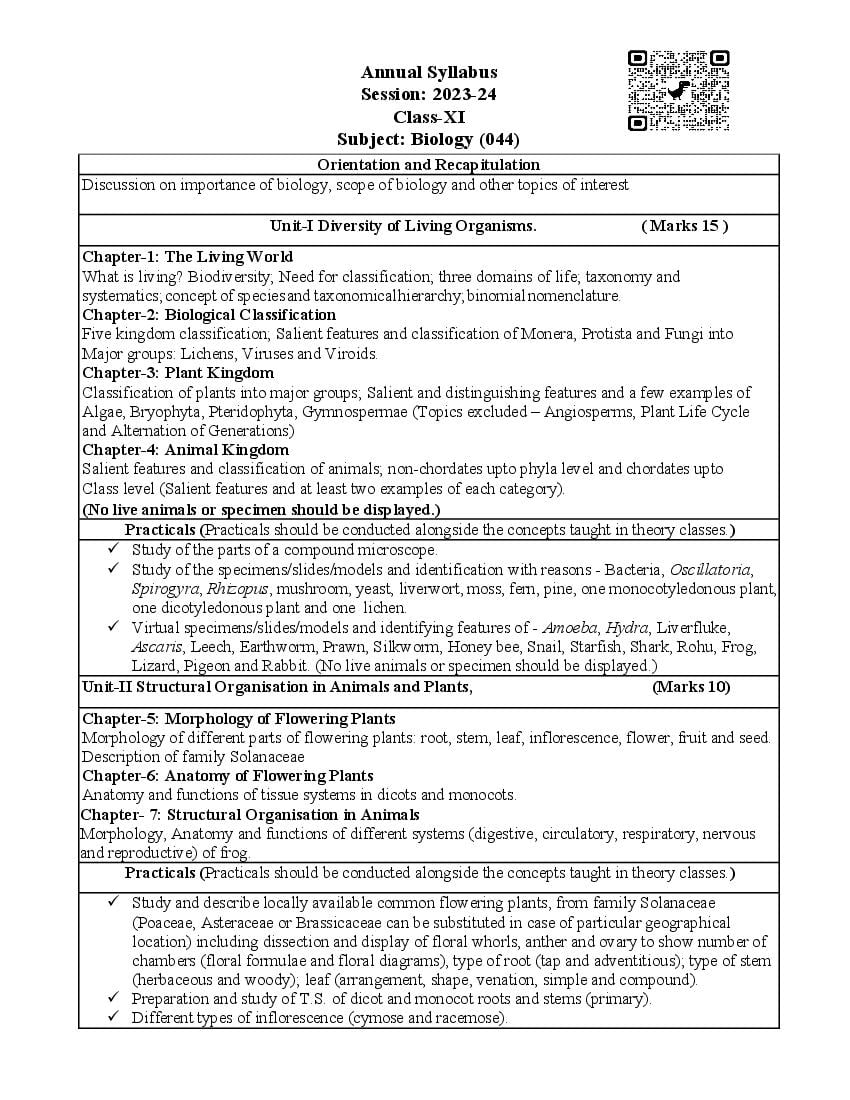
Session: 2023-24
Class-XI
Subject: Biology (044)
Orientation and Recapitulation
Discussion on importance of biology, scope of biology and other topics of interest
Unit-I Diversity of Living Organisms. ( Marks 15 )
Chapter-1: The Living World
What is living? Biodiversity; Need for classification; three domains of life; taxonomy and
systematics; concept of species and taxonomical hierarchy; binomial nomenclature.
Chapter-2: Biological Classification
Five kingdom classification; Salient features and classification of Monera, Protista and Fungi into
Major groups: Lichens, Viruses and Viroids.
Chapter-3: Plant Kingdom
Classification of plants into major groups; Salient and distinguishing features and a few examples of
Algae, Bryophyta, Pteridophyta, Gymnospermae (Topics excluded – Angiosperms, Plant Life Cycle
and Alternation of Generations)
Chapter-4: Animal Kingdom
Salient features and classification of animals; non-chordates upto phyla level and chordates upto
Class level (Salient features and at least two examples of each category).
(No live animals or specimen should be displayed.)
Study of the parts of a compound microscope.
Study of the specimens/slides/models and identification with reasons - Bacteria, Oscillatoria,
Spirogyra, Rhizopus, mushroom, yeast, liverwort, moss, fern, pine, one monocotyledonous plant,
one dicotyledonous plant and one lichen.
Virtual specimens/slides/models and identifying features of - Amoeba, Hydra, Liverfluke,
Ascaris, Leech, Earthworm, Prawn, Silkworm, Honey bee, Snail, Starfish, Shark, Rohu, Frog,
Lizard, Pigeon and Rabbit. (No live animals or specimen should be displayed.)
Unit-II Structural Organisation in Animals and Plants, (Marks 10)
Chapter-5: Morphology of Flowering Plants
Morphology of different parts of flowering plants: root, stem, leaf, inflorescence, flower, fruit and seed.
Description of family Solanaceae
Chapter-6: Anatomy of Flowering Plants
Anatomy and functions of tissue systems in dicots and monocots.
Chapter- 7: Structural Organisation in Animals
Morphology, Anatomy and functions of different systems (digestive, circulatory, respiratory, nervous
and reproductive) of frog.
Study and describe locally available common flowering plants, from family Solanaceae
(Poaceae, Asteraceae or Brassicaceae can be substituted in case of particular geographical
location) including dissection and display of floral whorls, anther and ovary to show number of
chambers (floral formulae and floral diagrams), type of root (tap and adventitious); type of stem
(herbaceous and woody); leaf (arrangement, shape, venation, simple and compound).
Preparation and study of T.S. of dicot and monocot roots and stems (primary).
Different types of inflorescence (cymose and racemose).
Page 2
Chapter-8: Cell-The Unit of Life
Cell theory and cell as the basic unit of life: Structure of prokaryotic and eukaryotic cells; Plant cell and
animal cell; cell envelope; cell membrane, cell wall; cell organelles - structure and function;
endomembrane system, endoplasmic reticulum, golgi bodies, lysosomes, vacuoles; mitochondria,
ribosomes, plastids, microbodies; cytoskeleton, cilia, flagella, centrioles (ultra-structure and function);
nucleus.
Note: Completion of mid-term syllabus by 15th September 2023.
MID-TERM EXAMINATION-2023
Chapter-9: Biomolecules
Chemical constituents of living cells: biomolecules, structure and function of proteins, carbohydrates,
lipids, nucleic acids; Enzyme - types, properties, enzyme action. (Topics excluded: Nature of Bond
Linking Monomers in a Polymer, Dynamic State of Body Constituents – Concept of Metabolism,
Metabolic Basis of Living, The Living State).
Chapter-10: Cell Cycle and Cell Division
Cell cycle, mitosis, meiosis and their significance
Mitosis in onion root tip cells and animal cells (grasshopper) from permanent slides
Test for the presence of sugar, starch, proteins and fats in suitable plant and animal materials.
Unit IV : Plant Physiology (Marks: 12 )
Chapter-13: Photosynthesis in Higher Plants: Photosynthesis as a means of autotrophic nutrition;
site of photosynthesis, pigments involved in photosynthesis (elementary idea); photochemical and
biosynthetic phases of photosynthesis; cyclic and non- cyclic photophosphorylation; chemiosmotic
hypothesis; photorespiration; C3 and C4 pathways; factors affecting photosynthesis.
Chapter-14: Respiration in Plants:
Exchange of gases; cellular respiration- glycolysis, fermentation (anaerobic), TCA cycle and Electron
Transport system (aerobic); energy relations - number of ATP molecules generated; amphibolic pathways;
respiratory quotient.
Chapter-15: Plant - Growth and Development
Seed germination; phases of plant growth and plant growth rate; conditions of growth; differentiation,
dedifferentiation and redifferentiation; sequence of developmental processes in a plant cell; growth
regulators - auxin, gibberellin, cytokinin, ethylene, ABA.
Study of osmosis by potato osmometer
Study of plasmolysis in epidermal peels (e.g. Rhoeo/lily leaves or fleshy scale leaves of onion
bulb).
Separation of plant pigments through paper chromatography.
Study of distribution of stomata in the upper and lower surface of leaves.
Study of the rate of respiration in flower buds/leaf tissue and germinating seeds.
Comparative study of the rates of transpiration in the upper and lower surfaces of leaves
Unit – V : Human Physiology ( Marks: 18)
Chapter-17: Breathing and Exchange of Gases
Respiratory organs in animals (recall only); Respiratory system in humans; mechanism of breathing and its
regulation in humans - exchange of gases, transport of gases and regulation of respiration, respiratory
volume; disorders related to respiration - asthma, emphysema, occupational respiratory
disorders.
Page 3
Composition of blood, blood groups, coagulation of blood; composition of lymph and its function; human
circulatory system - Structure of human heart and blood vessels; cardiac cycle, cardiac output, ECG; double
circulation; regulation of cardiac activity; disorders of circulatory system- hypertension, coronary artery
disease, angina pectoris, heart failure.
Chapter-19: Excretory Products and Their Elimination
Modes of excretion - ammonotelism, ureotelism, uricotelism; human excretory system – structure and
function; urine formation, osmoregulation; regulation of kidney function - renin - angiotensin, atrial
natriuretic factor, ADH and diabetes insipidus; role of other organs in excretion; disorders - uraemia,
renal failure, renal calculi, nephritis; dialysis and artificial kidney, kidney transplant.
Chapter-20: Locomotion and Movement
Types of movement - ciliary, flagellar, muscular; skeletal muscle, contractile proteins and muscle
contraction; skeletal system and its functions; joints; disorders of muscular and skeletal systems -
myasthenia gravis, tetany, muscular dystrophy, arthritis, osteoporosis, gout.
Chapter-21: Neural Control and Coordination
Neuron and nerves; Nervous system in humans - central nervous system; peripheral nervous system and
visceral nervous system; generation and conduction of nerve impulse.
Chapter-22: Chemical Coordination and Integration
Endocrine glands and hormones; human endocrine system - hypothalamus, pituitary, pineal, thyroid,
parathyroid, adrenal, pancreas, gonads; mechanism of hormone action (elementary idea); role of
hormones as messengers and regulators, hypo - and hyperactivity and related disorders; dwarfism,
acromegaly, cretinism, goitre, exophthalmic goitre, diabetes, Addison's disease.
Note: Diseases related to all the human physiological systems to be taught in brief.
Test for presence of urea in urine.
Test for presence of sugar in urine.
Test for presence of albumin in urine.
Test for presence of bile salts in urine.
Human skeleton and different types of joints with the help of virtual images/models only.
Annual syllabus is to be completed by 31st January 2024.
Investigatory project and its submission.
REVISION of whole syllabus and Final Practical Exam.
COMMON ANNUAL SCHOOL EXAMINATION-2024
Document Details
| Board / Org | Delhi Board |
| Exam | Class 11 |
| Type | Syllabus |
| Pages | 4 |
| Updated | 22 Jul 2026 |