NIOS Class 12 April 2024 Question Paper Gender Studies
Finished viewing? Save it for later —
Download NIOS Class 12 April 2024 Question Paper Gender Studies (PDF · 23 pages)About NIOS Class 12 April 2024 Question Paper Gender Studies
NIOS Class 12 April 2024 Question Paper Gender Studies is available here for free download. Published by NIOS for National Institute of Open Schooling Class 12, this question paper can be viewed online or downloaded as a PDF (23 pages). Candidates preparing for National Institute of Open Schooling Class 12 can use NIOS Class 12 April 2024 Question Paper Gender Studies to understand the exam pattern, the type of questions asked, and the overall difficulty level.
Frequently Asked Questions
How can I download NIOS Class 12 April 2024 Question Paper Gender Studies?
Open this page and click the Download button to save NIOS Class 12 April 2024 Question Paper Gender Studies as a PDF. It is completely free on AglaSem Docs.
Is NIOS Class 12 April 2024 Question Paper Gender Studies free to download?
Yes. NIOS Class 12 April 2024 Question Paper Gender Studies can be viewed online and downloaded as a PDF free of cost on AglaSem Docs.
How many pages does NIOS Class 12 April 2024 Question Paper Gender Studies have?
NIOS Class 12 April 2024 Question Paper Gender Studies contains 23 pages, which you can read online or download together as a single PDF.
Where can I find more National Institute of Open Schooling Class 12 study material?
You can find more National Institute of Open Schooling Class 12 question papers, sample papers, syllabus, and answer keys on AglaSem Docs.
NIOS Class 12 April 2024 Question Paper Gender Studies – Text
Read the full text of this question paper below — useful to quickly search, copy and reference the content online without downloading the PDF.
📄 View text version (23 pages)
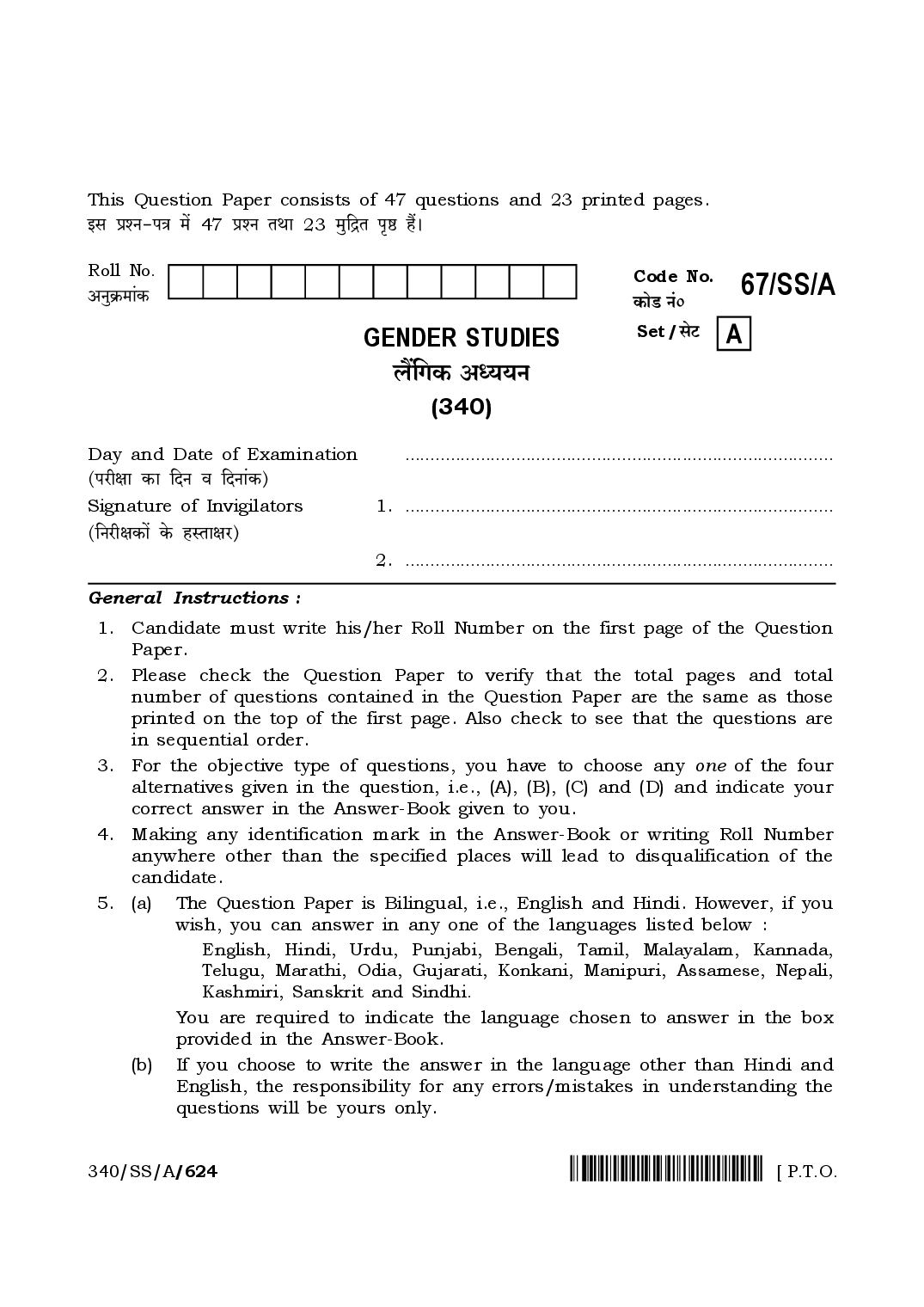
Page 1
Bg àíZ-nÌ ‘| 47 àíZ VWm 23 ‘w{ÐV n¥ð> h¢&
Roll No.
AZwH«$‘m§H$
Code No.
67/SS/A
u
H$moS> Z§0
Set / goQ>
GENDER STUDIES
b¢{JH$ Aܶ¶Z
(340)
Day and Date of Examination .....................................................................................
(narjm H$m {XZ d {XZm§H$)
Signature of Invigilators 1. .....................................................................................
({ZarjH$m| Ho$ hñVmja)
2. .....................................................................................
General Instructions :
1. Candidate must write his/her Roll Number on the first page of the Question
Paper.
2. Please check the Question Paper to verify that the total pages and total
number of questions contained in the Question Paper are the same as those
printed on the top of the first page. Also check to see that the questions are
in sequential order.
3. For the objective type of questions, you have to choose any one of the four
alternatives given in the question, i.e., (A), (B), (C) and (D) and indicate your
correct answer in the Answer-Book given to you.
4. Making any identification mark in the Answer-Book or writing Roll Number
anywhere other than the specified places will lead to disqualification of the
candidate.
5. (a) The Question Paper is Bilingual, i.e., English and Hindi. However, if you
wish, you can answer in any one of the languages listed below :
English, Hindi, Urdu, Punjabi, Bengali, Tamil, Malayalam, Kannada,
Telugu, Marathi, Odia, Gujarati, Konkani, Manipuri, Assamese, Nepali,
Kashmiri, Sanskrit and Sindhi.
You are required to indicate the language chosen to answer in the box
provided in the Answer-Book.
(b) If you choose to write the answer in the language other than Hindi and
English, the responsibility for any errors/mistakes in understanding the
questions will be yours only.
340/SS/A/624 [ P.T.O.
Page 2
Earphone or any such electronic devices in the Examination Hall.
7. In case of any doubt or confusion in the Question Paper, the English version
will prevail.
8. Write your Question Paper Code No. 67/SS/A, Set u on the Answer-Book.
gm‘mݶ AZwXoe …
1. narjmWu àíZ-nÌ Ho$ nhbo n¥ð> na AnZm AZwH«$‘m§H$ Adí¶ {bI|&
2. H¥$n¶m àíZ-nÌ H$mo Om±M b| {H$ àíZ-nÌ Ho$ Hw$b n¥ð>m| VWm àíZm| H$s CVZr hr g§»¶m h¡ {OVZr àW‘ n¥ð> Ho$
g~go D$na N>nr h¡& Bg ~mV H$s Om±M ^r H$a b| {H$ àíZ H«${‘H$ ê$n ‘| h¢&
3. dñVw{Zð> àíZm| _o§ AmnH$mo Mma {dH$ënm| (A), (B), (C) VWm (D) _| go H$moB© EH$ CÎma MwZZm h¡ VWm Xr JB©
CÎma-nwpñVH$m _| Amn ghr CÎma {bI|Ÿ&
4. CÎma-nwpñVH$m ‘| nhMmZ-{M• ~ZmZo AWdm {Z{X©ï> ñWmZm| Ho$ A{V[aº$ H$ht ^r AZwH«$‘m§H$ {bIZo na narjmWu H$mo
A¶mo½¶ R>ham¶m Om¶oJm&
5. (H$) n«íZ-nÌ Ho$db A§J«oOr/{hÝXr ‘mܶ‘ ‘| h¡& {’$a ^r, ¶{X Amn Mmh| Vmo ZrMo Xr JB© {H$gr EH$ ^mfm ‘|
CÎma Xo gH$Vo h¢ …
A§J«oOr, {hÝXr, CXÿ©, n§Om~r, ~§Jbm, V{‘b, ‘b¶mb‘, H$Þ‹S>, VobwJy, ‘amR>r, C{‹S>¶m, JwOamVr, H$m|H$Ur,
‘{Unwar, Ag{‘¶m, Zonmbr, H$í‘rar, g§ñH¥$V Am¡a {gÝYr&
H¥$n¶m CÎma-nwpñVH$m ‘| {XE JE ~m°³g ‘| {bI| {H$ Amn {H$g ^mfm ‘| CÎma {bI aho h¢&
(I) ¶{X Amn {hÝXr Ed§ A§J«oOr Ho$ A{V[aº$ {H$gr Aݶ ^mfm ‘| CÎma {bIVo h¢, Vmo àíZm| H$mo g‘PZo ‘| hmoZo dmbr
Ìw{Q>¶m|/Jb{V¶m| H$s {Oå‘oXmar Ho$db AmnH$s hmoJr&
6. narjmWu H$mo narjm hm°b ‘| H¡$ëHw$boQ>a, ‘mo~mBb ’$moZ, ãbwQy>W, B¶a’$moZ O¡go {H$gr ^r Bbo³Q´>m°{ZH$ CnH$aU H$mo
bo OmZo H$s AZw‘{V Zht h¡&
7. àíZ-nÌ ‘| {H$gr ^r àH$ma Ho$ g§Xoh AWdm Xþ{dYm H$s pñW{V ‘| A§J«oOr AZwdmX hr ‘mݶ hmoJm&
8. AnZr CÎma-nwpñVH$m na àíZ-nÌ H$s H$moS> Z§0 67/SS/A, goQ u {bI|&
340/SS/A/624 2
Page 3
b¢{JH$ Aܶ¶Z
(340)
Time : 3 Hours ] [ Maximum Marks : 100
g‘¶ … 3 KÊQ>o ] [ nyUmªH$ … 100
Note : (i) This question paper consists of 47 questions in all.
(ii) All questions are compulsory and carry marks as indicated against each
question.
(iii) Section—A consists of Question Numbers 1 to 30 as follows :
(a) Q. Nos. 1 to 20 are Multiple Choice Questions carrying 1 mark
each. For these questions, you have to choose the most appropriate
answer from amongst the four choices given as (A), (B), (C) and (D).
An internal choice has been provided in some of the questions. You
have to attempt only one of the given choices in such questions.
(b) Q. Nos. 21 to 30 are other Objective-type questions. Marks are
indicated against each question. Attempt as per instructions given
therein with each such question.
(iv) Section—B consists of Question Nos. 31 to 47 :
(a) Q. Nos. 31 to 37 are very short answer-type questions. Each
question carries 2 marks, to be answered in the range of 80 to
120 words.
(b) Q. Nos. 38 to 44 are short answer-type questions. Each question
carries 3 marks, to be answered in the range of 150 to 200 words.
(c) Q. Nos. 45 to 47 are long answer-type questions. Each question
carries 5 marks, to be answered in the range of 400 to
500 words.
{ZX}e … (i) Bg àíZ-nÌ ‘| Hw$b 47 àíZ h¢&
(ii) g^r àíZ A{Zdm¶© h¢& à˶oH$ àíZ Ho$ A§H$ Cg àíZ Ho$ gm‘Zo {XE JE h¢&
(iii) IÊS>–H$ ‘| àíZ g§»¶m 1 go 30 VH$ {ZåZmZwgma h¢ :
(a) àíZ g§»¶m 1 go 20 VH$ ~hþ{dH$ënr¶ àíZ h¢, {OZ‘| à˶oH$ àíZ 1 A§H$ H$m h¡& à˶oH$
àíZ ‘| {XE JE Mma {dH$ënm| (A), (B), (C) Am¡a (D)> ‘| go g~go Cn¶wº$ {dH$ën H$m M¶Z
H$a| Am¡a {bI|& BZ‘| go Hw$N> àíZm| ‘| Am§V[aH$ {dH$ën {X¶m J¶m h¡& AmnH$mo Eogo àíZm| ‘|
{XE JE {dH$ënm| ‘| go Ho$db EH$ H$m hr CÎma XoZm h¡&
340/SS/A/624 3 [ P.T.O.
Page 4
gm‘Zo {XE JE h¢& à˶oH$ àíZ Ho$ {bE {XE JE {ZX}em| Ho$ AZwgma BZ àíZm| Ho$ CÎma X|&
(iv) IÊS>–I ‘| àíZ g§»¶m 31 go 47 VH$ h¢ :
(a) àíZ g§»¶m 31 go 37, 2 A§H$ Ho$ A{V bKyÎmar¶ àH$ma Ho$ àíZ h¢, {OZHo$ CÎma 80 go
120 eãXm| ‘| XoZo h¢&
(b) àíZ g§»¶m 38 go 44, 3 A§H$ Ho$ bKyÎmar¶ àH$ma Ho$ àíZ h¢, {OZHo$ CÎma 150 go 200
eãXm| ‘| XoZo h¢&
(c) àíZ g§»¶m 45 go 47, 5 A§H$ Ho$ XrK©-CÎmar¶ àH$ma Ho$ àíZ h¢¢, {OZHo$ CÎma 400 go 500
eãXm| ‘| XoZo h¢&
(1) Answers of all questions are to be given in the Answer-Book given to you.
g^r àíZm| Ho$ CÎma AmnH$mo Xr JB© CÎma-nwpñVH$m ‘| hr {bI|&
(2) 15 minutes time has been allotted to read this question paper. The question
paper will be distributed at 2:15 p.m. From 2:15 p.m. to 2:30 p.m., the
students will read the question paper only and will not write any answer on
the Answer-Book during this period.
Bg àíZ-nÌ H$mo n‹T>Zo Ho$ {bE 15 {‘ZQ> H$m g‘¶ {X¶m J¶m h¡& àíZ-nÌ H$m {dVaU Xmonha ‘|
2:15 ~Oo {H$¶m OmEJm& Xmonha 2:15 ~Oo go 2:30 ~Oo VH$ N>mÌ Ho$db àíZ-nÌ H$mo n‹T>|Jo Am¡a
Bg Ad{Y Ho$ Xm¡amZ do CÎma-nwpñVH$m na H$moB© CÎma Zht {bI|Jo&
SECTION–A
IÊS>–H$
Answer all multiple choice questions :
g^r ~hþ{dH$ënr¶ àíZm| Ho$ CÎma Xr{OE :
1. (i) In America, women suffrage was granted in the year
(A) 1868 (B) 1869
(C) 1870 (D) 1871
A‘arH$m ‘| ‘{hbm ‘Vm{YH$ma H$mo {H$g df© ‘| ñdrH¥${V Xr JB©? 1
(A) 1868 (B) 1869
(C) 1870 (D) 1871
340/SS/A/624 4
Page 5
(A) 1874 (B) 1864
(C) 1856 (D) 1829
"gVr' àWm H$mo {H$g df© ‘| g‘má H$a {X¶m J¶m?
(A) 1874 (B) 1864
(C) 1856 (D) 1829
2. Who is the author of the book, Sex and Temperament in Three Primitive
Societies? 1
(A) B. B. Whiting (B) W. M. Whiting
(C) Margaret Mead (D) R. Brown
go³g E§oS> Q>|nam‘|Q> BZ W«r {à{‘{Q>d gmogmBQ>rO nwñVH$ Ho$ boIH$ H$m¡Z h¢?
(A) ~r0 ~r0 ìhmBqQ>J (B) S>ãë¶y0 E‘0 ìhmBqQ>J
(C) ‘mJ©aoQ> ‘rS> (D) Ama0 ~«mCZ
3. (i) Who published the book titled A History of Civilization in Ancient India? 1
(A) R. C. Dutt (B) P. C. Dutt
(C) Aurobindo Ghosh (D) P. C. Sarkar
{hñQ´>r Am°’$ {g{dbmBOoeZ BZ EpÝeE§Q> B§{S>¶m Zm‘H$ nwñVH$ H$mo {H$gZo àH$m{eV {H$¶m?
(A) Ama0 gr0 XÎm (B) nr0 gr0 XÎm
(C) Aa{~ÝXmo Kmof (D) nr0 gr0 gaH$ma
(ii) Which female character is not from the epic the Mahabharata?
(A) Kaikeyi (B) Madri
(C) Kunti (D) Draupadi
BZ‘| go H$m¡Z ‘hmH$mì¶ ‘hm^maV H$s ‘{hbm nmÌ Zht h¡?
(A) H¡$Ho$¶r (B) ‘mXar
(C) Hw§$Vr (D) Ðm¡nXr
340/SS/A/624 5 [ P.T.O.
Page 6
(A) Rama (B) Shiva
(C) Krishna (D) Brahma
‘ram~mB© {H$g ^JdmZ Ho$ gmW g§~§{YV h¢?
(A) am‘ (B) {ed
(C) H¥$îU (D) ~«÷m
5. Who established the first Dalit school? 1
(A) Raja Ram Mohan Roy (B) Jyotiba Phule
(C) Dr. Annie Besant (D) Bhikaiji Cama
àW‘ X{bV {dÚmb¶ H$s ñWmnZm {H$gZo H$s?
(A) amOm am‘‘mohZ am°¶ (B) Á¶mo{V~m ’w$bo
(C) S>m°0 EZr ~og|Q> (D) ^rH$mOr H$m‘m
6. (i) In which year did relations between Muslim League and Indian
National Congress become strained? 1
(A) 1920 (B) 1919
(C) 1924 (D) 1922
{H$g df© ‘| ‘wpñb‘ brJ Am¡a B§{S>¶Z ZoeZb H$m§J«og Ho$ [aíVm| Ho$ ~rM VZmd n¡Xm hþAm?
(A) 1920 (B) 1919
(C) 1924 (D) 1922
(ii) When did Sir Syed Ahmed Khan establish the All-Indian
Muhammadan Educational Conference?
(A) 1880 (B) 1886
(C) 1887 (D) 1882
ga g¡æ¶X Ah‘X ImZ Zo {H$g df© ‘| Am°b-B§{S>¶Z ‘whå‘X>Z EOwHo$eZb H$m°Z²’$aoÝg H$s
ñWmnZm H$s?
(A) 1880 (B) 1886
(C) 1887 (D) 1882
340/SS/A/624 6
Page 7
(A) Swarnakumari Ghosal (B) Kadambini Ganguly
(C) Sarojini Naidu (D) Raj Kumari Amrit Kaur
{~«{Q>e gm‘«mÁ¶ ‘| nhbr ‘{hbm ñZmVH$ H$m¡Z Wr?
(A) ñdU©Hw$‘mar Kmofmb (B) H$mXpå~Zr Jm§Jwbr
(C) gamo{OZr Zm¶Sy> (D) amOHw$‘mar A‘¥V H$m¡a
8. Polyandry is found among which of the following tribes? 1
(A) Khasis (B) Todas
(C) Santhals (D) Lechu
{ZåZ ‘o§ go {H$g OZOm{V ‘§o ~hþ{ddmh H$s àWm nmB© OmVr h¡?
(A) Imgr (B) Q>moS>m
(C) g§Wmb (D) boMy
9. (i) An example of matriarchal family is 1
(A) Khasi (B) Bhill
(C) Santhal (D) Lechu
‘mV¥gÎmmË‘H$ n[adma H$m EH$ CXmhaU h¡
(A) Imgr (B) ^rb
(C) g§Wmb (D) boMy
(ii) According to 73rd and 74th Constitutional Amendment, how much
percentage of seats are reserved in local government institutions?
(A) 32% (B) 31%
(C) 33% (D) 34%
73do§ Am¡a 74d§o g§d¡Ym{ZH$ g§emoYZ Ho$ AZwgma ñWmZr¶ gaH$mar g§ñWmAmo§ ‘| {H$VZo à{VeV grQ>§o
Ama{jV H$s JBª?
(A) 32% (B) 31%
(C) 33% (D) 34%
340/SS/A/624 7 [ P.T.O.
Page 8
was founded in the year 1
(A) 1971 (B) 1972
(C) 1961 (D) 1962
^maV ‘| Jar~ ñd{Z¶mo{OV ‘{hbm H$‘©Mm[a¶mo§ Ho$ {bE ~Zr Q´>oS> ¶y{Z¶Z "godm' H$s ñWmnZm {H$g
df© ‘o§ hþB©?
(A) 1971 (B) 1972
(C) 1961 (D) 1962
(ii) Who is known as the ‘Nightingale of India’ ?
(A) Raj Kumari Amrit Kaur (B) Sucheta Kripalani
(C) Sarojini Naidu (D) Aruna Asaf Ali
"^maV H$s H$mo{H$bm' Ho$ Zm‘ go {H$go OmZm OmVm h¡?
(A) amOHw$‘mar A‘¥V H$m¡a (B) gwMoVm H¥$nbmZr
(C) gamo{OZr Zm¶Sy> (D) AéUm Amg’$ Abr
11. Night blindness is caused due to the deficiency of which vitamin? 1
(A) Vitamin C (B) Vitamin B
(C) Vitamin D (D) Vitamin A
"aVm¡§Yr' {H$g {dQ>m{‘Z H$s H$‘r Ho$ H$maU hmoVr h¡?
(A) {dQ>m{‘Z C (B) {dQ>m{‘Z B
(C) {dQ>m{‘Z D (D) {dQ>m{‘Z A
12. (i) Between which age group does the period of adolescence fall? 1
(A) 8 to 18 years (B) 10 to 19 years
(C) 11 to 16 years (D) 11 to 18 years
{H$g Am¶w dJ© Ho$ ~rM {H$emoamdñWm H$m H$mb AmVm h¡?
(A) 8 go 18 df© (B) 10 go 19 df©
(C) 11 go 16 df© (D) 11 go 18 df©
340/SS/A/624 8
Page 9
(A) red meat, fish, poultry
(B) green vegetables, peas, kidney beans
(C) almonds, bananas, soya products
(D) cabbages, lemons, oranges
H¡$pëe¶‘ Ho$ ‘hÎdnyU© òmoV h¢
(A) bmb ‘m§g, ‘N>br, nmoëQ´>r (‘wJu)
(B) har gpãO¶m±, ‘Q>a, amO‘m
(C) ~mXm‘, Ho$bo, gmo¶m go ~Zr MrOo§
(D) Jmo^r, Zr§~y, g§Vao
13. Traditional joint family has several structural features. Ahuja, 1997 gave
which of the following? 1
(A) Division of labour in the joint family
(B) Principle of seniority
(C) Familistic organization
(D) Authoritarian structure
nma§n[aH$ g§¶wº$ n[adma ‘§o H$B© g§aMZmË‘H$ {deofVmE± hmoVr h¡§& 1997 ‘§o AmhþOm Zo {ZåZ{b{IV ‘o§
go ³¶m {X¶m?
(A) g§¶wº$ n[adma ‘§o l‘-{d^mOZ
(B) d[að>Vm H$m {gÕm§V
(C) n[admadmXr g§JR>Z
(D) A{YZm¶H$dmXr g§aMZm
14. In which type of family, a woman marries more than one man and may live
together or with each of them separately in turns? 1
(A) Avunculocal family (B) Patrilocal family
(C) Polyandrous family (D) Monogamous family
340/SS/A/624 9 [ P.T.O.
Page 10
h¡ ¶m dh à˶oH$ Ho$ gmW ~mar-~mar go AbJ ahVr h¡?
(A) ‘mVwbñWmZr¶ n[adma (B) {nV¥ñWmZr¶ n[adma
(C) ~hþnËZr n[adma (D) EH$nËZr$ n[adma
15. (i) Mortality refers to 1
(A) a measure of the number of deaths in a given population
(B) a measure of the number of births in a given population
(C) a measure of the number of marriages in a given population
(D) a measure of the number of women in a given population
‘¥Ë¶w-Xa g§X{^©V H$aVm h¡
(A) {H$gr Xr JB© OZg§»¶m ‘o§ hmoZo dmbr ‘m¡Vm§o H$s g§»¶m H$s ‘mn
(B) {H$gr Xr JB© OZg§»¶m ‘o§ OÝ‘m| H$s g§»¶m H$s ‘mn
(C) {H$gr Xr JB© OZg§»¶m ‘o§ em{X¶m| H$s g§»¶m H$s ‘mn
(D) {H$gr Xr JB© OZg§»¶m ‘§o ‘{hbmAm§o H$s g§»¶m H$s ‘mn
(ii) Marriage between Jews is a contract, called
(A) Aashirwad (B) Mehr
(C) Ketubah (D) Sacramental
¶hÿ{X¶m| Ho$ ~rM {ddmh EH$ AZw~§Y h¡, Omo H$hbmVm h¡
(A) Amerdm©X (B) ‘oha
(C) H$Qw>~m (D) nwZrV
16. When was the PCPNDT Act enacted? 1
(A) 1994 (B) 1993
(C) 1992 (D) 1991
nr0 gr0 nr0 EZ0 S>r0 Q>r0 Eo³Q> H$~ ~Zm¶m J¶m?
(A) 1994 (B) 1993
(C) 1992 (D) 1991
340/SS/A/624 10
Page 11
(A) equal (B) double
(C) four times (D) None of these
‘wg{b‘ H$mZyZ Ho$ A§VJ©V EH$ ~oQ>o H$mo ~oQ>r go ________ {X¶m OmVm h¡&
(A) ~am~a (B) XþJwZm
(C) Mm¡JwZm (D) BZ‘o§ go H$moB© Zht
(ii) What are the changes introduced by the Amendment Act of 1991 in
Parsi Intestate Succession Act, 1865?
(A) If a Parsi male dies intestate, his widow and children will get an
equal share of the property
(B) The daughters are entitled to an equal share with the sons
(C) The daughter is entitled to half of the son’s share
(D) Both (A) and (B)
nmagr {Zd©gr¶V CÎmam{YH$ma A{Y{Z¶‘, 1865 ‘| g§emoYZ A{Y{Z¶‘, 1991 Ûmam ³¶m n[adV©Z
{H$E JE h§¡?
(A) AJa EH$ nmagr nwéf {Zd©gr¶V ‘aVm h¡, Vmo CgH$s Om¶XmX H$mo CgH$s {dYdm Am¡a ~ƒmo§
‘§o ~am~a ^mJ ‘§o ~m±Q> {X¶m OmVm h¡
(B) ~o{Q>¶m± ^r nwÌm| Ho$ g‘mZ ~am~a {hñgo H$s hH$Xma h¡§&
(C) ~oQ>r, ~oQ>o ~oQ>mo§ Ho$ AmYo ^mJ H$s hH$Xma h¡&
(D) (A) Am¡a (B) XmoZmo§
18. As per the Supreme Court decision in the case of Gaurav Jain vs. Union
of India and Others (1990), what steps are necessary for checking/
curbing trafficking? 1
(A) Counselling (B) Cajoling
(C) Coercion (D) All of these
Jm¡ad O¡Z ~Zm‘ ^maV g§K Am¡a Aݶ (1990) Ho$ ‘m‘bo ‘| gdm}ƒ ݶm¶mb¶ Ho$ ’¡$gbo Ho$ AZwgma
VñH$ar H$s Om±M/amoH$ bJmZo Ho$ {bE H$m¡Z-go H$X‘ CR>mZo Amdí¶H$ h§¡?
(A) nam‘e© (B) ‘ZmZm
(C) X~md (D) BZ‘| go g^r
340/SS/A/624 11 [ P.T.O.
Page 12
(NPEGEL) focusses on 1
(A) developing cluster-wise model school
(B) community engagement
(C) gender sensitization of teachers
(D) All of the above
àma§{^H$ ñVa na b‹S>{H$¶m§o H$s {ejm Ho$ {bE amï´>r¶ H$m¶©H«$‘ {H$g na Ho$pÝÐV h¡?
(A) g‘yh-dma ‘m°S>b ñHy$b {dH${gV H$aZm
(B) gm‘wXm{¶H$ ì¶ñVVm
(C) {ejH$m| H$m qbJ g§doXrH$aU
(D) Cn¶w©º$ g^r
(ii) The scheme to provide education for girls from economically
marginalized section of society is
(A) KGBV (B) NPEGEL
(C) MSP (D) BSY
g‘mO Ho$ Am{W©H$ ê$n go d§{MV dJ© H$s b‹S>{H$¶mo§ Ho$ {bE {ejm àXmZ H$aZo H$s ¶moOZm h¡
(A) Ho$0 Or0 ~r0 dr0 (B) EZ0 nr0 B©0 Or0 B©0 Eb0
(C) E‘0 Eg0 nr0 (D) ~r0 Eg0 dmB0
20. (i) What is common among the following movies : 1
Pink, Dangal and Sultan
(A) Women as weaker sex
(B) Male dominance is visible
(C) Women in bold and strong characters
(D) Women in the minority
qnH$, X§Jb Am¡a gwëVmZ {’$ë‘m| ‘| ³¶m g‘mZVm h¡?
(A) Am¡aVo§ H$‘Omoa qbJ h¡§
(B) nwéf H$m dM©ñd {XIVm h¡
(C) {ó¶m± gmhgr Am¡a ‘O~yV M[aÌ ‘o§ {XImB© Xr§
(D) {ó¶m± Aëng§»¶H$ h¡§
340/SS/A/624 12
Page 13
(A) social mores (B) social norms
(C) family feuds (D) kinship
g‘yhmo§ ‘§o bmoJm§o H$mo {Z¶§{ÌV H$aZo dmbo àWmJV ì¶dhma H$mo {H$g ê$n ‘§o Xem©¶m OmVm h¡?
(A) gm‘m{OH$ ar{V-[admO (B) gm‘m{OH$ ‘mZX§S>
(C) nm[adm[aH$ H$bh (D) ZmVoXmar
21. Fill in the blanks (any three) : 1×3=3
(a) Article _____ states that the state shall not deny to any person equality
before the law or equal protection of laws.
(b) Article _____ guarantees right for the right against discrimination.
(c) Article _____ guarantees the right to equal opportunities in public
employment.
(d) Article _____ guarantees the right to the prohibition of employment of
children in factories, etc.
(e) Article _____ ensures equal pay for equal work to both sexes.
[aº$ ñWmZmo§ H$s ny{V© H$s{OE (H$moB© VrZ) …
(H$) AZwÀN>oX _____ Ho$ AZwgma amÁ¶, H$mZyZ Ho$ g‘j g‘mZVm ¶m H$mZyZm| Ho$ g‘mZ g§ajU go B§H$ma
Zhr§ H$aoJm&
(I) AZwÀN>oX _____ ^oX^md Ho$ {déÕ A{YH$ma H$s Jma§Q>r XoVm h¡&
(J) AZwÀN>oX _____ gmd©O{ZH$ amoOJma Ho$ g‘mZ Adga Ho$ A{YH$ma H$s Jma§Q>r XoVm h¡&
(K) AZwÀN>oX _____ H$maImZm| Am{X ‘| ~ƒm| Ho$ amoOJma na amoH$ bJmZo Ho$ A{YH$ma H$s Jma§Q>r XoVm h¡&
(L>) AZwÀN>oX _____ XmoZm| qbJmo§ Ho$ {bE g‘mZ H$m‘ Ho$ {bE g‘mZ doVZ gw{ZpíMV H$aoJm&
22. Fill in the blanks (any three) : 1×3=3
(a) Article _____ directs the State to make the provision for securing
human conditions of work and maternity relief for women.
(b) Article _____ provides the directive for early childhood care and
education to children.
(c) Article _____ directs the State to provide free and compulsory
education to children aged 6 to 14 years.
(d) The Maternity Benefit Act is _____.
(e) The Equal Remuneration Act was passed in _____.
340/SS/A/624 13 [ P.T.O.
Page 14
(H$) AZwÀN>oX _____ amÁ¶ H$mo ‘{hbmAmo§ Ho$ {bE H$m‘ H$s ‘mZdr¶ n[apñW{V¶mo§ Am¡a ‘mV¥Ëd amhV
gw{Z{íMV H$aZo H$m àmdYmZ H$aZo H$m {ZX}e XoVm h¡&
(I) AZwÀN>oX _____ ~ƒm§o H$mo àma§{^H$ ~MnZ H$s XoI^mb Am¡a {ejm Ho$ {bE {ZX}e àXmZ H$aVm
h¡&
(J) AZwÀN>oX _____ 6 go 14 df© H$s Am¶w Ho$ ~ƒm| H$mo ‘wâV Am¡a A{Zdm¶© {ejm àXmZ H$aZo
H$m {ZX}e XoVm h¡&
(K) ‘mV¥Ëd bm^ A{Y{Z¶‘ h¡ _____&
(L>) g‘mZ nm[al{‘H$ A{Y{Z¶‘ _____ ‘o§ nm[aV {H$¶m J¶m&
23. Define in one word/phrase (any three) : 1×3=3
(a) This is the complete process from agriculture production to food
availability to the people. It involves various stages, such as growing,
harvesting, processing, packaging, marketing and distribution of food
products
(b) This is the food security measure of the government to make food
available at subsidized rates
(c) This refers to the country’s food access from the country’s production
and the global market
(d) Insufficient food intake or hunger causes ill health and many
associated deformities. There is a decrease in body size, known
as
(e) It is a global health problem primarily due to iron deficiency.
EH$ eãX ¶m dm³¶m§e ‘| n[a^m{fV H$s{OE (H$moB© VrZ) …
(H$) ¶h H¥${f CËnmXZ go boH$a bmoJm| VH$ ^moOZ H$s CnbãYVm VH$ H$s nyar à{H«$¶m h¡, {Og‘| {d{^Þ
MaU em{‘b h§¡, O¡go CJmZm, H$Q>mB©, àg§ñH$aU, n¡Ho$qOJ, {dnUZ Am¡a ImÚ CËnmXm§o H$m {dVaU
(I) ¶h [a¶m¶Vr Xam§o na ^moOZ CnbãY H$amZo Ho$ {bE gaH$ma H$m ImÚ gwajm Cnm¶ h¡
(J) ¶h Xoe Ho$ CËnmXZ Am¡a d¡pídH$ ~mOma go Xoemo§ H$s ImÚ nh±þM H$mo g§X{^©V H$aVm h¡
(K) An¶m©á ^moOZ Ho$ godZ ¶m ^yI Ho$ H$maU Iam~ ñdmñ϶ Am¡a H$B© g§~§{YV {dH¥${V¶m± hmoVr h§¡&
eara Ho$ AmH$ma ‘| H$‘r hmoVr h¡, {Ogo H$hm OmVm h¡
(L>) ¶h EH$ d¡pœH$ ñdmñ϶ g‘ñ¶m h¡ {OgH$m ‘w»¶ H$maU Am¶aZ H$s H$‘r h¡
340/SS/A/624 14
Page 15
(a) The National Health Policy (NHP) was first formulated in India in the
year _____.
(b) Sustainable Development Goals (SDGs) were set by the UN General
Assembly in the year _____.
(c) Ayushman Bharat—Pradhan Mantri Jan Arogya Yojana (AB–PMJAY)
was launched on 23rd September of the year _____.
(d) According to UNFPA State of World Population Report 2020, an
indicator of the desirability of daughters i.e., the sex ratio at birth
is _____.
(e) The condition in which the blood’s capacity to carry oxygen decreases
due to which the person feels weak, dizzy and tired, also linked to
nutritional deficiencies, such as deficiency of iron, vitamin B12,
vitamin A and folates and the prevalence of infectious diseases
including malaria, tuberculosis and HIV also lead to this, is known
as _____.
[aº$ ñWmZm| H$s ny{V© H$s{OE (H$moB© VrZ) …
(H$) _____ df© ‘o§ ^maV ‘o§ nhbr ~ma amï´>r¶ ñdmñ϶ Zr{V ~ZmB© JB© Wr&
(I) _____ df© ‘o§ g§¶wº$ amï´> ‘hmg^m Ûmam gVV {dH$mg bú¶ {ZYm©[aV {H$E JE&
(J) 23 {gVå~a, _____ H$mo Am¶wî‘mZ ^maV—àYmZ‘§Ìr OZ Amamo½¶ ¶moOZm ewê$ H$s JB©&
(K) ¶y0 EZ0 E’$0 nr0 E0 ñQ>oQ> Am°’$ dëS>© nm°nwboeZ [anmoQ©> 2020 Ho$ AZwgma ~o{Q>¶m§o H$s dm§N>Zr¶Vm
H$m EH$ g§Ho$VH$ OÝ‘ Ho$ g‘¶ qbJ AZwnmV h¡ _____&
(L>) Eogr pñW{V {Og‘o§ aº$ H$s Am°³grOZ bo OmZo H$s j‘Vm H$‘ hmo OmVr h¡ {OgHo$ H$maU ì¶{º$
H$mo H$‘Omoar, M¸$a AmZm Am¡a WH$mZ ‘hgyg hmoVr h¡& ¶h nmofH$ VÎdm| H$s H$‘r O¡go Am¶aZ,
{dQ>m{‘Z B12, {dQ>m{‘Z A H$s H$‘r Am¡a BgH$s ny{V© ‘bo[a¶m, Vno{XH$ Am¡a EM0 AmB0 dr0
g{hV g§H«$m‘H$ amoJm§o Ho$ àgma go ^r Ow‹S>r hmoVr h¡& Bgo OmZm OmVm h¡ _____&
25. Write True or False (any two) : 1×2=2
(a) Women are often disadvantaged compared to men in access to
employment opportunities and conditions of work.
(b) In 2017, world leaders gathered at the UN to adopt 17 Sustainable
Development Goals.
(c) Women are the maximum in the category of marginal workers in rural
areas.
340/SS/A/624 15 [ P.T.O.
Page 16
(H$) amoOJma Ho$ Adgam| Am¡a H$m‘ H$s n[apñW{V¶m§o Ho$ ‘m‘bo ‘§o nwéfmo§ H$s VwbZm ‘| ‘{hbmE± AH$ga
d§{MV ahVr h¡§&
(I) 2017 ‘§o {díd Ho$ ZoVm, 17 gVV {dH$mg bú¶m§o H$mo AnZmZo Ho$ {bE g§¶wº$ amï´> ‘o§ EH$Ì hþE&
(J) J«m‘rU joÌm§o ‘o§ gr‘m§V l{‘H$ H$s loUr ‘o§ ‘{hbmE± gdm©{YH$ h¡§&
26. Write True or False (any two) : 1×2=2
(a) The Special Marriage Act deals with both registrations as well as
solemnization of marriage.
(b) The Special Marriage Act,1954 does not make provision for the
custody of children.
(c) Pre-natal diagnosis refers to not determining the sex of the child in
the mother’s womb.
ghr/JbV ~VmBE (H$moB© Xmo) …
(H$) {deof {ddmh A{Y{Z¶‘, {ddmh Ho$ n§OrH$aU Am¡a AZwð>mnZ XmoZmo§ go g§~§{YV h¡&
(I) {deof {ddmh A{Y{Z¶‘, 1954 ~ƒmo§ H$s A{^ajm H$m àmdYmZ Zhr§ H$aVm h¡&
(J) àgdnyd© {ZXmZ go VmËn¶© ‘m± Ho$ J^© ‘§o ~ƒo Ho$ qbJ H$m {ZYm©aU Zhr§ H$aZm h¡&
27. Write True or False (any two) : 1×2=2
(a) Difference theory was based on the belief that men have specific
attributes that women lack. Therefore, men tried to control women in
all sectors and kept all the vocations to themselves.
(b) Robin Lakoff was the first to raise the issue of the relationship
between gender and language through his article Language and
Woman’s Place.
(c) It is perceived that women choose action above words, but men prefer
to talk.
ghr/JbV ~VmBE (H$sB© Xmo) …
(H$) A§Va {gÕm§V Bg {dídmg na AmYm[aV Wm {H$ nwéfm§o ‘o§ {d{eï> JwU hmoVo h§¡ Omo ‘{hbmAmo§ ‘§o
Zhr§ hmoVo& Bg{bE nwéf g^r joÌm§o ‘§o ‘{hbmAmo§ H$mo {Z¶§{ÌV H$aVo h¡§ Am¡a g^r ì¶dgm¶m§o H$mo
AnZo nmg aIVo h¡§&
340/SS/A/624 16
Page 17
g§~§Y Ho$ ‘wÔo H$mo CR>mZo dmbo nhbo ì¶{º$ Wo&
(J) Eogm ‘mZm OmVm h¡ {H$ ‘{hbmE± eãXm| go D$na H$m‘ H$aZm ng§X H$aVr h¡§, bo{H$Z nwéf ~mVMrV
H$aZm ng§X H$aVo h¡§&
28. Write the full form of the following (any four) : 1×4=4
(a) SMA
(b) HMA
(c) DV Act
(d) PCPNDT
(e) UJJAWALA
(f) NGO
{ZåZ{b{IV Ho$ nyU© ê$n {b{IE (H$moB© Mma) …
(H$) Eg0 E‘0 E0
(I) EM0 E‘0 E0
(J) S>r0 dr0 Eo³Q>0
(K) nr0 gr0 nr0 EZ0 S>r0 Q>r0
(L>) C‚dbm (¶y0 Oo0 Oo0 E0 S>ãë¶y0 E0 Eb0 E0)
(M) EZ0 Or0 Amo0
29. Match Column—A with Column—B (any four) : 1×4=4
Column—A Column—B
(a) Pauline Kolenda (i) Married couples live in their
maternal uncle’s family
(b) A woman marries more than (ii) Types of joint family
one man
(c) Avunculocal family (iii) Nayars of Kerala
(d) Matrilocal family (iv) Relationship by marriage
(e) Affinal (v) Polyandrous marriage
(f) Ethics (vi) Related to the morality of proper
conduct
340/SS/A/624 17 [ P.T.O.
Page 18
IÊS-H$ IÊS-I
(H$) nm°brZ H$mob|S>m (i) {ddm{hV Omo‹S>o ‘m‘m Ho$ n[adma Ho$ gmW ahVo h§¡
(I) EH$ ‘{hbm EH$ go A{YH$ nwéfm| go (ii) g§¶wº$ n[adma Ho$ àH$ma
emXr H$aVr h¡
(J) ‘mVwbñWmZr¶ n[adma (iii) Ho$ab Ho$ Zm¶a
(K) ‘mV¥ñWmZr¶ n[adma (iv) {ddmh Ûmam g§~§Y
(L>) d¡dm{hH$ g§~§Y (v) ~hþnËZr {ddmh
(M) Zr{V (vi) C{MV AmMaU (H$s) Z¡{VH$Vm go g§~§{YV
30. Among the many gender issues related to different dimensions, one issue
is economy. There are programmes on television, radio and various other
forms discussing the equality of men and women in terms of socio-cultural
and economic aspects. Women contribute to the family in different roles,
i.e., as mothers, wives, sisters and daughters. Since work at home is not
monetized, it is not considered ‘work’. In all regions, women spend at least
twice as much time as men on unpaid domestic work.
Moreover, the women who work outside the home suffer from gender
discrimination in terms of they may not get their choice of work often
disadvantaged compared to men in access to employment opportunities
and conditions of work.
Different surveys conducted by organizations and State point out that—
(1) female workers are far lesser in number across all types of workers;
(2) women are the maximum in the category of marginal workers in rural
areas;
(3) this means that though women are counted as workers, they may not
be regularly employed throughout the year. This may be due to
agrarian crises, part-time jobs in urban area among other socio-
economic factors. It was in the year 1981 Census of India, the total
population was classified into three broad sections. Main workers,
marginal workers and non-workers. However, in the 1991 Census,
unpaid workers on farms and family enterprises were added to
capture women’s economic activities more realistically.
340/SS/A/624 18
Page 19
{d{^Þ ‘mܶ‘m§o na ór Am¡a nwéfm§o H$s gm‘m{OH$- gm§ñH¥${VH$ Am¡a Am{W©H$ g‘mZVm na {d{^Þ MMm©Am§o
Ho$ H$m¶©H«$‘ {XImE OmVo h§¡& ór n[adma ‘o§ {d{^Þ ^y{‘H$mE± {Z^mH$a AnZm ¶moJXmZ XoVr h¡—O¡go ‘m±,
nËZr, ~hZ Am¡a ~oQ>r H$s Vah& M±y{H$ Ka na H$m‘ H$m ‘wÐrH$aU Zhr§ hmoVm h¡, Bg{bE Bgo "H$m‘' Zhr§
‘mZm OmVm h¡& g^r joÌmo§ ‘§o ‘{hbmE± Ad¡V{ZH$ Kaoby H$m¶m}] na nwéfm| H$s VwbZm ‘o§ H$‘-go-H$‘ XmoJwZm
g‘¶ {~VmVr h¡§&
BgHo$ Abmdm, Omo ‘{hbmE± Ka go ~mha H$m‘ H$aVr h¡§, CÝh§o b¡§{JH$ ^oX^md H$m gm‘Zm H$aZm n‹S>Vm
h¡ ³¶m|{H$ CÝho§ CZH$s ng§X H$m H$m‘ Zhr§ {‘bVm& amoOJma Ho$ Adgam§o Am¡a H$m‘ H$s pñW{V¶m§o VH$ nwéfm§o
Ho$ nh±þM H$s VwbZm ‘| A³ga ZwH$gmZ hmoVm h¡&
g§JR>Zm§o Am¡a amÁ¶m§o Ûmam {H$E JE {d{^Þ gdo©jU Bg ~mV H$s Amoa Bemam H$aVo h¡§ {H$—
(1) g^r àH$ma Ho$ l{‘H$m§o ‘o§ ‘{hbm l{‘H$m| H$s g§»¶m ~hþV H$‘ h¡;
(2) J«m‘rU joÌm§o ‘§o gr‘mÝV l{‘H$m§o H$s loUr ‘§o ‘{hbmE± gdm©{YH$ h§¡;
(3) BgH$m ‘Vb~ ¶h h¡ {H$ ¶Ú{n ‘{hbmAmo§ H$mo l{‘H$m§o Ho$ ê$n ‘o§ {JZm OmVm h¡, bo{H$Z CÝh§o nyao
df© {Z¶{‘V ê$n go {Z¶mo{OV Zhr§ {H$¶m Om gH$Vm h¡& ¶h H¥${f g§H$Q>, ehar joÌm§o ‘§o A§eH$m{bH$
Zm¡H$[a¶m§o Am¡a Aݶ gm‘m{OH$-Am{W©H$ H$maH$m§o Ho$ H$maU h¡& df© 1981 H$s ^maV H$s OZJUZm
‘o§ Hw$b OZg§»¶m H$mo VrZ ì¶mnH$ dJmoª ‘§o dJuH¥$V {H$¶m J¶m Wm — ‘w»¶ l{‘H$, gr‘§mV l{‘H$
Am¡a J¡a-l{‘H$& hmbm±{H$, df© 1991 H$s OZJUZm ‘o§, ‘{hbmAmo§ H$s Am{W©H$ J{V{d{Y¶m§o H$mo
A{YH$ dmñV{dH$ ê$n go XoIZo (nH$‹S>Zo) Ho$ {bE IoVm§o Am¡a nm[adm[aH$ CÚ‘mo§ na Ad¡V{ZH$
l{‘H$m§o H$mo Omo‹S>m J¶m Wm&
Answer the following (any four) : 1×4=4
(a) Why women’s work is not considered as ‘work’ done at home?
(b) Mention any two ways in which gender discrimination is visible at
workplace.
(c) Mention where women are present maximum in rural areas.
(d) In which year’s Census report there was classification of workers?
(e) Mention the classification of workers.
{ZåZ{b{IV àíZm§o ‘| go {H$Ýhr§ Mma Ho$ CÎma Xr{OE …
(H$) ‘{hbmAm| Ho$ H$m‘ H$mo Ka H$m H$m‘ ³¶mo§ ‘mZm OmVm h¡?
(I) {H$Ýht Xmo VarH$mo§ H$m C„oI H$s{OE {OZgo H$m¶©ñWb na b¢{JH$ ^oX^md {XImB© XoVm h¡&
(J) J«m‘rU joÌm§o ‘§o ‘{hbmAm§o H$s g§»¶m g~go A{YH$ H$hm± h¡? CgH$m C„oI H$s{OE&
(K) {H$g df© H$s OZJUZm [anmoQ©> ‘§o l{‘H$mo§ H$m dJr©H$aU {H$¶m J¶m Wm?
(L>) l{‘H$m§o Ho$ dJuH$aU H$m C„oI H$s{OE&
340/SS/A/624 19 [ P.T.O.
Page 20
IÊS>–I
Answer the following very short answer-type questions :
A{V bKw-CÎmar¶ àíZm| Ho$ CÎma Xr{OE …
31. Name any two Indian Social Reform Movements of the 19th century. 1×2=2
19dr§ eVmãXr Ho$ {H$Ýht Xmo gm‘m{OH$ gwYma Am§XmobZm| Ho$ Zm‘ {b{IE&
32. (a) What are hegemonic masculinity and femininity? 1+1=2
Am{Yn˶ nwéfËd Am¡a órËd ³¶m h¡§?
(b) Who is transgender? 2
Q´>m§gOo§S>a ({dnarVqbJr) H$m¡Z h¡?
33. Name any two Central Government Schemes introduced for women
empowerment. 1×2=2
‘{hbm ge{º$H$aU Ho$ {bE H|$Ð gaH$ma Ho$ Ûmam ewê$ H$s JB© {H$Ýhr§ Xmo ¶moOZmAm| Ho$ Zm‘ {b{IE&
34. (a) Highlight the factors which led to the decline in a joint family. 2
g§¶wº$ n[adma H$mo nVZ H$s Amoa bo OmZo dmbo H$maUm§o na àH$me S>m{bE&
(b) Mention a few indicators of gender inequality. 1+1=2
b¢{JH$ Ag‘mZVm Ho$ Hw$N> g§Ho$VH$m| H$m C„oI H$s{OE&
35. Write about the primary nutritional problems found among women in
India. (Any two) 1×2=2
^maV ‘| ‘{hbmAm| ‘| àmW{‘H$ nmofU g§~§Yr g‘ñ¶mE± nmB© OmVr h¡§& {H$Ýht Xmo Ho$ {df¶ ‘|o {b{IE&
36. Explain the role of language in promoting gender equality in society. 2
g‘mO ‘| b¡§{JH$ g‘mZVm H$mo ~‹T>mdm XoZo ‘§o ^mfm H$s ^y{‘H$m H$s ì¶m»¶m H$s{OE&
340/SS/A/624 20
Page 21
gm‘wXm{¶H$ ao{S>¶mo ‘{hbm ge{º$H$aU ‘| {H$g àH$ma ¶moJXmZ XoVm h¡?
(b) Describe the purpose of gender inclusion fund as envisaged in the
NEP, 2020.
EZ0 B©0 nr0, 2020 ‘| n[aH$pënV qbJ g‘mdoeZ {Z{Y Ho$ CÔoí¶ H$m dU©Z H$r{OE&
Answer the following short answer-type questions : 3×7=21
bKw-CÎmar¶ àíZm| Ho$ CÎma Xr{OE …
38. How does gender discrimination affect the economy of a country? 3
b¢{JH$ ^oX^md {H$gr Xoe H$s AW©ì¶dñWm H$mo H¡$go à^m{dV H$aVm h¡?
39. (a) What are the three main pillars of sustainable development? 1×3=3
gVV {dH$mg Ho$ VrZ ‘w»¶ ñV§^ ³¶m h¡§?
(b) Explain the objectives of the Sexual Harassment of Women at
Workplace Act, 2013. 3
H$m¶©ñWb na ‘{hbmAm| na ¶m¡Z CËnr‹S>Z A{Y{Z¶‘, 2013 Ho$ CÔoí¶m| H$mo ñnï> H$s{OE&
40. Briefly write about the role of women in conserving natural resources. 2+1=3
àmH¥${VH$ g§gmYZm| Ho$ g§ajU ‘| ‘{hbmAm| H$s ^y{‘H$m Ho$ ~mao ‘| g§jon ‘| {b{IE&
41. What were the main objectives of National Rural Health Mission, 2005? 3
amï´>r¶ J«m‘rU ñdmñ϶ {‘eZ, 2005 Ho$ ‘w»¶ CÔoí¶ ³¶m Wo?
42. (a) What is the sex ratio? State the reasons for a declined sex ratio in our
country and how it may be rectified. 1+1+1=3
qbJmZwnmV ³¶m h¡? h‘mao Xoe ‘| qbJmZwnmV ‘| {JamdQ> Ho$ ³¶m H$maU h§¡ Am¡a Bgo H¡$go R>rH$ [H$¶m
Om gH$Vm h¡?
340/SS/A/624 21 [ P.T.O.
Page 22
noticed in women’s status. 1+2=3
gm‘m{OH$ n[adV©Z go ³¶m VmËn¶© h¡? ‘{hbmAm| H$s pñW{V ‘| AmnZo Omo Xmo n[adV©Z XoIo h¡§ CZH$m
C„oI H$s{OE&
43. Explain Marital Property Rights. Name the countries where they are
implemented. 3
d¡dm{hH$ g§n{Îm A{YH$mam| H$s ì¶m»¶m H$s{OE& CZ Xoemo§ Ho$ Zm‘ ~VmBE Ohm± ¶o bmJy h§¡?
44. (a) What do you understand by the objectification of women in the
media? 3
‘r{S>¶m ‘| ‘{hbm Ho$ dñVwH$aU Ho$ ~mao ‘§o Amn ³¶m g‘PVo h¡§?
(b) Define folk media and give examples. 2+1=3
bmoH$‘r{S>¶m H$mo n[a^m{fV H$s{OE Am¡a CXmhaU ^r Xr{OE&
Answer the following long answer-type questions :
XrK©-CÎmar¶ àíZm| Ho$ CÎma Xr{OE …
45. (a) Describe the rationale of Gender Studies. 5
qbJ Aܶ¶Z Ho$ Am¡{M˶ H$m dU©Z H$s{OE&
(b) Write about the Gender Studies in India.
^maV ‘| qbJ Aܶ¶Z Ho$ ~mao ‘| {b{IE&
46. (a) Mention about the participation of women in freedom struggle in
India. 5
^maV ‘| ñdVÝÌVm g§J«m‘ ‘| ‘{hbmAm| H$s ^mJrXmar H$m C„oI H$s{OE&
340/SS/A/624 22
Page 23
{d{^Þ àH$ma Ho$ g§¶wº$ n[admam| H$s gyMr ~ZmBE&
47. Describe the maintenance rights of women under Indian Law. 5
^maVr¶ H$mZyZ Ho$ VhV ‘{hbmAmo§ Ho$ ^aU-nmofU Ho$ A{YH$mam| H$m dU©Z H$s{OE&
340/SS/A/624 [24V—300] 23
Document Details
| Board / Org | NIOS |
| Exam | National Institute of Open Schooling Class 12 |
| Type | Question Paper |
| Pages | 23 |
| Language | english |
| Updated | 24 Sep 2026 |