AP TET 2024 Question Paper II Maths Science
Finished viewing? Save it for later —
Download AP TET 2024 Question Paper II Maths Science (PDF · 65 pages)About AP TET 2024 Question Paper II Maths Science
AP TET 2024 Question Paper II Maths Science is available here for free download. Published by Andhra Pradesh Exams for Andhra Pradesh Teacher Eligibility Test, this question paper can be viewed online or downloaded as a PDF (65 pages). Candidates preparing for Andhra Pradesh Teacher Eligibility Test can use AP TET 2024 Question Paper II Maths Science to understand the exam pattern, the type of questions asked, and the overall difficulty level.
Frequently Asked Questions
How can I download AP TET 2024 Question Paper II Maths Science?
Open this page and click the Download button to save AP TET 2024 Question Paper II Maths Science as a PDF. It is completely free on AglaSem Docs.
Is AP TET 2024 Question Paper II Maths Science free to download?
Yes. AP TET 2024 Question Paper II Maths Science can be viewed online and downloaded as a PDF free of cost on AglaSem Docs.
How many pages does AP TET 2024 Question Paper II Maths Science have?
AP TET 2024 Question Paper II Maths Science contains 65 pages, which you can read online or download together as a single PDF.
Where can I find more Andhra Pradesh Teacher Eligibility Test study material?
You can find more Andhra Pradesh Teacher Eligibility Test question papers, sample papers, syllabus, and answer keys on AglaSem Docs.
AP TET 2024 Question Paper II Maths Science – Text
Read the full text of this question paper below — useful to quickly search, copy and reference the content online without downloading the PDF.
📄 View text version (65 pages)
Page 1
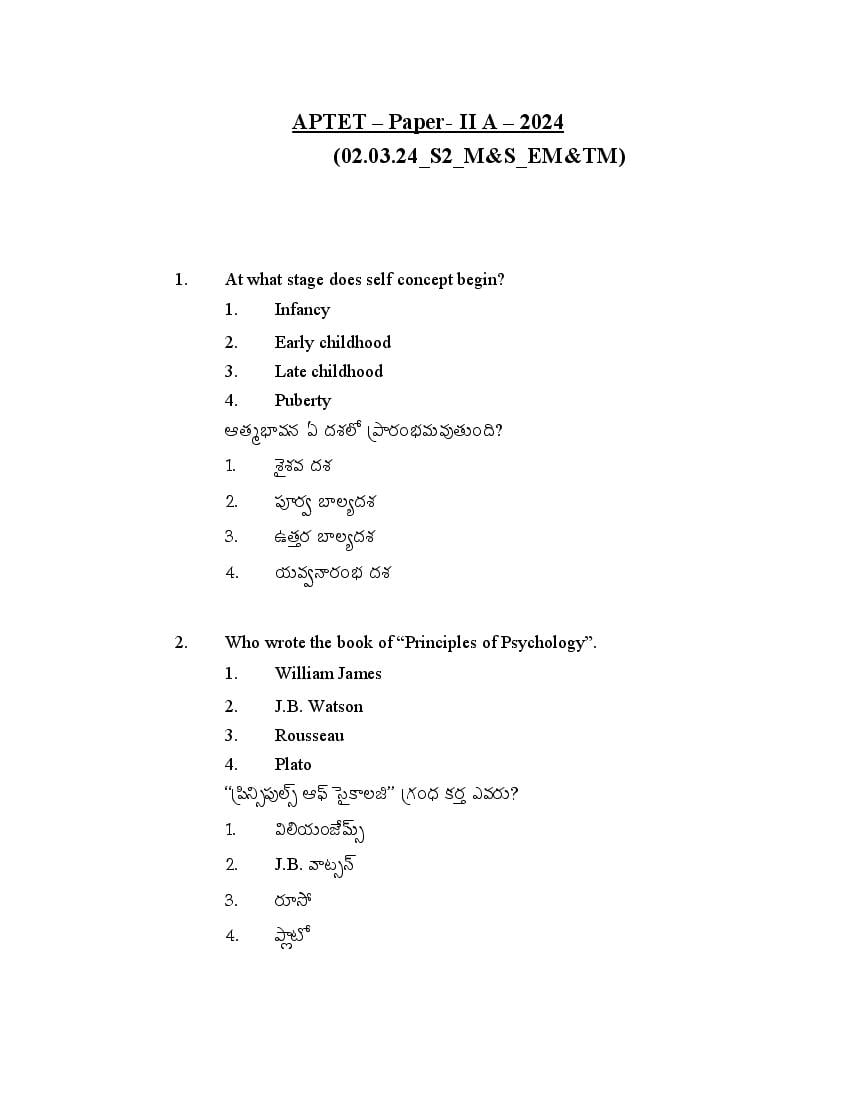
(02.03.24_S2_M&S_EM&TM)
1. At what stage does self concept begin?
1. Infancy
2. Early childhood
3. Late childhood
4. Puberty
Ôáuó²eq @ <XøýË çbÍsÁ+uóeTeÚÔáT+~?
1. XèXÕ eø <Xø
2. |PsÁÇ u²\«<Xø
3. ÔáïsÁ u²\«<Xø
4. jáTeÇHsÁ+uó <Xø
2. Who wrote the book of “Principles of Psychology”.
1. William James
2. J.B. Watson
3. Rousseau
4. Plato
»»ç|¾à|ÚýÙà |t dÕ¿±\µµ ç>·+<ó ¿£sïÁ mesÁT?
1. $*jáT+CñyTà
2. J.B. y³àH
3. sÁÖkþ
4. bÍ¢{Ë
Page 2
1. Piaget
2. Kohlberg
3. Chamsky
4. Rogers
uó²cÍ $¿±d+|Õ ç|jÖî >±\T #ûdq¾ ysÁT
1. |¾jáÖCñ
2. ¿ÃýÙsYZ
3. #yTà¿¡
4. sÃÈsYà
4. Forced forgetting of painful things is known as
1. Oppression
2. Identification
3. Projection
4. Repression
u²<óq T ¿£*Ð+#û |]d¾Ô
Tá \qT ç|jTá Ôá |PsÁÇ¿£eTT>± eTsÁºbþe&
@eT+{²sÁT?
1. nDºyûÔá
2. Ô<r¿£sD Á +
3. ç|¿¹ | D eTT
4. <e TqeTT
Page 3
1. id
2. ego
3. super ego
4. consciousness
ç¿ì+~ y{ìýË @~ q+< dÖçÔ bÍ{ìdT +ï ~.
1. nºÔáTï
2. nV²+
3. n<ó«V²+
4. #ûÔáq+
6. It needs to be taken up after teaching
1. Assessment for learning
2. Continuous comprehensive evaluation
3. Thinking Assessment
4. Assessment for interest
uË<óHq+ÔásÁ+ B #û|³¼e\d¾q nedsÁ+ +~.
1. nuó« dq ¿=sÁÅ£ n+#áH
2. sÁ+ÔásÁ deTç>· eTÖý²«+¿£q+
3. ýË#áq n+#áH
4. n_ósTÁ º ¿=sÁÅ£ n+#áH
Page 4
1. Repression
2. Fantasy
3. Compensation
4. Regression
|>{
· ì ¿£\\T ¿£q&+ @ sÁ¿¿£ £ Ôá+çÔá+
1. <eTq+
2. dÇís¿Á \£ Îq
3. |]VäsÁeTT
4. ç|Ü>·eTq+
8. According to Right To Education act, teachers can lose their
job after how many years if they don’t get the proper
qualification
1. 1 year
2. 2 years
3. 5 years
4. 7 years
$<«V²Å£Ø #á³+¼ ç|¿±sÁ+ bÍ<ó«jáTT\T ÔáÐq $<«sÁ½Ôá
bõ+<Å£+fñ m d+eÔáàsÁeTT\ ÔásÁTyÔá <ë>± ¿ÃýËÎÔsÁT
1. 1 d+eÔáÎsÁ+
2. 2 d+eÔáàs\T
3. 5 d+eÔáàs\T
4. 7 d+eÔáàs\T
Page 5
the front row when the maths teacher started writing on he
blackboard. What type of vision the boy must have had?
1. Short sight
2. Long sight
3. Blindness
4. Partial blindness
>Ã|¾nHû $<«] ºe] esÁTdýË Å£LsÁTÌ H&T. 8e ÔásÁ>·Ü >·DìÔá
bÍ<ó«jáTT&T uËsÁTM¦ T< ýÉ¿Ø£ \T #ûdT +ï &>± nÔáqT eTT+<T
esÁTdýË¿ì eºÌ Å£LsÁTÌ uËsÁT¦qT #áÖ&kÍÂ>qT. nÔáÅ£q <w¾¼
mý²+{ì~
1. çV²dÇ<w¾¼
2. BsÁé <w¾¼
3. n+<óÔ Çá eTT
4. bÍ¿ì¿ £ n+<óÔ Çá eTT
10. A student named Lokesh scored good marks in Statistics and
evinced keen interest and passion towards that subject. The
reason could be
1. IQ factor
2. G-factor
3. S-factor
4. SG factor
ý˹¿wt nHû $<«] kÍ+K«¿£Xædï+ýË eT+ºeÖsÁTØ\T Ôî#áTÌ¿=H&T.
BÔÃbͳT Xæd+ï |³¢ rçe n_ósTÁ º d¿ïì #áÖ|&¿ì ¿±sÁD+
1. IQ ¿±sÁ¿£+
2. G-¿±sÁ¿£+
3. S-¿±sÁ¿+
£
4. SG ¿±sÁ¿+ £
Page 6
and interests of teachers on new education subjects
1. Survey method
2. Observational method
3. Interview method
4. Experimental method
qÖÔáq $<« d++~óÔá $wjÖá \ |Õ bÍ<ó«jáTT\ yîKÕ sÁT\T,
n_ósTÁ #áT\T Ôî\TdT¿Ãe&¿ì kå¿£s«Á e+ÔáyTî q® n<ó«jáTq |<Ü
Æ
1. ds¹ Ç |<Ü
Æ
2. |]o\q |<ÆÜ
3. |]|#áÌÛ |<Ü Ý
4. ç|jÖî >· |<Ü Ý
12. A student named Sathish notices that his neighbor Raju is
working abroad. If Sathish gets inspired by Raju, this
motivation comes under
1. Natural motivation
2. Artificial motivation
3. intrinsic motivation
4. extrinsic motivation
drwt nHû $<«], |¿Øì +{ì sE $<ûXæ\ýË <ë>·+ #ûdT +ï &&
>·eT+º ÔáqT Å£L& çXø<>Æ ± #á~$ |Õ¿ì sy\qT¿Ãe&+
1. dV² È ç|sÁD
2. ¿£çÜeT ç|sÁD
3. n+ÔásÁZÔá ç|sÁD
4. u²V²« ç|sÁD
Page 7
Mathematical tables
1. Rote memory
2. Logical memory
3. Active memory
4. Passive memory
|¾\\¢ T >·DìÔ+á ýË, m¿±Ø\T ¿£+sÄdÁ + |³¼&+ ýË
dÜ +³T+~.
1. {¡¼ì dÜ
2. Ô]Ø¿£ dÜ
3. ç¿ìjÖá Ôá¿£ dÜ
4. çw¾ØjáÖÔá¿£ dÜ
14. In pre-childhood girls seek father’s love and affection and
mother as enemy or competitor. This phenomenon is called
1. Oediplus complex
2. Electra complex
3. super complex
4. Idia complex
|PsÁÇ u²\«<Xýø Ë neÖsTT\T Ôá+ç& ç|eT, nqTs>±\qT,
n_óeÖH ¿ÃsÁT¿=+{²sÁT. Ôá*¢ M]¿ì ç|Ô«á ]. B ç¿ì+~ $<ó+ >±
n+{²sÁT.
1. &|d t ¿±+|¢¿àù
2. m\翱¼ ¿±+|¢¿àù
3. dÖ|sY ¿±+|¢¿ùà
4. ~jáÖ ¿±+|¢¿àù
Page 8
who are playing in the playground. This kind of observation is
called
1. Non participant observation
2. Controlled observation
3. Participant observation
4. Natural observation
³ d\ +ýË &T¿=+³Tq $<«sÁT\ qT Ôás>Á Ü
· >·~ ýË|\ qT+º
bÍ<ó«jáTT&T >·eT+#á&+ @ |]o\q ç¿ì+<¿ì edT+ï ~.
1. nd+#á]Ôá |]o\q
2. jáT+çÜÔá |]o\q
3. d+#á]Ôá |]o\q
4. dV² È |]o\q
16. Annual examination comes under this evaluation
1. Error diagnostic evaluation
2. Summary evaluation
3. Formative evaluation
4. Continuous evaluation
y]ü¿£ |¯¿£\T eTÖý²«+¿£q+ ç¿ì+~¿ì ekÍïsTT
1. ýË|sÆsD Á eTÖý²«+¿£q+
2. d+ç>·V² D eTÖý²«+¿£q+
3. sÁÖ|D eTÖý²«+¿£q+
4. sÁ+ÔásÁ eTÖý²«+¿£q+
Page 9
1. Allport
2. Carl Rogers
3. Williamson
4. William Jones
n¹sÝ¥Ôá eT+çÔáD² sÁÖbõ+~+ºqysÁT
1. ýÙbþsY¼
2. ¿±sY¢sÃÈsYà
3. $*jáTyTdH
4. $*jáT+ CËHà
18. Verbal Tests can be used for
1. Illiterates
2. Children
3. Literates
4. Adults
Xæ_Ý¿£ |¯¿£\ T M]¿ì |jÖî Ð+#áe#áTÌqT.
1. sÁ¿£sdT«\¿ì
2. |¾\¢\¿ì
3. n¿£sdT«\¿ì
4. ejîÖÈqT\¿ì
Page 10
person shows is called
1. Attitude
2. Aptitude
3. Interest
4. Concentration
ÿ¿£ e«¿ìýï Ë ]Ýw¼yTî q® C²ãqeTT, Hî|Õ Ú D«eTT ç|ÜdÎ+<q\
deTT<jáÖ @eT+{²sÁT.
1. yîKÕ ]
2. dV²È kÍeTsÁÆ«+
3. n_ósÁTº
4. @¿±ç>·Ôá
20. 95% of the knowledge we have is acquired through these two
sensory organs
1. Skin - nose
2. Ear – nose
3. Eye – nose
4. Eye – ear
eTqÅ£ d+çbÍ|¾ï+#û C²ãq+ýË 95% C²ãH+û ç~jáÖ\ <Çs
\_ó+#áTqT.
1. #ásÁ+`eTTÅ£Ø
2. #î$`eTTÅ£Ø
3. ¿£qT`eTTÅ£Ø
4. ¿£qT`#î$
Page 11
1. Activity based Learning
2. Programmed Learning
3. Whole classroom teaching
4. Grouped Learning
dÇjáT+ yû>+· ÔÃ nuó« d¾+#áT³ BÔÃ kÍ<ó« eTeÚÔáT+~.
1. ¿£Ô«<ósÁ nuó« dq+
2. ¿±sÁ«ç¿£eTjáTTÔá nuó« dq+
3. yîTTÔáï+ ÔásÁ>·Ü uË<óq
4. _óq deTT<jáÖ\ nuó«dq+
22. Who created sociocultural theory that gave rise to cognitive
constructivism
1. Vygotsky
2. Bruner
3. Skinner
4. Kohler
C²ãq sD²Ôá¿£ y<¿ì }Ôá$TºÌq kÍ+|T¾ ¿£ kÍ+dØÜ¿£
d¾<Æ+Ô sÁÖbõ+~+ºq ysÁT
1. yîÕ>Ã{ÙdÓØ
2. çÖqsY
3. d¾ØqsY
4. ¿=V²\sY
Page 12
her father and also does not want to give it to her sister. Which
type of conflict is this
1. Approach-Approach
2. Avoidance-Avoidance
3. Approach-Avoidance
4. Duel-Approach-Avoidance
uó²qTeTÜ¿ì Ôáq Ôá+ç& ÔîºÌq |Ú{ì¼qsÃE ¿±qT¿£ rdT¿Ãe&+ w¼+
ýñ<T . ný²>· Ôáq #î*¿¢ ì eÇ&+ Å£L& w+¼ ýñ<T .
~ @ sÁ¿£yTî q® d+|T sÁD
ü
1. |]VäsÁ ` |]VäsÁ
2. |>e· T ` |>e· T
3. |]VäsÁ ` |>e· T
4. ~Ç |]VäsÁ ` |>e· T
24. The term “projection” was first used by
1. Carl Roger
2. Vygotsky
3. W.G. Allport
4. Sigmund Freud
»»ç|¹¿|D+µµ nHû |< yîTT<³>± ç|ÜbÍ~+ºq ysÁT
1. ¿±sY¢sÃÈsYà
2. yîÕ>Ã{ÙdÓØ
3. W.G. ýÙbþsY¼
4. d¾>· +& çbÍsTT&
Page 13
1. Imaginative thinking
2. Associative thinking
3. Directed thinking
4. Non-directed thinking
ç¿=Ôáï $wjÖá \qT ¿£qT>=&¿ì |jÖî >·|& û ýË#áq
1. }Vä ýË#áq
2. d+dsÁZ ýË#áq
3. ¹sÆ¥Ôá ýË#áq
4. n¹sÆ¥Ôá ýË#áq
26. Rubin was the first psychologist who explained the following
Law of perceptual organization
1. Law of proximity
2. Law of similarity
3. Law of closure
4. Figure ground relation ship
»sÁÖ_Hµ nHû eTHà $C²ãq Xæçdyï Ô û ïá yîTT³¼ yîTT<³ ç|Ô«á ¿£
e«ekÍ|¿ £ jáTeÖ $e]+#&T.
1. kÍMT|« jáTeT+
2. kÍeT« jáTeT+
3. |PsÁD jáTeT+
4. ¿£Ü ` ¿¹ ç Ôá d++<ó+
Page 14
1. Piaget
2. Vygotsky
3. Willam James
4. Kohlberg
HîÕÜ¿£ $¿±d d¾<Æ+Ô sÁÖbõ+~+ºq ysÁT.
1. |¾jáÖCÉ
2. yîÕ>Ã{ÙdÓØ
3. $*jáT+ CñyT à
4. ¿ÃýÙsYZ
28. A classroom belongs to this type
1. Formal group
2. Non formal group
3. Gang
4. Unorganized group
Ôás>Á Ü
· >·~ @ sÁ¿±¿ì #î+~q~
1. jáT$TÔá deTÖV²+
2. njáTÔá deTÖV²+
3. >·T+|Ú
4. ne«edÓ¿£ Ôá deTÖV²+
Page 15
1. Completing the syllabus in time
2. Completing all things
3. Providing written knowledge
4. Promoting learning
uË<óq (Pedagogy) ç|<óq \¿£« +
1. d¿±\+ýË bÍsÄ«+Xæ\qT |P]ï #ûjTá &+
2. n $wjÖá \qT |P]ï #ûjTá &+
3. *ÏÔá C²ãq$TeÇ&+
4. nuó« dqÅ£ <ÃV²<|& & +
30. An Average intelligent person’s IQ is
d>³
· T ç|C²ã e+ÔáT\ ç|C²ã \_Ý
1. 190-110
2. 70-90
3. 150-70
4. 110-130
Page 16
\¿£\ T e#áTÌ#áT+&q" ý²jáTqyîT® #áqT", >·\¢ >±<T ç|
Ôá«¿£e TT y>·T\TH ei<\jáTT eºÌq úsÁT \TÌHû
n¿£j Tá yîTq® >·+& ÔîÐq{ì¼ Ôá{²¿£eTTýËq uó²dØs!
|Õ |<« +ýË <Å£ &T nHû eֳţ nsÁ+
1. n<ó« Å£ &T
2. <¿£ ç|C²|Ü
3. ndeTsÁT&Æ T
4. deTsÁT& T
32. <Å£ &T ýñ sTT+{ì¿"ì <sÁe TT yûi=¿£ #óqT+& yû
\¿£\ T e#áTÌ#áT+&q" ý²jáTqyîT® #áqT", >·\¢ >±<T ç|
Ôá«¿£e TT y>·T\TH ei<\jáTT eºÌq úsÁT \TÌHû
n¿£j Tá yîTq® >·+& ÔîÐq{ì¼ Ôá{²¿£eTTýËq uó²dØs!
<Å£ &T ýñ \T¢ mý²+{ì~
1. úsÁTýñ deTTç<+ ý²+{ì~
2. >·+& ÔîÐq #îiTeÚ ý²+{ì~
3. +&T>± q Ôá{²¿£+ ý²+{ì~
4. >·+& ÔîÐq deTTç<+ ý²+{ì~
Page 17
y{ì¿ì deTjáT+ eÇ& eqsÁT\ |]sÁ¿D £ n+{²sÁT. ç|dT Ô
ï á
neds\Å£ eqsÁT\qT |jÖî Ð+#áT¿Ãe&+ uó$ w«ÔY ¿Ãd+ y{ì
d+sÁ¿ì+ #áT¿Ãe&+ýË deTÔáT\«ÔáqT bÍ{ì+#á& dTd¾s Á n_óe~Æ
n+{²sÁT. eqsÁT\qT d+sÁ¿ì+ #áT¿Ãe&¿ì nHû¿£ eÖsZ\T HsTT.
ç|Ü e«¿ìï edTeï Ú\ $jîÖ>± ÔáÐ+Z #áT¿Ãe&+, edTeï Ú\
|Úq]ÇjîÖ>·+, |Úq'#áç¿¡jáT+ <Çs Ôáq e+ÔáT dV²¿±s
n+~+#áe#áTÌ.
edTeï Ú\ $jîÖ>·+ ÔáÐ+Z #áT¿Ãe&+
1. dTd¾s Á n_óe~ÆýË uó²>·+
2. bõ<T|ÚýË uó²>·+
3. |¾dH¾ ]Ôáq+ ýË uó²>·+
4. eqsÁT\ d+sÁ¿D £ ýË uó²>·+
34. eqsÁT\qT C²ç>·Ô>ïá ± |jÖî Ð+#áTÅ£+³Ö, |ÚqsÁT <]Æ +#áT¿Ãe&¿ì
y{ì¿ì deTjáT+ eÇ& eqsÁT\ |]sÁ¿D £ n+{²sÁT. ç|dT Ô
ï á
neds\Å£ eqsÁT\qT |jÖî Ð+#áT¿Ãe&+ uó$ w«ÔY ¿Ãd+ y{ì
d+sÁ¿ì+ #áT¿Ãe&+ýË deTÔáT\«ÔáqT bÍ{ì+#á& dTd¾s Á n_óe~Æ
n+{²sÁT. eqsÁT\qT d+sÁ¿ì+ #áT¿Ãe&¿ì nHû¿£ eÖsZ\T HsTT.
ç|Ü e«¿ìï edTeï Ú\ $jîÖ>± ÔáÐ+Z #áT¿Ãe&+, edTeï Ú\
|Úq]ÇjîÖ>·+, |Úq'#áç¿¡jáT+ <Çs Ôáq e+ÔáT dV²¿±s
n+~+#áe#áTÌ.
dTd¾s Á n_óe~ÆýË eTTK«yîTq® n+Xø+
1. ç<e« dMT¿£sD
Á
2. eqsÁT\qT dw¾+¼ #á&+
3. eqsÁT\qT uó$ w«ÔáTï ¿Ãd+ sÁ¿ì+ #á&+
4. eqsÁT\qT |¿ì+ #á&+
Page 18
1. sÁÖ|¿±\+¿±sÁ+
2. eTT¿£|ï < ç >·kÍï\+¿±sÁ+
3. |eÖ\+¿±sÁ+
4. çÔûο±\+¿±sÁ+
36. »»eVäÇ! eÖ³\ yûT<] V²Ç>±&Tµµ
^Ôá ^d¾q |<¿ì |s«jáT|<\T
1. yûTçd¾,ï HûsÎÁ ]
2. eÖ³¿±], nV²+¿±]
3. _¿£>±&T, e+³y&T
4. H\T¿£, sÁdq
37. »»\¢\¿£>±Hûµµ bÍsÄ«+Xø ÜeÔá+ï
1. |s«esÁD+
2. ç|¿£ Ü
3. çdÓï #îÕÔáq«+
4. d+dØÜ
38. »»|\TÅ£, +<µµ |<\Å£ HHsÁ| < +
1. #³
2. u²³
3. eÖ³
4. ¿Ã³
Page 19
e#ûÌy&T ` eÚ«ÔáÎÔáï«sÁ |<+
1. n${ì
2. n\T¢&T
3. nÜ~¸
4. n\
40. ¿±e«+ #á<y *. ^Ôá^d¾q |<¿ì $¿£Ü
1. >·_Ò\+
2. ¿£Ò+
3. >·TV²
4. >·TD+
41. »»Ôá|Î d]>± bÍ{ì+ºrs*àq <ûXø+µµ nHû ns
Ôî*jáTCñd C²rjáT|<+
1. lseTsÁ¿£
2. ÔáTHÔáTq¿£\T
3. n³T¼&¿ bì þeÚ
4. dTç^yÈã
42. eTT+CñÜ ¿£+¿£D²¿ì n<yÝ Tî +<TÅ£ ` ~ ÿ¿£
1. bõ&T|Ú¿£<¸
2. kÍyîTÔá
3. C²rjáT+
4. ¿£Þ²sÁÖ|+
Page 20
$<ûojáTT\ eTHÃuó²y\qT Ôî*jáTCñjTá &+ bÍsÄ+Á <ûXÝ +ø .
1. H #á<T eÚ
2. dV²+
3. @ <ûXøyTû ÐH
4. \¢\¿£ >±Hû
44. |<\ eT<ó« nsÁe +ÔáyTî q® d++<ó @sÁÎsÁ#&á ¿ì |jÖî Ð+#û$
1. HeTy#῱\T
2. dsÇÁ HeÖ\T
3. ç¿ìjáT\T
4. $uóÅ £ \ï T
45. »»eTT³¼¿£ G +&<< ³
î T¢µµ |<\T ¿£*dï @sÁÎ&û d+~ó
1. ¿±sÁ d+~ó
2. >·TDd+~ó
3. jáTD²<ûXø d+~ó
4. n¿±sÁ d+~ó
46. |PsÁÇ |<\T *+>·, e#áq, $uó¿ ìï XøSq«+>± q deÖd+
1. $XâwD |PsÁÇ|< ¿£sÁ<ósÁjáT deÖd+
2. ne«sTÖuó²e deÖd+
3. qxÙ ÔáÔáTÎsÁTw deÖd+
4. ~Ç>·T deÖd+
Page 21
1. kͩ&T
2. NeT
3. <ÃeT
4. >·
48. u²>± #á~$Ôû eÖsÁTØ\T ekÍïsTT. ~ @ sÁ¿y£ Tî q® y¿£«+
1. #û<s ¿Á £ y¿£«+
2. n|«sÁ¿ £ y¿£«+
3. ¿±ïÇsÁ¿£ y¿£«+
4. XøçÔás¿Á £ y¿£«+
49. »»Xø¥<ósY |sÁTÂ>Üï, n\d¾bþjáÖ&Tµµ d+¥¢w¼ y¿±«
kÍeÖq« y¿£«eTT\T>± eÖ]dï
1. Xø¥<ós Y |sTÁ >Â Ôï&T . Xø¥<ós Y n\d¾bþjáÖ&T
2. Xø¥<ós Y |sTÁ >Â Ôáï¿£ n\d¾bþýñ<T
3. Xø¥<ós Y |sTÁ >Â &TÔáÖ n\d¾bþjáÖ&T
4. Xø¥<ós Y |sTÁ >Â Ôáýï <ñ T . Xø¥<ós Y n\d¾bþjáÖ&T
50. »»Ô=* Ôî\T>·T H³¿£+µµ
1. ¿£H«Xø\Ø+
2. ç|Ô|sÁTçBjáT+
3. eT+ȯ eT<óT ¿£¯jáT+
4. esÁ$ç¿£jTá +
Page 22
dÇÔá+çÔá ¿±e«+>± sÁº+#û~.
1. nqTy<+
2. ç|+<ó+
3. ýñK
4. |Ó]¿Ä £
52. »»eTqT#á]çÔáµµ ¿£$
1. n\¢kÍ |<Ýq
2. q+~ ÜeTq
3. <óÖsÁ̈{ì
4. eÖ<jTá « >±] eT\¢q
53. 10e n¿£s +Á jáTÜ kÍq+>± q |<« +
1. eTÔûïuó+
2. #á+|¿e£ Ö\
3. XæsÁÖÝ\+
4. ÔáÎ\eÖ\
54. @<jÖá MT <jÖá eÖMT< ýñ<T
sTT+Ôá d|Ú+#áT³ ~ MTÅ£ Ôá>T· H!
~
1. <ds deTjáT+ýË $<«sÁT\T bÍ&ûysÁT
2. d+翱+Ü deTjáT+ýË $<«sÁT\ T bÍ&ûysÁT
3. >±~ deTjáT+ýË $<«sÁT\ T bÍ&ûysÁT
4. ç¿ìd dt d+<sÒÁ +Û >± $<«sÁT\ T bÍ&ûysÁT
Page 23
ÈsÁ>· sÁÖ|+ s +&Ö +fñ n~
1. yîeÕ Tqd«+
2. yîXÕ wâ ¿¾ +£
3. yî¿Õ *£ ο£+
4. yî¿Õ £ Ôá+
56. ÔqT sçÜ n+Ô bõý²\ýË C²>±sÁ+ #ûXæq nH&T.
y¿±« ç|Ô«á ¿£ ¿£<¸q +ýË¿ì eÖ]dï
1. »»nÔáqT sçÜ n+Ô bõý²\ýË C²>±sÁ+ #ûjáTýñ<Tµµ
n nH&T.
2. »»úeÚ sçÜ n+Ô bõý²\ýË C²>±sÁ+ #ûXæqTµµ n nH&T.
3. »»HûqT sçÜ n+Ô bõý²\ýË C²>±sÁ+ #ûXæqTµµ n nH&T.
4. »»ÔáqT sçÜ n+Ô bõý²\ýË C²>±sÁ+ #ûXæqµµ nH&T.
57. H jîTT¿£Ø #á]çÔá ` deÖd|< +
1. Ôáq #á]çÔá
2. nÔá #á]çÔá
3. ú #á]çÔá
4. H #á]çÔá
58. ç¿ì+~ yýË e«Ü¹s¿±sÁ¿£ ç¿ìjÖá |<+
1. #û]
2. #ûsÁTÔáÖ
3. #û]Ôû
4. #ûs¿Á £
Page 24
1. HûqT ` yûTeTT
2. úeÚ ` HûqT
3. MTsÁT ` yûTeTT
4. nÔá&T ` yîT
60. d¾>T· |Z & T ÔáÖ H eTT+<T \&=<T.Ý ~ @ sÁ¿y£ Tî q® y¿£«+
1. XøÌjáÖsÁ¿£ y¿£«+
2. w<ósÁ¿£ y¿£«+
3. osÁsÁ¿£ y¿£«+
4. d+uó²eqsÁ¿£ y¿£«+
Page 25
The above expression can be used
1. to apologize
2. to grant permission
3. to take permission
4. to refuse permission
62. Someone says ‘sorry’ for stepping on your foot. How would
you respond?
Choose your response from the following.
1. That’s all right
2. Too bad
3. I do not feel anything
4. It’s all my fault
63. Choose the option that is a key element of a news report.
1. emotionally charged language
2. sensationalism
3. lengthy anecdotes
4. clarity and conciseness
64. Choose the option that is NOT a tip for writing a description.
1. use vague language
2. focus on details
3. consider the readers
4. organize language
Page 26
1. “Where are you going Dog?” the wolf asked.
2. “Where are you going, Dog?” the wolf asked.
3. “Where are you going Dog the wolf asked?”
4. Where are you going, Dog? The wolf asked.
66. Radha(A) as well as Kamala(B) have gone(C) to Delhi(D)
Choose the option that has a grammatical error.
1. A
2. B
3. C
4. D
67. The death of the bullock was ______ fortunate.
Choose the appropriate prefix to use before the word
‘fortunate’.
1. ill
2. mis
3. un
4. im
68. The word performance has stress on:
1. the second syllable
2. the first syllable
3. the second and third syllables
4. the third syllable
Page 27
1. The greatest work
2. major part or portion
3. a lion without fur
4. a lion with a lot of fur
70. If you want to go out, I will _______ the children for you.
Choose the correct phrase that fits the blank.
1. look up
2. look out
3. look after
4. look into
71. Choose the correctly spelt word
1. Percussionist
2. Percusionist
3. Parcusionist
4. Percussionst
72. Choose the option that can be used as a one word substitute for
“a person who can do anything for money”
1. teetotaler
2. theist
3. polyglot
4. mercenary
73. The covetous old fellow, with a spade and the old crone, with
a hoe, began to dig.
Choose the synonym of the word ‘covetous’.
1. handsome
2. greedy
3. liberal
4. altruistic
Page 28
Choose the right pair of opposite words of the word ‘pristine’
1. stale - mint
2. fresh - spoiled
3. impure - untidy
4. defiled - undamaged
75. Choose the correct sentence from the following.
1. Books are good friends.
2. The books are the good the friends
3. The books are a good friends
4. Books are good the friends.
76. The accident sadly resulted _______ the death of an old
woman.
Choose the preposition that fits the blank.
1. with
2. over
3. at
4. in
77. We asked her how it had _______.
Choose the word that completes the meaning of the sentence
grammatically.
1. to been happened
2. happens
3. happening
4. happened
Page 29
1. The great man is going to spend his old age in his
native town.
2. Why are you turning on the radio?
3. I have already bought it.
4. She is playing tennis now.
79. David asked his colleague, “Where will you go this summer?”
Choose the reported speech of the sentence above.
1. David told his colleague that he would go that summer.
2. David said to his colleague whether he would go that
summer.
3. David asked his colleague where he would go that
summer.
4. David asked his colleagues if they would go that
summer?
80. In yesterday’s competition the prizes _____ by the principal.
Choose the option that completes the sentence meaningfully.
1. were given away
2. are giving away
3. have given
4. will be give
81. There ______ no milk in the refrigerator.
Choose the verb that fits the blank.
1. have
2. were
3. is
4. are
Page 30
following.
1. Come when you like.
2. He confessed that he was guilty.
3. He cried as if he were in deep pain.
4. I know a boy whose father serves in the army
83. Mrs. Slater rose briskly at length in a business – like tone.
In the above sentence, ‘business – like’ is:
1. a compound noun
2. a compound adjective
3. a compound verb
4. a participle preposition
84. Choose the word that is not an adjective.
1. greedy
2. honest
3. sensitive
4. bureau
85. He came from a poor but educated family.
This sentence is an example of:
1. a simple sentence
2. a complex sentence
3. a compound sentence
4. a compound complex sentence
Page 31
Choose the linker that fits the blank.
1. that
2. although
3. though
4. in spite of
87. I’ve always been terribly fond _____ you.
Choose the preposition that fits the blank.
1. with
2. of
3. at
4. by
88. The film will be released next week.
The above sentence indicates:
1. offer
2. obligation
3. futurity
4. advice
89. Read the following passage.
Mahabharata is one of the greatest epics of our literature. It
answers all questions, relating to political social etc if we give
a proper interpretation. It is so popular that it has been
translated into many languages of the world.
One of the main qualities of the Mahabharata epic is :
1. It lacks of popularity in global culture
2. It focuses solely on political matters
3. It has the ability to address various aspects of life,
including political and social issues
4. The availability of its translations are limited
Page 32
Mahabharata is one of the greatest epics of our literature. It
answers all questions, relating to political social etc if we give
a proper interpretation. It is so popular that it has been
translated into many languages of the world.
Mahabharata is a ______ of answers to all questions.
Choose the correct option.
1. collection
2. encyclopedia
3. store house
4. compendium
Page 33
nܺq ç|<óq d+U«
1. 0
2. 1
3. 2
4. 3
92. For an integer ‘a’, a ´ 1 = a = 1´ a . This is
1. Inverse property
2. Identity property
3. Commutative property
4. Associative property
@<û |PsÁd+K« ‘a’ Å£ a ´1 = a = 1´ a nsTTq
1. $ýËeT <ós Á +
2. ÔáÔáàeT <ósÁ+
3. $eTjáT <ós Á +
4. dV² #ásÁ <ós Á +
Page 34
(Multiplicative Inverse)
eÚ«çÔáØeT+ (>·TD¿±sÁ $ýËeT+) ýñ n¿£sÁDj
¡ Tá d+K«
1. 0
2. -1
3. 1
4. 2024
94. Suppose ‘a’ and ‘b’ are positive real numbers. Then
(a + b ) (a - b ) =
‘a’eT]jáTT ‘b’\T <óq
ydeï d+K«\qTÅ£+fñ,
(a + b ) (a - b ) =
1. a-b
2. a2 - b
3. a - b2
4. a2 - b
95. If F = { x: x is a date of February 2024} then n(F) =
F ={ x: x nHû~ 2024 |¾çe] Hî\ýË Ô¯KT}nsTTq n(F) =
1. 28
2. 29
3. 30
4. 31
Page 35
shopkeeper is 20%, then cost price is
u¤eT¿±sÁT n$Tq yî\ ` 540. <T¿±D<sÁT&¿ì eºÌq ý²uó+
20% nsTTq u¤eT¿±sÁT ¿=q yî\
1. ` 648
2. ` 520
3. ` 500
4. ` 450
97. In general, which of the following is collected by shopkeeper
but not given to the government
1. Profit
2. Sales Tax (ST)
3. Value Added Tax (VAT)
4. Goods& Services Tax (GST)
kÍ<ósÁD+>±, ç¿ì+~ yýË B <T¿±D<sÁT&T edÖ\T
#ûdq¾ |Î{ì¿¡ ç|uTó ÔÇ¿ì #î*+¢ #á&T
1. ý²uó+
2. neT¿£|Ú |qT (ST)
3. $\Te <ó]Ôá |qT (VAT)
4. edTeï Ú\T eT]jáTT de\ |qT (GST)
Page 36
possible
1. with five matchsticks
2. with four matchsticks
3. with three matchsticks
4. with two matchsticks
ç¿ì+~ @ d+<sÒÁ +Û ýË VQuóT ÔájÖá sÁT #ûjTá ³+ kÍ<ó« +
¿±<T.
1. ×<T nÐZ|Ú \¢\T
2. H\T>·T nÐZ|Ú \¢\T
3. eTÖ&T nÐZ|Ú \¢\T
4. s +&T nÐZ|Ú \¢\T
99. The sum of exterior angles of a regular polygon
ÿ¿£ ç¿£eT VQuóT jîTT¿£Ø u²V²« ¿ÃD²\ yîTTÔá+ï
1. 90°
2. 180°
3. 360°
4. 400°
Page 37
1. Rectangle
2. Square
3. Rhombus
4. Kite
uóT C²\ bõ&eÚ\T eÖçÔáyTû deÖq+>± ¿£*Ðq #áÔTá sÁTÒÛÈ+
1. BsÁé#áÔáTsÁçd+
2. #áÔáTsÁçd+
3. deT#áÔTá sÁçd+
4. >±*|³+
101. The angle between a tangent to a circle and the radius drawn at
the point of contact is
ÿ¿£ eÔáï dÎsÁôs¹ KÅ£, dÎsÁô_+<TeÚ >·T+& ^ºq y«kÍs¿ì eT<ó«
>·\ ¿ÃD+
1. 30°
2. 45°
3. 60°
4. 90°
Page 38
e¯Z¿£ Ôá <Ôï+Xø+ jîTT¿£Ø eT<ó« >·Ô+á ¿£qT>=qT³Å£ dÖçÔá+
é f1 - f 0 ù
1. l+ê ´ hú
ë 2 f1 - f 0 - f 2 û
én ù
ê 2 - cf ú
2. l+ê ´ hú
ê f ú
ë û
éå f u ù
3. a + ê i i ´ hú
ë å fi û
å f i xi
4.
å fi
103. A bar graph is represented by rectangular bars of
1. uniform widths
2. uniform lengths
3. uniform heights
4. uniform values
ÿ¿£ ¿£MT s¹ U² ºçÔá+ýË BsÁé#Ô
á Tá sÁçkÍ¿±sÁ ¿£MT\T
1. @¿£¯Ü yî&\ TÎýË +{²sTT
2. @¿£¯Ü bõ&eÚýË +{²sTT
3. @¿£¯Ü mÔáTýï Ë +{²sTT
4. @¿£¯Ü $\Te\Ôà +{²sTT
Page 39
1. Multinomial
2. Trinomial
3. Binomial
4. Monomial
»2024µ nqTq~ <û¿ì <V²sÁD
1. VQÞø|~
2. çÜ|~
3. ~Ç|~
4. @¿£|~
105. If x + y + z = 0 then x 3 + y3 + z 3 =
x + y + z = 0 nsTTÔû x 3 + y3 + z 3 =
1. 0
2. 1
3. xyz
4. 3xyz
106. To get the imaginary roots of a quadratic equation
ax 2 + bx + c = 0
esÁZdMT¿£sÁD+ ax + bx + c = 0 Å£ ¿£*ÎÔáeTÖý²\T bõ+<\+fñ
2
1. b2 = 4ac
2. b2 – 4ac = 0
3. b2 – 4ac > 0
4. b2 – 4ac < 0
Page 40
nsÁ> ÃÞø d+|PsÁÔ
\á yîXÕ æ\«+qÅ£ dÖçÔá+
1. 2π r 2 sq.units
2. 3π r 2 sq.units
2 2
3. π r sq.units
3
4 2
4. π r sq.units
3
108. The area of a rhombus is 240 cm2 and one of the diagonals is
16 cm. Then the other diagonal
ÿ¿£ s+dt yîXÕ æ\«+ 240 #á.d+.MT. eT]jáTT < ¿£sÁeTT\ýË
ÿ¿£< bõ&eÚ 16 d+.MT. nsTTq Âs+&e ¿£sÁeTT bõ&eÚ
1. 15
2. 16
3. 30
4. 32
109. Area of the right angle triangle whose sides are 13cm, 12cm
and 5cm.
13 d+.MT , 12 d+.MT eT]jáTT 5 d+.MT uóT C²\T>± ¿£*qZ \+
¿ÃD çÜuóT È yîXÕ æ\«+
1. 30cm2
2. 60cm2
3. 75cm2
4. 78cm2
Page 41
cards
ÿ¿£ |¿£eTT¿£Ø\ ¿£³¼ qT+& msÁT|Ú sÁ+>·T sEqT rjáTT d+uó²e«Ôá
1
1.
13
1
2.
26
2
3.
13
2
4.
26
111. Distance between points ( - 4,0) and (6,0)
( - 4,0) (6,0) _+<TeÚ\ eT<ó« <ÖsÁ+
1. 2
2. 4
3. 6
4. 10
Page 42
C(7, - 4)
1. 1 Square unit
2. 2 Square units
3. 4 Square units
4. 16 Square units
_+<TeÚ\T A (5,2) B (4,7) C(7, - 4)\T osü\T>± >·\
çÜuóTÈ yîÕXæ\«+
1. 1 #á<sÁ|Ú jáTÖ{Ù
2. 2 #á<s |Á Ú jáTÖ³T¢
3. 4 #á<s |Á Ú jáTÖ³T¢
4. 16 #á<s |Á Ú jáTÖ³T¢
113. If A, B and C are interior angles of a triangle ABC, then
B+C
Sin
2
A, B eT]jáTT C \T çÜuóT È+ ABC ýË n+ÔásZÁ Ôá ¿ÃD²ýÉÔ
Õ û
B+C
Sin
2
A
1. Sin
2
B+C
2. Cos
2
A
3. Cos
2
B-C
4. Sin
2
Page 43
3 tan A R 4 nsTTÔû Cos A
3
1.
5
4
2.
5
4
3.
3
3
4.
4
115. When there was no mathematical or scientific material
available, this Indian scientist managed to measure the time
taken for the Earth’s rotation as 23 hours 56 mints and 4.1
seconds
1. Bhaskaracharya
2. Aryabhatta
3. Brahma Guptha
4. S. Ramanujan
>·DÔ ì Xá ædï |]¿£s\T n+<Tu²³TýË ýñ ¿±\+ýËHû uóÖ çuóeTD²¿ì
|f¼ñ ¿±\+ 23 >·+³\ 56 $TcÍ\ 4.1 d¿£qT¢>± >·D+ì ºq uó²sÁrjáT
>·DìÔáXædïyûÔáï
1. uó²dØs#sÁ«
2. sÁ«uó³¼
3. çV²>·T|ï
4. S. seÖqTÈH
Page 44
conclusion by applying known concepts, formulae in a
sequential way. His approach is
1. Inductive
2. Deductive
3. Analytical
4. Synthetic
d¾<Æ+Ôá sÁÖ|DýË ÿ¿£ $<«] <Ôï+Xø+ qT+& kÍs+Xø+qÅ£
>·Ô+á ýË Ôî*d¾q uó²eq\T, dÖçÔ\qT kþbÍqç¿£eT+ýË
nqTe]ï+#áTÅ£+³Ö sÁÖ|¾+#&T. nÔá |>e· T+
1. >·eTq
2. >·eTq
3. $Xâ¢wD
4. d+Xâ¢wD
117. The source word for Heuristic method is “Heurisko”
(which means I found). This is a
1. German word
2. Latin word
3. Greek word
4. Arabic word
nHûÇwD² |<ÝÜ ýñ¿£ VQ«]d¾¼¿ù |<ÝÜ¿ì eTÖý²<ósÁyîT®q »»VQ«]kþصµ
(nq>± HûqT ¿£qT>=HqT) nHû~ ÿ¿£
1. ÈsÁH |<+
2. ý²{ìH |<+
3. ç^Å£ |<+
4. nsÁ_¿ù |<+
Page 45
experience, Direct experience will
1. Increase
2. Decrease
3. No change
4. Constantly decrease
m&Zs&Y ýû Ù nqTuóe Xø+Å£eÚýË |Õ qT+& ç¿ì+<Å£ yîÞßâ ¿=BÝ ç|Ô«á ¿£
nqTuóe +
1. |sÁT>·TÔáT+~
2. Ôá>·TZÔáT+~
3. @ eÖsÁTÎ +&<T
4. d¾s +Á >± Ôá>T· Ô
Z Tá +~
119. According to Marry Potter & Virgil Mallory the Intelligent
Quotient of ‘Slow learners’ in Mathematics is
yûT¯ bõ³¼sY eT]jáTT $]¨ýÙ $Tý²¢]\ ç|¿±sÁ+ >·DÔ
ì +á ýË
»eT+< nuó²«dÅ£ \µ ç|C²ã\_Ý
1. >140
2. 120 - 140
3. 90 - 120
4. < 90
Page 46
will flourish in future is
1. Summative Evaluation
2. Formative Evaluation
3. Prognostic Evaluation
4. Diagnostic Evaluation
$<«] uó$ w«ÔáTýï Ë @sÁ+>·+ýË nsTTÔû deTsÁeÆ +Ôá+>± m<>>· \· &Ã
n+#áH yûd¾ #î|Î eTÖý²«+¿£q+
1. d+¿£\HÔá¿£ eTÖý²«+¿£q+
2. sD²Ôá¿£ eTÖý²«+¿£q+
3. çbÍ>·T¿ì¿ï £ eTÖý²«+¿£q+
4. ýË|sÆsD
Á eTÖý²«+¿£q+
Page 47
the scale at one end is 3.0 cm and at the other end is 33.1 cm
then the length of needle is
1. 30.1 m
2. 33.1 cm
3. 30.1 cm
4. 3m
ÿ¿£ n*¢¿£ dÖ~ bõ&eÚqT ¿=*#û³|ð&T dØ\T jîTT¿£Ø ÿ¿£ ºe]
¯&+>´ 3.0 d+.MT., eTs=¿£ ºe] ¯&+>´ 33.1 d+.MT. nsTTq
dÖ~ bõ&eÚ
1. 30.1 MT.
2. 33.1 d+.MT.
3. 30.1 d+.MT.
4. 3 MT.
122. The correct increasing order of types of frictional forces
1. Rolling, Sliding, Static
2. Rolling, Static, Sliding
3. Static, Sliding, Rolling
4. Static, Rolling, Sliding
|T sÁD
ü \ sÁ¿±\ ds qÕ sÃV²D ç¿£eT+
1. <=sÁT&¢ T , C²sÁT&T, dÕÜ ¿£
2. <=sÁT&¢ T , dÕÜ Æ ¿£, C²sÁT&T
3. dÕÜ Æ ¿£, C²sÁT&T, <=sÁT&¢ T
4. dÕÜ ¿£, <=sÁT&¢ T , C²sÁT&T
Page 48
the potential energy of the object is 480 J. Then the height at which
the object is with respect to the ground (Given g = 10ms –2)
1. 12 m
2. 12 cm
3. 4 cm
4. 4m
12 ¿ì.ç>±. ç<e«s¥ >·\ edTeï Ú uóÖ $T |Õ qT+& ¿=+Ôá mÔáTýï Ë +~.
edTeï Ú jîTT¿£Ø d¾Ü
Xø¿ïì 480 J nsTTÔû uóÖ $T qT+& edTeï Ú
jîTT¿£Ø mÔáTï (g = 10 MT.d–2)
1. 12 MT.
2. 12 d+.MT.
3. 4 d+.MT.
4. 4 MT.
Page 49
Group (X) Group (Y)
i. temperature a. J Kg.K
ii. heat b. J
iii. latent heat c. K
iv. specific heat d. J Kg
(X) eT]jáTT (Y) ç>·Ö|Ú\ d]jî®Tq ÈÔá
ç>·Ö|t (X) ç>·Ö|t (Y)
i. cþç>·Ôá a. J Kg.K
ii. we
TT b. J
iii. >·Tbþïwe
TT c. K
iv. $¥cþ¼we
TT d. J Kg
1. i – a, ii – b, iii – c, iv – d
2. i – c, ii – b, iii – d, iv – a
3. i – b, ii – a, iii – d, iv – c
4. i – c, ii – d, iii – b, iv – a
Page 50
done to move unit charge during this process is called
1. Potential at M
2. Potential at N
3. Potential difference between M and N
4. Electric current from M to N
ÿ¿£ yûXæ M _+<TeÚ qT+& N _+<TeÚÅ£ ¿£~*+#sÁT. $<ó+ >±
ç|eÖD yûXæ ¿£<\Ì&¿ì #ûdq¾ | ý² n+{²sÁT.
1. M e<Ý bõfÉjü Tá ýÙ
2. N e<Ý bõfÉj ü Tá ýÙ
3. M eT]jáTT N \ eT<ó« bõfÉj ü Tá ýÙ uó<ñ +
4. M qT+& N Å£ ç|eV¾²+#û $<T«ÔY
126. One of the following cannot be charged easily by friction
1. A plastic scale
2. A copper rod
3. An inflated balloon
4. A woolen cloth
ç¿ì+~ y{ìýË |T sÁD
ü <Çs Ôû*¿£>± yû¥Ôá+ #ûjTá ýñ~.
1. bÍ¢d¿¼¾ ù dØ\T
2. sÐ ¿£&¦
3. }~q uÉ\ÖH
4. eçd+ï
Page 51
preservative like Vinegar
|<sÆ\qT \Ç#ûd yî>·sYý² y&û+<TÅ£ ú{ìÔÃ ¿£*|
md¾{¿ì ù eT¢ XæÔá+
1. 5 – 8%
2. 10 – 15%
3. 15 – 20%
4. 100%
128. The formula unit mass of CaCl2
CaCl2 jîTT¿£Ø bÍsÁTý² jáTÖ{Ù ç<e«s¥
1. 58.5 u
2. 16 u
3. 23 u
4. 111 u
129. The incorrect statement among the following about the trends
in periodic properties when going from left to right across the
periods of the periodic table
1. The metallic nature of elements decreases
2. The number of valence electrons increases
3. The atoms lose their electrons more easily
4. The acidic nature of oxides increases
¿ì+~ y{ìýË, nesÁqï |{¿¼ì £ýË |Ó]jáT&¢ jáT+<T m&eT qT+& Å£&¿ì
yîÞßâ ³|ð&T, esÁqï <ós \ dsÁ[ýË d]¿±~
1. eTÖ\¿±\ ýËV² dÇuó²e+ Ôá>T· ÔZ Tá +~
2. yû\úà m\翱¼qT\ d+K« |sÁT>·TÔáT+~
3. |seÁ ÖDTeÚ\T dT\uó+ >± ÔáeT m\翱¼qT\qT ¿ÃýËÎÔsTT
4. ¿àÕ &\ eT¢ÔÇá + |sÁT>·TÔáT+~
Page 52
Column – I Column – II
i. Produce ringing sound a. Conductivity
ii. Can be drawn into wires b. Ductility
iii. Can be beaten into sheets c. Sonority
iv. Transfer heat from one d. Malleability
point to another point
esÁTd I, II \ýË n+Xæ\ d]jî®Tq ÈÔá\T
esÁTd ` I esÁTd ` II
i. <óÇ ÔáÎÜï #ûjTá T³ a. yV²¿£Ôá
ii. r>·\T>± kÍ>·BjáTT³ b. Ô+ÔáeÔá
ii. s
¹ Å£\T>± #ûjTá T³ c. <óÇ >·TD+
iv. cÍ ÿ¿£ _+<TeÚ qT+&
eTs=¿£ _+<TeÚÅ£ ç|kÍsÁ+ #ûjTá T³ d. dïsÁD¡jáTÔá
1. i – b, ii – c, iii – a, iv – d
2. i – c, ii – b, iii – d, iv – a
3. i – d, ii – c, iii – b, iv – a
4. i – c, ii – d, iii – b, iv – a
Page 53
1. Coke
2. Coal tar
3. Petrol
4. Natural gas
¿±sÁÒH jîTT¿£Ø <<|Ú dÇ#áÌyÛ Tî q® sÁÖ|+
1. ¿Ã¿ù
2. ¿ÃýÙ ÔsÁT
3. |ç{ËýÙ
4. dV² È yjáTTeÚ
Page 54
Group (I) Group (II)
i. Plaster of Paris a. CaOCl2
ii. Gypsum b. NaHCO3
1
iii. Bleaching powder c. CaSO4 H 2O
2
iv. Baking soda d. CaSO4 2H 2O
>·Öç|t I, II \ýË n+Xæ\ d]jîT® q ÈÔá\T
ç>·Ö|t (I) ç>·Ö|t (II)
i. bÍ¢d¼sY |t bÍ«]dt a. CaOCl 2
ii. |à+ b. NaHCO 3
1
ii. ;¢º+>´ bå&sY c. CaSO4 H 2O
2
iv. uñ¿+
ì >´ kþ& d. CaSO4 2H 2O
1. i – c, ii – d, iii – a, iv – b
2. i – a, ii – c, iii – b, iv – d
3. i – d, ii – c, iii – a, iv – b
4. i – c, ii – b, iii – a, iv – d
Page 55
Group A Group B
i) Jelly fish a) Pseudo coelom
ii) Ascaris b) Gastro vascular cavity
iii) Star fish c) Closed type of circulatory
system
iv) Snail d) Open type of circulatory
system
ç¿ì+~ y{ìýË d]>±Z ÈÔá #ûjTá &q~
deTÖV²+ A deTÖV²+ B
i) CÉ©¢ #û| a) $T<ó«Xø¯sÁ Å£V²sÁ+
ii) @*¿£bÍeTT b) ÈsÄs
Á Á ç|ds D
Á Å£V²sÁ+
iii) deTTç< q¿£ç Ôá+ c) d+eÔá sÁ¿ï£ ç|ds DÁ e«ed
iv) qÔáï d) $eÔá sÁ¿ï£ ç|ds DÁ e«ed
1. i-b, ii-a, iii-d, iv-c
2. i-a, ii-b, iii-d, iv-c
3. i-a, ii-b, iii-c, iv-d
4. i-b, ii-a, iii-c, iv-d
Page 56
1. They have green coloured pigment that helps in
respiration.
2. They prepare food for all organisms on earth.
3. They perform transpiration and release water vapour
into air.
4. They maintain the balance of oxygen and carbon
dioxide in the atmosphere.
n&eÚ\qT uóÖ $T jîTT¿£Ø Å£|#Ìá }|¾]ÜÔáT\ï T n+{²sÁT.
m+<T¿£+fñ
1. $ XæÇdç¿ìjTá Å£ |jÖî >·|& û Å£|#Ìá esÁ¿ ± ¿£*Ð HsTT.
2. $ uóÖ$T|Õ q JeÚ\+{ì ¿=sÁÅ£ Väs ÔájáÖsÁT#ûkÍïsTT.
3. $ uó²cþÎÔû࿱ È]|¾, ú{ì $] >±*ýË¿ì $&T<\ #ûkÍïsTT.
4. yÔesÁD+ýË ¿ìàÈH eT]jáTT ¿±sÁÒH &îÕ Â¿àÕ &\
deTÔáT\«ÔáqT ¿±bÍ&ÔsTT.
135. The theory of “Inheritance of acquired characters” was
proposed by
1. Charles Darwin
2. Alfred Russel Wallace
3. Jean Baptist Lamarck
4. August Weismann
»»]¨Ôá >·TD²\ nqTe+¥¿£Ôáµµ d¾<Æ+Ô ç|ÜbÍ~+ºq~.
1. #óÂsd¢ t &]ÇH
2. ýÙç|& sÁdàýÙ yýÉdt
3. JH u²|¾¼dt¼ ý²eÖsYØ
4. >·dd¼ t MdteÖH
Page 57
1. fibrous roots and parallel venation
2. tap root and reticulate venation
3. fibrous roots and reticulate venation
4. taproot and parallel venation
ÿ¿£ Xøq>· yîTT¿£Ø M{ì ¿£*Ð +&TqT.
1. >·TTsÁT yûsTÁ ¢ eT]jáTT deÖ+ÔásÁ Hî\ y«|q+
2. Ôá*¢ yûsTÁ eT]jáTT C²ý²¿±sÁ Hî\ y«|q+
3. >·TTsÁT yûsTÁ ¢ eT]jáTT C²ý²¿±sÁ Hî\ y«|q+
4. Ôá*¢ yûsTÁ eT]jáTT deÖ+ÔásÁ Hî\ y«|q+
137. Assertion (A): Protein rich diet will result in higher levels of
urea in the urine.
Reason (R): Proteins get deaminated in the liver.
Choose the correct answer.
1. A correct; R incorrect.
2. A incorrect; R correct
3. A and R both correct; R is the correct explanation for A.
4. A and R both correct; R is not the correct explanation for A.
ç|¿£³q (A) : n~ó¿£ eÖ+d¿£ ÔáT\ï T q Väs rdTÅ£+fñ
eTÖçÔá+ýË jáTÖ]jáÖ mÅ£Øe>± @sÁÎ&TÔáT+~.
¿±sÁD+ (R) : çbõ{¡H\ T ¿±ýñjTá +ýË &nyîTH® wû H Å £ >·TsÔsTT.
dÂsÕq deÖ<óH >·T]ï+#á+&.
1. A dÂsÕq~; R ds
 qÕ ~ ¿±<T.
2. A ds qÕ ~ ¿±<T; R dÂsÕq~.
3. A eT]jáTTR Âs+&Ö dÂsÕqyû; R nHû~ A Å£ ds qÕ $esÁD.
4. AeT]jáTT R Âs+&Ö dÂsÕqyû; R nHû~ A Å£ ds qÕ $esÁD ¿±<T.
Page 58
1. Sulphur dioxide
2. Methane
3. Nitrous oxide
4. Water vapour
V²]Ôá >·V² yjáTTeÚ ¿±~
1. d\ÎÛsY &îÕ Â¿àÕ &
2. MT<û̧H
3. HîçÕ ³dt ¿àÕ &
4. ú{ì$]
139. Incorrect match among the following
1. simple squamous epithelium – kidney tubules
2. stratified squamous epithelium - skin
3. cuboidal epithelium –ducts of salivary glands
4. columnar epithelium – inner lining of intestine
ç¿ì+~ y{ìýË ds qÕ ÈÔá ¿±~
1. dsÞÁ ø Xø\Ø\ |¿Þ£ ² ¿£DC²\+ ` eTÖçÔáH[¿£\T
2. d]ï Ôá Xø\Ø\ |¿Þ£ ² ¿£DC²\+ ` #ásÁ +
3. |T H¿±sÁ |¿Þ£ ² ¿£DC²\+ ` ý²ý²È\ ç>·+<óT \ HÞ²\T
4. d+ u󲿱sÁ |¿Þ£ ² ¿£DC²\+ ` |>·T ýË|* bõsÁ
Page 59
1. 5th cranial nerve
2. 10th cranial nerve
3. 2nd cranial nerve
4. 8th cranial nerve
<e&ýË ¿£+&s\ ¿£<*¿£qT jáT+çÜ+#û H&
1. 5e ¿£bÍ\ H&
2. 10e ¿£bÍ\ H&
3. 2e ¿£bÍ\ H&
4. 8e ¿£bÍ\ H&
141. Incorrect statement regarding flying birds
1. The bones of their hind limbs are typical for walking
and perching.
2. Their bones are solid and strong.
3. Their breast bones are modified to hold muscles of
flight.
4. Their bony parts of the forelimbs are modified as
wings.
m>·s>Á *· >¹ |Å£ \ >·T]+º d]¿± y¿£«+
1. M{ì yîqT¿£ ¿±Þøß meTT¿£\T q&e&¿ì, ¿=eT\|Õ
\&&¿ì nqTÅ£L\+>± +{²sTT.
2. M{ì meTT¿£\T <&ó+ >±, \+>± +{²sTT.
3. m>·s&Á ¿ì |jÖî >·|& û ¿£+&s\qT |{¼ì +#á&¿ì
nqTeÚ>± #óÜ meTT¿£\T eÖsÁTÎ#î+~ +{²sTT.
4. eTT+<] ¿±Þøß meTT¿£ uó²>±\T s ¿£Ø\T>± eÖsÁTÎ#î+~
+{²sTT.
Page 60
honey production
1. Apis cerana indica
2. Apis dorsata
3. Apis florae
4. Apis mellifera
yDìÈ«|sÁyTî q® ÔûHî ÔáÎÜïýË n~ó¿£ ~>·T& ¿Ãd+ |jÖî Ð+#û
ÔûH{
î >¡ \· sÁ¿+£
1. m|¾dt d¾sH +&¿±
2. m|¾dt &ÃsÁà{²
3. m|¾dt bþ]¢ jáÖ
4. m|¾dt yîT*¢|s
143. Polio drops (vaccine) contain
1. antibodies against polio virus
2. antibiotics against polio virus
3. dead or weakened polio virus
4. drugs against polio virus
bþ*jîÖ #áT¿£Ø\T ({¡¿±) ¿£*Ð +&û~
1. bþ*jîÖ yîÕsÁdtÔà bþs&û ç|Ü sÁ¿£¿±\T
2. bþ*jîÖ yîÕsÁdtÔà bþs&û dÖ¿£ëJe HXø¿±\T
3. #ábþsTTq ýñ< \VÓ²q|s#Á á &q bþ*jîÖ yîsÕ Ádt
4. bþ*jîÖ yîÕsÁdtÔÃ bþs&û eT+<T\T
Page 61
1. Potassium
2. Magnesium
3. Nitrogen
4. Phosphorus
yîTT¿£Ø\T eÖ+d¿£ ÔáT\ï qT ÔájÖá sÁT #ûdT ¿Ãe&¿ì
¿±e*d¾q eTÖ\¿£+
1. bõ{²w¾jáT+
2. yîT^w¾jTá +
3. qçÔáÈ
4. uó²dÇsÁ+
Page 62
1. Theory
2. Hypothesis
3. Law
4. Concept
~ ÿ¿£ jáT<sÆ\ deTÖVä @sÁÎsÁTdT+ï ~.
1. d¾<Æ+Ôá+
2. |]¿£\Îq
3. jáTeTeTT
4. uó²eq
146. The curriculum approach / method in which a firm command
on a subject is formed and the students feel satisfied that they
have learned the whole subject
1. Concentric Approach
2. Topical Approach
3. Psychological method
4. Logical order method
ÿ¿£ $wjTá +|Õ <ó &yTî q® qeT¿£+ @sÁÎ&, $<«sÁT\ T |P]ï $wjÖá
HûsTÁ Ì¿=HeTq Ôá|¾ï ¿£*>¹ bÍsÄ«Á ç|D²[¿£ $<óq+ / |<Ü Æ
1. @¿£¿¹ +ç<¿£ $<óq+
2. o]ü¿£ $<óq+
3. eTHÃyîCÕ ²ã¿£ |<Ü Ý
4. Ô]Ø¿£ ç¿£eT|<Ü Ý
Page 63
Association, the area required for each student in every
laboratory is
1. 100 sq. ft
2. 15 sq. ft
3. 60 sq. ft
4. 30 sq. ft
nÏ\ uó²sÁÔá $C²ãqXæçdï bÍ<ó«jáT d+|T + y] d¾bÍ sÁTà\ yûTsÁÅ£ ,
ç|Ü ç|jÖî >·Xæ\ýË ÿ¿ÃØ $<«]¿ì +&e\d¾q d\+
1. 100 #á.n
2. 15 #á.n
3. 60 #á.n
4. 30 #á.n
Page 64
1. Carolus Linnaeus
2. Aristotle
3. Empledocles
4. Socrates
»»Jqdtµµ eT]jáTT »»dÓÎwÓdtµµ nHû |<\qT yîTT<³>± |jîÖÐ+ºq e«¿ìï
1. ¿£sÃ\dt *HûjáTdt
2. n]kͼ{ìýÙ
3. m+|¾&¢ ÿd¢ t
4. kþç¿£{d¡ t
149. The fifth step in the Herbert’s period plan
1. Presentation
2. Association
3. Generalization
4. Application
V²sÒsY¼ |Ó]jáT& |<¸¿£+ýË ×<e kþbÍq+
1. $wjTá $XøB¿£sD Á +
2. d+dsÁeZ TT
3. kÍ<ósÁD¡¿£sÁD+
4. nqÇjáT+
Page 65
Curriculum Frame Work – 2011(APSCF – 2011)
1. The abilities of the children should always be kept in
mind in relation to learning.
2. Relating knowledge to life outside school.
3. Giving priority to assessment of learned content rather
than assessment of learning process.
4. Integrating the exams into classroom life to make it
more consistent.
+ç<óç|<ûXÙ sh bÍsÄÁ«ç|D²[¿± #áç³+ ` 2011 (APSCF – 2011)
jîTT¿£Ø ¿¡\¿£ dÖçÔá+ ¿±~
1. nuó« dqÅ£ d++~ó+º |¾\\¢ Xø¿ïì kÍeTsÆ«\qT
m\¢yÞû øý² <w¾ý¼ Ë +#áT¿Ãe&+
2. C²ãH bÍsÄXÁ æ\ yî\T|* J$Ôá+Ôà nqTd+<óq+ #ûjTá &+
3. nuó« dq ç|ç¿ìjTá jîTT¿£Ø n+#áH ¿£+fñ HûsTÁ ÌÅ£q
bÍsÄ«+Xæ\ n+#áHÅ£ mÅ£Øe çbÍ<óq«Ôá eÇ&+
4. |¯¿£\ qT eT]+Ôá nqT>·TD«+>± Ôás>Á Ü · >·~ J$Ôá+ÔÃ
@¿¡¿£ Ôá+ #ûjTá &+
Document Details
| Board / Org | Andhra Pradesh Exams |
| Exam | Andhra Pradesh Teacher Eligibility Test |
| Type | Question Paper |
| Pages | 65 |
| Updated | 22 Jul 2026 |