NCERT Book Class 9 English (Beehive) Chapter 7 Reach for the Top
Finished viewing? Save it for later —
Download NCERT Book Class 9 English (Beehive) Chapter 7 Reach for the Top (PDF · 15 pages)About NCERT Book Class 9 English (Beehive) Chapter 7 Reach for the Top
NCERT Book Class 9 English (Beehive) Chapter 7 Reach for the Top is available here for free download. Published by NCERT for Class 9, this books can be viewed online or downloaded as a PDF (15 pages). Candidates preparing for Class 9 can use NCERT Book Class 9 English (Beehive) Chapter 7 Reach for the Top to understand the exam pattern, the type of questions asked, and the overall difficulty level.
Frequently Asked Questions
How can I download NCERT Book Class 9 English (Beehive) Chapter 7 Reach for the Top?
Open this page and click the Download button to save NCERT Book Class 9 English (Beehive) Chapter 7 Reach for the Top as a PDF. It is completely free on AglaSem Docs.
Is NCERT Book Class 9 English (Beehive) Chapter 7 Reach for the Top free to download?
Yes. NCERT Book Class 9 English (Beehive) Chapter 7 Reach for the Top can be viewed online and downloaded as a PDF free of cost on AglaSem Docs.
How many pages does NCERT Book Class 9 English (Beehive) Chapter 7 Reach for the Top have?
NCERT Book Class 9 English (Beehive) Chapter 7 Reach for the Top contains 15 pages, which you can read online or download together as a single PDF.
Where can I find more Class 9 study material?
You can find more Class 9 question papers, sample papers, syllabus, and answer keys on AglaSem Docs.
NCERT Book Class 9 English (Beehive) Chapter 7 Reach for the Top – Text
Read the full text of this books below — useful to quickly search, copy and reference the content online without downloading the PDF.
📄 View text version (1 page)
Page 1
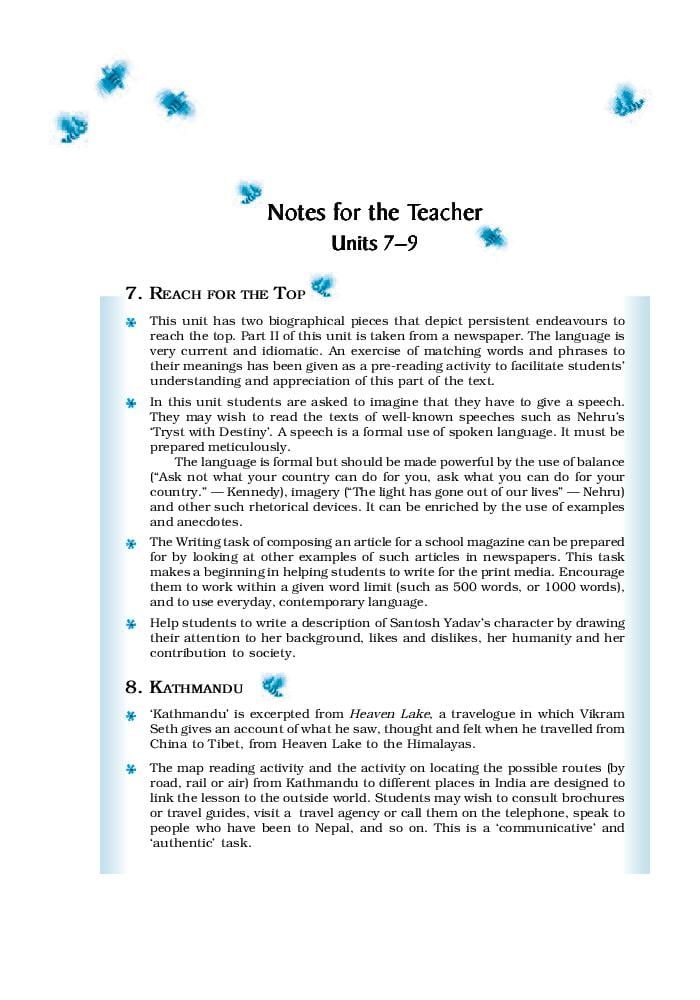
Teacher
Units 7–9
7. REACH FOR THE TOP
This unit has two biographical pieces that depict persistent endeavours to
reach the top. Part II of this unit is taken from a newspaper. The language is
very current and idiomatic. An exercise of matching words and phrases to
their meanings has been given as a pre-reading activity to facilitate students’
understanding and appreciation of this part of the text.
In this unit students are asked to imagine that they have to give a speech.
They may wish to read the texts of well-known speeches such as Nehru’s
‘Tryst with Destiny’. A speech is a formal use of spoken language. It must be
prepared meticulously.
The language is formal but should be made powerful by the use of balance
(“Ask not what your country can do for you, ask what you can do for your
country.” — Kennedy), imagery (“The light has gone out of our lives” — Nehru)
and other such rhetorical devices. It can be enriched by the use of examples
and anecdotes.
The Writing task of composing an article for a school magazine can be prepared
for by looking at other examples of such articles in newspapers. This task
makes a beginning in helping students to write for the print media. Encourage
them to work within a given word limit (such as 500 words, or 1000 words),
and to use everyday, contemporary language.
Help students to write a description of Santosh Yadav’s character by drawing
their attention to her background, likes and dislikes, her humanity and her
contribution to society.
8. KATHMANDU
‘Kathmandu’ is excerpted from Heaven Lake, a travelogue in which Vikram
Seth gives an account of what he saw, thought and felt when he travelled from
China to Tibet, from Heaven Lake to the Himalayas.
The map reading activity and the activity on locating the possible routes (by
road, rail or air) from Kathmandu to different places in India are designed to
link the lesson to the outside world. Students may wish to consult brochures
or travel guides, visit a travel agency or call them on the telephone, speak to
people who have been to Nepal, and so on. This is a ‘communicative’ and
‘authentic’ task.
82 / Beehive
Showing the first page only. Download the PDF above for the complete document.
Document Details
| Board / Org | NCERT |
| Exam | Class 9 |
| Type | Books |
| Pages | 15 |
| Updated | 22 Jul 2026 |