AP TET 2024 Question Paper II Social Science
Finished viewing? Save it for later —
Download AP TET 2024 Question Paper II Social Science (PDF · 58 pages)About AP TET 2024 Question Paper II Social Science
AP TET 2024 Question Paper II Social Science is available here for free download. Published by Andhra Pradesh Exams for Andhra Pradesh Teacher Eligibility Test, this question paper can be viewed online or downloaded as a PDF (58 pages). Candidates preparing for Andhra Pradesh Teacher Eligibility Test can use AP TET 2024 Question Paper II Social Science to understand the exam pattern, the type of questions asked, and the overall difficulty level.
Frequently Asked Questions
How can I download AP TET 2024 Question Paper II Social Science?
Open this page and click the Download button to save AP TET 2024 Question Paper II Social Science as a PDF. It is completely free on AglaSem Docs.
Is AP TET 2024 Question Paper II Social Science free to download?
Yes. AP TET 2024 Question Paper II Social Science can be viewed online and downloaded as a PDF free of cost on AglaSem Docs.
How many pages does AP TET 2024 Question Paper II Social Science have?
AP TET 2024 Question Paper II Social Science contains 58 pages, which you can read online or download together as a single PDF.
Where can I find more Andhra Pradesh Teacher Eligibility Test study material?
You can find more Andhra Pradesh Teacher Eligibility Test question papers, sample papers, syllabus, and answer keys on AglaSem Docs.
AP TET 2024 Question Paper II Social Science – Text
Read the full text of this question paper below — useful to quickly search, copy and reference the content online without downloading the PDF.
📄 View text version (58 pages)
Page 1
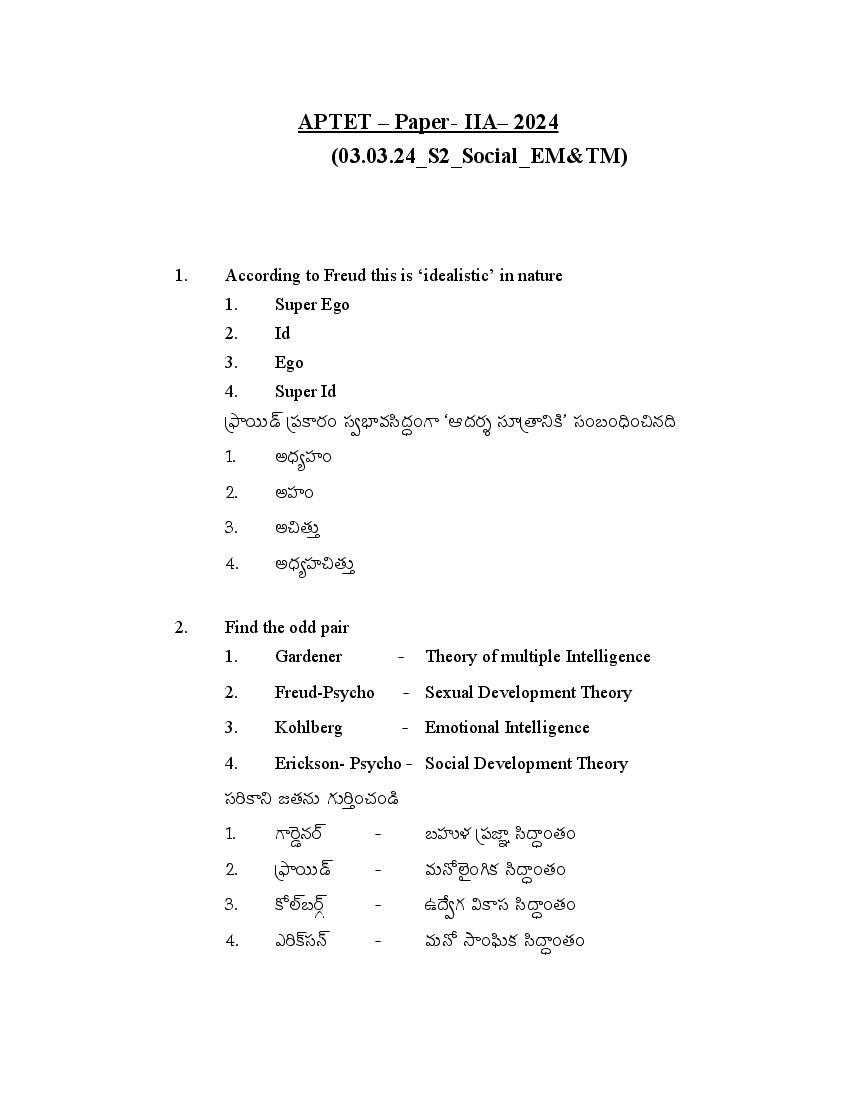
(03.03.24_S2_Social_EM&TM)
1. According to Freud this is ‘idealistic’ in nature
1. Super Ego
2. Id
3. Ego
4. Super Id
çbÍsTT& ç|¿±sÁ+ dÇuó²ed¾<+Æ >± »<sôÁ dÖçÔ¿ìµ d++~ó+ºq~
1. n<ó« V²+
2. nV²+
3. nºÔáTï
4. n<ó«V²ºÔáTï
2. Find the odd pair
1. Gardener ` Theory of multiple Intelligence
2. Freud-Psycho ` Sexual Development Theory
3. Kohlberg ` Emotional Intelligence
4. Erickson- Psycho ` Social Development Theory
d]¿± ÈÔáqT >·T]ï+#á+&
1. >±Âsq¦ sY ` VQÞø ç|C²ã d¾<Æ+Ôá+
2. çbÍsTT& ` eTHÃýÉ+Õ Ð¿£ d¾<Æ+Ôá+
3. ¿ÃýÙsYZ ` <ûÇ>· $¿±d d¾<Æ+Ôá+
4. m]¿ùdH ` eTHÃ kÍ+|T¾ ¿£ d¾<Æ+Ôá+
Page 2
and graphs
1. Logical – Mathematical Intelligence
2. Spatial Intelligence
3. Inter personal Intelligence
4. Intra Personal Intelligence
ç|Èã ¿£\ysÁT ºçÔ\qT, ç>±|\t qT dT\uó+ >± $Xâw¢ +¾ #á>\· sÁT
1. >·DìÔá Ô]Ø¿£ ç|Èã
2. çbÍ<û¥¿£ ç|Èã
3. e«¿£ï«+ÔásÁ ç|Èã
4. e«¿£ï«+ÔásÁZÔá ç|Èã
4. One of the following is a Projective test of Intelligence
1. 16 PF questionnaire
2. Bell’s adjustment Inventory
3. Minnesota Multiphasic personality Inventory
4. Children apperception Test
ç¿ì+~yýË ÿ¿£{ì ç|¿¹ |¿ £ |¯¿£
1. 16 |¾.m|.t ç|Xæe[
2. uÉýÙ dsTÁ uÆ ²³T XË~ó¿£
3. $THîkþ{² VQÞø<X ø eTÖ]ïeTÔáÇ XË~ó¿£
4. |¾\\¢ ÜeÔáï ç>±V²«¿£ |¯¿£
Page 3
1. Solitary play
2. Associative play
3. Parallel Play
4. Co-operative Play
yîTT<{ì kÍ+|T¾ ¿£ ¿£Ôá«+
1. @¿±+ÔáÁ ç¿¡&
2. d+dsÁZ ç¿¡&
3. deÖ+ÔásÁ ç¿¡&
4. dV² ¿±sÁ ç¿¡&
6. In this stage of moral development by Kohlberg the child’s
moral Judgment is based on the desire to obtain approval /
recognition of others
1. Anti-conventional
2. Pre-conventional
3. Conventional
4. Post conventional
¿ÃýÙsYZ ç|¿±sÁ+ HîÜÕ ¿£kÍsTT q+<T ¥XøeÚ HîÜÕ ¿£ sÁj
Tá +
ÔásTÁ \ yîÖ<+ ýñ< >·T]ï+|Ú |Õ <ósÁ|& ÈsÁT>·TÔáT+~.
1. e«Ü¹s¿£ d+ç|<jáT
2. |PsÁÇ d+ç|<jáT
3. d+ç|<jáT
4. Ôásï Á d+ç|<jáT
Page 4
1. Infancy
2. Early Childhood
3. Late Childhood
4. Adolescence
»<ûÇ>· ¿<¸]d¾dµt <Xø q+<T ç|<] ô+|&TqT
1. XèXÕ eø <Xø
2. |PsÁÇ u²\«<Xø
3. ÔáïsÁ u²\«<Xø
4. ¿eÖsÁ<X ø
8. According to Erickson the following Psycho Social
Developmental crisis formed is in Play age (3-5 years)
1. Role Identify - Role confusion
2. Initiative - Guilt
3. Autonomy - Doubt
4. Trust – mistrust
m]¿ùdH ç|¿±sÁ+ ç¿¡&<Xø (3`5 d+öö) ýË ¿£qÎ&û eTHÃkÍ+|¾T¿£ ¿ì¢w¼
|]d¾Ü
1. bÍçÔá >·T]ï+|Ú ` bÍçÔá d+~>·+Æ
2. #=sÁe #áÖ|&+ ` Ôá|ð #ûXæqq uó²eq
3. dÇjáT+ ç|Ü|Üï ` d+<ûV² +
4. qeT¿£+ ` n|qeT¿£+
Page 5
1. Development is not measurable but can be estimated
2. Growth has a quantitative aspect
3. Development is an integrated process
4. Growth is a multidimensional process
ç¿ì+~ ç|e#áHýË¢ d]¿±~
1. $¿±kÍ ¿=\eýñeTT ¿±ú n+#áH yûjTá >·\+
2. |sÁT>·T<\ |]eÖD²Ôá¿£yTî q® ~
3. $¿±d+ ÿ¿£ deTç>· ç|ç¿ìjTá
4. |sÁT>·T<\ VQeTTKyîTq® ç|ç¿ìjTá
10. The person who proposed that there is a language acquisition
Device (LAD) in the child’s brain
1. Thorndike
2. Chomsky
3. Pavlov
4. Bandura
¥XøeÚ yîT<&T q+<T »uó²cÍsÁ̈q |¿£sÁD+µ ( LAD ) eÚ+³T+<
ç|ÜbÍ~+ºq~
1. <¸sÁH& î¿Õ ù
2. #yTdÓØ
3. bÍyýËy
4. +&Ös
Page 6
of one (a) simple (b) complex (c) abstract and (d) concrete
1. a&c
2. b&d
3. b&c
4. a&d
»eTÖ&T q\¢ #á<s \Tµ nHû uó²eq @ s +&+{ì dyTû Þøq+ uó²eq?
(a) dsÁÞø (b) d+¿ìw
¢ ¼ (c) neTÖsÁï eT]jáTT (d) eTÖsÁï
1. a eT]jáTT c
2. b eT]jáTT d
3. b eT]jáTT c
4. a eT]jáTT d
12. Naturalizatioin belongs to this domain
1. Cognitive domain
2. Affective domain
3. Psychomotor domain
4. Socia domain
kÍÇuó²M¿£sÁD sÁ+>±¿ì #î+<TÔáT+~
1. C²ãHÔá¿£ sÁ+>·+
2. uó²yyûXø sÁ+>·+
3. eÖqd¾¿£ #á\HÔá¿£ sÁ+>·+
4. kÍ+|T¾ ¿£ sÁ+>·+
Page 7
my yesterday’s thinking about how I should be tomorrow. It is
an example for
1. Artificial motivation
2. Extrinsic motivation
3. General motivation
4. Achievement motivation
yîT¿Â eÕ sY »»¹s|Ú @ kÍsTTýË +&© n HûqT q #ûdq¾ ýË#áH
|*ÔáyûT H H{ì kÍsTTµµ n |s=ØHsÁT. ~ B¿ì <V²sÁD
1. ¿£çÜeT ç|sÁD
2. u²V²« ç|sÁD
3. kÍ<ósÁD ç|sÁD
4. kÍ<óq ç|sÁD
14. The type of learning involved in identifying one’s desired
object/person from various objects / persons
1. Rules learning
2. Discriminative learning
3. Valued learning
4. Generalization learning
$$<ó edTeï Ú\T/e«Å£ï\ qT+& ÔáqÅ£ ¿±e\d¾q edTeï Ú/e«¿ìï yûsTÁ
#ûd¾ >·T]ï+#á&+ ýË $T&jTá Tq nuó« dq+
1. jáTeÖ\ nuó«dq+
2. $#á¿£D nuó«dq+
3. $\Te\ nuó«dq+
4. kÍ<ósÁD¡¿£sÁD nuó«dq+
Page 8
of learning in this context is
1. Positive
2. Negative
3. Bilateral
4. Zero
d+^Ôá+ HûsTÁ Ì¿=q e«¿ìï Ôá HûsTÁ Ì¿Ãy\qTÅ£H&T.
d+<sÒÁ +Û ýË È]¹> nuó« dq <ý²sTT+|Ú
1. nqTÅ£L\
2. ç|ÜÅ£L\
3. ~ÇbÍsÁô«
4. XøSq«
16. The Psychologist known for his experiment using ‘Bobo doll’
is
1. Albert Bandura
2. Ebbinghaus
3. Lev Vygotsky
4. Carl Rogers
»uËuË&ýÙµ |jîÖÐ+º ç|jîÖ>·+ #ûd¾q ç|d¾<Æ eTHÃ$C²ãq XædïyûÔáï
1. ýÙsY¼ +&Ös
2. m_Ò+>´ Vädt
3. ýÉy yî>Õ ±{Ù dÓØ
4. ¿±sY¢ sÃÈsYà
Page 9
Organization’
1. Law of multiple response
2. Law of continuity
3. Law of partial activity
4. Law of practice
> kͼý¼Ù y<T\ n_óçbÍjáT+ ç|¿±sÁ+ »ç|Ô«á ¿£ sÁÇV²D jáTeT+µ
1. VQÞø ç|ÜdÎ+<q jáTeT+
2. n$sÁÞø jáTeT+
3. bÍ¿ì¿ £ #ás« jáTeT+
4. nuó²«d jáTeT+
18. Retaining the learned material and experiences in the mind for
some period is called as
1. Discriminate
2. Recall
3. Retention
4. Recognition
nuó« d¾+ºq $wjÖá \T, nqTuóy\T dÜ|<¸+ýË ¿=+Ô῱\+ \Ç
+&û ç|ç¿ìjTá
1. $#á¿D
£ #áÖ|Ú
2. Èã|¾ï¿ì Ôî#áTÌ¿Ãe&+
3. <ósÁD
4. >·T]ï+|Ú
Page 10
1. Classical conditioning
2. Cognitive Development theory
3. Sociocultural Theory
4. Instructional theory
ç¿ì+~ yýË ÿ¿£{ì S.R. d¾<+Ôá+
1. XædÓj
ï Tá +<óq +
2. d+C²ãHÔá¿£ n_óe~Æ d¾<Æ+Ôá+
3. kÍ+|T¾ ¿£ kÍ+dØÜ¿£ d¾<Æ+Ôá+
4. ¥¿£D ² d¾<Æ+Ôá+
20. Learning means the following change in the behavior
1. Artificial
2. Temporary
3. Partial
4. Almost permanent
nuó« dq+ n+fñ ç|esÁqï ýË ç¿ì+~ $<óy Tî q® eÖsÁTÎ
1. ¿£çÜeTyîTq®
2. ÔÔØ*¿£yTî q®
3. bÍ¿ì¿ £yTî q®
4. <<|Ú XæXøÇÔáyTî q®
Page 11
1. NPE - 1986
2. Kothari Commission
3. NCF - 2005
4. RTE – 2009
“sÁ+ÔásÁ deTç>· eTÖý²«+¿£H” ç|ÜbÍ~+ºq ysÁT
1. NPE - 1986
2. ¿=sį ¿£MTwH
3. NCF - 2005
4. RTE – 2009
22. The term ‘Dejavu’ belongs to
1. Greek
2. French
3. German
4. Latin
»&îC²eÚµ nHû |<+ ç¿ì+~ uó²wÅ£ #î+~q~
1. ç^Å£
2. ç|+#Y
3. ÈsÁH
4. ý²{ìH
23. Maximum storage capacity of ‘Digi locker’
»»& ý²¿£sYµµ jîTT¿£Ø >·]w¼ \Ç kÍeTsÁ«+
1. 154 B
2. 1 GB
3. 500 MB
4. 100 MB
Page 12
yîTT³¼yTî T<{ì ‘ yîTsTTHç|yT ¿£+|P«³sY ’
1. Cray J90
2. Cray T90
3. UNIVAC – I
4. EDSAC
25. Find the correct order of ‘Data Processing’
ç¿ì+~yýË »&û{² çbÍdd¾+>´µ jîTT¿£Ø KºÌÛÔyá Tî q® ç¿£eT+
1. Input Processing Storage Output
2. Input Storage Processing Output
3. Input Processing Output Storage
4. Input Storage Output Processing
26. Date of conversion of Mid-day-Meal scheme to ‘Jagananna
Gorumuddaµ in Andhra Pradesh
+ç<óç |<Xû ýÙ Ë eT<ó«V² uóËÈq |<¿ó ± »È>·qq >ÃsÁT eTT<µÝ >±
eÖ]Ìq Ôû~
1. 21-01-2020
2. 20-04-2020
3. 12-01-2020
4. 23-04-2020
27. Cash given yearly to each 9th class Student studying in hostels
under ‘YSR Vidya Jyothi Scheme’
‘YSR $<«CË«Ü |<ó¿+
£ µýË Vädý¼ ýÙ Ë +&û 9e Ôás>Á Ü
· $<«sÁT\ Å£
d+eÔáàs¿ì #ûÌ q>·<T
1. ` 4500/-
2. ` 15000/-
3. ` 3000/-
4. ` 12500/-
Page 13
»nydt¼µ (Avast) nHû~
1. Antivirus software
2. Open source Learning Software
3. Internet web browsing Software
4. Micro Soft Software
29. ‘TOEFL’ stands for
‘TOEFL’ nq>±
1. Test of English as a French Language
2. Test of English as a First Language
3. Test of English as a Foreign Language
4. Test of English as a Fundamental Language
30. One of the following is not a ‘Zip Software’
1. Winzip
2. PKzip
3. Netzip
4. Unzip
ç¿ì+~yýË »|t kÍ|y¼t sû µY ¿±~
1. $H|t
2. |¾¿Â |t
3. Hî{Ù|t
4. nH|t
Page 14
y#\Ôá >·*Z |sTÁ wyÅ£Ø \i#áT#áTH
ú#á ¿£Ü jáT>·T#áT eT~ d+
¿Ã#áeTT ýñÅ£ +&"~sÁT>·T >·TeÇ\#îH!
|Õ |<« +ýË » d+¿Ã#áeTTµ nHû |<¿ì nsÁ+
1. y#\Ôá
2. uój Tá eTT, È+Å£
3. y«¿Ã#áeTT
4. d+ÔÃweTT
32. ú#áTqÅ£ <óq eTT >·*qZ
y#\Ôá >·*Z |sTÁ wyÅ£Ø \i#áT#áTH
ú#á ¿£Ü jáT>·T#áT eT~ d+
¿Ã#áeTT ýñÅ£ +&"~sÁT>·T >·TeÇ\#îH!
|sTÁ w yÅ£Ø\T n+fñ
1. eT<óT sÁyTî q® eÖ³\T
2. ¿£]qÄ yîTq® yÅ£Ø\T
3. sÁV² d«+>± #î|Î eÖ³\T
4. ºq|¾\\¢ eÖ³\T
Page 15
È+>± |¯¿¹ q #îbÍÎ*à +³T+~. »»>·<« + ¿£MH+ ¿£w+ e<µï µ
(¿£$ ç|ÜuóÅ £ >·<« yûT ^³T ssTT) nHû ç|d<¾ ÃÆ¿ïì se&¿ì<û
¿±sÁDyîT® +³T+~. >·<« + #ó+á <ÃsÁV¾²Ôá+>± +³T+~. ¿±{ì¼ |<« +
ý²>± $q&¿ì n+Ôá +|Ú>± +&<T . n+<Te\¢ |<« sÁ#qá çXËÔá*
¿£]+ü ºq+Ôá>± >·<« sÁ#qá ¿£]+ü #áý¿ñ b£ þe&+ÔÃ yîTT<{ì qT+º
¿£eÚ\T B|Õ yîTT>·TZ #áÖ|ýñ<T . nsTTÔû ¿=+Ôá eT+~ eÖçÔá+ ÔáeT
yûT<óXø¿Ô
ïì à #ó+á <à sÁV²¾ ÔáyTî q® >·<« Å£L& #ó+á <dT àe\¢ ¿£*>¹
ç|jîÖÈH\ q+{ì kÍ~ódÖ ï sjáT>·*>±sÁT. +<TÅ£ uó{ ²¼#sÁT«
¿±<+], ¿¹ Ôáq <XÅø £ eÖsÁ #á]çÔá yîTT<ýqÕÉ $ ÔsØD²\T.
¿£eÚ\T >·<« sÁ#qá |Õ yîTT>·TZ #áÖ|¿£ bþe&¿ì ¿±sÁD+
1. >·<« +|Õ ºq #áÖ|Ú +&³+e\¢
2. >·<« sÁ#qá ¿£w+¼ nqT¿Ãe&+ e\¢
3. |<« sÁ#qá çXËÔá* ¿£]+ü ºq+Ôá>± >·<« sÁ#qá
¿£]+ü #á¿b£ þe&+
4. |<«¿ì q $\Te >·<«¿ì ýñ¿b£ þe&+ e\¢
Page 16
È+>± |¯¿¹ q #îbÍÎ*à +³T+~. »»>·<« + ¿£MH+ ¿£w+ e<µï µ
(¿£$ ç|ÜuóÅ £ >·<« yûT ^³T ssTT) nHû ç|d<¾ ÃÆ¿ïì se&¿ì<û
¿±sÁDyîT® +³T+~. >·<« + #ó+á <ÃsÁV¾²Ôá+>± +³T+~. ¿±{ì¼ |<« +
ý²>± $q&¿ì n+Ôá +|Ú>± +&<T . n+<Te\¢ |<« sÁ#qá çXËÔá*
¿£]+ü ºq+Ôá>± >·<« sÁ#qá ¿£]+ü #áý¿ñ b£ þe&+ÔÃ yîTT<{ì qT+º
¿£eÚ\T B|Õ yîTT>·TZ #áÖ|ýñ<T . nsTTÔû ¿=+Ôá eT+~ eÖçÔá+ ÔáeT
yûT<óXø¿Ô
ïì à #ó+á <à sÁV²¾ ÔáyTî q® >·<« Å£L& #ó+á <dT àe\¢ ¿£*>¹
ç|jîÖÈH\ q+{ì kÍ~ódÖ ï sjáT>·*>±sÁT. +<TÅ£ uó{ ²¼#sÁT«
¿±<+], ¿¹ Ôáq <XÅø £ eÖsÁ #á]çÔá yîTT<ýqÕÉ $ ÔsØD²\T.
>·<« + ¿£MH+ ¿£w+ e<+Ü n+fñ...
1. |<« + >·<« + ÿ¿£f!ñ
2. >·<« + e<+ÔáT\ \jáT+
3. >·<« + ¿£eÚ\Å£ ¿=sÁTÅ£&T |&< T
4. ¿£$ ç|ÜuóÅ £ >·<« yûT ^³TssTT
35. |eÖq <ós Á kÍeT«+#ûÔá |yTû jáÖ |eÖq+>±
}V¾²+ºq³¢sTTÔû
1. |eÖ\+¿±sÁ+
2. çÔûο±\+¿±sÁ+
3. ý²{²qTçbÍkÍ\+¿±sÁ+
4. nÜXøjÖî ¿ìï n\+¿±sÁ+
36. »»¹¿Ôáq+, |Ô¿£+µµ |<\Å£ d]jîT® q |s«jáT|<+
1. >·<
2. ¿±+&
3. CÉ+&
4. n+&
Page 17
1. u²\#á+ç<T ç|ÜÈã
2. ºq ¥XøeÚ
3. ¿£|Î Ôá*¢ |[ß
4. m<
38. |Údï¿£ |sqÁÄ + eTqdTÅ£ ý²¢d+ ¿£*ÐdT+ï ~.
^Ôá ^d¾q |<¿ì HHsÁ| < \T
1. <>·ZsÁ, kÍ<ó«+
2. ç|jTá Ôá+, e«ekÍjáT+
3. qÖÔáq+, bÍÔá<q+
4. ç>·+<¸uó²>·+, ÔàV²+
39. eTsÁD+ ¿£*Ð+|~ ` eÚ«ÔáÎÔáï«sÁ |<+
1. neTÔá+
2. #áç¿£+
3. eq+
4. q+<q+
40. sÃE |+¿ìï uóËÈq+ È]Ð+~.
^Ôá^d¾q |<¿ì $¿£Ü
1. Üï
2. +Ü
3. uó> e· +ÔáT&T
4. \>·+
Page 18
1. ¿±\<ós Á +
2. ¿£qT$|ð
3. ¿£qTeTÖjáTT³
4. ¿±\#áç¿£+
42. ç¿ì+~ yýË ¿£+sÄÁÔ\y«\T
1. n#áTÌ\ú
2. ÿ z W
3. m @ × ÿ z W
4. m @ ×
43. >·V²dÆ <ós , d+Ôq çbÍ<óH«, dÔ«á + >=|ÎÔáH
>·T]+º #î|Î &yTû bÍsÄ+Á <ûXÝ +ø
1. H #á<T eÚ
2. Xæy~
3. <ósÁuË<ó
4. sÁ+>·d\+
44. me] ÈjáT+Ü +ç<ó H³¿£s+Á >· ~HÃÔáàe+>± ÈsÁT|ÚÅ£+{²sÁT.
1. Þ²ß] s|T e
2. >·TsÁC²& nbÍÎseÚ
3. ¿£+<TÅ£L] M¹sXø*+>·+
4. yû<+ yî+¿£³ sjáTXæçd¾ï
Page 19
m. uósÁÔá G sÁÇsÁ n. ÔáÇ d+~ó
_. çbÍDeTTH G rdqT . jáTD²<ûXø d+~ó
d¾. |~V²qT G @Þøß . >·TD d+~ó
&. nDT G nçd+ï . dsÞÁ ²<ûXø d+~ó
1. m ` , _ ` , d¾ ` , & ` n
2. m ` , _ ` , d¾ ` n, & `
3. m ` , _ ` , d¾ ` , & ` n
4. m ` , _ ` , d¾ ` , & ` n
46. »¿£sÁ <ósÁjTá µ deÖd+ n+fñ
1. $XâwD eTT, dsÇÁ HeT+ deÖd+>± eÖsÁ&+
2. $XâwD eTT, ç¿ìjTá deÖd+>± eÖsÁ&+
3. $XâwD ²¿ì, HeTy#῱¿ì deÖd+ ÈsÁ>&· +
4. $XâwD²¿ì, ne«jáÖ¿ì deÖd+ ÈsÁ>·&+
47. »»bÍ<¸Ã~¸µµ |<¿ì nsÁ+
1. deTTç<+
2. #îsTÁ eÚ
3. q~
4. bÍÔÞø+
Page 20
1. XøçÔás¿Á +£
2. nqTeTÔá«sÁ¿£+
3. ¿±ïÇsÁ¿£+
4. #û<sÁ¿£+
49. »»deTTç< rsÁ+ýË |¾\\¢ T &TÅ£+³THsÁTµµ
y¿±«¿ì e«Ü¹s¿±sÁ¿£ y¿£«+
1. deTTç< rsÁ+ýË |¾\¢\T &T¿ÃuËÔáTHsÁT
2. deTTç< rsÁ+ýË |¾\\¢ T &T¿Ãe&+ ýñ<T
3. deTTç<rsÁ+ýË |¾\\¢ T &ûXæsÁT
4. deTTç< rsÁ+ýË |¾\¢\T &\qTÅ£+³THsÁT
50. ¿ì+~ yýË C²ãq|ÓsÄÁ |ÚsÁkÍØsÁ+ bõ+< sÁ#áq
1. leTç<eÖjáTD ¿£\Îe¿£+
2. $XøÇ+uósÁ
3. seÖjáTD $we¿£+
4. bÍÅ£&TsÞøß
51. »»$¥w¼Ôá ¿£*Ðq ç|<ûXæ\qT <]ô+ºq|Ú&T bõ+~q nqTuóÖÜ,
nqTuóy \qT esÁH Ôá¿£+>± sd ç|ç¿ìjTá
1. ç|+<ó sÁ#qá
2. jáÖçÔ sÁ#qá
3. >¹ jáT sÁ#qá
4. |Ó]¿Ä £
Page 21
1. Ü¿£Øq
2. qqjáT
3. miÀq
4. bþÔáq
53. U I I U I U I I I U I I U I I U I U IU
>·TsÁT\|T TeÚ\T ý² +fñ |<« + neÚÔáT+~
1. XæsÁÖÝ\+
2. ÔáÎ\eÖ\
3. eTÔûïuó+
4. #á+|¿e£ Ö\
54. yû~¿£ MT< q{ì+#û deTjáT+ýËHû ÿ¿£ çdÓï ç|d$ +º+~.
~ H³¿£ deÖÈ+ýË È]Ð+~
1. nuóT «<jTá H³¿£ deÖK«
2. dTsÁ_ó H³¿£ deÖÈ+
3. >·T+³ÖsÁT |d ¼t ¿£+|ú
4. +<sTÁ È>·HÃV¾² deÖÈ+
55. d+~ó È]¹> s +&T |<\ýË |PsÁÇ|<+ ºe] n#áTÌqT
ý² n+{²sÁT.
1. |sÁdÎsÁ+
2. |PsÁÇ dÇsÁ+
3. dÇsÁ yûTÞøq+
4. |sÁdÇsÁ+
Page 22
¿£ý²yT nHsÁT. y¿±« ç|Ô«á ¿£ ¿£<q¸ +ýË¿ì eÖsÁÌ>±
1. »»Ôáq J$Ôá+ýË mHà ¿£cͼ\T m<TsÁT#áÖ&ýñ<Tµµ.
|]d¾Ü ¿ì #ûsqTµµ n ¿£ý²yT nHsÁT.
2. »»úÅ£ J$Ôá+ýË mHà ¿£cͼ\T Hî<T s=Ø |]d¾Ü ¿ì
e#ÌqTµµ n ¿£ý²yT nHsÁT.
3. »»Ôáq J$Ôá+ýË mHà ¿£cͼ\T m<Ts qÕ d¾Ü ¿ì
#ûsqTµµ n ¿£ý²yT nHsÁT.
4. »»HûqT J$Ôá+ýË mHà ¿£cͼ\ Hî<Ts=Ø d¾Ü¿ì #ûsqTµµ
n ¿£ý²yT nHsÁT.
57. »Ôáµ >·D+ >·TsÁT \|T TeÚ\T
1. UII
2. U I U
3. U U I
4. I U I
58. »»VäVä! m+Ôá yî|Õ ¯ Ôá«eTT!µµ ~ @ sÁ¿y£ Tî q® y¿£«+
1. nqTeTÔá«sÁÆ¿£ y¿£«+
2. çbÍsÁHsÁ¿£ y¿£«+
3. XøÌs«sÁ¿£ y¿£«+
4. ç|XæsÁ¿ £ y¿£«+
Page 23
1. |Õ&e Tç] yî+¿£³ dTu²ÒseÚ
2. |+&¢ eTç] seTdTu²ÒseÚ
3. H«|Ü dTu²ÒseÚ
4. sjáTçbþ\T dTu²ÒseÚ
60. úeÚ | #ûjTá Å£ ` ~ @ sÁ¿£yTî q® y¿£«+
1. ç|XæsÁ¿ +£
2. kÍeTsÆ«sÁ¿£+
3. w<ósÁ¿£+
4. nqTeTÔá«sÁ¿ +£
Page 24
1. Well done!
2. You should see a dentist.
3. I don’t like you.
4. Let me do it for you.
62. The following can be used to congratulate someone.
1. I have no problem.
2. You should be very careful.
3. Shall we go to a movie?
4. Bravo! you have done well
63. Time lines is important in news reporting.
Choose the option to support the above sentence
1. to remain relevant
2. to ensure accuracy
3. to entertain readers
4. to include personal opinions
64. Choose the option that should be included in the body of the
invitation.
1. Host’s favourite movie
2. Clear and concise event details
3. A list of host’s hobbies
4. The host’s fovourite music band
Page 25
1. Sarada said, “If you remember it, will you please tell
me?”
2. Sarada said, If you remember it will you please tell me.
3. “Sarada said,” If you remember it will you please
tell me?
4. Sarada said. “If you remember it will you please,
tell me?”
66. They are (A) / looking forward (B) / to meet (C) /
their parents (D).
Choose the part that has a grammatical error.
1. A
2. B
3. C
4. D
67. Choose the suffix that suits to get the adjectival form of the
word ‘Child’
1. ly
2. ish
3. ness
4. lly
68. The word “arrangement” has stress on:
1. the third syllable
2. the first syllable
3. the second syllable
4. the first and second syllables
Page 26
“Move in order to make room for someone”
1. set foot
2. give way
3. lose heart
4. call it a day
70. They set down on the last stage of their journey.
Choose the option that can improve the underlined part in the
above sentence.
1. set out
2. set up
3. set in
4. set aside
71. Choose the correctly spelt word.
1. Simultanious
2. Simultanoeus
3. Simultaneous
4. Saimultanueous
72. Choose the option that can be used as a one-word substitute
for “a person who solves problems in a practical and sensible
way”.
1. mercenary
2. theist
3. teetotaler
4. pragmatist
Page 27
Choose the synonym of the word ‘tricked’.
1. precise
2. informed
3. deceived
4. accurate
74. My austere father used to avoid all inessential comforts and
luxuries.
Choose the word which is opposite in meaning to the word
‘austere’
1. fancy
2. stern
3. adamant
4. flinty
75. ‘The’ is not used before
1. the superlative adjectives
2. the names of unique things
3. the names mountain ranges
4. abstract nouns
76. My problems are very similar ______ yours.
Choose the word that fits the blank.
1. with
2. to
3. for
4. from
Page 28
Choose the correct verbs that fit the blanks respectively
1. are damage; finding
2. damage; will find
3. has damage; found
4. had damaged; found
78. Choose the sentence in the past continuous tense
1. The birds were chirping in the tress
2. It rained and the people got wet
3. Who is listening to me?
4. Some children are reading books
79. His friend asked. “Did you see the snake the next day,
doctor?”
Choose the reported speech of the sentence above.
1. His friend asked the doctor if he had seen the snake the
following day.
2. His friend asked the doctor how he had seen the snake
next day.
3. The doctor asked his friend whether he had seen the
snake next day.
4. His friend asked the doctor if he did not see the snake
the next morning.
80. Our National Anthem ________ Rabindranath Tagore.
Choose the option that completes the sentence meaningfully.
1. was composed on
2. is composed with
3. was composed with
4. was composed by
Page 29
Choose the option that fits the blank.
1. were
2. are
3. have been
4. was
82. Choose the sentence with a noun clause.
1. The jury believed that the man was guilty.
2. I am a student
3. I know who you are
4. Raju, who is a teacher, lives next to us.
83. The word ‘erratum’ is:
1. a plural noun
2. an adjective
3. an ordinary verb
4. a singular noun
84. Identify the plural noun from the following
1. fungus
2. data
3. thesis
4. syllabus
85. They waved at him as the train slowly left the platform.
Choose the true statement about the sentence given above.
1. The sentence is in the past perfect tense.
2. The sentence is a simple sentence
3. The sentence is a complex sentence
4. The sentence has three verbs
Page 30
Choose the linker that fits the blank.
1. although
2. nor
3. or
4. equally
87. Victoria dressed ________ her mother’s instructions.
Choose the propositional phase that fits the blank.
1. in place of
2. along with
3. in front of
4. according to
88. We should complete the shooting by tomorrow evening.
In the above sentence, the function of the word ‘should’ is to
express:
1. obligation
2. possibility
3. offer
4. order
Page 31
The life of a student is comparatively speaking a sheltered life.
There are of course, certain responsibilities they are definite
and they are assigned to you by those who are willing to take
care of you and there is not much need to be constantly
exercising your own judgments.
The main characteristic of the student life described in the
passage is:
1. Independence and autonomy
2. Sheltered and guided
3. Stressful and overwhelming
4. Chaotic and unpredictable
90. Read the following passage
The life of a student is comparatively speaking a sheltered life.
There are of course, certain responsibilities they are definite
and they are assigned to you by those who are willing to take
care of you and there is not much need to be constantly
exercising your own judgments.
Choose the false statement based on the passage above.
1. Students have certain responsibilities
2. Students need to exercise their own judgments
3. Students are well – cared of
4. Students are not assigned their work.
Page 32
1. Malwa Plateau
2. Chotanagpur
3. Deccan
4. Tibet
uó²sÁÔá<ûXø+ýË nÐ|sÁÇÔá eTÖý²¿ì #î+~q nÜ çbÍNq |ÓsÄÁuóÖ$T
1. eÖý²Ç|ÓsuÁÄ Öó $T
2. #óÃ{²H>´|P sY
3. <¿£ØH
4. {ìuÉ{Ù
92. For the first time Disaster Management was defined as a
developmental issue in this plan
1. 10th five year plan
2. 12th five year plan
3. 5th five year plan
4. 7th five year plan
yîTT<{kì Í]>± »$|ÔTá ï sÁÇV²Dµ n_óe~Æ n+Xø+>± sÁs TT+#á&q
ç|D²[¿£
1. 10e |+#áesÁçü |D²[¿£
2. 12e |+#áesÁçü |D²[¿£
3. 5e |+#áesÁçü |D²[¿£
4. 7e |+#áesÁçü |D²[¿£
Page 33
1. crow
2. eagle
3. hawk
4. vulture
|¿ì #ábþsTTq È+ÔáTeÚ\qT Üq&+ <Çs |s«esÁD²
Xø~Æ#ûdTï+~.
1. ¿±¿ì
2. &û>·
3. >·<Ý
4. s+<T
94. The winds blowing in the northern plains in summers are
known as
1. KaalBaisakhi
2. Loo
3. Trade winds
4. Chinook
yûd$ ¿±\+ýË Ôásï ÁyTî <® H\ýË M#û |eH\T
1. ¿±ýÙukÕÉ ÍÏ
2. \Ö
3. y«bÍsÁ|e H\T
4. ºqÖ¿ù
Page 34
1. Bhangar
2. Terai
3. Bhabar
4. Khadar
Ôásï yÁ Tî <® q+ýË |ÚsÔáq ÿ+ç&T eT{ì¼
1. uó+>·sY
2. fÉssTT
3. uó²sY
4. U²<sY
96. Hiware Bazar is located in
1. Karnataka
2. Maharashtra
3. Kerala
4. Madhya Pradesh
V¾²y¹s C²sÁT ¿£Ø& ¿£\<T
1. ¿£s³¿£
2. eTVäsçw¼
3. ¿¹ sÁÞø
4. eT<ó« ç|<Xû Ù
Page 35
1. Land water relationship
2. Distance from the equator
3. Rainfall
4. Upper air circulation
oÔÃwd¾Ü ç|uó²$Ôá+ #ûd n+Xæ\ýË ýñ~
1. uóÖ $T¿ì ú{ì¿ì >·\ d++<ó+
2. uóÖeT<ó« ¹sK qT+& <ÖsÁ+
3. esÁübÍÔá+
4. |]Ôá\ >±* ç|ds D Á
98. Limestone, mica and gypsum are
1. Metallic mineral
2. Non – metallic minerals
3. Fuel minerals
4. Nuclear minerals
dTq|ÚssTT, yîT¿® ±, |à+ nqTq$
1. ýËV² KC²\T
2. nýËV² KC²\T
3. +<óq KC²\T
4. nDT KC²\T
Page 36
1. 22 years
2. 18 years
3. 25 years
4. 21 years
yîÖ{²sÁT yV²H\T q&|{
²¿ì ¿£úd ejîÖ|]$TÜ
1. 22 d+öö\T
2. 18 d+öö\T
3. 25 d+öö\T
4. 21 d+öö\T
100. Show the correct chain of distribution of goods
1. Retailer ® producer ® wholesaler ® consumer
2. Wholesaler ® retailer ® producer ® consumer
3. Producer ® retailer ® wholesaler ® consumer
4. Producer ® wholesaler ® retailer ® consumer
edTï |+|¾D¡ >=\TdTqT d]>± dÖº+#û~.
1. º\¢sÁ edTeï Ú\T ® ÔáÎÜï<sÁT&T ® {ËÅ£esÁÅï £ &T ®
$jîÖ>·<sÁT
2. {ËÅ£esÁÅï £ &T ® º\¢sÁesÁïÅ£&T ® ÔáÎÜï<sÁT ®
$jîÖ>·<sÁT
3. ÔáÎÜï<sÁT ® º\¢sÁesÁïÅ£&T ® {ËÅ£esÁÅï £ &T ®
$jîÖ>·<sÁT
4. ÔáÎÜï<sÁT ® {ËÅ£esÁÅï £ &T ® º\¢seÁ sÁÅï £ &T ®
$jîÖ>·<sÁT
Page 37
rearing livestock in this farming
1. Mixed farming
2. Shifting cultivation
3. Subsistence farming
4. Commercial farming
e«ekÍjáT+ýË VäsÃÔáÎÜï¿,ì |Xø eÚ\ yûTÔáÅ£ , |Xø |+|¿±¿ì
uóÖ $T |jÖî ÐkÍïsTÁ .
1. $TçXøeT e«ekÍjáT+
2. $kÍï|q e«ekÍjáT+
3. JeH<ósÁ e«ekÍjáT+
4. yDìÈ« e«ekÍjáT+
102. TISCO (Tata Iron and Steel Company) was started in the year
TISCO ({²{² ×sÁH n+& dÓý
¼ Ù ¿£+|ú)qT çbÍsÁ+_ó+ºq d+eÔáàsÁ+
1. 1910
2. 1907
3. 1912
4. 1908
Page 38
1. Death Rates
2. Migrations
3. Disasters
4. Birth Rates
ÈHuó² eÖsÁTÎÅ£ ~ ç|<óq ç|ç¿ìjTá ¿±<T
1. eTsÁD²\ s¹ ³T
2. e\d\T
3. $|ÔTá \ï T
4. ÈqH\ s¹ ³T
104. An indicator used by the World Bank to classify countries
1. Human Development
2. National Income
3. Per capita Income
4. Economic Development
<ûXæ\qT e¯Z¿]£ +#á{²¿ì ç||+ #áu²«+Å£ |jÖî Ð+#û dÖº¿£
1. eÖqy_óe~Æ
2. C²rjáT <jáT+
3. Ôá\d] <jáT+
4. ]Æ¿±_óe~Ý
Page 39
1. Delhi
2. Vijayawada
3. Hyderabad
4. Benguluru
ç¿ì+~ yýË $eÖHçXøjTá q>·s+Á ¿±~
1. &ó©¢
2. $ÈjáTy&
3. VÕ²<su²<T
4. uÉ+>·ÞSø sÁT
106. ‘Antyodaya Anna Yojana’ (AAY) was launched in the year
»n+Ôë<jáT nq jîÖÈqµ (AAY) |<¸¿ ± @ d+eÔáàsÁ+ýË
çbÍsÁ+_ó+#sÁT
1. 1998
2. 1995
3. 2000
4. 2002
Page 40
1. Illiteracy level
2. Customs and Traditions
3. Lack of Job opportunities
4. Lack of access to healthcare
|<]¿± ¿=\e{²¿ì |jÖî Ð+#û kÍeÖ¿£ dÖº¿£ ¿±~
1. sÁ¿£sd«Ôá kÍsTT
2. #sÁ kÍ+ç|<jáÖ\T
3. <ë>±e¿±Xæ\T ýñ¿£bþeÚ³
4. sÃ>·« d+sÁ¿£D bõ+<ýñ¿£bþeÚ³
108. The company which controls the production in more than one
country is known as
1. World Trade Organisation
2. International Monetary Fund
3. Multi National Company
4. United Nations Organisation
ÿ¿£ <ûX+ø ¿£+fñ mÅ£Øe <ûXæ\ýË ÔáÎÜï jáT+çÜ+#û d+d
1. ç||+ #á yDìÈ« d+d
2. n+Ôás¨rjáT ç<e«~ó
3. VQÞø C²Ü d+d
4. ׿£«sÈ«d$TÜ
Page 41
1. Expenditure on wages
2. Expenditure on raw materials
3. Expenditure on machines
4. Expenditure on marketing
d¾s Á ýñ¿£ uó Ü¿£ |³T¼& nHû~
1. yûÔHá \|Õ e«jáT+
2. eTT&ds TÁ Å£\|Õ e«jáT+
3. jáT+çÔ\|Õ e«jáT+
4. eÖÂsØ{ì+>´|Õ e«jáT+
110. The Harappan People worshipped Pashupathi and
1. Mother Goddess
2. Sri Krishna
3. Sri Rama
4. Annapurna Devi
V²sÁbÍÎ ç|È\T |Xø |Ü eT]jáTT M] |P+#ûysÁT.
1. neTÔá*¢
2. l¿£w
3. lseT
4. nq|Ps<û$
Page 42
1. Ganapathideva
2. Rudrama Devi
3. ProlaRaju - II
4. PratapaRudra
yîÖ³T|*¢ XædH C²¯ #ûdq¾ ysÁT
1. >·D|Ü <ûeÚ&T
2. sÁTç<eT<û$
3. Âs+&e çbþ\sE
4. ç|Ô|sTÁ ç<T&T
112. One who changed the capital from Delhi to Devagiri
1. Firoz Shah Tughlaq
2. Muhammad Bin Tughlaq
3. GhiyasuddinTughlaq
4. Balban
sÈ<ó &ó©¢ qT+& <ûeÐ]¿ì eÖ]Ìq ysÁT
1. |s¾ ÃCÙ cÍ ÔáT>·¿¢ ù
2. eTV²eT< ;H ÔáT>·¿¢ ù
3. |¾TjáÖEBÝH ÔáT>·¢¿ù
4. u²\ÒH
Page 43
1. Lord Dalhousie
2. Lord Canning
3. Warren Hastings
4. William Bentinck
uó²sÁÔá<ûXø+ýË yîTT<{ì >·esÁsY ÈqsÁýÙ
1. ý²sY¦ &ý ½d¾
2. ý²sY¦ ¿±+>´
3. ysÁH V²d¾+¼ >´à
4. $*jáT+ uÉ+{ì+¿ù
114. Rabindranath Tagore started ‘Santiniketan’ in
sÁM+ç<H<¸ sÄ>·ÖsY »Xæ+ܹ¿ÔáHµqT kÍ|¾+ºq d+eÔáàsÁ+
1. 1901
2. 1905
3. 1910
4. 1912
115. After Independence the states were reorganised on the basis of
1. The area of the state
2. The population of the state
3. Spoken language of the state
4. Resources of the state
kÍÇÔá+çÔ«q+ÔásÁ+ sçcͼ\ |Úq]ÇuóÈq B <ósÁ+>± È]Ð+~
1. sçwy¼ XÕî æ\«+
2. sçw¼ÈHuó²
3. sçw+¼ ýË eÖ{²¢&û uó²w
4. sçw¼ eqsÁT\T
Page 44
1. Namibia
2. Tanzania
3. Kenya
4. South Africa
d+ÖsÁT C²rjáT <«qeq+ ¿£\ <ûX+ø
1. qMT_jáÖ
2. {²+C²jáÖ
3. ¿H«
4. <¿D ì ç|¿¾ ±
117. Constituent Assembly was formed in
sC²«+>· duó @sÁÎ&q d+eÔáàsÁ+
1. 1945
2. 1946
3. 1948
4. 1950
118. The following was NOT a member in the Triple Alliance
1. Austria
2. Germany
3. France
4. Italy
çÔîbÕ Í¿ì¿ £ Å£L³$TýË du«ó <ûX+ø ¿±~
1. çd¾¼jáÖ
2. ÈsÁú
3. çbÍHà
4. ³©
Page 45
1. Mao Zedong
2. Ken SaroWiwa
3. Ho Chi Minh
4. Sun yat -Sen
ç¿ì+~ y]ýË |s«esÁDyûÔïá
1. eÖyÃCÉ&+>´
2. ¿Â HkÍsÃ$y
3. VAº$TH
4. dHj Tî {Ù`dH
120. International Court of Justice located in
1. Hague
2. Geneva
3. Paris
4. Newyork
n+Ôás¨rjáT H«jáTkÍq+ #á̳ ¿£\<T
1. V²>´
2. CÉúy
3. bÍ]dt
4. qÖ«jáÖsYØ
Page 46
1. Telangana
2. Odisha
3. Bengal
4. Kerala
»Ôîuó²>±µ <«eT+ çbÍsÁ+uóyîT®q sçw¼+
1. Ôî\+>±D²
2. ÿ&Xæ
3. uÉ+>±ýÙ
4. ¿¹ sÁÞø
122. The first five year plan was focused on
1. Agriculture
2. Industries
3. Removal of Poverty
4. Unemployment
yîTT<{ì |+#áesÁü ç|D²[¿£ ¿¹ +çB¿£]+ºq n+Xø+
1. e«ekÍjáT+
2. |]çXøeT\T
3. |<]¿£ sÁÖ\q
4. sÁT<ëÐÔá
Page 47
1. JyotiraoPhule
2. Narayana Guru
3. Pandita Ramabai
4. IshwarchandraVidyasagar
»>·Tý²+Ð]µ nHû |Úd¿ï +£ sd¾qysÁT
1. CË«ÜseÚ |Pýñ
2. HsjáTD >·TsÁT
3. |+&Ôá sÁeÖu²sTT
4. XøÇsY #á+ç<$<«kÍ>·sY
124. Number of species used for medicinal purposes by Adivasis
Ww<ó ç|jÖî ÈH\ ¿=sÁÅ£ ~ydÓ\T |jÖî Ð+#û
e¿£ C²ÔáT\ d+K«
1. 3500
2. 8000
3. 550
4. 10000
125. Untouchability has been abolished through this Article
+<óq <Çs n+³sÔáq+ w~ó+#á&q~
1. 15
2. 17
3. 19
4. 21
Page 48
Constituent Assembly
sC²«+>· duóÅ£ çbÍÜ<ó« + eV¾²+ºq w&Ö«ýÙ¦ Å£ý²\Å£ #î+~q
duóT«\T
1. 25
2. 26
3. 28
4. 30
127. One of the following does NOT belong to “Right to Freedom”
1. Freedom of speech and expression
2. Right to practice any profession
3. Right to Practice any Religion
4. Right to form Associations
ç¿ì+~ yýË »kÍÇÔá+çÔá|Ú V²Å£ØµÅ£ #î+<~.
1. uó²eç|¿³
£ H dÇ#áÌÛ
2. @ eÜï nsTTH #û|f ¼ñ V²Å£Ø
3. @eTÔHîÕ H #á]+#ûV² Å£Ø
4. d+|Ö \qT @sγT #ûdT Å£Hû V²Å£Ø
128. Education was included in Fundamental rights through this
amendement.
sC²«+>· desÁD <Çs $<«qT çbÍ<¸$T¿£ V²Å£Ø\ýË #ûsÌsÁT
1. 42
2. 44
3. 73
4. 86
Page 49
1. City of Russia
2. Russian President
3. Reform of Gorbachev
4. Nuclear Bomb used in world war - II
>±¢dHt Ãdtï nqTq~
1. sÁcÍ« q>·s+Á
2. sÁcÍ« n<ó«Å£&T
3. >ÃsÁÒ#ûy d+dØsÁD
4. s +&e ç||+ #á jáTT<+Æ ýË y&q nDTu²+T
130. The slogan of the Left front in the West Bengal Assembly
elections in 1977
1. Garibi Hatao
2. Save Democracy
3. Land to the tiller
4. Jai Jawan Jai Kisan
1977 |¥ÌeTuÉ+>±ýÙ nd+;¢ m¿£\ýË yeT|¿£ Å£L³$T H<+
1. >·¯; V²sÄyà (|<]¿± sÁÖ*<Ý+)
2. ç|C²kÍÇeÖ« ¿±bÍ&+&
3. <THûy&<û uóÖ $T
4. CÉÕ ÈyH CÉÕ ¿ìkÍH
131. The retirement age of High court Chief Justice
VÕ²¿ÃsÁT¼ ç|<ó q H«jáTeTÖ]ï |<M $sÁeTD ejáTdT
1. 60
2. 62
3. 63
4. 65
Page 50
1. Dispur
2. Aizwal
3. Guwahati
4. Kohima
H\T>·T Xæq« sçcͼ\Å£ ¿£*|¾ eT& VÕ²¿ÃsÁT¼ #á̳ q~
1. &d|t P sY
2. ×C²ÇýÙ
3. >V²Ü
4. ¿ÃV¾²eÖ
133. According to the urban water commission, the water
requirement per person per day in urban area in litres
nsÁÒH y³sY ¿£MTwH ç|¿±sÁ+, |³¼D çbÍ+Ôá+ýË ç|Ü e«¿ìï¿ì sÃE¿ì
nedsÁyîT®q úsÁT ©³sÁ¢ýË
1. 135
2. 140
3. 145
4. 150
Page 51
1. Aryans
2. Indus people
3. Chinese
4. Egyptians
ç|Üï yîTT<{kì Í]>± |+&+ºqysÁT
1. sÁT«\T
2. d¾+<óÖ ç|È\T
3. #îúÕ jáTT\T
4. |Ú¼ysÁT
135. He was considered the greatest reformer in Indian
Sanatana Dharma
1. Madhwacharya
2. AdiShankaracharya
3. Ramanujacharya
4. Swami Vivekananda
uó²sÁÔá dHÔáq <ósÁ+ýË M] >=|ÎeTÔá d+dØsÁï>± uó²$kÍïsÁT.
1. eT<óÇ#sÁT«\T
2. ~Xø+¿£s#sÁT«\T
3. seÖqTC²#sÁT«\T
4. kÍÇ$T $yû¿±q+<
Page 52
Godavari
1. Avanthi
2. Magadha
3. Asmaka
4. Chedhi
>Ã<e] qB rsÁ+ýË q eTVäÈq|<+
1. ne+Ü
2. eT>·<ó
3. nd¿£
4. #óû~
137. The Sanchi Stupa is located in
1. Uttar Pradesh
2. Madhya Pradesh
3. Bihar
4. Kerala
kÍ+N dÖ| + ¿£Ø& ¿£\<T
1. Ôásï Á ç|<Xû Ù
2. eT<ó« ç|<Xû Ù
3. ;VäsY
4. ¿¹ sÁÞø
138. ‘Liberalisation’ started from the year.
»]Æ¿£ dsÁ°¿£sÁDµ çbÍsÁ+uóyîT®q d+eÔáàsÁ+
1. 1990
2. 1991
3. 1992
4. 1995
Page 53
1. Benjamin Bloom
2. Anderson and Krathwohl
3. Elizebeth Simpson, R.H. Dhawe
4. Grunland
eÖqd¾¿£ #á\HÔá¿£ sÁ+>·+|Õ ¿£w¾#dû q¾ ysÁT
1. uÉ+yîTH Ö¢yT
2. +&sàÁ H, 翱ÔYVä ýÙ
3. m*ÈuÉ{Ù d¾+|àH, sY. V²#Y. <yû
4. ç>ÃHý²+&
140. The teacher should not encourage the student in this regard.
1. Problems solving
2. Dependency nature
3. Questioning
4. Discussions
$wjTá +ýË bÍ<ó«jáTT&T $<«] bþÔáàV¾²+#áÅL£ &<T .
1. deTkÍ« |]cÍØsÁ+
2. <ósÁ|& û dÇuó²e+
3. ç|¥+#á&+
4. #ásÁÌ\T
Page 54
1. NCF – 2000 Recommendations
2. NCF – 1986 Recommendations
3. NCF – 2005 Recommendations
4. Eshwaribhai Patel committee
»uË<óqýË kÍsTT\ y¯>± e¯Z¿£sÁD #ûd¾ uË~ó+#*µ n
dÖº+ºq ysÁT
1. NCF – 2000 d¾bÍ sÁTà\T
2. NCF – 1986 d¾bÍ sÁTà\T
3. NCF – 2005 d¾bÍ sÁTà\T
4. Xøǯuó²jYT |fýñ Ù ¿£$T{¡
142. The results obtained after studying social studies are
1. Values
2. Aims
3. Objectives
4. Specifications
kÍ+|T¾ Xæçdï n<ó« jáTq+ ÔásTÁ yÔá e#ûÌ |* Ô\T
1. $\Te\T
2. XøjÖá \T
3. \¿±«\T
4. dÎwÓ¿¼ s£ D Á \T
Page 55
recommended by
1. Kothari commission
2. Eshwaribhaipatel committee
3. Dr. S. Radhakrishnan committee
4. NCF - 1986
kÍ+|T¾ ¿£ Xædï n<ó« jáTq+ýË uó²>·+>± ]Æ¿X£ æçkÍï #ûsÌ\
d¾bÍ sÁTà #ûdq¾ ¿£$T{ì
1. ¿=sÄ] ¿£MTwH
2. Xøǯuó²jYT |fýñ Ù ¿£$T{¡
3. &öö jáTdt s<ó¿£wH ¿£$T{¡
4. NCF – 1986
144. According to John Dewy the number of important steps in
problem solving method
C²H&Ö«sTT ç|¿±sÁ+ deTkÍ«|]cÍØsÁ |<ÝÜýË
eTTK«yîT®q kþbÍH\T
1. 2
2. 4
3. 6
4. 10
Page 56
Rama Raju in the class room” comes under the teaching
strategy of
1. Puppetry
2. Tableau
3. Role play
4. Brain Storming
»»sÁÖ<ósY|sY¦, n\Ö¢] dÓÔseÖsE d+uó²wDqT $<«sÁT\T ÔásÁ>·Ü
>·~ýË n_óqsTT+º #áÖ|&+ nHû~µµ uË<óH eP«V²+ ¿ì+<¿ì
edT+ï ~.
1. ÔÃ\Tu¤eTý²³
2. ÔuË¢
3. bÍçÔábþwD
4. yûT<óÃeT<óq +
146. Source Method was introduced in this country for the first
time
1. America
2. India
3. England
4. Germany
eqsÁT\ |<Ü
Æ yîTT<³ <ûX+ø ýË ç|yXû ø |{²¼sTÁ .
1. nyîT]¿±
2. +&jáÖ
3. +>±¢+&T
4. ÈsÁú
Page 57
kings during their times come under the following category
1. Objects related to Geography
2. Objects of Historical Importance
3. Objects of civics
4. Objects of Economics
H{ì sE\T |jÖî Ð+ºq uósD Á ²\T, |ÚsÔáq uóe H\T,
HD²\T. XædH\T njáTT ¿ÃeÅ£ #î+<TÔsTT.
1. uó >Ã[¿£ XæçkÍï¿ì d++~ó+ºq edTeï Ú\T
2. #]çÔá¿£ çbÍ<óq«Ôá >·\ edTeï Ú\T
3. båsÁXæçkÍï¿ì #î+~q edTeï Ú\T
4. nsÁX æçkÍï¿ì #î+~q edTeï Ú\T
148. The most traditional method of evaluation in the following
1. Check lists
2. Projective tests
3. Written tests
4. Oral tests
ç¿ì+~ y{ìýË nÜ dHÔáqyîTq® eTÖý²«+¿£q |<Ü
Ý
1. XË<óq dÖº¿£\T
2. ç|¿¹ | ¿ £ |¯¿£\ T
3. sÔá |¯¿£\ T
4. eTòÏ¿£ |¯¿£\ T
Page 58
#]çÔá¿£ uË<óH |<ÝÜýË sÁ¿±\T
1. 2
2. 3
3. 4
4. 5
150. “The process of ascertaining the Educational objectives to
which extent achieved is evaluation” defined by
1. Scriven
2. Ralph Tyler
3. Tuckman
4. James M Broadfield
»»$<«\¿±«\T m+Ôá esÁÅ£ kÍ~ó+#á³+ È]Ð+<à Ôî\TdT¿=Hû
$<óqyûT eTÖý²«+¿£q+µµ n sÁǺ+ºqysÁT.
1. çdÕeH
2. sýÙÎf Û \®É sY
3. ³¿ùeTH
4. CñyT à jáT+ çu²&|Óý¦Ù
Document Details
| Board / Org | Andhra Pradesh Exams |
| Exam | Andhra Pradesh Teacher Eligibility Test |
| Type | Question Paper |
| Pages | 58 |
| Updated | 22 Jul 2026 |