ACET 2019 Answer Key (Jun)
Finished viewing? Save it for later —
Download ACET 2019 Answer Key (Jun) (PDF · 6 pages)About ACET 2019 Answer Key (Jun)
ACET 2019 Answer Key (Jun) is available here for free download. Published by Actuaries India for ACET, this answer key can be viewed online or downloaded as a PDF (6 pages). Candidates preparing for ACET can use ACET 2019 Answer Key (Jun) to understand the exam pattern, the type of questions asked, and the overall difficulty level.
Frequently Asked Questions
How can I download ACET 2019 Answer Key (Jun)?
Open this page and click the Download button to save ACET 2019 Answer Key (Jun) as a PDF. It is completely free on AglaSem Docs.
Is ACET 2019 Answer Key (Jun) free to download?
Yes. ACET 2019 Answer Key (Jun) can be viewed online and downloaded as a PDF free of cost on AglaSem Docs.
How many pages does ACET 2019 Answer Key (Jun) have?
ACET 2019 Answer Key (Jun) contains 6 pages, which you can read online or download together as a single PDF.
Where can I find more ACET study material?
You can find more ACET question papers, sample papers, syllabus, and answer keys on AglaSem Docs.
ACET 2019 Answer Key (Jun) – Text
Read the full text of this answer key below — useful to quickly search, copy and reference the content online without downloading the PDF.
📄 View text version (6 pages)
Page 1
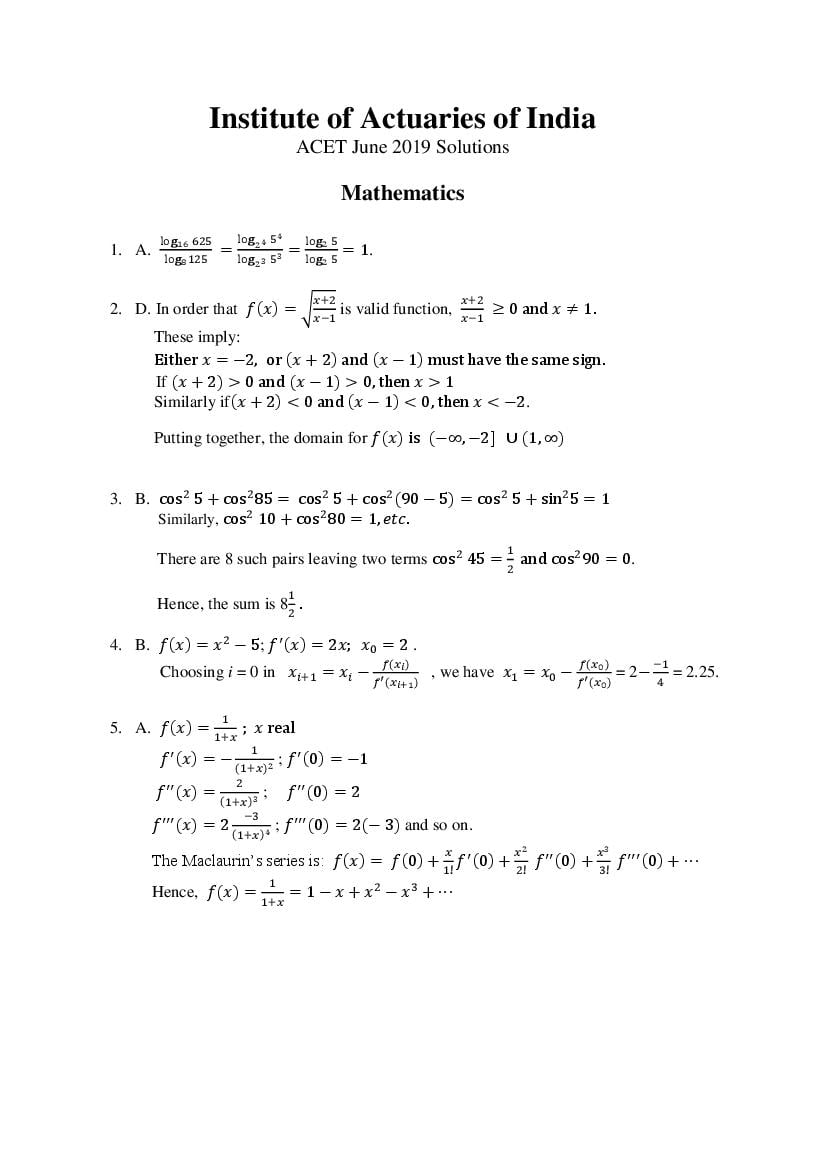
ACET June 2019 Solutions
Mathematics
log16 625 log 4 54 log 5
1. A. = log2 53 = log2 5 = 1.
log8 125 23 2
𝑥+2 𝑥+2
2. D. In order that 𝑓(𝑥) = √𝑥−1 is valid function, 𝑥−1 ≥ 0 and 𝑥 ≠ 1.
These imply:
Either 𝑥 = −2, or (𝑥 + 2) and (𝑥 − 1) must have the same sign.
If (𝑥 + 2) > 0 and (𝑥 − 1) > 0, then 𝑥 > 1
Similarly if(𝑥 + 2) < 0 and (𝑥 − 1) < 0, then 𝑥 < −2.
Putting together, the domain for 𝑓(𝑥) is (−∞, −2] ∪ (1, ∞)
3. B. cos 2 5 + cos2 85 = cos 2 5 + cos 2 (90 − 5) = cos 2 5 + sin2 5 = 1
Similarly, cos 2 10 + cos 2 80 = 1, 𝑒𝑡𝑐.
1
There are 8 such pairs leaving two terms cos 2 45 = 2 and cos 2 90 = 0.
1
Hence, the sum is 82 .
4. B. 𝑓(𝑥) = 𝑥 2 − 5; 𝑓 ′ (𝑥) = 2𝑥; 𝑥0 = 2 .
𝑓(𝑥 ) 𝑓(𝑥 ) −1
Choosing i = 0 in 𝑥𝑖+1 = 𝑥𝑖 − 𝑓′ (𝑥 𝑖 ) , we have 𝑥1 = 𝑥0 − 𝑓′ (𝑥0 ) = 2− 4 = 2.25.
𝑖+1 0
1
5. A. 𝑓(𝑥) = 1+𝑥 ; 𝑥 real
1
𝑓 ′ (𝑥) = − (1+𝑥)2 ; 𝑓 ′ (0) = −1
2
𝑓 ′′ (𝑥) = (1+𝑥)3 ; 𝑓 ′′ (0) = 2
−3
𝑓 ′′′ (𝑥) = 2 (1+𝑥)4 ; 𝑓 ′′′ (0) = 2(− 3) and so on.
𝑥 𝑥2 𝑥3
The Maclaurin’s series is: 𝑓(𝑥) = 𝑓(0) + 1! 𝑓 ′ (0) + 2! 𝑓 ′′ (0) + 3! 𝑓 ′′′ (0) + ⋯
1
Hence, 𝑓(𝑥) = 1+𝑥 = 1 − 𝑥 + 𝑥 2 − 𝑥 3 + ⋯
Page 2
6. C. (𝑥−1)2 (𝑥+3) = (𝑥−1)2 + (𝑥−1) + (𝑥+3) implies
𝑥 2 + 1 = 𝐴(𝑥 + 3) + 𝐵(𝑥 − 1)(𝑥 + 3) + 𝐶(𝑥 − 1)2 . … (1)
1 5
Letting 𝑥 = 1, in (1) we have, 𝐴 = 2 and 𝑥 = −3, we have 𝐶 = 8
3
Equating the coefficients of 𝑥 2 : 𝐵 + 𝐶 = 1 and 𝐵 = 8 . Hence 𝐴 + 4𝐵 = 2.
Alternatively, differentiating (1) wrt x, we have 2𝑥 = 𝐴 + 2𝐵(𝑥 + 1) + 2𝐶(𝑥 − 1)
and letting 𝑥 = 1 we have 𝐴 + 4𝐵 = 2.
7. D. (16
2𝑟
16
) = (3𝑟+1) implies 2𝑟 = 16 − (3𝑟 + 1) [ since (𝑛𝑟) = (𝑛−𝑟
𝑛
)]
Hence, 𝑟 = 3. Therefore, (4𝑟
3
) = (12
3
) = 220.
1 9 1 9−𝑟
8. C. The typical term in (2𝑥 2 + 𝑥) is (9𝑟)(2𝑥 2 )𝑟 (𝑥) .
In order that this term is a constant, we must have 2𝑟 = 9 − 𝑟, 𝑖. 𝑒. 3𝑟 = 9 or 𝑟 = 3.
1 9−3
Letting 𝑟 = 3, in the typical term, we have (39)(2𝑥 2 )3 (𝑥) = (39)(2)3 = 672.
log𝑒 𝑥−log𝑒 4 0
9. B. lim𝑥→4 is in 0 form .
𝑥−4
1
1
By L′ Hôpital′s rule, we have, lim𝑥→4 𝑥 = .
1 4
1
2𝑥 log𝑒 𝑥×2 − 2𝑥×
10. A. 𝑓(𝑥) = log 𝑥 , 𝑥 > 0. Hence, 𝑓 ′ (𝑥) = (log𝑒 𝑥)2
𝑥
𝑒
2(log𝑒 𝑥−1)
= (log𝑒 𝑥)2
> 0 if log 𝑥 > 1 or if 𝑥 > 𝑒.
11. B. If 𝑥 = 𝑟 cos 𝜃 then 𝑥 2 = 𝑟 2 cos2 𝜃 and 𝑦 = 𝑟 sin 𝜃 , then 𝑦 2 = 𝑟 2 sin2 𝜃 .
𝑥 2 + 𝑦 2 = 𝑟 2 (cos 2 𝜃 + sin2 𝜃) = 𝑟 2 .
𝜕𝑟 𝜕𝑟 𝑥 𝑟 cos 𝜃
Hence, 2𝑟 𝜕𝑥 = 2𝑥 ⟹ 𝜕𝑥 = 𝑟 = 𝑟 = cos 𝜃.
𝑥4 𝑥4 1 𝑥4 𝑥4 𝑥4 1
12. A. ∫ 𝑥 3 log 𝑒 𝑥 𝑑𝑥 = log 𝑒 𝑥∙ 4 − ∫ 4 𝑥 𝑑𝑥 = log 𝑒 𝑥∙ 4 − 16 = 4 (log 𝑒 𝑥 − 4) + 𝑐.
13. C.
𝜋 𝜋 𝜋
2 2 sin3 𝑥 2 2
∫ sin2 𝑥 cos 𝑥 𝑑𝑥 = ∫ sin2 𝑥 𝑑 (sin 𝑥) = | = .
−
𝜋
−
𝜋 3 −𝜋 3
2 2 2
14. C. The function |𝑥| = −𝑥 if 𝑥 < 0 and 𝑥 if 𝑥 > 0. Hence,
∞ 0 ∞
1 −|𝑥| 1 𝑥 1 −𝑥 1 1
∫ 𝑒 𝑑𝑥 = ∫ 𝑒 𝑑𝑥 + ∫ 𝑒 𝑑𝑥 = + = 1.
−∞ 2 −∞ 2 0 2 2 2
Page 3
𝑏 = 0.
Hence, (2𝑖 + 𝑚𝑗⃗ +𝑘 ).( ⃗⃗𝑏 = 𝑖 − 2𝑗⃗ +𝑘
⃗ ⃗ ) = 0 ⇒ (2)(1) + (𝑚)(−2) + (1)(1) = 0
⇒ 2 − 2𝑚 + 1 = 0 ⇒ 2𝑚 = 3
3
⇒ 𝑚 = 2.
⃗⃗⃗𝑎.⃗⃗⃗⃗
𝑏 2+6−6 2
𝑎 on ⃗⃗⃗⃗
16. B. The projection of ⃗⃗⃗⃗ 𝑏 is |⃗⃗⃗⃗𝑏 | = = .
√1+4+9 √14
1 −1 1 1 −1 1
17. D. The rank of the matrix [ 1 1 −1] is 3, since | 1 1 −1| = 4 ≠ 0
−1 1 1 −1 1 1
18. A. Given that:
cos 𝑥 sin 𝑥 0
𝐴(𝑥) = [− sin 𝑥 cos 𝑥 0].
0 0 1
cos 𝑥 sin 𝑥 −1 0 (
cos 𝑥 − sin 𝑥
)
0
[𝐴(𝑥)]−1 = [(− sin 𝑥 cos 𝑥) 0] = [ sin 𝑥 cos 𝑥 0] = 𝐴(−𝑥).
0 0 1 0 0 1
Statistics
19. D. Total number of ways = (64) + (41)(63) + (42)(62) = 15 + 80 + 90 = 185.
20. A.
𝑃((𝐴 ∩ 𝐵) ∩ (𝐴 ∪ 𝐵)) 𝑃(𝐴 ∩ 𝐵)
𝑃(𝐴 ∩ 𝐵|𝐴 ∪ 𝐵) = = .
𝑃(𝐴 ∪ 𝐵) 𝑃(𝐴 ∪ 𝐵)
𝑃(𝐴 ∪ 𝐵) = 𝑃(𝐴) + 𝑃(𝐵) − 𝑃(𝐴 ∩ 𝐵) = 0.5 + 0.3 − 0.1 = 0.7.
0.1 1
So, 𝑃(𝐴 ∩ 𝐵|𝐴 ∪ 𝐵) = 0.7 = 7
21. C. Suppose Failure is denoted by 𝐹.
𝑃(𝐹|𝐴) = 0.20, 𝑃(𝐹|𝐵) = 0.10, 𝑃(𝐴) = 0.70, 𝑃(𝐵) = 0.30. So
𝑃(𝐹|𝐴)𝑃(𝐴) 0.20 × 0.70 0.14 14
𝑃(𝐴|𝐹) = = = = .
𝑃(𝐹|𝐴)𝑃(𝐴) + 𝑃(𝐹|𝐵)𝑃(𝐵) 0.20 × 0.70 + 0.1 × 0.30 0.17 17
22. C. Mean = 0. Standard deviation cannot be 0. The distribution is symmetric. Mode = 0
(since 0 has highest frequency).
23. B. Median of new observations = 10 + 4 × 12.8 = 61.2.
24. A. 𝑃(1 < 𝑋 ≤ 4) = 𝑃(𝑋 = 2) + 𝑃(𝑋 = 3) + 𝑃(𝑋 = 4) = 0.15 + 0.25 + 0.15 = 0.55.
Page 4
𝑋 ∼ Poisson(3). 𝐸(𝑋) = 3, 𝑉𝑎𝑟(𝑋) = 3
2
𝐸(𝑋 2 ) = 𝑉𝑎𝑟(𝑋) + (𝐸(𝑋)) = 3 + 9 = 12
So, 𝐸(40 − 2𝑋 − 𝑋 2 ) = 40 − 2 × 3 − 12 = 22.
26. D. 𝑋 ∼ Binomial(10, 0.5). 𝑉𝑎𝑟(𝑋) = 10 × 0.5 × 0.5.
𝑋 𝑉𝑎𝑟(𝑋) 10 × 0.5 × 0.5
𝑉𝑎𝑟(𝑌) = 𝑉𝑎𝑟 ( ) = = = 0.025.
10 102 102
∞
27. A. Find 𝑘 from ∫0 𝑓(𝑥)𝑑𝑥 = 1.
∞ ∞ ∞
3 −𝑥/2
∫ 𝑓(𝑥)𝑑𝑥 = ∫ 𝑘𝑥 𝑒 𝑑𝑥 = 2 𝑘 ∫ 𝑢3 𝑒 −𝑢 𝑑𝑢 = 16𝑘 × Γ(4) = 16𝑘 × 3!
4
0 0 0
= 96𝑘.
1
So 𝑘 = 96.
28. D. 𝑋 ∼ 𝑁(50, 122 ).
𝑋−50 75−50
𝑃(𝑋 > 50) = 𝑃 ( 12 > ) = 𝑃(𝑍 > 2.083) < 𝑃(𝑍 > 1.96) =
12
0.025 [where 𝑍 ∼ 𝑁(0, 1)] .
2 2
29. B. 𝑉𝑎𝑟(𝑋1 𝑋2 ) = 𝐸((𝑋1 𝑋2 )2 ) − (𝐸(𝑋1 𝑋2 )) = 𝐸(𝑋12 𝑋22 ) − (𝐸(𝑋1 𝑋2 ))
2 2
= 𝐸(𝑋12 )𝐸(𝑋22 ) − (𝐸(𝑋1 )) (𝐸(𝑋2 )) (𝑋1 and 𝑋2 are independently distributed).
𝐸(𝑋1 ) = 0, 𝑉𝑎𝑟(𝑋1 ) = 0.5, 𝐸(𝑋2 ) = 1 and 𝑉𝑎𝑟(𝑋2 ) = 0.8.
2
This implies 𝐸(𝑋12 ) = 𝑉𝑎𝑟(𝑋1 ) + (𝐸(𝑋1 )) = 0.5.
2
𝐸(𝑋22 ) = 𝑉𝑎𝑟(𝑋2 ) + (𝐸(𝑋2 )) = 0.8 + 1 = 1.8.
Hence 𝑉𝑎𝑟(𝑋1 𝑋2 ) = 0.5 × 1.8 − 0 × 1 = 0.90.
𝐶𝑜𝑣(−1.5𝑋, 2𝑌+3) −1.5×2×𝐶𝑜𝑣(𝑋,𝑌)
30. B. 𝑟𝑋𝑌 = 0.3. 𝐶𝑜𝑟𝑟(−1.5𝑋, 2𝑌 + 3) = 𝑠𝑑(−1.5𝑋)×𝑠𝑑(2𝑌+3) = 1.5×𝑠𝑑(𝑋)×2×𝑠𝑑(𝑌) =
−𝑐𝑜𝑣(𝑋,𝑌)
= −𝑟𝑋𝑌 = −0.3.
𝑠𝑑(𝑋)×𝑠𝑑(𝑌)
31. B. Two regression lines pass through (𝑥̅ , 𝑦̅).
So 𝑥̅ + 3 𝑦̅ = 5
4𝑥̅ + 3𝑦̅ = 8
4
This gives (𝑥̅ , 𝑦̅) = (1, 3).
Page 5
32. C. Median = 50 percentile = 52000.
33. A. First quartile 𝑄1 = 28000. Third quartile 𝑄3 = 96000.
Interquartile range = 𝑄3 − 𝑄1 = 96000 − 28000 = 68000.
34. D. The percentage of families with income between 52000 and 140000 is 40.
35. B. Sales decrease from 3rd to 4th, 6th to 7th, 8th to 9th and 10th to 11th. So answer is 4.
36. C. Percentage increase:
2nd to 3rd year: (3/22) × 100 < 20%
4th to 5th year: (2/21) × 100 < 20%
5th to 6th : (4/23) × 100 < 20%
th th
7 to 8 : (3/29) × 100 < 20%
th th
9 to 10 : (3/28) × 100 < 20%
th th
11 to 12 : (6/29) × 100 > 20%
37. B. 𝑛(𝑃1 ) = 35, 𝑛(𝑃2 ) = 45, 𝑛(𝑃1 ∪ 𝑃2 ) = 80 − 15 = 65.
𝑛(𝑃1 ∪ 𝑃2 ) = 𝑛(𝑃1 ) + 𝑛(𝑃2 ) − 𝑛(𝑃1 ∩ 𝑃2 ).
So number of employees of who have opted both 𝑃1 and 𝑃2
𝑛(𝑃1 ∩ 𝑃2 ) = 35 + 45 − 65 = 15.
38. C. The number of employees who have opted only 𝑃1
= 𝑛(𝑃1 ) − 𝑛(𝑃1 ∩ 𝑃2 ) = 35 − 15 = 20.
English
39. B
40. C
41. A
42. C
43. A
44. C
45. C
46. A
47. A
48. A
49. C
Page 6
51. D
52. C
53. B
54. D
55. A
56. A
57. C
58. C
59. B
60. C
61. D
62. C
Logical Reasoning
63. D.
64. A.
65. C. The given words can be successive specifications of an address, starting from the
Room number and specifying up to the district.
66. B. 𝑥 weeks 𝑥 days = (7𝑥 + 𝑥) days = 8𝑥 days.
67. B. P's mother has taken legal steps to allow another person to act on her behalf.
Therefore, this is the only choice that indicates that a power of attorney has been
established.
68. D. One has to count only the cubes that lie completely inside. They form another cube
with sides of length 2 cm. The volume is 8 cm3, and so there are 8 smaller cubes in it.
69. D. At 4 o’clock the minute hand lags the hour hand by 20 minute spaces. In order that
the two hands are in opposite directions, the minute hand has to have a net lead of 30
minute spaces. So there should be a gain of 50 minute spaces. The minute hand gains
60
55 minute spaces in 60 minutes. Therefore 50 minute spaces are gained in 55 × 50 =
6
54 11 minutes.
70. C.
**********************************
Document Details
| Board / Org | Actuaries India |
| Exam | ACET |
| Type | Answer Key |
| Pages | 6 |
| Updated | 09 Jun 2026 |