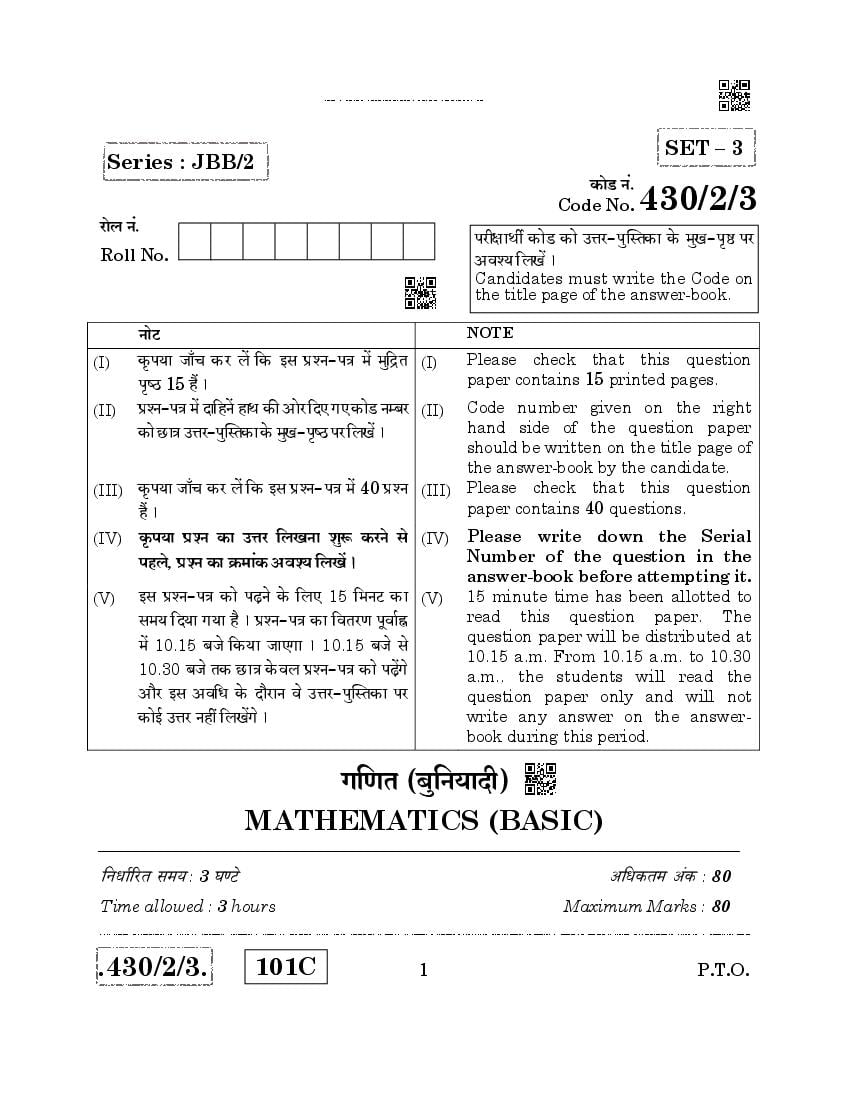
CBSE Class 10 Mathematics Basics Question Paper 2020 Set 430-2-3
Finished viewing? Save it for later —
Download CBSE Class 10 Mathematics Basics Question Paper 2020 Set 430-2-3 (PDF · 16 pages)About CBSE Class 10 Mathematics Basics Question Paper 2020 Set 430-2-3
CBSE Class 10 Mathematics Basics Question Paper 2020 Set 430-2-3 is available here for free download. Published by CBSE for Class 10, this question paper can be viewed online or downloaded as a PDF (16 pages). Candidates preparing for Class 10 can use CBSE Class 10 Mathematics Basics Question Paper 2020 Set 430-2-3 to understand the exam pattern, the type of questions asked, and the overall difficulty level.
Frequently Asked Questions
How can I download CBSE Class 10 Mathematics Basics Question Paper 2020 Set 430-2-3?
Open this page and click the Download button to save CBSE Class 10 Mathematics Basics Question Paper 2020 Set 430-2-3 as a PDF. It is completely free on AglaSem Docs.
Is CBSE Class 10 Mathematics Basics Question Paper 2020 Set 430-2-3 free to download?
Yes. CBSE Class 10 Mathematics Basics Question Paper 2020 Set 430-2-3 can be viewed online and downloaded as a PDF free of cost on AglaSem Docs.
How many pages does CBSE Class 10 Mathematics Basics Question Paper 2020 Set 430-2-3 have?
CBSE Class 10 Mathematics Basics Question Paper 2020 Set 430-2-3 contains 16 pages, which you can read online or download together as a single PDF.
Where can I find more Class 10 study material?
You can find more Class 10 question papers, sample papers, syllabus, and answer keys on AglaSem Docs.
CBSE Class 10 Mathematics Basics Question Paper 2020 Set 430-2-3 – Text
Read the full text of this question paper below — useful to quickly search, copy and reference the content online without downloading the PDF.
📄 View text version (16 pages)
Page 1
Series : JBB/2
.
Code No. 430/2/3
.
- -
Roll No.
Candidates must write the Code on
the title page of the answer-book.
NOTE
(I) - (I) Please check that this question
15 paper contains 15 printed pages.
(II) - (II) Code number given on the right
- - hand side of the question paper
should be written on the title page of
the answer-book by the candidate.
(III) - 40 (III) Please check that this question
paper contains 40 questions.
(IV) (IV) Please write down the Serial
, Number of the question in the
answer-book before attempting it.
(V) - 15 (V) 15 minute time has been allotted to
- read this question paper. The
question paper will be distributed at
10.15 10.15
10.15 a.m. From 10.15 a.m. to 10.30
10.30 - a.m., the students will read the
- question paper only and will not
write any answer on the answer-
book during this period.
()
MATHEMATICS (BASIC)
{ZYm©[aV g‘¶ : 3 KÊQ>o A{YH$V‘ A§H$ : 80
Time allowed : 3 hours Maximum Marks : 80
.430/2/3. 101C 1 P.T.O.
Page 2
(i) - – , ,
- 40
(ii) - 1 20 20
(iii) - 21 26 6
(iv) - 27 34 8
(v) - 35 40 6
(vi) - - , -
, - , -
(vii) , ,
(viii)
–
1 – 10 1
23
1. ?
2 52
5
(a) 2 (b) 4 (c) 5 (d) 1 1
2.
(a) 1 (b) 4 (c) 2 (d) 3 1
.430/2/3. 2
Page 3
Read the following instructions very carefully and strictly follow them :
(i) This question paper comprises four sections – A, B, C and D.
This question paper carries 40 questions. All questions are compulsory.
(ii) Section A – Question no. 1 to 20 comprises of 20 questions of one mark
each.
(iii) Section B – Question no. 21 to 26 comprises of 6 questions of two marks
each.
(iv) Section C – Question no. 27 to 34 comprises of 8 questions of three
marks each.
(v) Section D – Question no. 35 to 40 comprises of 6 questions of four
marks each.
(vi) There is no overall choice in the question paper. However, an internal
choice has been provided in 2 questions of one mark, 2 questions of two
marks, 3 questions of three marks and 3 questions of four marks. You
have to attempt only one of the choices in such questions.
(vii) In addition to this, separate instructions are given with each section and
question, wherever necessary.
(viii) Use of calculators is not permitted.
Section – A
Question numbers 1 to 10 are multiple choice questions of 1 mark each.
Select the correct option.
23
1. The decimal expansion of will terminate after how many places of
25 52
decimal ?
(a) 2 (b) 4 (c) 5 (d) 1 1
2. The maximum number of zeroes a cubic polynomial can have, is
(a) 1 (b) 4 (c) 2 (d) 3 1
.430/2/3. 3 P.T.O.
Page 4
(a) 3 (b) –3 (c) 7 (d) 4 1
4.
1 1 2 3
(a) (b) (c) (d) 1
4 2 3 4
5. 2 3
(a) (b)
(c) (d) 1
6.
(a) (b) (c) (d) 1
7. .. (HCF) 27 .. (LCM) 162 54 ,
(a) 36 (b) 35 (c) 9 (d) 81 1
8.
A(2, –3) B(5, 6) x- ,
(a) 2 : 3 (b) 3 : 5 (c) 1 : 2 (d) 2 : 1 1
9. kx2 + 2x + 3k , k
1 1 2 2
(a) (b) – (c) (d) – 1
3 3 3 3
.430/2/3. 4
Page 5
(2, y), then the value of y is
(a) 3 (b) –3 (c) 7 (d) 4 1
4. Two coins are tossed simultaneously. The probability of getting at most
one head is
1 1 2 3
(a) (b) (c) (d) 1
4 2 3 4
5. 2 3 is
(a) an integer (b) a rational number
(c) an irrational number (d) a whole number 1
6. The cumulative frequency table is useful in determining
(a) Mean (b) Median
(c) Mode (d) All of these 1
7. HCF of two numbers is 27 and their LCM is 162. If one of the number is
54, then the other number is
(a) 36 (b) 35 (c) 9 (d) 81 1
8. x-axis divides the line segment joining A(2, –3) and B(5, 6) in the ratio :
(a) 2 : 3 (b) 3 : 5 (c) 1 : 2 (d) 2 : 1 1
9. If the sum of the zeroes of the quadratic polynomial kx2 + 2x + 3k is equal
to their product, then k equals.
1 1 2 2
(a) (b) – (c) (d) – 1
3 3 3 3
.430/2/3. 5 P.T.O.
Page 6
5
(a) (b) 5 2 (c) 10 2 (d) 10 3 1
2
11 15
11. (tan260º + sin245º) ________ 1
12. 3 : 4 ,
_________ 1
13. x2 – x – 6 = 0 ________ 1
14.
(4, 0) (0, 6) ________. 1
A(1, 3) B(4, 6) 2 : 1
________. 1
sin θ cos 43º
15. ________ 1
cos (90 – θ) sin 47º
16 20
16. 3k – 2, 4k – 6 k + 2 , k 1
17. (cos 48º – sin 42º) 1
(tan 23º) (tan 67º) 1
.430/2/3. 6
Page 7
The length of the chord (in cm) is
5
(a) (b) 5 2 (c) 10 2 (d) 10 3 1
2
Question numbers 11 to 15, fill in the blanks :
11. The value of (tan260º + sin245º) is ________. 1
12. The corresponding sides of two similar triangles are in the ratio 3 : 4, then
the ratios of the area of triangles is _________. 1
13. Value of the roots of the quadratic equation, x2 – x – 6 = 0 are ________. 1
14. The area of triangle formed with the origin and the points (4, 0) and (0, 6)
is ________. 1
OR
The co-ordinate of the point dividing the line segment joining the points
A(1, 3) and B(4, 6) in the ratio 2 : 1 is ________. 1
sin θ cos 43º
15. The value of is ________. 1
cos (90 – θ) sin 47º
Question numbers 16 to 20, Answer the following :
16. If 3k – 2, 4k – 6 and k + 2 are three consecutive terms of A.P., then find the
value of k. 1
17. Find the value of (cos 48º – sin 42º). 1
OR
Evaluate : (tan 23º) (tan 67º) 1
.430/2/3. 7 P.T.O.
Page 8
PQ AB POQ = 30º , 1
– 1
19. 52
1
20. ABC PQR 25 49
QR = 9.8 , BC 1
–
21 26 2
21. (2x2 – x + 3) (2 – x) 2
1 1
22. = 2 sec2 2
1 sin θ 1 sin θ
2
1 tan 2θ = cos2 – sin2 2
1 tan θ
.430/2/3. 8
Page 9
18. In figure-1 PQ and AB are two arcs of concentric circles of radii 7 cm and
3.5 cm resp., with centre O. If POQ = 30º, then find the area of shaded
region. 1
Fig. – 1
19. A card is drawn at random from a well-shuffled pack of 52 cards. Find the
probability of getting a red king. 1
20. Two similar triangles ABC and PQR have their areas 25 cm2 and 49 cm2
respectively. If QR = 9.8 cm, find BC. 1
Section – B
Question numbers 21 to 26 carry 2 marks each.
21. Divide (2x2 – x + 3) by (2 – x) and write the quotient and the remainder. 2
1 1
22. Prove that : = 2 sec2 2
1 sin θ 1 sin θ
OR
1 tan 2θ
Prove that : 2
= cos2 – sin2 2
1 tan θ
.430/2/3. 9 P.T.O.
Page 10
:
(i)
(ii) 9 2
24. 10 25 ? 2
25. ABC, AB = AC , BC
P, AC Q AB R P BC
2
26. 17.5 44 ,
2
–
27 34 3
27. 3 3
272 1032 (HCF) 3
28. x = 3 sin + 4 cos y = 3 cos – 4 sin , x2 + y2 = 25 3
sin + sin2 = 1 , cos2 + cos4 = 1. 3
29. ABCD P ,
PA2 + PC2 = PB2 + PD2 3
.430/2/3. 10
Page 11
boys. 2
OR
Two dice are tossed simultaneously. Find the probability of getting
(i) an even number on both dies.
(ii) the sum of two numbers more than 9. 2
24. In a lottery, there are 10 prizes and 25 blanks. What is the probability of
getting a prize ? 2
25. An isosceles triangle ABC, with AB = AC, circumscribes a circle, touching
BC at P, AC at Q and AB at R. Prove that the contact point P bisects BC. 2
26. The radius of a circle is 17.5 cm. Find the area of the sector of the circle
enclosed by two radii and an arc 44 cm in length. 2
Section – C
Question numbers 27 to 34 carry 3 marks each.
27. Prove that 3 is an irrational number. 3
OR
Using Euclid’s algorithm, find the HCF of 272 and 1032. 3
28. If x = 3 sin + 4 cos and y = 3 cos – 4 sin then prove that x2 + y2 = 25. 3
OR
If sin + sin2 = 1; then prove that cos2 + cos4 = 1. 3
29. In a rectangle ABCD, P is any interior point. Then prove that
PA2 + PC2 = PB2 + PD2. 3
.430/2/3. 11 P.T.O.
Page 12
4 7
3
31. , A, B, C D , -2
, , ,
‘ ABCD ?’
, ? 3
– 2
32.
2x – 3y + 13 = 0; 3x – 2y + 12 = 0 3
33. 70 52 21
3
34. –3 2
3
.430/2/3. 12
Page 13
OR
Draw a circle of radius 4 cm and construct the pair of tangents to the
circle from an external point, which is at a distance of 7 cm from its
centre. 3
31. In a classroom, 4 friends are seated at the points A, B, C and D as shown in
Fig. 2. Champa and Chameli walk into the class and after observing for a
few minutes Champa asks Chameli, “Don’t you think ABCD is a square ?”
Chameli disagrees. Using distance formula, find which of them is correct. 3
Figure – 2
32. Solve graphically :
2x – 3y + 13 = 0; 3x – 2y + 12 = 0 3
33. A horse is tethered to one corner of a rectangular field of dimensions
70 m 52 m, by a rope of length 21 m. How much area of the field can it
graze ? 3
34. Find the quadratic polynomial, the sum and product of whose zeroes are –3
and 2 respectively. Hence find the zeroes. 3
.430/2/3. 13 P.T.O.
Page 14
35 40 4
35. ,
60º 30 , 30º
[ 3 = 1.732 ] 4
36. 15 16
(
) 4
10
,
4
37.
4
4
38. 17 8 5 11
43 , n 4
3, 5, 7, 9, … 120 ? 4
39. 46
4
40.
10 – 25 25 – 40 40 – 55 55 – 70 70 – 85 85 – 100
2 3 7 6 6 6 4
_________
.430/2/3. 14
Page 15
Question numbers 35 to 40 carry 4 marks each.
35. A person standing on the bank of a river observes that the angle of
elevation of the top of a tree standing on opposite bank is 60º. When he
moves 30 m away from the bank, he finds the angle of elevation to be 30º.
Find the height of the tree and width of the river. [Take 3 = 1.732] 4
36. From a solid cylinder whose height is 15 cm and the diameter is 16 cm, a
conical cavity of the same height and same diameter is hollowed out. Find
the total surface area of remaining solid. (Give your answer in terms of ) 4
OR
The height of a cone is 10 cm. The cone is divided into two parts using a
plane parallel to its base at the middle of its height. Find the ratio of the
volumes of the two parts. 4
37. Prove that the ratio of the areas of two similar triangles is equal to the
ratio of the squares of their corresponding sides. 4
OR
Prove the length of tangents drawn from an external point to a circle are
equal. 4
38. The 17th term of an A.P. is 5 more than twice its 8th term. If 11th term of
A.P. is 43; then find its nth term. 4
OR
How many terms of A.P. 3, 5, 7, 9, … must be taken to get the sum 120 ? 4
39. Three consecutive positive integers are such that the sum of the square of
the first and the product of the other two is 46. Find the integers. 4
40. Find the mean of the following distribution :
Class 10 – 25 25 – 40 40 – 55 55 – 70 70 – 85 85 – 100
Frequency 2 3 7 6 6 6 4
__________
.430/2/3. 15 P.T.O.
Page 16
Document Details
| Board / Org | CBSE |
| Exam | Class 10 |
| Type | Question Paper |
| Pages | 16 |
| Updated | 22 Jul 2026 |