Edudel Syllabus Class 11 Political Science
Finished viewing? Save it for later —
Download Edudel Syllabus Class 11 Political Science (PDF · 2 pages)About Edudel Syllabus Class 11 Political Science
Edudel Syllabus Class 11 Political Science is available here for free download. Published by Delhi School Education for Class 11, this syllabus can be viewed online or downloaded as a PDF (2 pages). Candidates preparing for Class 11 can use Edudel Syllabus Class 11 Political Science to understand the exam pattern, the type of questions asked, and the overall difficulty level.
Frequently Asked Questions
How can I download Edudel Syllabus Class 11 Political Science?
Open this page and click the Download button to save Edudel Syllabus Class 11 Political Science as a PDF. It is completely free on AglaSem Docs.
Is Edudel Syllabus Class 11 Political Science free to download?
Yes. Edudel Syllabus Class 11 Political Science can be viewed online and downloaded as a PDF free of cost on AglaSem Docs.
How many pages does Edudel Syllabus Class 11 Political Science have?
Edudel Syllabus Class 11 Political Science contains 2 pages, which you can read online or download together as a single PDF.
Where can I find more Class 11 study material?
You can find more Class 11 question papers, sample papers, syllabus, and answer keys on AglaSem Docs.
Edudel Syllabus Class 11 Political Science – Text
Read the full text of this syllabus below — useful to quickly search, copy and reference the content online without downloading the PDF.
📄 View text version (3 pages)
Page 1
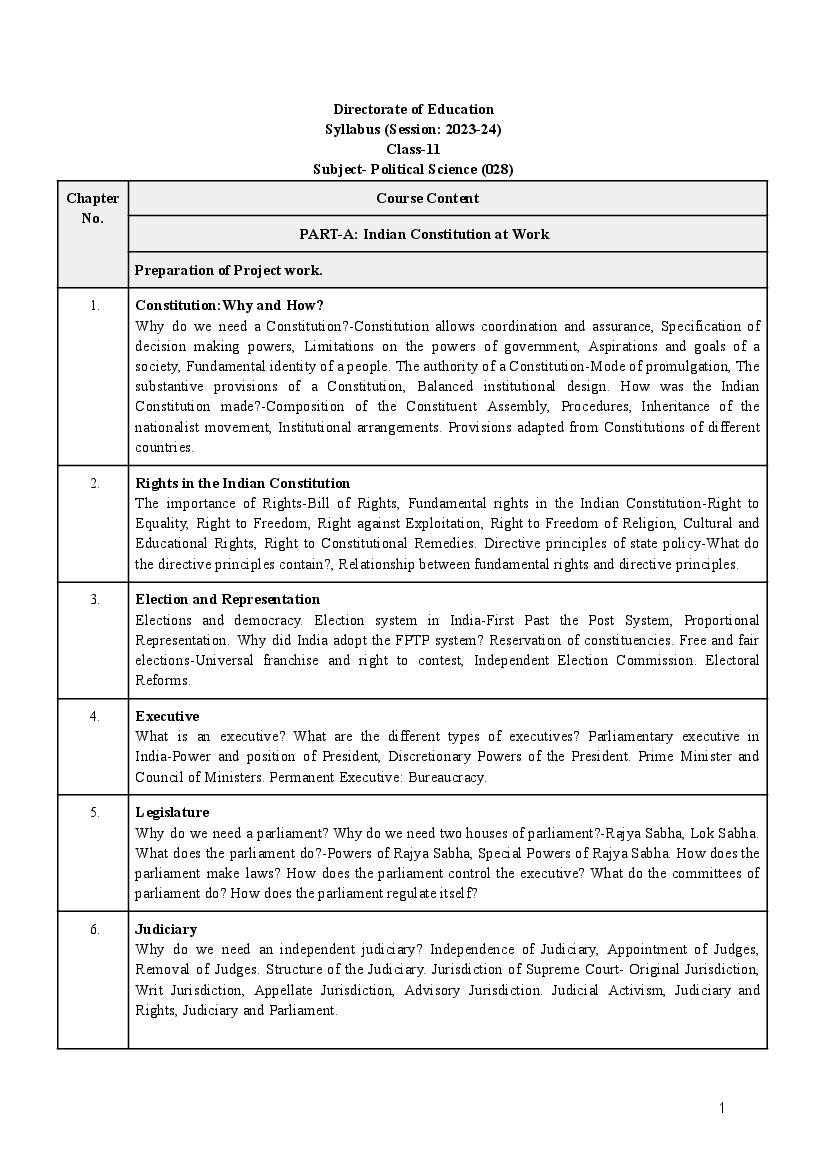
Syllabus (Session: 2023-24)
Class-11
Subject- Political Science (028)
Chapter Course Content
No.
PART-A: Indian Constitution at Work
Preparation of Project work.
1. Constitution:Why and How?
Why do we need a Constitution?-Constitution allows coordination and assurance, Specification of
decision making powers, Limitations on the powers of government, Aspirations and goals of a
society, Fundamental identity of a people. The authority of a Constitution-Mode of promulgation, The
substantive provisions of a Constitution, Balanced institutional design. How was the Indian
Constitution made?-Composition of the Constituent Assembly, Procedures, Inheritance of the
nationalist movement, Institutional arrangements. Provisions adapted from Constitutions of different
countries.
2. Rights in the Indian Constitution
The importance of Rights-Bill of Rights, Fundamental rights in the Indian Constitution-Right to
Equality, Right to Freedom, Right against Exploitation, Right to Freedom of Religion, Cultural and
Educational Rights, Right to Constitutional Remedies. Directive principles of state policy-What do
the directive principles contain?, Relationship between fundamental rights and directive principles.
3. Election and Representation
Elections and democracy. Election system in India-First Past the Post System, Proportional
Representation. Why did India adopt the FPTP system? Reservation of constituencies. Free and fair
elections-Universal franchise and right to contest, Independent Election Commission. Electoral
Reforms.
4. Executive
What is an executive? What are the different types of executives? Parliamentary executive in
India-Power and position of President, Discretionary Powers of the President. Prime Minister and
Council of Ministers. Permanent Executive: Bureaucracy.
5. Legislature
Why do we need a parliament? Why do we need two houses of parliament?-Rajya Sabha, Lok Sabha.
What does the parliament do?-Powers of Rajya Sabha, Special Powers of Rajya Sabha. How does the
parliament make laws? How does the parliament control the executive? What do the committees of
parliament do? How does the parliament regulate itself?
6. Judiciary
Why do we need an independent judiciary? Independence of Judiciary, Appointment of Judges,
Removal of Judges. Structure of the Judiciary. Jurisdiction of Supreme Court- Original Jurisdiction,
Writ Jurisdiction, Appellate Jurisdiction, Advisory Jurisdiction. Judicial Activism, Judiciary and
Rights, Judiciary and Parliament.
1
Page 2
● Mid-Term Examination.
● Discussion of Mid-Term question paper
7. Federalism
What is Federalism, Federalism in the Indian Constitution-Division of Powers. Federalism with a
strong central government, Conflicts in India’s federal system-Centre-State Relations, Demands for
Autonomy, Role of Governors and President’s Rule, Demands for New States, Interstate Conflicts.
Special provisions-Jammu and Kashmir.
8. Local Governments
Why local governments? Growth of Local Government in India. 73rd and 74th amendments. 73rd
Amendment-Three Tier Structure, Elections, Reservations, Transfer of Subjects, State Election
Commissions, State Finance Commission. 74th Amendment. Implementation of 73rd and 74th
Amendments.
9. Constitution as a Living Document
Are constitutions static? How to amend the constitution? Why have there been so many amendments?
Contents of amendments made so far-Differing Interpretations, Amendments through Political
Consensus, Controversial Amendments. Basic structure and evolution of the constitution.
Constitution as a Living Document-Contribution of the Judiciary, Maturity of the Political
Leadership.
10. The philosophy of the Constitution
What is meant by the philosophy of the constitution? Constitution as Means of Democratic
Transformation. Why do we need to go back to the Constituent Assembly? What is the political
philosophy of our constitution?-Individual freedom, Social Justice, Respect for diversity and minority
rights, Secularism, Universal franchise, Federalism, National identity. Procedural Achievements,
Criticisms, Limitations.
PART B-Political Theory
1. Political Theory:An Introduction
What is Politics? What do we study in political theory? Putting Political theory into practice. Why
should we study political theory?
2. Freedom
The Ideal of freedom, The sources of Constraints-Why do we need constraints? The Harm Principle.
Negative and Positive liberty.
3. Equality
Why does equality matter? -Equality of opportunities, Natural and Social Inequalities. Three
dimensions of equality. Feminism, Socialism, How can we promote equality?
2
Page 3
What is Justice?-Equal Treatment for Equals, Proportionate Justice, Recognition of Special Needs.
Just distribution, John Rawls Theory of Justice. Pursuing Social Justice. Free Markets versus State
Intervention.
5. Rights
What are rights? Where do rights come from? Legal rights and the state. Kinds of rights. Rights and
responsibilities.
6. Citizenship
Introduction. Full and equal membership. Equal Rights. Citizen and Nation. Universal Citizenship.
Global Citizenship.
7. Nationalism
Introducing Nationalism. Nations and Nationalism-Shared Beliefs, History, Shared National Identity.
National self-determination. Nationalism and Pluralism.
8. Secularism
What is Secularism?- Inter-religious Domination, Intra-religious Domination. Secular State. The
western model of secularism. The Indian model of secularism. Criticisms of Indian
secularism-Western Import, Minoritism, interventionist, Vote Bank Politics.
● Completion of the Annual syllabus by 31th January 2024.
● Preparation of Project work and viva voce for evaluation.
● Preparation for the Annual Examination.
● Declaration of Annual result.
Prescribed Books:
1. Indian Constitution at Work, Class XI, Published by NCERT
2.Political Theory, Class XI, Published by NCERT.
3. Added Reference Material available on CBSE website.
Note:
● The additional reference material is for classroom transactions and will not be assessed in the
Annual Examination.
● For more information click on the following link or scan the QR code.
https://cbseacademic.nic.in/web_material/CurriculumMain24/SrSec/PoliticalScience_SrSec_2023-24.
Links for NCERT Rationalised 2023-24 Political Science textbooks:
https://ncert.nic.in/textbook.php?keps2=1-10
https://ncert.nic.in/textbook.php?keps1=1-8
3
Document Details
| Board / Org | Delhi Board |
| Exam | Class 11 |
| Type | Syllabus |
| Pages | 2 |
| Updated | 22 Jul 2026 |