AHSEC 2nd Year Syllabus 2024-25 Biotechnology
Finished viewing? Save it for later —
Download AHSEC 2nd Year Syllabus 2024-25 Biotechnology (PDF · 4 pages)About AHSEC 2nd Year Syllabus 2024-25 Biotechnology
AHSEC 2nd Year Syllabus 2024-25 Biotechnology is available here for free download. Published by Assam Board for Class 12, this syllabus can be viewed online or downloaded as a PDF (4 pages). Candidates preparing for Class 12 can use AHSEC 2nd Year Syllabus 2024-25 Biotechnology to understand the exam pattern, the type of questions asked, and the overall difficulty level.
Frequently Asked Questions
How can I download AHSEC 2nd Year Syllabus 2024-25 Biotechnology?
Open this page and click the Download button to save AHSEC 2nd Year Syllabus 2024-25 Biotechnology as a PDF. It is completely free on AglaSem Docs.
Is AHSEC 2nd Year Syllabus 2024-25 Biotechnology free to download?
Yes. AHSEC 2nd Year Syllabus 2024-25 Biotechnology can be viewed online and downloaded as a PDF free of cost on AglaSem Docs.
How many pages does AHSEC 2nd Year Syllabus 2024-25 Biotechnology have?
AHSEC 2nd Year Syllabus 2024-25 Biotechnology contains 4 pages, which you can read online or download together as a single PDF.
Where can I find more Class 12 study material?
You can find more Class 12 question papers, sample papers, syllabus, and answer keys on AglaSem Docs.
AHSEC 2nd Year Syllabus 2024-25 Biotechnology – Text
Read the full text of this syllabus below — useful to quickly search, copy and reference the content online without downloading the PDF.
📄 View text version (4 pages)
Page 1
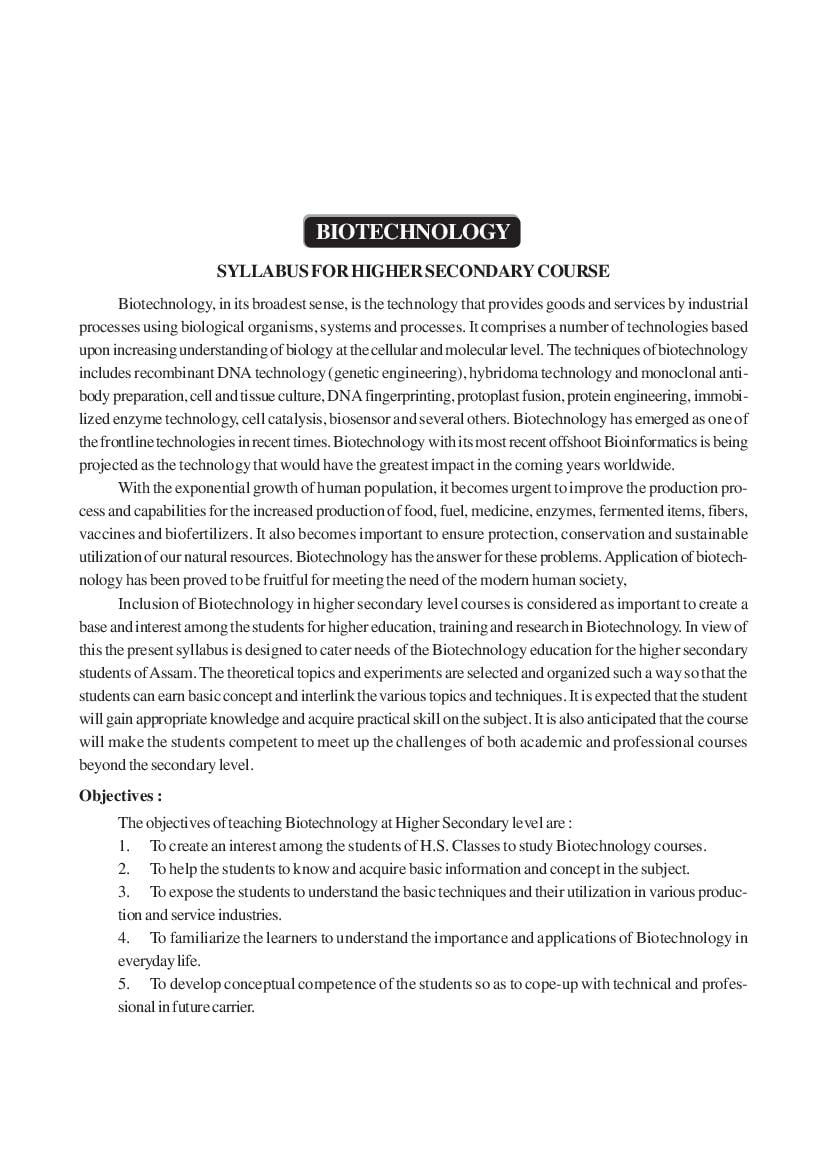
Biotechnology, in its broadest sense, is the technology that provides goods and services by industrial
processes using biological organisms, systems and processes. It comprises a number of technologies based
upon increasing understanding of biology at the cellular and molecular level. The techniques of biotechnology
includes recombinant DNA technology (genetic engineering), hybridoma technology and monoclonal anti-
body preparation, cell and tissue culture, DNA fingerprinting, protoplast fusion, protein engineering, immobi-
lized enzyme technology, cell catalysis, biosensor and several others. Biotechnology has emerged as one of
the frontline technologies in recent times. Biotechnology with its most recent offshoot Bioinformatics is being
projected as the technology that would have the greatest impact in the coming years worldwide.
With the exponential growth of human population, it becomes urgent to improve the production pro-
cess and capabilities for the increased production of food, fuel, medicine, enzymes, fermented items, fibers,
vaccines and biofertilizers. It also becomes important to ensure protection, conservation and sustainable
utilization of our natural resources. Biotechnology has the answer for these problems. Application of biotech-
nology has been proved to be fruitful for meeting the need of the modern human society,
Inclusion of Biotechnology in higher secondary level courses is considered as important to create a
base and interest among the students for higher education, training and research in Biotechnology. In view of
this the present syllabus is designed to cater needs of the Biotechnology education for the higher secondary
students of Assam. The theoretical topics and experiments are selected and organized such a way so that the
students can earn basic concept and interlink the various topics and techniques. It is expected that the student
will gain appropriate knowledge and acquire practical skill on the subject. It is also anticipated that the course
will make the students competent to meet up the challenges of both academic and professional courses
beyond the secondary level.
Objectives :
The objectives of teaching Biotechnology at Higher Secondary level are :
1. To create an interest among the students of H.S. Classes to study Biotechnology courses.
2. To help the students to know and acquire basic information and concept in the subject.
3. To expose the students to understand the basic techniques and their utilization in various produc-
tion and service industries.
4. To familiarize the learners to understand the importance and applications of Biotechnology in
everyday life.
5. To develop conceptual competence of the students so as to cope-up with technical and profes-
sional in future carrier.
Page 2
SYLLABUS FOR HIGHER SECONDARY FINAL YEAR COURSE
One Paper Time : Three Hours Total Marks-70
Pass Marks-21
Unitwise Distribution of Marks and Periods :
Unit No. Title Marks Periods
Unit-1 Protein Engineering and Bioinformatics 15 23
Unit-2 Genetic Engineering and genomics 15 32
Unit-3 Environmental Biotechnology & Bioethics 10 20
Unit-4 Microbial Technology 10 25
Unit-5 Plant Cell Culture Technology 10 25
Unit-6 Animal Cell Culture Technology 10 25
Total 70 150
Unitwise Distribution of Course contents : Marks
Unit-1 : Protein Engineering and Bioinformatics : 15
Protein based products and designing
Proteins
Proteomics : an introduction
Introduction to Bioinformatics
Sequences and Nomenclature
Information Sources
Analysis using Bioformatics tools
Unit-2 : Genetic Engineering and Genomics : 15
Recombinant DNA technology-definition and tools
Making recombinant DNA
Construction of DNA library :
Genomic and CDNA
Cloning vectors
Polymerase Chain Reaction (PCR)
DNA probes
Hybridization techniques : Southern, Northern and Western
DNA sequencing
Genomics : an introduction
Unit-3 : Environmental Biotechnology & Bioethics : 10
Bioremediation of oil pollution reducing environmental impact of chemical
herbicides & fertilizers; biosensors to detect environmental pollution.
Page 3
Biofertilizers-definition and uses.
Biofuels : definition and application
Genetically Modified Organisms and
Ethical Issue
Intellectual Property Rights-Patenting Life forms
Unit-IV : Microbial Technology 10
Classification of microorganism
Microbial culture techniques
Measurement and kinetics of microbial growth
Strain Isolation and Isolation of microbial products
Application of microbial culture
Unit-V : Plant cell culture Technology 10
Introduction; Cellular Toti potency
Plant cell and tissue culture techniques and media
Application of plant tissue culture
Gene transfer methods in plants
Transgenic plants for crop improvement
Unit-VI : Animal Cell Culture Technology 10
Introduction
Animal Cell Culture Technology and media
Characterization of cell lines
Scale up of animal cell culture process
Application of animal cell culture
Stem cell technology
SYLLABUS FOR BIOTECHNOLOGY PRACTICAL
Total Marks-30
Scheme of Evolution : Marks
1. Two Experiments 8 + 8 = 16
(One computer based Practical)
Data retrieval and data search using Internet site of NCBI
Download a DNA protein sequence from Internet, analyze and comment over it
Ion-exchange chromatography for protein
Estimation of DNA
Isolation of microbes from a given biological sample
Sterilization techniques : Dry heat and moist heat sterilization,
Chemical sterilization and ultra filtration
Determination of bacterial growth curve
Page 4
Determination of blood groups
Estimation of blood glucose by enzymatic method
Demonstration of plant tissue culture technique
Isolation of bacterial plasmid DNA and its detection by gel electrophoresis
Minor project work/Seminar
2. Viva on practical 4
3. Practical Record 4
4. Seminar/Minor project 6
Recommended Books
1. CBSE publication for class XI and XII
ANNEXURE
Laboratory Requirements :
A. Must include the following components for Laboratory:
(a) One small lab with Laminar Air flow cabinete and Single working desk
(b) Working Laboratory with working table & Chairs, Washing facilities, light arrangement.
(c) Essential equipments : Autoclave, oven, Refrigerators, Incubator, Water distillation, Centrifuge.
(d) Glassware’s, measuring equipment etc.
(e) Small Culture room (air conditioned) and culture racks.
***
Document Details
| Board / Org | Assam Board |
| Exam | Class 12 |
| Type | Syllabus |
| Pages | 4 |
| Updated | 22 Jul 2026 |