AHSEC 2nd Year Syllabus 2024-25 Economics
Finished viewing? Save it for later —
Download AHSEC 2nd Year Syllabus 2024-25 Economics (PDF · 8 pages)About AHSEC 2nd Year Syllabus 2024-25 Economics
AHSEC 2nd Year Syllabus 2024-25 Economics is available here for free download. Published by Assam Board for Class 12, this syllabus can be viewed online or downloaded as a PDF (8 pages). Candidates preparing for Class 12 can use AHSEC 2nd Year Syllabus 2024-25 Economics to understand the exam pattern, the type of questions asked, and the overall difficulty level.
Frequently Asked Questions
How can I download AHSEC 2nd Year Syllabus 2024-25 Economics?
Open this page and click the Download button to save AHSEC 2nd Year Syllabus 2024-25 Economics as a PDF. It is completely free on AglaSem Docs.
Is AHSEC 2nd Year Syllabus 2024-25 Economics free to download?
Yes. AHSEC 2nd Year Syllabus 2024-25 Economics can be viewed online and downloaded as a PDF free of cost on AglaSem Docs.
How many pages does AHSEC 2nd Year Syllabus 2024-25 Economics have?
AHSEC 2nd Year Syllabus 2024-25 Economics contains 8 pages, which you can read online or download together as a single PDF.
Where can I find more Class 12 study material?
You can find more Class 12 question papers, sample papers, syllabus, and answer keys on AglaSem Docs.
AHSEC 2nd Year Syllabus 2024-25 Economics – Text
Read the full text of this syllabus below — useful to quickly search, copy and reference the content online without downloading the PDF.
📄 View text version (8 pages)
Page 1
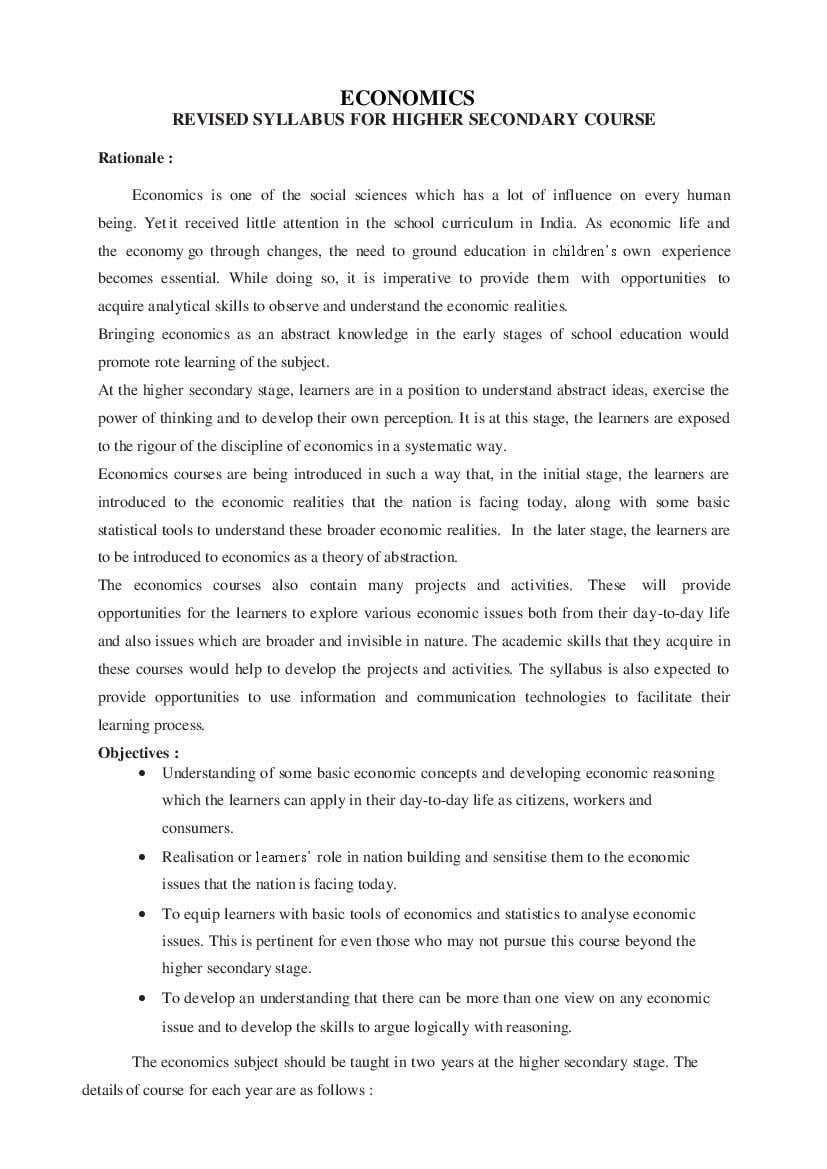
REVISED SYLLABUS FOR HIGHER SECONDARY COURSE
Rationale :
Economics is one of the social sciences which has a lot of influence on every human
being. Yet it received little attention in the school curriculum in India. As economic life and
the economy go through changes, the need to ground education in children’s own experience
becomes essential. While doing so, it is imperative to provide them with opportunities to
acquire analytical skills to observe and understand the economic realities.
Bringing economics as an abstract knowledge in the early stages of school education would
promote rote learning of the subject.
At the higher secondary stage, learners are in a position to understand abstract ideas, exercise the
power of thinking and to develop their own perception. It is at this stage, the learners are exposed
to the rigour of the discipline of economics in a systematic way.
Economics courses are being introduced in such a way that, in the initial stage, the learners are
introduced to the economic realities that the nation is facing today, along with some basic
statistical tools to understand these broader economic realities. In the later stage, the learners are
to be introduced to economics as a theory of abstraction.
The economics courses also contain many projects and activities. These will provide
opportunities for the learners to explore various economic issues both from their day-to-day life
and also issues which are broader and invisible in nature. The academic skills that they acquire in
these courses would help to develop the projects and activities. The syllabus is also expected to
provide opportunities to use information and communication technologies to facilitate their
learning process.
Objectives :
Understanding of some basic economic concepts and developing economic reasoning
which the learners can apply in their day-to-day life as citizens, workers and
consumers.
Realisation or learners’ role in nation building and sensitise them to the economic
issues that the nation is facing today.
To equip learners with basic tools of economics and statistics to analyse economic
issues. This is pertinent for even those who may not pursue this course beyond the
higher secondary stage.
To develop an understanding that there can be more than one view on any economic
issue and to develop the skills to argue logically with reasoning.
The economics subject should be taught in two years at the higher secondary stage. The
details of course for each year are as follows :
Page 2
SYLLABUS FOR HIGHER SECONDARY FINAL YEAR COURSE
Marks 100[ (80 Theory )+ 20 (Project)]
Unit wise Distribution of Marks and Periods :
Part A : Introductory Macroeconomics
Unit No. Title Marks Periods
1 National Income and Related Aggregates 10 30
2 Determination of Income and Employments 12 22
3 Money and Banking 06 12
4 Government Budget and the Economy 06 12
5 Open Economy 06 14
Total 40 90
Part B : Indian Economic Development
Unit No. Title Marks Periods
6 Development Experience (1947-1990) 07 13
7 Economic Reforms since 1991 05 10
8 Current Challenges facing Indian 22 55
Economy
9 Development Experiences of India: A 06 07
comparison with neighbours
Total 40 85
Part C : Project Work in Economics 20 20
Part A: Introductory Macroeconomics
Unit :1 National Income and Related Aggregates Marks 10 Periods 30
1. Macroeconomics: Meaning, emergence of macroeconomics; Major sectors in an economy
(Household, Firms, Government, External)
2. Basic concepts in Macroeconomics : consumption goods, capital goods, final goods,
intermediate goods; stocks and flows; Investment, Gross investment, Net investment and
depreciation
Page 3
Income- Value added or Product method, Expenditure Method, Income Method.
• Factor Cost, Basic Prices and Market Prices.
Aggregates related to National Income:
Gross National Product (GNP), Net National Product (NNP), Gross Domestic Product
(GDP) and Net Domestic Product (NDP) - at market price, at factor cost; Personal
Income, Personal Disposable Income, National Disposable Income and Private
income; Real and Nominal GDP.
• GDP and Welfare.
Unit 2 : Determination of Income and Employment. Marks 12 Periods 25
• Aggregate demand and its components.
• Consumption function, Propensity to consume and propensity to save (average and
Marginal), Investment function.
• Income determination in two sector model
• Determination of Equilibrium Income in the short run: macroeconomic equilibrium with
price level fixed, effect of an autonomous change in aggregate demand on income and
output, investment multiplier and its mechanism.
• Meaning of full employment, Deficit demand, excess demand.
Unit 3: Money and Banking Marks 6 Periods 12
• Money - Meaning and its functions
• Demand for money; motives for demand for money.
• Supply of money; Various measures of supply of money.
• Central bank and its functions
• Commercial Banks- Meaning and functions. Credit creation by the commercial banks.
• Limits to credit creation and money multiplier.
• Policy tools to control money supply.
• Demonetization
Unit 4: Government Budget and the Economy Marks 6 Periods 12
• Government budget- meaning, objectives and components.
• Classification of receipts revenue receipts and capital receipts.
• Classification of expenditure - revenue expenditure and capital expenditure,
• Balanced Budget, Surplus Budget and Deficit Budget; measures to correct government
deficit- Fiscal Policy: Changes in government expenditure and changes in tax, public debt;
Fiscal Responsibility and Budget management Act, 2003; GST (Concept only).
• Measures of Government deficit- Revenue deficit, Fiscal deficit, Primary deficit
Page 4
• Balance of Payments: meaning, Current Account, Capital Account, Balance of payments
surplus and deficit
• The foreign exchange market, Foreign exchange rate: fixed exchangecate, flexible
exchange rate and managed floating exchange rate.
• Determination of forcing exchange rate under fixed and flexible exchange rate.
• Merits and demerits of flexible and fixed exchange rate.
Part B: Indian Economic Development
Unit 6: Development Experience (1947-1990) Marks 7 Periods 13
• A brief introduction of the states of Indian economy on the eve of the independence.
• Indian economic system and common goals of Five Years Plans.
• Main features, problems and policies of agriculture (institutional aspects and new
agricultural strategy)
• Industry and Trade: Industrial Policy Resolution 1956; Small Scale Industry-Role and
Importance; Trade Policy-Import Substitution.
Unit 7: Economic Reforms since 1991 Marks 5 Periods 10
• Rationale of Economic Reforms; Liberalisation, Privatisation and Globalisation; appraisals
economic reforms in India.
• Features and appraisals of liberalization, globalisation and privatisation (LPG Policy)
Unit 8: Current Challenges facing Indian Economy Marks 22 Periods 55
• Human Capital Formation: Human capital, Sources of Human capital, Human Capital and
Human Development, State of Human capital Formation in India Education Sector in
India.
• Rural Development: Key Issues- credit and marketing in rural areas.
• Agriculture market system, Diversification into Productive a ctives, Sustainable
development and organic farming
• Employment: Growth and changes in work force participation rate in formal and
informal sectors; problems and policies.
• Environment and Sustainable development: Environment- Definition and functions,
Sustaiable dwelopment-meaning, strategies for sustainable development, nature of
environmental challenges facing india.
[ N.B.: at the time of discussion of the above topics in unit 8, the faculty/ teacher should also
make references about the Assam Economy]
Page 5
• Human Capital Formation: Human capital, Sources of Human capital, Human Capital
and Human Development, State of Human capital Formation in India Education Sector
in India.
• Rural Development: Key Issues- credit and marketing in rural areas.
• Agriculture market system, Diversification into Productive actives, Sustainable
development and organic farming
• Employment: Growth and changes in work force participation rate in formal and
informal sectors; problems and policies.
• Environment and Sustainable development: Environment- Definition and functions,
Sustaiable dwelopment-meaning, strategies for sustainable development, nature of
environmental challenges facing india.
[ N.B.: at the time of discussion of the above topics in unit 8, the faculty/ teacher should also
make references about the Assam Economy]
Unit 9: Development Experiences of India: A comparison with neighbors Marks 6 Periods 7
• India and Pakistan
• India and China
• With reference to issues: Demographic indicators, Economic growth, Sectoral
Development & Human Development Indicators.
Part C: Project in Economics Marks 20 Periods 20
Guidelines for Project Work in Economics (Class XII)
The objectives of the project work are to enable learners to:
• Probe deeper into theoretical concepts learnt in classes Xl and XII
• Analyse and evaluate real world economic scenarios using theoretical constructs and
Arguments
• Demonstrate the learning of economic theory
• Follow up aspects of economics in which learners have interest.
• Develop the communication skills to argue logically The expectations of the project work
are that:
• Learners will complete only ONE project in each academic session
• Project should be of 3500- 4000 words (excluding diagrams & graphs), preferably hand-
written
• lt will be an independent, self -directed piece of study
Page 6
The teacher plays a critical role in developing thinking skills of learners. A teacher should :
• Help each learner select the topic based on recently published extracts from the news,
media, government policies, RBI bulletin, NITI Aayog reports, IMF/World Bank reports
etc., after detailed discussions and deliberations of the topic
• Play the role of a Facilitator and Supervisor to monitor the project work of the learner
through periodic discussions
• Guide the research work in terms of sources for the relevant data
• Educate learner about plag1arism and the importance of quoting the source of the
informati0n to ensure authenticity of research work
• Prepare the learner for the presentation of the project work
• Arrange a presentation of the project file
Scope of the Project:
Learners may work upon the following lines as suggested flow chart:
Choose a title/topic
Collection of the research material/data
Organization of material/data
Present material/data
Analysing the material/data for conclusion
Draw the relevant conclusion
Presentation of the project work
Expected Checklist:
• Introduction of topic/title
• Identifying the causes, consequences and/or remedies
• Various stakeholders and effect on each of them
• Advantages and disadvantages of situations or issues identified
• Short-term and long-term implications of economic strategies suggested in the courseof
research
• Validity, reliability, appropriateness and relevance of data used for research work and
Presentation in the project file
• Presentation and writing that is succinct and coherent in project file
• Citation of the materials referred to, in the file in footnotes, resources section, bibliography
etc
Page 7
At the end of the stipulated term, each learner will present the research work in the Project File to
the External and Internal examiner. The questions should be asked from the Research Work/
Project File of the learner. The internal examiner should ensure that the study submitted by the
learner is his/her own original work. In case of any doubt, authenticity should be checked and
verified.
Marking Scheme :
Sl. Heading Marks Allotted
No.
1 Relevance of the topic 3
2 Knowledge 6
Content/Research
3 Presentation Technique 3
4 Viva –Voce 8
Suggestive list of projects
Class XII
Micro and small Scale Industries Food Supply Channel in India
Contemporary Employment Disinvestment policy of the government
situation in India
Goods and Service Tax Act and its Health Expenditure (of any state)
impact on GDP
Human Development Index Inclusive Growth Strategy
Self- Help Group Trends in Credit availability in India
Functions of Commercial Bank and Environmental challenges facing India (eg.
Central Bank Global warming)(may be a problem
pertaining to the locality)
Employment and other related Poverty in India
issues in India
Monetary policy committee and its Role of RBI in Control of Credit
functions
Government Budget and its Trends in budgetary condition of India
components
Exchange Rate determination- Currency War-reasons and repercussions
Methods and Techniques
Livestock- Backbone of Rural India Alternate fuel- types and importance
Sarwa Siksha Abhiyan- cost Ratio Golden Quadrilateral- Cost ratio benefit
benefits
Minimum Support Price Relation between Stock Price Index and
Economic Health of the Nation
Waste Management in India- Need Minimum Wage rate – Approach and
of the hour Application
Digital India- Step towards the Rain Water Harvesting – a solution to
future water crisis
Vertical Farming- an alternate way Silk Route- Revival of the past
Make in India- The way ahead Bumper Farming- Back to the nature
Page 8
Analysis
Any other newspaper article and its Any other topic (specially related to own
evaluation on the basis of economic States/ regions/locality etc.)
principles
Document Details
| Board / Org | Assam Board |
| Exam | Class 12 |
| Type | Syllabus |
| Pages | 8 |
| Updated | 22 Jul 2026 |