HBSE Class 12 Sample Paper 2026 Answers Accountancy
Finished viewing? Save it for later —
Download HBSE Class 12 Sample Paper 2026 Answers Accountancy (PDF · 15 pages)About HBSE Class 12 Sample Paper 2026 Answers Accountancy
HBSE Class 12 Sample Paper 2026 Answers Accountancy is available here for free download. Published by Haryana Board for Class 12, this answer key can be viewed online or downloaded as a PDF (15 pages). Candidates preparing for Class 12 can use HBSE Class 12 Sample Paper 2026 Answers Accountancy to understand the exam pattern, the type of questions asked, and the overall difficulty level.
Frequently Asked Questions
How can I download HBSE Class 12 Sample Paper 2026 Answers Accountancy?
Open this page and click the Download button to save HBSE Class 12 Sample Paper 2026 Answers Accountancy as a PDF. It is completely free on AglaSem Docs.
Is HBSE Class 12 Sample Paper 2026 Answers Accountancy free to download?
Yes. HBSE Class 12 Sample Paper 2026 Answers Accountancy can be viewed online and downloaded as a PDF free of cost on AglaSem Docs.
How many pages does HBSE Class 12 Sample Paper 2026 Answers Accountancy have?
HBSE Class 12 Sample Paper 2026 Answers Accountancy contains 15 pages, which you can read online or download together as a single PDF.
Where can I find more Class 12 study material?
You can find more Class 12 question papers, sample papers, syllabus, and answer keys on AglaSem Docs.
HBSE Class 12 Sample Paper 2026 Answers Accountancy – Text
Read the full text of this answer key below — useful to quickly search, copy and reference the content online without downloading the PDF.
📄 View text version (15 pages)
Page 1
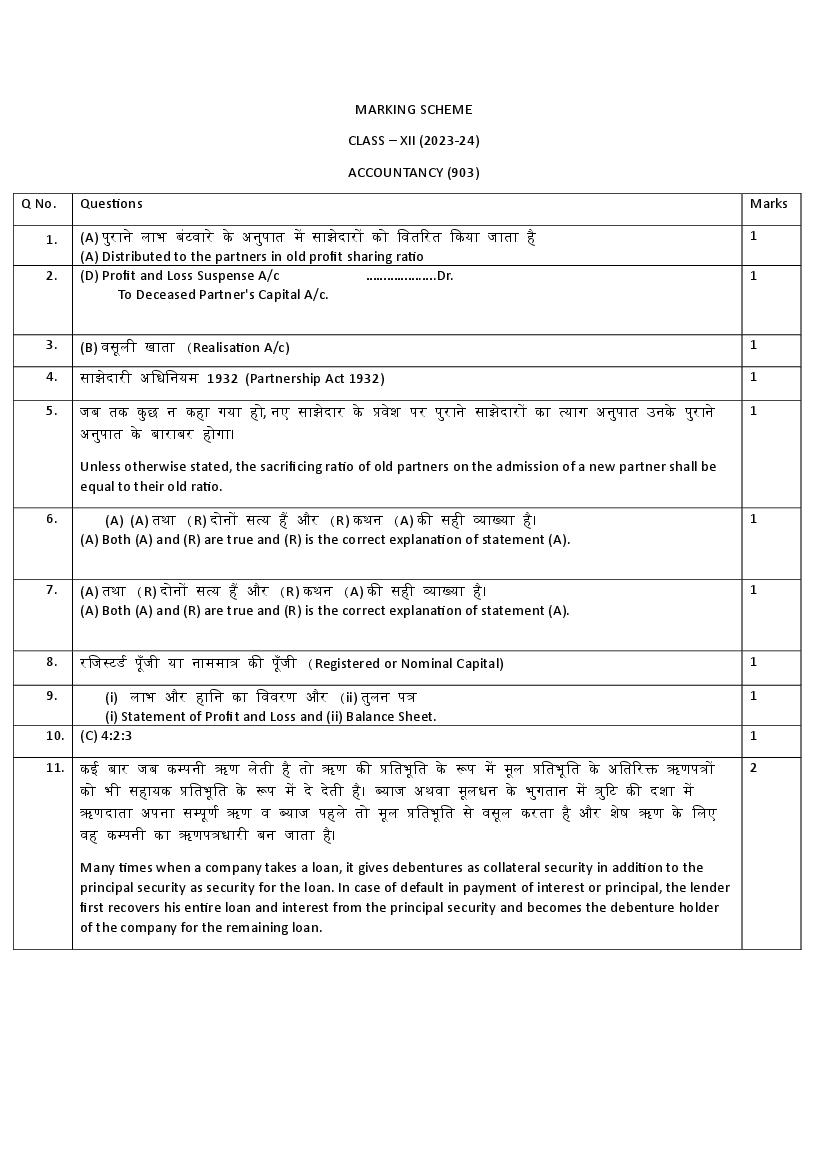
CLASS – XII (2023-24)
ACCOUNTANCY (903)
Q No. Questions Marks
1. (A) पुराने लाभ बंटवारे के अनुपात में साझेदारों को ववतररत ककया जाता है 1
(A) Distributed to the partners in old profit sharing ratio
2. (D) Profit and Loss Suspense A/c …………….….Dr. 1
To Deceased Partner's Capital A/c.
3. (B) वसूली खाता (Realisation A/c) 1
4. साझेदारी अवधवनयम 1932 (Partnership Act 1932) 1
5. जब तक कु छ न कहा गया हो, नए साझेदार के प्रवेश पर पुराने साझेदारों का त्याग अनुपात उनके पुराने 1
अनुपात के बाराबर होगा।
Unless otherwise stated, the sacrificing ratio of old partners on the admission of a new partner shall be
equal to their old ratio.
6. (A) (A) तथा (R) दोनों सत्य हैं और (R) कथन (A) की सही व्याख्या है। 1
(A) Both (A) and (R) are true and (R) is the correct explanation of statement (A).
7. (A) तथा (R) दोनों सत्य हैं और (R) कथन (A) की सही व्याख्या है। 1
(A) Both (A) and (R) are true and (R) is the correct explanation of statement (A).
8. रवजस्टर्ड पूूँजी या नाममात्र की पूूँजी (Registered or Nominal Capital) 1
9. (i) लाभ और हावन का वववरण और (ii) तुलन पत्र 1
(i) Statement of Profit and Loss and (ii) Balance Sheet.
10. (C) 4:2:3 1
11. कई बार जब कम्पनी ऋण लेती है तो ऋण की प्रवतभूवत के रूप में मूल प्रवतभूवत के अवतररक्त ऋणपत्रों 2
को भी सहायक प्रवतभूवत के रूप में दे देती है। ब्याज अथवा मूलधन के भुगतान में त्रुरट की दशा में
ऋणदाता अपना सम्पूणड ऋण व ब्याज पहले तो मूल प्रवतभूवत से वसूल करता है और शेष ऋण के वलए
वह कम्पनी का ऋणपत्रधारी बन जाता है।
Many times when a company takes a loan, it gives debentures as collateral security in addition to the
principal security as security for the loan. In case of default in payment of interest or principal, the lender
first recovers his entire loan and interest from the principal security and becomes the debenture holder
of the company for the remaining loan.
Page 2
1
1
OR अथवा
(i) ककसी साझेदार द्वारा फमड में और पूूँजी लगाने पर, तथा 1+1
(ii) ककसी साझेदार द्वारा अन्य साझेदारों की सहमवत से स्थायी रूप से फमड से पूूँजी वनकालने पर।
(i) When a partner invests more capital in the firm, and
(ii) When a partner permanently withdraws capital from the firm with the consent of the other partners.
13. ½
½
½
½
OR अथवा
(i) व्यवसाय का सुववधाजनक स्थान, (ii) प्रबन्ध की कु शलता
(i) Convenient location of business, (ii) Efficiency of management
1+1
14. JOURNAL
Page 3
1. Bank A/c Dr. 1,80,000
To Premium for goodwill A/c 60,000
To C’s capital A/C 1,20,000 ½
(being amount of goodwill premium brought
in cash)
2. 60,000
Premium for goodwill A/c Dr.
60,000
To A’s Capital A/c
1
(being Transfer of premium for goodwill to
sacrificing partner’s in sacrificing ratio)
Calculation of new profit sharing ratio : C takes 1/4th share out of 1.
Thus, the remaining profit is ¾ , this is divided equally between A and B.
A’s new share = ¾ x ½ = 3/8
½
B’s new share = ¾ x ½ = 3/8
Sacrifice made by A = 5/8 – 3/8 = 2/8
Sacrifice made by B = 3/8-3/8 = 0
15. (i) संपवियों और दावयत्त्वों के पुनमुडलयांकन पर उसके वहस्से की हावन ; 1+1
(ii) पुस्तको में कदखाई गई ख्यावत के अपलेखन में उसका वहस्सा |
(i) his share of the loss on revaluation of assets and liabilities;
(ii) his share in the write-off of goodwill shown in the books.
16.
Date Particulars Debit Credit
(Rs.) (Rs.)
Share Capital A/c 7,000 ½
..............Dr.
To share first call A/c
2,000
To share forfeiture A/c
5,000
(Being forfeiture of 1000 share )
Bank A/c ……………………Dr. 2,400
Share Forfeiture A/c …………………….Dr. 1,800
½
To Share Capital A/c 4,200
Page 4
1
Share Forfeiture A/c …………………Dr. 1,200
To Capital Reserve A/c 1,200
(Being forfeiture money transferred to capital reserve)
Working note:
Forfeiture amount on 1000 share = Rs. 5,000
Therefore, Forfeiture amount on 600 share = Rs. 5000/1000 X 600 = Rs. 3,000
1
Less: Loss on reissue = Rs. 1,800
Transferred to Capital Reserved Rs. 1,200
17.
½ x6=3
18.
1
1
½
½
Page 5
(1) Number of Debenture issued = 7,60,000 ÷ 95 = 8,000.
(2) As per new guidelines, Capital Reserve cannot be used for writing off Discount/Loss on Issue of
Debenture.
19.
2
1
OR अथवा ½x6=3
1. Debit of Current A/c.
2. Credit of Current A/c.
3. Credit of Current A/c.
4. Credit of Current A/c.
5. Debit of Current A/c.
6. Credit of Current A/c.
Page 6
21. Revaluation Account
Particulars Amount Particulars Amount 1.5
To Patents 2,000 By Provision for Doubtful debts 2,000
To profit Transferred to: By Typewriter 2,600
A’s Capital A/c 2,000 By Provision for discount on Creditors 400
B’s Capital A/c 1,000
5,000 5,000
Page 7
To Balance c/d 60,000 35,000 - BY Balance b/d 40,000 30,000 - 1.5
By Reserve Fund 8,000 4,000 -
By Revaluation 2,000 1,000 -
By Premium for
Goodwill -
10,000 -
1,42,000 1,18,000 - 60,000 35,000 -
To Balance C/d 60,000 35,000 19,000 By Balance B/d 60,000 35,000
By Bank - - 19,000
60,000 35,000 19,000 60,000 35,000 19,000
Partner’s Capital A/c
Page 8
as at 1st April 2022
Liabilities Amount Assets Amount
Capital A/c Machinery 33,600
A 60,000 Building 25,000 1
B 35,000 Stock 20,000
C 19,000 1,14,000 Bank 14,000
Creditors 20,000 Sundry debtors 40,000
Less: Provision 400 19,600 Less: Provision 1,600 38,400
Typewriter 2,600
1,33,600 1,33,600
Working notes:
C's capital is not given in the question. He will bring capital according to his share of profit. C's share
in the profits is 1/6. A and B are shareholders in the remaining 5/6. After all adjustments, A and B's
1
capital is Rs. 60,000 + Rs. 35,000 = Rs. 95,000.
If capital for 5/6 part = 95,000
Then capital for 1 part = 95,000 × 6/5 = 1,14,000
Therefore, capital for 1/6 part is = 1,14,000 x 1/6 = 19,000
Calculation of bank balance :
Goodwill brought in cash by C 10,000
Capital brought in cash by C 19,000
29,000
(-) Bank overdraft 15,000
Balance in bank 14,000
OR अथवा
1. नया लाभ ववभाजन अनुपात ज्ञात करना। 1x5=5
2. ख्यावत का लेखांकन व्यवहार
3. सम्पवियों एवं दावयत्वों के पुनमूडलयांकन के वलए लेखांकन व्यवहार
4. संचयों एवं संवचत लाभों का लेखांकन व्यवहार
5. साझेदारों की पूूँवजयों को नए लाभ-ववभाजन अनुपात में समायोवजत करना।
Page 9
2. Accounting treatment of goodwill
3. Accounting treatment for revaluation of assets and liabilities
4. Accounting treatment of reserves and accumulated profits
5. To adjust the capitals of partners as per the new profit sharing ratio.
22. JOURNAL
Sr. No. Particulars L. Debit Credit
F
Bank A/c ………..Dr. 34,00,000
To Equity Share Capital A/c 34,00,000
(Being application money received)
1/2
Equity share Application A/c …………Dr. 34,00,000
To Equity share capital A/c 24,00,000
To Equity share allotment A/c 6,00,000
1/2
To Bank A/c 4,00,000
(Being shares allotted and balance refunded)
Equity share allotment A/c …………Dr. 51,00,000
To Equity share capital A/c 36,00,000
To securities premium reserve A/c 15,00,000
(being share allotment money including premium
1/2
due)
Bank A/c ………….Dr.
42,00,000
Calls in arrears A/c ………….Dr.
3,00,000
1/2
To Equity share allotment A/c
45,00,000
(being allotment money received)
Equity share capital A/c ………….Dr.
4,00,000
Securities premium reserve A/c ………..Dr. 1,00,000
2,00,000
1/2
To share forfeited A/c
3,00,000
To calls in arrears A/c
(Being 4000 share forfeited for non payment of
Page 10
Bank A/c ………..Dr.
Share Forfeiture A/c …………Dr. 2,40,000
To share capital A/c 60,000 3,00,000 1/2
(Being forfeited share reissued at Rs.14 per share)
Share forfeited A/c Dr.
To Capital Reserve A/c 90,000 90,000
(being share forfeited money transferred to capital ½
reserve A/c)
Working Notes:
(1) Pro-rata allotment has been made in the ratio of 5: 4. It means 60,000 shares have been allotted
to the applicants of 60,000 x 5/4=75,000 shares.
(3)(a) Total Number of shares applied by Anand = 4,000 × 5/4 = 5,000 shares
Excess application money received :
5,000 shares-4,000 shares = 1,000 shares × 40 = ₹40,000 1.5
(b) ₹
Allotment money due from Anand = 4,000 × 85 3,40,000
Less: Excess received on application stage 40,000
Allotment money not received 300000
(c) Total amount due on allotment: 60,000 shares × 85 51,00,000
Less: Excess received on application 6,00,000
45,00,000
Less: Amount not received from Anand on allotment 3,00,000
Net Amount received on allotment in cash 42,00,000
(3) Transfer of Capital Reserve :
Forfeited amount on 4,000 shares = ₹2,00,000
Hence, Forfeited amount on 3,000 shares = 2,00,000 x 3,000 1,50,00
4,000
Less: Loss on Reissue = 3,000 × 20 60,000
Transfer to Capital Reserve 90,000
OR अथवा
अंशों के अवभदान का अथड है कक कोई व्यवक्त या संस्था ककसी कं पनी के अंश (शेयर) खरीदने
के वलए आवेदन कर रहा है। कं पनी द्वारा अंश वनगडमन (शेयर जारी करना) करने के बाद, 1+4=5
Page 11
Basis Over-Subscription Under-subscription
1. Shared applied Shares Applied In this case, In this case, the number of
the number of shares applied shares applied by the public is
by the public is more than the less than the number of shares
number of shares offered. offered.
2. Acceptance of All applications are not All applications are fully
Application accepted. Some may be accepted.
rejected or shares are allotted
on a pro-rata basis.
3. Refund of Excess The excess application money Since all applicants receive full
Application money is either refunded or adjusted allotment, there is no excess
in allotment or future calls. amount to be refunded.
4. Minimum Subscription The company does not face The company may face
any issue regarding minimum difficulty in receiving minimum
subscription (90% of issued subscription.
capital).
23. वविीय वववरण लेखांकन प्रकिया के अवन्तम पररणाम हैं। यह ककसी व्यवसाय की लाभप्रदता 1
Page 12
Ans. Financial statements are the end results of the accounting process. They provide information
about the profitability and financial position of a business.
24. (D) लेखांककत तथ्य (D) Recorded Facts 1
25. बैंक ओवरड्राफ्ट में कमी को आम तौर पर नकदी प्रवाह वववरण के अंतगडत वविीय गवतवववधयों के 1
अंतगडत नकदी बवहवाडह के रूप में वगीकृ त ककया जाता है।
A decrease in a bank overdraft is generally classified as a cash outflow under financing activities
within a statement of cash flows.
26. (A) (A) तथा (R) दोनों सत्य हैं और (R) कथन (A) की सही व्याख्या है। 1
(A) Both (A) and (R) are true and (R) is the correct explanation of statement (A).
27. संचालन व्यय operating expenses 1
28. (i) लाभ-हावन के ववषय में सूचना प्रदान करना | 1+1=2
(ii) वविीय वस्थवत के ववषय में सूचना प्रदान करना।
(i) To provide information about profit and loss.
(ii) To provide information about financial position.
29. Cost of Revenue from Operations = Revenue from Operations - Gross Profit ½
= ₹6,00,000-25% of ₹6,00,000
=₹6,00,000-₹1,50,000 = ₹4,50,000 ½
Inventory Turnover Ratio = Cost of Revenue from Operations ½
Average Inventory
3 (Given) = 4,50,00
Average Inventory
Average Inventory = ₹4,50,000/3 = ₹1,50,000 ½
Opening Inventory + Closing Inventory = Average Inventory × 2 ½
= ₹1,50,000 × 2 = ₹3,00,000
Since Opening Inventory is 25% of Closing Inventory, ratio between Opening Inventory and Closing
Inventory will be 25: 100 Or 1:4
1
Opening Inventory = ₹3,00,000× 1/5 =₹ 60,000
Closing Inventory = ₹3,00,000 × 4/5 = ₹2,40,000
OR अथवा
Inventory Turnover Ratio = Cost of Revenue from Operations (Cost of Goods Sold) = ……times
Average Inventory 1+2=3
Page 13
पररवर्शतत हो रहा है। इस अनुपात में सुधार होने का अथड है कक या तो स्टॉक में कम वववनयोग से
उतनी ही मात्रा में संचालन कियाओं से आगम हो रहा है अथवा स्टॉक में वबना वृवि के ही संचालन
कियाओं से आगम की मात्रा में वृवि हो गई है।
Inventory Turnover Ratio = Cost of Revenue from Operations (Cost of Goods Sold) = ……times
Average Inventory
A high stock turnover ratio shows that the stock is being converted into revenue from operating
activities at a faster pace. An improvement in this ratio means that either the same amount of
revenue is being generated from operating activities with less investment in stock or the amount of
revenue from operating activities has increased without any increase in stock.
30.
2
1.5
1.5
OR अथवा
यह एक ववशेष अववध के दौरान रोकड़ एवं रोकड़ समतुलयों (Cash equivalents) के स्त्रोतों (Inflow or
Sources) तथा उपयोगों (Outflows or uses) का वववरण है।
रोकड़ प्रवाह वववरण की चार सीमाएूँ : 1+4=5
1. तरलता का माप करने के वलए उपयुक्त नहीं |
2. ऊपरी कदखावाट की संभावना |
3. गैर – नकदी व्यवहारों की अवहेलना |
Page 14
It is a statement of the inflows or sources and outflows or uses of cash and cash equivalents during a
particular period.
Four limitations of the cash flow statement:
1. Not suitable for judging the liquidity
2. Possibility of window dressing
3. It ignores non-cash transaction
4. It ignores the accrual concept of accounting
COMPUTERIZED ACCOUNTING
23 Data, Report, Ledger, Hardware, Software. (any two) ½ marks
each
24 (i) Accounting transactions ½ marks
each
(ii) Accounting software
25 (C) Assets, Capital, Liabilities, Revenue and Expenses 1
26 (C) Column between start and end points of Excel sheet 1
27 (C) Data is not made available to everybody. 1
28 Sequential codes:- Sequential codes are those codes in which the numbers or letters are arranged in 1
a consecutive order.These types of codes are mostly applied in source documents such as cheques,
invoices.
It also helps in document search by tracking a relevant document based on the code or by identifying
the missing codes in a document based on the numbers.
Mnemonic codes:- Mnemonic codes are those codes that consist of alphabets or abbreviations as
symbols for codifying a piece of information. E.g. HQ for headquarters, DLI for Delhi in train
bookings. 1
29 A graph is defined as a diagram or a pictorial representation that represents the interrelation 1
between data or values in an organized manner.
The three advantages of graphs are as follows: (any two)
1+1
1. It makes data presentable and easy to understand.
2. It helps in summarizing the data in a crisp manner.
3. It helps in the comparison of data in a better way.
OR
Types of vouchers (any three):
(i) Contra voucher: Used for fund transfer between cash and Bank A/c only. This voucher is used if
1+1+1
cash is withdrawn from Bank for office or deposited in the Bank from office.
Page 15
be towards any income such as receipts from Debtors, loan/advance taken or refund of
loan/advance etc.
(iii) Payment Voucher: All outflow of money is recorded through payment voucher such payments
may be towards any purchases, Expenses, due to creditors, loan/advance etc.
(iv) Journal Voucher: It is an adjustment voucher, normally used for non-cash transactions like
adjustment between ledgers.
30 The error is #NUM! Error. The steps to correct it are: 1
1. Optionally, click the cell that displays the error, click the button that appears and then click
show calculation steps.
1
2. Review the following causes and solutions: Using an unacceptable argument in the function
that requires anumeric argument. Make sure that the arguments used in the function are
numbers. Using a worksheet function that iterates, such as IRR or RATE, and the function
cannot find the result. Use a different starting value for the worksheet function.
2
3. Then click the Microsoft button > Excel option and then click the formulas category.
OR
1
5
Document Details
| Board / Org | Haryana Board |
| Exam | Class 12 |
| Type | Sample Paper |
| Pages | 15 |
| Updated | 24 Sep 2026 |