AHSEC 2nd Year Syllabus 2024-25 English Alternative
Finished viewing? Save it for later —
Download AHSEC 2nd Year Syllabus 2024-25 English Alternative (PDF · 4 pages)About AHSEC 2nd Year Syllabus 2024-25 English Alternative
AHSEC 2nd Year Syllabus 2024-25 English Alternative is available here for free download. Published by Assam Board for Class 12, this syllabus can be viewed online or downloaded as a PDF (4 pages). Candidates preparing for Class 12 can use AHSEC 2nd Year Syllabus 2024-25 English Alternative to understand the exam pattern, the type of questions asked, and the overall difficulty level.
Frequently Asked Questions
How can I download AHSEC 2nd Year Syllabus 2024-25 English Alternative?
Open this page and click the Download button to save AHSEC 2nd Year Syllabus 2024-25 English Alternative as a PDF. It is completely free on AglaSem Docs.
Is AHSEC 2nd Year Syllabus 2024-25 English Alternative free to download?
Yes. AHSEC 2nd Year Syllabus 2024-25 English Alternative can be viewed online and downloaded as a PDF free of cost on AglaSem Docs.
How many pages does AHSEC 2nd Year Syllabus 2024-25 English Alternative have?
AHSEC 2nd Year Syllabus 2024-25 English Alternative contains 4 pages, which you can read online or download together as a single PDF.
Where can I find more Class 12 study material?
You can find more Class 12 question papers, sample papers, syllabus, and answer keys on AglaSem Docs.
AHSEC 2nd Year Syllabus 2024-25 English Alternative – Text
Read the full text of this syllabus below — useful to quickly search, copy and reference the content online without downloading the PDF.
📄 View text version (4 pages)
Page 1
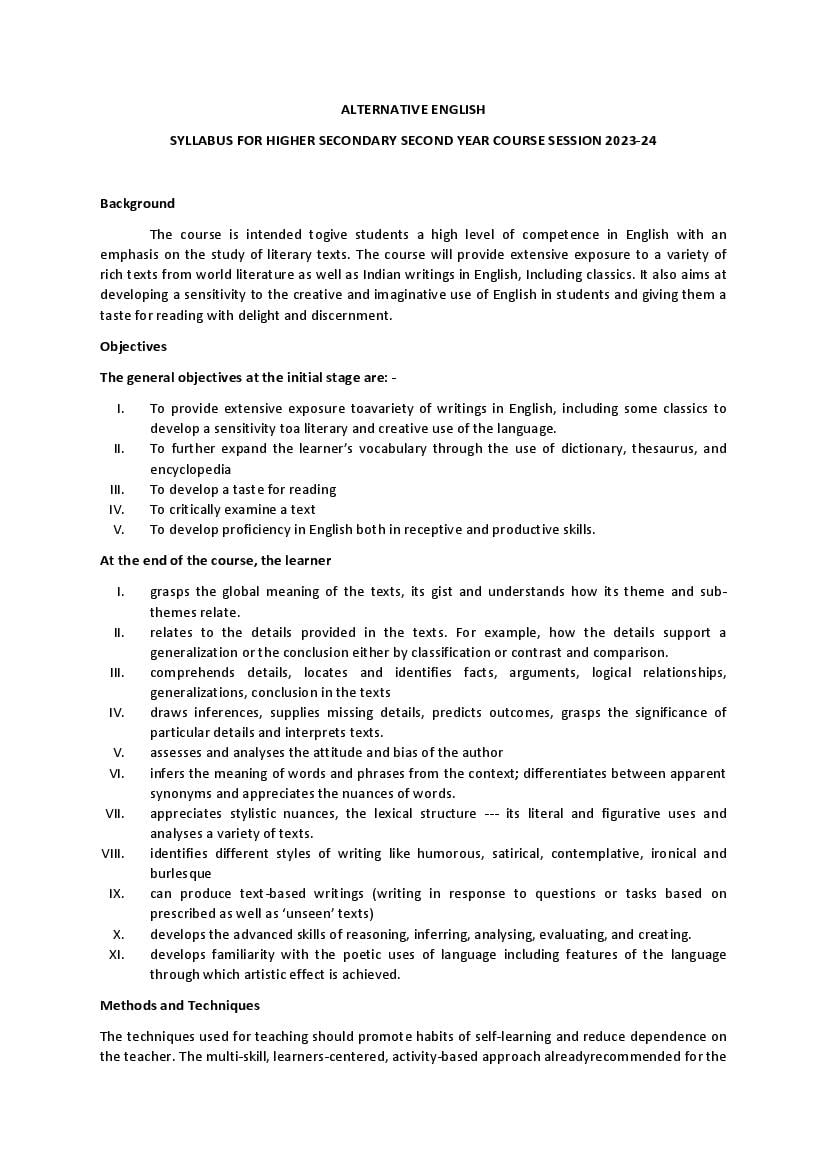
Background
The course is intended togive students a high level of competence in English with an
emphasis on the study of literary texts. The course will provide extensive exposure to a variety of
rich texts from world literature as well as Indian writings in English, Including classics. It also aims at
developing a sensitivity to the creative and imaginative use of English in students and giving them a
taste for reading with delight and discernment.
Objectives
The general objectives at the initial stage are: -
I. To provide extensive exposure toavariety of writings in English, including some classics to
develop a sensitivity toa literary and creative use of the language.
II. To further expand the learner’s vocabulary through the use of dictionary, thesaurus, and
encyclopedia
III. To develop a taste for reading
IV. To critically examine a text
V. To develop proficiency in English both in receptive and productive skills.
At the end of the course, the learner
I. grasps the global meaning of the texts, its gist and understands how its theme and sub-
themes relate.
II. relates to the details provided in the texts. For example, how the details support a
generalization or the conclusion either by classification or contrast and comparison.
III. comprehends details, locates and identifies facts, arguments, logical relationships,
generalizations, conclusion in the texts
IV. draws inferences, supplies missing details, predicts outcomes, grasps the significance of
particular details and interprets texts.
V. assesses and analyses the attitude and bias of the author
VI. infers the meaning of words and phrases from the context; differentiates between apparent
synonyms and appreciates the nuances of words.
VII. appreciates stylistic nuances, the lexical structure --- its literal and figurative uses and
analyses a variety of texts.
VIII. identifies different styles of writing like humorous, satirical, contemplative, ironical and
burlesque
IX. can produce text-based writings (writing in response to questions or tasks based on
prescribed as well as ‘unseen’ texts)
X. develops the advanced skills of reasoning, inferring, analysing, evaluating, and creating.
XI. develops familiarity with the poetic uses of language including features of the language
through which artistic effect is achieved.
Methods and Techniques
The techniques used for teaching should promote habits of self-learning and reduce dependence on
the teacher. The multi-skill, learners-centered, activity-based approach alreadyrecommended for the
Page 2
of prescribed selected texts for comprehension will receive greater focus as one of the activities.
Learners will be trained to read independently and intelligently, interacting actively with texts and
other reference materials (dictionary, thesaurus, encyclopedia etc.) as necessary. Some pre-reading
activity will generally be required, and course books should suggest those activities. It is important to
remember that every text can generate different reading strategies.
Students should be encouraged to interpret texts in different ways while presenting their views.
Some projects may also be assigned to students from time to time.
Page 3
One paper Three hours Marks 100
Unit wise distribution of Marks and Periods:
Unit no Topic Marks Periods
Unit- I Prose 40 90
Unit-II Poetry 30 40
Unit- III Grammar And Comprehension 20 35
Unit- IV Essay 10 15
Total 100 180
Distribution of course content [Unit Wise]
Selected Prose (Marks - 40)
1. A Cup of Tea Katherine Mansfield
2. The Voyage Bhupen Hazarika
3. The Verger William Somerset Maugham
4. The Martyr’s Corner R.K. Narayan
5. Bina Kutir Saurav Kumar Chaliha
Selected Poetry (Marks - 30)
1. Ozymandiasof Egypt P.B. Shelly
2. Because I Could Not Stop for Death Emily Dickinson
3. Strange Meeting Wilfred Owen
4. The Solitude of Alexander Selkirk William Cowper
5. The Lake Isle of Innisfree WB Yates
6. Night of the Scorpion Nissim Ezekiel
Grammar (Marks 5+5 = 10)
1. Common Errors (Marks - 05)
2. Question Tags (Marks - 05)
Comprehension (Marks 10)
1. Comprehension based on a given conversational passage.
Essay (Marks - 10)
1. Essay Writing
Page 4
Type of No Of questions Marks
question
LA type 5 marks 5 25
SA Type 3 marks 6 18
2 marks 12 24
VSA Type 1 mark 20 20
½ marks 26 13
Total 65 nos. 100 marks
Weightage to objective
Objective Marks %
Knowledge 20 20%
Understanding 30 30%
Application 50 50%
Prescribed textbook: Harmony: An Anthology of Prose and Poetry
Document Details
| Board / Org | Assam Board |
| Exam | Class 12 |
| Type | Syllabus |
| Pages | 4 |
| Updated | 22 Jul 2026 |