Bihar Board Class 11th 12th Syllabus Business Studies
Finished viewing? Save it for later —
Download Bihar Board Class 11th 12th Syllabus Business Studies (PDF · 6 pages)About Bihar Board Class 11th 12th Syllabus Business Studies
Bihar Board Class 11th 12th Syllabus Business Studies is available here for free download. Published by Bihar Board for Class 12, this syllabus can be viewed online or downloaded as a PDF (6 pages). Candidates preparing for Class 12 can use Bihar Board Class 11th 12th Syllabus Business Studies to understand the exam pattern, the type of questions asked, and the overall difficulty level.
Frequently Asked Questions
How can I download Bihar Board Class 11th 12th Syllabus Business Studies?
Open this page and click the Download button to save Bihar Board Class 11th 12th Syllabus Business Studies as a PDF. It is completely free on AglaSem Docs.
Is Bihar Board Class 11th 12th Syllabus Business Studies free to download?
Yes. Bihar Board Class 11th 12th Syllabus Business Studies can be viewed online and downloaded as a PDF free of cost on AglaSem Docs.
How many pages does Bihar Board Class 11th 12th Syllabus Business Studies have?
Bihar Board Class 11th 12th Syllabus Business Studies contains 6 pages, which you can read online or download together as a single PDF.
Where can I find more Class 12 study material?
You can find more Class 12 question papers, sample papers, syllabus, and answer keys on AglaSem Docs.
Bihar Board Class 11th 12th Syllabus Business Studies – Text
Read the full text of this syllabus below — useful to quickly search, copy and reference the content online without downloading the PDF.
📄 View text version (6 pages)
Page 1
~
!J..qtionale
The course in business studie.~ is introduced at the +2 stage of Higher Secondary Education~ part of formal
commerce education. the other two nece~rily being Fina~c!~ Accounlin~ and Enuepru,e,urshi_p. Th~rcfore. 11
I~
~
becomes necessary that classroom tran.~ct1ons and other act1v1t1es are done m such II manner 1h11 fe.arners.develop
a good understanding of the principles and practices which impacts business as well as its relationship with the
society.
I.~
It is said that the 21 " century shall be the century of Human Capital. The knowledge capital shall play the ~
provital role our country, the second largest populated country of the world is really fortunate Lo have the youngest
I~
~
population comparing to any other country of toe world. The median-age of India's population is about 24.9 years.
i.e. below 25 years of age. We r ~ed to capitalize the biggest opportunit y what we have right now with our youthful
population and this can be achieved only and mainly through a type of education which will ultimately be able to
create creativity, originality, right thinking, right mind and above all right type of awareness with the knowledge led
concept of the subject. The present syllabus has been thoroughly prepared by keeping in view the above vision.
While preparing the syllabus the NCERT Module and the current contents in the syllabus of CBSES and
Bihar Intennediate Council have been considered.
All the units have been well spread keeping in view potentiality of XJ-XII standard students, class schedules.
teaching standard, Chss room infrastructure, etc.
Key Objective :
To develop a better understanding of why and how to the business, trade, industry and commerce.
To develop a good orientation among the students pertaining to the latest news and views of various types of •
organization, their financing needs, capital structure, administration and so on.
To make students aware relating to global trade, multinationals, upon economy and science, technology and
R & D of the work of business.
A special care has been taken to make students aware as to e environmental related issue in the world of
business.
Finally, the course is prepared to make the students, competent so much that in future years they are success-
ful in their classrooms and the job-market related battle fields.
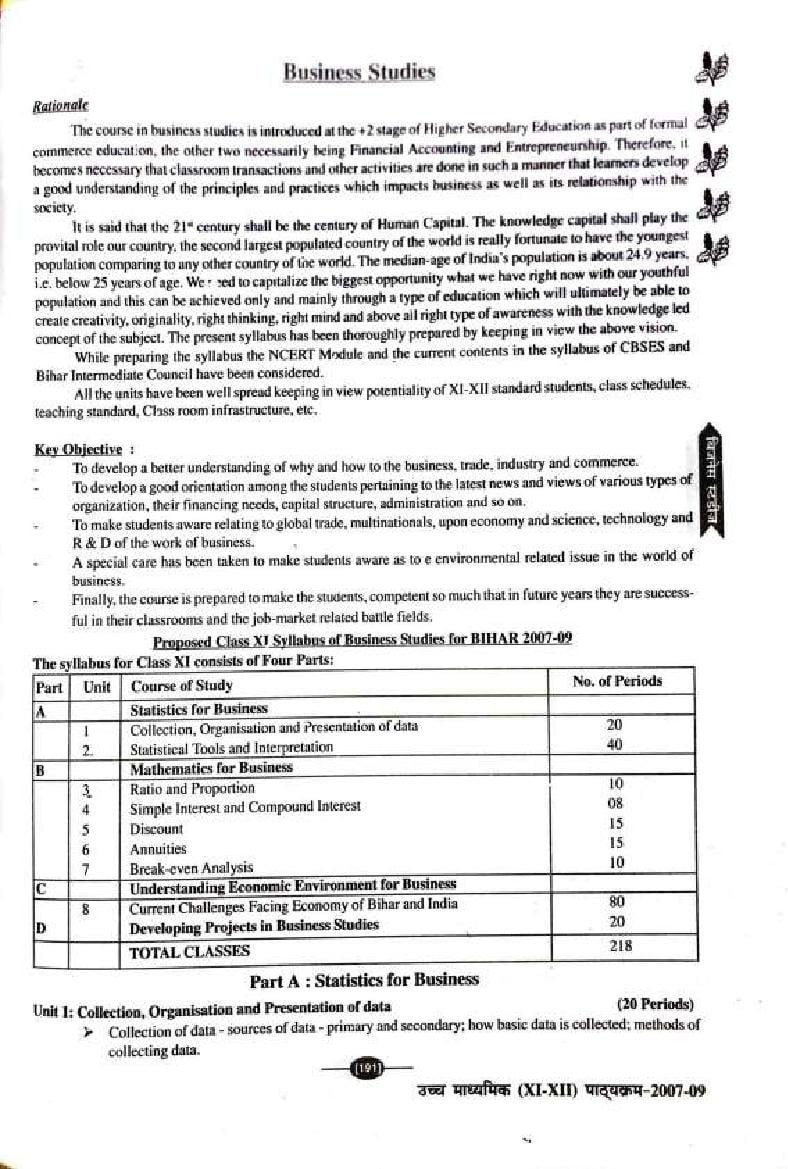
Proposed Class XJ Syllabus of Business Studies for BIHAR 2007-09
The syllabus for Class XI consists of Four Parts:
Part Unit Course of Study No. of Periods
A Statistics for Business
l Collection, Organisation and Presentation of data 20
2. Statistical Tools and Interpretation 40
B Mathematics for Business
Ratio and Proportion IO
l
4 Simple Interest and Compound Interest 08
5 Discount 15
Annuities 15.
6
7 Break-even Analysis IO
C Understanding Economic Environment for Business
Current Challenges Facing Economy of Bihar and India 80
8
D Developing Projects in Business Studies 20
TOTAL CLASSES 218
Part A : Statistics for Business
Unit 1: Collection, Organisation and Presentation of data (20 Periods)
► Collection of data - sources of data - primary and secondary; how basic data is collected; methods of
collecting data.
--- ~ q1t.4Mcfi (XI-XII) qicl<.lcJiq-2007.09
Page 2
Organi1;ation of Dai.a: M~nin g and typo o f ,anabk s. f·~uen cy
►
,agmm m.-.oc Prc.i~n ,nuon or O;H.J.
► Presem at,on of Data: Tabular Prt-~nta1,a n ond D
( i) Geome tric forms ( bard,a grarm and p ,c diagrams.).
(ii) Freque ncy diagra ms (hi~tog ram, pol}go n and ogive) and
(iii) Arithm etic line graphs (lime serie1 graph).
(40 Periocfs )
Unit 2: Statist ical Tools and Interpretation
ond mode
► Measu re.s of Centra l Tenden cy- mean (simple and weighaed). median
e deviati on, meon deviari on and standard
► Measu res of Disper sion - absolu1e dispers ion (range. quartil
co-effi cient of mean deviation. co-
deviati on); relative dis persion (co-eff icient of quartil e-devia tion.
efficie nt of variatio n);
r show, measur e or indicate:
Introdu ction lo Index Numbe rs - meanin g; What does an Index numbe
►
consum er price inde,t and indcll
How you can constru ct index numbe r: types - wholes ale price index,
numbe rs.
of industr ial produc tion. uses of index numbe rs; Inflation and index
ss interpr etation may be attempted.
Note: For ·an the numeri cal proble ms and solutio ns. the approp riate busine
interpr etation for the results derived
This means, the studen ts need to solve the problem s and provid e
·
Note to the textbook writers :
The learner s should not have any prob-
(i) Examp les will have to be provid ed from si mple busines s data.
Beside s arrivin g at results using
lem in unders tanding the busines s data provide d in those examp les.
to interpr et the results. So care must
formul ae of various statisti cal tools, the learners are also expect ed
s can unders tand withou t know-
be taken to provid e very simple busines s inform ation. which the learner
ing the concep tual meanin g in depth
ation for learner s to develo p under-
(ii) There should be many questio ns based on the schema of the examin
standin g and provid e opportu nities for practice.
Part B: Mathematics for Business
(10 Periods)
Unit 3: Ratio and Proportion
► Meani ng a nd compo sition of ratios
► Meani ng of propor tion; continu ed proport ion ; mean propor tion
► Proper ties of ratio & propor tion
o lnverte ndo
o Altern endo
o Compo nendo
o Divide ndo
o Conva tendo
(08 Periods)
Unit 4: Simple Interest and Compound Interest
► Proble m solving based on simple and compo und interes t
(15 Periods)
Unit S: Discount
► True Discou nt
► Banke r's Discou nt
► Discou nted Value
,~ ► Presen t Value
.~ ► Cash Discou nt
•-~ ► Bill of exchan ge
(15 Periods)
~ Unit 6: Annuities
► Meani qg
► Formu lae for presen t value and amoun t
► Deferred Annuit y
► Applie d proble ms on loans
► Sinkin g Funds
► Schola rships
(10 Periods)
----
Unit 7: Break-even Analysis
~ lflb.4f'icfi (XI-XII) Qlq_4'1i+l-2007-09
Page 3
Unit 8: Current Challenges Facing Economy of Blhar and India (8& Ptriods) ~
► Agriculture (Production, Productivity, marketing, storage) M
·,..
?'; , Industry (agro-based, industrial licensing, recent initia tives in industrial sector wi1h
ward areas and small enterprises, etc)
respect to b.ack- ~
~
I~
► Foreign trade and role of Business fraternity.
~ ·•· Liberalisation, globalisation and privatization
► Poverty- absolute and relative; Meaning of poverty line; vicio~s ~ire le of ~verty; causes of poverty : I~
,· ·
Government and non-government measures on poverty allev1auons: Mam programmes for poverty ~
alleviation: A critical assessment;
► Rural development: Key issues - credit and marketing - role of cooperatives and self help groups:
agricultural diversification; alternative farming - organic farming _ _ .
► Buman Capital Pormation: How people become resource: Role of human capital m economic devel-
opment; Growth of Education Sector in India
► Employment: Growth, informalisation and other issues; Problems and policies
► Infrastructure: Meaning-and Types; Case Studies: Energy and Health- Problems and Policies-A criti-
cal assessment;
► Capital formation in Bihar; capital requirements for economic growth.
► Environment: Sustainahlc economic development; limited availability of resources; environmental
degradation.
· Part D: Developin\! Projects in Business Studies (20 Periods)
-- Objective: The idea behind introducing this unit is
► to enable the students to develop the ways and means by which a project can be developed using the
skills learned in the course. This includes all the steps involved in designing a project starting from
choosing a title, exploring the information relating to the title, collection of primary and secondary
data, analysing the data, presentation of the project and using various statistical and mathematical
tools and their interpretation and conclusion.
► To develop vision for becoming partner in development of your area.
The students shall be encouraged to develop
► Projects, which have both primary data, secondary data.
► Case studies of a few organisations/ outlets.
Some sugf!estive examples of projects and case studies are:
(i) ·. larket survey
(ii) Employment potential survey
(iii) Understand the dynamics of poverty
(iv) Consumer awareness amongst households
(v) Changing prices of some vegetables in your market
(vi) Study of a cooperative institution: milk cooperatives
(vii) Study of Self Help Group of your village/Panchayat/town.
Note to teachers/learners: Since almost all subjects have project work, there should not selection of
· same topic for different subject, that is the leame~ has to select different subject for different subject.
Examination System for Class XI
Two Internal Examination at interval of six months having different syllabus from the proposed syllabus of
class XI. Each examination shall be of 100 marks and have following three components:
► Project work- 30% weightage ► Viva- 20% weightage
► Written Examination- 50% weightage.
• The written examination shall consist of four types of questions
• Part- I: Fill in the blanks or one line answers- 15% weightage
• Part- II: Short answer type to be written in 100-150 words- 20% weightage
• Part- III: Medium answer type to be written in 250-300 words- 30% weightage
• Part- IV: Long answer type to be writt_en in 600-700 words- 35% weightage.
•
Wherever relevant the answer must contain examples and specific references from b usmess
---
•
· d I d'
environment of B1har an n 1a.
~ l1iWf'lcfi (XI-XII) 4i&_ilwiq-2007-09
Page 4
Proposed OIL~ .XII Syllabw or fu~foe;,s :,ty~• ~
The syllabuc, ror Cla.~s XI J comtm· ort ~o Pa m·
Part Unit Course or Study
No. of -
Periods
A Foundations or Businl'S!i ltO -
I Nature and purpme of bll5ineu 20
2. Fonns of Business Organization 28
3 Private. Public and Global Enterprises 16
4 Business Services 18
5 Emerging Modes of Business 14
6 Social Responsibility of Business and Business Ethics 14
B Corporate Organisation, Finance and Trade 88
7 Formation of a Company 16
8 Sources of Business Finance , 08
9 Small Business 20
10 Internal Trade 20
11 International Business 24
C Developing Projects in Business Studies 20
Total Periods 218
tPartA : Foundations of Business (Total Periods=ll0)
~ Unit-I : Nature and purpose of business: (20 Periods)
Ii, ► Concept and characteristics of business
► Business, profession and employment - distinctive features;
► Objectives of business - economic, social, role of profit in Business;
.. .
► Class1ficat1on of busmess acttv1t1es. Industry and Com me rce
► Industry: types- primary, secondary, tertiary
► Commerce: Trade and Auxiliaries;
► Business Risks - Nature and Causes;
Unit- II Forms of Business Organization: (28 Periods)
► Sole proprietorship- meaning, features, merits and limitations;
► Joint Hindu Family Business- meaning, features, merits and limitations;
► Partnerships- meaning, types, partnership deed, registration, merits, limitations, types of part-
ners;
► Co-operative Societies - types, features, merits and limitations;
► Company- Private Ltd. & Public Ltd.: meaning, features , merits and limitations;
► Choice of f01m of business organisation
►
\
Starting a business- Basic factors
Unit- III Private, Public and Global Enterprises: (16 Periods)
► Private Sector and Public Sector;
► Forms of Organising Public Sector Enterprises:
• Departmental Undertaking
-~ •
•
Statutory Corporation
Government Company
~ ►
► Changing role Qf Public Sector
Global Enterprises (Multinational Companies): me·a ning, features, merits and limitations; In-
~
dian Global Enterprises (Multinational Companies)
► Joint Ventures: meaning, features, merits and limitations.
~Unit-IV Business Services: (18 Periods)
► Nature and types.o f Business Services: Banking, Insurance, Transportation, War'!housing, Tele-
communication;
► Banking: Type of Banks, Functions of Commercial J3anks, E-banking;
►
----
Insurance: principles, types- life, fire and marine;
' ~ lfl't4f'1cfi (XI-XII) Ql<l~iii'l-2007-09
Page 5
► Postal and Tele.com ser\'ice~: I~
► Warehouiiing: types and funct ion.s. <!IF
]Jnit-Y Emerging Modes of BU.Mnas: ( (4 Pniods} M
► E-B_usin~s: mcaning •.fcatu~. benefit, a~ limi101ions: Resoor~ required _ ror sm::c.cs,;ful e- ¢IF'.
busmess 1mplcmentat1on; On-line tran~110ns- paymen1 mechanism. sccun l y and safocy of
business transactions I~
► Ouisourcing: concept, need. scope and limitations. ~
Unit-YI Social Responsibil ity or Buslna11 and 8115iness Ethks: ( 14 Periods) I~
tJ1,fJ'
► Concept of Social Responsibility;
► Case for social responsibility;
► Responsibility towards different interest groups: owners, investors. employees. consumers.
govemmenl, community and public in general;
► Business and environmental protection;
► Business ethics: concept and elements
: Business Organisation, Finance and Trade (Total Periods=:88)
PartB
(16 Periods)
Unit-VII : Formation of a Company
► Stages in the fonnation of a company
• Promotion • Incorporation, and • Commencem ent of Business
Unit-VIII : Sources of Business Finance (08 Periods)
► Nature and significance
► Financial requirements and sources: owner's funds and borrowed funds
Unit-IX : Small Business (20 Periods)
► Small scale industry, Tiny Sector and Cottage Industry;
► Rural Industry;
► Role of small business in rural Bihar and rural India;
► Problems of small business in rural Bihar and rural India;
► Governmen t Assistance and special schemes for industries in rural and backward areas;
► How a small business is established.
Unit-X : Internal Trade (20 Periods)
► Meaning of Internal Trade
► Types of Internal Trade: wholesale and retail;
► Services of a wholesaler and a retailer
► Types of Retail Trade:
• Itinerant retailers and fixed shops
• Department al Store, Super market, malls, Chain store. 111 .1i I , irder business,
• Consumer's Cooperative Stores ~
• Automatic vending machine
• Network Marketing
► Role of chamber of Commerce and Industries in the promotion of Internal Trade.
► Role of Self Help Groups in promotion of internal trade.
Unit XI International Business (24 Periods)
► Nature, Importance , Scope and complexities involved in International Business;
► Basic information about ways of entering into International Business with special reference to
Bihar;
► 1ypes of International Business:
• Contract manufacturing;
• Licensing;
• Franchising ;
• Joint Ventures;
• Setting up Wholly Owned Subsidies;
► Export - Import procedures and Documentation;
► Foreign Trade Promotion:
• Organizatio nal support
■ Incentives
~ 1'f&tf.:tcfi (XI-XII) 414_4fJiq-2007-09
Page 6
• Spec ial &onomn:: lofw:s- Natun· & lmporta.n.:e.
► International T'mdc lns1iiu1ions and ;\ grttments·
• World Trade Organi~1ion
• UNCTAD
• Bila1eral Agreements
► Ned for environmental management vis-d-vis development. popuhuion. Environment an~ Bus.ille5&. Na.tu,.
ral Disasters (earthquakes, droughts. noods, cyclones, land~lidc:s). man-made technological and indus11i;lJ
and their impact on bus iness and its growth.
Part C: Developing Projects In Business Studies <-iO Pe.rk)ds)
Objective: The idea behind introducing this unit is
► to strengthen the learners to develop the ways and means by which a project can be developed using
the skills learned in the course. This includes all the steps involved in designing a project starting from
choosing a title. exploring the information relating to the title, collection of primary and secondary
data, analysing the data, presentation of the project and using various statistical and mathematical
tools and their interpretation and conclusion.
► Developing project in such a way which facilitates learners to develop idea towards business.
► To develop vision for becoming partner in development of your area.
The students shall be encouraged to develop
► Projects. which have both primary data, secondary data.
► Case studies of a few organisations/ outlets.
► Marketsurvey
Some suggestive examples of projects and case studies are:
(i) Market survey
(ii) Employment potential survey
(iii) Status of internal trade in your area
(iv) Consumer awareness amongst households
(v) Potential of International Business in local market
(vi) Retail Business
(vii) Study of Self Help Group of your village/Panchayat/town in promotion of business.
Note to teachersnearners: Since almost all subjects have project work, there should not selection of
same topic for different subject, that is the learner has to select different subject for different subject.
Examination System for Class XII
There shall be two sets of examination in class XII-
I. Three Internal Examination
2. One External Examination
1. Internal Examination:
Three Internal Examination at interval of three months having different syllabus from the
proposed syllabus of class XII. Each examination shall be of 100 marks and have following
three components:
► Project work- 30% weightage
► Viva- 20% weightage
► Written Examination- 50% weightage.
• The written examination shall consist offour types of questions
• Part- I: Fill in the blanks or one line answers- 15% weightage
• Part- II: Short answer type to be written in 100-150 words- 20% weightage
• Part- III: Medium answer type to be written in 250-300 words- 30% weightag,
• Part- IV: Long answer type to be written in 600-700 words- 35% weightage.
o Wherever relevant the answer must contain examples and specific references from
economy of Bihar and India.
2. External Examination:
This is to be conducted by Bihar School Examination Board.
~ lfi&lfitc:6 (XI-XII) Qlq_<.lc;fiq-2007-09
Document Details
| Board / Org | Bihar Board |
| Exam | Class 12 |
| Type | Syllabus |
| Pages | 6 |
| Updated | 24 Sep 2026 |