Bihar Board Class 11th 12th Syllabus Entrepreneurship
Finished viewing? Save it for later —
Download Bihar Board Class 11th 12th Syllabus Entrepreneurship (PDF · 7 pages)About Bihar Board Class 11th 12th Syllabus Entrepreneurship
Bihar Board Class 11th 12th Syllabus Entrepreneurship is available here for free download. Published by Bihar Board for Class 12, this syllabus can be viewed online or downloaded as a PDF (7 pages). Candidates preparing for Class 12 can use Bihar Board Class 11th 12th Syllabus Entrepreneurship to understand the exam pattern, the type of questions asked, and the overall difficulty level.
Frequently Asked Questions
How can I download Bihar Board Class 11th 12th Syllabus Entrepreneurship?
Open this page and click the Download button to save Bihar Board Class 11th 12th Syllabus Entrepreneurship as a PDF. It is completely free on AglaSem Docs.
Is Bihar Board Class 11th 12th Syllabus Entrepreneurship free to download?
Yes. Bihar Board Class 11th 12th Syllabus Entrepreneurship can be viewed online and downloaded as a PDF free of cost on AglaSem Docs.
How many pages does Bihar Board Class 11th 12th Syllabus Entrepreneurship have?
Bihar Board Class 11th 12th Syllabus Entrepreneurship contains 7 pages, which you can read online or download together as a single PDF.
Where can I find more Class 12 study material?
You can find more Class 12 question papers, sample papers, syllabus, and answer keys on AglaSem Docs.
Bihar Board Class 11th 12th Syllabus Entrepreneurship – Text
Read the full text of this syllabus below — useful to quickly search, copy and reference the content online without downloading the PDF.
📄 View text version (7 pages)
Page 1
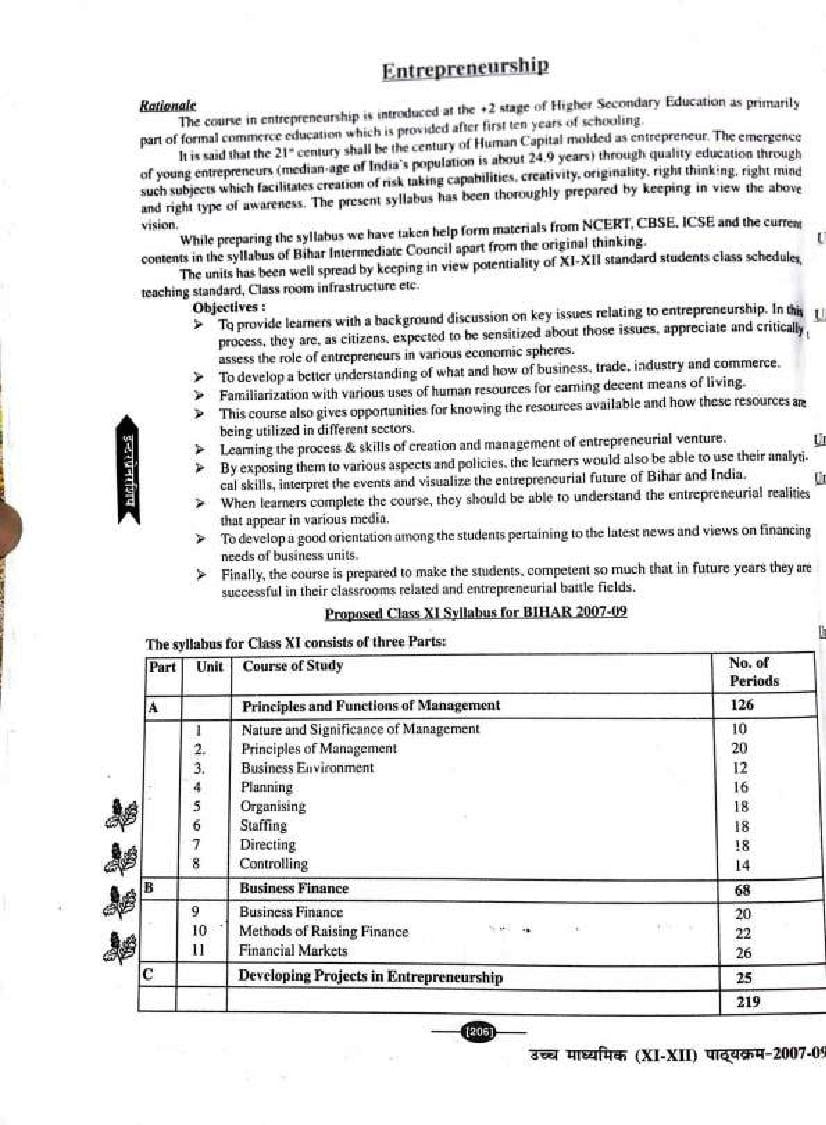
Rationale.
The ooun,c in cn1rcprcncurship is introduced at the -t·2 !.t:tgc o f Higher S:ec~ndury Education as primarily
pa.rt of fonnal oommcroc cducauon which i., pn'.)" idcd after first ten ) c~r.; of schooling.
It is said that ihc 21 • century shall be 1hc century of Human Cnpual molded ns cn1rcpreneur. The emergence
of young entrepreneurs (median-age o f India's population is n~ul 24.~ yetJrs) throu~h q~Jlily ~du~u1ion through
such subjects whi ch facilitates crealion of risk taking capnblliucs. tren 11v1ty. ooginaltty. ng~t th!nk!~g. right mind
and right type of awareness. The presen1 syllabus hns been thoroughly pr~pared by keeping in view the nbovc
vision. While preparing the syllabus we have taken help form materinls from
NCERT, C BSE. lCSE and the current
contents in the syllabus of Bihar Intermediate Cooncil apart from the original thinking. l}
The units has been well spread by keeping in view potentiality of XI-XII standard students class schedule3,
teaching standard, Class room infrastructure etc.
► TQ provide
Objectives : learners with a background discussion on key issues relating to entrepreneursh ip. In this !L
process. they are, as citizens. expected to be sensitized about those issues. appreciate and critically 1
assess the role of entrepreneurs in various economic spheres.
► To develop a better understanding of what and how of business. trade. i:1dustry and commerce.
► Familiarization with various uses of human resources for earning decent means of living.
► This course also gives opportunities for knowing the resources available and how these resources are
being utilized in different sectors.
► Leaming _the process & skills of creation and management of entrepreneurial venture. Jl!
► By exposmg them to various aspects and policies. the learners would also be able to use their analyti-
cal skills, interpret the events and visualize the entrepreneurial future of Bihar and India. !le
► When learners complete the course, they should be able to understand the entrepreneuria l realities
that appear in various media.
► To develop a good orientation among the students pertaining to the latest news and views on financing
needs of business units.
► Finally, the_ cour~e is prepared to make the students, competent so much that in future years they are
successful m thetr classrooms related and entrepreneurial battle fields.
Proposed Class XI Syllabus for BIHAR 2007-09
The syllabus for Class XI consists of three Parts:
lli
Part Unit Course of Study No. of
Periods
A Principles and Functions of Management 126
1 Nature and Significance of M anagement 10
2. Principles of Management 20
..
3. Business E11vironment 12
4 Planning 16
5 Organising 18
6 Staffing 18
7 Directing 18
8 Controlling 14
B Business Finance 68
9 Business Finance 20
10 Methods of Raising Finance ... ·•
22
11 Financial Markets 26
C Developing Projects in Entrepreneur ship 25
219
~ q1wf'4cfi (XI-XII) Qiq__Ciij-iq-2007-09
Page 2
\
l.
_part A Principles and Functions or Managemen t (Total Periods= l19) JI)
'\. ( 10 Periods)
W-tl1=1 Naturt' and Signtncana of ManagetMTII
<
. ~ ..
► Management :
• Co ncept
~
~
.,,
• Objective~
' . • Importance
'\!,~
► Nature of Management. Managemcnl as Science. An, Profession:
I~
·1
►
► Levels of Management: top, supervisory
Management functions: Planning. organizing. staffing. directing and controlling
~
► Coordination: Nature and importance
(20 Periods)
.L!.ni1=..l1 Principles or Management:
► Meaning, Nature & significance of Management
► Fayol's Principles of Management
'
► Taylor's Scientific Management: Principles and techniques
(12 Periods)
Unit - III Business Environment:
► Business Environment: meaning and importance;
► Dimensions of Business Environment: Political. Economic. Social, Technological and
· Legal;
Economic Environment in India; Impact of Government policy changes on business and
►
industry with a special reference to adoption of the policies of liberalization, privatization
and globalisation.
Unit -IV Planning: (16 Periods)
► Meaning, features, importance and limitations;
Unit- V Organising: (18 Periods)
► Meaning and importance;
► Steps in the process of organizing;
► Structure of organisation: Functional and Divisional
► Formal and informal organisation
► Delegation: meaning, elements and importance
► Decentralisatio n: meaning and importance
► Difference between delegation and decentralisation
Unit- VI Staffing: (18 Periods)
► Meaning, need and importance of staffing;
► Staffing as a part of Human Resource Management;
► Steps in staffing process;
► Recruitment : Meaning and sources;
► Selection: meaning and process;
► Training and Development:
• Meaning,
• Need,
• Methods- on the job and off the job methods of training.
l!.nit- VII Directing: (18 Periods)
► Meaning, importance and principles;
► Elements of Direction:
• Supervision- meaning and importance;
• Motivation- meaning and importance, Maslow's hierarchy of needs; financial and non-
financial incentives;
• Leadership- meaning, importance; qualities of a good leader;
■ Communicatio n- meaning and importance; types of communicatio n; formal and infor-
mal communicatio n; barriers to effective communicatio n.
~ lUWf'icfi (XI-XII) Ql&_'-Rf,q-2007-09
Page 3
► Muning and 1 ~
► Rcla1ion~hip bc1wcen planning and cootroU ing.
► Steps in the ~ of control:
► Tcchn iq~ of coouollio~
Part B Busines.t1 Finance: (Total Periods= 68)
Unit-I X BustneM Flnana (lO Pt_rfods )
► Bu~ines, Finance: meaning, role, objectives of financial manage ment:
► Financial plannin g: meaning and importance:
► Capital structur e of a firm - meaning and factors ; . . .
► Fixed and working capital - meaning and factors affectmg their requirem ents.
JJnft-X : Method s of Raising Finance:
<22 Periods)
► Equity shares
► Preference shares
► Debentu res
► Bonds
► Retained Profits
► Public Deposits
► Loan from Commercial Banks
► Loan from Financial Institutions
► Global Depository Receipt
► Trade Credit
► Discounting of Bills of Exchange
• Unit-X I Financ ial Market s (26 Periods)
► Concep t of Financial Market
► Money Market: Nature, instruments, significance
► Capital Market:
• Nature and
• Type- Primary market and secondary market;
► Demat
► Stock Exchange
• Meaning
• Function
• Types- National Stock Exchange of India, Bombay Stock Exchan ge, Magadh
Stock
Exchange; their listing and trading procedures
► Objective and Functions of Market Regulatory Board: Securit ies and Exchan ge
Board oflndia
(SEBI).
Note: For all the solutions, the appropriate entrepreneurial interpretation may be attempt
ed. This means, the stu-
dents need to see the syllabus, the problems and provide interpretation for the
results derived from a busi-
l.~ ness person perspective to the extent possible.
~ Note to the textbook writers :
(i) Examples will have to be provided from real life business situations. The
learners should not have any
I~ problem in understanding the entrepreneurial concepts provide d in those exampl
es. Besides arriving at
<!lJfP conclusion of various situations, the learners are also expected to interpre t the
results. So care must be
taken to provide very simple business information, which the learners can underst
and without knowing
the conceptual meaning in depth.
(ii) There should be many questions based on the schema of the examin ation
for learners to develop under-
standin g and provide opportu nities for practice.
(iii) Since this course is expecte d to create opportunities for learners to kno'.J/
about v_arious aspects of the
entrepreneurial activity of Bihar and India, there is a need to provide informa
tion in an interesting
---
manner. Differe nt forms of diagram s and charts, pictures and maps could be
used for this. Since the
~ q19.1f114, (XI-XI I) Qlq_4cJiq-2007-09
Page 4
plained in a simple manner. Scn~11mng the lc.amcf toW'3Jth. v-,mou.s ,u~ alm forml ~ ~ of this ~
course; many real c,rnmplc<1 in slm4llc way~ coutd be ll\Cd. ~
Part C : Developing Projects in Entrcpreneun bJp (ZS Pmods) ~
Objective: The idea behind in1roducing this unit is U
► to enable the students to develop the ways and means by which a proj(ct can be de.velopcd U$ihg the dJff'
skills ~came~ in the co~rse . Th!s inclu~ aJI ~ steps inv~lved in des!gning a _p rojec t stia~ing from . I .:~
choosing a title, ellplonng the mfonnat1on relallng to the title , cotlect1on of pnmu y Ind secon<bry ~
infonnation. analysing the infonnation, presentation of the project ano using various tools and thei r
interpretation and conclusion.
► Introduction of learners to the world of business through facilitation of development of core e ntrepre-
neurial skills.
► To develop vision for becoming partner in development of your area.
The students shall be encouraged to develop :
► Projects, which have both primary and secondary source of infonnation on the entrepreneur and
her/his venture.
► Case studies of a few organisations/ outlets. Some indicative types may be:
o Study of a successful entrepreneur
o Study of a successful business unit and how the success can be replicated
o Study of competition in business.
o Study of mobilization of Financial Resources/ human resources
o Study of Marketing strategy of the unit.
o Study of a loss making unit to find out the reason of loss and suggestion for correction.
Note to teachers/learners: Since almost all subjects havP- project work, there should not selection of
same topic for different subject, that is the learner has to select different subject for different subject.
Some suggestive examples of projects and case studies are:
(i) A report on Market structure of your neighborhood;
(ii) Consumer awareness amongst households
(iii) Retail business activity in local market
(iv) Study of a cooperative institution: milk cooperatives
(v) Study of Self Help Group of your village/Panchayat/town.
Examination System for Class XI
Two Internal Exami~ati~n at interval of six months having different syllabus from the proposed syllabus of
class XI. Each exammat10n shall be of lOO marks and have following three components:
► Project work- 30% weightage
► Viva- 20% weightage
► Written Examination- 50% weightage.
• The written examination shall consist of four types of questions
• Part- I: Fill in the blanks or one line answers- 15% weightage
• Part- II: Short answer type to be written in 100-150 words- 20%
weightage
• Part- III: Medium answer type to be written in 250-300 words- 30%
weightage
• Part- IV: Long answer type to be written in 600-700 words- 35%
weightage.
■
Wherever relevant the answer must contain examples and specific references
from economy of Bihar and India.
--- ~ q1EQf'lcfi (XI-XII) Gi&_ci<h'l-2007-09
Page 5
Th e syIIabus ~ or 0 a!ss XII com:ist, or rour Part,·
Part Unit Course of Study No.or
Periods
A Marketing end Ad,crtlslng ss
I Marketing and Advertising 35
2 Patents, Trademarks & Copyright 20
B Consumer Protection 25
3 Consumer Protection 25
C Entreprenrurship Devrlopment 120
4 Creation of a Business unit 10
5 Entrepreneurship Development 15
6 Enterprise Management 15
7 Entrepreneurship & Human Activities 20
8 Acquiring entrepreneurial values and motivation 20 {
9 Entrepreneurial Opportunities & Enterprise Creation 20
10 Enterprise Planning & Resourcing 20
D Developing Projects in Entrepreneurship 20
~ Part A
~
TOTAL 220
r : Marketing and Advertising : (Total Periods= 55)
~: Unit- I : Marketing and Advertising: (35 Periods)
~ ► Marketing: meaning, functions, role;
► Distinction between marketing and selling;
► Concept and Elements Marketing Mix:
• Product - Nature, Classification, Branding, Labeling and Packaging;
• Physical distribution - meaning, role;
• Channels of distribution - meaning, types, factors determining choice of channels;
• Sales Promotion- meaning and role; promotion mix;
• Price - factors influencing pricing
• Advertising: significance, how to conduct advertising for small business
• Personal selling;
Unit-II Patents, Trademarks & Copyright: (20 Periods)
► Patents: meaning and impo11ance;
► Trademarks: meaning and importance;
► Copyright: meaning and importance;
► Significance of patents, trademarks and copyright for small business.
► Understanding Patents, Trademarks & Copyright in light of traditional practices.
PartB
~ Unit-III
: Consumer Protection :
Consumer Protection:
(Total Periods= 25)
(~5 Periods)
l
► Importance of Consumer protection:
► Consumer rights;
~ ►
► Consumer responsibilities;
Ways and means of consumer protection: Consumer awareness and legal redressal with special
~
reference to consumer protection Act,
► Right to Information_Act;
► Role of consumer organizations and NGOs.
~PartC : Entrepreneurship Development :
Unit-IV : Creation of a Business unit
(Total Periods= 120)
(10 Periods)
► Stages in the creation of a Business unit: Company, etc.
---
• Promotion • Incorporation. and • Commencement of Business
~ irr~f'fcfi (XI-XII) q14_4c;1,q-2007-09
Page 6
;. Concept. Funchoos. aod Nc-cd ; t l5 Pcriud,s) • -~
► Bntrc:prencun\hip (.nomc.1cnJlrcs and C<>mp.::1cnc1C<S . ~
► Proce..c.~o f Enl n::1,rcnc urs.hlp rk H". fopmcnt; _, .~
JJnfC.- YJ : Enterprise Management ~
► Office Manngerncn1: Filing. lndeidng. Office cquipmenis .
15
( Ptri0<.I.,)
► Ergono m ics- Mea ning and Importance. ~
► Organi~ing/ productio n o f goods & sen:iccs- Quality. q ua n1i1y & now of Inputs ·
► Manag ing growth & s us tenance- 11 ffectmg change modern isation ex pansion d" •r: I.EE\
and substitution . · · · · i,ersi,,cation <.!1fJ'
► ~ntrepreneuri~I discipline: Co_m pany law- meaning and importance; labour law- meuning and
importance, Right IO Information Act.
Unft - VII Entrepreneurship & Human Activities: (20 Pe·riods)
► Concept ► Function ► Need,
► Characteristics ► competency
► Relevance of entrepreneurship to socio-economic gain -
o generating national wealth.
o creating wage & self employment,
o creating micro, small & medium enterprises,
o optimizing human & natural resources
► Nature, purpose & pattern of human activities- economic & non-economic: need for inno-
vation
► Rati u nale and relationship of entrepreneurial pursuits & human activities.
Unit - VIII Acquiring entrepreneurial values and motivation (20 Periods)
► Entrepreneurial Values- Meaning and concept;
► Entrepreneurial Attitudes- Meaning and concept: and
► Entrepreneurial Motivation - Meaning and concept: Achievement motivation
► Developing entrepreneurial motivation & competency
► Barriers to entrepreneurship
► Help & support to entrepreneurs.
► Strategy for entrepreneurship development.
Unit- IX Entrepreneurial Opportunities & Enterprise Creation (20 Periods)
► Sensing entrepreneurial opportunities
► Environment scanning
► Market Assessment
► Identification of entrepreneurial opportunities
► Selection of enterprise
► Steps in setting of an enterprise
Unit- X : Enterprise Planning & Resourcing (20 Periods)
► Business Planning- Preparation of a Project report
► Resource assessment- financial & non-financial
► Assessing Fixed & working capital requirements, funds, flows, profit ratios, break even analysis, etc.
► Mobilizing technologies for starting an enterprise
Note: For all the solutions, the appropriate entrepreneurial interpretation may be attempted. This means, the stu~
dents need to see the syllabus, the problems and provide interpretation for the results derived from a busi-
ness person perspective to the extent possible.
Note to the textbook writers :
(i) Examples will have to be provided from real life business situations. The learners should not have any
problem in understanding the entrepreneurial concepts provided in those examples. Besides arriving at
conclusion of various situations, the learners are also expected to interpret the results. So care must be
taken to provide very simple business information, which the learners can understand without knowing
the conceptual meaning in depth.
(ii) There should be many questions based on the schema of the examination for learners to develop under-
---
standing and provide opportunities for practice.
'·
~ q1&1~q:; (XI-XII) Ql<l40iq-2007-09
Page 7
the
... ) s·,nee this coun;e i.._., c~pcctcd 10 create opponuniliC'i forneed
(111 lcamcf'S 10 ·n .
l 10 a n intere st"•ng
LS 3
I nrnvrdc infonfl'alJOE
0 ,,. ~ · used r h ' S
entre prene urial activity of Bihar and India, there
· 1
es and map.s coul~ be . or ,s. · ince Lhe
manner. Diffe rent forms of di11grarn s and chart s. pictur
which arc used ,n this cours e, COUid be ex.
leamM s tudy thic1 couni c for the fi ~ t time. rhc concepts
ds vario us issues also forms a part o f lhis
plained in a simp le mann er. Sensi tizing the learne r towar
be used.
cours e; many real exam ples in simpl e ways could (lO Periods)
Part D : Developing Proj ects in Entr epre neur ship : .
.
Objec tive: The idea behin d introd ucing this unjt is a proJ~ t ~an be de~el oped ~sing the
s by which
► to enabl e the stude nts to devel op the ways and mean 1 gmng a proJe
_ ct st8 rtmg from
steps invol ved in des_
skills learn ed in the cours e. This includ es all the
ring the inform ation relati ng to the title, colle cuon _of pnr~a ry and secon da?
choos ing a tide, explo
n of the proje ct and usmg vano us tools and their
inform ation , analy sing the inform ation, prese ntatio
interp retati on and concl usion .
gh facilitation of devel opme nt of core entrepre-
► Introd uctio n of learn ers to the world of busin ess throu
neuri al skills .
nt of your area.
► To devel op visio n for becom ing partn er in devel opme
The stude nts shall be encou raged to develop
sourc e of inform ation on the entre prene ur and
► Proje cts, which have both prima ry and secon dary
her/h is ventu re.
indic ative types may be:
► Case studi es of a few organ isatio ns/ outlets. Some
o Study of a succe ssful entre prene ur
succe ss can be replic ated
J o Study of a succe ssful busin ess unit and how the
J o Study of comp etitio n in business.
huma n resou rces
o Study of mobi lizati on of Financial Resou rces/
o Study of Mark eting strate gy of the unit.
n of loss and sugge stion for corre ction .
o Study of a loss maki ng unit to find out the reaso
have proje ct work , there shoul d not selec tion of
Note to teach ers/le arner s : Since almo st all subje cts
has to selec t differ ent subje ct for differ ent subje ct
same topic for differ ent subje ct, that is the learn er
es are:
Som e sugg estiv e exam ples of projects and case studi
your neigh borho od;
(i) A repor t on Mark et struct ure of
(ii) Cons umer aware ness amon gst house holds
(iii) Retai l busin ess activi ty in local mark et
coope rative s
(iv) Unde rstan ding the coope rative institution: milk
your villag e/Pan chaya t/tow n.
L! (v) Prom otion of susta tinab le Self Help Grou p of
Exam inati on Syste m for Class XII
Ther e shall be two sets of exam inatio n in class XII-
I. Thre e Intern al Exam inatio n
2. One Exter nal Exam inatio n
1. Inter nal Exam inati on:
,.• hs havin g differ ent syllab us from the propo sed
Thre e Intern al Exam inatio n at interv al of three mont
of 100 mark s and have follow ing three comp o-
syJJa bus of class XII. Each exam inatio n shall be
!I
nents :
Proje ct work - 30% weigh tage
>, ►
►
►
Viva- 20% weigh tage
Writt en Exam inatio n- 50% weigh tage.
>, • The writte n exam inatio n shall consi st of four types
•
of quest ions
Part- I: Fill in the blank s or one line answ ers- 15%
weigh tage
50 word s- 20% weigh tage
Part- II: Short answ er type to be writte n in 100-1
t
>, •
•
•
Part- ill: Medi um answ er type to be writte n in 250-3
Part- IV: Long answ er type to be writte n in 600-7
00 word s- 30% weigh tage
00 word s- 35% weigh tage.
ples and speci fie refere nces from econo my
>, o Wher ever relev ant the answ er must conta in exam
of Biha r and India .
2. Exte rnal Exam inati on:
---
n Board .
This is to be cond ucted by Bihar Scho ol Exam inatio
~ ,ugqf.:icfi (XI-XII) Qlcl4i!Jiq 2007-09
Document Details
| Board / Org | Bihar Board |
| Exam | Class 12 |
| Type | Syllabus |
| Pages | 7 |
| Updated | 24 Sep 2026 |