Bihar Board Class 11th 12th Syllabus Economics
Finished viewing? Save it for later —
Download Bihar Board Class 11th 12th Syllabus Economics (PDF · 7 pages)About Bihar Board Class 11th 12th Syllabus Economics
Bihar Board Class 11th 12th Syllabus Economics is available here for free download. Published by Bihar Board for Class 12, this syllabus can be viewed online or downloaded as a PDF (7 pages). Candidates preparing for Class 12 can use Bihar Board Class 11th 12th Syllabus Economics to understand the exam pattern, the type of questions asked, and the overall difficulty level.
Frequently Asked Questions
How can I download Bihar Board Class 11th 12th Syllabus Economics?
Open this page and click the Download button to save Bihar Board Class 11th 12th Syllabus Economics as a PDF. It is completely free on AglaSem Docs.
Is Bihar Board Class 11th 12th Syllabus Economics free to download?
Yes. Bihar Board Class 11th 12th Syllabus Economics can be viewed online and downloaded as a PDF free of cost on AglaSem Docs.
How many pages does Bihar Board Class 11th 12th Syllabus Economics have?
Bihar Board Class 11th 12th Syllabus Economics contains 7 pages, which you can read online or download together as a single PDF.
Where can I find more Class 12 study material?
You can find more Class 12 question papers, sample papers, syllabus, and answer keys on AglaSem Docs.
Bihar Board Class 11th 12th Syllabus Economics – Text
Read the full text of this syllabus below — useful to quickly search, copy and reference the content online without downloading the PDF.
📄 View text version (7 pages)
Page 1
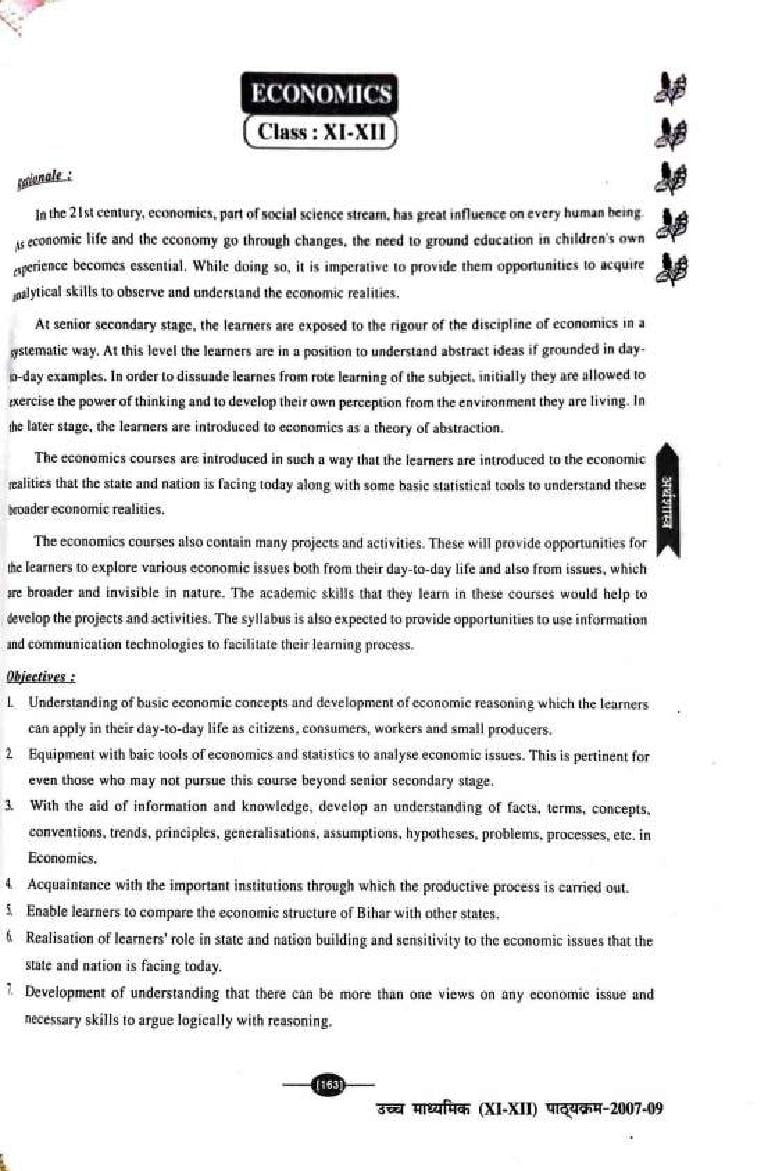
In the 21st century, economics, part of social science stream. has great influence on every hum~n being.
AS economic life and the economy go through changes, the need to ground education in children's own
experience becomes essential. While doing so, it is imperative 10 provide them opportunities 10 acquire
analytical skills to observe and understand the economic realities.
At senior secondary stage, the learners are exposed to the rigour of the discipline of economics in a
1ystematic way. At this level the learners are in a position to understand abstract ideas if grounded in day-
1()-day examples. In order to dissuade learnes from rote learning of the subject, initially they are allowed to
exercise the power of thinking and to develop their own perception from the environment they are living. In
the later stage, the learners are introduced to economics as a theory of abstraction.
The economics courses are introduced in such a way that the learners are introduced to the economic
realities that the state and nation is facing today along with some basic statistical tools to understand these
broader economic realities.
The economics courses also contain many projects and activities. These will provide opportunities for
the learners to explore various economic issues both from their day-to-day life and also from issues, which
are broader and invisible in nature. The academic skills that they learn in these courses would help to
develop the projects and activities. The syllabus is also expected to provide opportunities to use information
and communication technologies to facilitate their learning process.
Obiectives :
I. Understanding of basic economic concepts and development of economic reasoning which the learners
can apply in their day-to-day life as citizens, consumers, workers and small producers.
2 Equipment with baic tools of economics and statistics to analyse economic issues. This is pertinent for
even those who may not pursue this course beyond senior secondary stage.
3. With the aid of information and knowledge, develop an understanding of facts, terms, concepts,
conventions, trends, principles, generalisations, assumptions, hypotheses, problems, processes, etc. in
Economics.
4. Acquaintance with the important institutions through which the productive process is carried out.
5. Enable learners to compare the economic structure of Bihar with other states.
6. Realisation of learners' role in state and nation building and sensitivity to the economic issues that the
state and nation is facing today.
7. Development of understanding that there can be more than one views on any economic issue and
necessary skills to argue logically with reasoning.
--- ~ q1Wf'icfi (XI-XII) q1~44iq-2007-09
L
Page 2
No. or
J>art U nit C ourse or Scudy Period.s
A Statlstl u for Econom ics
05
I. Introduc tio n
25
2. Collec tion. Organisa tion ond Presentat ion of data
50
3. Statistic al Tools a nd Interpret ation
B Econom ic . Develop men t o r B'haar
• & India
18
4. Develop ment Policies and Experien ce (1947-90 )
14
5. Econom ic Reforms since J 991
Current Challeng es Facing Economy of Bihar and 60
6.
India
Developm ent Experien ce of Bihar ·= A comparis on 10
7.
with other states
Developm ent Experien ce of India : A comparis on 10
8.
with neighbo urs
20
C Develop ing Projects in Econom ics
Total periods required in Class-X I 212
'
PART-A : STATISTICS FOR ECONOMICS
Ohiective:
e
• The learners are expected to acquire skills in collection, organisation and presentation of quantitativ
and qualitative information pertaining to various simple economic aspects systematically.
draw
• Intends to provide some basic statistical tools to analyse, interpret any economic information and
appropriate inferences.
data.
• In this process, the learners are also expected to understand the behaviour of various economic
UNIT-I: Introduction (Periods: 05)
• What is Economics ?
of
• Basic understanding of economics and economic phenomenon especially in context of the concept
scarcity and allocation of resources.
• Definitions ofEconomics : Adam Smith, Alfred Marshall, Lionel Robbins, Samuelson.
• Meaning, Scope and importance of statistics in Economics:
UNIT-2: Collection, Organisation and Presentation of Data (Periods: 25)
of
• Collection of Data - Soruces of Data - Primary and secondary; how basic data is collected; methods
collecting data; Three important sources of secondary data. Census of India, National Sample Survey
Organisation and Directorate of Statistics & Evaluation, Bihar, Patna.
• Organisation of Data : Meaning and types of variables; Frequency Distribution.
I.~• Presentation of Data : Tabular Presentation and Diagrammatic Presentation of Data:
e:p (i) Geometric forms (bar diagams and pie diagrams),
(ii) Frequency diagrams (histogram, polygon and ogive) and
I.~ (iii) Arithmetic line graphs (time series graph). (Periods: 50)
e:p UNIT-3: Statistical Tools and Interpretation ,
I~•.· Measures of Central Tendency - mean (simple and weighted), median and mode.
, mean deviation and stan~ard
e:p Measures of Disperson - Absolute dispersion (range, quartile deviation
deviation), relative dispersion (co-efficient of quartile-deviation, co-efficient of mean deviat1on,
I.~ co-efficient of variation), Lorenz Curve: meaning and it8 application. 011
e:p • Introduction to Index Numbers - meaning; What does an Index number show, measure or indicate; H01
'.
I.~ you ca~ construe~ index num?er; types - wholesale price index, consumer price index and index
~ industrial production, uses of index numbers; Inflation and index numbers.
- - - - -TTx;r lJI l!4 f'4cfi (XI-XII) 'Q'tcl4?Pf~ 200709
•
I
Page 3
al pro blem!. and so1 Jlton~
attempted. Th is me ans , the , the aP i)fO f'l. llc «OM\m~<:
s tud en b ne ed to so he the ~n,,n•~ t.rn"3t'1 nt.l k l .d:!
~- prn blcm~ and pt'o...-i<J.c mf c:tl lff• 1
~ote to
(1)
the te xt ~k wr ite rs :
Ex am ples will hav e to be
pro ble m in un de rstand ing
p"Ovidcd fmfl1 ~,mplc eco no
the cconom,c daia pro \ idt d
mi c d:r1a l h-c lt.brn~,~ .,_h
.tttt·i-~ t or 11\c. rC:j,ur~
.,.tld nn l h.111c .ioy
tfJ:P
~
,~
usi ng for mu lae of variou!) in th° '~ eu mr lc"
ltt "tJc~ Mtr ., tn¥ ,ll n:<ut,.,
stal1Mical ,ool$c, 1hc \ca me,~
car e mu st be taken to pro vid are aJs oe, pcc1c:d to tr.i etp l rS
wi tho ut kn ow ing the con cep
e very !ilmple economic mf
o rmo110n. wh1c.h the.- k.itnc
r.el tht rcittl1• Sfl a- p
tual meaning in dep th . •~ un un du •t.m<l I ~
(ii) Th ere sho uld be ma
ny qu est ion !\ bas ed on the ~
schema or the ua mi na uo n
un der sta nd ing and provide for leamer:i 10 dev elop
oppo rtunit ie~ for practice.
PART-B ; ECONOM IC DE
VE LO PMENT OF BIHAR & INDI
~
Obiective; A
• To provide learners with a
background discussion on
In this pro ces s, they are, key iss ues rel ati ng to eco no
as cit ize ns , ex pe cte d to be my of Bi har and lnd iu .
critically assess the role of sen sit ize d ab ou t tho se iss
the ue s . appre cia te an d
• Th is co urs e also giv es op po rtugonitveies rnm en t in various economi
for kn ow ing the econo mi
c sphere s.
resources are be ing uti liz ed c res ou rce s avai lable and
in dif fer en t sec tors. ho w the se
• By exposing the ~ to quan~itativ~ dat~ on var
be abl e to use the ir an aly tic iou s economi c asp ect s and po
al ski lls , int erp ret the econo lic ies , the lea rne rs wo uld als
Bih ar and Ind ia. mic ev en ts and visualize the o
eco no mi c future of
• By com p~ rin g eco no mi
~ ?er for ma nc e of Bih ar / Ind
als~ pro vid es op po rtu ~1 tie ia wit
s for ·kn ow ing wh ere we sta h ou t nei gh bo uring sta tes / nat ion s. this co urs e
• This co urs e als o pro vid nd today - as a sta te / na tio
es n.
debate on va rio us eco no mithe sco pe for alt ern ati ve views and cre ate s op po rtu
c iss ue s and tre nd s. nit ies for the lea rne rs to
• ~h en_lea rne rs _c om ple
m various me dia . te the co urs e, they sho uld
be able to un der sta nd the eco
no mic rea lities tha t ap pe ar
UNIT-4: D~velopme_nt Po
lic ies an d Ex pe rienc e (19
, A bn ef mt rod uct 10 n of 47 -90 )
, Common go als of Fiv e the sta te of eco no my of Bi ha r and Indian on the ev (P eri od s: 18 )
Ye ar Pla ns. e of ind epe ndenc e.
, Main fea tur es, pro ble ms
an d po lic ies of :
* Ag ric ult ure (in sti tut ion
al asp ect s an d ne w agr icu
* Ind ust ry (ag ro- ba sed , ltu ral str ate gy etc .)
ind ust ria l'li cen sin g, etc .)
* Fo rei gn tra de . and
UNIT-5: Ec on om ic Re for
ms sin ce - 19 91
, Need & ma in fea tur ~s :
Lib erl isa tio n, glo bal isa tio (P eri od s: 14)
1 An appraisal of SE Z & LP n and Pri vat isa tio n .
G Po lic ies .
• Impact on Bi ha r.
UNIT-6: Cu rre nt Ch all en ge
s Fa cin g Ec on om y of Bi
• Poverty: Ab sol ute 2n d ha r an d Ind ia
rel ati ve ; Me an ing of po ve (P eri od s: 60 )
Government an d no n-g ov ry line; vic iou s cir cle of po
ern me nt me as ure s on po ver ty ; cau ses of po ver ty;
alleviation : A cri tic al ass ess ve rty all ev ait ion s; Ma in ·
me nt. pro gra mm es for po ve rty
• Rural de ve lop me nt : Ke
y iss ue s - credit an d ma
agricultural div ers ifi ca tio n; rke tin g - rol e of co -op era
alt ern ati ve far mi ng - org tiv es an d sel f he lp gro u~ s;
• Population gr ow th ov er an ic far mi ng .
th e ye ar s; Ce ns us of 20
occupational dis tri bu tio n; 01 ; age , sex co mp osi tio n;
the cu rre nt Na tio na l Po lic de nsi ty of po pu lat ion and
• Human Capital Fo rm ati y on Po pu lat ion .
on : Ho w peo ple be co me res
Growth of Ed uc ati on Se ctc ourc;e ; Role of hu ma n capita
r in Ind ia. l in economic de velopment;
1
Employment: Gr ow th inf
orm ali sat ion an d oth er iss
Infrastructure: Me an ing ue s; Pro ble ms an d po lic ies
& typ es; Ca se stu die s: En erg .
assessment · y an d He alt h- Pro ble ms an
d Po lic ies - A Cr itic al
The role of Pu bli c Di str ibu tio ·
n Sy ste m in pro vid ing foo
PDs. d sec uri ty in Bi ha r; A cri tic
---
al ex am ina tio n of the
.. ~ qcwfllcfi (XI-XII) Qlcl_c(c;ii
q 2007-09
Page 4
• Envlron111ntt ~ SU1J2inabfo econo mic de,do pmt:nr:
. ,
Capit al form. lion in Bih~t : C..pital n::quimncnH (Of ccona
,m, c
~=.ah ~i: bility of resources; envir0:
"nitQ~l
. •illt o[/U!( stalU (Pt!l'i:od;
dcg~ dat lon, ;s-: 10
CINU-7 : Pnd um, nt &Ru knct of BLhor : ,, .c ampq mJlJL!f 1
• Bihar and J>unja b
. menta l Indi ca to rs.
• Bihar and Maharashtta or.her develop . hb rn
l•sue s : Orow lh ~ •oral devel opme nt and 0 ( Pttrfud, . I
UNJT-8 ,· Dtr,,topm~n1 Exoe ri,ou oflndia ; A com11arison will,
neu: - " • OJ
• India and Pakis tah
• d " ators
• India and China . devel opme nla 1.'" ,c ·
Issue s : Grow th, sector al devel opme nt and other
rs: rs know about vario us aspec••
Note to the textb ook write
. rtunit ies for 1eaern e• 10·n an intere stin "'or
. h'
S tnce I 1s cours e 1s expec ted to create oppo
_e inform al•~" ~-ffer en forms !~~n ner. To the
the econo my of Bihar and India, there is a need to provid ln st ea .'
1
f h. fi iagram s and
exten t possi ble data is long tabula r fonn shoul d be avoid ed.
this cours e or t e irst time , t,"--
. '
charts , pictur es and maps could be used. .
Smee the Iearn ers study . .
e dmann er.
"'54!
Sensi f1z·1ng11ie
. . Id be plaine d m a simpl
. d
• ex
econo mic conce pts which are used m this cours e, cou · ental degra datio n an gen er concer ns also
Iearner towar ds variou. s issues such as pover ty, enviro nm
• · le weays could be used.
,.1orms a part ofth1•s cours e; many real exam p 1es m s1mp
NOM ICS
PA RT-C : D EVE LOP ING PR OJE CTS IN ECO
(Periods: 20)
Obiective ,· The idea behind introducing this unit is
by which a proje ct can be devel oped using the
• to enabl e the stude nts to devel op the ways and means
involv ed in desig ning a proje ct starting from
skills learne d in the cours e. This includes all the steps
the title, collec~io_n of prima ry and _se~ondary data,
choos ing a title, explo ring the inform ation relatin g to
variou s statis tical tools and their interpretation
analy sing the data, prese ntatio n of the project and using
and concl usion .
nt of your area.
• To devel op vision for becom ing partne r in devel opme
'I
I The stude nts shall be encou raged to develop -
I '·I) • Proje cts, which have both prima ry data, secon dary data.
• Case studie s of a few organ isatio s / outlet s.
s are :
Some sugge stive exam ples of proje cts and case studie
A repor t on demo graph ic struct ure of your neigh bourh ood;
(i)
(ii) Consu mer .i waren ess amon gst house holds .
(iii) Chan ging prices of some veget ables in your market.
(iv) Study of a co-np .!rativ e institu tion : milk co-op erativ es.
/ town.
(v) Study of Self Help Group of your villag e/ Panch ayat
subjec ts have projec t work, there shoul d not selection of same
Note to Teach ers/L earne rs: Since almos t all
select differ ent topic for differ ent subject.
topic for differ ent subje cts. That is the learne r has to
EXAMINATION SYS TEM FOR CLA SS-X I
g differ ent syllab us fro mt he proposed syllabus
Two Intern al Exam inatio n at interv al of six months havin
and have follow ing three comp onent s :
•-~ of class- XI. Each exam inatio n shall be of I 00 marks
~ • Proje ct work - 30% weigh tage
• Viva - 20% weigh tage
Written Exam inatio n 50% weigh tage
The writte n exam in_a tion shall consi st of four types of quest ions :-
lines answe r - 15 % weigh tage. ·
* Part- I : Fill in the blank s or one
0 words - 20% weigh tage.
* Part- II : Short _answe r type to be written in I 00-15 250-3 00 word s_ 30% weigh tage.
* Part- III : Medi um answe r type to be writte n in
words _ 35% weigh tage.
* Part- IV: Long answe r type to be written in 600- 700 and speci ic refere nces from econo my of Bihar ao
d
Wher ever releva nt the answe r must conta in exam ples
India.
+
------41D-
~ l:IIU4f.:;i41 (XI-XII) Qicl4&1'f-2007.-09
I
l l
Page 5
!Jfl1k'bus for Class-XI/ con.f ists ofl11rt:L Par!l._:
Part Unit No. of
Course of Study
P e rfod t
A Introductory Microeconomics
1. Introduction
05
'
2. Consumer Behaviour and Demand 25
3. Producer Behaviour & Supply 37
4. Forms of Market and Price Determination 20
5. Simple applications of Tools of demand and supply curves 12
B Introductory Macro-Economics
6. National Income and related aggregates 30
7. Determination of Income and Employment 25
8. Money and Banking 18
9. Government Budget and the Economy 17
10. International Projects in Economics 10
C Developing Projects in Economics 10
Total no. of Periods required 218
PART-A : INTRODUCTORY MICROECONOMICS
)biective :
--- This course introduces the learner to economcis as a Science of abstraction and re,soniong. It introduces
1
some basic concepts and tools to understand economic issues of an individual or a firm and how decision
are taken in variety of markets. It also intellds to provide exposure to the leafllers on how choices are
made and how a variety of tools are used to optimally allocate the resou_rces.
UNIT-I : Introduction (Periods: 10)
, What is microeconomics ?
, Central problems of an economy, production possibility curve and opportunity cost.
UN]To2: Consumer Behaviour a11d Demand (Periods: 25)
Consumer's Equilibrium - Meaning and attainment of equilibrium through Utility Approach : One and
1
two commodity cases;
mand determinants of demand, demand schedule, demand curve, movement along
, Deman d , market de ,
and shifts in demand curve. . . . .
. . . f demand measurement of price elast1c1ty of demand - percentage, total expenditure and
, Pnce e 1asttc1ty o '
oeometric method. .
t> B haviour & Supph (Periods: 37)
UNJT-3: Producer _e . Returns to Factor and Returns to Scale.
' pro duction function ·ply determinants of supply, supply schedule, supply curve movement along and
, Supply : Market sup ,
shifts in s~P?1Y ~urve, ly meas urement of price elasticity of supply - percentage and geometric method.
t Price elastJCJty O ~lr:or~ run costs- Total cost, Total variable cost, Total Fixed cost; Average Fixed cost,
Cost a nd Revenue · t nd Marginal cost-meaning and their relationship. Revenue-total, average and
Average van·able . cos a rtunity cost: d e f m1t1on,
' ·· · ·
apphcat1on. • _
marginal revenue, ?ppo Meaning and its conditions in terms of total cost and total revenue.
, Tbnum - . .
, Producers equi 1 d Price Determmatzon (Periods : 20)
NIT-4 · Forms 0 Market an · ·
f t compeuuon, Mono P Y, onopo 1st1c compeuuon - t e1r meaning and ",eatures.
ol M 1· · · · h · · ·
· k t - per ec
• Forms of Mar e --- ..................... ---- .
~ lUt4f'4cfi {XI-XIl) Qlcl<IQiq-2007-09
Page 6
f shi fts in den, and an.J
• pc11 1 on - >qui ~
• P n· ee dc1crmrna.a11o n und er pcr fec l com
~ . <P,r ,04
UNIT- s : Simp_ e applica tians ,:if Tool& oldf..oulJJJcho
ibil ity to
I <WJLJJ.1JWlrJ JJLU.J . ing. rloo
ose the ;~~u es : rn 11on
•
r nnd ceilings an::
I!
giv en the nc • rnat ive e xan,plc., r~ "• :t
• Th e tea che u can be teac her s arc cnc our ngcd ,o choose a lte
( FA D) Th eor y. The •::
a_vaila bility d ecline . •
s imp le anJ eas y to und e r~ta nd.
Mo re exa mple from day-10-da y
con tex r_co uld be
8•: en. M ore nurnc
No te to tex t boo k wri ter s :
ritaJ
en. Use of pic ture s, c harts a nd si mp le ta ble s is essential,
ved ) wil l hav e to be giv
exa mp les (sol S
PA RT-B : I NT RODUCTORY
MACRO-ECONOMIC
. . .
Obicctive ,· odu ced in this Cou
eco nom y and som e of its eco nom ic th e orrz atto ~ ar~ intr
• The ove rall wo rkin g of an th
t-re gul ate~ e funct_aon_mst g _o f ~conomic aspcctsllc
gov em ~e~
The lea rne rs will get bas ic ide a of how the ,ons. bud gctin or
ting of the pro duc tion act1 v1t1es, run nin g ~na nc, ~I '". 'tut g and
a cou ntr y thro ugh acc oun h oth er cou ntri es. The imp act ,tw ill hav e on citi iens _isa11 0
inte ract ion wit .
the acc oun ting of its eco nom ic
.
bne fly intr odu ced . (Periods: 301
Inc om e and rela ted agg rea tes
UNI T-6 •· Na tion al .
• Ma cro eco nom ics : Me ani ng NN P (at ma rke t pnc e and fac_tor cost), National
con cep ts of GDP, GN P, ND P, me.
• Cir cul ar flow of inc om e, e and Per son al D,_sposabte Inco
e Inc om e (gr oss and net ); Iriv ate Incom~. Per son al Inc om end itur e method .
Dis pos abl om e me tho d and Exp
om e : Value Ad ded me tho d, Inc
• Me asu rem ent of Nat ion al Inc (Periods :2S)
Qf[ nco me and Em plo yme nt
UNI T-7 : De term ination s.
e sup ply and the ir com pon ent
• Ag gre gat e dem and , Ag gre gat sav e (av era ge and ma rgi nal )
pro pen sity to
Pro spe nsi ty to con sum e and .
loy me nt and full em plo ym ent
• Me ani ng of Inv olu nta ry une mp o sec tor mo del .
em plo ym ent : Tw
De term ina tion of inc om e and
lier and its wo rkin g. and - availability
Co nce pt of inv es tme nt mu ltip : Me asu res to cor rec t exc ess and def icie nt dem
icie nt dem and
• Pro ble ms of exc ess and def
ent spe ndi ng.
of cre dit, cha nge in Go ver nm (Peri~ds: 18)
UN IT- 8: Mo ney an d Ba nki ng
and fun ctio ns .
• Mo ney - me ani ng, evo luti on effe cts of infl atio n on dif fer ent gro
ups of society ; measures
; dem and -pu ll ; cau ses ,
• Inf lati on : cos t-p ush
to con tro l infl atio n.
fun ctio ns.
• Cen tral Ban k - me ani ng' and
and fun ctio ns .
• Co mm erc ial ban ks - me ani ng vat isa tion and Modernisation .
ica nt ref orm s and issu es in Ind ian Ban kin g Sys tem : Pri (Periods : 17)
• Re cen t sig nif y
ent Bu dge t and the Eco nom
UN IT- 9: Go ver nm
ng and its com pon ent s.
• Go ver nm ent bud get - me ani
get.
• Ob jec tive s of gov ern me nt bud
enu e and cap ital ;
I
r. • Cla ssif ica tion of rec eip ts - rev
';
Tax es - typ es dev elo pm ent al and non·
I
•
itur e - rev enu e and cap ital , pla n and non -pl an &
Cla ssif ica tion of exp end
f
,,
I •
dev elo pm ent al. : me ani ng adn imp lica tion s.
I
B•• get , sur plu s bud get and def icit bud get me asu res to contain different
I_F Bal anc ed bud
icit and prim ary def icit : me ani ng and imp lica tion s;
~ Rev enu e def icit , fisc al def
I_FB def icit s.
ia. 4
(Periods: 1 )
~ • Lat est bud get of Bih ar and Ind
de
UN IT- JO : Int ern atio nal Tra
de tak es pla ce
I_FB • Wh y Int ern atio nal Tra
g and :om pon ent s
rnand
~ me nts acc ou~ ts - ~ea nin through de
• Ba la~ e of pay and dem erit s, De term ina tion
g (Fi xed and Flex1ble), me rits
I_FB• For eig n exc han ge rate - me anm
~ and sup ply.
exc han ge rate issu es.
.~ • A bri ef ana lys is abo ut rec ent
2001-09
- - - - -~ lllWf'ttcfi (XI-XII) 'Q'l<lli~
Page 7
ELOPI~UH.OJf.( TS t ;\ Et CJ'iOM tt'S
~ .. .
li}JJfJ
\
I
n,e idea behmd mtroducmg this unit i~ -
, ,' To enable the students to enhance the ways
and mcan J by which a proJect I c11se , 1ud} can
JI)
using the skills learned in the course. This inclu he dt~c lopcd
des all the steps invo lved in desig ning a p roJe.C
I~
fn;,m choosing a title, exploring the infonnation I stumng tJJf}'.
relating to the title, review of available hterncure.
of primary an_d_sccondary data , analy sis and prese colle<:Mn
nt:uion of data. their mterpretation and conclusio
To enhance v1s1on for becoming partner in de velop
ment of your area.
n. I~
Some suggestive examples of projects and case
studi es are:-
~
• Understanding the demand and supply patte
rn of your village / mohalla:
• Impact of Inflation on consumption pattern
• Role of Self Help Group in thrift and credit
promotion.
The teachers and learners are encouraged to take
innovative projects.
+
EXAMINATION SYSTEM FOR CLASS-XII
There shall be two sets of examination in Class
- XII :
I. Three Internal Examination
2 One External Examination
1. _Internal Exa min atio n:- Three Internal
Examination at interval of three momhs ha ving
syllabus from the proposed syllabus of class-XII different
. Each examination shall be of I 00 marks and have
following three components :
• Project work - 30% weightage
• Viva: 20% weightage
• Written Examination : 50% weightage
• The written examination shall consist of four
types of questions
• Part -I: Fill in the blanks or one line answers
- 15% weightage
• Part -II: Short answer type to be written in 100-
150 words - 20% weightage
• Part-III : Medioum answer type to be written
in 250- 300 words - 30 J weightage
• Part-IV: Long answer type to be written in 600-
700 words - 35% v·eightage.
• Wherever relevant the answer must contain
examples and specific r.:ference from economy
and India. of Bihar
2. External Examination : This is to be cond
ucted by Bihar School Examination Board.
••
--- ~ iu~f~cfi (XI-XII) Qi<l~i;fiq-2007-09
Document Details
| Board / Org | Bihar Board |
| Exam | Class 12 |
| Type | Syllabus |
| Pages | 7 |
| Updated | 24 Sep 2026 |