Bihar Board Class 11th 12th Syllabus Biology
Finished viewing? Save it for later —
Download Bihar Board Class 11th 12th Syllabus Biology (PDF · 17 pages)About Bihar Board Class 11th 12th Syllabus Biology
Bihar Board Class 11th 12th Syllabus Biology is available here for free download. Published by Bihar Board for Class 12, this syllabus can be viewed online or downloaded as a PDF (17 pages). Candidates preparing for Class 12 can use Bihar Board Class 11th 12th Syllabus Biology to understand the exam pattern, the type of questions asked, and the overall difficulty level.
Frequently Asked Questions
How can I download Bihar Board Class 11th 12th Syllabus Biology?
Open this page and click the Download button to save Bihar Board Class 11th 12th Syllabus Biology as a PDF. It is completely free on AglaSem Docs.
Is Bihar Board Class 11th 12th Syllabus Biology free to download?
Yes. Bihar Board Class 11th 12th Syllabus Biology can be viewed online and downloaded as a PDF free of cost on AglaSem Docs.
How many pages does Bihar Board Class 11th 12th Syllabus Biology have?
Bihar Board Class 11th 12th Syllabus Biology contains 17 pages, which you can read online or download together as a single PDF.
Where can I find more Class 12 study material?
You can find more Class 12 question papers, sample papers, syllabus, and answer keys on AglaSem Docs.
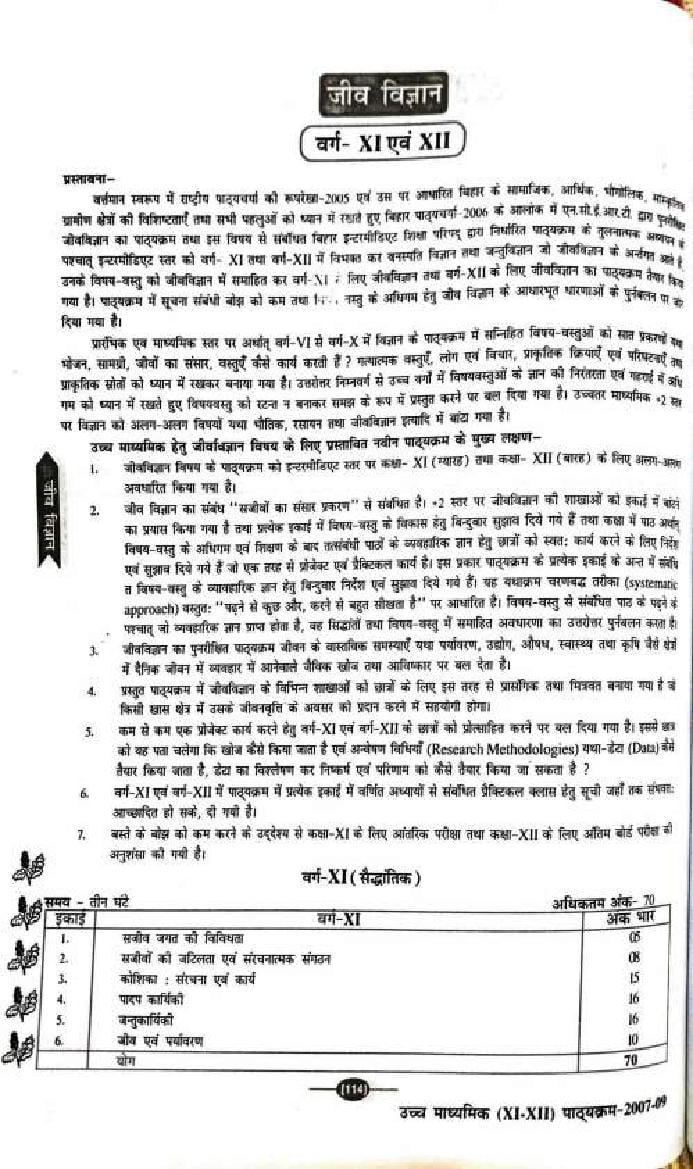
Bihar Board Class 11th 12th Syllabus Biology – Text
Read the full text of this syllabus below — useful to quickly search, copy and reference the content online without downloading the PDF.
📄 View text version (17 pages)
Page 1
Q@jcij1i-
~~ 'If ~ q~ ~ ~ -2005 v.ci oll tJl 3llmftl f.Jffl ct wnfJt<ti, 3'Tftf<f;, ~ .
1JP!ITVI tm' <ti't fqfoce1t11t ifttl lf1ft 'ffi.13l1 <tll f.2IA ii f.1m ~ mm~
-2006 ct 3ITMfcli if ~ .m.t3m.tt. ~ ~
Jlt1~iifi1 cfiT ~ atll fff f,wJ ~ 'ijiffmr f.fm $-lt'llfoQ.2 ~ ~ WT Rfi ~ ct ~ ~
~ $-l<iilfsQ.2 m 'cfiT qll- XI o'U tflf-XII if fr.t,m Cfi'{ cffiQ@ f,;rar, o'U ;;f•itf<4iill1 ~ ,iilclfcli!H ct~ 3!Ti} ~
m ~- 'cfiT Jlt1rc-ii111 ll ~ Cfi'{ wf- \l f ~ ..tlc1fc1i!FI <!tll wf-XII ct ft.ro: -ffi<lfqifH cfiJ ~ ~ ~
lJm ti qjclqijiij ij ~ ~ ~ 'cfiT qilJ "fftll t;,•, I ~ ct 3TitPJl1 -tg ~ f,;rar, ct ~ tmullaTI ct~ ~
~ 11m ti
~ 'Q;cf q114fJ4cfi ~ 'q'{ 3l!ffil. <Pf-VI ~ q11- X 11 ~ ct ~ ~ ~ f.wl-~an ~ ~ ~ ~
~- wnft, ~ cfiJ mil<, ~ ~ cfiTtf Cfi'{ffi t? ~ ~ -~ ~ ~· ~ ~ ll;q ~ il'II
~ mar <tll f.2IA 11 fflCfi'{ ~ ~ t, ~ Cf7Jl lf rc1114c1~3JT ct ~
~ ~ ~ 'q,1 f.mmrr ~ ~ 1f aifti
1J1J 'cfiT ~ 1l ffl(1 ~ fqq4c1~ <tll ~ lf ~
-;r cRJcti"{ wm ct ~ Cfi'{;f 'q'{ i@ w:rr ~ ti ~ ~ +2 ~
tJl ~ 'cfiT 3lWT-3lWT ~ ~qr ,Mrci;-, ~ o'U "tl<lfcli!H ~ ' I f ~ 11m i1
~ qjt4~qi ~ 'ffl<ff~ ftmf cfi fl;ro; ~ 'fdt.r Qlcl<Rif•q <fi ~ ~-
1. -i11<1fqiifl1 ~ c t ~ 'cfiT ~..!<JilQ;Q,2 «R tJl ~ - XI(~) ntll <iiW- XU(~) ct~ 3ffi71-~
~f<n<R~t1
2. ~ ~ cfiJ ~ " ~ cfiT m:1R ~ " ~ ~ ti +2 ~ 'q°{ -fficjfqifl1 clil ~3lT Cfil ~ -q' i1fc:i
cfiJ vqm f<n<R ~ t o?.Tf ffi ~ if ~ - ~ ct ~ tg ~ ~ ~ ~ t' atll cfiijl 1f ~ ~
fflll-~ ct 3lf~ ~ fir~ ct ofR ~ -qrat ct o!lclt;lf<cfi ~ tg ~ 'cfiT ~: ffl cfiB ct ffilt ~
~ ~ wl 1Pl i ~ 'Q,<li' iR6 ~ ffi'R ~ ~ cfiTtf ti~ '!lcfiR q1q_4<1>4 ~ct 3Fif 1l ~
a ffllr-~ ct o!ll<lt:IR<fi ~ tg ~ Mr ll;ci ~ wl 1Pl ti 'lJ6 ~ ~ ~ (systematic
approach)~: " ~ ~ ~ aft<, cfiB ~ ~ ~ i" tJl ~ ti ~ - ~ ~ ~ 'qlo i w.l ;t
~ -;;JT o!lcl(;IR.cfi ~ 'lfll<r '(;1(IJ t_ <15 ~ o?.Tf ~ - ~ if~ ~ cfiJ ~ ~ ~ t1
3. ,,ijc1fcli!H cfiT ~ct 'lfqf ~ . ~ . ~. ~ ntll ~ ~ a;hf
'if ~ ~ if clfcftITT if ~ ~ ~ o?.1f ~ tJl -@ trr ti
4. ~ ~ if -fficjfqifi1 ,t ~ 'fflffi3lT Cfil ffl'5I)' ct ~ ~ oW 'tl 'llRifircfi <ltll ~ ~ lf1II t o11
fclim ~ ~ if m -fficl1i:Jf~{ct 3l<lm 'cfiT ~ Cfi'{;f if m1fl "ITT1TII
5. cfi1l ~ cfi1l 'Q,<li' ~ cfiTtf cfiB tg tflf-XI ~ qif-XII ct ~ 'cfiT ~ cfw) ~ .rn w:rr Tf4T t1 ~ 'ffl
'nT W 11clT ';@'llT fcfi ~ ~ f<fim -;;JJ<IT t ~ ~ W~ (Research Methodologies) '4'tll-W (Data)~
ffi fcf;m ,ifJ<f1 t, w cfiT ~ Cfi'{ ~ v.ci 'tfRUJl1l cfiT ~ wrr{ ~ ~i ~ t?
6. cflf-xr ~ qif-xn i f ~ ~ ~ ~ if qfurn 3l~ ~ ~tr\'1 ~f.Rcfi<.1 <R,m tg ~ '\jf(;l ocll m :
31i'i@ifGd 'ITT 'ff<t, <a ~ t1
7. -ml ct -rm cfiT cfi1l cfiB c t ~ -a ~ - XI ct~ 31@ITTi Wijj ntU cfiaJJ-Xll ct~ 31fuq i!Ti lfU~ c!il
~q;J~t,
cflf-XI ( ~;airaq;)
~fuc:fiHI.I arci- 70
-XI 3tq;'ijlr
(l5
Ol
15
16
16
JO
70
--- ~ q,f4f4q; (XI-XII) Qiq_cletirf-2007.()9
Page 2
Gt-x.D ~1ftf tq ce,:'
~ ~ ~ ftlftlQcU- ,,
~ -J: • ¼cf fcfflt@T cfi1 ~ ~ ~I
IJ11
~ ( ~ cfi1 ~ ~ ~ tJ1fP
.~.~ )Wtn ~~~ 'ff'W fl";u qq@, ~ ~
• <fl't 31<NR11111
~
$flc fil~ :'IIT Tf~ ~~
( . , ~ . iR«li, ~ (!'I ~ ) < ! ' I ~
•
'QR1J ~,t TI- ( ~ ~ ~I
tm a~ ~ lfii$ciiial~fl<ti '4lfir fcrctim ~ fl) <1'fl ~ CfiT ~
• <~cfi~)~cfi cfi1 ~
~ cf>l <fil qtf l<l{ ifcfi)I
•
• ll~ ~ ~ - ~l<H1$( « umbn r..mm
,.,.,,.,~ ,.,.,,"J (~) . ~ ( ~), ~q,!fti{lq;f;;I,
'ffilAl ~cfilflq1 ~ ~ 31lfefcti ~ I
. ::;.;:zr ~ cf,l ~ ~ ~ ~ (~<.'l)q,1$a, 1il~Qil ~. lR~4>1$ll, f-i1"11t44
• cm:qfu ~ . ~ ~. ~ ( ~ ) . ~ ~. ~ I
~•4'l'1tcfi clil<f)
= ~ \'1"1ull = ~ qiiJ m-qr;:q ~"1ull . ~
1lllJ ~ ,t fl:r-@T311 cfi1 ~
~ ~ qiv!J ~
~ ...mi
~ %1
'fJI "1"'1'1'1
'qf~;III
,t ~
1
~ ~ ~
""'1'1t'I\,
~
~ I l4C'<tq) WW cfi1 ~ ~ ~ ~ qif ~ <1'fl ~
•
'a,m 11{ ~
"Cf{
t11-ioitf o'-11 q1ffl1ll 1t ~ ~ ~ (Systematic position), ~tt ct 1'1r' (Specimen) <tiT ~ qiv) "If ~ ctiT
~ q;r,n, ~ tcl;{ ~ ~ cfiT-1 cf>l ~ <tiT mw.u, ~ o?.U tim-1m1 (Weed) q@ ~ ~ cfi1 ~ ,
~ cfwlTI
filf-Il: ~ c6} ;itre('ldl 'llci ij{'a-tici4cfi ~
• ~ c6l" "4lcfi1Rctl :
(i) ~. a-fl ~ ~ cf>l ~ v:ci ~ ~I
. ~.~o ?.U ~<ii l~I _
(ii) ~
cfi1 qllR- ( ~ ~ ffl ~ ~ ~ ~ ~ ~
(iii) fcri1:R ~ "CR)-
,
, , , "
cl 1!{'i~til, ifiPihilil, wr-it { ~ ) I
• -«hl .;t amtmfi twlT ( ~ ) : .
(iv) ~ TI cf>l 3'1ffl -;;JRcfifUI
(v) Q,cfiill;jjq;il ~ fi;.jj;,iq:i1 ~m cfil ~. cA a?.U 'q'"fil <iiT 3ffilftn ~ I
. cA a?.U ~ <iiT ~ V!-f 3ffilftn ~ (~ ~
(vi) \if('fl~f,q, ~ct
ffi)I
• ~ c i t ~ atraftqj mwrr V!I cfi1d =
(vii) '31fcfi "Q,c{ ~ V<tiRI
(viii) ~ @H~<ll, ~ "Q,c{ ffl11m <lil ~ fl, ~ f l , ~ 'fl, ~ ' f l ~ ~ 'fll
(1nqlfl1qi cfifd)
~
~all ~ "ifwlT, ~ct
, ~ q;1 ai1q;11tf,1q 'cl'~ (Morphological characters) cfi1
'ifivll n'fl fctim ~ ~ a?.U fi;i!l"'q:il <Titt ct~. a-n a?.U -qfu <iiT ~ ~ ~
t~ ~ ~ q;1 ~
~ ~ ~ ~ ~ ~ ~ l l ~ (dissecting microscope and compound microscope) 'if
~ ~. ~ . ~ . kif~ ~~.~, cl•gf'i-fll-11 a?.U ~ct ~m <lil qUR ~ I "'qJi 1l;(f ~
fModet) laU ~ ~ ~ ~ 31<fi~(i(ct,'i ~ ,t 3llcfiTWfiT a?.U 3l@Rcn ~311 cfi1 3lUflR ~ I
"11-111: "'~•· : mv-u ~ ~ <iiT ~ ~
c6TV
• ~ . 'q,1fflCfiT 3"lflR 11 ~ "Q,<i ~ I
• fQt ~ ( ~ ) ~.twi)fecfi ~ slitR4'fc!<ii Cfi)fficfil <iil 31@ ~ <~ ~> ~ v;q'
---
T-115 R iJ'.11~ Wl<til~~qj)mcfiT-q 3ffll
~ iuu,ifqq; (XI-X II) Qi&_c.l<fiq- 2007-09
Page 3
• ~ ~ - ,rt? ll1J'F1 lfflll, ~ ~ ll'ml. ~ t{1' R"1J ~ (P11s,ve 1ncs iet
"'t
transpor t)
• ~ M (Cell wall)
~ . 3hf<~64Jllft=t¥t, ~ ~
• ~31Y ~ ~ ~ l1;cf° T-i't if;fli- q1,2)..:tfiJ~•U, ~
f,f4z~Qlq , ~ . li-li~t1h.flq , ~ (vacuole ) , ~ ~ (Cyloskeleton). ~
(Microtubules), ~ (Centriole), -q~ (Cilia). if;"lfl"f ( FJagella), ~ ,
• ~ 'tffi- ~ ~ . ~ ~ (Amitosis), ~ (Mitosis). ~ (Meiosis).
~ ~ oti ~ <~ ~ l1;ct' ~ ~
m -if >
• ~ 31VJ (Biomolecules) - ~ ct ~ m-114f1cf> ~ • .,cf>1 ◄ fn g 1" $l ,.2 , sniR, ~ .~
(Nucleic acid) clft lh;r-n ~ if;flf, ffl1lq {~ ) <t>'t ~ ~ •~ '!lcJin cltll ~
~
~ qft 3lT~ ~ ~ ~ ~ , .
( u14')fi14, ~ )
fcnm ~ ~ ~ ~ ~ ~ c1ft ~ 3ITT 3RR ct ~ tg q;g (section) om ~ (smears)
m clft ~3TT lt ~ fcNr;;A "'1 ~311 cfiT ~ ~ ~ ~
clft ~ 'ij ~ cfivTT; '2l'NI ct~
cfiv1T om ~3TT qft ~ 1l ~ ~ ~ cfiT ~ <fwfll 4,1.if61~~2 ( ~ om °RRf), mir-r ~ crni 1'>'\
~ fcnm 'qf~ ~ ~ lt "qclT 'l9'llAT ~ ~ Cfwfll ~ ~ ~ cfiT ~ ~ cfiT f.p:rrur cfivTTI
ogy) (Periods: 25)
~-IV : ~~( Pla nt Physiol
ll .i;ffl cfiT ~
cfiT i;ffl fq,rcr, ~ ~ ~ .~
• ~ i;ffl ~. ~ ~ . ~
om ~ ct ~ ~ <R m "'1 ~-M~ ,
• ~ • 'SfCnm ~ • ~m 1l ~ ~ ~ • ffl qf{4)fs~ otll q,tct1~J1~11
( u14'r14, cnrd)
~ <fwfl fcfi ~ ~ ct ~ ~ (Chloro phyll)~ ~ ~ fcfi~1fq~1. ~ ~ t, ~ .
-q'
3ffl:'Wf(Jf (Imbibition) "'1 ~ cfiT 3 l ~, m ~ (apical bud) '4iT 'tfi~ 'ij 6ZR cfi ~'-l'Jcf cfiT ~ ; fclftR
~ 1l ~ ~ cfiT 3ll2PRI
~ ~ (Animal Physiology) ( 1-l'Rcf cfi' ~ -ij) (Periods: 30)
~-V:
• 3lT~ ~ : -qrq;:r ~ 3lq'Wf(Jf , ~ . ~ om ~ ,
• lJfu~ ~I
• R<BfUT ~ ~ - onfciiT mi~ 3TTl':'Wcit m~,
Cu14'r14, cnrd)
~ ffl"O'q' " ~ " "'1 f,;t,41~ftt.1a1 <R ~~p H cfiT '5r,rn1 ~ ~ GRT lJRq' m qiffi
"ctR 1l ~
cfiT 3l~I ~ ~ GRT ~ cfi ~ ~ cfiT 3l~ I
~ ~
(Periods-20)
'Jcfifl-VI: qqfcHOI
• ~ cfiT ~ ,
~. ~ (Population), eiifti211Rtcfll, ~ .~. ~ ~ ~ ~ cfil' ~ ,
•
'-~ • ~ mi- ~ mi cfi ~ ~ ~ cfiT\Cfi / 3lcfllcr
~ 3A ~
~ • ~ ~ ~ ~ ~ ~ ~ ( i n t e r a c t i o n ), , . cffii'Tq{Uf, ~ . ~
~ 'tR ~
~
cfiT '51'-l'Jcf I
~ • WJl9 q1ffft,tjfdq;1 <fi v<fi'R, 3lTffl ~ , 3lTffl ~ , mi ~
lJfuclft (™) , ~ ~ ~
I~ ~ ~ (Biogeochemical cycle), (ffl o~, ~fsifo.l)1
~ ( u,4'n14, ~) .
~--qm <fi ~ ~ cfiT ,;quy ~ ~e.,ur ~ o~ M~ VCfiR cfi ~ <im 'tfr~ ~ ~311' ~ - ~ ~ cii\ ~ ; ·
I~ R;T ~
~Wt r ~ o m ~ qi1 ~ ~ ~ <llJt1iol,i; ~ ~ 'qUR tfitl
+
--- ~ iua,f'iq:; (XI-XII) Qlq_40ii.i-2007-09
Page 4
z.
.
~#1-
(lllf-XD
➔
40~
'.
71
t1JJT.:1/cl~-li{i;1rzt1,""i(Practical) ~
1JSf ~ (Major Exp~rim~nts) ,
1, (i) ~ ~ (D1ssectmg microsc ope) ct- 'W11 q;i 3ltlltR
1
(ii) ~ ~ (Comp ound microsc ope) ct- 'W11 q;i 3ltlltRI
(iii) ,i:ct,011.:i\4::tl (Monoc ot) ~
~ ~
fi;.,.",..,q=:ft (Dicot) ,ft~ ct- a-fl -a~ ;;rg CfiT ~
Q~ T-fqi1 ~ 3lc:fr1li:fi1 <liBTI • .
~ ~
•
~ ~ @,,,~
(iv) ~ ~ ,mt-~ ~ ~ ~i{~B cfiT 3ltlltRI
(v) ~ ~ -~ cf>1 cf>1~ii:fil3TI -q ~ ~ CfiT ~ ( ~ « · ' I i ~ ~ ~ ~ ) I •
~!!io ~ l']"q -tft~ ~
(fami ly)~~ CfiT cti:fi.ftq\'l ~ ~
(vi) m~ qUR, ~ W~ ~ m (Floral
formula and floral diagram ) 1
('cfi) 1-11ct,hf1 (lsi). ~',t-1-hil
(1T) ~ ...mq,{I ( il<(-t1~tjl)
(tt) <H•<i'il~<(-t"l ("6. ) i:fitxi1<(-tli\
(~) ~ (~)
(vii) ~an. fdct'q{_<!I -a~ ~ cfiT 6\li:fiiRq\1<-1 ·3l1:Zi<Rt
(viii) ~ ~ ~ (Mode l) WU ~ ~ ml-lR ~ W (General viscera) cfiT 3ll:2flRI
2, ~ "!l'm'1T (Short Experi ments)
(i) 3lf,:imur <f'5{ (Osmom eter) GTU an'~ cfiT 3l'!:ZllAI
(ii) ~ ~ (Epider mal peels) Ti ~ ~ (Plasmolysis) cfiT 3l1:Zi<RI
(iii) ~. fcfiflf~1<1 'fl oHHil"4o, (lmibiti on) ~ CfiT 3l'!:ZllAI
(iv) ,ft~ Tf CO ~ ~ ~ ~ Tf CO ~ ~ CfiT 3l'!:ZllAI
2 2
(v) qr{ i:f>'iMi:fii Wt:t (quadra te metho d)~ "41'-e:cr ~ "17' -ai,~<Ail~m-11 (ireq•1ency) cfiT ~ ,
3. ~ (Spotting)
(i) ¢11i:fiiP:q\1-
(cfi) ~RAT/ qm ~ ~4ict(uj 11 ~ ~-~I
(~) ~ . ~ "a~ .fr-it ~ ~-~I
(lT) lWi i~~ ~~I
("f.f) ~ ~ ~ ~ (Specim en) cfil CfiT{1JT / "q'fu{ ffl <fim ~
'q:cfi ~ ( cC•ITi:fi<ul) t
('&.) ~ ~ ~ 'q:cfi ~ (Specim en) CfiT CfiT{1JT / "q'fu{ ffl <fim ~ ~ ( ce•ffi:fi<u,) I ..
(ii) ~'lf"-41! (4 (lsobila teral) ~ ~'=IU (dorsiventral) ~ Tf ~- <fil 3l'!:ZllA, 4<i•Ht?fi ct- m'-t. :1:J<11T
~ -q" 3l'sroJ (ovule) cfil ~ I
(iii) ~(Int egum ent), ~ ~ (Intes tine),~ (Kidney), ~ (Liver) , ~ (Pancre as), 3Rf:~
m'q lN1 N{.1_<!0 , ~ . ~ . ft;tlT- ~ (Gonde s), ~ - ~ -a~ cf"4"0T (Ovary and testes) Ti ~
~ - ~ cfil ~ ( ~ @l~~B ~ ~)I
t "- ~ (Bioch emistry )
(i) ~ 1l ~ 'il>i aqf~ cfil i:rctT ~ I
--- .~ q1~f~c fi (XI-XII) Qlq,_4<fiq-2007~4)9
,
Page 5
(iii) 11.' 1f Cl.fW{'f1 ~ a qftrqfa 1'>1 1ffll ""1111
(iv) ,ht 1f ~ m
aqftrq fc, 1'i1 1@I ff'JAJ I
s. tmPWWfi-
d ~ 3lTffl ~ -..rat t f.fi ~ • ~ -~ ifiTaf -JI\~ lJGlJf 1fiT 11. mJr.t 1Mil ~
t f.fi fcfi1\ ~ 1ITTRT ~ 1fiT ~ WJf1fa ~ 1"ff ~ ~ ~
'ifif, m lfJ 3lTffl ~ ~
~q(i d '1ftvTrq ~ 51~dcfi(UI ~ I ~ ~ ctl lJtt ~ JlJGf ctiT-l q ~ ~ ~ ~I '
+
3fil44 @q - - 70
<A-XII
06
1. ~a m ~ 18
2. an:1c1ill1..:t am h - ~ 18
3. ~ dcfi.flif>l ~ oWt ~ 18
4. 64iclt: il«i -;;fti:l ~ l1;cl' 1fRq ~
10
5. ~v :ci ~ 70
~
35~ ~-
(cPi-XII)
lWf- 1:
ct ~ . ~ <liT ~ 1WT, ~ ~ (gametogenesis), 'tJU7l'OT v;ct ~ •
• lfrm -q 'lr-ir-R - ~
~"Q ff ~ qjJ ~ .
~ -q 'Jr-ir-R V!i rcftfim- ~ m1, ~-"'q fuff ct fcf<mt 1f m -~
31h 1Uey -il ~ q,l ~ •
• (~ ) : 1i11' qiJ mm, ll1f~ ~ m
1Ufuq , ~ . ~ qjJ f.rqfur ( ~ ;;r;R) , ~ . -uqvr
(Pregnancy and Parturation), 'ZR -~~ (~. \'ft. ~.)I
~ l<ITT Uf- ~ ~ . 1N f.RN "v:ci "$r ~ WI (Sexually transmitted diseases) (STDs)I
•
(w1<il fl1q; 4iN)
if>1 ~ <liT ~ @1~&_,a <fi 1U8P1 ~ ~ qi"ffJI
~ c t ~ 3PJlt1JfllT <liT 3JC!P-R <fivfTI ~ -q'°( 4<1•Mfctcfil
~ (gynoecium) ct amwlJ ct ~ ~ <I~ ~ ~ @1,&_e m 'cfi'viT <f'-Il ~ ct 3R< ~31 1 Clil 'il'II
ct ~ <I~ ~ ct ~ ~ <liT ~ @1,&_,(,f qiJ ~ 'cfivfT ~ ~= ¥11!
~ ~ <liT ~ · l<A~
<liT ~
'cfi) qg;:u-111 <I'~ ~ ;;r;R ct fcn,r-J ~ <R-ffl •
ct 3R< ~a n ct;) ~ Ovary ct 3R< ~
45 ,fiftlR
fcfifl-Il: 40':lcfW14'1 ~ ~ fctq;m -
~
. ~
~ <liT ffl : v_q; ~ v:ci fu- ~ (monohybrid and dihybrid cross) ,~ qi(
• 4°&Hcilct
(Gene interaction)- ~ Sl'lifc@ - q r ~ . ~ -g,:nfqm, ◄ s1'Jlfqc,~
cffil'1J@ ~ I ~ ar-a: ~
(Multiple alleles), m ~. l{N~f~ Htl
fcITT1FI
• 11fd cliT 1l'71W ~
a,11 (Chromosome theory of Inhe ritan ce)- esw-1a1 v;ci ,;jFJ
1l m - ~ XX.X y<f'-I l m - esct•-icfi cffiPffif ~ ~ W I
-qf.11
<iilfflcfiT ~ cffiT11@, ~
glq)q, lfctlfl, ~ (Colour blin dnes s),~ ~ v;-ilf4411
• ~ if>1 ~ n-g (Chromatin fibre) v:cf ~
-ilHcfiiU, ~
(Chromosome) I
! ~ (DNA replication), 3tijcfPllcfi 'ifct<f ~ (Gene tic code), ~
• it. ~- ~
(fran scrip tion), 3tjcii~lcfi<Oi (Translation) 1
--- ~ lllUlf'lcii (XI-XII) Qlc:i_40i"- 2007-09
Page 6
Gm:nfl,q; ~
~ ~ <6 ~ ~ ~-c fill (tiss ue secti on) q;J ~ q,vf1 ( ~ - ~ ~ ) 1 DNA
"q;t ~ ~I
~ -IV: ~ ~
.
cSQc4glflq; •
~
"q'Rc f qi@:IIOI (Applied Biology and Human welf are) -
35 tflft q- •
• 4~flR-11 (anim al hus ban dry ),~
~ (Po ultr y),~ ~ (fi she rie s), ~~
~ otrA
~ ( 3Wf lJ;ci ~ ) , iilillc:11-fl ~ (Ho rtic ultu re), ~ "tffi.'R (apiculture), ffltf- ~
"q;t ~
(Ser icult ure) ct <iITT: ll ~ <ill1<fitil, ~ 1J;ci ~$: !' ~"ff <tt ~ 1J;ci ~ I
• ~. ~ ~ lJ;ci ~ !HiW i(UI (food processing) ll w,ITT; liim
1Hi% (UI 'q:ci ~ I
• ~ ~ "TJ:ci ~ ~ <fi' ~ ~ 1J;cj ~ I
• 1@-"5fiil'tR "TJ:ci ~ ll ~I ~
• ~ (Imm uno logy )~ 'itcf;t (vaccines) <tt ~
~ 1J;ci "<il'R'<fiTUI
• ~ lJ;ci -O•ll"J-iH<fi (Path ogen s) I
• m lJ;cf ~ I
• ~
• 41f(ff¥.lfdcfi1 'a';J 1R ~ -il1{-i@i CfiT ~ I
~ _ ~ ·
• • • c:4-4..flc:1 ~ · .
• ~ \HHQ -,f clil' llTilfOT-
cA ~ . q-fi <fit "lffic{ , cA cRJcf ~ ~
m:t ,t cmuI 'WfiG m<f -;-.ftq)' (endangered species) qft ~
. c:11-04°1, ,mmq 'c:A, ~ ~ ~ ~ ~-+ ~
~
fqr1'<11il4 ,r11q1 <ti ,:,•.-.,- , n,i ~I .
~
•
(con cept ), ~<4>2.ll@ TTrl
• 44\c:1(004 ~ - q4Jq(OI ~ . ~
.._....,
~
~
"o., .,
~ ~. ~
.._...,
~.
~
"o., -·,
~
~o..,-•
=,t "ll"1lq =
~qiI
• qqfq( U04 ~ ·
., ----- ~ 1utz1f'lcfi (XI-Xii) Qlc:\_40ii;-2007-09
1Ai£54
Page 7
~ ~ pH ifllT ~ lfftl ~ ~ i71l'I ~ -tr.f ~ ~
~ ~ .t ~ ll ~ ~ ~
~ ct 'ifiW71 , ~ 1ft1I f!frt"1I m ~ ~ llT ~ ~
~ ~ -t ~ ~ ~ 'qtf{ ,n mm m ~
~ -.t' 11t 1R ~ itit, ffilf-v-t M 1ft ~ - ~ ifil if11' t-t m f Wtn ~ ~ ~
~ -q' ~ ~ ~ 11t1faiji(VJ ,f ~ ~
~"'
3lNlfm ~ "q1R m~ ~ ~ ~ ~ I M fl,~ ~ ~ iJm ~
+
ifff'4' .__,
'
cf1f-xn ( u141n1cfi >
~ftfififtq 3'icfi- 30
~
I.
2.
WUTT'fl:c{~
Sl<l~•l~ll('tl ftllift 'f1:c{ ~
cm-XII
---
atc.; '1rt
20
05
05
~~~~'fl:c{~
3.
cwfln1T
~
40 ~
-
30
(cllf-XII)
Jll4T'fi1cb(Practical) a1W lR
1. ~ m (Major Experiments)
(i) fcrt ,r-f ~ct ~3l lfqi l3l~ I
(agencies) <1eu (~, clit{) ct ~ ~ ll ~ ~ q;y ~ I
(ii) fqf,r,:;r ~
GfU ~ q;y l{;i -if,R mi (urinogenital system) v:ci ~
mi (Circulatory system)1iil
(iii) "'qyi v;ci ~
~,
(jv) ~ q;y o'fifct;r mi qiJ 3l~ ("'qyi 3l~ ~ ID"U) I
2. . ~ m (Minor Experiments) l ~ ftl~ "ct fc!f,r,:, ~3l !
(i) ~ ~ ~ ID"U tim iflR (Grasshopper) ct <f!fUI (testes) ii 3
<iil3l~~~I
ID"U ~
v;ci flaraft1
~ q;g (tissue section) ll ~ ~ q;J 3 l ~
(ii) ~ ~ ~
ogous) 3llIT q;y 3 l ~ v;ci ~ I
,:,{iii) ,:ft~ v;ci ~311' ct ~ (homologous)~ wrcwf (anal
-cit~ v;ci ~311' q;y 3 l ~ aeu ~ ~ 1R ~ ,
(iv) ~ qJfflq{'O'J ll llTll ~
(v) ~ q@ffi1 1f if ~ "!ft~ ~ ~31T q;y 3l~ , ~ 6lj'fi{11dl 1R ~ I
ID"U ~ ~ fflllm ~ ~ (blastula) v;ci • (gastrula) ct ~ cfil2 q;J
(vi) ~ ~ ~
3l~ f
3. q,ft~@411 (Ecology)
(i) fclf,r,:;r m ~ ~ cfiT ~ 31~ cfwlT creu m ,1TT ~ -qm cfiT -~ qj{,f'ff
~ (ii)
(iii) ~ ~ ~
~ "'1 ~
m
ij ;;ftq)' <~- ~) qiJ 31~ 1
tiRUJ ll:TJ:ffil (water holding capacity) creu pH
~ ffll
g1~2)HT;ifl (Hae mato logy )~ iiii4lcfif'l~1 (Bioc
hemistry)
~4 .
(i) ii14J•ct1f<111t.il2( !,TU \<Rf ll t)q),ct)f<11 qiJ RtJRUII
"Nti qiUJ (WB C) <tt ~ m
~
1J11RTI
(ii) tJq)f11$2lt.il2< !,TU m ll Bffi m qjUJ (RBC) ~
(iii) ~ ou<fi ~ ~ ~ ll ..iliiT!il$~2, m2R creu cffiJ q;J 3lt:2J1RI
1l'Rcl ~ A, B, 0 m ~
Jls. (iv) q;y 31~ 1
lfm ~ 'l1i mw ~ (Spotting)
~ -urr ~ <fi(-lclR-11 _;ftq "<!'eu ~ . q;1~i.-1Rc11, ~ 3PTTifT v;ci· ,-{>11.ai)fuqq -q ~ 'Q,<i;I
---
(i) ~
. (ii ) m 'fl~ I
7
~
.
qJt24f~cfi (XI-XII) Qlc:l4lJiSf- 200 -09
Page 8
4.
COU RSE STR UCT URE
Class-XI (Theory)
one Paper Three Hours
Unit Class -XI Max. Marks : 70
I. Divers ity in living world Weigh tage
2. Struct ural organi zation and compl ex·t . • • • 05
C e 11 : S tructu re and functio n 1 Y tn 11vmg organi•sm
3. 10
4, Plant Physio logy 15
5. Huma n Physio logy 16
6. Organ ism and Enviro nment 16
10
Total 70
BIOLOGY
(CLASS-XI) 35 Period s
UNIT-I; DIVE RSITY IN LIVIN G WORLD
• Introd uction and signifi cance of biodiversity.
• System atics (Gene ral introdu ction, Identif ication classif ication )
and binom ial and
Trinom ial system of nomen clature , concep t of Taxons
• Classi ficatio n of the living organi sms: Five kingdo m classif ication
(Mone ra, Protist a,
Fungi , Planta e and anima lia) and Two kingdom sys~em.
• System of Plant Classification (Artificial, Natural and phylogenetic
systems) and animal
classif ication (Non-c hordat e upto phylum level and chorda te upto
class level)
• Eleme ntary idea of Micro- organi sm : Viroids, Prions , Viruse s
(status of viruse s),
bacter iophag es, bacter ia, cyanob acteria and their econom ic import
ance.
• Chara cterist ic feature and elemen tary idea of differe nt plant groups
(Thall ophyta ,
Bryop hyta, pterido phyta, Gymn osperm and Angio sperm) .
• Botan ical Garde n, Zoolog ical parks, Sanctuary, Natural musue ms,
herbar ia.
KEY POINTS FOR DEVELOPING SUBJECT MATTER
' ' ~e~nin~ of Biodiv ersity and definit ion and its signifi cance.
·
Living organi sms show a very large divers ity in form and structu re
rangin g from unir,ellular to very large
multicellular well differe ntiated bodies .
' Fo~ case of study, they have been organiseci into catego ries on t~e b~sis
of genera l charac ters (big i.e.
lllaJor group) and gradua lly furthe r big groups have· been catego rised
mto smalle r groups on the basis of
• '~ial charac ters and indivi duals as specie s and its variety (conce
pt of Ta~on).
, Principally, all living organi sms can be placed in one or the other
of ~ve_ Kmgd oms. . .
f.a_ch kingdom is furthe r sub-di vided, there are several levels .:,f orga01sat1on, the
lowest m the hierarc hy
being species.
--- . ~ ,m;af4i:fi (XI-XII) Gi&_4cJiq-2007-09
b!riHMfNARI
Page 9
• The ~inomi1J •~••cm li1erally · 1.wo n•~ c • &an,sltl ~
genenc name wuh a specific epithet. . bacteria, cyanobacLeria hns to d l\
· 'd s. p nons,
· · es• bac1enoph•ge. escn.
• St ructure o f v1ro1 virus rd ' r ·ng and non-living thing) Ee •~ (
special ch1racteristics of virus (characters rcga ing iv• I s ~
· onol'llic i1Q
. ·,h 1 uitable cxamp e ·
of such micro-organism has 10 illu11rare wi
pRACTICALS
. · h neighbourhood. note their hchav·
• Study the large variation of living organisms mt e mmon features. Study preserved tour. ~harac,,
and categorize !hem into groups based on some co rrelatives between the characte/~c•nicn1.· r1
one representative of each group, to underst a nd co •sites of it .__
o~ ,
. llect press dry and prepare plant spec·11llens ~- -..,
and their systematic position. Learn how to co ' · ' 1
b · m / museum · th 1,
(Commc-'l and weedy species) for the here arm
UNIT-II; STRUCTURAL ORGANISATION AND COMPLEXITY IN LIVI~CA N.
• Morphology or Plants : . . . . . ~
• Morphology of roots, stems and leaf with ~heir modi f1cat1on . %.lf,
• Morphology of Inflorescence: ~owe~s, and
fru1ts_ seeds.
• Descriptions of different ~am1hes on t~e basis of flor~I characters : Malv
Solanaceae, liliaceae, cruc1ferae, legummasae, compos1teae, graminae (Poa~ ·
• Anatomy or Plants : ~i
* Elementary idea about tissue system.
* Anatomical structure of root, stem and leaf, monocot and di cot plant.
* Morphological and anatomical structure of hydrophytic .
and xerophytic pl .
h ant ll'ii
d I f ( I d
special reference to root, stem an ea on Ya apt1ve aracters). c
• Brief anato~and function in animals :
* Tissue and its type.
* Digestive, respira~ory, circulatory, nervous and reproductive systcms(i
Earthworm, cockroach, frog-and rabbit.
KEY POINTS FOR DEVELOPING SUBJECT MATTER
• The general function cf root, stem and leaf shows special function by their modification.
• Floral characteristics form the basis of classification and identification of Angiosperms. Each familyht!
eccnomic, ornamental and medicinal value as possible as it is to be given examples. A list of plantswill
binmr.ial nomenclature is to be describe (local plants with local name should be described).
• Higher organisation of animals and plants is achieved through assembly of thousand/ millions ofclll;
mto specialised tissues that in turn form organs a~d organ systems. The organisation of the living b-Ody
shows division fo labour. Organisms show increasing complexity in structure and function from 1t1
lower to the higher levels.
• Light and electron microscopes are used as tools for the study of tiss ues . Cells and cell organelles whm
it is needed for precise structure and special function .
• .. The ~daptive characters of hydrophytic plant and xerophytic plants have to describe on the morphologic~
and anatomical basis.
• The structure of the animal body shows a wide range in morphology and anatomy.
PRACTICALS
. danimal!
Stu d. y t he morpho,I og1cal characters of local plants. Study different type of tissue in plants a~ . •ble
by permanent slides and prepare temporary slides by cutting Ts of root stem and leaf of a su.,w1101
· . . · · ' • DescnP ·
plant (monocot and d1col) and observe m dissecting microscope and compound microscope . .nosae · nJ
· J b. · 1 a
0 f Ioca I fl owermg Pants elongmg to malvaceae, solanaceae liliaceae cruciferae, legurn • rnal
· ( ) S d f ' ' and ,nrc
grammae poaceae . tu y o one vertebrate and one invertebrate for their morphology
organisation (through charts and models). . ds-.111
, (PertD
UNIT-III; CELL : STRUCTURE AND FUNCTION
I od · d of cell.
• elementary idea of Tools and techniques used in st u Y r oti( i t il
ntr uction and
• U!tra st ructure of typical Eukaryotic cell and differences with Prok:J y
Differences between animal cell and plant cell.
----
• Protoplasm: Structure (chemical composition)
Page 10
active trans port. •• Concept 0 r unit· membrwne model, · U
f-1uid mosaic model. pusivc: 1 nd
· 8fF '
• Cell wall
• Stru cture and runctlon r
go1g1
' bod' /d' 0
. ce 11 orp nell a: Mitochondria. plast . lit!
ids. endoplaJmte, qflf;
1es ICtyosomes, ribos
centrioles cilia d n omes I . • bules
I
• an age1la, nucleus. • YSOS<>mcs. vacuoles. cytos keleroo. m,cr01u •,,
• Ce11 cydcle,: Cell division: Amitosis. Mitosis and Meio
ce 11 an p ant cell). sis and their significance (animal
• Biomolecules : Basic che · .
f b h d . mica1constituen living bodies, structure and funcu•ons tJlff
o car o y rates, proteins, lipids and nucletsicofacids
U'
.
• Enzyme_s : Its types, properties and major function
energy nch compounds El (elementary idea) ATP and orher
•
• ementary ideas . . . r .
of vitam ins and maJo functions.
KEY POI NTS FOR DEVELOPING SUBJECT MAT
TER
1
TheceII organ. elles
. are
. designed to perfo
. rm. tasks sue h • breakdown
· ' cellular respiration is t~ be dealt wi th respiratory
as synthesis, , resp1•rat1on
· and trans
port.
chain (Electron transport system) of mitochondria and
oxidative phos~hor!la~ion. Chl~roplast (a form of plast
ids), a brief description of electron transport
system and ~aJor differe~ces with ETS of mitochond
ria. Maj.or steps in photosynthesis as a function of
chloroplast 1s to be descnbe.
Essential processes of cell division : Mitosis and meio
sis are similar in animals and plants with some
' basic differences.
Living bodies contain different categories of macro and
1 micromolecules.
Macromolecules are of four broad categories.
I •
carbohydrates are maJo r energy reserves and also serve the function of provi
' majority of living organisms. ding structural support to •
Proteins, the major macro group besides providing
1 structural support, mediate many physiological
functions like catalysis, defence, transport and sensing.
Enzymes are an important class of proteins, responsibl
1 e for all metabolic activities of the cell. (Types of
enzymes and functions should be summerised in tubul
ar form).
1 Lipids serve as major components of membranes, as energ
y reserves and some hormones.
, The DNA has a double helical structure.
1 Nucleic acids are the genetic material and are responsibl
e for determining the protein synthesis.
• The major functions of vitamins and their deficienci
es and excess causes disease (It can be summariescd
in tabular form).
PRACTICALS
, Observe suitable animal and plant cells (Sections and
1 smears) to highlight similarities and differences
study of mitosis in onion root tip and animal cells (perm
anent slides). Test for carbohydrates (glucose
and starch), proteins and fats and their detection in
suitable plant and animal materials. Make a fluid
mosaic model of plasma membrane .
~ PLANT PHYSIOLOGY (Periods-25)
• Plant water relationship, water potential of cell,
absorption of water and minerals,
ascent of sap, transpiration and mechanism of stoma
ta! opening and closure, Xerophytic
adaptation for transpiration.
• Respir· t' • Photosynthesis • Plant growth and development
a 1On . .
• Growth regulator, Photoperiodism and vernehzat1
on.
KEY POINTS FOR DEVELOPING SUB.IEC~
1 Ctll
to cell M:AT TER . .
movement of water, ,,rood• gas and nutrients· is dependent pnnctpally on concentration gradients
·Ille! di ffusion
• ~ nces ~ moved against concentration gradient throu
gh active transport.
' 1\e
, rri!~ts st
lose water through th~ir om~ta.
·:-,,u o of water over larger distances m Plants 00 transpiration pull. Discuss transpiration in plants
, ~• eobalt chloride method (as experiment).
~ Jlfttlure iJ responsibl e for movement of waterup tO 5 hort distances and for guttation.
--- ~ 1ft~f'4cti {XI-XII) Qlc(cl<fiq-2007-09
Page 11
. ·ents for lud f e,
l ,
• Planu require • variety of m,ner1I hnulf eric nitrogen . hesize
. I
s,mp e sugars
. h
tn I c prescllee
n diox ide and synt
• Jom e planlJ are able 10 fiI ll 1tmosp or "4.. ,
• Green planu use the c, pathway to fix carb
o
' ·
release energy.
• " Some plants have the C, pathway. . s 10 blcally. '
• Sugar are oxid ised by all livingfrom organism . . ,
. d . gy food anac ro act1V1t1cs.
• Some organisms enve ener nd
d~ 11 metabolic
~ ve~~;ment in plants.
• This energy is trapped as ATP s uti~ an e
• Growth regulators regulate grow th '
fRACTICAL..S ,
on of wa
• and Ii ht for photosynthesis. Study imbibiti
1 : the effect of apical bud rem ova l on plants Sier~ ,
rate reqw rem ent o.f chlo roph yl . S · IUdy~
• Demonst osis . tu Y
or raisi ns. Stud y plas mol ys1s and o~m
(P , q
respiration in different plant matenals. . .on 'fio4
. n, respirati ~
HUMAN PHYSIO LOG Y . st1o. n and absorptio . i
UNIT·Yi 'd f phy siolo gy of d1ge , c1rcu1 ~
• Elementa'?' 1 eas o '
and excretion.
• Movement and locomottion ion. .
• Ner vous system, sensory system and endocrine sys~II\
Ordina
• Cont roI and cO• •
T MATTER
KEY POINTS FOR DEVELOPING SUBJEC
th th th
dow n enzy mati cally in stage s and nutri ents abso.rbed as ey. pas~ rough e alime ntaryci~
• Food is brok en th1 of resp iration 114
iration is to describe. Brea ~g is a part
• Difference between breathing and resp lei~
on is a proc ess of gase ous exch ange (0 2 and CO2) at organ, tissue cell and organelle
respirati
.. .
leading to oxidation of sugar in the cells. , the compos1t1on of body fluids as plasma, lymph and bl~ Ti
em)
• In the circulatory system (vascular syst ~:•
is t'o be describe.ponents·of the blood are involved in diverse functions.
• The various com .
nutr ients as well as was te prod ucts are tran sported in the body through the vascular system
• Ga,es,
are eliminated by excretory system.
• Metabolic wastes produced in the body
and osmoregulation.
• Kidney play important role in excretion other excessive
of kidney and nitrogenous waste products and
• Nephron is the structural and functional unit
le of nephron.
waste products are filtered out through the tubu tional unitof 1.
cle is resp onsi ble for mov eme nt and loco motion of body. The Sarcomere is the func
• Mus interactioo,
yosin and other components of sarcomere
myofibril of skeletal muscle. Due .to Actin-m
movements in the body.
muscular contraction and relaxation provides
ion of neural and endocrine systems in the
booJ.
co-o rdin ation requ ire func tion al inte grat
• Control and s hypothalmir
nervous system. Endocrine system comprise
Neuron is the structural and functional unit of al,gastro-
ei (hyp otha lmic regu lator y horm ones / facto rs), pitutary glands, thyroids, parathyroid, adren
nucl
ds.
intestinal hormones, Islets of langerhans, gona brain . Stimutiare
different stimuli and transmit them to the
• Sense organs are specialised to receive
the nerve fibre.
propagated in form of action potential through
PRACTICALS
t slides of
re and pH on activity of Salivary amylase. Study of permanen
I~ • Study the effect of temp eratu
of fro .
t:!JF human blood cells, studSM y of permanent slide of skeletal muscle fibre g (Periods-JO !
IRONMENI 2
I~ UNIT-YI: ORGANI AND ENVogy .
(!;lf}J • Introduction of ecol ,
ion dynamics community, ecosysrem, a,ornt
• Conc~pt of species, population, populat '
and biosphere.
hysiei1
st
• lEctosy ~m (Abiotic ·com ponent and biotic component) ·
• n erac
.
· n op
t1on of. Ab'iotic ~ iactors and Biotic factors Effects of populatto 3 °
·
environment I e Climatic ' ed aph.1c and other abiotic factors. . cosysrei!I
• Types of ma.~; , Energy now in e
. _J ecosy stems. Food chain, food web
8 iogeochem1cal cycle (Gaseous and sedimentary ).
Page 12
KEY POINTS FOR DEV
--- ELOPING su
intro
duction of ecology, a brief of histo . 1
, IO decologica .
· I terms with deft · ·
QJECJ: MAITEB
ncn background of r::_ 0
. n,t,on hnve to describe ~ 1ogy, ba,ic concept or ecolou with
#
0se pt of species, popu 1at1on, community . h · . U
, co~~~oation and exampl_e. Com~unity with ph;:~nl :~~~?riotc dcftnl~ion ha1 been given whh a brief 6!1fP
e~P rn i.e. ecosystems m a particular area the onment constuutc a balanced and self susc•lnlng
sY 5te systems of earth i.e. Biosphere. • ccosy st~ms of particular climatic zone cons1i1u1c biomc I~
aod ecot' 011 within
. ab'1ot1c
. factors within
. biotic fa t f/lF'
Jnterac I • I' . c ors and between ab'10r
, ecosystem, various IVlng organisms are arranged in ad . ic and biotic fnc1ors affects to e1ch other. I~
, lo transfer of food energy from the source in pla t h efinite sequence according to their food habits. ~
f~:oer) with repeated e_ating and being eaten is ::l:e~o:gh a se~ies of organisms (arrangfp)JfDJ!01~I
f1l h other at several pomts at which food en ° 0
~ chain. These chains arc interlinked wit~
ea; re at each trophic level, there is flow of en:rgy t~ansfer is called trophic leveL It is the food chain
~ elinked and forms a web like arrangement krgy. t ecosySlem there are many food chains and all are
111h1erchemical component of the ecosystem m nown. as a food .
web
·
10
, fhernical cycles are of two types gaseous and odv~ definite cycle - Biogas chemical cycle, Biogas
ce • se 1mentary.
PRACTICALS
Go 10 nearby local area and survey and make a list of diff: . .
' ommunity, food chain and food web in ch erenttypesoforg_amsms(Plantandanimals)andconst1tutes
c · art paper by drawtng schemetric diagram and details.
•I•
PRACTICALS
Time : 3 Hours Marks: 30
, Experiments and Spotting 20 Marks
, Classroom records and viva based on experiments 05 Marks
1
Records of One investigatory project and viva based on the project 05 Marks
+
CPRACTICAL CLASSES FOR CLASS - XI) ( Periods-40)
I, Major Experiments :
(i) Study parts of a dissecting microscope.
(ii) Study parts of a compound microscope.
(iii) Preparation of temporary slides of monocot and dicot stems and roots by cutting transverse
section (Histological observation).
(iv) Study of permanent slide of muscle fibre of frog.
(v) Study of mitosis in onion root tip cells (temporary slide preparation).
(vi) Description of flowres in technical terms with floral formula and floral diagram of plants from
following families:
(a) Malvaceae (b) Solanaceae (c) Brassicaceae (cruciferae)
(d) Leguminosae (e) Compositae (f) Poaceae.
(vii) Study external morphology of earthworm. cockroach and frog.
(viii) Study the general viscera of frog by chart & model.
t Minor Experiments : . . .
(i) Study of Osmosis by osmometer.. (ii) Study of Plasmolys1s tn epidermal peels.
(iii) Study of imbibition in seeds/ raisins. . .
(iv) Study of CO consumption in plant and CO 2 evolvment tn animal.
2
(v) De~rmination of frequency of plant species by quadrate method.
3. SpottJng :
l. Morphology -
(a) One from modification of roots/ stems/ leaves. (b) One from inflorescence/ fruit and seed.
kl One from Skeleton of Frog.
--- ~ lfft'Afwii (XI-XII) Qlq_<tl;fiq-2007-09
Page 13
(d ) One rom ---- nd identif'iCIUon WI
•\h
~ .,_.lme• and idcnJlflctl~Ofl reasons (classification) - animal aro..'
Ps,
(c) One from specimen I m with histology. ,
from -rmancnt slides conce. I) pollen with pollen tube. ovules in the
( f) One r -'--,ventra
I nd UUI • . gIands as pttu1tary,
. . °"•"-
th ~_,.
2. One from tear (lsobil11era .a k' 1
" .
dney 1tver,
pancreas endocnne
. Yflli.i
m mamma 1.
3. One firom lnteaumcnl.
e
in&cSUOC.
. I r • h nse in pancreas
1.,anger a
ere. (Perina ...-"'-~
-~111
gonads (ovary and &csteJ), ,s ets o tt\ 1
4. Biochemistry : 1·n urine. · / blood sample.
(i) To deteel the presence ofrureagar .in unne
(ii) To detect the presence O su in in urine.
(iii) To detect the presence of album . t
1
(iv) To deteci the presence of sta rch tn pan ·
s. Project work: ·
O
ne investigatory project that w~u~d engage them,for abou ,
Student are expected to carry out d be pected to submit a proJect report of the same t '• ,
. . They woul . dex. the,·r investigation. Take gut.de1·me from y hat ~ .
in actual expenmentat1on.
include presentation of the resu Its obtatne
. . ID
k our ~~
°
. • f pro•ect
. direction
teacher for the nght J
wor .
+
' .
·
COURSE STRUCTURE
Class-XO (Theory)
I I. I. I.
Three Hours Max. Marks: 71
Unit Class-XII Weigbtage
I. Reproduction and development 06
2. -Genetics and organic evolution 18
3. Biotechnology & its application 18
4. Applied Biology and human welfare 18
5. Man and Environment IO
Total 70
~LASS-XII
REPRODUCTION AND DEVELOPMENT 35 Periods
UNIT-I;
• Reproduction in Plants - Types of reproduction, reproductive part of flower,
gametogenesis, pollination and fertilization; Development of seeds and fruits.
• Reproduction and development in Human - Reproductive system in male and fema~;
Role of sex-hormones in the development of sexual characters, menstrual cycle,
production of gametes (gametogenesis), fertilization, implantation, embryo
development, pregnancy and parturation, Test-tube baby (IVF).
• Reproduction Health-Birth control, contraception and sexually transmitted diseases(STlls).
KEY POINTS FOR DEVELOPING SUBJECT MATTER
Plant show negetative, asexual and sexual reproduction.
In flowering plants (Angiosperms), the flower contains reproductive organs i.e. androecium (male
reproductiv~ organ) and gynoecium (female reproductive organ. They may be unisexual or bisexual.
There are different ways of pollination in which pollen grains reach to stigma.
The male g~~ete~ are produced in the pollen tube, while the female gamete is produced in the embryosac.
Double fert1hzat1on leads to the formation of embryo and endosperm.
. 1( h
In amma s ex. uman) testes produce sperms and ovaries p od ·
B h I dt . r uce ova. . chc
ot ma e an emale gametes production is under hormonal regulation· production of ova is acy
process (menstrual cycle). '
The genetic make up of the sperms determine th f h . ,-
Th i rtT ed (Z . . e sex o t e unborn child. herull
• e e , ,z egg ygote) •m~Jants in the uterine wall where ·t . t d with the mot
birth. . t remams conn~ e
-G- ~ l11f2'~&i (XI-XII) 'Qt(4f1' :Jl1fl
"
Page 14
r ole 'file z~g
auon o
unde rgoe s clea vage and then .,... .. thro ugl,
f three gem unal laye rs.
h .
, rott'1 cornpletion oft e_ gest allo .
diffm mt .... .. of de,, dop mcnl lcal iwg IO
n ~no d. a fully de velo ped baby is deli vere
the M
'1fl/f7
After ceptive meth ods mte rfer~ wi th one or mor d.
e o f the foll owing. Gam ete pfOd uctio n. ovulatio
1...6
co~t: , fusion of ga~ ~tes an~ imp lanta tion .
These meth ods of binh contro l thus help in
n. sper m ~
ctehV ~he ova is fertt hzed usin g a don or sper fami ly plan nin~-
to tVf for furth er deve lopm ent. m outs ide the body and the fenil iz.ed ovlt
is impl anted ,n U
11terus
we ion is lega l, but not rcco mm en ded f · ~
or birth cont rol, pren anta l sex
,-bOrt
fe sex can help to prev ent sexu ally tran smit ted dise ases and AIDS
dete rminatio n is illeg al. M
sa . (6fP
PRACTI CALS
f the repr oduc tive part s of flow er. Stud y of
todyO perm anen t slide s of poll en tube grow th on
, S dy ofT. S. of ovar y O f gyn ~ciu . .
m 10 temp orar y slide prep arati on to see ovul
the stigma.
510 of perm anen t slid es of TS of es and its arrangcmcn t ·
~y . . mam mali an teste s and ovar y to loca te sper
m and ovu m and stages of
111etogenes1s. .
ga • GEN ETI CS AND ORG ANI C EVO LUT ION
~ • Intr odu ctio n 45 Per iods
• Men deli sm - Men del's expe rime nts of mon ohyb
of inhe ritan ce. rid and dihy brid cros s, Men del's law
• Gen e inte ract ion - Inco mpl ete dom inan ce,
grou ping s), Epis tasis . co-d omi nanc e, mul tiple allel es (blo od
• Chr omo som e theo ry of inher:_itance, link age
and cros sing over , cyto plas mic inhe ritan ce.
Sex -det erm inat ion in hum an bein gs : XX,
Xy, Sex- link ed inhe ritan ce and coge nita
dise ases ex. Hae mop hilia , colo ur blin dnes l
s, Sick le celle d anae mia.
• Elem enta ry idea of Gen e, chro mati n fibre
and chro mos ome .
• DNA - repl icat ion, Gen etic code , tran scrip
tion and tran slati on.
• Gen e expr essi on and regu latio n
• Mec han ism of var iati on- at chro mos ome
level (chr omo som al abbe ratio n and it gen e
leve l (mu tatio n).
.
• The orie s and evid ence s of orga nic evol
Dar win ism.
utio n, Lam arck ism, Dar win ism a~ Neo -
KEY POI NTS FOR DEV ELO PIN G SUB
JEC T MA TTE R
1 Plant and anim als show Men deli an inhe ritan
ce.
, Organisms may also show cyto plas mic inhe
ri~ance. .
DNA constitutes gen e whi ch carr ies info rma
tton from one gene ratio n to the next . .
1 Genes on the sam e c h rom
osOme s Show 11. nkag e and are inhe rited toge ther unle ss ~ros sing
• .Concept o f chrom osom e w h 1c. h 1·s mad e up of supe r and supe r coili ng of chro . ove r occu
. rs.
. mati n fibre (chr oma tin fibre
is the DNA stran d wra pped by prot eins ).
• The lac oper on exem plifi es a typi cal mod .
el of gene regu latio n. . .
· · · · . ·
D1ver~1ty '.n am~ als and plan 0 t of vari ation s in the gene tic mat enal .
ts arise s
Mutation 1s an imp orta nt sour ce of vari atio ~ . · it a brie f of chro mos oma l abbe ratio n shou
n. Befo re • ld be
given. ·
1 F . tton
. sm . gene tic
. mat ena . . - .
urther, vana • 1wo~ Id ffec t the enti re popu latio n over
a gene ratio ns to give nse to
_
1 new species and. ther efor e, lead _ t o evol utto _n
The process of evol utio n is expl aine d by vano . h ries (lam arck ism, Darw inism and Neo -Da rwin ism) .
~s t eo
Different type s of evid ence s supp ort the theo
ries.
PRA CTI CAL S
1 tu
S dy mitosis in onio n root tips to see the e and its mov eme nt diffe rent stag es of
chr~ mos om f hom olog us chroinmos mito sis
ome s in mei osis in the
(temporary slide prep arat ion) . O_bserve cros s 0
gr-~si.:hopp er testi s {per man ent shde ). Stud m~ ~:e: s and hom olog ous orga ns in vari ous plan ts and
y ana og
lntm.aJs.
----- ~ lflttt f&tc fi (XI-XII) Qlq_4c;iiq 200 7-09
L
Page 15
of Bio1echnology.
• Elementary idea of components
• Tools and techniques. . G ti lly modified (GM) organls
• Recombinant DNA technology, . ene ca It}-. ApplJc-a
in health, Agriculture nnd lndu 51r1os. 1'
• Insulin and BT-Cotton.
• DNA finger printing
KEY POINTS FOR DEVELOPING SUBJE~T MATT~R
b f g and joining in any desired way The d'
• DNA is a long polymer than can be edi_ted y cut 1.n ·crobes, animals or plants to ~re e itcd DN
molecule (recombinant DNA) can be reintroduced into mi ate genetic ~
.f. . . ~11,
mod1 1ed (GM) organisms or transgenics. . . . biotechnology _ for exam
• rDNA technology is the very base of many apphcat1ons in pie lo prOduct
desired drugs and for gene therapy. • h ·eldin hi h •
• rDNA technology plays important role in the development of hig yi g g resi stance and Pc
resistance varieties of crop plants. t' d' Sl
• The foods of such variety (GM food) and crops has raised seve~a1 ~ues t0ns regar ing its bio.safet
. of human consumpt10n,
from the point • men t an d other social issues.
. environ . . . Y
• nd
A combination of classical breeding with rDNA technology a genetic rnod!fication has great potential
for animal breeding. · h · · ·
• While cloning has been in use for plants since sev~ral decodes, use of th e tee mque m animals, particularly
human cloning, raises several ethical and other issues. . . .
• rDNA technology (gene therapy) can provide effective remedies fo~ several genetic disorders.
• DNA finger printing is also used for identification and crime detection.
PRACTICALS
• Stain tissue section for nucleic acids (aceto-carmine staining), Make a model of DNA.
UNIT-IV; APPLIED BIOLOGY AND HUMAN WELFARE 3S Periods
• Introduction
• Elementary idea of animal husbandry, poulty, fisheries, silviculture (litchi, mango),
Horticulture, Apiculture, Sericulture, Cultivation of Makhana and Medicinal plants.
• Improvement in agriculture, food production and food processing, food processing
and micro organisms.
• Basic concepts of plant breeding and tissue culture.
• Microbes in sewage treatment and energy generation.
• Basic concept of Immunology, vaccines.
• Parasites and pathogens.
• Cancer and AIDS
• Adolescence and drug/ alcohol abuse.
KEY POINTS FOR DEVELOPING SUBJECT MATTER
• Our (Bihar) state has large scope for animal husbandry, poultry, Fisheries, silvicijlture, Horticulture,
Apiculture and Sericulture. An account of methods of culture and their improvement has 10 be given. In
anim~l husbandr~, poultry and .Fisherie.s, their maintainance and nutritional improvement are needed 10
de~~pb~ fo~ maximum product1~n of ':ulk, eggs and chicken and fishes. There is large scope and ~round
forcultivatlon of Makhana and fishes m North Bihar. Emphasis on cultivation of medicinal plant 1s tobe
considered.
Improvemen~ in ~gricultu~e, food production and food processing in Agriculture, food production an~
food processing 1s the ultimate goal for maximum yield at food st How can we preven
· of 1·1qu1'd",ood and other food sporlage ?
",ermentat10n orage 1eve.1
The human body has its ovon defence mechanism.
Our body is capable of producing millions of types of ant'b d' d vercome the
. I o 1es to trap / remove an o
adverse affects of these foreign bodies/ chemicals.
Page 16
~o
,e-.er, .,. we rtc~d to dt I
. •c op an11boo1CS m 2\lvafiu 11 . o.ccquH"cu. J , ,
111 1,101IY• • d •
, iJ11 . ation can help'" ~velopmg Immunity to s pe ·r d'
vacc•~ IIY enginrered micro-organisms arc scn,i c1 >' . iscases. M
1 (jeoet~c:s
organisms t:kc hclminthes (Ascarics ;~ 8~ biorcactors for production of vn.cc1tm and drug!i. ~
1
1ofect1_o (Typhoid, pneumonia), viruses (comm' 1 ari'9) protoioa (Amocbiasi.s. Mialarin. Klll-t.HH t1 lar), M
1
bactefl~f our body and produce characteristic sy on co d, ~ IDS) and fungi (Ringworm) attacks specific ~
,ystcfl\·ve measure and medicine. Some of thes mptoms._ Disease caused by such pansiu::s huvc individual
pre"~"
od 11v108
.' conditions . e preventive measures demand improved personal hyg.ienc ~
.
• . ·onal plant breedmg has been the method f . . .
rradillnd diseases and adapted to a given clim f O crea_ti_ng vane ties that are high on yield, resistance to
pests~ a ic condition. This has been the source of green revolution
·o1nd1a.
1 ,
wmethods of propagation using tissue culture and e . . . .
Ne methods of crop improvement horti It g ne!ic alteration usmg rDNA technology provide
ooveI . . ' cu ure pest resistance .
. robes thnne by dehydration / conservation of . .
1,4,c. obes can be exploited to househ Id d organic and inorganic compounds. These characteri stic
of rnicr O
pro ucts (yoghurt/ vinegar)
. ases like cancer and AIDS - the major cau f d . ·
1 Oise measures se O eath 10 the modern world-need adequate preventive
/contro1 ·
e people who are unable to handle the e ·
, Sorn . . f • t'
arent re11e m ac ions t·k d
I e rug and alcohol
motiona1stress and strain of growing up (adolescent) find
. .
app percussious like physiol • d c?nsum~t 10n; 10 reality a
non-solution since it leads to
severe re ogica1an emotional disorders.
PRACTICALS
dy and observe fungal growth (mould) the bread s
. tudy the permanent slides of pathogenic protozoan '
Stu . . . on
(En tamoeba
' Le1smama donovam plasmod1'm
' . ) d c
an omment on the symptoms of the diseases that they
cause.
MAN AND ENVIRONMENT
30 Periods
• Effect of increasing population on Ecosystem .
• Conservation of biological resources - Wildlife and forest conservation. Importance
of forests , hazards of deforestation, afforestation, Indian forests; causes for extinction
of some wild life. Concept of endangered species, Measures and steps for conservation
of endangered species.
Environmental Issues -
• Environmental pollution; Air pollution, water pollution, soil pollution, noise pollution,
radiation pollution, their effects and methods of control.
• Environmental laws.
KEY POINTS FOR DEVELOPING SUBJECT MATTER
' In nature, alt the ecological factors interacting to each other in balanced way and form a self sustaining
balanced environment i.e. ecosystem .
' Due to man-made activities, increasing population make a pressure on the ecological factors and pressure
going beyond the limit ecological factors are unbalanced and disturbed and ultimately ecosystem of
particular area is disturbed.
1
The cascading effect of disturbed ecosystem is visualised in deforestation. Destruction of natural habitat
of _wildlife resulting into its extinction and being endangered, due to destrucction of habitat of wild
a~•mals, people of nearby area are disturbed due to infilteration of such wild animals. The forest acts as
Windbreak, it lessens the velocity of wind during storm and control foods. Community (biotic component)
Rd'1sturbed due to unbalance
d system of food chain and food web·
I:For balancing the ecosystem conservation of biological resou~ces is ess~ntial.
Increasing population, urbanisation, establishment of industries, fac~ones, use_of au~omobll~s, sound •
.
1
Ystern and radioactive substances and other man made activity result mto pollution, Microbes 1s helpful
1 lri ~ewage treatment. . . . .
Ltvelopm
. ent 1.s a co ntin
. uous
process. D eve lopment should be without disturbing the environment it is
·
---
1
' be d1"cui.:;ed.
~ ~1t'Af~cfi (XI-XII) Qlq_49iq- 2007-09
Page 17
of environment impact assessment 'nd
• The 'silent valley' u a cue study, 10 undcr1l1nd the value ni" Qf
peoples participation.
PRACTICALS
study them for pH and presence or an 11.
• Collect water from any waler bodies around you and or y ~ing
atic diagram on chart paper showing different types
organism and micro-organism. Make schem · Poll~, ~
ts and met hod or conlro a explain 11 incl
I d · · · ;
and descr ibe pointwisc abou t cause of pollu tion, effec
schematic diagram on chart paper and dcrn ~s. 'ro.i
can take any topics of Unit-V and explain it by making . bYst uden ts.
. 1on O!lstralt ('
guidelines and make easy exp Iama1
in class. Teacher will provide
+
PRACTICALS
Marks: 30
Time : 3 Hours
20 Mans
• Experiments and Spotting 05 Marks
• Classroom records and viva based on experiments 05 Marks
on the project
• Records of One investigatory project and viva based
+
(PRACTICAL CLASSES FOR CLASS - xn)
Major Experiments :
(i) Study of the reproducing part of different flowers.
ent agencies (wind. insect)
(ii) Study of flowers adapted to pollination by differ
m of frog. (by chart and models)
(iii) Study of urinogenital system and circulatory syste
and models)
(iv) Study of nervous system of Cockroach. (by chart
Minor Experiments :
ent. (available permanent slide)
(i) Study of stages of meiosis in grasshopper testes and comm
stain, permanent slide) and comment.
(ii) Study tissue section for nucleic acid (acetocarmine
(available permanent slide)
plants and animals and comment.
(iii) Study of homologous and analogous organs in
. Comment upon on their adaptations.
(iv) Study plants and animals of aquatic conditions
. Comment upon their adaptation.
(v) Study plants and animals found in dry conditions
rabit. (available permanent slide)
(vi) Study of t.s. of blastula and gastrula of frog and
3. Ecology:
for moisture content.
(i) Collect and study soil from different sites and study them
(ii) Study the pH and water holding capacity of soil.
(iii) Study the soil biota from different sites.
4. Haematology and Biochemistry :
inometer.
(i) Determination of Haemoglobin in blood by Haemoglob
ocyto mete r.
(ii) Total count of RBC and WBC in blood b y Haem tissues.
and anim als
(iii) Study of carbohydrate, protein and fats in plant
(iv) Study of Human A, B, 0 blood groups.
5. Spotting with suitable comments :
helminthes (Ascaris filaria) Entamoeba,
(i) One from infections and disease due to organisms like ' •
plasmodium . .
(ii) One from seeds.
(iii) One from fruits.
anent slides).
(iv) One from stages of mitosis and meiosis (perm .
(v) Pollen show ing (with polle n tube)
ovary in mammal (permanent slide)
(vi) One from reproductive organs as T.S. of testes and T.S. of
, T.S. of ovary of flower.
(vii) One from homologous and analogous organs.
Project work :
ry project that would engage them for about a
. St:~ent are also ex_pected ~o carry out one investigato
cted to submit a ro·ect re ort or the same·that
wee •~ actual expenm_entahon. They would be expe
wouhld mclude pr_esent~t•on _of the resultsctobtained in their investigation. fak~ guidJines from con~rned
---
tcac er for the right direction of proje work.
. ~
- - ...........~
lliuif&tcfi (XI-XII) qjq_cn,,q- 2
001JfJ
Document Details
| Board / Org | Bihar Board |
| Exam | Class 12 |
| Type | Syllabus |
| Pages | 17 |
| Updated | 24 Sep 2026 |