AHSEC 2nd Year Syllabus 2024-25 Entrepreneurship Development
Finished viewing? Save it for later —
Download AHSEC 2nd Year Syllabus 2024-25 Entrepreneurship Development (PDF · 3 pages)About AHSEC 2nd Year Syllabus 2024-25 Entrepreneurship Development
AHSEC 2nd Year Syllabus 2024-25 Entrepreneurship Development is available here for free download. Published by Assam Board for Class 12, this syllabus can be viewed online or downloaded as a PDF (3 pages). Candidates preparing for Class 12 can use AHSEC 2nd Year Syllabus 2024-25 Entrepreneurship Development to understand the exam pattern, the type of questions asked, and the overall difficulty level.
Frequently Asked Questions
How can I download AHSEC 2nd Year Syllabus 2024-25 Entrepreneurship Development?
Open this page and click the Download button to save AHSEC 2nd Year Syllabus 2024-25 Entrepreneurship Development as a PDF. It is completely free on AglaSem Docs.
Is AHSEC 2nd Year Syllabus 2024-25 Entrepreneurship Development free to download?
Yes. AHSEC 2nd Year Syllabus 2024-25 Entrepreneurship Development can be viewed online and downloaded as a PDF free of cost on AglaSem Docs.
How many pages does AHSEC 2nd Year Syllabus 2024-25 Entrepreneurship Development have?
AHSEC 2nd Year Syllabus 2024-25 Entrepreneurship Development contains 3 pages, which you can read online or download together as a single PDF.
Where can I find more Class 12 study material?
You can find more Class 12 question papers, sample papers, syllabus, and answer keys on AglaSem Docs.
AHSEC 2nd Year Syllabus 2024-25 Entrepreneurship Development – Text
Read the full text of this syllabus below — useful to quickly search, copy and reference the content online without downloading the PDF.
📄 View text version (3 pages)
Page 1
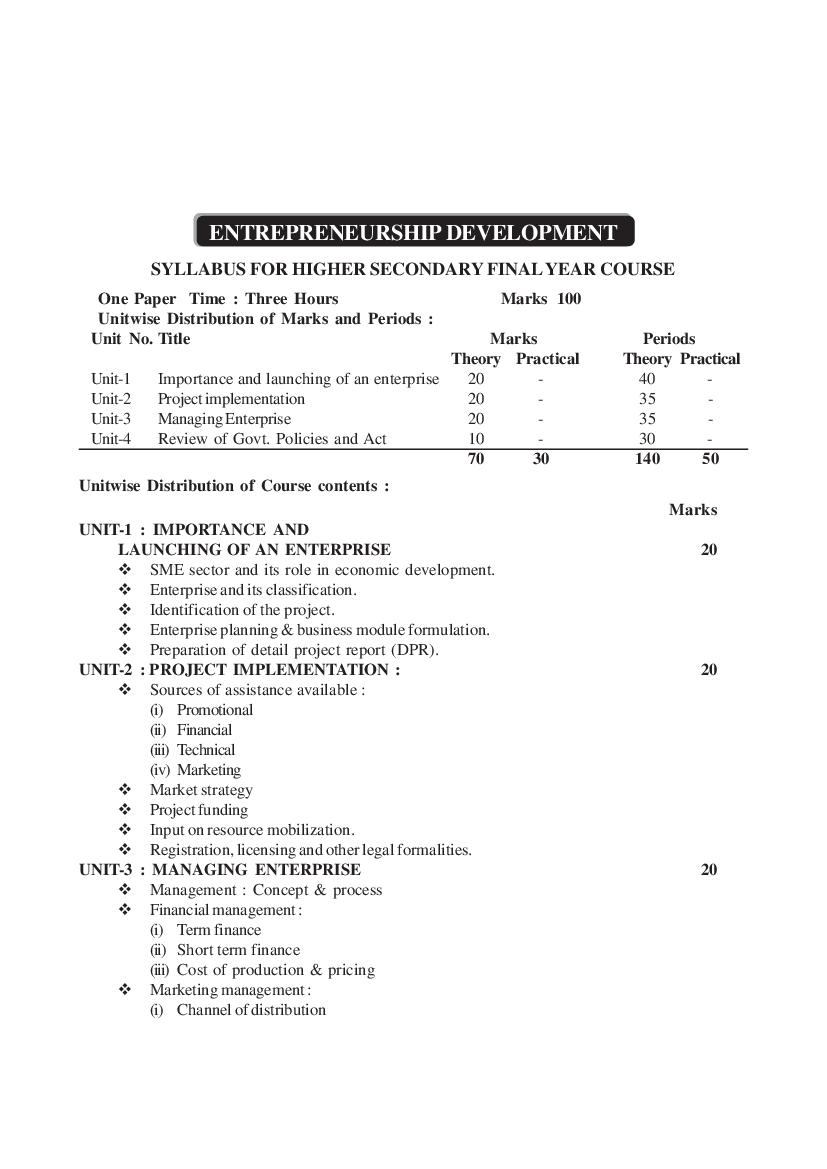
SYLLABUS FOR HIGHER SECONDARY FINAL YEAR COURSE
One Paper Time : Three Hours Marks 100
Unitwise Distribution of Marks and Periods :
Unit No. Title Marks Periods
Theory Practical Theory Practical
Unit-1 Importance and launching of an enterprise 20 - 40 -
Unit-2 Project implementation 20 - 35 -
Unit-3 Managing Enterprise 20 - 35 -
Unit-4 Review of Govt. Policies and Act 10 - 30 -
70 30 140 50
Unitwise Distribution of Course contents :
Marks
UNIT-1 : IMPORTANCE AND
LAUNCHING OF AN ENTERPRISE 20
SME sector and its role in economic development.
Enterprise and its classification.
Identification of the project.
Enterprise planning & business module formulation.
Preparation of detail project report (DPR).
UNIT-2 : PROJECT IMPLEMENTATION : 20
Sources of assistance available :
(i) Promotional
(ii) Financial
(iii) Technical
(iv) Marketing
Market strategy
Project funding
Input on resource mobilization.
Registration, licensing and other legal formalities.
UNIT-3 : MANAGING ENTERPRISE 20
Management : Concept & process
Financial management :
(i) Term finance
(ii) Short term finance
(iii) Cost of production & pricing
Marketing management :
(i) Channel of distribution
Page 2
(ii) Sales promotion technique
(iii) Product mix
Human resource management.
Operational management.
Record & Account management.
Taxation (Income tax/ VAT, CST, Excise duty etc.)
UNIT-4 REVIEW OF GOVERNMENT POLITICS AND ACT : 10
Industrial policies (since liberalization, 1991).
MSME Act 2006
EVALUATION : 30
Internal Assessment : (Practical) Preparation of individual bankable project report, Case
Study on successful as well as unsuccessful entrepreneur, industrial profile, performance of
local SME, marketing strategies of consumer durable etc.
External Assessment : (Theory) Written examination on the content of UNIT-1 to 4.
Marks of each UNIT should not be allocated so as to evaluate the total course as a whole.
NOTE TO THE TEACHERS :
ROLE OF TEACHER’S & EDUCATIONAL INSTITUTE
Teachers have to play the role of change agents. Their roles are more of Facilitator rather normal
teacher. The role of Trained Teacher will be very important in implementing Entrepreneurship subject
in their respective institutes. As it is known fact that trained teacher in the field of entrepreneurship
are very limited, it is imperative that educational institutions provide training on Entrepreneurship to selected
teachers by way of their participation in Teachers’ Training Programme (TTP)/ Faculty Development
Programme (FDP) on Entrepreneurship as mentioned. This apart, at least one member (teacher) must
be trained in a longer duration Entrepreneur Trainer-Motivators’ Programme. Subsequently, these teachers
may opt for further training in specialized areas of Entrepreneurship such as Business Opportunity Guidance
(BOG). Project Identification Formulation and Appraisal (PIFA), Marketing as well as Financial management
etc.
In order to create an environment within the educational institution for promoting entrepreneurship
among the students, the following initiatives are envisaged :
Teachers will be required to be out of the classroom for establishing institutional networking and
contacts required for getting external support.
High level of involvement of teachers is an aspect in developing Entrepreneurship among the students.
This is in turn, calls for putting in additional hours of effect of the part of the teachers apart from
normal working hours.
There is a need to establish a strong network among various organizations and agencies involved in
finance, infrastructure and technology infusion & upgradation etc. Such support system agencies are to be
taken into confidence while implementing ED activities in the educational institution.
Establishing contacts with entrepreneurs and industry associations would be beneficial while organizing
industrial visit, getting information on various products and also in placing the students in the industrial units for
the preparation of project reports.
A strong follow-up and monitoring mechanism is to be set up by the teachers. This will require a
Page 3
different type of approach through the Alumni Association since the students in science and technology stream
are at the national level.
A series of seminars, workshop, symposium and popular talk can be organized based on the needs of
the students who have just established or on the verge of establishing their enterprises. These short duration
activities can cover recent management techniques : expert procedures, patent, rules etc.
CREATING ENTREPRENEURSHIP AWARENESS
This is the path-breaking stage as it aims at making the students look at Entrepreneurship as on effective
alternative to a ‘White-collar job’. The following activities could be taken up for creating awareness about
entrepreneurship among the XII year students so that from very initial stage, they can focus their attention on
the option of setting up their own enterprises.
Creative Corner : A prominent place of the institution may be allotted to display information about
product, success stories of ‘high achievers’ and salient features of an Entrepreneurship Development Programme.
Forming an Entrepreneurship Forum : Those students, who are interested in Entrepreneurship, can
club-together and form a forum with the support from the faculty of the institutions. The forum can organize on
a continuous basis activities such as i) inviting achievers and successful entrepreneurs to talk to the students, ii)
elocution & essay compactions, iii) exhibitions on new products/ process and iv) video films on success
stories, products/ process, etc.
Trade Fair Visit : Interested students can be taken to trade fairs to collect information on industrial
products of their interest.
Seminars : One day seminars on ‘I can do it’ can be organized on business opportunities based on
available resources & skills and how these can be utilized in establishing business ventures.
Institutional Visit : Students visit to financial institutions, promotional organizations, industry associa-
tions, research institutions and banks would help them in collecting information on availability of finance,
technology, raw-materials and export potentials.
Establishment of a Commercial Activities Centre : The educational institutions can take up the
initiative to establish a ‘Commercial Activities Centre’ (CAC) within the institution. Such a centre may include
a stationery shop, canteen etc. to be run by the students or the members of Entrepreneurship forum. The main
objective of the CAC is to provide students ‘hand-on-experience’ of managing a commercial activity. Later
on, the Centre can extend its role by providing market opportunities for the products designed and produced
by the students. This will promote not only new initiatives among the students but also experimental learning in
Entrepreneurship.
***
Document Details
| Board / Org | Assam Board |
| Exam | Class 12 |
| Type | Syllabus |
| Pages | 3 |
| Updated | 22 Jul 2026 |