AHSEC 2nd Year Syllabus 2024-25 Fine Arts
Finished viewing? Save it for later —
Download AHSEC 2nd Year Syllabus 2024-25 Fine Arts (PDF · 4 pages)About AHSEC 2nd Year Syllabus 2024-25 Fine Arts
AHSEC 2nd Year Syllabus 2024-25 Fine Arts is available here for free download. Published by Assam Board for Class 12, this syllabus can be viewed online or downloaded as a PDF (4 pages). Candidates preparing for Class 12 can use AHSEC 2nd Year Syllabus 2024-25 Fine Arts to understand the exam pattern, the type of questions asked, and the overall difficulty level.
Frequently Asked Questions
How can I download AHSEC 2nd Year Syllabus 2024-25 Fine Arts?
Open this page and click the Download button to save AHSEC 2nd Year Syllabus 2024-25 Fine Arts as a PDF. It is completely free on AglaSem Docs.
Is AHSEC 2nd Year Syllabus 2024-25 Fine Arts free to download?
Yes. AHSEC 2nd Year Syllabus 2024-25 Fine Arts can be viewed online and downloaded as a PDF free of cost on AglaSem Docs.
How many pages does AHSEC 2nd Year Syllabus 2024-25 Fine Arts have?
AHSEC 2nd Year Syllabus 2024-25 Fine Arts contains 4 pages, which you can read online or download together as a single PDF.
Where can I find more Class 12 study material?
You can find more Class 12 question papers, sample papers, syllabus, and answer keys on AglaSem Docs.
AHSEC 2nd Year Syllabus 2024-25 Fine Arts – Text
Read the full text of this syllabus below — useful to quickly search, copy and reference the content online without downloading the PDF.
📄 View text version (4 pages)
Page 1
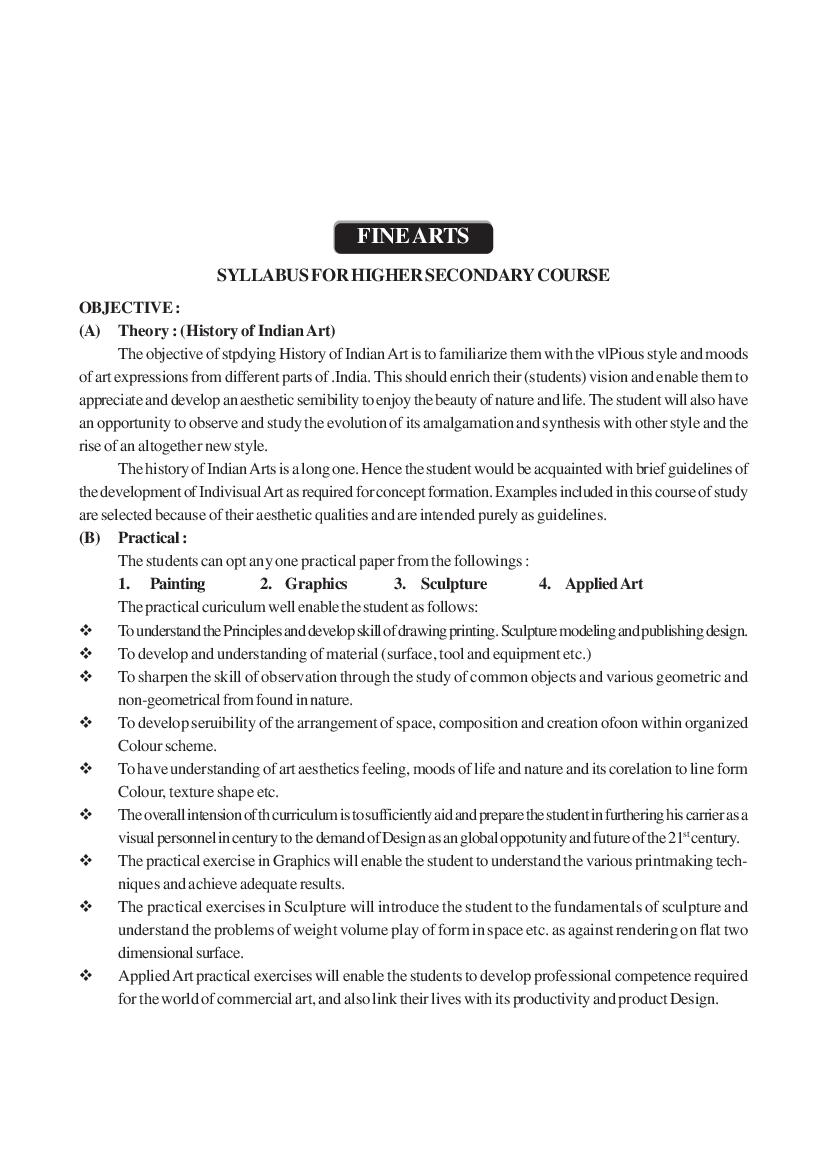
OBJECTIVE :
(A) Theory : (History of Indian Art)
The objective of stpdying History of Indian Art is to familiarize them with the vlPious style and moods
of art expressions from different parts of .India. This should enrich their (students) vision and enable them to
appreciate and develop an aesthetic semibility to enjoy the beauty of nature and life. The student will also have
an opportunity to observe and study the evolution of its amalgamation and synthesis with other style and the
rise of an altogether new style.
The history of Indian Arts is a long one. Hence the student would be acquainted with brief guidelines of
the development of Indivisual Art as required for concept formation. Examples included in this course of study
are selected because of their aesthetic qualities and are intended purely as guidelines.
(B) Practical :
The students can opt any one practical paper from the followings :
1. Painting 2. Graphics 3. Sculpture 4. Applied Art
The practical curiculum well enable the student as follows:
To understand the Principles and develop skill of drawing printing. Sculpture modeling and publishing design.
To develop and understanding of material (surface, tool and equipment etc.)
To sharpen the skill of observation through the study of common objects and various geometric and
non-geometrical from found in nature.
To develop seruibility of the arrangement of space, composition and creation ofoon within organized
Colour scheme.
To have understanding of art aesthetics feeling, moods of life and nature and its corelation to line form
Colour, texture shape etc.
The overall intension of th curriculum is to sufficiently aid and prepare the student in furthering his carrier as a
visual personnel in century to the demand of Design as an global oppotunity and future of the 21st century.
The practical exercise in Graphics will enable the student to understand the various printmaking tech-
niques and achieve adequate results.
The practical exercises in Sculpture will introduce the student to the fundamentals of sculpture and
understand the problems of weight volume play of form in space etc. as against rendering on flat two
dimensional surface.
Applied Art practical exercises will enable the students to develop professional competence required
for the world of commercial art, and also link their lives with its productivity and product Design.
Page 2
SYLLABUS FOR HIGHER SECONDARY FINAL YEAR COURSE
Unit No. Title Marks
Unit-1 The Rajasthani School of Miniature Painting 5
Unit-2 The Mughal School of Miniature Painting 10
Unit-3 Assamese Manuscript Pinting 5
Unit-4 The Bengal School of Painting
Unit-5 Contemporary trends in India Arts 10
Total 30
Unit-1 : The Rajasthani School of Miniature painting
th th
(16 Century A.D to 19 Century A.D)
(i) Introduction to Indian Miniature Schools with brood study of Rajasthani Schools,
Their origin, development and significant features.
(ii) Schools– Mewar, Ma1wa, Jaipur, Bundi, Katah, Bikaner, Kishangarh
(iii) Study of the following Rajasthani Paintings :
Title Painter School
Maru-Rangini Sahibdin Mewar
Radha (Bani-thani) Nihal Chand Kishangarh
Bharat Meets Rama Guman Jaipur
Unit-2 : The Mughal School of Miniature Painting
(16th Century AD to 19th Century AD)
(i) Introduction to the Mughal School of miniature painting with reference to the various Mughal
rulers and its origin, development and special futures developed under their ruler.
(ii) Study of the following Mughal painting.
Title Painter School
Krishna lifting mount Gobardhan Miskin Akbar
Baber crossing the river sone Jagannath Akbar
Jahangir holding the Picture of Madonna Abul Hussan Jahangir
Falcon on birds nest Ustab Mansoor Jahangir
Kabir and Raidas Ustad Fauirallah Shahjahan
Khan
Dara Shilah Mughal (oudh)
Unit-3 : Assamese Manuscript Painting :
(14th century to 20th century AD)
(i) Introduction and Background of the Assamese Manuscript painting in context to the saivite
movement of the Vaishnava saint Srimanta Shankardeva in Assam.
(ii) Origin, development and the main features.
(iii) Study of the following manuscript painting
Page 3
Title Painter School
Hastibidyarnava Di1bar
Chitra Bhagawata
(Lav Kushar Yudha)
Mahabharata subject Rajagharia/Royal School
Unit-4 : The Bengal School of Painting & Contemporary trends in India Arts :
(a) Evolution of the Indian National Flag (First-1906, Middl-1921 and Final-1947-the three stage)
Study of the form and the colour scheme,
(b) 1. Introduction to Bengal school of painting with understanding of origin, Development and
main futures of the school.
2. Contribution of Indian Artist in the struggle for National Freedom Movements.
3. Study of the fol1owing Artist and their painting.
(a) Raja Ravi Vcrma
(b) Abanindra Nath Tagore
(c) Rabindra Nath Tagore
(d) Nandalal Bose
(e) Amrita Sher Gill
Unit-5 : The Contemporary Trends in Indian Art– Study of the following Artists :
(a) Binod Behari Mukherjee
(b) Ramkinker Baij
(c) M.F. Hussain
(d) Somenath Hore
(e) Mukta Bordoloi
(f) Asu Deb
(g) Sobha Brahma
(h) Romesh Ghosh
(i) Troilokya Dutta
(j) Neelpawan Barua
(k) Benu Mishra
(1) Pranab Baruah
Note : The names of the artists and their works as listed above are only suggested and the teachers
should expand it according to their own resources. However the questions will be set from
the above mentioned only.
SYLLABUS FOR FINE ARTS PRACTICAL
Painting
Time : Six hours Full Marks- 70 Pass Marks-28
Unit No. Title Marks
Unit-1 Nature/Object study 15
Unit-2 Painting and composition 30
Unit-3 Sessional work 25
Total 70
Page 4
Unit-1 : Nature/Object study :
(i) Study of fowers and foliages and plants, vegetable etc. Objects of nature are to be studied
in detail like trees, big/small and the landscapes in its environrnent details and colour hues.
(ii) Nature study in pen and ink, Pastel and water colour/ Tempera
Unit-2 : Painting and Composition :
(i) Study of objects relating to geometric fomls/ basic forms (like sphere, cone, cubes, cylinder)
in watercolour, pastel and oil painting from a fixed View point.
(ii) Sketches from life and composition done with mediums like– oil pastel and watercolour, and
oil colours. Emphasis must be given to creative compositions.
Unit-3 : Sessional work :
(i) Five selected nature and objects of study exercised in drawing and in any medium done
during the session and including 2 (Two) Nature studies/ Landscapes.
(ii) Two selected works of Painting done during the year
These paintings and selected works are to be certified by the school authorities that it has
been executed by the student and is to be placed before the external examiners for assessment.
Note: The timetable is to be framed in such a way so as to allow the student to work continuously
for a maximum of two periods at a stretch.
Format of the question :
Unit-1 : Nature/Object study :
Draw and paints the still life or the group of object arrange before you from a fixed point of
view on the drawing paper (½ imperial size/full imperial size) in pencil. The drawing should be
proportionate to paper size. The objects should be painted in realistic manner with proper light
shade and perspective.
Note : The group of object is to be decided by the external and internal examiner jointly and the
arrangement for nature study/object study is to be arranged before the candidates. The selection
of objects should be in such a war the natural and geometrical forms may be covered by the
groups of objects. Any objects relating to nature and in accordance to availability of season and
location may included. Two draperies in different colours, one light, the other is to be included
in the background keeping in view the colours and tones of objects chosen study.
Unit-2 : Painting and Composition
Question Format
Make of painting composition on any one of the following five subjects on any medium as oil
pastel, Acrylic or oil paintmg of your chcice in the paper size/ canvas provided. The composition
should be original andd effective. Weight age will be given to a well-composed drawing and effective
use off the medium. Creativity is a must at this stage.
Note : Any five subjects for painting will be decided by the Paper Setter. The question should be
according to the standard of class XII & natural environment of Assam.
General Instruction to Examiners :
The candidates must be given one-hour break after first three hours.
The work of candidate is to be evaluated jointly by eeternal & internal examiners and duly sign
by both jointly.
Document Details
| Board / Org | Assam Board |
| Exam | Class 12 |
| Type | Syllabus |
| Pages | 4 |
| Updated | 22 Jul 2026 |