HBSE Class 12 Sample Paper 2026 Answers Computer Science
Finished viewing? Save it for later —
Download HBSE Class 12 Sample Paper 2026 Answers Computer Science (PDF · 14 pages)About HBSE Class 12 Sample Paper 2026 Answers Computer Science
HBSE Class 12 Sample Paper 2026 Answers Computer Science is available here for free download. Published by Haryana Board for Class 12, this answer key can be viewed online or downloaded as a PDF (14 pages). Candidates preparing for Class 12 can use HBSE Class 12 Sample Paper 2026 Answers Computer Science to understand the exam pattern, the type of questions asked, and the overall difficulty level.
Frequently Asked Questions
How can I download HBSE Class 12 Sample Paper 2026 Answers Computer Science?
Open this page and click the Download button to save HBSE Class 12 Sample Paper 2026 Answers Computer Science as a PDF. It is completely free on AglaSem Docs.
Is HBSE Class 12 Sample Paper 2026 Answers Computer Science free to download?
Yes. HBSE Class 12 Sample Paper 2026 Answers Computer Science can be viewed online and downloaded as a PDF free of cost on AglaSem Docs.
How many pages does HBSE Class 12 Sample Paper 2026 Answers Computer Science have?
HBSE Class 12 Sample Paper 2026 Answers Computer Science contains 14 pages, which you can read online or download together as a single PDF.
Where can I find more Class 12 study material?
You can find more Class 12 question papers, sample papers, syllabus, and answer keys on AglaSem Docs.
HBSE Class 12 Sample Paper 2026 Answers Computer Science – Text
Read the full text of this answer key below — useful to quickly search, copy and reference the content online without downloading the PDF.
📄 View text version (14 pages)
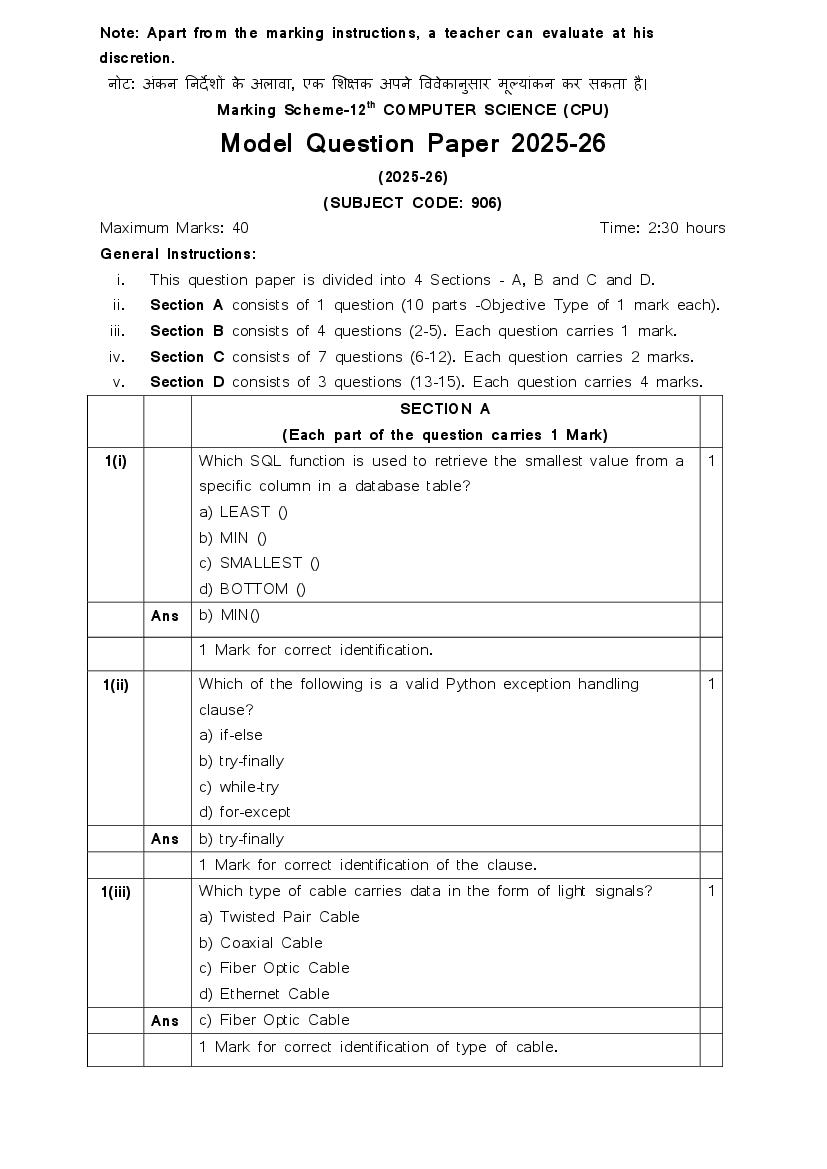
Page 1
discretion.
नोट: अंकन ननर्दे शों के अलावा, एक शशक्षक अपने वववेकानस
ु ार मल
ू ्ांकन कर सकता है ।
Marking Scheme-12th COMPUTER SCIENCE (CPU)
Model Question Paper 2025-26
(2025-26)
(SUBJECT CODE: 906)
Maximum Marks: 40 Time: 2:30 hours
General Instructions:
i. This question paper is divided into 4 Sections - A, B and C and D.
ii. Section A consists of 1 question (10 parts -Objective Type of 1 mark each).
iii. Section B consists of 4 questions (2-5). Each question carries 1 mark.
iv. Section C consists of 7 questions (6-12). Each question carries 2 marks.
v. Section D consists of 3 questions (13-15). Each question carries 4 marks.
SECTION A
(Each part of the question carries 1 Mark)
1(i) Which SQL function is used to retrieve the smallest value from a 1
specific column in a database table?
a) LEAST ()
b) MIN ()
c) SMALLEST ()
d) BOTTOM ()
Ans b) MIN()
1 Mark for correct identification.
1(ii) Which of the following is a valid Python exception handling 1
clause?
a) if-else
b) try-finally
c) while-try
d) for-except
Ans b) try-finally
1 Mark for correct identification of the clause.
1(iii) Which type of cable carries data in the form of light signals? 1
a) Twisted Pair Cable
b) Coaxial Cable
c) Fiber Optic Cable
d) Ethernet Cable
Ans c) Fiber Optic Cable
1 Mark for correct identification of type of cable.
Page 2
a) Adware
b) Trojan
c) Repeater
d) Worm
Ans c) Repeater
1 Mark for correct identification.
1(v) Full form of SMTP is ____________________ Protocol. 1
Ans Simple Mail Transfer
1 Mark for writing the correct Full Form.
1(vi) ________________ is the largest type of network that spans over 1
countries or even continents.
Ans WAN or Wide area Network
1 Mark for writing the correct type of network.
Note: Do not deduct mark for any spelling mistakes.
1(vii) Mesh topology is more expensive than other topologies because 1
of its high cable requirement. (True/False)
Ans True
1 Mark for correct identification.
1(viii) In a queue, the insertion of elements happens at the front end, 1
and the deletion occurs at the rear end. (True/False)
Ans False
1 Mark for correct identification.
Direction: In the questions given below, there are two statements
marked as Assertion (A) and Reason (R). Choose the correct
option out of the choices given below in each question:
1(ix) Assertion (A): A stack follows the LIFO (Last In, First Out) 1
principle.
Reason (R): In a stack, the element inserted first is always
removed first.
a) Both (A) and (R) are true, and (R) is the correct explanation
of (A).
b) Both (A) and (R) are true, but (R) is not the correct
explanation of (A).
c) (A) is true, but (R) is false.
d) (A) is false, but (R) is true.
Ans c) (A) is true but (R) is false.
Page 3
1(x) Assertion (A): A router is used to connect multiple networks and 1
direct data packets between them.
Reason (R): A router operates only within a Local Area Network
(LAN).
a) Both (A) and (R) are true, and (R) is the correct explanation
of (A).
b) Both (A) and (R) are true, but (R) is not the correct
explanation of (A).
c) (A) is true, but (R) is false.
d) (A) is false, but (R) is true.
Ans c) (A) is true but (R) is false.
1 Mark for correct identification.
SECTION B
(Each question carries 1 mark)
2. What is the syntax of the close() method in Python while working 1
with files?
Ans Syntax for close()
file.close()
1 mark for correct syntax.
deduct ½ marks for each syntactical mistake.
3. What does the INSERT command do in SQL? 1
Ans The INSERT command in SQL is used to add new records
(rows) into a table.
1 Mark for correct usage of INSERT Command.
4. What is stack in data structure? 1
Ans A stack is a linear data structure that follows the LIFO (Last In,
First Out) principle, where the last item added is the first to be
removed.
1 mark for any correct definition of Stack.
5. Write the names of any two commonly used networking devices. 1
Ans Router
Switch
Hub
Modem
Network Interface Card (NIC)
OR
Any other network device other then above.
Page 4
Do not deduct marks for spelling mistakes.
OR
What do you understand by the term computer network?
Ans Two or more computers connected to share resources is called a
computer network.
1 mark for any correct definition of computer network.
SECTION C
(Each question carries 2 marks)
6. Case Study Question: 2
Rahul recently downloaded a free game from an unknown
website. After installing it, he noticed his computer slowed down
significantly. On further inspection, he found that the game was
silently running other unknown programs in the background and
sending unusual data over the internet.
(i) What type of malware is most likely responsible for this
behaviour?
a) Worm
b) Spyware
c) Trojan
d) Ransomware
Ans c) Trojan
1 Mark for correct identification.
(ii) What is a common purpose of this malware?
a) To display unwanted ads
b) To steal personal data or control the system secretly
c) To demand money for unlocking files
d) To delete important files
b) To steal personal data or control the system secretly
1 Mark for correct identification.
7. How is a Spyware different from an adware? 2
Ans Differences between Spyware and Adware:
Spyware
1. Secretly collects and sends user information without
consent.
Page 5
sensitive data.
Adware
1. Displays unwanted advertisements to the user.
2. Mainly designed to generate revenue by showing ads, not
necessarily to steal data.
1 mark each for any correct difference between the two. (Max 2
differences)
8. Describe any two SQL aggregate functions with examples. 2
Ans SQL Aggregate Functions
SUM(): Calculates the total sum of a numeric column.
Example:
SELECT SUM(Salary) FROM Employees;
This query calculates the total salary of all employees.
COUNT(): Counts the number of rows in a column or table.
Example:
SELECT COUNT(*) FROM Employees;
This query counts the total number of employees in the table.
AVG(): Calculates the average value of a numeric column.
Example:
SELECT AVG(Salary) FROM Employees;
This query calculates the average salary of employees.
MIN(): Finds the minimum value in a column.
Example:
SELECT MIN(Salary) FROM Employees;
This query finds the lowest salary among employees.
MAX(): Finds the maximum value in a column.
Example:
SELECT MAX(Salary) FROM Employees;
This query finds the highest salary among employees.
½ marks for any correct aggregate functions name.
½ marks for correct definition of the above functions.
1 mark for correct example of the respective functions stated
above (1/2 marks each).
Do not deduct marks for any spelling mistakes.
OR
Page 6
products being sold in a grocery shop.
PCode PName UPrice Manufacturer
Washing
P01 120 Surf
Powder
P02 Toothpaste 54 Colgate
P03 Soap 25 Lux
P04 Toothpaste 65 Pepsodent
P05 Soap 38 Dove
P06 Shampoo 245 Sunsilk
Write an SQL query to create the "Product" table with appropriate
data types including primary key declaration.
Ans SQL Query to Create the "Product" Table:
CREATE TABLE Product
(
PCode VARCHAR (5) NOT NULL PRIMARY KEY,
PName VARCHAR (50) NOT NULL,
UPrice INT NOT NULL,
Manufacturer VARCHAR (50) NOT NULL
);
2 marks for correct SQL query with correct syntax.
Deduct ½ mars for each syntax error.
9. When is the ImportError built-in exception raised? Provide an 2
example to support your answer.
Ans a) ImportError:
This error occurs when you try to import a module that doesn't
exist or is not found in the Python environment.
Example:
import non_existent_module # This will raise ImportError
because the module doesn't exist
1 Mark for any correct explanation of ImportError build-in
exception.
1 Mark for correct example.
10. Explain any two network topologies. 2
Ans Different types of network topologies:
1. Bus Topology: All devices are connected to a single
central cable (the bus). Data sent by one device is
Page 7
implement but can be inefficient with many devices.
2. Star Topology: All devices are connected to a central hub
or switch. Data travels through the hub to reach the
destination device. It is easy to manage and scale, but if
the hub fails, the entire network is affected.
3. Ring Topology: Devices are connected in a circular
fashion, and data travels in one direction around the ring.
Each device has exactly two neighbors. It provides efficient
data transfer, but a failure in any device can disrupt the
whole network.
4. Mesh Topology: Every device is connected to every other
device. This provides high redundancy and reliability, as
multiple paths exist for data to travel. However, it requires
more cabling and can be complex to manage.
5. Hybrid Topology: A combination of two or more different
types of topologies (e.g., star and bus). This can take
advantage of the strengths of different topologies to suit
specific network requirements.
6. Tree Topology: A variation of the star topology, where
groups of star-configured networks are connected to a
central bus or backbone. This structure is scalable and
hierarchical, making it suitable for large networks.
½ marks each for naming any correct network topology.
½ marks each for any correct definition of respective topology.
Full marks to draw diagrams with details even without
explanation.
11. Define the following: 2
a) Throwing an exception
b) Catching an exception
Ans a) Throwing an exception: It means signaling an error in the
program using the throw keyword.
b) Catching an exception: It means handling an error using a
try-catch block to prevent the program from crashing.
1 mark for any correct explanation of throwing an exception.
1 mark for any correct explanation of catching an exception.
Give ½ marks each if the student writes only keywords and not
explain the exceptions.
OR
Write the file mode in python that will be used for opening the
following files.
Page 8
b) A binary file "bfile.dat" in write mode.
Ans a) A text file "example.txt" in both read and write mode:
File mode: 'r+'
b) A binary file "bfile.dat" in write mode:
File mode: 'wb'
1 Mark each for writing correct file modes.
12. Case Study Question: 2
Priya is attending her online class through a video conferencing
app. During the session, her video and audio keep buffering. She
checks her internet speed and finds that her current download
speed is only 512 Kbps, which is much lower than the required
speed for smooth streaming.
(i) What does Kbps stand for?
a) KiloBytes per second
b) KiloBits per second
c) KiloBeams per second
d) KiloBauds per second
Ans b) KiloBits per second
1 Mark each for correct identification.
(ii) Which of the following speeds is higher than 512 Kbps?
a) 256 Kbps
b) 128 Kbps
c) 1 Mbps
d) 64 Kbps
Ans c) 1 Mbps
1 Mark each for correct identification.
SECTION D
(Each question carries 4 Mark)
13. Write a Python program to implement a queue. 4
# Initialize an empty list to represent the queue
Ans queue = [ ]
# Function to insert an element into the queue (enqueue)
def enqueue(element):
queue.append(element)
print(f'{element} added to the queue')
# Function to remove an element from the queue (dequeue)
def dequeue():
if len(queue) < 1:
print("Queue is empty! Cannot dequeue.")
return None
else:
Page 9
print(f'{removed_element} removed from the queue')
# Add elements to the queue (enqueue)
enqueue("P1")
enqueue("P2")
enqueue("P3")
# Display the current state of the queue
print("Current queue:", queue)
# Remove elements from the queue (dequeue)
dequeue()
dequeue()
# Display the current state of the queue after deletion
print("Current queue after dequeue:", queue)
# Try to dequeue when the queue is empty
dequeue()
Sample Output:
P1 added to the queue
P2 added to the queue
P3 added to the queue
Current queue: ['P1', 'P2', 'P3']
P1 removed from the queue
P2 removed from the queue
Current queue after dequeue: ['P3']
Queue is empty! Cannot dequeue.
2 Marks for Enqueue/ Inserting element operation in queue in any
program.
2 Marks for Dequeue/ Deleting element operation in queue in any
program.
Deduct ½ marks if there is any syntax error while writing
program.
Give 1 mark if only diagrams or example is given.
OR
Explain the concept of selection sort with an example.
Selection sort:
It is a simple and efficient sorting algorithm that works by
repeatedly selecting the smallest (or largest) element from
the unsorted portion of the list and moving it to the sorted
portion of the list.
The algorithm repeatedly selects the smallest (or largest)
element from the unsorted portion of the list and swaps it
with the first element of the unsorted portion.
Page 10
of the list until the entire list is sorted.
Let us consider the following array as an example:
{64, 25, 12, 22, 11}
First pass:
For the first position in the sorted array, the whole array is
traversed from index 0 to 4 sequentially. The first position
where 64 is stored presently, after traversing whole array it is
clear that 11 is the lowest value.
64 25 12 22 11
Thus, replace 64 with 11. After one iteration 11, which happens
to be the least value in the array, tends to appear in the first
position of the sorted list.
11 25 12 22 64
Second Pass:
For the second position, where 25 is present, again traverse the
rest of the array in a sequential manner.
11 25 12 22 64
After traversing, we found that 12 is the second lowest value in
the array and it should appear at the second place in the array,
thus swap these values.
11 12 25 22 64
Third Pass:
Now, for third place, where 25 is present again traverse the rest
of the array and find the third least value present in the array.
11 12 25 22 64
While traversing, 22 came out to be the third least value and it
should appear at the third place in the array, thus swap 22 with
element present at third position.
Page 11
Fourth pass:
Similarly, for fourth position traverse the rest of the array and find
the fourth least element in the array
As 25 is the 4th lowest value hence, it will place at the fourth
position.
11 12 22 25 64
Fifth Pass:
At last the largest value present in the array automatically get
placed at the last position in the array
The resulted array is the sorted array.
11 12 22 25 64
1 mark for any correct definition of selection sort.
3 marks for correctly explaining the concept of selection sort with
example.
Deduct 1/2 marks for each mistake in any step/pass.
Do not deduct any marks if explained correctly and no definition
is given.
14. What is RDBMS? Explain the following terms in the context of 4
the relational data model:
i) Domain
ii) Tuple
iii) Relation
Ans RDBMS (Relational Database Management System):
An RDBMS is a system used to store and manage data in
tables, which are organized into rows and columns. It helps in
easily retrieving, updating, and managing large amounts of data.
Examples of RDBMS include MySQL, Oracle, and SQL Server.
i) Domain:
A domain is the set of possible values that a column (attribute) in
a table can have. For example, the domain of an Age column
could be any number between 0 and 150.
ii) Tuple:
A tuple is a single row in a table. It contains all the data for one
record. For example, in a table of students, one tuple might
include (101, "John", 20) as a student's information.
Page 12
A relation is a table in a database. It consists of rows (tuples)
and columns (attributes). Each relation (table) stores data about a
specific topic, like a table for students or employees.
½ marks for full form and ½ marks for any correct definition of
RDBMS.
1 mark each for any correct explanation of domain, tuple and
relation each.
½ marks each if only example is given for these terms without
their definitions.
Ignore any spelling mistakes in Hindi as well as in English if the
meaning of the word is understood.
OR
The XYZ School maintains records of its students and their
subjects in two tables: STUDENT and SUBJECT. The tables
contain the following data:
STUDENT Table:
RollNumber Name Address Grade StudentID
1001 Aarav Delhi A S001
1002 Riya Noida B S002
1003 Rahul Gurgaon A S003
SUBJECT Table:
StudentID SubjectName Marks
S001 Math 85
S001 Science 90
S002 English 75
S003 History 80
a) Identify the candidate key/s in the STUDENT table.
b) Write an SQL query to retrieve the SubjectName and Marks
for all subjects of the student with StudentID S001.
c) What is the degree of the SUBJECT table?
d) What is the cardinality of the STUDENT table?
Ans a) The StudentID is the candidate key.
Page 13
subjects of the student with StudentID S001:
SELECT SubjectName, Marks
FROM SUBJECT
WHERE StudentID = 'S001';
c) The degree of the SUBJECT table is 3.
d) The cardinality of the STUDENT table is 3.
1 mark each for each correct answer.
15. What do you understand by Data Transfer Rate (DTR)? Explain 4
the different units of data transfer rate, such as bps, Kbps, Mbps,
Gbps, and Tbps. Also, explain how increasing the bandwidth of a
network affects the DTR.
Ans Data Transfer Rate (DTR): Data Transfer Rate (DTR) refers to
the speed at which data is transmitted over a network or between
devices. It is typically measured in bits per second (bps) and
indicates how much data can be transferred in a given amount of
time.
Different Units of Data Transfer Rate:
1. bps (bits per second):
The basic unit of data transfer rate, representing one bit of
data transferred per second. A speed of 100 bps means
100 bits of data are transferred per second.
2. Kbps (kilobits per second):
1 Kbps equals 1,000 bits per second. It is used for lower
data transfer rates.
3. Mbps (megabits per second):
1 Mbps equals 1,000,000 bits per second. It is commonly
used for broadband and high-speed internet connections.
4. Gbps (gigabits per second):
1 Gbps equals 1,000,000,000 bits per second. It is used in
high-performance networks such as fiber optics.
5. Tbps (terabits per second):
1 Tbps equals 1,000,000,000,000 bits per second. It is
typically used in large-scale data centers and advanced
network infrastructure.
Effect of Increasing Bandwidth on DTR: When the bandwidth of
a network is increased, the data transfer rate (DTR) also
increases.
1 mark for any correct definition of Data Transfer Rate.
Page 14
Units.
½ marks for the relation between bandwidth and DTR.
OR
Write short note on the following:
a) FTP
b) Bluetooth
c) HTTP
d) Wi-Fi
a) FTP (File Transfer Protocol):
FTP is a protocol used for transferring files between a client and
a server over a network. It allows users to upload, download, and
manage files remotely. Example: Transferring files from a
computer to a web server.
b) Bluetooth:
Bluetooth is a wireless technology that allows devices to
communicate with each other over short distances (up to 100
meters). It is commonly used for connecting devices like
headphones, speakers, and smartphones.
c) HTTP (HyperText Transfer Protocol):
HTTP is a protocol used for transferring data over the web. It
allows web browsers to request and display web pages from
servers. Example: When you enter a website address, your
browser uses HTTP to retrieve the page.
d) Wi-Fi (Wireless Fidelity):
Wi-Fi is a type of network that uses wireless communication to
connect devices like laptops, smartphones, and printers within a
limited area, such as a home or office.
1 mark for any correct explanation of FTP.
1 mark for any correct explanation of Bluetooth.
1 mark for any correct explanation of HTTP.
1 mark for any correct explanation of Wi-Fi.
Give ½ marks each only if full form is given without definition for
FTP, HTTP and Wi-Fi.
Document Details
| Board / Org | Haryana Board |
| Exam | Class 12 |
| Type | Sample Paper |
| Pages | 14 |
| Updated | 24 Sep 2026 |