Manipur Board Class 11 Syllabus 2027 History
Finished viewing? Save it for later —
Download Manipur Board Class 11 Syllabus 2027 History (PDF · 7 pages)About Manipur Board Class 11 Syllabus 2027 History
Manipur Board Class 11 Syllabus 2027 History is available here for free download. Published by Manipur Board for Class 11, this syllabus can be viewed online or downloaded as a PDF (7 pages). Candidates preparing for Class 11 can use Manipur Board Class 11 Syllabus 2027 History to understand the exam pattern, the type of questions asked, and the overall difficulty level.
Frequently Asked Questions
How can I download Manipur Board Class 11 Syllabus 2027 History?
Open this page and click the Download button to save Manipur Board Class 11 Syllabus 2027 History as a PDF. It is completely free on AglaSem Docs.
Is Manipur Board Class 11 Syllabus 2027 History free to download?
Yes. Manipur Board Class 11 Syllabus 2027 History can be viewed online and downloaded as a PDF free of cost on AglaSem Docs.
How many pages does Manipur Board Class 11 Syllabus 2027 History have?
Manipur Board Class 11 Syllabus 2027 History contains 7 pages, which you can read online or download together as a single PDF.
Where can I find more Class 11 study material?
You can find more Class 11 question papers, sample papers, syllabus, and answer keys on AglaSem Docs.
Manipur Board Class 11 Syllabus 2027 History – Text
Read the full text of this syllabus below — useful to quickly search, copy and reference the content online without downloading the PDF.
📄 View text version (8 pages)
Page 1
Manipur Board Class
11 Syllabus 2027
History
EXAM YEAR TYPE SUBJECT
Manipur Class 11 2027 Syllabus History
Notes · Sample Papers · Previous Year Papers · Mock Tests
Page 2
m .co
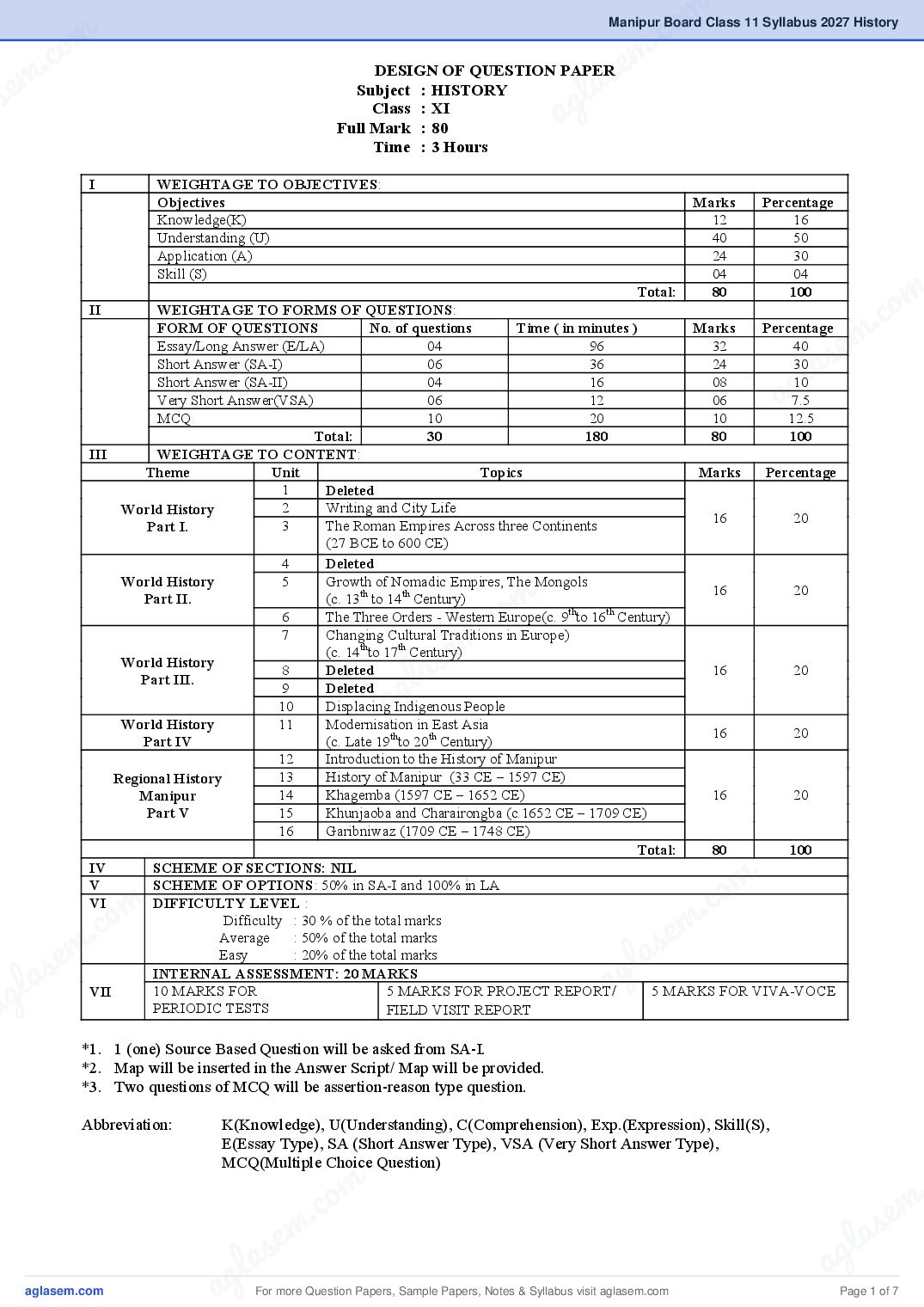
m .co DESIGN OF QUESTION PAPER
s e m
se Subject : HISTORY
g l a
Class : XI
Full Mark : 80 a
Time : 3 Hours
I WEIGHTAGE TO OBJECTIVES:
Objectives Marks Percentage
Knowledge(K) 12 16
Understanding (U) 40 50
Application (A) 24 30
Skill (S) 04 04
m
.co
Total: 80 100
II
m
WEIGHTAGE TO FORMS OF QUESTIONS:
.co m
FORM OF QUESTIONS No. of questions Time ( in minutes ) Marks Percentage
Essay/Long Answer (E/LA)
m
04 96 32 40
s e
s e
Short Answer (SA-I) 06 36 24 30
l a
a ag
Short Answer (SA-II) 04 16 08 10
g l
Very Short Answer(VSA) 06 12 06 7.5
a
MCQ
Total:
10
30
20
180
10
80
12.5
100
III WEIGHTAGE TO CONTENT:
Theme Unit Topics Marks Percentage
1 Deleted
World History 2 Writing and City Life
16 20
Part I. 3 The Roman Empires Across three Continents
(27 BCE to 600 CE)
4 Deleted
World History 5 Growth of Nomadic Empires, The Mongols
(c. 13th to 14th Century)
m 16 20
.co
Part II.
6 The Three Orders - Western Europe(c. 9thto 16th Century)
7
m
Changing Cultural Traditions in Europe)
e
World History
8 Deleted
las
(c. 14thto 17th Century)
16 20
Part III.
9
10
Deleted
ag
Displacing Indigenous People
World History 11 Modernisation in East Asia
16 20
Part IV (c. Late 19thto 20th Century)
12 Introduction to the History of Manipur
Regional History 13 History of Manipur (33 CE – 1597 CE)
Manipur 14 Khagemba (1597 CE – 1652 CE) 16 20
Part V 15 Khunjaoba and Charairongba (c.1652 CE – 1709 CE)
16 Garibniwaz (1709 CE – 1748 CE)
Total: 80 100
IV SCHEME OF SECTIONS: NIL
m
.co
V SCHEME OF OPTIONS: 50% in SA-I and 100% in LA
VI
m DIFFICULTY LEVEL :
m .co Difficulty : 30 % of the total marks
Average : 50% of the total marks
s e m
s e Easy : 20% of the total marks
g l a
g la VII
INTERNAL ASSESSMENT: 20 MARKS
10 MARKS FOR 5 MARKS FOR PROJECT REPORT/ a 5 MARKS FOR VIVA-VOCE
a PERIODIC TESTS FIELD VISIT REPORT
*1. 1 (one) Source Based Question will be asked from SA-I.
*2. Map will be inserted in the Answer Script/ Map will be provided.
*3. Two questions of MCQ will be assertion-reason type question.
Abbreviation: K(Knowledge), U(Understanding), C(Comprehension), Exp.(Expression), Skill(S),
E(Essay Type), SA (Short Answer Type), VSA (Very Short Answer Type),
MCQ(Multiple Choice Question)
m .
.co s e m
s em l a
g la ag
a For more Question Papers, Sample Papers, Notes & Syllabus visit Page 1 of 7
Page 3
CLASS : XI
80 Marks
Theme Unit / Topics Objectives Periods Marks
I. Deleted
II. Writing and City Life Learners to
(a) Growth of town - describe the emergence of towns 5
(b) Nature of Early Urban Cities - state the life in the cities
World
History
III. The Roman Empires Across Three Learners will
Part-I 16
Continents (c. 27 BCE to 600 CE) - describe the circumstances that led
(a) Political Evolution emergence of the Roman Empire
(b) Economic Expansion - explain the political, social and 10
(c) Religion economic activities of the Roman
(d) Late Antiquity Empire
(e) Prevailing Institutions of Slavery
IV. Deleted
V. Growth of Nomadic empire 10
The Mongol (c. 13th – 14th Century)
World
History
VI. The Three Orders – Western Europe Learners will 16
Part-II
(c. 9th – 16th Century) - highlight the nature of feudalism
(a) Feudal Society and Economy - state the society under the Church 10
(b) Formation of States
(c) Church and Society
VII. Changing Cultural Traditions in Europe) Learners will
(c. 14th -17 th Century) - outline the cause of Renaissance
(a) New ideas and new trends in literature - describe the changes in life under
and arts Renaissance 10
World (b) Relationship with other ideas
History (c) The Contribution of West Asia
16
Part-III
VIII. Deleted
IX. Deleted
X. Displacing Indigenous People 10
XI. Modernisation in East Asia Learners to
World (c. Late 19th -20 th Century) - describe the impact of
History (a) Militarisation and economic growth in industrialisation in Japan 15 16
Part-IV Japan - explain the causes of the success of
(b) China and Communist alternative. Communist in China
For more Question Papers, Sample Papers, Notes & Syllabus visit Page 2 of 7
Page 4
m .co
m .co s e m
se g l a
a
World
History XII. Introducing To History of Manipur
Part-V (a) Natural vegetation of Manipur - will state the geographical 2
feature
(b) The people of Manipur - will state the different
people inhabiting Manipur.
m
.co
(c) Consolidation of the Ningthouja power - to describe how the Ningthouja
o m consolidated its power
3
m
. c - to explain Manipur’s relation with
s e
e m
(d) Manipur’s relation with the rest of India other parts of India
l a
l as ag
ag XIII. (a)History of Manipur (c. 33 CE – 1597 CE) - will describe the political
Political activity of the period activity of the period
3
(b) External relation - to state Manipur’s relation with
Burma, Assam, etc.
XIV. Khagemba, (1597 CE – 1652 CE) - to state the political activity under
(a) Political activity under Khagemba Khagemba
(b) Administrative function - will describe the change in social 3 16
(c) Social and economic reform under and economic activity
Khagemba
m
.co
XV. Khunjaoba To Charairongba
s em - will describe the political
la
(1652 CE – 1709 CE) activity of the period
(b) Development works ag
(a) Political activity of the period - to state developmental
works carried out by the kings
3
(c) Contact with other parts of India - to explain relation with other parts
(d) Relation with the inhabitants of hills of India
(e) External relations - will state external relations
(f) Developments works - to describe developmental 3
works
VI. Garibniwaz, (1709 CE – 1748 CE) - to describe political activity of the
(a) Political activity of the period period
m
.co
(b) External relation - will state external relation 3
m
.co
(c) Social, Cultural and Religious changes - to describe developmental
works. e m
e m l as
las ag Total 90 80
ag
PRESCRIBED TEXTBOOK :
Themes in World History and Regional History (Manipur)
Textbook for Class XI
Published by: Council of Higher Secondary Education, Manipur.
REFERENCE BOOK :
m
Themes in World History ( Textbook in History for Class XI)
.
.co
Published by: NCERT, New Delhi.
s e m
s em l a
g la ag
a For more Question Papers, Sample Papers, Notes & Syllabus visit Page 3 of 7
Page 5
History is one of the most important disciplines in school education. It is the study of
the past, which helps us to understand our present and shape our future. It promotes the
acquisition and understanding of historical knowledge in breath and in depth across cultures.
The course of history in senior secondary classes is to enable to students to know that history
is a critical discipline, a process of enquiry, a way of knowing about the past rather than just a
collection of facts. The syllabus helps them to understand the process, through which a
historian collects, chooses, scrutinizes and assembles different types of evidences to write
history. The syllabus in class-XI is organized around some major themes in world history. In
class XII the focus shifts to a detailed study of some themes in ancient, medieval and modern
Indian history. Council of HrSecondary education, Manipur has decided to introduce project
work in history for classes XI and XII in 2026-27 as a part of regular studies in classroom, as
project work gives students an opportunity to develop higher cognitive skills. It takes students
to a life beyond text books and provides them a platform to refer materials, gather
information, analyse it further to obtain relevant information and decide what matter to keep
and hence understand how history is constructed.
OBJECTIVES: - Project work will help students: -
To develop skills to gather data from a variety of sources investigate diverse viewpoints
and arrive at logical deductions.
To develop skills to comprehend, analyse, interpret, evaluate historical evidence and also
understand the limitations of historical evidence.
To develop 21st century managerial skills of co-ordination, self-direction and time
management.
To give a multidisciplinary approach to topics.
To learn to work on diverse cultures, races, religions and lifestyles
. To learn through constructivism a theory based on observation and scientific study.
To inculcate a spirit of inquiry and research.
To communicate data in the most appropriate form using a variety of techniques.
To provide greater opportunity for interaction and exploration.
To understand contemporary issues in context to our past.
For more Question Papers, Sample Papers, Notes & Syllabus visit Page 4 of 7
Page 6
m .co
m .co s e m
se g l a
a
ASSESSMENT
The total marks for the project will be 20 marks. The following are the criteria for evaluation:
A.PROJECT REPORT:(5)
CRITERIA MARK m
m
1. Content and its presentation (power-point) 2 .co
.co
2. Organisation and originality
m
1
s e m
e
3.Analysis, Interpretation and inferences drawn
s
1
l a
l a
4. Sources used
g
1
ag
a PROJECT REPORT (TOTAL)
Note: Project mark should me submitted just before final (school) exam.
5
B. VIVA-VOCE: (5)
CRITERIA MARK
1.Understanding of the project 2
2. Efficiency in answering questions with examples 3
VIVA-VOCE (TOTAL) 5
m
m .co
e
NOTE: At the end of session, each learner will present the research work in the Project File
s
la
to the External or Internal Examiner. The Examiner should ensure that the study submitted by
g
a
the learner in his/her own original work and in his/her own handwriting.
C. AVERAGE MARK OF 2/3 PERIODIC TESTS (10)
CRITERIA MARK
1. Mark score in the first periodic test --------
2. Mark score in the second periodic test --------
3. Mark score in the third periodic test --------
AVERAGE MARK SHOULD BE OUT OF 10 MARK ----(10)
o m
m . c
c. o NOTE: IN
AVERAGE MARK OF THE PERIODIC TESTS SHOULD ME m
s e (BEST TWO
SUBMITTED
e m a
THE FIRST WEEK OF NOVEMBER OF EVERY YEAR.
l
l as OUT OF THREE PERIODIC TESTS)
ag
ag
m .
.co s e m
s em l a
g la ag
a For more Question Papers, Sample Papers, Notes & Syllabus visit Page 5 of 7
Page 7
The project work to be done in group of five.
Each group to select one topic.
Each student to have a separate project file.
The project should be minimum of 20-30 pages each.
Use colorful sheets for the work and spiral binding.
Each group has to prepare Power point presentation related to their topic.
The groups can give power-point presentation at the time of project report
submission.
The project should be totally research and survey based.
The project must be neat and well-presented and must be completely handwritten.
The topic and the group members must be first approved by the teacher.
The project should be done on inter leaf A-4 sized sheets.
Students have to preserve the initial draft of the project as well as any research papers
that they may have used. (To be attached at the end of the project)
Revise and write all the assignments of the chapters done in the class.
Prepare Power Point Presentation of the chapters allocated to the Groups.
Revise and practice the map work done in the class.
FINAL PRESENTATION/LAYOUT OF THE PROJECT
Section 1: History Project (Title of the Project) Name: School: Year: Roll no :
Section 2: Certificate of authenticity (To be pasted) Teacher’s Signature
Section 3: Index Section
Section 4: Acknowledgement (Acknowledging the institution , the place visited and the
person who has helped.)
Section 5: Preface: Problem Statement/Objective of the project
Section 6: Introduction: (Objective/learning outcomes of the project. Introduce the
selected topic by giving some historical background)
Section 7: Summary of the topic Activities done during the project
Section 8: Observations and Analysis
Section 9: Conclusion Summarized suggestions of findings/Future scope of study
Section 10: Appendix,Bibliography,Personconsulted,Books , films, referred
Section 11: Values and life skills learned through the project.
Section 12: Thank you
___
For more Question Papers, Sample Papers, Notes & Syllabus visit Page 6 of 7
Page 8
m .co
m .co s e m
se g l a
a
CLASS XI
PROJECT WORK
m
m THEMES IN WORLD HISTORY .co
.co s e m
TOPICS:
s em l a
g la
Contribution of King Khagemba and King Garibniwaj. ag
a The Legacy of Mesopotamia civilization with special reference town planning, Script
and Writing system, Mathematics, Astronomy, Science and their calendar.
The Roman Empire with special reference to Architecture, government and society.
Origin of the Meitei Kingdom
Role of Genghis Khan in establishing nomadic empire.
m
.co
Europe from 13th to 16th century.
European voyages and explorations.
s em
g la
History Of Aborigines-America/Australia
a
Case study on China , Japan and Korea. (Path to modernization)
m
m .co
m .co s e m
s e g l a
g la a
a
m .
.co s e m
s em l a
g la ag
a For more Question Papers, Sample Papers, Notes & Syllabus visit Page 7 of 7
Document Details
| Board / Org | Manipur Board |
| Exam | Class 11 |
| Type | Syllabus |
| Pages | 7 |
| Updated | 04 Nov 2026 |