HBSE Class 12 Sample Paper 2026 Answers English Elective
Finished viewing? Save it for later —
Download HBSE Class 12 Sample Paper 2026 Answers English Elective (PDF · 5 pages)About HBSE Class 12 Sample Paper 2026 Answers English Elective
HBSE Class 12 Sample Paper 2026 Answers English Elective is available here for free download. Published by Haryana Board for Class 12, this answer key can be viewed online or downloaded as a PDF (5 pages). Candidates preparing for Class 12 can use HBSE Class 12 Sample Paper 2026 Answers English Elective to understand the exam pattern, the type of questions asked, and the overall difficulty level.
Frequently Asked Questions
How can I download HBSE Class 12 Sample Paper 2026 Answers English Elective?
Open this page and click the Download button to save HBSE Class 12 Sample Paper 2026 Answers English Elective as a PDF. It is completely free on AglaSem Docs.
Is HBSE Class 12 Sample Paper 2026 Answers English Elective free to download?
Yes. HBSE Class 12 Sample Paper 2026 Answers English Elective can be viewed online and downloaded as a PDF free of cost on AglaSem Docs.
How many pages does HBSE Class 12 Sample Paper 2026 Answers English Elective have?
HBSE Class 12 Sample Paper 2026 Answers English Elective contains 5 pages, which you can read online or download together as a single PDF.
Where can I find more Class 12 study material?
You can find more Class 12 question papers, sample papers, syllabus, and answer keys on AglaSem Docs.
HBSE Class 12 Sample Paper 2026 Answers English Elective – Text
Read the full text of this answer key below — useful to quickly search, copy and reference the content online without downloading the PDF.
📄 View text version (5 pages)
Page 1
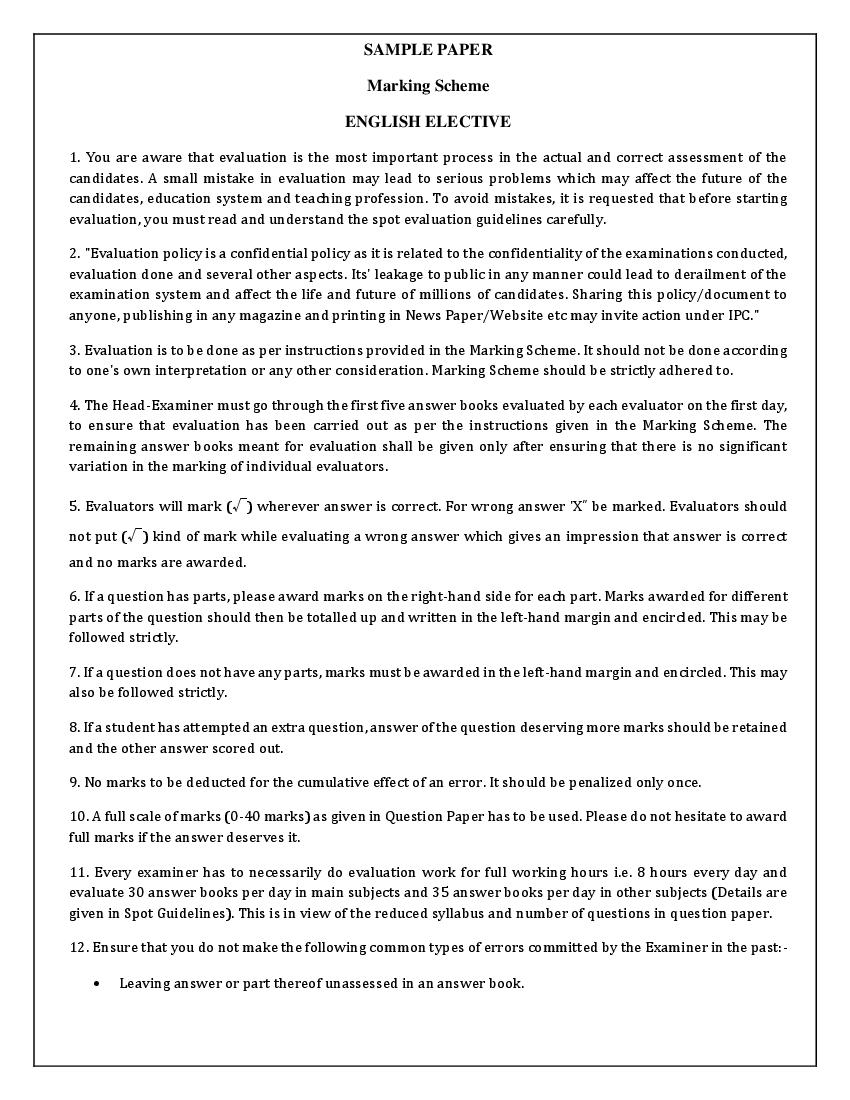
Marking Scheme
ENGLISH ELECTIVE
1. You are aware that evaluation is the most important process in the actual and correct assessment of the
candidates. A small mistake in evaluation may lead to serious problems which may affect the future of the
candidates, education system and teaching profession. To avoid mistakes, it is requested that before starting
evaluation, you must read and understand the spot evaluation guidelines carefully.
2. "Evaluation policy is a confidential policy as it is related to the confidentiality of the examinations conducted,
evaluation done and several other aspects. Its' leakage to public in any manner could lead to derailment of the
examination system and affect the life and future of millions of candidates. Sharing this policy/document to
anyone, publishing in any magazine and printing in News Paper/Website etc may invite action under IPC."
3. Evaluation is to be done as per instructions provided in the Marking Scheme. It should not be done according
to one's own interpretation or any other consideration. Marking Scheme should be strictly adhered to.
4. The Head-Examiner must go through the first five answer books evaluated by each evaluator on the first day,
to ensure that evaluation has been carried out as per the instructions given in the Marking Scheme. The
remaining answer books meant for evaluation shall be given only after ensuring that there is no significant
variation in the marking of individual evaluators.
5. Evaluators will mark (√) wherever answer is correct. For wrong answer 'X” be marked. Evaluators should
not put (√) kind of mark while evaluating a wrong answer which gives an impression that answer is correct
and no marks are awarded.
6. If a question has parts, please award marks on the right-hand side for each part. Marks awarded for different
parts of the question should then be totalled up and written in the left-hand margin and encircled. This may be
followed strictly.
7. If a question does not have any parts, marks must be awarded in the left-hand margin and encircled. This may
also be followed strictly.
8. If a student has attempted an extra question, answer of the question deserving more marks should be retained
and the other answer scored out.
9. No marks to be deducted for the cumulative effect of an error. It should be penalized only once.
10. A full scale of marks (0-40 marks) as given in Question Paper has to be used. Please do not hesitate to award
full marks if the answer deserves it.
11. Every examiner has to necessarily do evaluation work for full working hours i.e. 8 hours every day and
evaluate 30 answer books per day in main subjects and 35 answer books per day in other subjects (Details are
given in Spot Guidelines). This is in view of the reduced syllabus and number of questions in question paper.
12. Ensure that you do not make the following common types of errors committed by the Examiner in the past:-
Leaving answer or part thereof unassessed in an answer book.
Page 2
Wrong totalling of marks awarded on a reply.
Wrong transfer of marks from the inside pages of the answer book to the title page.
Wrong question wise totalling on the title page.
Wrong totalling of marks of the two columns on the title page.
Wrong grand total.
Marks in words and figures not tallying.
Wrong transfer of marks from the answer book to online award list.
Answers marked as correct, but marks not awarded. (Ensure that the right tick mark (√) is correctly
and clearly indicated. It should not merely be a line. Same is with the (X) for incorrect answer.) Half or
a part of answer marked correct and the rest as wrong, but no marks awarded.
13. While evaluating the answer books if the answer is found to be totally incorrect, it should be marked as cross
(X) and awarded zero (0) Marks. 'Zero' should be mentioned both in figures and words.
14. The Board permits candidates to obtain photocopy of the Answer Book on request in an RTI application and
also separately as a part of the re-evaluation process on payment of the processing charge
15. Any unassessed portion, non-carrying over of marks to the title page, or totalling error detected by the
candidate shall damage the prestige of all the personnel engaged in the evaluation work as also of the Board.
Hence, in order to uphold the prestige of all concerned, it is again reiterated that the instructions be followed
meticulously and judiciously.
16. The Examiners should acquaint themselves with the guidelines given in the Guidelines for Spot Evaluation
before starting the actual evaluation.
17. Every Examiner shall also ensure that all the answers are evaluated, marks carried over to the title page,
correctly totalled and written in figures and words.
Page 3
OBJECTIVE- testing comprehension of unseen passage comprehension passage
Q1. Unseen Passage (6 Marks)
Each correct answer carries 1 mark. Attempt any 6 out of 8. Suggested answers:
a) Rising digital distractions and deteriorating attention spans.
b) It encourages shallow focus and hampers sustained concentration.
c) People have more online friends but feel lonelier.
d) Mindful and balanced use of digital tools.
e) (iii) Mindful and balanced use of technology is essential.
f) App design aims to trigger instant gratification and habit formation.
g) Burden.
h) To be used in moderation.
Q2. Poem Comprehension (6 Marks)
Each correct answer carries 1 mark. Attempt all. Suggested answers:
a) Resting in the peaceful woods.
b) Responsibilities or duties in life.
c) Repetition of 'And miles to go before I sleep' emphasizes resolve and unfulfilled commitments.
d) Snow-covered woods create a calm and serene mood.
e) Determined.
f) He has a long way to travel in life.
SECTION – B: WRITING SKILLS AND GRAMMAR (12 Marks)
A OBJECTIVE- to use an appropriate style to write a letter regarding poor patrolling by the police in
your area, organize and present ideas coherently.
Q3. Writing (6 Marks)
Attempt any two. Each carries 6 marks. Break-up: Format (1), Content (3), Expression (2).
a) Letter to Book House Manager:
- Format: sender's/receiver's address, subject, salutation, closing.
- Content: bulk order, discounts, delivery, invoice, terms, etc.
- Expression: coherence, tone, grammar.
b) Paragraph on 'Books vs Screens':
- Title (1), logical flow (3), grammar/style (2).
c) Report on 'Tree Plantation Drive':
- Title, byline (1), what/when/where/how (3), expression (2).
Page 4
Each carries 1 mark. Suggested answers:
a) She said that I must submit the form before Friday.
b) A farewell party was organized by the students.
c) must
d) Each of the students was given their own assignment.
e) on
f) but
SECTION – C: LITERATURE (23 Marks)
Q5. Reference to Context (5 Marks)
Any one extract. Each sub-question 1 mark.
A: Emily Dickinson, 'Hope is the thing with feathers'.
- Hope is compared to a bird; singing represents persistence.
- Poetic device: metaphor in 'sings the tune without the words'.
- Mood: Optimistic.
B: Shakespeare's Sonnet 55.
- Theme: Poetry outlasts monuments.
- Device: Personification in 'sluttish time'.
- Poem's durability > marble.
Q6. Long Answers (2×5 = 10 Marks)
Evaluate for: Content (3), Expression (2).
a) Eveline: psychological conflict, duty vs desire, fear of unknown.
b) Broken Images: duality, identity, self-perception through technology.
c) Light vs shadow in ‘Soul’s Prayer’: contrast of divine wisdom and earthly confusion.
Q7. Short Answers (4×2 = 8 Marks)
Each carries 2 marks (Content 1 + Expression 1).
Brief and relevant answers expected.
SECTION – D: DRAMA (17 Marks)
Q8. Long Answer (1×5 = 5 Marks)
Evaluate for: Content (3), Expression (2).
a) Prakriti: name reflects nature; transformation through spiritual realization.
b) Manjula: inner conflict with identity, public vs private image, truth vs illusion.
Page 5
Each carries 2 marks. Focus on clarity and interpretation.
Sample points for each character/situation expected.
Q10. Literary Devices (4 Marks)
Each 1 mark.
a) Simile – comparison using 'like'.
b) Metaphor: 'heart of stone' – unfeeling person.
c) Personification – moon performing human action.
d) Alliteration – repetition of consonant sounds. Example: 'She sells sea shells…'
Document Details
| Board / Org | Haryana Board |
| Exam | Class 12 |
| Type | Sample Paper |
| Pages | 5 |
| Updated | 24 Sep 2026 |