AHSEC 2nd Year Syllabus 2024-25 Music
Finished viewing? Save it for later —
Download AHSEC 2nd Year Syllabus 2024-25 Music (PDF · 22 pages)About AHSEC 2nd Year Syllabus 2024-25 Music
AHSEC 2nd Year Syllabus 2024-25 Music is available here for free download. Published by Assam Board for Class 12, this syllabus can be viewed online or downloaded as a PDF (22 pages). Candidates preparing for Class 12 can use AHSEC 2nd Year Syllabus 2024-25 Music to understand the exam pattern, the type of questions asked, and the overall difficulty level.
Frequently Asked Questions
How can I download AHSEC 2nd Year Syllabus 2024-25 Music?
Open this page and click the Download button to save AHSEC 2nd Year Syllabus 2024-25 Music as a PDF. It is completely free on AglaSem Docs.
Is AHSEC 2nd Year Syllabus 2024-25 Music free to download?
Yes. AHSEC 2nd Year Syllabus 2024-25 Music can be viewed online and downloaded as a PDF free of cost on AglaSem Docs.
How many pages does AHSEC 2nd Year Syllabus 2024-25 Music have?
AHSEC 2nd Year Syllabus 2024-25 Music contains 22 pages, which you can read online or download together as a single PDF.
Where can I find more Class 12 study material?
You can find more Class 12 question papers, sample papers, syllabus, and answer keys on AglaSem Docs.
AHSEC 2nd Year Syllabus 2024-25 Music – Text
Read the full text of this syllabus below — useful to quickly search, copy and reference the content online without downloading the PDF.
📄 View text version (22 pages)
Page 1
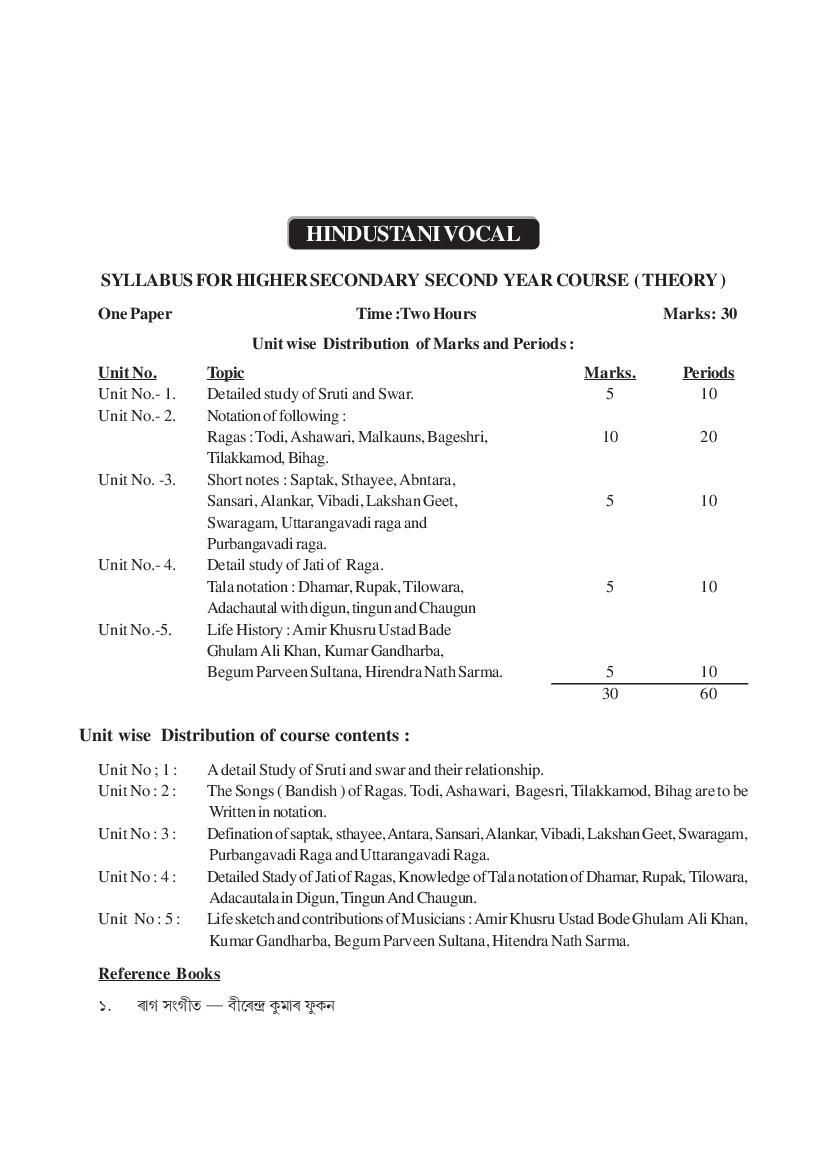
SYLLABUS FOR HIGHER SECONDARY SECOND YEAR COURSE ( THEORY )
One Paper Time :Two Hours Marks: 30
Unit wise Distribution of Marks and Periods :
Unit No. Topic Marks. Periods
Unit No.- 1. Detailed study of Sruti and Swar. 5 10
Unit No.- 2. Notation of following :
Ragas : Todi, Ashawari, Malkauns, Bageshri, 10 20
Tilakkamod, Bihag.
Unit No. -3. Short notes : Saptak, Sthayee, Abntara,
Sansari, Alankar, Vibadi, Lakshan Geet, 5 10
Swaragam, Uttarangavadi raga and
Purbangavadi raga.
Unit No.- 4. Detail study of Jati of Raga.
Tala notation : Dhamar, Rupak, Tilowara, 5 10
Adachautal with digun, tingun and Chaugun
Unit No.-5. Life History : Amir Khusru Ustad Bade
Ghulam Ali Khan, Kumar Gandharba,
Begum Parveen Sultana, Hirendra Nath Sarma. 5 10
30 60
Unit wise Distribution of course contents :
Unit No ; 1 : A detail Study of Sruti and swar and their relationship.
Unit No : 2 : The Songs ( Bandish ) of Ragas. Todi, Ashawari, Bagesri, Tilakkamod, Bihag are to be
Written in notation.
Unit No : 3 : Defination of saptak, sthayee, Antara, Sansari, Alankar, Vibadi, Lakshan Geet, Swaragam,
Purbangavadi Raga and Uttarangavadi Raga.
Unit No : 4 : Detailed Stady of Jati of Ragas, Knowledge of Tala notation of Dhamar, Rupak, Tilowara,
Adacautala in Digun, Tingun And Chaugun.
Unit No : 5 : Life sketch and contributions of Musicians : Amir Khusru Ustad Bode Ghulam Ali Khan,
Kumar Gandharba, Begum Parveen Sultana, Hitendra Nath Sarma.
Reference Books
1. 1±· ¸—·œÓ¬ ñ ¬ıœÀ1f fl≈¡˜±1 Ù≈¬fl¡Ú
Page 2
2. fl¡F ¸—·œÓ¬ ñ ’±1n∏ Ó¬¬ı˘± - ø˝√√˜±—·q fl≈¡˜±1 ¬ı1n∏ª±
3. ˆ¬±1Ó¬œ˚˛ ¸—¶¥®øÓ¬1 ¬Û1•Û1±Ó¬ ¸Sœ˚˛± ¸—¶¥®øÓ¬1 1+¬ÛÀ1‡± - ¿‡À·f Ú±Ô √±¸º
HINDUSTANI VOCAL
SYLLABUS FOR HIGHER SECONDARY SECOND YEAR COURSE ( PRACTICAL )
One Paper Time :Two Hours Marks: 70
Unit wise Distribution of Marks and Periods :
Unit No. Topic Marks. Periods
Unit No.- 1. Ability to perform Vilambit Kheyal with Alap,
Of following Raga : Bageshree, Malkouns and Bihag. 40 70
Unit No.- 2. Ability to perform Drut Kheyal : Todi, Ashawari,
Bageshree, Tilakkamod, Malkouns and Bihag. 5 10
Unit No. -3. Ability to identify from notes song Aakar. 5 10
Unit No.- 4. Orel rendering of Tala with Tali, Khali, Dugun
Tingun , Chaugun in - Trital, Ektal, Chautal, 10 15
Dharmartal, Adachautal and Deepchandi.
Unit No.-5. Ability to perform Dhrupad and Dhamar with
Dugun, Tingun and Chaugun in any of the 10 15
Ragas in the course
Total 70 120
Unit wise Distribution of course contents :
Unit No ; 1 : The student should be able to perform a Vilambit Kheyal With Alap and Tan in the
following Ragas : Bageshre, Malkouns, and Bihag.
Unit No : 2 : Performance of Drut Kheyal in Todi, Ashawari, Bageshree Tilakkamod, Malkouns and
Bihag.
Unit No : 3 : Student should be able to Identify Ragas from notes song In Aakar.
Unit No : 4 : Orel rendering of Talas, Showing Tali and Khali with hand gestures, of the following
Talas : Trital, Ektal, Chautal, Dhamar, Adaachautal and Deepchandi in dugun, tingun,
and Chaugun.
Unit No : 5 : The student is sto perform Dhrupad and Dhamar in any of the Ragas in the course.
Page 3
SYLLABUS FOR HIGHER SECONDARY SECOND YEAR COURSE ( THEORY )
Time :Two Hours: Marks: 30
Unit wise Distribution of Marks and Periods :
Unit No. Topic Marks. Periods
Unit No.- 1. Origin of Kathak – Dance and its Development 6 12
Unit No.- 2. Brief knowledge of Grantha ( Book ) 5 10
(a) Natya Sastra
(b) Abhinaya Darpan
Unit No. -3. Knowledge of three types of Laya Knowledge
of the following terms
(a) Lassya Nrittya
(b) Kavit 5 10
(c) Thaat
(d) Tukda
(e) Paran
(f) Gat - Nikas
(g) Gat – Bhava
Unit No.- 4. Knowledge of patra – lakshanam 4 8
Unit No.-5. Life sketch of the following Gurus and their
Contribution. 5 10
(a) Acchan Maharaj
(b) Birju – Maharaj
(c) Bindadin Maharaj
Unit No.-6. Ability to write tala notation from practical unit 5 10
30 60
Unit wise Distribution of course contents : Second year (Theory)
Unit No.- 1. Name and place of the origin with period justification of the name Kathak presentation in
Page 4
Temple and Mughal court, Development in modern period.
Unit No.- 2. Name of the Author, Period of composition and Major topics related with Dance.
Unit No. -3. Defination with proper example is essential.
Unit No.-4. To be studied merits and demerits of Nartak (Dancer)
Unit No.- 5. Prime importance should be on the life sketches and contribution in the field of Kathak.
Unit No.- 6. Proper notation in Bhatkhandey system.
Reference Books
1. ÚÓ¬«Ú fl¡˘± ˜?≈ø1 - 1˜ ‡G, 2˚˛ ‡G - ‰¬±1n∏ ¬ı1√Õ˘º
2. Ú‘Ó¬… fl¡˘± √˙«Ú - 1±˜fl‘¡¯∏û Ó¬±˘≈fl¡√±1º
KATHAK DANCE
SYLLABUS FOR HIGHER SECONDARY SECOND YEAR COURSE ( PRATICAL )
Time :Two Hours: Marks: 70
Unit wise Distribution of Marks and Periods :
Unit No. Topic Marks. Periods
Unit No.- 1. Revision of previous course of unit- 1, unit – 2 and 20 35
Unit – 3
Unit No.- 2. Trital
One advanced Thaat with Kasak – Masak, one
Amadjuri Paran, one Parmelu Tukda, one 25 40
Chakradhar Tihai, one Bedam Tihai, one
Chakradhar Paran with chakkar ( SPIN ), one foot
Work based on Takita – Dhigita Bols. One Gat Bhava
Unit No. -3. Dhamar Tala
(a) Barabar, Dugun and chougun Laya with Tihai
(b) One Thaat 15 25
(c) One chakradhar, Amad, One Paran, One Tihai
(d) One simple and chakradhar Tukda
10 20
Unit No.- 4. Padhant of the Bols 70 120
Page 5
Unit wise Distribution of course contents : Second year (Practical)
Unit No.- 1. Previous contents of unit – 1, unit – 2, unit – 3.
Unit No.- 2. To be practice wrist, neck, and eye movements with Laya and Tala.
Unit No. -3. To be studied the Tala with proper division in the form of pure dance.
Unit No.-4. Speaking the bols showing proper Som, Tali, Khali and Matra with hands.
Page 6
SYLLABUS FOR HIGHER SECONDARY SECOND YEAR COURSE ( THEORY )
Time :Two Hours Marks: 30
Unit wise Distribution of Marks and Periods :
Unit No. Topic Marks. Periods
Unit No.- 1. Knowledge about Baaz. 5 10
Unit No.- 2. Knowledge of the Gharanas of Sitar players 5 10
Unit No. -3. Life sketch of : Pandit Nikhil Benarjee, 10 20
Ustad Vilayat Khan, Akhtar Khan, Nilima Borthakur.
Unit No.- 4. Study of the following Technical Terminology :
Kan, Gamak, Meend, Som, Tali, Khali. 10 20
30 60
Unitwise Distribution of Course Contentes : SITAR : THEORY : SECOND YEAR :
Unit : 1 : Knowledge of different Baaz or the playing style of Sitar.
Unit : 2 : Knowledge of the different Gharanas of Sitar players
Unit : 3 : Life sketch of the famous Sitar players of Assam and India.
Unit : 4 : Knowledge of the Technical Terminology by which a Sitar player can produce Gamak,
Meend. Knowledge of Som, Tali, Khali.
Reference Books
1. Œ‰¬Ó¬±1 ø¬ı:±Ú - øÚø˘˜± ¬ı1ͬ±fl≈¡1
2. Á¬—fl¡±1 - 1 ˜ ‡G, 2 ˚˛ ‡G - ˝◊f Œfl¡“±ª1
Page 7
SITAR
SYLLABUS FOR HIGHER SECONDARY SECOND YEAR COURSE (PRACTICAL)
One Paper Time :Two Hours Marks: 70
Unit wise Distribution of Marks and Periods :
UNIT NO: TITLE Marks. Periods
Unit No.- 1. At least 10 paltas with Meend and Gamak. 5 10
Unit No.- 2. Vilambit Gat in Raga Desh, Bhupali and
Brindabani Sarang with Todas. 40 60
Unit No. -3. Rajakhani Gat in Raga Desh, Bhairabi and Kafi Raga. 15 30
Unit No.- 4. Practice of Tali Khali of Trital, Ektal, Rupaktal, 5 10
Dadratal, Jhaptal.
Unit No.- 5. Ability to produce the swaras – Shuddha, Tivra,
Komal in Mondra – Madhya – Tar Saptak. 5 10
70 120
Unitwise Distribution of Course Contentes: PRACTICAL : SITAR: SECOND YEAR :
Unit : 1 : Ability to perform the paltas with Meend and Gamak in Sitar.
Unit : 2 : Vilambit Gat in Raga Desh, Bhupali and Brindabani Sarang in Trital with Todas.
Unit : 3 : Rajakhani Gat in Desh Raga, Bairabi and Kafi Raga.
Unit : 4 : Ability to show the tali and khali of Trital, Ektal, Rupak Tala, Dadra Tala, Jhaptala.
Unit : 5 : Playing ability in Sitar of the Suddha, Tivra, Komal Swara in Mandra – Madhya – and Tar
Saptak.
Page 8
SYLLABUS FOR HIGHER SECONDARY SECOND YEAR COURSE ( THEORY )
One Paper Time :Two Hours Marks: 30
Unit wise Distribution of Marks and Periods :
Unit No. Topic Marks. Periods
Unit NO.- 1. (a) Study of previous course
Or
(b) Define with example – peshkar, Quida, Vistar (Palta),
Rela, Gat, Tehai (domdar and Bedom), Farmaishi 6 15
Chakradar, Graha, Yati, Jati, Kisme (Prakar),
Laggi, Ladi, Mukhda, Paran, Tukda.
Unit No.- 2. (a) A brief knowledge of different gharanas of Tabla. 6 15
Unit No. -3. Writing in notation of the tals in barabar, Dugun, tingun and
chougun laya – Teora, Pancham Sawari, Sool, 6 15
Mattatal (9 matra) Gajjhampa, Dhamar and Deepchani.
Unit No.- 4. Life History and contribution of : (Any One)
Ustad Abid Hussain Khan, Sachin Barthakur, Late Keshay 6 10
Changkakpto, Promod Das, Gopi Nath Das (Barpeta)
Unit No.-5. Merits and demerits of Tabla player 6 5
30 60
Reference Books
1. ˆ¬±1Ó¬œ˚˛ ¸—·œÓ¬ ¸±Òfl¡ - ά0 ø√ø˘¬Û 1?Ú ¬ı1ͬ±fl≈¡1º
2. Ó¬¬ı˘± ø¬ı:±Ú - ά0 ø√ø˘¬Û 1?Ú ¬ı1ͬ±fl≈¡1º
3. Ó¬±˘ ˜øÌfl”¡È¬ - ¬ÛªÚ ¬ı1√Õ˘º
4. fl¡F ¸—·œÓ¬ ’±1n∏ Ó¬¬ı˘± - ø˝√√˜±—q fl≈¡˜±1 ¬ı1n∏ª±º
Page 9
TABLA
SYLLABUS FOR HIGHER SECONDARY SECOND YEAR COURSE (PRACTICAL)
One Paper Time :Two Hours Marks: 70
Unit wise Distribution of Marks and Periods :
Unit No. Topic Marks. Periods
Unit No.- 1. (a) Study of previous course
(b) Hattali of all prescribed tals in barabar, 10 20
dugun, tingun and chaugun laya.
(c) Knowledge of Adilaya
Unit No.- 2. (a) Ability to play peshkar in Trital, Jhaptal,
Rupak and Ektal.
(b) Two quidas with at least 8 vistara and tehai in Trital, 15 25
Rupak, Japtal and Ektal of ‘Terekete’ ‘dheredhere’ vani
in barabor, dugun, and chaugun laya.
Unit No. -3. One paran, two gats, four tukdas, one simple Chakradar,
one farmaishi chakradar in Trital and Rupaktal. 15 25
Unit No.- 4. (a) Padhant of some composition in second year
Course. 15 25
or
Knoweldge of Accompainment in vocal/Instrumental
(b) Use of Simple rela in tintal, Ektal and
Japtal with visler and tehai.
Unit No.-5. Elementary knowledge of tuning of the Instrument. 15 25
Total 70 120
Page 10
SYLLABUS FOR HIGHER SECONDARY SECOND YEAR COURSE (THEORY)
Time :Two Hours Marks: 30
Unit wise Distribution of Marks and Periods :
Unit No Topic Marks. Periods
Unit NO.- 1. Notation of prescribed Ragas:- Brindavani Sarang Yaman,
Ashawari, Behag and Durga (Bilawal Thata) Bhimpalashi 10 20
Unit No.- 2. Comparative study between Hindustani music and Karnataki
music. Study of the following Talas : Trital,Ektal, Jhaptal, 5 10
Rupak, Dadra, Kaharwa, Dhamar, Deepchandi and choutal.
Unit No. -3. Study of the following technical terminology :
Jaties of Raga, Sthayee – Antara, Kan, Gamak, Meed, 5 10
Arohan – Abarohan, Pakad, Gat, Tal, Laya, Som,Khali –
Tali, Avartan, Bhajan, Khayal, Dhrupad-Dhamar.
Unit No.- 4. Description and comparision of prescribed Ragas.
Essay on musical topics ( Example : importance of 5 10
Music in school level, Role of music in Social unity etc.
Unit No.-5. Life sketch : Pt. Gajanan Rao Joshi, Ustad Alauddin
Khan. Pt. V.G. Jog, V. D. Paluskar
Sandhiprakash Raga, Purvangavadi – Uttarangavadi
Raga, Suddha –Shayalog – Sankirna Raga. 5 10
30 60
Unit wise Distribution of Course : VIOLIN : THEORY : 2nd YEAR
Unit : 1 : Ability to write notation of prescribe Ragas. (with Alap, Gat, Tan etc.)
Unit : 2 : (a) Knowledge of comparative study between Hisdustani and Karnataki music.
(b) Ability to write with notation the prescribe Talas in Ekgun & Chougun Dugun.
Unit : 3 : Knowledge to define the musical terms.
Unit : 4 : (a) Knowledge to describe and compare the Ragas prescribe above.
(b) Essay on musical Topics : Importance of music in school level, Role of music in
Social unity.
Unit : 5 : (a) Life sketch of famous Violin players of Assam and Indian.
Page 11
(b) Knowledge about the Sandhiprakash Raga, Purvangavadi- Uttarangavadi Raga –
Suddha Shayalog – Sankirna Raga.
Reference Books
1. 1±· ¸—·œÓ¬ - ¬ıœÀ1f fl≈¡˜±1 Ù≈¬fl¡Úº
2. Œ¬ı˘± ø¬ı:±Ú [ø˝√µœ]
3. Ó¬¬ı˘± ø¬ı:±Ú - ø√˘œ¬Û 1?Ú ¬ı1ͬ±fl≈¡1º
VIOLIN
SYLLABUS FOR HIGHER SECONDARY SECOND YEAR COURSE (PRATICAL)
Time :Two Hours Marks: 70
Unit wise Distribution of Marks and Periods :
Unit No. Topic Marks. Periods
Unit No.- 1. Introduction of Violin in details ( Name of parts of
Violin ) Practice of more swaras by single finger on 5 10
Single string in one – way bowing. Tuning of instrument.
Unit No.- 2. Prescribed Ragas : ( students must to learn/play )
Vilambit and Drut Gat with – Alap – Tan – Jhala of 40 60
One/more Ragas for 15 minutes with Tabla
Accompaniment]: Brindavani Sarang, Yaman, Ashawari,
behag, Bhimpalashi and Durga ( Bilawal Thata )
Unit No. -3. Describe how to produce the swaras –Shuddha,
Tivra, Komal in Mandra – Madhya – Tar Saptak. 5 10
Practice if various Alankar ( at least 30 Nos. of
Various chanda in prescribed Ragas )
Unit No.- 4. Practice of song: One Bishnu Rabha Geet, atiya sangit,
JBhupendra sangit, Loka git. Practice of Nagma 5 10
for various Talas.
Unit No.-5. Prescribed Talas : Trital, Ektal, Jhaptal, Rupak, Dadra,
Kaharwa, Dhamar, Deepchandi and Chautal with
ali – Khali, in Ekgun Dugun, Chaugun. 15 30
70 120
Page 12
Unitwise Distribution of Course Contentes : VIOLIN : 2nd YEAR: PRACTICAL :
Unit : 1 : (a) Knowledge to introduce the Violin with its different parts.
(b) Ability to play more swaras by single finger on single string in one way bowing in
Violin.
(c) Knowledge to tune the Violin.
Unit : 2 : (a) Ability to play one or more prescribed Ragas in Vilabit and Drut gat with Alap, Tan,
Jhala for 15 minutes with Tabla Accompaniment .
Unit : 3 : (a) Ability to produce the swaras – Shuddha, Tivra, Komal in Mandra, Madhya and
Tara Saptak.
(b) Knowledge to play various Alankars in various chanda of Prescribed Ragas.
Unit : 4 : (a) Practice of various songs to play in Violin.
(b) Ability to play Nagma in various Talas.
Unit : 5 : Ability to show the prescribed Talas with Hath – Tali and khali in Ekgun, Dugun and
Chaugun laya.
Page 13
Page 14
BORGEET
SATTRIYAVOCAL MUSIC
SYLLABUS FOR HIGHER SECONDARY SECOND YEAR COURSE (THEORY)
Time :Two Hours Marks: 30
Unit wise Distribution of Marks and Periods :
Unit No. Topic Marks. Periods
Unit - 1. Study of the previous course 5 10
Unit - 2. Nada (Ahata and Anahata) Musical sound and voice.
three characteristics of Nada 5 10
Unit - 3. Difference Between Shruti and Swara 5 10
Unit - 4. Elementary study of Folk Assamese Lokageet,
Tokarigeet and Bihunam 5 10
Unit - 5. Study on the history of Shattriya music 5 10
Unit - 6. Life history of Shankardeva, Madhabdeva, Hari
Ram Byan and Giri Kanta Mohonta 5 10
30 60
BORGEET
SYLLABUS FOR HIGHER SECONDARY SECOND YEAR COURSE (PRACTICAL)
Time : One Hours Marks: 70
Unit wise Distribution of Marks and Periods :
Unit No. Topic Marks. Periods
Unit - 1. Revision of previous course 10 20
Unit - 2. Practical knowledge of the following Talas =
Rupaktal, Parital, Jotial, Bishamtal 10 30
Unit - 3. Two Borgeet and one Ankiyageet on each Raga =
Ashowari, Shyam and Gouri 10 30
Unit - 4. Oral rendering of Talas 10 25
Unit - 5. Ability to perform one Tokarigeet and Bihunam 10 25
Unit - 6. Viva 20
70 130
***
Page 15
SATTRIYA DANCE
SYLLABUS FOR HIGHER SECONDARY COURSE
Objectives :
To enable the student :
to acquire knowledge of cultural heritage of Assam with special reference to Sattriya Dance - a
major component of Assamese culture.
to take interest and develop proper attitude towards study of Sattriya Dance which, inter-alia,
would provide Job opportunity to the learner practitioner.
to provide facility for those students who might not opt for other general or vocational subjects.
to acquire proficiency in this lesser known art form of Assam with a view to providing facility for
broader exposure of Sattriya Dance.
to attract the younger generation to keep themselves engaged in the pursuit of finer art forms like
Dance and music so as to avert their attention from being a strayed in the social set up.
to introduce as one of the subjects to serve the purpose of extra curricular activities.
SATRIYA DANCE
SYLLABUS FOR HIGHER SECONDARY FINAL YEAR COURSE
One Paper Three Hours Marks 100
Unitwise Distribution of Marks and Periods : (Theory : 30 Marks)
Unit No. Topics Marks Periods
Unit-l : Introduction to Classical dance traditions of India. 5 10
Unit-2 : Angkiya-naat and its distinctive features with special reference
to Rukmini-Haran Naat of Sankardeva. 10 14
Unit-3 : Introduction to four kinds of Abhinayas, viz, angika, vasika, aharya
and swattwika in Classical dances with special reference
to Sattriya Dance. 4 6
Unit-4 : Bhari-maan and Hastas in Sattriya Dance 15 Asamayukta hasta, 10
Samayukta hasta and 5 Bharimaan 5 10
Unit-5 : Introduction to tile following taals : 6 20
(a) Pari-taal
(b) Chut-kala-taal
(c) Khar-man-taal
(d) Carikhaniya-misra-taal
(e) Rupak-taal
(f) Domani-taal
(g) Sarubisam-taal
Total 30 60
Page 16
Unitwise Distribution of Course contents :
Unit-1 : Knowledge of classical dance form- names, places of their origin and sources of emergence, if any
Unit-2 : The following topics are to be studies :
(a) Name of the dramas of Sankardeva and Madhavdeva.
(b) Use of Gita, Sloka and Bhatima.
(c) Language of Angkiya Naat.
(d) Dances used in the play.
Unit-3 : Definition of each of the four kinds of abhinaya. Dress and decor used in Sattriya Dances.
Name of 15 Asamayukta hasta, 10 Samayukta hasta and 5 Bharimaans.
Unit-4 : Importance of Bharimaan and Hastas in dance.
Unit-5 : Competency in Bhatkhande system of writing of the given taals.
SYLLABUS FOR SATTRIYA DANCE PRACTICAL
Total Marks- 70
Unitwise Distribution of Marks and Periods :
Unit No. Title Marks Periods
Unit-1 : Mati-akhara 10 30
Unit-2 : Dance (Nritya) 45 80
Unit-3 : Hasta 5 10
Unit-4 : Bharimaan 5 10
Unit-5 : Taal 5 10
Total 70 140
Unitwise Distribution of Course contents :
Marks
Unit-1 : Mati-akhara : 10
Ketela
Jatani
Calana [‰¬˘Ú±]
Moropa
Kakilakhoca [fl¡øfl¡˘± Œ‡±‰¬±]
Khahaki
Pak (cereki-, ur-, thita-, geri-, kati-, ¬Û±fl¡ [Œ‰¬À1fl¡œ, ά◊1, øͬȬ±, Œ·ø1, fl¡±øȬ, ά◊Ò±]
udha-,
theng- mela-tukura-, [ŒÍ¬—À˜˘±-È≈¬fl≈¡1±]
urpak-, tukura) [ά◊1¬Û±fl¡, È≈¬fl≈¡1±]
Jap (orat jap, beng jap)
Tamal-mocara [Ȭ˜±˘ Œ˜±‰¬1±]
Teltupi
Kachai-pani-khowa
Morai-pani-khowa
Kamitana
Page 17
Jor-kamitana
Cit-khar
Luti-khar
Kaati-khar
Unit-2 : Dance : 45
Suddha Cali (one Ram-dani)
Rajaghariya Cali (one Ram-dani)
Behar-nac (Ram-dani part only)
Suddha Cali [(Gitar-nac (Ek-taal)]
Jhumura (Mela-nac)
Unit-3 : Hasta : 5
Sikhar, Muthi, Hamsamukha, Ardha Chandra,
Suchimukh, Padmakosa, Ghronika,
Ankusa, Dhanu, Vana, Tantrimukha,
Gajadanta, Karkata, Dola, Maral.
Unit-4 : Bhari-maan : 5
Juti, Ciral, Citika, Tewai, Leceri
Unit-5 : Taal 5
Pari -taal, Cut-kala-, Saru-visama-, Khar-maan
Practical Class :
(a) One practical class is equal to two theory classes of 45 minutes each.
(b) Dress code of practical Class :
(i) For boys: White Dhoti / Payjama and Kurta with Tangali.
(ii) For girls: White Salwar- kamiz with long dopatta. The kamiz should be wide enough as
required.
(iii) Junuka of the following size may be used :
No-10 for both boys and girls and in each leg there should be 25 Junukas.
REFERENCE BOOKS
1. Indian Classical Dance : : Dr. Kapila Vatsyayan.
2. Paramparagatu Bharatiya Natya : K. Vatsyayan.
Translated by Dr. Birendra Nath Dutta.
3. Asamiya Natya Sahitya : : Dr. Satyendra nath Sarmah.
4. Sattriya Nrityar Prarambhik Gyan : Ghanakanta Borah Borbayan.
5. Sattriya Nritya Aru Sattriya Nrityar Taal : Maheswar Neog and Keshab Changkakati
6. Sattriya Nrityar Katha : : Dr. Jagannath Mahanta
7. Sattriya Nrityar Rup Darsan : Karuna Bora.
8. Sattriya Nrityar Hasta : : Dr. Jagannath Mahanta
9. Sattriya Nrityar Adipath : Tanuja Bora
***
Page 18
SYLLABUS FOR HIGHER SECONDARY SECOND YEAR COURSE (THEORY)
Time :Two Hours Marks: 30
Unit wise Distribution of Marks and Periods :
Unit No. Topic Marks. Periods
Unit No.- 1. Historical account of Khol Badya and its use 5 10
Unit No.- 2. Introductory note of the following :
Gaman, Ghat, Sanchar, Chok, Bhangani, Taal, 5 10
Maan, Hali, Bhag or Bibhag, Matra.
Unit No. -3. Life History of Madhavdeva, Roseshwar Saikia 6 10
Borbayan, Paramananda Barbayan.
Unit No.- 4. Description with diagrams of the musical
Instruments of sattriya Dance according to 6 10
The classification of instruments.
Unit No.-5. Taals
Sorubisam, Barbisam, Kharman, Chutkola, Suta 8 20
30 60
Reference Books
1. Tal Pradip : Keshab Changkakati
2. Sattriya Khol Pradip : Gobinda Saikia
3. Khol Badya Anga : Mahananda Das Bayan
4. Khol Vigyan : Dr. Dilip Ranjan Borthakur
5. Badya Abhigyan : Dr Debajit Saikia
KHOL
SYLLABUS FOR HIGHER SECONDARY SECOND YEAR COURSE (PRACTICAL)
Time :Two Hours Marks: 70
Unit wise Distribution of Marks and Periods :
Unit No. Topic Marks. Periods
Unit No.- 1. Revision of First year Course 10 15
Unit No.- 2. Practical knowledge of the following Talas :
- Suta taal
Page 19
- Borbisam taal
- Sarubisam taal 20 35
- Chutkala taal
- Kharman taal
Unit No. -3. Reciting of the taals by mouth and showing
Tali , Khali by hand. 20 35
Unit No.- 4. Different type of taals according to Kamalabari,
Bordowa and Barpeta Sattra.
- Parital
- Jati tal 20 35
- Rupak 70 120
Page 20
Page 21
HIGHER SECONDARY 2ND YEAR COURSE
THEORY PAPER (MARKS - 30)
Unitwise distribution of Marks and Periods.
Unit No. Title Marks Periods
Unit No.1 Koowledge about the Bihu Dance 5 12
– The Mirror of Assamese Culture– Knowledge
about Jeng Bihu, Missing Bihu (Bihu nam also of
Both Bihu forms)
Unit No.2 The Costumes and Ornaments used in Assamese Folk
Music and Dance forms 5 10
Unit No.3 Characteristics of (a) Jhumur Dance, (b) Bagrumba Dance
(c) Bardoisikhla Dance, (d) Karbi Dance (e) Dewdhani Dance 5 10
Unit No.4 Characteristics of Goalporia Lokageet, Nagara Naam,
Kamrupee Lokageet, Ojahpali, Thiya Naam
Knowledge of (a) Mohkheda geet or Mohoho geet,
(b) Moni Konwarar geet (c) Phool Knwarar geet
(d) Ban geet (e) Gopaldevar geet (f) Jikir & Jari
(g) Nao Khela geet (h) Holi geet (i) Aainam, (j) Dehbichar geet
(k) Tokari geet (l) Nichukani geet (m) Biya Naam 5 8
Unit No.5 Describe about the use of Abanaddha Vadya, Ghana
Vadya, Susir Vadya and Tat Vadya in Assamese
Folk Music &Dance 5 10
Unit No.6 Life History of (a) Moghai Ojha, (b) Khirod Khaklary
(c) Jogesh Bharali (d) Umakanta Bairagi (e) Pratima Barua Pande
(f) Mohan Bhawariya (g) lalit Chandra Ojah
(h) Narahari Bura Bhakat (i) Rameshwar Pathak 5 10
Total 30 60
Page 22
ASSAMESE FOLK MUSIC
HIGHER SECONDARY 2ND YEAR COURSE
PRACTICAL PAPER (MARKS - 70)
Unitwise distribution of Marks and Periods.
Unit No. Title Marks Periods
Unit No.1 Singing Performance of Bihu geet, Mohkheda Geet (Mohoho
Geet) Moni Knowar Geet, Phool Kuwar Geet, Bon Geet,
Jikir and Jari, Nao Khela Geet, Holi Geet 10 25
Unit No.2 Ability to sing Kamrupee and Goalpariya Lokageet,
Ojapali with its rhythm 10 25
Unit No.3 Basic knowledge of Talas used in folk music (Tali & Khali) 10 30
Unit No.4 (i) Knowledge about rhythm of Bihu Dhol
(ii) Knowledge of tuning of various folk instruments 10 30
Unit No.5 Knowledge of various costumes used in Folk music performance 10 30
Unit No.6 Viva 20
Total 70 140
ASSAMESE FOLK DANCE
HIGHER SECONDARY 2ND YEAR COURSE
PRACTICAL PAPER (MARKS - 70)
Unitwise distribution of Marks and Periods.
Unit No. Title Marks Periods
Unit No.1 Ability to perform the Bihu dance with its rhythm 10 30
Unit No.2 Ability to perform the Bodo Dance, Rabha Dance, Tiwa
Dance, Dewri Dance with its rhythm 10 30
Unit No.3 A general Knowledge of Dewdhani Dance 5 20
Unit No.4 Knowledge about the use of Abanaddha Vadya, Ghana Vadya,
Susir Vadya and Tat Vadya in Assamese Folk Music and Dance 10 30
Unit No.5 Knowledge about the rhythm of instrumants related to Bihu Dance 5 15
Unit No.6 Knowledge of various costumes and ornaments used in various
Folk Dance 10 15
Unit No.7 Viva 20
Total 70 140
Document Details
| Board / Org | Assam Board |
| Exam | Class 12 |
| Type | Syllabus |
| Pages | 22 |
| Updated | 22 Jul 2026 |