HBSE Class 12 Sample Paper 2026 Answers Geography
Finished viewing? Save it for later —
Download HBSE Class 12 Sample Paper 2026 Answers Geography (PDF · 6 pages)About HBSE Class 12 Sample Paper 2026 Answers Geography
HBSE Class 12 Sample Paper 2026 Answers Geography is available here for free download. Published by Haryana Board for Class 12, this answer key can be viewed online or downloaded as a PDF (6 pages). Candidates preparing for Class 12 can use HBSE Class 12 Sample Paper 2026 Answers Geography to understand the exam pattern, the type of questions asked, and the overall difficulty level.
Frequently Asked Questions
How can I download HBSE Class 12 Sample Paper 2026 Answers Geography?
Open this page and click the Download button to save HBSE Class 12 Sample Paper 2026 Answers Geography as a PDF. It is completely free on AglaSem Docs.
Is HBSE Class 12 Sample Paper 2026 Answers Geography free to download?
Yes. HBSE Class 12 Sample Paper 2026 Answers Geography can be viewed online and downloaded as a PDF free of cost on AglaSem Docs.
How many pages does HBSE Class 12 Sample Paper 2026 Answers Geography have?
HBSE Class 12 Sample Paper 2026 Answers Geography contains 6 pages, which you can read online or download together as a single PDF.
Where can I find more Class 12 study material?
You can find more Class 12 question papers, sample papers, syllabus, and answer keys on AglaSem Docs.
HBSE Class 12 Sample Paper 2026 Answers Geography – Text
Read the full text of this answer key below — useful to quickly search, copy and reference the content online without downloading the PDF.
📄 View text version (6 pages)
Page 1
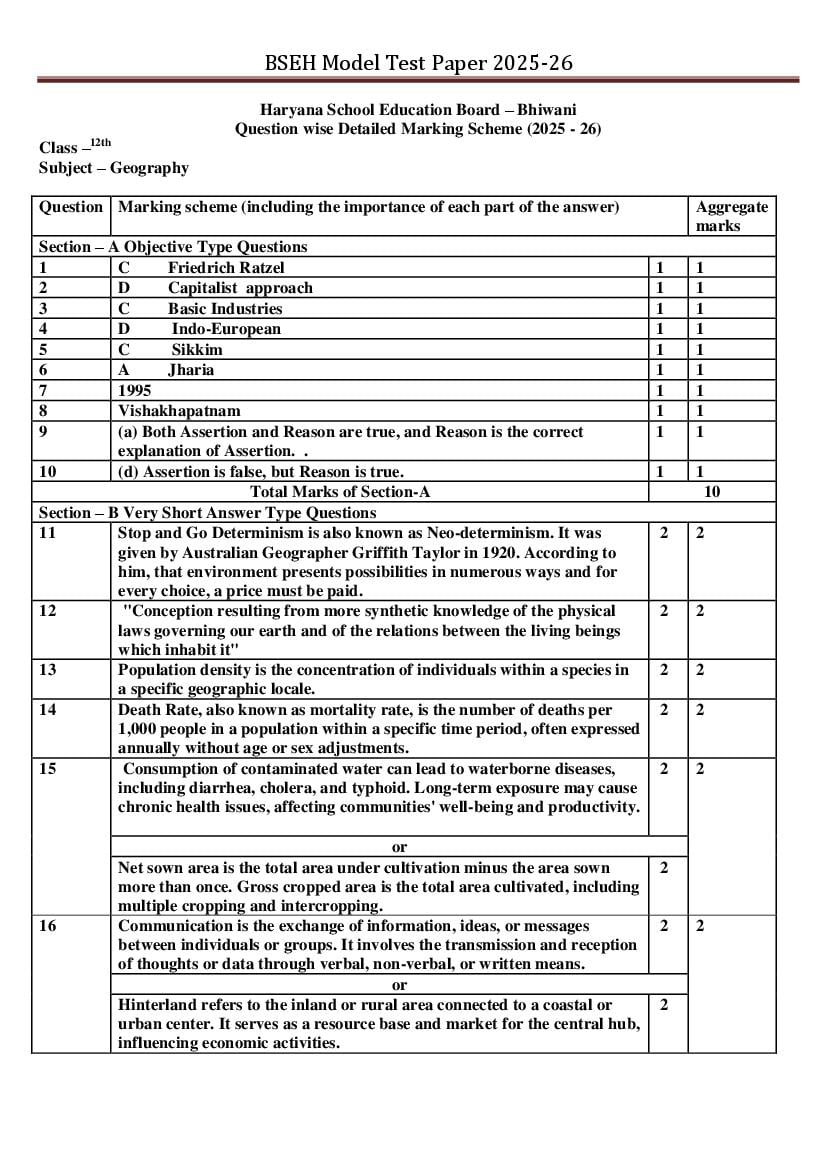
Question wise Detailed Marking Scheme (2025 - 26)
Class –12th
Subject – Geography
Question Marking scheme (including the importance of each part of the answer) Aggregate
marks
Section – A Objective Type Questions
1 C Friedrich Ratzel 1 1
2 D Capitalist approach 1 1
3 C Basic Industries 1 1
4 D Indo-European 1 1
5 C Sikkim 1 1
6 A Jharia 1 1
7 1995 1 1
8 Vishakhapatnam 1 1
9 (a) Both Assertion and Reason are true, and Reason is the correct 1 1
explanation of Assertion. .
10 (d) Assertion is false, but Reason is true. 1 1
Total Marks of Section-A 10
Section – B Very Short Answer Type Questions
11 Stop and Go Determinism is also known as Neo-determinism. It was 2 2
given by Australian Geographer Griffith Taylor in 1920. According to
him, that environment presents possibilities in numerous ways and for
every choice, a price must be paid.
12 "Conception resulting from more synthetic knowledge of the physical 2 2
laws governing our earth and of the relations between the living beings
which inhabit it"
13 Population density is the concentration of individuals within a species in 2 2
a specific geographic locale.
14 Death Rate, also known as mortality rate, is the number of deaths per 2 2
1,000 people in a population within a specific time period, often expressed
annually without age or sex adjustments.
15 Consumption of contaminated water can lead to waterborne diseases, 2 2
including diarrhea, cholera, and typhoid. Long-term exposure may cause
chronic health issues, affecting communities' well-being and productivity.
or
Net sown area is the total area under cultivation minus the area sown 2
more than once. Gross cropped area is the total area cultivated, including
multiple cropping and intercropping.
16 Communication is the exchange of information, ideas, or messages 2 2
between individuals or groups. It involves the transmission and reception
of thoughts or data through verbal, non-verbal, or written means.
or
Hinterland refers to the inland or rural area connected to a coastal or 2
urban center. It serves as a resource base and market for the central hub,
influencing economic activities.
Page 2
Section – C Short Answer Type Questions
17 Intermittent Nature: Periodical markets in rural areas occur at regular 1 3
intervals, often weekly or monthly, providing a cyclical opportunity for
buying and selling goods and services.
Temporary Structures: These markets are typically set up with 1
temporary structures such as tents or open-air spaces. Stalls and booths
are erected for the duration of the market and dismantled afterward.
Diverse Goods and Services: Periodical markets offer a wide range of 1
goods and services, including agricultural products, handicrafts,
livestock, and various household items. The diversity of products reflects
the local economic activities and needs.
18 Population explosion refers to an abrupt and exponential increase in the 1 3
population size.
In India (1951-1981), factors contributing to rapid growth include high 1
birth rates due to social norms, lack of awareness about family planning,
and limited access to contraception.
Additionally, declining death rates due to improved healthcare and 1
sanitation amplified the demographic shift, leading to a significant
population increase during this period.
19 The evolution of towns in India reflects historical, cultural, and 1 3
economic changes. Ancient civilizations like the Indus Valley had
planned urban centers.
Medieval times saw the emergence of trade and commerce hubs. Colonial 1
rule led to the establishment of administrative towns.
Post-independence, urbanization accelerated with industrialization. 1
Today, Indian towns showcase a blend of tradition and modernity,
shaped by historical events and contemporary developmental trends.
20 "Target Area Planning" in geography involves focusing developmental 2 3
efforts on specific regions facing distinct challenges. It tailors strategies to
address the unique needs of a targeted area. This approach ensures more
effective and customized solutions for diverse geographical contexts.
For example, the development of arid regions may emphasize water 1
management projects, while urban target areas could concentrate on
infrastructure and housing development to address population density
and urbanization challenges.
21 India's foreign trade is characterized by diversity in exports, including 3 3
textiles, pharmaceuticals, and software services. Imports consist of crude
oil, machinery, and electronic goods. The trade balance is often trade
deficit due to higher import value. India engages in both bilateral and
multilateral trade agreements. The service sector, particularly IT and
software exports, plays a significant role. Foreign trade policies are
influenced by global economic trends, aiming to foster economic growth
and international cooperation.
or
The Atal Tunnel, officially named the Atal Tunnel, Rohtang, is a highway 3
Page 3
highway tunnel above 10,000 feet, stretching approximately 9.02
kilometers. Inaugurated in 2020, it connects Manali to Lahaul-Spiti
Valley, providing year-round accessibility and reducing travel time.
Named after former Prime Minister Atal Bihari Vajpayee, the tunnel is a
crucial infrastructural feat for the region's development.
22 The major sources of air pollution include vehicular emissions, industrial 3 3
activities, and the burning of fossil fuels. Transportation, particularly
vehicles running on gasoline or diesel, releases pollutants like nitrogen
oxides and particulate matter. Industries emit pollutants such as sulfur
dioxide and volatile organic compounds. Combustion of fossil fuels in
power plants and for heating also contributes to air pollution, impacting
air quality and posing risks to human health and the environment.
or
Urban waste disposal in India faces significant challenges, including 3
inadequate waste management infrastructure, insufficient segregation of
waste at source, and limited recycling facilities. Improper disposal leads
to environmental pollution, health hazards, and strain on landfill sites.
Rapid urbanization exacerbates the problem, as cities struggle to keep
pace with the increasing waste generation. Lack of awareness and
community participation further hinder effective waste management,
contributing to the complex issue of urban waste disposal in the country.
Total Marks of Section-C 18
Section – D Long Answer Type Questions
23 Population change refers to alterations in the size, composition, and 1 5
distribution of a population over a specific period. Its components
include births (fertility), deaths (mortality), and migration.
Fertility: The number of births per 1,000 people in a given population 2
determines fertility. High fertility contributes to population growth,
while low fertility can result in population decline and aging.
Mortality: Mortality rate is the number of deaths per 1,000 people. High
mortality rates can lead to population decline, while low mortality rates
contribute to population growth and demographic transition.
Migration: Migration involves the movement of people across regions.
Immigration increases population, while emigration decreases it.
Migration patterns impact population distribution and demographic
characteristics.
Effects: 2
Population Growth: High birth rates relative to death rates contribute to
population growth.
Demographic Transition: Shifts from high birth and death rates to low
rates, impacting population age structures.
Population Aging: Declining fertility and increasing life expectancy result
in an older population, affecting societal structures and resource
allocation.
Page 4
persist, populations can decline, impacting labor forces and economic
productivity.
or
The distribution of the world's population is profoundly influenced by a 1
myriad of social and cultural factors:
Cultural Practices: Cultural values and traditions impact birth rates,
family size, and migration patterns. For example, cultural norms may
influence the desirability of having large families.
Religion: Religious beliefs often shape attitudes toward family planning 1
and influence demographic behaviors. Religiously motivated migration
patterns can also contribute to population distribution.
Language: Language ties people together and can be a factor in the 1
formation of ethnic or cultural groups, influencing settlement patterns.
Urbanization: The shift from rural to urban living is a cultural trend. 1
Economic opportunities, lifestyle changes, and urban amenities
contribute to population concentration in cities.
Social Policies: Government policies related to healthcare, education, and
family planning influence population distribution by shaping
demographic behaviors and socioeconomic development
24 Tertiary activities, also known as the service sector, encompass a wide 1 5
range of economic activities that provide services to individuals,
businesses, and other sectors. There are several types of tertiary
activities:
Retail and Wholesale Trade: Involves the sale of goods to consumers 1
(retail) or to other businesses (wholesale).
Transportation and Communication: Includes services related to the
movement of goods and people, as well as communication services such
as telecommunications and media.
Finance and Banking: Encompasses financial services, banking, 1
insurance, and investment activities.
Healthcare and Education: Provides essential services for the well-being
of individuals and society, including healthcare, education, and research.
Tourism and Hospitality: Involves services related to travel, 1
accommodation, and recreational activities.
Professional Services: Includes legal, accounting, consulting, and other
professional services.
Information Technology (IT): Encompasses services related to computer 1
technology, software development, and data management.
Entertainment and Recreation: Involves services related to
Page 5
These tertiary activities play a crucial role in modern economies,
contributing to employment, economic growth, and overall societal well-
being.
or
Subsistence Agriculture is a farming practice primarily oriented towards 1
providing food for the farmer's family, with little surplus for sale. It
contrasts with commercial agriculture that produces crops for the
market.
Primitive Subsistence Agriculture: This type involves traditional, labor- 2
intensive methods with minimal use of technology. Farmers use simple
tools and rely on manual labor. Slash-and-burn cultivation is common,
where a plot of land is cleared by cutting and burning vegetation. The
fertility of the land is restored through fallowing. This type is prevalent
in parts of Africa, South America, and Southeast Asia.
Intensive Subsistence Agriculture: Characterized by high labor input per 2
unit of land, intensive subsistence agriculture aims to maximize output
from a limited land area. It often involves the use of irrigation, multiple
cropping, and high-yielding crop varieties. This type is prevalent in
densely populated areas of Asia, such as parts of India and China.
Both types aim to meet the basic needs of the farming household, with the
primary distinction lying in the level of technology and intensity of labor
employed.
25 In the post-independence period, India has implemented various 1 5
strategies for agricultural development to address food security, increase
productivity, and improve the livelihoods of farmers. Some important
strategies include:
Green Revolution (1960s): Introducing high-yielding varieties of seeds,
along with irrigation and increased fertilizer use, helped boost crop
yields, particularly in wheat and rice. This initiative significantly
increased food production.
Land Reforms: Post-independence, there were efforts to redistribute land 1
to address inequities in landownership. Land reform policies aimed to
enhance agricultural productivity and reduce social inequalities.
Community Development Programs: Initiatives like the Community 1
Development Program (CDP) aimed to improve infrastructure,
education, and health facilities in rural areas to uplift the overall living
standards of the rural population.
Integrated Rural Development Program (IRDP): Launched in 1978, the 1
IRDP focused on alleviating poverty in rural areas through various
income-generating activities, including agriculture, animal husbandry,
and small-scale industries.
National Agricultural Policy (2000): This policy emphasized sustainable 1
agriculture, diversification of crops, water-use efficiency, and
modernization of agricultural practices to enhance productivity and
reduce environmental impact.
or
Page 6
the present without compromising the ability of future generations to
meet their own needs. It involves the integration of economic, social, and
environmental dimensions to promote long-term well-being and preserve
natural resources.
Renewable Energy Adoption: Encouraging the use of renewable energy 1
sources, such as solar, wind, and hydropower, reduces reliance on finite
fossil fuels, mitigates environmental impact, and promotes sustainable
energy practices.
Resource Efficiency: Implementing measures to enhance resource 1
efficiency and reduce waste generation, including recycling programs,
sustainable forestry practices, and responsible water management.
Biodiversity Conservation: Protecting and restoring ecosystems helps 1
maintain biodiversity. Conservation efforts, habitat restoration, and
sustainable land-use practices contribute to ecosystem resilience.
Green Infrastructure: Developing green spaces within urban areas, 1
promoting sustainable urban planning, and investing in green
infrastructure like parks and green roofs improve air quality, mitigate
heat island effects, and enhance overall urban sustainability.
Total Marks of Section-D 15
Section – E Map Work
26 Mayurbhanj – An area of iron ore mining 1 5
Amritsar International airport 1
Aasam 1
Bokaro Coal field 1
Visakhapattanam Sea Port 1
aggregate marks 60
Document Details
| Board / Org | Haryana Board |
| Exam | Class 12 |
| Type | Sample Paper |
| Pages | 6 |
| Updated | 24 Sep 2026 |