UPSC NDA NA I 2026 Notification
Finished viewing? Save it for later —
Download UPSC NDA NA I 2026 Notification (PDF · 107 pages)About UPSC NDA NA I 2026 Notification
UPSC NDA NA I 2026 Notification is available here for free download. Published by UPSC for NDA, this notification can be viewed online or downloaded as a PDF (107 pages). Candidates preparing for NDA can use UPSC NDA NA I 2026 Notification to understand the exam pattern, the type of questions asked, and the overall difficulty level.
Frequently Asked Questions
How can I download UPSC NDA NA I 2026 Notification?
Open this page and click the Download button to save UPSC NDA NA I 2026 Notification as a PDF. It is completely free on AglaSem Docs.
Is UPSC NDA NA I 2026 Notification free to download?
Yes. UPSC NDA NA I 2026 Notification can be viewed online and downloaded as a PDF free of cost on AglaSem Docs.
How many pages does UPSC NDA NA I 2026 Notification have?
UPSC NDA NA I 2026 Notification contains 107 pages, which you can read online or download together as a single PDF.
Where can I find more NDA study material?
You can find more NDA question papers, sample papers, syllabus, and answer keys on AglaSem Docs.
UPSC NDA NA I 2026 Notification – Text
Read the full text of this notification below — useful to quickly search, copy and reference the content online without downloading the PDF.
📄 View text version (60 pages)
Page 1
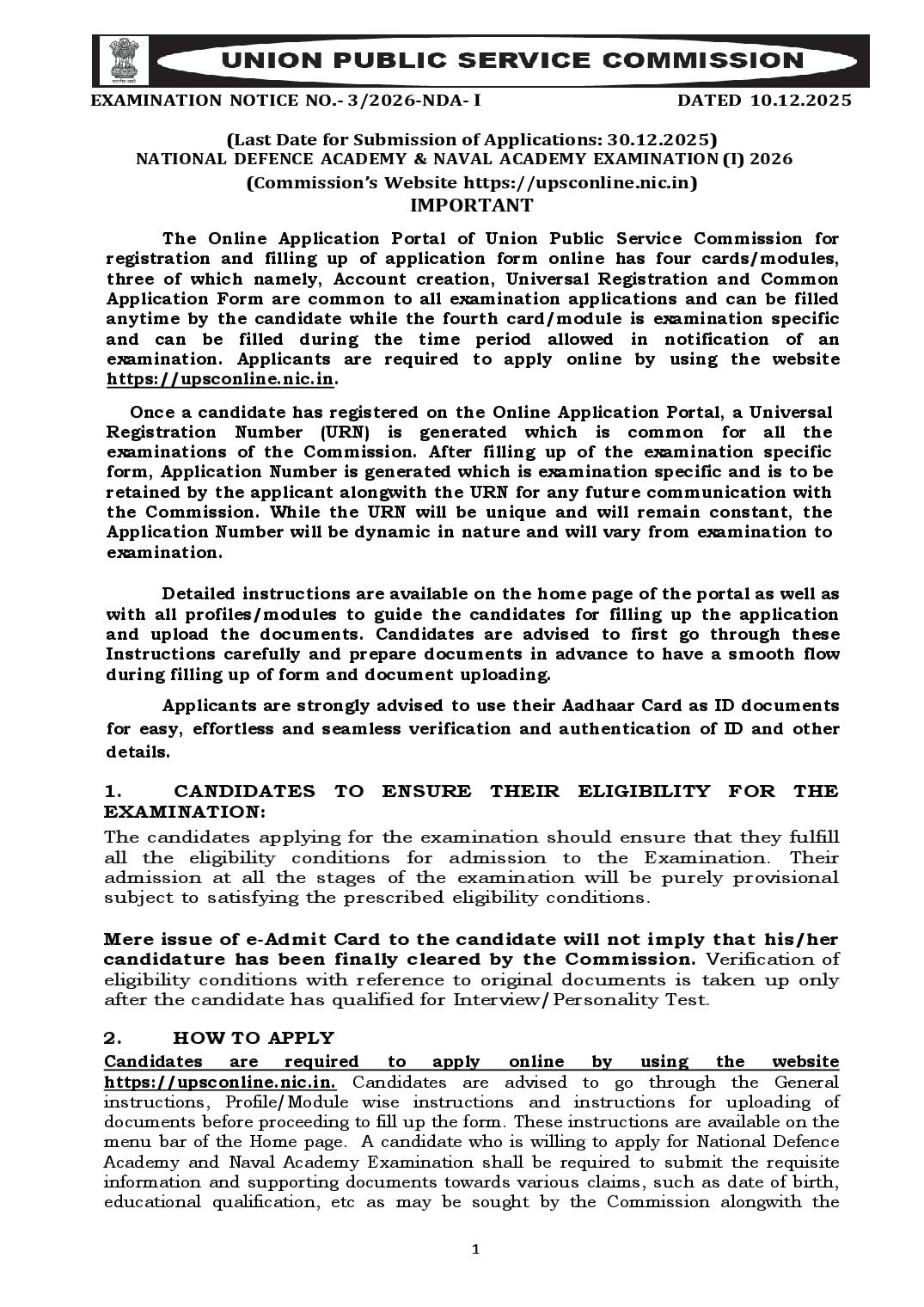
(Last Date for Submission of Applications: 30.12.2025)
NATIONAL DEFENCE ACADEMY & NAVAL ACADEMY EXAMINATION (I) 2026
(Commission’s Website https://upsconline.nic.in)
IMPORTANT
The Online Application Portal of Union Public Service Commission for
registration and filling up of application form online has four cards/modules,
three of which namely, Account creation, Universal Registration and Common
Application Form are common to all examination applications and can be filled
anytime by the candidate while the fourth card/module is examination specific
and can be filled during the time period allowed in notification of an
examination. Applicants are required to apply online by using the website
https://upsconline.nic.in.
Once a candidate has registered on the Online Application Portal, a Universal
Registration Number (URN) is generated which is common for all the
examinations of the Commission. After filling up of the examination specific
form, Application Number is generated which is examination specific and is to be
retained by the applicant alongwith the URN for any future communication with
the Commission. While the URN will be unique and will remain constant, the
Application Number will be dynamic in nature and will vary from examination to
examination.
Detailed instructions are available on the home page of the portal as well as
with all profiles/modules to guide the candidates for filling up the application
and upload the documents. Candidates are advised to first go through these
Instructions carefully and prepare documents in advance to have a smooth flow
during filling up of form and document uploading.
Applicants are strongly advised to use their Aadhaar Card as ID documents
for easy, effortless and seamless verification and authentication of ID and other
details.
1. CANDIDATES TO ENSURE THEIR ELIGIBILITY FOR THE
EXAMINATION:
The candidates applying for the examination should ensure that they fulfill
all the eligibility conditions for admission to the Examination. Their
admission at all the stages of the examination will be purely provisional
subject to satisfying the prescribed eligibility conditions.
Mere issue of e-Admit Card to the candidate will not imply that his/her
candidature has been finally cleared by the Commission. Verification of
eligibility conditions with reference to original documents is taken up only
after the candidate has qualified for Interview/Personality Test.
2. HOW TO APPLY
Candidates are required to apply online by using the website
https://upsconline.nic.in. Candidates are advised to go through the General
instructions, Profile/Module wise instructions and instructions for uploading of
documents before proceeding to fill up the form. These instructions are available on the
menu bar of the Home page. A candidate who is willing to apply for National Defence
Academy and Naval Academy Examination shall be required to submit the requisite
information and supporting documents towards various claims, such as date of birth,
educational qualification, etc as may be sought by the Commission alongwith the
1
Page 2
module i.e. Examination specific module (including fees and centre etc.). Failure to
provide the required information/documents alongwith the Common Application Form
(CAF) will entail cancellation of candidature for the examination.
NOTE 1: The Commission provides a one-time facility for candidates to update or
modify their Universal Registration Number (URN) profile. Please note that any changes
made to the URN Profile will not be reflected in applications already submitted. The
updated information will apply only to applications submitted after the candidate has
made the necessary changes and successfully re-locked the URN Profile.
NOTE 2- Live Photo Capture for filling up of Common Application Form (CAF):
Applicants are required to upload their photograph and also capture their live
photograph while filling up the Common Application Form (CAF). Applicants must
ensure that the uploaded photograph and the live photograph captured is clear as per
instructions given on “Instructions and FAQs > Instruction for filling the form > Photos
and Signature” available on the Commission’s website https://upsconline.nic.in.
2.1 The candidate will not be allowed to withdraw their applications after the
submission of the same.
2.2 Candidate should also have details of one photo ID viz. Aadhaar Card/ Voter
Card(EPIC)/ PAN Card/ Passport/ Driving License/ School Photo ID/Any other photo
ID Card issued by the State/Central Government. The details of this photo ID will have
to be provided by the candidate while filling up the Universal Registration (URN) profile.
This Photo ID will be used for all future reference and the candidate is advised to carry
this ID while appearing for examination/SSB.
2.3 Applicants are strongly advised to use their Aadhaar Card as ID documents for
easy, effortless and seamless verification and authentication of ID and other details.
3. LAST DATE FOR SUBMISSION OF APPLICATIONS:
The Online Applications can be filled upto 06:00 PM of 30.12.2025. The eligible
candidates shall be issued an e-Admit Card on the last working day of the
preceding week of the date of the examination which will be made available on
the UPSC website (https://upsconline.nic.in) for downloading by the candidates.
Admit Card will not be sent by any other means e.g. by post or email.
4. Marking answers in the OMR sheet
For both writing and marking answers in the OMR sheet (Answer Sheet) candidates
must use black ball pen only. Pens of any other colour is not permitted. Do not use
Pencil or Ink pen. Candidates should note that any omission/mistake/discrepancy in
encoding/filling of details in the OMR answer sheet especially with regard to Roll
Number and Test Booklet Series Code will render the answer sheet liable for rejection.
Candidates are further advised to read carefully the “Special Instructions” contained in
Appendix- II of the Notice.
5. PENALITY FOR WRONG ANSWERS:
Candidates should note that there will be penalty (Negative Marking) for wrong answers
marked by a candidate in the Objective Type Question Papers.
6. Online Question Paper Representation Portal (QPRep)
The Commission provides opportunity to the candidates to make representations to the
Commission on the questions asked in the Papers of the Examination in a time frame of
7 days (a week) from the next day of the Examination Date to 6.00 p.m. of the 7th day.
Such representation must be submitted through the “Online Question Paper
Representation Portal (QPRep)” only by accessing the URL
https://upsconline.gov.in/miscellaneous/QPRep/. No representation by
email/post/hand or by any other mode shall be accepted and the Commission shall not
2
Page 3
shall be accepted under any circumstances after this window of 7 days is over.
7. HELPDESK FOR CANDIDATE
The Commission has established a dedicated helpline to assist the
candidates during the application process. Candidates seeking clarification,
guidance, or assistance related to the application process or examination
details can contact the helpline no. 011-24041001 or email ID –
[email protected]. The helpline will be operational from 10:00 AM to 5:30
PM on all working days during the application window i.e from 10.12.2025
to 30.12.2025. Applicants may utilize this service for any issues relating to
the application process, including fee payment, uploading of documents,
etc.
8. MOBILE PHONES BANNED:
(a) The use of any mobile phone (even in switched off mode), pager or any
electronic equipment or programmable device or storage media like pen
drive, smart watches etc. or camera or blue tooth devices or any other
equipment or related accessories either in working or switched off mode
capable of being used as a communication device during the examination is
strictly prohibited. Any infringement of these instructions shall entail
disciplinary action including ban from future examinations.
(b) Candidates are advised in their own interest not to bring any of the
banned item including bags, mobile phones or any valuable/costly items to
the venue of the examination, as no arrangement for safe-keeping will be
made at the venue of the examination. Commission will not be responsible
for any loss in this regard.
9. Please follow the Instruction in respect of uploading of
Photograph as elaborated in the Instructions to upload documents in
the home page of the online application portal.
10. The candidates should reach the venue of the Examination well
in time at least 30 minutes prior to the commencement of each
session of the Examination. No late entry will be allowed inside the
Exam-venue under any circumstances.
11. Face Authentication for Candidates at the Examination Venue
In order to ensure a secure and smooth examination process,
all candidates will be required to undergo face authentication at the
examination venue mandatorily. Candidates are advised to enter the
examination venue well in time for face authentication/identity
verification and frisking.
CANDIDATES ARE REQUIRED TO APPLY ONLINE AT https://upsconline.nic.in ONLY.
NO OTHER MODE IS ALLOWED FOR SUBMISSION OF APPLICATION.
GOVERNMENT STRIVES TO HAVE A WORKFORCE WHICH REFLECTS GENDER
BALANCE AND WOMEN CANDIDATES ARE ENCOURAGED TO APPLY.
3
Page 4
Commission on 12th April, 2026 for admission to the Army, Navy and Air Force wings
of the NDA for the 157th Course and for the 119th Indian Naval Academy Course (INAC)
commencing from 1st January, 2027.
The date of holding the examination as mentioned above may be changed if so
required, at the discretion of the Commission.
The approximate number of vacancies to be filled on the basis of results of this
examination will be as under :—
Vacancies
Academy Service Total
Male Female
National Defence Army 198 10 208
Academy Navy 37 05 42 (All Executive branch)
Air Force
(i) Flying 90 02 92
(ii) Ground Duties 16 02 18
(tech)
(iii) Ground Duties 08 02 10
(non tech)
Naval Academy (10+2 Cadet Entry Scheme) 21 03 24 (All Executive Branch)
Total 370 24 394
Note : Indian Army Publishes the vacancies for Men and Women separately for various services
and Entries keeping into account the operational and administrative needs of the force as
envisaged in the existing and future scenarios. Though the vacancies for men and women
categories for all services of NDA/Naval Academy are being notified through common
Notification and tested through a common written examination for administrative purpose,
NDA/Naval Academy men and women are separate entries and selection for both these categories
is done separately but in a gender pure manner as per vacancies notified. THE PREPARATION
OF WRITTEN RESULTS AND FINAL MERIT LISTS FOR MEN AND WOMEN IN
NDA/NAVAL ACADEMY FOR THESE CATEGORIES WILL ALSO BE DONE
SEPARATELY AS PER VACANCY NOTIFIED.
Vacancies are provisional and may be changed depending on the availability of
training capacity of National Defence Academy and Indian Naval Academy.
N.B. (i) Candidates are required to specify clearly in the Exam Specific module, the
Services for which he/she wishes to be considered in the order of his/her preference [1
to 4]. He/She is also advised to indicate as many preferences as he/she wishes to opt
so that having regard to his/her rank in the order of merit due consideration can be
given to his/her preferences when making appointments.
(ii) Candidates should note that they will be considered for appointment to those
services only for which they express their preferences and for no other service(s). No
request for addition/alteration in the preferences already indicated by a candidate in
his application will be entertained by the Commission. Further, in view of multiple
reconfirmations of information submitted during the application process, the
Commission has decided not to extend the facility of making any correction(s) in any
field(s) of the application form after its submission and closure of the application
window of this Examination. It is mandatory for a candidate to exercise at least one
preference to be considered for service allocation.
(iii) Admission to the above courses will be made on the basis of results of the
4
Page 5
personality test by the Services Selection Board of candidates who qualify in the
written examination.
2. CENTRES OF EXAMINATION:
The Examination will be held at the following Centres :
1 AGARTALA 28 GHAZIABAD 55 NAVI MUMBAI
2 AGRA 29 GORAKHPUR 56 PANAJI (GOA)
3 AJMER 30 GURUGRAM 57 PATNA
SRI VIJAYA PURAM
4 AHMEDABAD 31 GWALIOR 58
(PORT BLAIR)
5 AIZAWL 32 HYDERABAD 59 PRAYAGRAJ (ALLAHABAD)
6 ALIGARH 33 IMPHAL 60 PUDUCHERRY
7 ALMORA (UTTARAKHAND) 34 INDORE 61 PUNE
ANANTPUR (ANDHRA
8 35 ITANAGAR 62 RAIPUR
PRADESH)
CHHATRAPATI
SAMBHAJINAGAR
9 36 JABALPUR 63 RAJKOT
[AURANGABAD
(MAHARASHTRA)]
10 BENGALURU 37 JAIPUR 64 RANCHI
11 BAREILLY 38 JAMMU 65 SAMBALPUR
12 BHOPAL 39 JODHPUR 66 SHILLONG
13 BHUBANESWAR 40 JORHAT 67 SHIMLA
14 BILASPUR (CHHATISGARH) 41 KARGIL 68 SILIGUDI
15 CHANDIGARH 42 KOCHI 69 SRINAGAR
16 CHENNAI 43 KOHIMA 70 SRINAGAR (UTTARAKHAND)
17 COIMBATORE 44 KOLKATA 71 SURAT
KOZHIKODE
18 CUTTACK 45 72 THANE
(CALICUT)
19 DEHRADUN 46 LEH 73 THIRUVANANTHAPURAM
20 DELHI 47 LUCKNOW 74 TIRUCHIRAPALLI
21 DHARAMSHALA 48 LUDHIANA 75 TIRUPATI
22 DHARWAD 49 MADURAI 76 UDAIPUR
23 DISPUR 50 MANDI 77 VARANASI
24 FARIDABAD 51 MUMBAI 78 VELLORE
25 GANGTOK 52 MYSORE 79 VIJAYAVADA
26 GAYA 53 NAGPUR 80 VISHAKHAPATNAM
HANUMAKONDA
27. GAUTAM BUDDH NAGAR 54 NASHIK 81
(WARANGAL URBAN)
Applicants should note that there will be a ceiling on the number of candidates
allotted to each of the centres except Chennai, Dispur, Kolkata and Nagpur. Allotment of
Centres will be on the first-apply-first- allot basis and once the capacity of a particular
centre is attained, the same will be frozen. Applicants, who cannot get a centre of their
choice due to ceiling, will be required to choose a Centre from the remaining ones.
Applicants are, thus, advised that they may apply early so that they could get a Centre of
their choice.
N.B. : Notwithstanding the aforesaid provision, Commission reserves the right to
change the Centres at their discretion if the situation demands.
5
Page 6
places of examination. Candidates should note that no request for change of centre will
be granted.
3. CONDITIONS OF ELIGIBILITY:
(a) Nationality: A candidate must be unmarried male / female and
must be :
(i) a citizen of India, or
(ii) a subject of Nepal, or
(iii) a person of Indian origin who has migrated from Pakistan, Burma, Sri Lanka
and East African Countries of Kenya, Uganda, the United Republic of
Tanzania, Zambia, Malawi, Zaire and Ethiopia or Vietnam with the intention
of permanently settling in India.
Provided that a candidate belonging to categories (ii) and (iii), above shall be a person in
whose favour a certificate of eligibility has been issued by the Government of India.
Certificate of eligibility will not, however, be necessary in the case of candidates who
are Gorkha subjects of Nepal.
(b) Age Limits, Sex and Marital Status:
Only unmarried male/female candidates born not earlier than 01st Jul 2007 and not
later than 01st July 2010 are eligible.
The date of birth accepted by the Commission is that entered in the Matriculation or
Secondary School Leaving Certificate or in a certificate recognised by an Indian
University as equivalent to Matriculation or in an extract from a Register of Matriculates
maintained by a University which must be certified by the proper authority of the
University or in the Secondary School Examination or an equivalent examination
certificates. No other document relating to age like horoscopes, affidavits, birth extracts
from Municipal Corporation, service records and the like will be accepted. The
expression Matriculation/ Secondary School Examination Certificate in this part of the
instruction includes the alternative certificates mentioned above.
NOTE 1: Candidates should note that only the date of birth as recorded in the
Matriculation/ Secondary School Examination Certificate available or an equivalent
certificate on the date of submission of applications will be accepted by the Commission
and no subsequent request for its change will be considered or granted.
NOTE 2: Candidates should also note that once a date of birth has been claimed by them
in the Online Application form and entered in the records of the Commission for the
purpose of admission to an Examination, no change will be allowed subsequently or at
any subsequent examination on any ground whatsoever.
NOTE 3 : The candidates should exercise due care while entering their date of birth in
the respective column of the Universal Registration Number (URN) profile for the
Examination. If on verification at any subsequent stage any variation is found in their
date of birth from the one entered in their Matriculation or equivalent Examination
certificate, disciplinary action will be taken against them by the Commission under the
Rules.
NOTE 4 : The candidates should also note that no addition/deletion/any changes are
allowed in the online application form in the NDA & NA Examination in any
circumstances once it is submitted.
6
Page 7
A candidate who marries subsequent to the date of his/her application though
successful at this or any subsequent Examination will not be selected for training. A
candidate who marries during training shall be discharged and will be liable to refund
all expenditure incurred on him/her by the Government.
(c) Educational Qualifications:
(i) For Army Wing of National Defence Academy :—12th Class pass of the
10+2 pattern of School Education or equivalent examination conducted by a
State Education Board or a University.
(ii) For Air Force and Naval Wings of National Defence Academy and for the
10+2 Cadet Entry Scheme at the Indian Naval Academy :—12th Class pass
with Physics, Chemistry and Mathematics of the 10+2 pattern of School
Education or equivalent conducted by a State Education Board or a
University.
Candidates who are appearing in the 12th Class under the 10+2 pattern of School
Education or equivalent examination can also apply for this examination.
Such candidates who qualify the SSB interview but could not produce
Matriculation/10+2 or equivalent certificate in original at the time of SSB interview
should forward duly self attested Photocopies to ‘Directorate General of Recruiting,
Army HQ, West Block.III, R.K. Puram, New Delhi-110066’ and for Naval Academy
candidates to ‘Naval Headquarters, DMPR, OI&R Section, Room No. 204, ‘C’ Wing,
Sena Bhavan, New Delhi-110011’ by 10th December 2026 failing which their candidature
will be cancelled. All other candidates who have produced their Matriculation and 10+2
pass or equivalent certificates in original at the time of attending the SSB interview and
have got the same verified by the SSB authorities are not required to submit the same
to Army HQ or Naval HQ as the case may be. Certificates in original issued by the
Principals of the Institutions are also acceptable in cases where Boards/Universities
have not yet issued certificates. Certified true copies/photostate copies of such
certificates will not be accepted.
In exceptional cases the Commission may treat a candidate, who does not
possess any of the qualifications prescribed in this rule as educationally qualified
provided that he/she possesses qualifications, the standard of which in the opinion of
the Commission, justifies his/her admission to the examination.
NOTE 1 : Candidates appearing in the 11th class exam are not eligible for this
examination.
NOTE 2 : Those candidates who have yet to qualify in the 12th class or equivalent
examination and are allowed to appear in the UPSC Examination should note that this is
only a special concession given to them. They are required to submit proof of passing
the 12th class or equivalent examination by the prescribed date (i.e. 10th December 2026)
and no request for extending this date will be entertained on the grounds of late conduct
of Board/University Examination, delay in declaration of results or any other ground
whatsoever.
NOTE 3 : Candidates who are debarred by the Ministry of Defence from holding any type
of Commission in the Defence Services shall not be eligible for admission to the
examination and if admitted, their candidature will be cancelled.
NOTE 4 : Those candidates, who have failed CPSS/PABT (Computerized Pilot Selection
System/Pilot Aptitude Battery Test) earlier, are now eligible for Air Force in Ground
7
Page 8
Commission’s website and also at the Selection Centres.
(d) Physical Standards:
Candidates must be physically fit according to physical standards for
admission to National Defence Academy and Naval Academy Examination (I), 2026 as
per guidelines given in Appendix-III.
(e) A candidate who has resigned or withdrawn on disciplinary grounds from any
of the training academies of Armed Forces is not eligible to apply.
4. FEE
Candidates (excepting SC/ST candidates/female candidates / Wards of
JCOs/NCOs/ORs specified in Note 2 below who are exempted from payment of fee) are
required to pay a fee of Rs. 100/- (Rupees one hundred only) by using
Visa/Master/RuPay Credit/Debit Card/UPI Payment or by using internet banking of any
Bank.
N.B. 1 : Candidates should note that payment of examination fee can be made only
through the modes prescribed above. Payment of fee through any other mode is neither
valid nor acceptable. Applications submitted without the prescribed fee/mode (unless
remission of fee is claimed) shall be summarily rejected.
N.B. 2 : Fee once paid shall not be refunded under any circumstances nor can the fee
be held in reserve for any other examination or selection.
N.B. 3: For the applicants in whose case payments details have not been received from
the bank, they will be treated as fictitious payment cases and their applications will be
rejected in the first instance. A list of all such applicants shall be made available on the
Commission's website within two weeks after the last day of submission of online
application. The applicants shall be required to submit the proof of their fee payment
within 10 days from the date of such communication either by hand or by speed post to
the Commission. On receipt of documentary proof, genuine fee payment cases will be
considered and their applications will be revived, if they are otherwise eligible.
NOTE-1 : Candidates belonging to Scheduled Castes/Scheduled Tribes and those
specified in Note 2 below are not required to pay any fee. No fee exemption is,
however, available to OBC candidates and they are required to pay the full
prescribed fee.
NOTE-2 : The Wards of serving/ex-Junior Commissioned Officers/Non-Commissioned
Officers/Other Ranks of Army and equivalent ranks in the Indian Navy/Indian Air Force
are also not required to pay the prescribed fee if they are studying in Military School
(formerly known as King George's School)/Sainik School run by Sainik Schools
Society.
[N.B. : A certificate of eligibility for fee exemption is required to be obtained by
all such candidates from the Principals concerned individually and produced for
verification at the time of SSB Test/Interview by the candidates who are
declared qualified for the SSB Test/Interview.]
5. HOW TO APPLY
(a) Candidates are required to apply online by using the website
8
Page 9
Profile/Module-wise instructions and instructions for upload of documents before
proceeding to fill up the form. These instructions are available on the menu bar of the
Home page. A candidate who is willing to apply for National Defence Academy and
Naval Academy Examination shall be required to submit the requisite information and
supporting documents towards various claims, such as date of birth, educational
qualification, etc as may be sought by the Commission alongwith the Universal
Registration Number (URN), Common Application Form (CAF) and the fourth module i.e.
Examination specific module (including fees and centre etc.). Failure to provide the
required information/documents alongwith the Common Application Form (CAF) will
entail cancellation of candidature for the examination.
NOTE 1: The Commission provides a one-time facility for candidates to update or
modify their Universal Registration Number (URN) profile. Please note that any changes
made to the URN Profile will not be reflected in applications already submitted. The
updated information will apply only to applications submitted after the candidate has
made the necessary changes and successfully re-locked the URN Profile.
NOTE 2- Live Photo Capture for filling up of Common Application Form (CAF):
Applicants are required to upload their photograph and also capture their live
photograph while filling up the Common Application Form (CAF). Applicants must
ensure that the uploaded photograph and the live photograph captured is clear as per
instructions given on “Instructions and FAQs > Instruction for filling the form > Photos
and Signature” available on the Commission’s website https://upsconline.nic.in.
The candidate will not be allowed to withdraw their applications after the
submission of the same. Further no correction /alteration/modification in any field(s) of
the application form is allowed after its submission and closure of the application
window of this Examination.
NOTE-1: No queries, representations etc. shall be entertained by the Commission in
respect of correcting details that are required to be filled up by the candidates by
exercising due diligence and caution as the timely completion of examination process is
of paramount importance.
NOTE-2: Candidate should also have details of one photo ID viz. Aadhaar Card/ Voter
Card (EPIC)/ PAN Card/ Passport/ Driving License/School Photo ID/Any other photo ID
Card issued by the State/Central Government. The details of this photo ID will have to
be provided by the candidate while filling up Universal Registration (URN). This photo ID
will be used for all future referencing and the candidate is advised to carry this ID while
appearing for examination/SSB.
Applicants are strongly advised to use their Aadhaar Card as ID documents for easy,
effortless and seamless verification and authentication of ID and other details.
NOTE-3: All candidates whether already in Government Service including candidates
serving in the Armed Forces, Sailors (including boys and artificers apprentices) of the
Indian Navy, Cadets of Rashtriya Indian Military College (previously known as Sainik
School, Dehradun), Students of Rashtriya Military Schools (formerly known as Military
Schools) and Sainik Schools run by Sainik Schools Society, Government owned
industrial undertakings or other similar organizations or in private employment should
apply online direct to the Commission.
(a) Persons already in Government Service, whether in permanent or temporary
capacity or as work charged employees other than casual or daily rated employees or
those serving under the Public Enterprises; (b) Candidates serving in the Armed Forces,
9
Page 10
Rashtriya Indian Military College (previously known as Sainik School, Dehra Dun),
Students of Military Schools formerly known as King George's Schools and Sainik
Schools run by Sainik Schools Society are required to inform their Head of
Office/Department, Commanding Officer, Principals of College/School concerned, as the
case may be, in writing that they have applied for this examination. Candidates should
note that in case a communication is received by the Commission from their
employer/authority concerned withholding permission to the candidates applying
for/appearing at the examination, their applications will be liable to be
rejected/candidatures will be liable to be cancelled.
NOTE-4: WHILE FILLING IN THE EXAM SPECIFIC MODULE, THE CANDIDATE
SHOULD CAREFULLY DECIDE ABOUT HIS/HER CHOICE OF THE CENTRE FOR THE
EXAMINATION.
IF ANY CANDIDATE APPEARS AT A CENTRE OTHER THAN THE ONE INDICATED
BY THE COMMISSION IN HIS/HER E-ADMIT CARD, THE PAPERS OF SUCH A
CANDIDATE WILL NOT BE VALUED AND HIS/HER CANDIDATURE WILL BE
LIABLE TO CANCELLATION.
NOTE-5 : APPLICATIONS WITHOUT THE PRESCRIBED FEE (UNLESS REMISSION OF
FEE IS CLAIMED AS IN PARA 4 ABOVE) OR INCOMPLETE APPLICATIONS SHALL BE
SUMMARILY REJECTED. NO REPRESENTATION OR CORRESPONDENCE REGARDING
SUCH REJECTION SHALL BE ENTERTAINED UNDER ANY CIRCUMSTANCES.
CANDIDATES ARE NOT REQUIRED TO SUBMIT ALONG WITH THEIR APPLICATIONS
ANY CERTIFICATE IN SUPPORT OF THEIR CLAIMS REGARDING AGE,
EDUCATIONAL QUALIFICATIONS, SCHEDULED CASTES/SCHEDULED
TRIBES/OTHER BACKWARD CLASSES AND FEE REMISSION ETC EXCEPT THE
PHOTO ID CARD. THEY SHOULD THEREFORE, ENSURE THAT THEY FULFIL ALL THE
ELIGIBILITY CONDITIONS FOR ADMISSION TO THE EXAMINATION. THEIR
ADMISSION TO THE EXAMINATION WILL ALSO THEREFORE BE PURELY
PROVISIONAL. IF ON VERIFICATION AT ANY LATER DATE IT IS FOUND THAT
THEY DO NOT FULFIL ALL ELIGIBILITY CONDITIONS, THEIR CANDIDATURE WILL
BE CANCELLED. THE RESULT OF THE WRITTEN PART OF THE EXAMINATION IS
LIKELY TO BE DECLARED IN THE MONTH OF May, 2026. All the candidates who
have successfully qualified in the written examination are required to register
themselves online on Directorate General of Recruiting website
www.joinindianarmy.nic.in, with the same E- mail ID as provided to UPSC while
filling UPSC online application. Candidates must ensure that their e-mail IDs given in
their online applications are valid and active. These candidates would then be
allotted Selection Centres through the aforesaid website. In case of any
problems/queries, candidates should contact Directorate General of Recruiting on
the telephone numbers given on their website or through feedback / query module
after logging on to their profile.
NOTE-6 : CANDIDATES WHO HAVE PASSED WRITTEN TEST ARE NOT REQUIRED TO
SUBMIT THEIR ORIGINAL CERTIFICATE OF AGE AND EDUCATIONAL
QUALIFICATION EITHER TO DIRECTORATE GENERAL OF RECRUITING, ARMY HQ,
WEST BLOCK-III, RK PURAM, NEW DELHI-110066 OR TO NAVAL HEADQUARTERS,
DMPR, OI&R SECTION, 'C' WING, SENA BHAWAN, NEW DELHI-110011.
ALL CANDIDATES CALLED FOR SSB INTERVIEW MUST CARRY THEIR ORIGINAL
MATRICULATION CERTIFICATE OR EQUIVALENT EXAMINATION CERTIFICATE TO
THE SERVICES SELECTION BOARD (SSB). ORIGINALS WILL HAVE TO BE PRODUCED
BY THE CANDIDATES WHO QUALIFY AT THE SSB INTERVIEW SOON AFTER THE
INTERVIEW. THE ORIGINALS WILL BE RETURNED AFTER VERIFICATION. THOSE
10
Page 11
THEIR ORIGINAL 10+2 PASS CERTIFICATE OR MARKS SHEET FOR THE SSB
INTERVIEW. IF ANY OF THEIR CLAIMS IS FOUND TO BE INCORRECT THEY MAY
RENDER THEMSELVES LIABLE TO DISCIPLINARY ACTION BY THE COMMISSION IN
TERMS OF THE FOLLOWING PROVISIONS:
A candidate who is or has been declared by the Commission or respective service HQ
to be guilty of :—
(a) Obtaining support for candidature by the following means,namely :—
(i) offering illegal gratification to; or
(ii) applying pressure on; or
(iii) blackmailing, or threatening to blackmail any person
connected with the conduct of the examination; or
(b) impersonation; or
(c) procuring impersonation by any person; or
(d) submitting fabricated/incorrect documents or documents which have been
tampered with; or
(e) uploading irrelevant or incorrect photos/signature in the application form in
place of actual photo/signature.
(f) Making statements which are incorrect or false or suppressing material
information; or
(g) resorting to the following means in connection with the candidature for the
examination, namely :—
(i) obtaining copy of question paper through improper means;
(ii) finding out the particulars of the persons connected with secret work
relating to the examination;
(iii) influencing the examiners; or
(h) being in possession of or using unfair means during the examination; or
(i) writing obscene matter or drawing obscene sketches or irrelevant matter in the
scripts; or
(j) misbehaving in the examination hall including tearing of the scripts, provoking
fellow examinees to boycott examination, creating a disorderly scene and the like;
or
(k) harassing, threatening or doing bodily harm to the staff employed by the
Commission for the conduct of their examination; or
(l) being in possession of or using any mobile phone, (even in switched-off mode),
pager or any electronic equipment or programmable device or storage media like
pen drive, smart/Digital watches etc. or camera or bluetooth devices or any other
equipment or related accessories (either in working or switched off mode) capable
of being used as a communication device during the examination; or
(m) violating any of the instructions issued to candidates along with their E-Admit
Card permitting them to take the examination; or
(n) attempting to commit or, as the case may be, abetting the commission of all or
any of the acts specified in the foregoingclauses;
In addition to being liable to criminal prosecution, shall be disqualified by the
Commission from the Examination held under these Rules, and /or shall be
liable to be debarred either permanently or for a specified period:-
11
Page 12
(ii) by the Central Government from any employmentunder them;
And shall be liable to face disciplinary action under the appropriate rules if
already in service under Government.
Provided that no penalty under this rule shall be imposed except after:—
(i) giving the candidate an opportunity of making such representation in
writing as the candidate may wish to make in that behalf; and
(ii) taking the representation, if any, submitted by the candidate within the
period allowed for the purpose, into consideration.
Any person who is found by the Commission or respective service HQ to be guilty of
colluding with a candidate (s) in committing or abetting the commission of any of the
misdeeds listed at Clauses (a) to (m) above, render himself/herself liable to action in
terms of the Clause (n).
Note: If a candidate is found to be in possession or using unfair means, he/she may
not be allowed to continue in the said exam as soon as the incident comes to notice of
the Examination functionaries and the action against the candidates may be taken in
consultation with the Commission. Further, the candidate may also not be allowed in any
of the subsequent papers of the said examination.
6. LAST DATE FOR SUBMISSION OF APPLICATIONS:
(i) The Online Applications can be filled upto 30th December, 2025 till 6:00 PM.
7. TRAVELLING ALLOWANCE:
Candidates appearing for SSB interview for the first time for a particular type of
Commission i.e. Permanent or Short Service, shall be entitled for AC III Tier to and fro
railway fare or bus fare including reservation cum sleeper charges within the Indian
limits. Candidates who apply again for the same type of Commission will not be entitled
to travelling allowance on any subsequent occasion.
8. CORRESPONDENCE WITH THE COMMISSION/ ARMY / NAVAL /AIR
HEADQUARTERS:
The Commission will not enter into any correspondence with the candidates
about their candidature except in the following cases:
(i) The eligible candidates shall be issued an e-Admit Card on the last
working day of the preceding week of the date of the examination. The e-Admit
Card will be made available in the UPSC website [https://upsconline.nic.in] for
being downloaded by candidates. No Admit Card will be sent by post. For
downloading the e-Admit Card the candidate must have his/her detail like
Application ID & Date of Birth etc.
(ii) If a candidate does not receive his/her e-Admit Card or any other
communication regarding his/her candidature for the examination before the
commencement of the examination, he/she should at once contact the
Commission. Information in this regard can also be obtained from the
Facilitation Counter located in the Commission’s Office either in person or
Helpdesk No. 011-24041001. In case no communication is received in the
Commission’s Office from the candidate regarding non-receipt of his/her e-
Admit Card before the examination, he/she himself/herself will be solely
12
Page 13
(iii) No candidate will ordinarily be allowed to take the examination unless
he/she holds a e-Admit Card for the examination. On receipt of e-Admit Card,
check it carefully and bring discrepancies/errors, if any, to the notice of the
UPSC immediately. The courses to which the candidates are admitted will be
according to their eligibility as per educational qualifications for different
courses and the preferences given by the candidates.
The candidates should note that their admission to the examination will be
purely provisional based on the information given by them in the Application
Form. This will be subject to verification of all the eligibility conditions.
(iv) If a candidate receives an e-Admit Card in respect of some other
candidate on account of processing error, it should be notified to the
Commission with a request to issue the correct e- Admit Card. Candidates may
note that they will not be allowed to take the examination on the strength of
an e-Admit Card issued in respect of another candidate.
(v) The decision of the Commission as to the acceptance of the application of
a candidate and his/her eligibility or otherwise for admission to the
Examination shall be final.
(vi) Candidates should note that the name in the e-Admit Card in some cases,
may be abbreviated due to technical reasons.
(vii) Candidates must ensure that their e-mail IDs & mobile number given in
their online applications are valid and active.
IMPORTANT : All Communications to the Commission should invariably be made on
email – [email protected] and shall contain the following particulars.
1. Name/Course Number and year of the examination.
2. URN (Universal Registration Number)
3. Application ID
4. Roll Number (if received).
5. Name of candidate (in full and in block letters).
6. Postal Address as given in the application.
7. VALID AND ACTIVE registered EMAIL-ID and registered
Mobile Number.
N.B. (i) : Communications not containing the above particulars may not be attended
to.
N.B. (ii) : If a letter/communication is received from a candidate after an examination
has been held and it does not give his/her full name and roll number, it will be ignored
and no action will be taken thereon.
AFTER HAVING CLEARED THE WRITTEN EXAMINATION THE CANDIDATES
SHOULD LOG ON TO THE FOLLOWING WEBSITES FOR THEIR SSB CENTRE & DATE
OF INTERVIEW :-
www.joinindianarmy.nic.in
www.joinindiannavy.gov.in
The candidate with Air Force as first choice are also to register on
13
Page 14
Candidates whose names have been recommended for interview by the Services
Selection Board should address enquiries or requests, if any, relating to their interview
or visit website of respective service headquarters after 20 days from the
announcement of written results as follows :—
For candidates with Army as first choice—Army Headquarters, AG’s Branch, RTG
(NDA Entry), West Block-III, Wing-1, R.K. Puram, New Delhi – 110 066, Phone No.
20862673 (Extn. 201) or www.joinindianarmy.nic.in
For candidates with Navy/Naval Academy as first choice—Naval Headquarters,
Directorate of Manpower & Recruitment, O.I. & R. Section, Room No. 204, ‘C’ Wing,
Sena Bhavan, New Delhi-110011, Phone No. 23011282/23010151 Email :
[email protected] or www.joinindiannavy.gov.in
For candidates with Air Force as first choice—Dte of Personnel (Officers), Air
Headquarters, (VB) Room No 838. `A’ Block, Defence Offices Complex, Kasturba Gandhi
Marg, New Delhi-110001 Phone No. 23010231 Extn 7645/7646/7610.
Candidates are required to report for SSB interview on the date intimated to them in
the call up letter for interview. Requests for postponing interview will only be
considered in exceptional circumstances and that too if it is administratively
convenient for which Army Headquarters will be the sole deciding authority. Such
requests should be addressed to the Administrative Officer of the Selection Centre
from where the call letter for interview has been received. No action will be taken on
letters received by Army/Navy/Air HQs. SSB interview for the candidates qualified in
the written examination is likely to be held during the months of June 2026 to July
2026 or as suitable to Recruiting Directorate. For all queries regarding Merit list,
joining instructions and any other relevant information regarding selection process,
please visit website www.joinindianarmy.nic.in.
9. ANNOUNCEMENT OF THE RESULTS OF THE WRITTEN EXAMINATION,
INTERVIEW OF QUALIFIED CANDIDATES, ANNOUNCEMENT OF FINAL RESULTS
AND ADMISSION TO THE TRAINING COURSES OF THE FINALLY QUALIFIED
CANDIDATES:
The Union Public Service Commission shall prepare a list of candidates who obtain the
minimum qualifying marks in the written examination as fixed by the Commission at
their discretion. Such candidates shall appear before a Services Selection Board for
Intelligence and Personality Test where candidates for the Army/Navy wings of the NDA
and 10+2 Cadet Entry Scheme of Indian Naval Academy will be assessed on Officers
Potentiality and those for the Air Force in addition to the above will have to qualify
Computerised Pilot Selection System (CPSS).
Candidates who have opted for the Air Force as one of their choices shall
undergo the CPSS if they qualify the SSB and express their willingness. For this purpose,
they are required to submit an Undertaking Form indicating their willingness or
unwillingness to undergo the CPSS at the selection centre before the commencement of
the medical examination.
In case a candidate is either declared failed in CPSS or not tested due to being in
the Habitual Wearing of Glasses (HWG) category, he can be considered for Air Force
Ground Duties, if willing.
14
Page 15
The provisions relating to the rounding off of marks, wherever applicable, and the
principles for resolving cases of tie in scores shall be as prescribed below:-
(A) Rounding off marks:
Marks obtained by the candidates shall be rounded off up to two decimal digits,
at all stage(s) of the examination, by applying the standard rounding off principle,
wherever applicable. Accordingly, while applying the tie-breaking principles, the
rounded-off marks upto two decimal digits shall be considered for resolving all tie
cases.
(B) Tie Breaking Principles
(i) If the marks in aggregate (Final Marks) are equal, the candidate securing more
marks in written total will be ranked higher.
(ii) If the marks at (i) above are equal, the candidate securing more marks in
“Paper-II : General Ability Test” will be ranked higher; and
(iii) If the marks at (i) and (ii) above are also equal, the candidate senior in age will
be ranked higher.
(iv) In cases where a tie persists even after applying the above tie-breaking
principles, it will be resolved at the discretion of the Commission.
10. TWO-STAGE SELECTION PROCEDURE
Two-stage selection procedure based on Psychological Aptitude Test and Intelligence
Test has been introduced at Selection Centres/Air Force Selection Boards/Naval
Selection Boards. All the candidates will be put to stage-one test on first day of
reporting at Selection Centres/Air Force Selection Boards/Naval Selection Boards. Only
those candidates who qualify at stage one will be admitted to the second
stage/remaining tests. Those candidates who qualify stage II will be required to submit
the Original Certificates along with one photocopy each of : (i) Original Matriculation
pass certificate or equivalent in support of date of birth, (ii) Original 10+2 pass certificate
or equivalent in support of educational qualification.
Candidates who appear before the Services Selection Board and undergo the test there,
will do so at their own risk and will not be entitled to claim any compensation or other
relief from Government in respect of any injury which they may sustain in the course of
or as a result of any of the tests given to them at the Services Selection Board whether
due to the negligence of any person or otherwise. Parents or guardians of the candidates
will be required to sign a certificate to this effect.
To be acceptable, candidates for the Army/Navy/Naval Academy and Air Force should
secure the minimum qualifying marks separately in (i) Written examination as fixed by
the Commission at their discretion and (ii) Officer Potentiality Test as fixed by the
Services Selection Board at their discretion. Over and above candidates for the Air Force,
and all the SSB qualified candidates as per their willingness, eligibility and preference
for flying branch of Air Force, should separately qualify the CPSS.
N.B.: EVERY CANDIDATE FOR THE FLYING BRANCH OF AIR FORCE IS GIVEN
COMPUTERISED PILOT SELECTION SYSTEM (CPSS) (PILOT APTITUDE TEST)
15
Page 16
THEREFORE HOLD GOOD FOR EVERY SUBSEQUENT INTERVIEW HE/SHE HAS
WITH THE AIR FORCE SELECTION BOARD. A CANDIDATE WHO FAILS IN THE
CPSS CANNOT APPLY FOR ADMISSION TO THE NATIONAL DEFENCE ACADEMY
EXAMINATION FOR THE FLYING BRANCH OF AIR FORCE WING OR GENERAL
DUTIES (PILOT) BRANCH OR NAVAL AIR ARM.
Candidates who have been given the Computerised Pilot Selection System (CPSS) for any
previous NDA course should submit their application for this examination for the Air
Force Wing only if they have been notified as having qualified in CPSS. In case a
candidate has failed in CPSS/not tested for CPSS for being HWG (Habitual Wearer of
Glasses), the candidate would be considered for Ground Duty branch of IAF, Navy, Army
and NAVAC as per his/her choices.
The form and manner of communication of the result of the examination to individual
candidates shall be decided by the Commission at their discretion and the Commission
will not enter into correspondence with them regarding the result.
Success in the examination confers no right of admission to the Academy. A candidate
must satisfy the appointing authority that he/she is suitable in all respects for
admission to the Academy.
11. ADMISSION TO THE TRAINING COURSES OF THE FINALLY QUALIFIED
CANDIDATES
Subject to these conditions, the qualified candidates will then be placed in a single combined list
on the basis of total marks secured by them in the Written Examination and the Services Selection
Board Tests. The final allocation/selection for admission to the Army, Navy, Air Force of the
National Defence Academy and 10+2 Cadet Entry Scheme of Indian Naval Academy will be made
upto the number of vacancies available subject to eligibility, medical fitness and merit-cum-
preference of the candidates. The candidates who are eligible to be admitted to multiple
Services/Courses will be considered for allocation/selection with reference to their order of
preferences and in the event of their final allocation/ selection to one Service/Course, they will not
be considered for admission to other remaining Services/Courses.
The eligible candidate will be issued a joining letter through the online portal (profile),
specifying the reporting date. After receiving the joining letter, candidates must download the
Joining Instructions for the course from www.joinindianarmy.nic.in and comply with the
guidelines provided. Candidates who fail to report to the academy within 07 (seven) days of the
specified reporting date, without submitting a prior written intimation or request, will have their
candidature liable for cancellation. No correspondence in this regard will be entertained thereafter.
12. DISQUALIFICATION FOR ADMISSION TO THE TRAINING COURSE:
Candidates who were admitted to an earlier course at the National Defence Academy, or
to the 10 + 2 Cadet Entry Scheme of Indian Naval Academy but were removed there
from for lack of officer-like qualities or on disciplinary grounds will not be admitted to
the Academy.
Candidates who were previously withdrawn from the National Defence Academy or
16
Page 17
however, eligible for admission to the Academy provided they satisfy the medical and
other prescribed conditions.
13. The details regarding (a) the scheme and syllabus of the examination, (b)
Special Instructions to candidates for objective type tests, (c) Physical standards for
admission to the National Defence Academy and Naval Academy and (d) Brief
particulars of the service etc., for candidates joining the National Defence Academy and
Naval Academy are given in Appendices I, II, III and IV respectively.
NOTE: BEFORE APPLYING, CANDIDATES MUST GO THROUGH THE INSTRUCTIONS GIVEN IN
THE NOTIFICATION VERY CAREFULLY. THE NOTICE OF EXAMINATION IS PUBLISHED BOTH IN
ENGLISH AND HINDI. IN CASE OF ANY DISPUTE, THE ENGLISH VERSION WILL PREVAIL.
(J. K. Mandal)
Under Secretary
Union Public Service Commission
17
Page 18
(The Scheme and Syllabus of Examination)
A. SCHEME OF EXAMINATION
1. The subjects of the written examination, the time allowed and the maximum marks
allotted to each subject will be as follows:—
Subject Code Duration Maximum
Marks
Mathematics 01 2½ Hours 300
General Ability Test 02 2½ Hours 600
Total 900
SSB Test/Interview: 900
2. THE PAPERS IN ALL THE SUBJECTS WILL CONSIST OF OBJECTIVE TYPE
QUESTIONS ONLY. THE QUESTION PAPERS (TEST BOOKLETS) OF
MATHEMATICS AND PART “B” OF GENERAL ABILITY TEST WILL BE SET
BILINGUALLY IN HINDI AS WELL AS ENGLISH.
3. In the question papers, wherever necessary, questions involving the metric system of
Weights and Measures only will be set.
4. Candidates must write the papers in their own hand. In no circumstances will they be
allowed the help of a scribe to write answers for them.
5. The Commission have discretion to fix qualifying marks in any or all the subjects at
the examination.
6. The candidates are not permitted to use calculator or Mathematical or logarithmic
table for answering objective type papers (Test Booklets). They should not therefore, bring
the same inside the Examination Hall.
B. SYLLABUS OF THE EXAMINATION
PAPER-I
MATHEMATICS
(Code No. 01)
(Maximum Marks-300)
1. ALGEBRA
Concept of set, operations on sets, Venn diagrams. De Morgan laws, Cartesian
product, relation, equivalence relation.
Representation of real numbers on a line. Complex numbers— basic properties,
modulus, argument, cube roots of unity. Binary system of numbers. Conversion of a number
in decimal system to binary system and vice-versa. Arithmetic, Geometric and Harmonic
progressions. Quadratic equations with real coefficients. Solution of linear inequations of two
variables by graphs. Permutation and Combination. Binomial theorem and its applications.
Logarithms and their applications.
18
Page 19
Types of matrices, operations on matrices. Determinant of a matrix, basic properties
of determinants. Adjoint and inverse of a square matrix, Applications-Solution of a system of
linear equations in two or three unknowns by Cramer’s rule and by Matrix Method.
3. TRIGONOMETRY:
Angles and their measures in degrees and in radians. Trigonometrical ratios. Trigonometric
identities Sum and difference formulae. Multiple and Sub-multiple angles. Inverse
trigonometric functions. Applications-Height and distance, properties of triangles.
4. ANALYTICAL GEOMETRY OF TWO AND THREE DIMENSIONS:
Rectangular Cartesian Coordinate system. Distance formula. Equation of a line in
various forms. Angle between two lines. Distance of a point from a line. Equation of a circle
in standard and in general form. Standard forms of parabola, ellipse and hyperbola.
Eccentricity and axis of a conic. Point in a three dimensional space, distance between two
points. Direction Cosines and direction ratios. Equation two points. Direction Cosines and
direction ratios. Equation of a plane and a line in various forms. Angle between two lines and
angle between two planes. Equation of a sphere.
5. DIFFERENTIAL CALCULUS:
Concept of a real valued function–domain, range and graph of a function. Composite
functions, one to one, onto and inverse functions. Notion of limit, Standard limits—examples.
Continuity of functions—examples, algebraic operations on continuous functions. Derivative
of function at a point, geometrical and physical interpretation of a derivative—applications.
Derivatives of sum, product and quotient of functions, derivative of a function with respect to
another function, derivative of a composite function. Second order derivatives. Increasing and
decreasing functions. Application of derivatives in problems of maxima and minima.
6. INTEGRAL CALCULUS AND DIFFERENTIAL EQUATIONS:
Integration as inverse of differentiation, integration by substitution and by parts,
standard integrals involving algebraic expressions, trigonometric, exponential and hyperbolic
functions. Evaluation of definite integrals—determination of areas of plane regions bounded
by curves— applications.
Definition of order and degree of a differential equation, formation of a differential
equation by examples. General and particular solution of a differential equations, solution of
first order and first degree differential equations of various types—examples. Application in
problems of growth and decay.
7. VECTOR ALGEBRA:
Vectors in two and three dimensions, magnitude and direction of a vector. Unit and
null vectors, addition of vectors, scalar multiplication of a vector, scalar product or dot
product of two vectors. Vector product or cross product of two vectors. Applications—work
done by a force and moment of a force and in geometrical problems.
19
Page 20
Statistics: Classification of data, Frequency distribution, cumulative frequency
distribution— examples. Graphical representation— Histogram, Pie Chart, frequency
polygon— examples. Measures of Central tendency— Mean, median and mode. Variance
and standard deviation— determination and comparison. Correlation and regression.
Probability : Random experiment, outcomes and associated sample space, events,
mutually exclusive and exhaustive events, impossible and certain events. Union and
Intersection of events. Complementary, elementary and composite events. Definition of
probability—classical and statistical—examples. Elementary theorems on probability—
simple problems. Conditional probability, Bayes’ theorem—simple problems. Random
variable as function on a sample space. Binomial distribution, examples of random
experiments giving rise to Binominal distribution.
PAPER-II
GENERAL ABILITY TEST
(Code No. 02)
(Maximum Marks—600)
Part ‘A’—ENGLISH (Maximum Marks—200)
The question paper in English will be designed to test the candidate’s understanding of
English and workman like use of words. The syllabus covers various aspects like : Grammar
and usage, vocabulary, comprehension and cohesion in extended text to test the candidate’s
proficiency in English.
Part ‘B’—GENERAL KNOWLEDGE (Maximum Marks—400)
The question paper on General Knowledge will broadly cover the subjects : Physics,
Chemistry, General Science, Social Studies, Geography and Current Events.
The syllabus given below is designed to indicate the scope of these subjects included
in this paper. The topics mentioned are not to be regarded as exhaustive and questions on
topics of similar nature not specifically mentioned in the syllabus may also be asked.
Candidate’s answers are expected to show their knowledge and intelligent understanding of
the subject.
Section ‘A’ (Physics)
Physical Properties and States of Matter, Mass, Weight, Volume, Density and
Specific Gravity, Principle of Archimedes, Pressure Barometer.
Motion of objects, Velocity and Acceleration, Newton’s Laws of Motion, Force and
Momentum, Parallelogram of Forces, Stability and Equilibrium of bodies, Gravitation,
elementary ideas of work, Power and Energy.
Effects of Heat, Measurement of Temperature and Heat, change of State and Latent
Heat, Modes of transference of Heat.
Sound waves and their properties, Simple musical instruments.
20
Page 21
Lenses, Human Eye.
Natural and Artificial Magnets, Properties of a Magnet, Earth as a Magnet.
Static and Current Electricity, conductors and Non-conductors, Ohm’s Law, Simple
Electrical Circuits, Heating, Lighting and Magnetic effects of Current, Measurement of
Electrical Power, Primary and Secondary Cells, Use of X-Rays.
General Principles in the working of the following:
Simple Pendulum, Simple Pulleys, Siphon, Levers, Balloon, Pumps, Hydrometer,
Pressure Cooker, Thermos Flask, Gramophone, Telegraphs, Telephone, Periscope,
Telescope, Microscope, Mariner’s Compass; Lightening Conductors, Safety Fuses.
Section ‘B’ (Chemistry)
Physical and Chemical changes. Elements, Mixtures and Compounds, Symbols,
Formulae and simple Chemical Equations, Law of Chemical Combination (excluding
problems). Properties of Air and Water.
Preparation and Properties of Hydrogen, Oxygen, Nitrogen and Carbondioxide,
Oxidation and Reduction.
Acids, bases and salts.
Carbon—different forms.
Fertilizers—Natural and Artificial.
Material used in the preparation of substances like Soap, Glass, Ink, Paper, Cement, Paints,
Safety Matches and Gun-Powder
Elementary ideas about the structure of Atom, Atomic Equivalent and Molecular Weights,
Valency.
Section ‘C’ (General Science)
Difference between the living and non-living.
Basis of Life—Cells, Protoplasms and Tissues.
Growth and Reproduction in Plants and Animals.
Elementary knowledge of Human Body and its important organs.
Common Epidemics, their causes and prevention.
Food—Source of Energy for man. Constituents of food, Balanced Diet.
The Solar System—Meteors and Comets, Eclipses.
Achievements of Eminent Scientists.
21
Page 22
A broad survey of Indian History, with emphasis on Culture and Civilisation.
Freedom Movement in India.
Elementary study of Indian Constitution and Administration.
Elementary knowledge of Five Year Plans of India.
Panchayati Raj, Co-operatives and Community Development.
Bhoodan, Sarvodaya, National Integration and Welfare State, Basic Teachings of Mahatma
Gandhi.
Forces shaping the modern world; Renaissance, Exploration and Discovery; War of
American Independence. French Revolution, Industrial Revolution and Russian Revolution.
Impact of Science and Technology on Society. Concept of one World, United Nations,
Panchsheel, Democracy, Socialism and Communism. Role of India in the present world.
Section ‘E’ (Geography)
The Earth, its shape and size. Latitudes and Longitudes, Concept of time.
International Date Line. Movements of Earth and their effects.
Origin of Earth. Rocks and their classification; Weathering—Mechanical and
Chemical, Earthquakes and Volcanoes.
Ocean Currents and Tides.
Atmosphere and its composition; Temperature and Atmospheric Pressure, Planetary
Winds, Cyclones and Anti-cyclones; Humidity; Condensation and Precipitation; Types of
Climate, Major Natural regions of the World.
Regional Geography of India—Climate, Natural vegetation. Mineral and Power
resources; location and distribution of agricultural and Industrial activities.
Important Sea ports and main sea, land and air routes of India. Main items of Imports
and Exports of India.
Section ‘F’ (Current Events)
Knowledge of Important events that have happened in India in the recent years.
Current important world events.
Prominent personalities—both Indian and International including those connected with
cultural activities and sports.
NOTE :
Out of maximum marks assigned to part ‘B’ of this paper, questions on Sections ‘A’, ‘B’,
‘C’, ‘D’, ‘E’ and ‘F’ will carry approximately 25%, 15%, 10%, 20%, 20% and 10%
weightages respectively.
22
Page 23
The SSB procedure consists of two stage Selection process - stage I and stage II.
Only those candidates who clear the stage I are permitted to appear for stage II. The details
are :
(a) Stage I comprises of Officer Intelligence Rating (OIR) tests are Picture Perception
and Description Test (PP&DT). The candidates will be shortlisted based on combination of
performance in OIR Test and PP&DT.
(b) Stage II Comprises of Interview, Group Testing Officer Tasks, Psychology Tests and
the Conference. These tests are conducted over 4 days. The details of these tests are given
on the website www.joinindianarmy.nic.in.
The personality of a candidate is assessed by three different assessors viz. The
Interviewing Officer (IO), Group Testing Officer (GTO) and the Psychologist. There are no
separate weightage for each test. The marks are allotted by assessors only after taking into
consideration the performance of the candidate holistically in all the tests. In addition, marks
for Conference are also allotted based on the initial performance of the Candidate in the three
techniques and decision of the Board. All these have equal weightage.
The various tests of IO, GTO and Psych are designed to bring out the
presence/absence of Officer Like Qualities and their trainability in a candidate. Accordingly
candidates are Recommended or Not Recommended at the SSB.
APPENDIX– II
Special Instructions to Candidates for objective type tests
1. Articles permitted inside Examination Hall
Clip board or hard board (on which nothing is written) a good quality Black Ball
Pen for marking responses on the Answer Sheet. Answer Sheet and sheet for rough
work will be supplied by the invigilator.
2. Articles not permitted inside Examination Hall
Do not bring into the Examination Hall any article other than those specified above
e.g. any valuable/costly items, mobile phones, Smart/Digital watches other IT
Gadgets, books, bag, notes, loose sheets, electronic or any other type of calculators,
mathematical and drawing instruments, Log Tables, stencils of maps, slide rules,
Test Booklets and rough sheets pertaining to earlier session(s) etc.
Possession (even in switch off mode)/use of Mobiles phones, Bluetooth,
pagers or any other communication devices or any other incriminating
material (notes on e-admit card, papers, eraser etc.) are not allowed inside
the premises where the examination is being conducted. Any infringement of
these instructions shall entail disciplinary action including ban from future
examinations.
Candidates are advised in their own interest not to bring any of the banned
items including mobile phones/Bluetooth/pagers to the venue of the
examination, as NO arrangements for safekeeping will be made at the venue
of the examination. Candidates are advised not to bring any valuable/costly
23
Page 24
same will be made at the venue of the examination. Commission will not be
responsible for any loss in this regard.
3. Penalty for wrong Answers
THERE WILL BE PENALTY (NEGATIVE MARKING) FOR WRONG ANSWERS
MARKED BY A CANDIDATE IN THE OBJECTIVE TYPE QUESTION PAPERS.
(i) There are four alternatives for the answer to every question. For each
question for which a wrong answer has been given by the candidate. One third
(0.33) of the marks assigned to that question will be deducted as penalty.
(ii) If a candidate given more than one answer, it will be treated as a wrong
answer even if one of the given answers happens to be correct and there will be
same penalty as above for that question.
(iii) If a question is left blank i.e. no answer is given by the candidate, there
will be no penalty for that question.
4. Unfair means strictly prohibited
No candidate shall copy from the papers of any other candidate nor permit his/her
papers to be copied nor give nor attempt to give nor obtain nor attempt to obtain
irregular assistance of any description.
5. Conduct in Examination Hall
No candidate should misbehave in any manner or create disorderly scene in the
Examination Hall or harass the staff employed by the Commission for the conduct
of the examination. Any such misconduct will be severely penalised.
6. Answer Sheet particulars
(i) Write with Black ball pen your Centre and subject followed by test booklet
series (in bracket), subject code and roll number at the appropriate space
provided on the answer sheet at the top. Also encode your booklet series
(A, B, C, or D as the case may be), subject code and roll number in the
circles provided for the purpose in the answer sheet. The guidelines for
writing the above particulars and for encoding the above particulars are
given in Annexure. In case the booklet series is not printed on the test
booklet or answer sheet is un-numbered, please report immediately to the
invigilator and get the test booklet/answer sheet replaced.
(ii) Candidates should note that any omission/mistakes/discrepancy
in encoding/filling of details in the OMR answer sheet, especially with regard
to Roll Number and Test Booklet Series Code, will render the answer sheet
liable for rejection.
(iii) Immediately after commencement of the examination please check that the
test booklet supplied to you does not have any unprinted or torn or missing
pages or items etc., if so, get it replaced by a complete test booklet of the same
series and subject.
7. Do not write your name or anything other than the specific items of
information asked for, on the answer sheet/test booklet/sheet for rough work.
24
Page 25
Answer Sheet. Do not write anything on the reverse of the answer sheet.
9. Since the answer sheets will be evaluated on computerised machines,
candidates should exercise due care in handling and filling up the answer sheets.
They should use black ball pen only to darken the circles. For writing in
boxes, they should use black ball pen. Since the entries made by the
candidates by darkening the circles will be taken into account while
evaluating the answer sheets on computerised machines, they should make
these entries very carefully and accurately.
10. Method of marking answers
In the ‘OBJECTIVE TYPE’ of examination, you do not write the answers. For each
question (hereinafter referred to as “Item”) several suggested answers (hereinafter
referred to as “Responses”) are given. You have to choose one response to each
item. The question paper will be in the Form of TEST BOOKLET. The booklet will
contain item bearing numbers 1, 2, 3.......etc. Under each item, Responses marked
(a), (b), (c), (d) will be given. Your task will be to choose the correct response. If
you think there is more than one correct response, then choose what you
consider the best response.
In any case, for each item you are to select only one response, if you select more
than one response, your response will be considered wrong.
In the Answer Sheet, Serial Nos. From 1 to 160 are printed. Against each numbers,
there are circles marked (a), (b), (c) and (d). After you have read each item in the
Test Booklet and decided which one of the given responses is correct or the best.
You have to mark your response by completely blackening with black ball
pen to indicate your response.
For example, if the correct answer to item 1 is (b), then the circle containing the
letter (b) is to be completely blackened with black ball pen as shown below :-
Example : (a) • (c) (d)
11. Entries in Scannable Attendance List.
Candidates are required to fill in the relevant particulars with black ball pen only
against their columns in the Scannable Attendance List, as given below.
i) Blacken the circle (P) under the column (Present/Absent)
ii) Blacken the relevant circle for Test Booklet Series
iii) Write Test Booklet Serial No.
iv) Write the Answer Sheet Serial No. and also blacken the Corresponding
circles below.
v) Append signature in the relevant column.
12. Please read and abide by the instructions on the cover of Test Booklet. If any
candidate indulges in disorderly or improper conduct he/she will render
himself/herself liable for disciplinary action and/or imposition of a penalty as the
Commission may deem fit.
25
Page 26
How to fill in the Answer Sheet of objective type tests in the Examination
Hall
Please follow these instructions very carefully. You may note that since the
answer sheets are to be evaluated on machine, any violation of these
instructions may result in reduction of your score for which you would
yourself be responsible. Before you mark your responses on the Answer Sheet,
you will have to fill in various particulars in it.
As soon as the candidate receives the Answer Sheet, he/she should check that it is
numbered at the bottom. If it is found un-numbered he/she should at once get it
replaced by a numbered one.
You will see from the Answer Sheet that you will have to fill in the top line, which
reads thus:
कें द्र विषय विषय कोड अनुक्रम क
ां
Centre Subject Subject Code Roll Number
If you are, say, appearing for the examination in Delhi Centre for the
Mathematics Paper* and your Roll No. is 081276, and your test booklet series is
‘A’ you should fill in thus, using black ball pen.
कें द्र विषय विषय कोड अनुक्रम क
ां
Centre Subject Subject Code Roll Number
Delhi English 0 1 0 8 1 2 7 6
You should write with black ball pen the name of the centre and subject in English or
Hindi
The test Booklet Series is indicated by Alphabets A, B, C or D at the top right
hand corner of the Booklet.
Write your Roll Numbers exactly as it is in your e-Admit Card with Black ball pen
in the boxes provided for this purpose. Do not omit any zero(s) which may be
there.
The next step is to find out the appropriate subject code from the Time Table. Now
encode the Test Booklet Series, Subject Code and the Roll Number in the circles
provided for this purpose. Do the encoding with Black Ball pen. The name of the
Centre need not be encoded.
Writing and encoding of Test Booklet Series is to be done after receiving the Test
Booklet and confirming the Booklet Series from the same. For Mathematics
*subject paper of ‘A’ Test Booklet Series you have to encode the subject code,
which is 01. Do it thus:
26
Page 27
पुवतिक क्रम (अ) Subject
Booklet Series (A)
अनुक्रम क
ां
Number
All that is required is to blacken 0 8 1 2 7 6
completely the circle marked ‘A’
0 0 0 0 0
below the Booklet Series and below
1
the subject code blacken completely 1 1 1 1
the Circles for “0” (in the first vertical 2 2 2 2 2
column) and “1” (in the second 3 3 3 3 3 3
vertical column). You should then 4 4
4 4 4 4
encode the Roll No.081276. Do it
thus similarly: 5 5 5 5 5 5
6 6 6 6 6
Important: Please ensure that
7 7 7 7 7
you have carefully encoded
your Subject, Test Booklet 8 8 8 8 8
Series and Roll Number 9 9 9 9 9 9
*This is just illustrative and
may not be relevant to your
Examination.
APPENDIX – III
GUIDELINES FOR PHYSICAL STANDARDS FOR ADMISSION TO THE
NATIONAL DEFENCE ACADEMY.
NOTE: CANDIDATES MUST BE PHYSICALLY AND MENTALLY FIT ACCORDING
TO THE PRESCRIBED PHYSICAL STANDARDS. MEDICAL FITNESS CRITERIA
GIVEN BELOW ARE AS PER EXISTING GUIDELINES AS ON DATE OF
PUBLICATION AND THESE GULIDELINES ARE SUBJECT TO REVISION.
A NUMBER OF QUALIFIED CANDIDATES ARE REJECTED SUBSEQUENTLY ON
MEDICAL GROUNDS. CANDIDATES ARE THEREFORE ADVISED IN THEIR OWN
INTEREST TO GET THEMSELVES MEDICALLY EXAMINED BEFORE SUBMITTING
THEIR APPLICATIONS TO AVOID DISAPPOINTMENT AT THE FINAL STAGE.
27
Page 28
finalisation of medical examination conducted at the Military Hospital after being
recommended at the SSB.
2. Few of such commonly found defects/ailments are listed below:
(a) Wax (Ears)
(b) Deviated Nasal Septum
(c) Hydrocele/Phimosis
(d) Overweight/Underweight
(e) Under Sized Chest
(f) Piles
(g) Gynaecomastia
(h) Tonsillitis
(i) Varicocele
NOTE: Permanent body tattoos are only permitted on inner face of forearm i.e. from inside
of elbow to the wrist and on the reverse side of palm/back (dorsal) side of hand/Permanent
body tattoos on any other part of the body are not acceptable and candidates will be barred
from further selection. Tribes with tattoo marks on the face or body as per their existing
custom and traditions will be permitted on a case to case basis. Comdt Selection Centre will
be competent auth for clearing such cases.
3. Civilian candidates appearing for all types of commission in the Armed Forces will be
entitled to out-patients treatment from service sources at public expense for injuries sustained
or diseases contracted during the course of their examination by the Selection Board. They
will also be entitled to in-patient treatment at public expense in the Officer’s ward of a
hospital provided—
(a) the injury is sustained during the tests or,
(b) the disease is contracted during the course of the examination by selection
board and there is no suitable accommodation in local civil hospital or it is
impracticable to remove the patient to the civil hospital; or,
(c) the medical board requires the candidate’s admission for observation.
NOTE: They are not entitled to special nursing.
4. Medical Procedure
A candidate recommended by the Services Selection Board will undergo a medical
examination by a Board of Service Medical Officers. Only those candidates will be admitted
to the academy who are declared fit by the Medical Board. The proceedings of the Medical
Board are confidential and will not be divulged to anyone. However, the candidates declared
unfit will be intimated by the President of the Medical Board and the procedure for request
for an Appeal Medical Board will also be intimated to the candidate.
5. Candidates declared unfit during Appeal Medical Board will be intimated about the
provision of Review Medical Board.
28
Page 29
Ground Duty Branch) are given in Annexure ‘A’. Annexure ‘B’ and Annexure ‘C’
respectively, which is also available at following websites:-
(i) For Officers Entry into Army Medical Standards and Procedure of Medical
Examination at www.joinindianarmy.nic.in
(ii) For Officers Entry for Air Force (flying & Ground duty branches) Medical
Standards and Procedure of Medical Examination at
www.careerindianairforce.cdac.in
(iii) For Officers Entry for Navy: Medical Standards and Medical Examination at
www.joinindiannavy.gov.in
Note: The proceedings of the Medical Board are confidential will not be divulged to
anyone. Directorate General of Recruiting has no role to play in any Medical Boards
and procedure advised by the competent medical authorities will be strictly adhered.
MEDICAL EXAMINATION OF FEMALE CANDIDATES
1. General methods and principles of medical examination of female candidates will be
the same as for male candidates. However, special points pertaining to Medical Examination
of female candidates are given in succeeding paragraphs.
2. A detailed menstrual, gynaecological and obstetric history in the form of a
questionnaire is to be obtained from the candidate.
3. A detailed physical and systemic examination will be carried out of the candidate and
she should be examined by a Lady Medical Officer or a Lady Gynecologist only.
4. The examination must include the following inspections:-
(a) External genitalia.
(b) Hernial orifices and the perineum.
(c) Any evidence of stress urinary incontinence or genital prolapsed outside
introitus.
(d) Evidence of lump breast and galactorrhoea
5. In all unmarried female candidates, speculum or per vaginal examination will not be
carried out.
6. Ultrasound scan of the abdomen and pelvis is mandatory in all female candidates
during the initial Medical Examination.
7. Any abnormality of external genitalia will be considered on merits of each case.
Significant hirsutism especially with male pattern of hair growth along with radiological
evidence of PCOS, will be a cause for rejection.
8. Following conditions will entail female candidates being declared unfit:
(a) Primary or secondary amenorrhoea
29
Page 30
(c) Stress urinary incontinence
(d) Congenital elongation of cervix or prolapsed which comes outside the introitus
even after corrective surgery.
(e) Pregnancy. Pregnancy will be a cause of rejection for NDA entry.
(f) Complex ovarian cyst of any size.
(g) Simple ovarian cyst more than six cm.
(h) Endometriosis and Adenomyosis.
(i) Submucous fibroid of any size.
(j) Broad ligament or cervical fibroid of any size causing pressure over ureter.
(k) Single fibroid uterus more than three cm in diameter; fibroids more than two
in number (each fibroid not more than fifteen mm in diameter) or fibroids
causing distortion of endometrial cavity.
(l) Congenital uterine anomalies except arcuate uterus.
(m) Acute or chronic pelvic infection.
(n) Disorders of sexual differentiation.
(o) Any other condition will be considered on merits of each case by the
Gynaecologist.
9. Following conditions will be declared as FIT:-
(a) Unilocular clear ovarian cyst up to six cm.
(b) Minimal fluid in pouch of Douglas.
Medical fitness after laparoscopic surgery or laparotomy. Candidates reporting after
undergoing cystectomy or myomectomy will be accepted as fit if she is asymptomatic,
ultrasound pelvis is normal, histopathology of tissues removed is benign and per operative
findings are not suggestive of endometriosis. Fitness will be considered twelve weeks after
laparoscopic surgery and when the wound has healed fully. Candidate will be considered FIT
after laprotomy one year after the surgical procedure.
Annexure -A
MEDICAL STANDARDS AND PROCEDURE OF MEDICAL EXAMINATION
FOR OFFICER ENTRIES INTO ARMY
1. Introduction:
(a) The primary responsibility of the Armed Forces is defending territorial
integrity of the nation. For this purpose Armed Forces should always be prepared for
war. Armed Forces personnel undergo rigorous training in preparation for war. Armed
Forces also assist civil authorities if required whenever the need arises like in the case
30
Page 31
mental and physical health. Such candidates should also be capable of withstanding
rigorous stress and strain of service conditions to perform their military duties in
adverse terrain and uncongenial climate incl sea and air, in remote areas, in austere
conditions with no medical facilities. A medically unfit individual due to
disease/disability can not only drain precious resources but can also jeopardize lives
of other members of the team during operations. Therefore only medically fit
candidates are selected who emerge fit to be trained for war.
(b) The Armed Forces Medical Services are responsible for ensuring selection of
‘Medically Fit’ individuals into the Armed Forces.
(c) All Armed Forces personnel regardless of occupational specialty, unit
assignment, age or gender should have a basic level of general ‘Medical fitness’
when inducted into service. This basic level of fitness can then be used as a
benchmark to train personnel for further physically demanding occupational
specialties or unit assignments. This will enhance deployable combat readiness.
(c) Medical examinations are carried out meticulously by Armed Forces Medical
Services Medical Officers. These Medical Officers are well oriented to specific
working conditions of Armed Forces after undergoing basic military training. Medical
examinations are finalized by the Board of Medical Officers. The decision of the
Medical Board is final. In case of any doubt about any
disease/disability/injury/genetic disorder etc noticed during enrolment/
commissioning, the benefit of doubt will be given to State.
Medical Standards.
2. Medical standards described in the following paragraphs are general guidelines. They
are not exhaustive in view of the vast knowledge of disease. These standards are subject to
change with advancement in the scientific knowledge and change in working conditions of
Armed Forces due to introduction of new eqpt/trades. Such changes will be promulgated
from time to time by policy letters by competent authorities. Medical Officers, Spl Medical
Officers and Medical Boards will take appropriate decisions based on following guidelines
and principles.
3. To be deemed ‘Medically fit’, a candidate must be in good physical and mental
health and free from any disease/syndrome/disability likely to interfere with the
efficient performance of military duties in any terrain, climate, season incl sea and air,
in remote areas, in austere conditions with no medical aid. Candidate also should be
free of medical conditions which require frequent visit to medical facilities and use of
any aid / drugs.
(a) It will, however, be ensured that candidate is in good health. There should be no
evidence of weak constitution, imperfect development of any system, any congenital
deformities/ diseases/syndrome or malformation.
(b) No swelling/s including tumours/cyst/swollen lymph node/s anywhere on the body.
No sinus/es or fistula/e anywhere on the body.
(c) No hyper or hypo pigmentation or any other disease/syndrome/disability of the skin.
31
Page 32
(e) No scars which can impair the functioning and cause significant disfigurement.
(f) No arterio-venous malformation anywhere in/on the body.
(g) No malformation of the head and face including asymmetry, deformity from fracture
or depression of the bones of the skull; or scars indicating old operative interference
and malformation like sinuses and fistulae etc.
(h) No impairment of vision including colour perception and field of vision.
(j) No hearing impairment, deformities/disabilities in ears vestibule-cochlear system.
(k) No impediment of speech due to any aetiology.
(l) No disease/disability/ congenital anomaly/syndrome of the bones or cartilages of the
nose, or palate, nasal polyps or disease of the naso-Pharynx, uvula and accessory
sinuses. There should be no nasal deformity and no features of chronic tonsillitis.
(m) No disease /syndrome/disability of the throat, palate tonsils or gums or any disease or
injury affecting the normal function of either mandibular joint.
(n) No disease /syndrome/disability of the heart and blood vessels incl congenital,
genetic, organic incl hypertension, and conduction disorders.
(o) No evidence of pulmonary tuberculosis or previous history of this disease or any
other disease/syndrome/disability chronic disease of the lungs and chest including
allergies/immunological conditions, connective tissue disorders, musculoskeletal
deformities of chest.
(p) No disease of the digestive system including any abnormality of the liver, pancreas
incl endocrinal, congenital, hereditary or genetic diseases /syndromes and
disabilities.
(q) No diseases/syndrome/disability of any endocrinal system, reticuloendothelial
system.
(r) No diseases/ syndrome/ disability of genito-urinary system including malformations,
atrophy/hypertrophy of any organ or gland.
(s) No active, latent or congenital venereal disease.
(t) No history or evidence of mental disease, epilepsy, incontinence of urine or enuresis.
(u) No disease/deformity/syndrome of musculo-skeletal system and joints incl skull,
spine and limbs.
(v) There is no congenital or hereditary disease/ syndrome/disability.
32
Page 33
However, any abnormal traits noticed during medical examination will be a cause for
rejection.
5. Based on the above mentioned guidelines usual medical conditions which lead to
rejection are:-
(a) Musculo-skeletal deformities of spine, chest and pelvis, limbs e.g. scoliosis,
torticollis, kyphosis, deformities of vertebrae, ribs, sternum, clavicle, other bones of
skeleton, mal-united fractures, deformed limbs, fingers, toes and congenital
deformities of spine.
(b) Deformities of Limbs: Deformed limbs, toes and fingers, deformed joints like
cubitus valgus, cubitus varus, knock knees, bow legs, hyper mobile joints, amputated
toes or fingers and shortened limbs.
(c) Vision and eye: Myopia, hypermetropia, astigmatism, lesions of cornea, lens, retina,
squint and ptosis.
(d) Hearing, ears, nose and throat: Sub standard hearing capability, lesions of pinna,
tympanic membranes, middle ear, deviated nasal septum, and congenital
abnormalities of lips, palate, peri-auricular sinuses and lymphadenitis/ adenopathy of
neck. Hearing capacity should be 610 cm for Conversational Voice and Forced
Whispering for each ear.
(e) Dental conditions:-
(i) Incipient pathological conditions of the jaws, which are known to be
progressive or recurrent.
(ii) Significant jaw discrepancies between upper and lower jaw which may hamper
efficient mastication and/or speech will be a cause for rejection.
(iii) Symptomatic Temporo-Mandibular Joint clicking and tenderness. A mouth
opening of less than 30 mm measured at the incisal edges, Dislocation of the
TMJ on wide opening.
(iv) All potentially cancerous conditions.
(v) Clinical diagnosis for sub mucous fibrosis with or without restriction of mouth
opening.
(vi) Poor oral health status in the form of gross visible calculus, periodontal pockets
and/or bleeding from gums.
(vii) Loose teeth: More than two mobile teeth will render the candidate unfit.
(viii) Cosmetic or post-traumatic maxillofacial surgery/trauma will be UNFIT for at
least 24 weeks from the date of surgery/injury whichever is later.
(ix) If malocclusion of teeth is hampering efficient mastication, maintenance of oral
hygiene or general nutrition or performance of duties efficiently.
33
Page 34
skeletal lesions of chest wall.
(g) Abdomen and genitor-urinary system: Hernia, un-descended testis, varicocele,
organomegaly, solitary kidney, horseshoe kidney & cysts in the kidney/liver, Gall
bladder stones, renal and ureteric stones, lesions/deformities of urogenital organs,
piles, sinuses and lymphadenitis/pathy.
(h) Nervous system: Tremors, speech impediment and imbalance.
(j) Skin: Vitiligo, haemangiomas, warts, corns, dermatitis, skin infections growths and
hyperhydrosis.
6. Height and Weight Standards for Female Candidates joining NDA (Army):
Age Minimum weight Age: 17 to 20 Age: 20 +01 Age : 30 + 01 Age: Above
(yrs) for all ages yrs day-30 yrs Day- 40 yrs 40 yrs
Height
(cm) Weight (Kg) Weight (Kg) Weight (Kg) Weight (Kg) Weight (Kg)
140 35.3 43.1 45.1 47.0 49.0
141 35.8 43.7 45.7 47.7 49.7
142 36.3 44.4 46.4 48.4 50.4
143 36.8 45.0 47.0 49.1 51.1
144 37.3 45.6 47.7 49.8 51.8
145 37.8 46.3 48.4 50.5 52.6
146 38.4 46.9 49.0 51.2 53.3
147 38.9 47.5 49.7 51.9 54.0
148 39.4 48.2 50.4 52.6 54.8
149 40.0 48.8 51.1 53.3 55.5
150 40.5 49.5 51.8 54.0 56.3
151 41.0 50.2 52.4 54.7 57.0
152 41.6 50.8 53.1 55.4 57.8
153 42.1 51.5 53.8 56.2 58.5
154 42.7 52.2 54.5 56.9 59.3
155 43.2 52.9 55.3 57.7 60.1
156 43.8 53.5 56.0 58.4 60.8
157 44.4 54.2 56.7 59.2 61.6
158 44.9 54.9 57.4 59.9 62.4
159 45.5 55.6 58.1 60.7 63.2
160 46.1 56.3 58.9 61.4 64.0
161 46.7 57.0 59.6 62.2 64.8
162 47.2 57.7 60.4 63.0 65.6
163 47.8 58.5 61.1 63.8 66.4
(a) The minimum height required for entry into the Armed Forces for female Candidates
is 152 cm. Gorkhas and candidates belonging to Hills of North Eastern region of
India, Garhwal and Kumaon will be accepted with a minimum height of 148 cm. An
allowance for growth of 02 cm will be made for candidates below 18 yrs at the time
34
Page 35
Flying Branch also requires other anthropometric standards like sitting height, leg
length and thigh length.
(b) Weight for height charts given below is for all categories of personnel. This chart is
prepared based on the BMI. The chart specifies the minimum acceptable weight that
candidates of a particular height must have. Weights below the minimum specified
will not be acceptable in any case. The maximum acceptable weight of height has
been specified in age wise categories. Weights higher than the acceptable limit will be
acceptable only in the case of candidates with documented evidence of body building,
wrestling, and boxing at the National level. In such cases the following criteria will
have to be met.
(i) Body Mass Index should be below 25.
(ii) Waist Hip ratio should be below 0.9 for male and 0.8 for female.
(iii) Waist Circumference should be less than 90 cm for male and 80 cm for
female.
(iv) All biochemical metabolic parameters should be within normal limits.
Note: The height and weight for candidates below 17 years will be followed as per guidelines
by ‘Indian Academy of Paediatrics growth charts for height, weight and BMI for 05 Years to
16 Years old children’ amended from time to time.
7. Height and Weight Standards for Male Candidates joining NDA (Army): Height
requirement varies as per the stream of entry. Weight should be proportionate to height as per
the chart given below:-
Minimum
Age Age: 17 to Age: 20+01 Age: 30 + 01 Age: Above
weight for
(yrs) 20 yrs day - 30 yrs day - 40 yrs 40 yrs
all ages
Height
Weight (Kg) Weight (Kg) Weight (Kg) Weight (Kg) Weight (Kg)
(cm)
140 35.3 43.1 45.1 47.0 49.0
141 35.8 43.7 45.7 47.7 49.7
142 36.3 44.4 46.4 48.4 50.4
143 36.8 45.0 47.0 49.1 51.1
144 37.3 45.6 47.7 49.8 51.8
145 37.8 46.3 48.4 50.5 52.6
146 38.4 46.9 49.0 51.2 53.3
147 38.9 47.5 49.7 51.9 54.0
148 39.4 48.2 50.4 52.6 54.8
149 40.0 48.8 51.1 53.3 55.5
150 40.5 49.5 51.8 54.0 56.3
151 41.0 50.2 52.4 54.7 57.0
152 41.6 50.8 53.1 55.4 57.8
35
Page 36
154 42.7 52.2 54.5 56.9 59.3
155 43.2 52.9 55.3 57.7 60.1
156 43.8 53.5 56.0 58.4 60.8
157 44.4 54.2 56.7 59.2 61.6
158 44.9 54.9 57.4 59.9 62.4
159 45.5 55.6 58.1 60.7 63.2
160 46.1 56.3 58.9 61.4 64.0
161 46.7 57.0 59.6 62.2 64.8
162 47.2 57.7 60.4 63.0 65.6
163 47.8 58.5 61.1 63.8 66.4
164 48.4 59.2 61.9 64.6 67.2
165 49.0 59.9 62.6 65.3 68.1
166 49.6 60.6 63.4 66.1 68.9
167 50.2 61.4 64.1 66.9 69.7
168 50.8 62.1 64.9 67.7 70.6
169 51.4 62.8 65.7 68.5 71.4
170 52.0 63.6 66.5 69.4 72.3
171 52.6 64.3 67.3 70.2 73.1
172 53.3 65.1 68.0 71.0 74.0
173 53.9 65.8 68.8 71.8 74.8
174 54.5 66.6 69.6 72.7 75.7
175 55.1 67.4 70.4 73.5 76.6
176 55.8 68.1 71.2 74.3 77.4
177 56.4 68.9 72.1 75.2 78.3
178 57.0 69.7 72.9 76.0 79.2
179 57.7 70.5 73.7 76.9 80.1
180 58.3 71.3 74.5 77.8 81.0
181 59.0 72.1 75.4 78.6 81.9
182 59.6 72.9 76.2 79.5 82.8
183 60.3 73.7 77.0 80.4 83.7
184 60.9 74.5 77.9 81.3 84.6
185 61.6 75.3 78.7 82.1 85.6
186 62.3 76.1 79.6 83.0 86.5
187 62.9 76.9 80.4 83.9 87.4
188 63.6 77.8 81.3 84.8 88.4
189 64.3 78.6 82.2 85.7 89.3
190 65.0 79.4 83.0 86.6 90.3
191 65.7 80.3 83.9 87.6 91.2
192 66.4 81.1 84.8 88.5 92.2
193 67.0 81.9 85.7 89.4 93.1
194 67.7 82.8 86.6 90.3 94.1
195 68.4 83.7 87.5 91.3 95.1
196 69.1 84.5 88.4 92.2 96.0
36
Page 37
198 70.6 86.2 90.2 94.1 98.0
199 71.3 87.1 91.1 95.0 99.0
200 72.0 88.0 92.0 96.0 100.0
201 72.7 88.9 92.9 97.0 101.0
202 73.4 89.8 93.8 97.9 102.0
203 74.2 90.7 94.8 98.9 103.0
204 74.9 91.6 95.7 99.9 104.0
205 75.6 92.5 96.7 100.9 105.1
206 76.4 93.4 97.6 101.8 106.1
207 77.1 94.3 98.6 102.8 107.1
208 77.9 95.2 99.5 103.8 108.2
209 78.6 96.1 100.5 104.8 109.2
210 79.4 97.0 101.4 105.8 110.3
(a) Weight for height charts given above is for all categories of personnel. This chart is
prepared based on the BMI. The chart specifies the minimum acceptable weight that
candidates of a particular height must have. Weights below the minimum specified will not
be acceptable in any case. The maximum acceptable weight of height has been specified in
age wise categories. Weights higher than the acceptable limit will be acceptable only in the
case of candidates with documented evidence of body building, wrestling, and boxing at the
National level. In such cases the following criteria will have to be met.
(i) Body Mass Index should be below 25.
(ii) Waist Hip ratio should be below 0.9 for males and 0.8 for females.
(iii) Waist Circumference should be less than 90 cm for males and 80 cm for
females.
(iv) All biochemical metabolic parameters should be within normal limits.
Note: The height and weight for candidates below 17 years will be followed as per guidelines
by ‘Indian Academy of Paediatrics growth charts for height, weight and BMI for 05 Years to
16 Years old children’ amended from time to time.
(b) The minimum height required for male/female candidates for entry into the Armed
Forces is 157 cm or as decided by the respective recruiting agency. Gorkhas and candidates
belonging to Hills of North Eastern region of India. Garhwal and Kumaon, will be accepted
with a minimum height of 152 cm.
Note : An allowance for growth of 02 cm will be made for both male and female candidates
below 18 yrs of age at the time of examination. The minimum height requirement for the
Flying Branch is 163 cm. Anthropometric standards like sitting height, leg length and thigh
length are also required by the Flying Branch.
8. Following investigations will be carried out for all officer entries and for pre-
commission training academies. However examining medical officer/ medical board may ask
for any other investigation deemed fit.
37
Page 38
(b) Urine RE
(c) Chest X-ray
(d) USG abdomen and Pelvis.
9. Certain standards vary depending on age and type entry viz stds for vision as follows:-
Graduate &
Post graduate &
equivalent entries:
Standards : 10+2 equivalent entries:
CDSE, IMA,
Parameter entries, NDA(Army), JAG, AEC , APS,
OTA, UES,
TES and equivalent RVC,TA, AMC, ADC,
NCC,TGC &
SL & equivalent
equivalent
Uncorrected
vision(max 6/36 & 6/36 6/60 &6/60 3/60 & 3/60
allowed)
Rt 6/6 & Lt 6/6
BCVA Rt 6/6 & Lt 6/6 Rt 6/6 & Lt 6/6
< -5.50 D Sph
< -2.5 D Sph < -3.50 D Sph
(including max
( including max ( including max
Myopia astigmatism ≤ +/- 2.0
astigmatism ≤ +/- 2.0 astigmatism ≤ +/-
D Cyl)
D Cyl) 2.0 D Cyl)
<+3.50 D Sph
<+2.5 D Sph, <+3.50 DSph
(including max
( including max ( including max
Hypermetropia astigmatism ≤ +/- 2.0
astigmatism ≤ +/- 2.0 astigmatism ≤ +/-
D Cyl)
D Cyl) 2.0 D Cyl)
Lasik/equivalent Permitted*
Not permitted Permitted *
surgery
CP-II
Colour
CP-II CP-II
perception
*LASIK or Equivalent kerato-refractive procedure
(a) Any candidate who has undergone any kerato-refractive procedure will have a
certificate/operative notes from the medical centre where he/she has undergone the
procedure, specifying the date and type of surgery.
Note: Absence of such a certificate will necessitate the Ophthalmologist to make a
decision to reject the candidate with specific endorsement of “Unfit due to
undocumented Visual Acuity corrective procedure”.
(b) In order to be made FIT, the following criteria will have to be met:
(i) Age more than 20 yrs at the time of surgery
(ii) Minimum 12 months post LASIK
38
Page 39
(iv) Axial length by IOL Master equal to or less than 26 mm
(v) Residual refraction of less than or equal to +/- 1.0 D incl cylinder, (provided
acceptable in the category applied for).
(vi) Normal healthy retina.
(vii) Corneal topography and ectasia markers can also be included as addl criteria.
Candidates who have undergone radial keratotomy are permanently unfit
10. Form to be used for med board proceedings is AFMSF-2A.
11. Procedure of Medical Examination Board: Medical Examination Board for selection
for officers and pre-commissioning training academies are convened at designated Armed
Forces Medical Services Hospitals near Service Selection Boards (SSB). These Medical
Boards are termed as ‘Special Medical Board’ (SMB). Candidates who clear SSB interview
are referred to Armed Forces Medical Services Hospital with identification documents. Staff
Surgeon of Hospital will identify the candidate, guide the candidate to fill the relevant
portions of the AFMSF-2, organize investigations and examination by Medical, Surgical,
Eye, ENT, Dental specialists. Female candidates are examined by Gynaecology Specialist
also. After examination by Specialists, the candidate is brought before Medical Board.
Medical Board once satisfied with findings of Specialists will declare fitness of candidate. If
any candidate is declared ‘Unfit’ by SMB, such candidates can request for ‘Appeal Medical
Board’ (AMB). Detailed procedure for AMB will be provided by President SMB.
12. Miscellaneous aspects:
(a) Clinical methods of examinations are laid down by O/O DGAFMS.
(b) Female candidates will be examined by female medical officers and specialists. In
case of non availability they will be examined by Medical Officer in the presence of
female attendant.
(c) Fitness following surgery: Candidates may be declared fit after surgery. However,
there should not be any complication; scar should be healthy, well healed and attained
required tensile strength. The candidate shall be considered fit after 01 year of
open/laproscopic surgeries for hernia and twelve weeks of laparoscopic abdominal
surgery for cholesystectomy. For any other surgery, fitness shall be considered only
after 12 weeks of the laparoscopic surgery and 12 months after an open surgery.
Candidate shall be unfit for any surgeries for injuries, ligament tear, and meniscus tear
of any joint, irrespective of duration of surgery.
Annexure B
MEDICAL STANDARDS AND PROCEDURE OF MEDICAL EXAMINATION FOR
OFFICER ENTRIES INTO NAVY
PROCEDURE ON CONDUCT OF MEDICAL BOARDS
1. A candidate recommended by the Services Selection Board (SSB) will undergo a
medical examination (Special Medical Board) by a Board of Service Medical Officers. Only
those candidates, who are declared fit by the Medical Board, will be admitted to the
39
Page 40
unfit of their results and the procedure for an Appeal Medical Board (AMB)to be completed
in a Command Hospital or equivalent within 42 days of Special Medical Board.
2. Candidates who are declared unfit by the Appeal Medical Board (AMB) may request
for Review Medical board (RMB) within one day of completion of Appeal Medical Board.
The President AMB will intimate about the procedure of challenging the findings of AMB.
The candidates will also be intimated that sanction for holding of Review Medical Board
(RMB) will be granted at the discretion of DGAFMS based on the merit of the case and that
RMB is not a matter of right. The candidate should address the request for RMB if he/ she so
desires to DMPR, Integrated Headquarters Ministry of Defence (Navy), Sena Bhawan, Rajaji
Marg, New Delhi – 110011 and a copy of the same is handed over to the President of AMB.
O/o DGAFMS will inform the date and place (Delhi and Pune only) where the candidate will
appear for a RMB.
3. The following investigations will be carried out mandatorily during Special Medical
Board. However, Medical Officer / Medical Board examining a candidate may ask for any
other investigation as required or indicated:-
(a) Complete Haemogram
(b) Urine RE/ME
(c) X Ray chest PA view
(d) USG abdomen & pelvis
(e) Liver Function Tests
(f) Renal Function Tests
(g) X Ray Lumbosacral spine, Anterior-Posterior and Lateral views
(h) Electrocardiogram (ECG)
PHYSICAL STANDARDS FOR OFFICERS (MALE/ FEMALE) ON ENTRY
4. The candidate must be physically fit according to the prescribed physical standards.
(a) The candidate must be in good physical and mental health and free from any
disease/ disability which is likely to interfere with the efficient performance of
dutiesboth ashore and afloat, under peace as well as war conditions in any part of the
world.
(b) There should be no evidence of weak constitution, bodily defects or
underweight. The candidate should not be overweight or obese.
40
Page 41
Height-Weight Chart : Navy
Height 17 yrs + 1 day 18 yrs + 1 day 20 yrs + 1 day
Up to 17 yrs Above 30 yrs
in Mtrs to 18 yrs to 20 yrs to 30 yrs
Minimu Maxim Minim Maxim Minim Maxim Minim Maxim Minim Maxim
m um um um um um um um um um
Weight Weigh Weight Weight Weight Weigh Weight Weight Weight Weight
in Kg t in Kg in Kg in Kg in Kg t in Kg in Kg in Kg in Kg in Kg
1.47 37 45 40 45 40 48 40 50 40 52
1.48 37 46 41 46 41 48 41 50 41 53
1.49 38 47 41 47 41 49 41 51 41 53
1.5 38 47 42 47 42 50 42 52 42 54
1.51 39 48 42 48 42 50 42 52 42 55
1.52 39 49 43 49 43 51 43 53 43 55
1.53 40 49 43 49 43 51 43 54 43 56
1.54 40 50 44 50 44 52 44 55 44 57
1.55 41 50 44 50 44 53 44 55 44 58
1.56 41 51 45 51 45 54 45 56 45 58
1.57 42 52 46 52 46 54 46 57 46 59
1.58 42 52 46 52 46 55 46 57 46 60
1.59 43 53 47 53 47 56 47 58 47 61
1.6 44 54 47 54 47 56 47 59 47 61
1.61 44 54 48 54 48 57 48 60 48 62
1.62 45 55 49 55 49 58 49 60 49 63
1.63 45 56 49 56 49 58 49 61 49 64
1.64 46 56 50 56 50 59 50 62 50 65
1.65 46 57 50 57 50 60 50 63 50 65
1.66 47 58 51 58 51 61 51 63 51 66
1.67 47 59 52 59 52 61 52 64 52 67
1.68 48 59 52 59 52 62 52 65 52 68
1.69 49 60 53 60 53 63 53 66 53 69
1.7 49 61 53 61 53 64 53 66 53 69
1.71 50 61 54 61 54 64 54 67 54 70
1.72 50 62 55 62 55 65 55 68 55 71
1.73 51 63 55 63 55 66 55 69 55 72
1.74 51 64 56 64 56 67 56 70 56 73
1.75 52 64 57 64 57 67 57 70 57 74
1.76 53 65 57 65 57 68 57 71 57 74
1.77 53 66 58 66 58 69 58 72 58 75
1.78 54 67 59 67 59 70 59 73 59 76
1.79 54 67 59 67 59 70 59 74 59 77
1.8 55 68 60 68 60 71 60 75 60 78
41
Page 42
1.82 56 70 61 70 61 73 61 76 61 79
1.83 57 70 62 70 62 74 62 77 62 80
1.84 58 71 63 71 63 74 63 78 63 81
1.85 58 72 63 72 63 75 63 79 63 82
1.86 59 73 64 73 64 76 64 80 64 83
1.87 59 73 65 73 65 77 65 80 65 84
1.88 60 74 65 74 65 78 65 81 65 85
1.89 61 75 66 75 66 79 66 82 66 86
1.9 61 76 67 76 67 79 67 83 67 87
1.91 62 77 67 77 67 80 67 84 67 88
1.92 63 77 68 77 68 81 68 85 68 88
1.93 63 78 69 78 69 82 69 86 69 89
1.94 64 79 70 79 70 83 70 87 70 90
1.95 65 80 70 80 70 84 70 87 70 91
Notes for Male Candidates:-
(a) The minimum and maximum weight for height will be standard for all categories of
personnel. Candidates with weight below the minimum specified will not be accepted.
(b) Male candidates with weight higher than specified will be acceptable only in
exceptional circumstances in case of candidates with documented evidence of body
building, wrestling, boxing or muscular build. In such cases, the following criteria are
to be met:-
(i) Body Mass Index should not be more than 25.
(ii) Waist : Hip Ratio less than 0.9.
(iii) All biochemical parameters such as blood sugar Fasting and Post Prandial, blood
urea, creatinine, cholesterol, HbA1C%, etc are within normal limits.
(c) The fitness can only be given by a Medical Specialist.
(d) The minimum acceptable height is 157 cms. However, relaxation in height is
permissible to candidates holding domicile of areas as mentioned below and talented
sports male candidates:
Minimum Height for
Sl No. Category
Male Candidates
(i) Tribals from Ladhakh Region 155 Cm
Andaman & Nicobar, Lakshdweep and
(ii) 155 Cm
Minicoy Islands
Gorkhas, Nepali, Assamese, Garhwali,
(iii) 152 Cm
Kumaoni and Uttarakhand
(iv) Bhutan, Sikkim & North East Region 152 Cm
(v) Extra talented sports candidates 155 Cm
42
Page 43
(a) The minimum and maximum weight for height will be standard for all categories of
personnel. Candidates with weight below the minimum specified will not be accepted.
(b) Candidates with weight higher than specified will be acceptable only in exceptional
circumstances in case of candidates with documented evidence of body building, Wrestling,
boxing or muscular build. In such cases, the following criteria are to be met :
(i) Body Mass Index should not be more than 25.
(ii) Waist : Hip Ratio less than 0.8 for female.
(iii) All biochemical parameters such as blood sugar Fasting and Post Prandial, blood
urea, creatinine, cholesterol, HbA1C%, etc are within normal limits.
(c) The fitness can only be given by a Medical Specialist.
(d) The minimum acceptable height for female Candidates is 152 cms. However,
relaxation in height is permissible to candidates holding domicile of areas as mentioned
below:
Minimum Height
Srl
Category for Female
No.
Candidates
(i) Tribals from Ladhakh Region 150 Cm
(ii) Aandaman& Nicobar, Lakshdweep and Minicoy 150 Cm
Islands
(iii) Gorkhas, Nepali, Assamese, Garhwali, Kumaoni and 147 Cm
Uttarakhand
(iv) Bhutan, Sikkim &North East Region 147 Cm
(e) The above relaxation in height will not be applicable to candidates seeking entry as
officers into the Navy in Pilot/ Observer specialisations of the Executive branch.
6. During the medical examination of candidates, the following principal points will be
ensured:-
(a) The candidate is sufficiently intelligent, although the responsibility on this
point rests with the Enrolling Officer. The Medical Officer will bring to the Enrolling
Officer’s notice any deficiency he/she may observe during the examination.
(b) The hearing is good and that there is no sign of any disease of ear, nose or
throat.
(c) Vision in either eye is up to the required standard. His/ her eyes are bright,
clear and with no obvious squint or abnormality. Movements of eye balls should be
full and free in all directions.
(d) Speech is without impediment.
(e) There is no glandular swelling.
(f) Chest is well formed and that his/her heart and lungs are sound.
43
Page 44
(h) There is no evidence of hernia of any degree or form.
(j) There is free and perfect action of all the joints.
(k) Feet and toes are well formed.
(l) Absence of any congenital malformation or defects.
(m) He/she does not bear traces of previous acute or chronic disease pointing to an
impaired constitution.
(n) Presence of sufficient number of sound teeth for efficient mastication.
(p) Absence of any disease of the Genito-Urinary tract.
The candidates very often do not give family history of disease because of ignorance.
At times deliberate attempt is made for concealment of disease for fear of rejection. In all
these cases Recruiting Medical Officer should state in concerned Para of AFMSF-2A, if there
is any relevant history of Fits, Leprosy, Epilepsy or Tuberculosis. It is, however, essential to
make a thorough clinical examination of candidates for any signs of organic disease/physical
deformity. Recruiting Medical Officer should either reject the candidate or endorse the
disease in respective column, if it is of acceptable nature.
7. Major defects for rejection are as under:-
(a) Weak constitution, imperfect development, congenital malformation, muscular
wasting.
Note:- Muscular wasting is to be judged entirely by its effect on function.
(b) Malformation of the head including deformity from fracture or depression of
the bones of the skull.
(c) Assessment of Scoliosis. Idiopathic Scoliosis upto 10 degrees for Lumbar
Spine and 15 degrees of Dorsal Spine will be acceptable provided.
(i) Individual is asymptomatic.
(ii) No history of trauma to spine.
(iii) No chest asymmetry/shoulder imbalance or pelvic obliquity in the
lumbar spine.
(iv) There is no neurological deficit.
(v) No congenital anomaly of the spine.
(vi) There is absence of syndromic features.
(vii) ECG is normal.
(viii) No deformity exists on full flexion of the spine.
(ix) No restriction of range of movements.
(x) No organic defect causing structural abnormality.
(d) Skeletal deformity either hereditary or acquired and disease or impairment of
function of bones or joints.
Note:- Rudimentary cervical rib causing no signs or symptoms is acceptable.
44
Page 45
amputation.
(f) Deformity of feet and toes.
(i) Hyperextensible Finger Joints. All candidates shall be thoroughly
examined for hyper-extensible finger joints. Any extension of fingers bending
backwards beyond 90 degrees shall be considered hyper-extensible and
considered unfit. Other joints like Knee, Elbow, Spine and Thumb shall also
be examined carefully for features of hyper laxity/ hypermobility. Although
the individual may not show features of hyper laxity in other joints, isolated
presentation of hyper extensibility of finger joints shall be considered unfit
because of the various ailments that may manifest later if such candidates are
subjected to strenuous physical training as mentioned above.
(ii) Mallet Finger. Loss of extensor mechanism at the distal inter-
phalangeal joint leads to Mallet finger. Chronic mallet deformity can lead to
secondary changes in the PIP and MCP joint which can result in compromised
hand function. Normal range of movement at DIP joints is 0-80 degree and
PIP joint is 0-90 degrees in both flexion and extension. In Mallet finger,
candidate is unable to extend/ straighten distal phalanx of fingers completely.
(aa) Candidates with mild condition i.e., less than 10 degrees of
extension lag without any evidence of trauma, pressure symptoms and
any functional deficit should be declared Fit.
(ab) Candidates with fixed deformity of fingers will be declared
Unfit.
(iii) Polydactyly. Can be assessed for fitness 12 weeks post-op. Can be
declared fit if there is no bony abnormality (X-Ray), wound is well healed and
scar is supple and there is no evidence of neuroma or clinical examination.
(iv) SimpleSyndactyly. Can be assessed for fitness 12 weeks post op. Can
be declared fit if there is no bony abnormality (X-Ray), wound is well healed
and scar is supple and webspace is satisfactory.
(v) Complex Syndactyly. Unfit
(vi) Polymazia. Candidates to be considered fit after 12 weeks of post
operative period if there is no post operative complication with a well healed
surgical would and no residual disease.
(vii) Hyperostosis FrontalisInterna. Will be considered fit in the absence
of any other metabolic abnormality.
(g) Healed Fractures.
(i) All intra-articular fractures especially of major joints (Shoulder, elbow,
wrist, hip, knee and ankle) with or without surgery, with or without implant
shall be considered unfit.
45
Page 46
considered unfit and will be considered for fitness after minimum of 12 weeks
of implant removal.
(iii) Nine (09) months will be the minimum duration for considering
evaluation following extra-articular injuries of all long bones (both upper and
lower limbs) post injury which have been managed conservatively. Individual
will be considered fit if there is:-
(aa) No evidence of mal-alignment/mal-union.
(ab) No neuro-vascular deficit.
(ac) No soft tissue loss.
(ad) No functional deficit.
(ae) No evidence of osteomyelitis/sequestra formation.
(h) CubitusRecurvatum. >10 degrees is Unfit
(j) Cubitus Valgus.
(i) Measurement of Carrying Angle. The carrying angle at the elbow is
assessed conventionally with the elbow in full extension using a protractor
goniometer to measure the axes from the surface margin of the arm and
forearm. However, variations in the development of the soft tissues in the arm
and forearm generally lead to inconsistencies in the measured results. So far,
there is no uniform method to measure the carrying angle of the elbow.
However, measuring the carrying angle of the elbow through identification of
bony landmarks on the acromion, medial and lateral epicondyles of the
humerus, and the distal radial and ulnar styloid processes is recommended.
Carrying angle is measured by a manual goniometer with two drawing axes of
the arm and forearm. The axis of the arm is defined by the lateral border of the
cranial surface of the acromion to the midpoint of the lateral and medial
epicondyles of the humerus. The axis of the forearm is defined by the
midpoint of the lateral and medial epicondyles of the humerus to the midpoint
of the distal radial and ulnar styloid processes.
(ii) Cubitus valgus should be primarily a clinical diagnosis. The suggested
indications to perform a radiographic evaluation include:-
(aa) History of trauma
(ab) Scar around elbow
(ac) Asymmetry of angles
(ad) Distal neurovascular deficit
(ae) Restricted range of motion
(af) If deemed necessary by Orthopaedic Surgeon
(k) Hyperextension at Elbow Joint. Individuals can have naturally
hyperextended elbow. This condition is not a medical problem, but can be a cause of
fracture or chronic pain especially considering the stress and strains military
46
Page 47
of the neutral position is impairment in the activities of daily living.
(i) Measurement modality. Measured using a Goniometer
(ii) Normal elbow extension is 0 degrees. Up to 10 degrees of
hyperextension is within normal limits if the patient has no history of trauma
to the joint. Anyone with hyperextension more than 10 degree should be unfit.
8. Eye.
(a) Deformity or morbid condition of the eye or eyelids that is liable for aggravation
or recurrence.
(b) Manifest squint of any degree.
(c) Active trachoma or its complication or sequelae.
(d) Visual acuity below prescribed standards.
Notes:-
1. Visual standards for NDA/ NA entry are as follows :-
Criteria NDA/ NA
Uncorrected Vision 6/12 6/12
Corrected Vision 6/6 6/6
Limits of Myopia -1.0 D Sph
Limits of Hypermetropia +2.0 D Sph
Astigmatism (within limits of myopia and + 1.0 D Cyl
hypermetropia)
Binocular Vision III
Colour Perception CP Pass*
* CP defect will be assessed by only Ishihara test during SMB. However,
Anomaloscope to be used during AMB/RMB for confirmation, as application.
2. Kerato Refractive Surgery. Keratometry will be performed for candidates at
SMB for detecting undeclared refracto-corrective procedures like
PRK/LASIK/SMILE, etc. Values for the same will be endorsed in SMB. Candidates
who have undergone any Refractory Surgery (PRK/LASIK/SMILE) can be
considered fit in all branches (except submarine, diving and MARCO cadre) subject
to the following conditions:-
(a) Surgery should not have been carried out before 20 yrs of age.
(b) Uncomplicated surgery at least 12 months before examination
(Certificate mentioning the type of refractive surgery, date of surgery and
pre-operative refractive error from concerned eye centre is to be produced by
the candidate at the time of recruitment medical examination).
(c) Post LASIK Standards. Candidate will be considered Fit if Axial
Length by IOL Master is equal to or less than 26 mm by IOL Master or A
47
Page 48
450 microns.
(d) Residual refraction less than or equal to +1.0 D Sph or Cyl, provided
within the permissible limit for the category applied for. However, for Pilot
and Observer entries, the residual refraction should be nil.
(e) Pre-operative refractive error not more than +/- 6.0 D
(f) Normal retinal examination.
3. Kerato-Refractory Surgery (PRK, LASIK, SMILE) is not acceptable for
special cadres such as submarine, diving and MARCO. Candidates who have
undergone Radial Keratotomy are permanently unfit for all branches.
4. Ptosis. Candidate will be considered fit post-operative provided there is no
recurrence one year after surgery, visual axis is clear with normal visual fields
and upper eyelid is 02 mm below the superior limbus. Candidates, who have
not undergone surgery for the condition, would be considered fit if they meet
any of the following criteria:-
(a) Mild ptosis
(b) Clear visual axis
(c) Normal visual field
(d) No sign of aberrant degeneration/ head tilt
5. Exotropia. Unfit
6. Anisocoria. If size difference between the pupils is >01mm, candidate will be
considered unfit.
7. HeterochromiaIridum. Unfit
8. Sphincter Tears. Can be considered fit is size difference between pupils is
<01mm, pupillary reflexes are brisk with no observed pathology in cornea, lens or
retina.
9. Pseudophakia. Unfit
10. Lenticular Opacities. Any lenticular opacity causing visual deterioration, or
is in the visual axis or is present in an area of 07 mm around the pupils, which
may cause glare phenomenon, should be considered Unfit. The propensity of
the opacities not to increase in size or number should also be a consideration
when deciding fitness. Small stationery lenticular opacities in the periphery
like congenital blue dot cataract, not affecting the visual axis/ visual field may
be considered by specialist (Should be less than 10 in number and central area
of 04 mm to be clear).
11. Optic Nerve Drusen. Unfit
48
Page 49
following conditions exist:-
(i) Inner eye symmetry in cup disc ratio is >0.2.
(ii) Retinal Nerve Fibre Layer defect seen by RNFL analysis on OCT.
(iii) Visual field defect by Visual Field Analyser.
13. Keratoconus. Unfit
14. Lattice.
(a) The following lattice degenerations will render a candidate Unfit:-
(i) Single circumferential lattice extending more than two clock
hours in either or both eyes.
(ii) Two circumferential lattices each more than one clock hour in
extent in either or both eyes.
(iii) Radial lattices.
(iv) Any lattice with atrophic hole/ flap tears (Unlasered).
(v) Lattice degenerations posterior to equator.
(b) Candidates with lattice degeneration will be considered Fit under the
following conditions:-
(i) Single circumferential lattice without holes of less than two
clock hours in either or both eyes.
(ii) Two circumferential lattices without holes each being less than
one clock hour in extent in either or both eyes.
(iii) Post Laser delimitation single circumferential lattice, without
holes/ flap tear, less than two clock hours extent in either or both eyes.
(iv) Post Laser delimitation two circumferential lattices, without
holes/flap tear, each being less than one clock hour extent in either or
both eyes.
9. Ear, Nose and Throat.
(a) Ear. History or recurrent ear ache, tinnitus or vertigo, impairment of hearing,
disease of the external meatus including atresia, exostosis or neoplasm which prevent
a thorough examination of the drum, unhealed perforation of the tympanic membrane,
aural discharge or sign of acute or chronic suppurative otitis media, evidence of
radical or modified radical mastoid operation.
Notes:-
1. A candidate should be able to hear forced whisper at a distance of 610 cms
with each ear separately with back to the examiner.
49
Page 50
of healed chronic otitis media in the form of tympanosclerosis/ scarred tympanic
membrane affecting less than 50% of Pars Tensa of tympanic membrane will be
assessed by ENT Specialist and will be acceptable if Pure Tone Audiometry (PTA)
and Tympanometry are normal. All cases of Tympanoplasty and
Myringoplasty/Myringotomy for choronic Otitis Media will entail permanent
rejection.
(i) The fwg conditions would render a candidate Unfit:-
(aa) Residual perforation
(ab) Residual hearing loss on Free Field Hearing and/or PTA
(ac) Any other type of tympanoplasty (other than Type 1
Tympanoplasty) or middle ear surgery (including ossiculoplasty,
stapedotomy, canal wall down mastoidectomy, atticotomy, attico-
antrostomy, etc)
(ad) Any implanted hearing device (eg. cochlear implant, bone
conduction implant, middle ear implants etc)
(b) Bony Growth of External Auditory Canal. Any candidate with clinically
evident bony growth of external auditory canal like exostosis, osteoma, fibrous
dysplasia etc. will be declared Unfit. Assessment of operated cases will be done after
minimum period of 4 weeks. Post-surgery histopathology report and HRCT temporal
bone will be mandatory. If the histo-pathological report is suggestive of a neoplasia or
HRCT temporal bone is suggestive of partial removal or deep extension it would
entail rejection.
(c) Nose. Disease of the bones or cartilages of the nose, marked nasal allergy,
nasal polyps, atrophic rhinitis, disease of the accessory sinuses and nasopharynx.
Septal Perforation. Nasal septal perforation can be anterior cartilaginous or posterior
bony perforation. Any septal perforation greater than 01 cm in the greatest dimension
is a ground for rejection. A septal perforation which is associated with nasal
deformity, nasal crusting, epistaxis and granulation irrespective of the size is a ground
for rejection.
(i) Nasal Polyposis. It is also known as Chronic Rhinosinusitis with
polyposis (CRSwNP). Nasal polyposis is mostly associated with allergy,
asthma, sensitivity to NSAIDs and infection i.e. bacterial and fungal. Most of
these patients have high chances of recurrence and require long term
management with nasal/ oral steroids and are unfit for extremes of climate and
temperature conditions. Any individual detected to have nasal polyposis on
examination or with history of having undergone surgery for nasal polyposis
will be rejected.
(d) Throat. Disease of throat palate, tongue, tonsils, gums and disease or injury
affecting the normal function of either mandibular joints.
50
Page 51
tonsillitis is acceptable.
(e) Disease of the larynx and impediment of speech. Voice should be normal.
Candidates with pronounced stammer will not be accepted.
10. Dental Condition. It should be ensured that a sufficient number of natural and sound
teeth are present for efficient mastication.
(a) A candidate must have a minimum of 14 dental points to be acceptable in
order to assess the dental condition of an individual. Dental points less than 14 are a
cause of rejection. The dental points are allotted as under for teeth in good opposition
with corresponding teeth in the other jaw:-
(i) Central incisor, lateral incisor, canine, 1st Premolar, 2nd Premolar and
under developed third molar with 1 point each.
(ii) 1st molar and 2nd molar and fully developed 3rd molar with 2 points
each.
(iii) When all 32 teeth are present, there will be a total count of 22 or 20
points according to whether the third molars are well developed or not.
(b) The following teeth in good functional apposition must be present in each
jaw:-
(i) Any 4 of the 6 anteriors.
(ii) Any 6 of the 10 posteriors.
All these teeth must be sound/ repairable.
(c) Candidates suffering from severe pyorrhea will be rejected. Where the state of
pyorrhea is such that in the opinion of the Dental Officer, it can be cured without
extraction of teeth, the candidates may be accepted. A note about the affected teeth is
to be inserted by the Medical/ Dental Officer in the medical documents.
(d) Artificial dentures are not to be included while counting the dental points.
11. Neck.
(a) Enlarged glands, tubercular or due to other diseases in the neck or other parts
of the body.
Note:- Scars of operations for the removal of tubercular glands are not a cause for
rejection provided there has been no active disease within the preceding five years
and the chest is clinically and radiologically clear.
(b) Disease of the thyroid gland.
(c) Chest. The following are criteria for rejection:-
(aa) Deformity of chest, congenital or acquired.
(ab) Expansion less than 5 cms.
51
Page 52
evaluated for fitness 12 weeks post-op. Candidates to be considered fit after 12
weeks op post operative period if:
(ad) There is a well healed surgical wound with no residual disease.
(ae) No post operative complication.
(af) Surgical scar should be sufficiently matured and unlikely to cause any
problems during military training,
(ag) Normal general physical examination.
(ah) Endocrine workup is normal.
12. Skin and Sexually Transmitted Infection (STI).
(a) Skin disease unless temporary or trivial.
(b) Scars which by their extent or position cause or are likely to cause disability/
or marked disfigurement.
(c) Hyperhydrosis - Palmar, plantar or axillary.
(d) Congenital, active or latent sexually transmitted diseases.
Note:- In cases with old healed scar over the groin or penis/ vagina suggestive of past
STI, blood will be tested for STI (Including HIV) to exclude latent Sexually
Transmitted Disease.
13. Respiratory System.
(a) History of chronic cough or Bronchial Asthma.
(b) Evidence of Pulmonary Tuberculosis.
(b) Evidence of diseases of bronchi, lungs or pleurae detected on radiological
examination of the chest will disqualify the candidate.
Note:- An X-Ray examination of the chest will be carried out under following
circumstances:-
(i) On entry into the service as a cadet or direct entry.
(ii) At the time of grant of permanent commission in case of short service
commissioned officer.
14. Cardio-Vascular System.
(a) Functional or organic disease of the heart or blood vessels, presence of
murmurs or clicks on auscultation.
(b) Tachycardia (Pulse Rate persistently over 96/min at rest), bradycardia (Pulse
Rate persistently below 40/ min at rest), any abnormality of peripheral pulses.
52
Page 53
140/90mm Hg will be rejected. All such candidates shall undergo a 24 hour
Ambulatory Blood Pressure Monitoring (24h ABPM) to differentiate between white
coat hypertension and persistent hypertension. Wherever feasible, candidates will be
evaluated by a Cardiologist at AMB. Those with normal 24h ABPM and without any
target organ damage can be considered fit after evaluation by a cardiologist.
(c) Electrocardiogram (ECG). Any ECG abnormality detected at SMB will be a
ground for rejection. Such candidates will be evaluated by a cardiologist during AMB
with echocardiography for structural abnormality and stress test if deemed necessary.
Benign ECG abnormalities like incomplete RBBB, T wave inversion in inferior leads,
T inversion in V1-V3 (persistent juvenile pattern), LVH by voltage criteria (due to
thin chest wall) may exist without any structural heart disease. Echocardiography
should be performed in all such cases to rule out an underlying structural heart disease
and opinion of Senior Adviser (Medicine)/ Cardiologist should be obtained. If
echocardiography and stress tests (if indicated) are normal, the individual can be
considered fit.
15. Abdomen.
(a) Evidence of any disease of the gastro-intestinal tract, enlargement of liver, gall
bladder or spleen, tenderness on abdominal palpation, evidence/ history of peptic
ulcer or previous history of extensive abdominal surgery. All officer entry candidates
are to be subjected to the Ultra Sound Examination of the abdominal and pelvic
organs for detecting any abnormalities of the internal organs.
(b) Hyperbilirubinemia of any nature is Unfit except for Unconjugated
Hyperbilirubinemia where genetic studies confirm Gilbert’s Syndrome as the
etiological factor meeting criteria fulfilled below:-
(i) Unconjugated Hyperbilirubinemia with Total Serum Bili rubin <
3mg/dl, normal transaminases, PT/INR and albumin.
(ii) HBs Ag and Anti HCA should be negative.
(iii) No abnormality on PBS, Reticulocyte count, lactate dehydrogenenase
levels, (LDH), Vit B12 and Hb electrophoresis.
(iv) Normal Ultrasonogram of the lover and FIBROSCAN.
(v) Diagnosis of Gilbert’s Syndrome by genetic analysis of UGT1A1 gene.
(c) Post-op Assessment. Post-op duration for assessment of fitness in common
conditions:-
(i) Hernia. Those who have been operated for hernia may be declared fit
provided:-
(aa) 24 weeks have elapsed since the operation for Anterior Abdominal
Wall hernia. Documentary proof to this effect is to be produced by the
candidate.
53
Page 54
(ac) There has been no recurrence of hernia or any complication connected
with the operation.
(ii) Other Conditions. Those who have been operated for below
mentioned conditions may be declared fit provided:-
(aa) Open Cholecystectomy. 24 weeks (In the absence of Incisional
Hernia)
(ab) Laparoscopic Cholecystectomy. 08 weeks (Normal LFT, Normal
histopathology)
(ac) Appendicectomy.
(i) Laparoscopic Appendectomy will be assessed for post
operative fitness after a minimum period of 04 weeks. Candidates will
be considered fit if:-
(aa) Post site scars have healed well.
(ab) Scars are supple.
(ac) Histo-pathological report of acute appendicitis is available.
(ad) USG confirmation of absence of port site incisional hernia.
(ii) Open Appendectomy with muscle split approach will be
assessed for post op fitness after a minimum period 12 weeks.
Candidates will be considered fit if:-
(aa) Wound has healed well.
(ab) Scar is supple and non tender.
(ac) Histo-pathological report of acute appendicitis is available.
(ad) USG confirmation of absence of surgical site incisional hernia.
(iii) Open Appendectomy with muscle cut approach will be
assessed for post op fitness after a minimum period 06 months.
Candidates will be considered fit if:-
(aa) Wound has healed well.
(ab) Scar is supple and non tender appendicitis is available.
(ac) Histo-pathological report of acute
(ad) USG confirmation of absence of surgical site incisional
(ad) Pilonidal Sinus. 12 weeks
(ae) Fistula-in-Ano, Anal Fissure and Grade IV Hemorrhoids.12 weeks
post-op with satisfactory treatment and recovery.
(af) Hydrocele and Varicocele. 08 weeks post-op with satisfactory
treatment and recovery.
(ag) Urachal cyst. 08 weeks post-op with satisfactory treatment and
absence of any remnant.
54
Page 55
treatment has been carried out.
(d) Hepatic Calcification.
(i) FIT:-
(i) Solitary calcification ≤ 3cm or multiple pin point or small
calcifications up to 5 in number and not involving more than 2
contiguous segments of liver. Cluster with total diameter not exceeding
3 cm along with no symptom (pain, fever, Wt loss).
(ii) No history/features of TB, parasite infections, or chronic liver
disease.
(iii) No other organ involvement (eg., lung/spleen calcifications).
(iv) Benign imaging features (smooth, well-defined, no mass
effect).
(v) Normal Serum Calcium, AFP, Serum Calcium, IGRA and
Hydated serology and any other clinically relevant test as per Physician
discretion.
(ii) UNFIT:-
(i) Solitary size > 3 cm.
(ii) Multiple calcification or cluster size > 3 cm.
(iii) Calcification within a mass (irregular, enhancing, or necrotic
appearance).
(iv) Active Cystic lesion with wall/daughter cryst calcifications
with positive hydatid serology).
(v) Associated findings (e.g., liver abscess, biliary obstruction,
vascularn aneurysm).
(vi) Active TB/fungal infection (e.g., lung/spleen calcifications +
symptoms).
(vii) Abnormal Serum Calcium levels.
(viii) Relevant laboratory tests to be done on case-to-case basis as per
Physician discretion.
(e) Hepatic Hemangioma
(i) FIT:-
55
Page 56
normal echotexture of liver and normal values of PT/INR, Platelets,
Alpha Feto Protein and PIVKA or DCP in select cases.
(ii) UNFIT:-
(aa) Hemangioma greater than 2.5 cm
(ab) Multiple Hemangiomas.
(ac) Atypical Hemangioma (Radiological diagnosos on CT Scan) of
any size.
(ad) Subcapsular Haemangioma of any size or number
(ae) Any size or number of Haemangioma in spleen.
(f) Splenic Calcification and SOL
(i) FIT:-
(aa) Solitary calcification ≤ 2 cm or multiple with total size not
exceeding 2 cm along with no symptoms (pain, fever, weight loss).
(ab) No history/features of TB, parasite infections, or chronic liver
disease.
(ac) No other organ involvement (eg., lung/spleen calcifications).
(ad) Benign imaging features (smooth, well-defined, no mass
effect).
(ae) Normal IGRA, Hb electrophoresis, Vasculitic work up and
Hydatid serology and any other clinically relevant test as per Physician
discretion.
(ii) UNFIT:-
(aa) Solitary size > 2 cm.
(ab) Multiple calcification or cluster size > 2 cm.
(ac) Calcification within a mass (irregular, enhancing, or necrotic
appearance).
(ad) Active Cystic lesion with wall/daughter cryst calcifications
with positive hydatid serology).
(ae) Associated findings (e.g., splenic abscess, biliary obstruction,
vascularn aneurysm).
(af) Active TB/fungal infection.
56
Page 57
Physician discretion.
(g) Agenesis of Gall Bladder. Will be considered fit in the absence of any other
abnormality of the biliary tract. MRCP will be done for all such cases.
16. Genito-Urinary System.
(a) Any evidence of disease of genital organs.
(b) Bilateral undescended testis, unilateral undescended testis retained in the inguinal
canal or at the external abdominal ring unless corrected by operation.
Note:- Absence of one testis is not a cause for rejection unless the testis has been
removed on account of disease or its absence has affected the physical or mental
health of the candidate.
(c) Disease or malformation of the kidneys or urethra.
(d) Incontinence of urine and nocturnal enuresis.
(e) Any abnormality on examination of urine including albuminuria or glycosuria.
(f) The following are criteria for rejection:-
(i) Renal Calculi. Irrespective of size, numbers, obstructive or non-obstructive.
History of renal calculi (History or radiological evidence) will render a
candidate Unfit.
(ii) Calyecdasis
(iii) Bladder Diverticulum
(iv) Simple Renal Cyst. > 1.5 Cm
17. Central Nervous System.
(a) Organic disease of Central Nervous System.
(b) Tremors.
(c) Candidates with history of fits and recurrent attacks of headache/ migraine will
not be accepted.
18. Psychiatric Disorders. History or evidence of mental disease or nervous instability in
the candidate or his/her family.
19. Lab Investigation (Hematology).
(a) Polycythemia. Hemoglobin more than 16.5g/dL in males and more than 16g/dL
in females will be considered as Polycythemia and deemed Unfit.
57
Page 58
or equal to 10% of total WBC counts is to be deemed Unfit.
(c) Eosinophilia. Absolute eosinophil counts greater than or equal to 500/ cu mm is
deemed Unfit.
20. Women Candidates. They should not be pregnant and should also be free from
gynaecological disorders such as primary or secondary Amenorrhea/ Dysmenorhoea/
Menorrhagia etc. All women candidates are to be subjected to Ultra Sound Examination of
the abdominal and pelvic organs for detecting any abnormalities of the internal organs.
21. Acceptable Defects on Entry. Candidates for the Navy with the following minor
defects may be accepted. These defects are however to be noted in the medical forms on
entry.
(a) Knock Knees with a separation of less than 5 cm at the internal malleoli.
(b) Mild curvature of legs not affecting walking or running. Intercondylar distance
should not be over 7 cm.
(c) Mild stammering not affecting expression.
(d) Mild degree of varicocele.
(e) Mild degree of varicose veins.
Note:- Remedial operations wherever required are to be performed prior to entry. No
guarantee is given about ultimate acceptance and it should be clearly understood by a
candidate that the decision whether an operation is desirable or necessary is one to be
made by their private medical advisor. The Government will accept no liability
regarding the result of operation or any expenses incurred.
(f) Any other slight defect which produces no functional disability and which in the
opinion of medical officer/ medical board will not interfere with the individual’s
efficiency as an officer or sailor.
Annexure C
MEDICAL STANDARDS FOR NDA (AIR FORCE)
(FLYING & GROUND DUTY BRANCHES)
GENERAL INSTRUCTIONS
1. In this section, standardized guidelines for the physical assessment of candidates for
commissioning through NDA into flying and ground duty branches in the IAF are elaborated.
The purpose of these guidelines is to lay down uniform physical standards and to ensure that
the candidates are free of health conditions that may hamper or limit their performance in the
respective branch. The guidelines enumerated in this section are meant to be applied in
conjunction with the standard methods of clinical examination.
2. All candidates during their induction should meet the basic physical fitness standards
which will enable them to proficiently undergo the training and the subsequent service in
varied climatic and work environments. A candidate will not be assessed physically fit unless
58
Page 59
withstanding the severe physical and mental strain for prolonged periods. The requirements
of medical fitness are essentially the same for all branches, except for aircrew in whom the
parameters for visual acuity, anthropometry and certain other physical standards are more
stringent.
3. The medical standards spelt out pertain to initial entry medical standards.
Continuation of medical fitness during training will be assessed during the period medical
examinations held at NDA/AFA prior to commissioning. They are not exhaustive, in view of
the vast spectrum of diseases. These standards are subject to change with the advancement in
the scientific knowledge and change in working conditions of Armed Forces.
4. Laboratory and Radiological Investigations for Special Medical Board
(a) Hematology: Complete Haemogram (Haumoglobin estimation, Total
Leucocyte Count with Differential Leucocyte Count, Platelet Count).
(b) Hb Electrophoresis will be carried out in candidates for commissioning to
exclude Haemoglobinopathies.
(c) Biochemistry: Liver function test (LFT), Renal Function Test (RFT), Blood
glucose estimation (Fasting and tow hours after 75g anhydrous glucose/82.5g glucose
monohydrate loading), Lipid profile.
(d) Urine Routine Examination (RE) and Microscopic Examination (ME).
(e) ECG
(f) Radiology:-
(i) Radiograph Chest PA view in all candidates.
(ii) Radiograph Limbosacral Spine: AP and Lateral views in all candidates.
(iii) In addition to the above radiographs, Cervical Spine – AP and Lateral
views, Dorsal Spine – AP and Lateral views will be carried out in all
candidates being assessed for flying duties.
(iv) USG Abdomen and Pelvis.
(v) Any other additional investigation deemed necessary will be conducted
during the Appeal stage.
General Physical Assessment
5 Every candidate, to be fit for the Air Force, must conform to the minimum standards
laid down in the succeeding paragraphs. The physical parameters should fall within the
acceptable ranges and should be proportionate.
6. The residual effects of old fractures/ injuries are to be assessed for any functional
limitation. If there is no effect on function, the candidate can be assessed fit. Following
categories should be meticulously assessed:
(a) Spine injuries. Cases of old fractures of spine are unfit. Any residual
deformity of spine or compression of a vertebra will be cause for rejection.
59
Page 60
loss of function, or neuroma formation, which causes pain significant tingling,
indicate unsuitability for employment in flying duties.
(c) Keloids. The presence of large or multiple keloids will be a cause for
rejection.
(d) Surgical Scars. Minor well-healed scars for e.g. as resulting from any
superficial surgery do not, per se, indicate unsuitability for employment. Extensive
scarring of a limb or torso that may cause functional limitation or unsightly
appearance should be considered unfit.
(e) Birth Marks. Abnormal pigmentation in the form of hypo or hyper-
pigmentation is not acceptable. Localized, congenital mole/ naevus, however, is
acceptable provided its size is <10 cm. Congenital multiple naevi or vascular tumours
that interfere with function or are exposed to constant irritation are not acceptable.
(f) Subcutaneous Swellings. Lipoma will be considered fit unless the lipoma is
causing significant disfigurement/ functional impairment due to the size/ location.
Neurofibroma, if single will be considered fit. Multiple neurofibromas associated with
significant Café-au-lait spots (more than 1.5 cm size or more than one in number) will
be considered unfit.
(g) Cervical Rib. Cervical rib without any neuro-vascular compromise will be
accepted. Meticulous clinical examination to rule out neuro-vascular compromise
should be performed in such cases. This should be documented in the Medical Board
proceedings.
(h) Cranio-facial Deformities. Asymmetry of the face and head or uncorrected
deformities of skull, face or mandible which will interfere with proper fitting of
oxygen mask, helmet or military headgear will be considered unfit. Major deformities
even after corrective surgery will be considered unfit.
(j) History relating to Operations. A candidate who has undergone an
abdominal operation involving extensive surgical intervention or partial/ total excision
of any organ is, as a rule, unfit for service. Operation involving the cranial vault with
any residual bony defect will be unfit. Major thoracic operations will make the
candidate unfit.
Measurements and Physique
7. Chest Shape and Circumference. The shape of the chest is as important as its actual
measurement. The chest should be well proportioned and well developed. Any chest
deformity likely to interfere with physical exertion during training and performance of
military duties or adversely impact military bearing or are associated with any cardio-
pulmonary or musculoskeletal anomaly are to be considered unfit. Minimum recommended
chest circumference for Candidates is 77 cm. The chest expansion should be at least 05 cm
for all candidates. For the purpose of documentation, any decimal fraction lower than 0.5 cm
will be ignored, 0.5 cm will be recorded as such and 0.6 cm and above will be recorded as 1
cm.
60
Document Details
| Board / Org | UPSC |
| Exam | NDA |
| Type | Notification |
| Pages | 107 |
| Language | english |
| Updated | 24 Sep 2026 |