Karnataka Diploma CET 2017 Question Paper Ceramics Technology
Finished viewing? Save it for later —
Download Karnataka Diploma CET 2017 Question Paper Ceramics Technology (PDF · 32 pages)About Karnataka Diploma CET 2017 Question Paper Ceramics Technology
Karnataka Diploma CET 2017 Question Paper Ceramics Technology is available here for free download. Published by KEA for Karnataka Diploma Common Entrance Test, this question paper can be viewed online or downloaded as a PDF (32 pages). Candidates preparing for Karnataka Diploma Common Entrance Test can use Karnataka Diploma CET 2017 Question Paper Ceramics Technology to understand the exam pattern, the type of questions asked, and the overall difficulty level.
Frequently Asked Questions
How can I download Karnataka Diploma CET 2017 Question Paper Ceramics Technology?
Open this page and click the Download button to save Karnataka Diploma CET 2017 Question Paper Ceramics Technology as a PDF. It is completely free on AglaSem Docs.
Is Karnataka Diploma CET 2017 Question Paper Ceramics Technology free to download?
Yes. Karnataka Diploma CET 2017 Question Paper Ceramics Technology can be viewed online and downloaded as a PDF free of cost on AglaSem Docs.
How many pages does Karnataka Diploma CET 2017 Question Paper Ceramics Technology have?
Karnataka Diploma CET 2017 Question Paper Ceramics Technology contains 32 pages, which you can read online or download together as a single PDF.
Where can I find more Karnataka Diploma Common Entrance Test study material?
You can find more Karnataka Diploma Common Entrance Test question papers, sample papers, syllabus, and answer keys on AglaSem Docs.
Karnataka Diploma CET 2017 Question Paper Ceramics Technology – Text
Read the full text of this question paper below — useful to quickly search, copy and reference the content online without downloading the PDF.
📄 View text version (32 pages)
Page 1
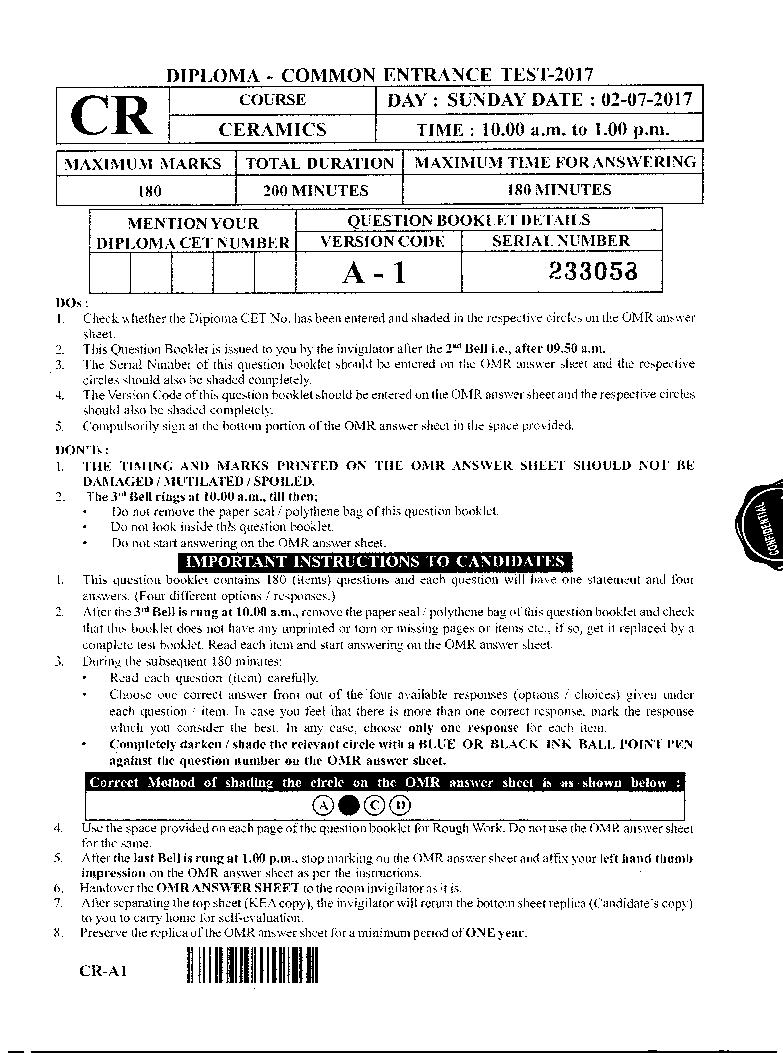
COURSE DAY : SUNDAY DATE : 02-07-2017
CR CERAMICS TIME : 10.00 a.m. to 1.00P .m.
MAXIMUM MARKS TOTAL DURATION MAXIMUM TIME FOR ANSWERING
180 200 MINUTES 180 MINUTES
MENTION YOUR QUESTION BOOKLET DETAILS
DIPLOMA CET NUMBER VERSION CODE SERIAL NUMBER
A -1 233058
llOs :
1. Check whether the Diploma CET No. has been entered and shaded in the respective circles on the OMR answer
sheet.
2. This Question Booklet is issued to you by the invigilator after the 2" Bell i.e., after 09.50 a.m.
3. The Serial Number of this question booklet should be entered on the OMR answer sheet and the respective
circles should also be shaded completely.
4. The Version Code of this question booklet should be entered on the OMR answer sheet and the respective circles
should also be shaded completely.
5. Compulsorily sign at the bottom portion of the OMR answer sheet in the space provided.
DON'Ts :
I. THE TIMING AND MARKS PRINTED ON THE OMR ANSWER SHEET SHOULD NOT BE
DAMAGED / MUTILATED / SPOILED.
2. The 3" Bell rings at 10.00 a.m., till then;
• Do not remove the paper seal / polythene bag of this question booklet.
• Do not look inside tilts question booklet.
• Do not start answering on the OMR answer sheet.
IMPORTANT INSTRUCTIONS TO CANDIDATES
1. This question booklet contains 180 (items) questions and each question will have one statement and four
answers. (Four different options / responses.)
2. After the 3cd Bell is rung at 10.00 a.m., remove the paper seal polythene bag of this question booklet and check
that this booklet does not have any unprinted or torn or missing pages or items etc., if so, get it replaced by a
complete test booklet. Read each item and start answering on the OMR answer sheet.
3. During the subsequent 180 minutes:
• Read each question (item) carefully.
• Choose one correct answer from out of the four available responses (options choices) given under
each question item. In case you feel that there is more than one correct response, mark the response
which you consider the best. In any case, choose only one response for each item.
• Completely darken / shade the relevant circle with a BLUE OR BLACK INK BALL POINT PEN
against the question number on the OMR answer sheet.
Correct Method of shading the circle on the OMR answer sheet is as shown below :
4. Use the space provided on each page of the question booklet for Rough Work. Do not use the OMR answer sheet
for the same.
5. After the last Bell is rung at 1.00 p.m., stop marking on the OMR answer sheet and affix your left hand thumb
impression on the OMR answer sheet as per the instructions.
6. Handover the OMR ANSWER SHEET to the room invigilator as it is.
7. After separating the top sheet (KEA copy), the invigilator will return the bottom sheet replica (Candidate's copy)
to you to carry home for self-evaluat on.
8. Preserve the replica o the OMR answer sheet for a minimum period of ONE year.
CR-Al iii 111111111111111111111
Page 2
APPLIED SCIENCE
I. The S.I. unit of Coefficient of Viscosity is
(A) Poise (B) NSm--2
(C) NS-I m- (D) NS-1 in
2. The prefix used for I0+9 is
(A) Mega (B) Tera
(C) Giga (D) Hecta
3. The physical quantity which has the dimensional formula [ML°T-2] is
(A) Force (B) Surface tension
(C) Viscosity (D) Work
4. The least count of slide callipers is given by
(A) 1 MSD 1 VSD (B) 1 MSD x 1 VSD
I MSD
(C) 1 MSD - 1 VSD (D)
1 VSD
5. The product of force and time is
(A) Momentum (B) Moment
(C) Impulse (D) Acceleration
6. The change in position of a particle in a particular direction is referred to as
(A) Speed (B) Displacement
(C) Velocity (D) Acceleration
A-1 2 CR
Page 3
a
(A) Sn = u + -(2n - (B) Sn = u - (2n -1)
(C) S. = u + -(2n +1) (D) Sn = u - -- (2n +1)
2
8. A bullet of mass 0.01 kg is fired with a velocity of 960 ms-1 from a rifle of mass 3 kg, the
velocity of recoil of rifle is
(A) -320 ms-1 (B) - 0.32 ms-1
(C) - 3.2 ms-1 (D) -32 ms-1
9. One of the following is not a scalar quantity :
(A) Mass (B) Density
(C) Force (D) Speed
10. If a body fixed about a point rotates in clockwise direction, the moment of force is measured
as
(A) Positive (B) Negative
(C) Zero (D) Equal
11. The resultant magnitude of two forces P and Q acting in same line and in same direction is
(A) P - Q (B) P +Q
(C) Q - P (D) -
Q
CR 3 A-1
Page 4
(A) 100 N (B) 10N
(C) 48 N (D) 14 N
13. The value of resultant magnitude of two forces acting at a point is maximum, when the
angle between the two forces is
(A) 0° (B) 90°
(C) 180° (D) 45°
14. Rise of liquid in a capillary tube is due to
(A) Energy (B) Viscosity
(C) Surface tension (D) Pressure
15. The ratio of volume stress to volume strain is called
(A) Bulk modulus (B) Young's modulus
(C) Rigidity modulus (D) Poisson's ratio
16. The reciprocal of bulk modulus of elasticity is called
(A) Compressibility (B) Rigidity
(C) Plasticity (D) Modulus of elasticity
17. The force of cohesion is maximum in
(A) Solids (B) Gases
(C) Liquids (D) Plasma
A-1 4 CR
Page 5
(A) 8 x10² Nm-I (B) 80 Nin
(C) 8 x10-- Nm (D) 8 x10³ Nin-I
19. Pressure at the bottom of a container having base area of 10 m2 filled with water to a height
of 10 m is
(A) 9.8 x 10⁴ Pa (B) 980 x 104 Pa
(C) 9.8 x 10⁻⁴ Pa (D) 980 x 10-4 Pa
20. 100 °C when expressed in absolute scale is
(A) 100 K (B) 0 K
(C) 273 K (D) 373 K
21. Gas law which gives the relation between pressure and volume changes is
(A) Boyle's law (B) Charles' law
(C) Gay-Lussac's law (D) Hooke's law
22. Amount of heat required to raise the temperature of one gram of water through 1 °C is
(A) Heat capacity (B) Conductivity
(C) Calorie (D) Joule
23. An example of longitudinal wave is
(A) Sound waves (B) Waves on the surface of water
(C) Light waves (D) Electromagnetic waves
CR 5 A-1
Page 6
(A) v c T (B) v
(C) v (D) v oc
25. The distance between a node and the next antinode in a stationary wave is equal to
(A) one wavelength (B) half wavelength
(C) twice wavelength (D) one fourth wavelength
26. Damage caused by marching military columns to the suspension bridge is due to
(A) Echo (B) Resonance
(C) Beats (D) Interference
27. During forced vibrations, if the forced frequency is F1 and natural frequency is F, . the body
resonates if
(A) F1 > F, (B) F>>F1
(C) = 2.5 F, (D) =F,
28. The fundamental frequency of transverse vibrations of the stretched string is inversely
proportional to
(A) tension (B) length of string
(C) square root of tension (D) square root of length of string
29. Minimum length of a hall to produce an echo is
(A) 50 m (B) 34 m
(C) 25 m (D) 17m
A-1 6 CR
Page 7
(A) Polarisation (B) Photoelectric effect
(C) Interference (D) Compton effect
31. The spectrum of black body radiation is successfully explained by
(A) Newton's corpuscular theory of light
(B) Huygen's wave theory of light
(C) Maxwell's electromagnetic theory of light
(D) Planck's quantum theory of light
32. For constructive interference of light, the path difference should be
2n2.
(A) (B) (2n+ 1 )
(C) (2n +1)— (D) (2n+1)
3 4
33. Two very close objects are just resolved if the central maximum of one object is on
(A) central maximum of another
(B) first minimum of another
(C) beyond second minimum of another
(D) between central maximum and first minimum of another
34. The light is incident at polarising angle Op and the angle of refraction is r, then
(A) Op+ r = 0° (B) Op+ r = 90°
(C) Op+ r = 180° (D) Op+ r = 360°
CR 7 A-1
Page 8
(A) Kinetic energy (B) Potential energy
(C) Work function (D) Energy function
36. When the size of the scattering particle is small, the intensity of scattered light is inversely
proportional to
(A) fourth power of wavelength (B) square of wavelength
(C) square root of wavelength (D) cube of wavelength
37. Time for which an atom stays in metastable state is of the order of
(A) Seconds (B) Milli-seconds
(C) Micro-seconds (D) Nano-seconds
38. If an element emits (3-ray then its atomic number
(A) increases by one (B) decreases by one
(C) remains same (D) decreases by two
39. If the concentration of 1-1± ions is more than 10-7 gmion per litre, the solution is
(A) Base (B) Acid
(C) Neutral (D) Both Acid and Base
40. A galvanic cell is one in which
(A) chemical energy produce electric energy
(B) electric energy produce chemical energy
(C) chemical energy will not produce electric energy
(D) electric energy will not produce chemical energy
A-1 8 CR
Page 9
APPLIED MATHEMATICS
I 2 3
41. The value of x if x 3 = 0 is
3 4 3
(A) 0 (B) -3
(C) 3 (D) 18
42. The value of x, if 4x + y = 7, 3y +47. = 5 and 3z A- 5x =2 is
(A) 0 (B) I
(C) 3 (D) -1
2 -11
43. If A= , then A -1 is
3 - 4 _I
-4 - 3 -4I
(B) -
1 5-32
1 I- -4 (D) - 1 - 4 1
(C) --
11 1 I1 -3 2
2 -1
44. The characteristic equation of the matrix A= is
5 -6
(A) A2 +8A-71 = 0 (B) A- + 4A -1 71 = 0
(C) A2 + 4A + 71= 0 (D) A2 + 4A - 71= 0
CR 9 A-1
Page 10
45. If +A= , then A is
3 21 3 -2-1
(A) (B)
-2 0] 2 0
-2 3
(C) (D)
2 01 2
, -)4
46. The middle term of the expansion of i is
xi
(B) 2 12 12
(A) 24Cio 2 11)
x12
(C) 24 c )1010 (D) 24 -)12 12
C11.. X
47. The term independent of x in ".* 1 is
3X)
(A) 9 C6 (4)6 (B) ° C,(3)
4 )6 z 3\6
(C) ' 6 (D)
3) \, 4)
48. If 3i - 2j + k, i - 3j 5k, 2i + j - 4k are the sides of a triangle, then the triangle is
(A) Right angled triangle (B) Equilateral triangle
(C) Isosceles triangle (D) Isosceles right angled triangle
49. If -a+ = (2, -I. 4) and (2, -3, 4), then projection of a on his
2,3 (g)
(A)
N/21 Ai129
_73 -23
(C) (D)
J29
Space For Rough NVork
A-1 10 CR
Page 11
-vFT-
(A) J65 (B) 65
3 ^
V65
(C) (D) 65
9
tan2 45 + cot'30
51. If x sin 45 -- then the value of x is
sin-45 + cos245
(A) 4 (B) 2
(C) 6 (D) 8
4 it 3 7/
52. The value of —see- --cosec-+ —a+-3 tan - —
7( — 2 in- is
3 3 6 4 4 3
11 53
(A) (B)
12 12
7
(C) (D)
12 12
53. The value of
(
+0
sin (90 —0) sec \ 2 tan (180-0)
•+ is
cos (360 — 0) cosec (7t + 0) tan (-0)
(A) 1 (B) —1
(C) 3 (D)
54. The value of cosec 43 cot 43 cot 47 cos 47
(B) 0
(D) 2
CR 11 A-1
Page 12
55.
1- tan 69° tan 66°
(A) I (B) -1
(C) (D)
A
56. If tan --- = x then sin A + tan A is
4x 4x
(A) (B)
1- 1+ A--
4x 4.v
(C) (D)
1+ x4
57. The value of sin 70°- sin 50° - sin10° is
(A) 1 (B) 0
1
(C) -1 (D) -
58. sin - x is also equal to
(A) cosec -1' I \ (B) cosec x
X
1
(C)cosec -1 (D)
sin .v
59. Centroid divides the median in the ratio
(A) 2 : 1 (B) 1 :2
(C) 1 : 1 (D) 1 :4
60. The co-ordinates of a point which divides the line join of the points (a + h, a - h) and
(a - b, a + h) in the ratio 2 : 3 is
Sa + 5b 5a - 5b a+b a—b
(A) (B)
5 5
5a + b 5a — b 5a—b a+5b
(C) (D)
5 5 5
A-1 12 CR
Page 13
(A) 5x — 3y = 15 (B) 5x + 3y = 15
(C) 5x + 3y 1 (D) 15.v + 15y = 1
62. The angle between the lines whose slopes are 3 and respectively is
ti
(A) LT (B)
6
(C) (D)
4
63. The equation of the straight line passing through (2, 3) and x intercept is twice its y intercept
is
(A) x + 2y = 8 (B) x — 2y = 8
(C) +y=4 (D) 2x + 2v = 8
64. The equation to the line passing through the point (-6, 7) and parallel to the line joining
(3, 4) and (6, —8) is
(A) 4x + y + 31 —0 (B) x + 4y — 1 =0
(C) — 4y 1 = 0 (D) 4x+ y+ 17 =0
65. lim (sec 0 — tan 0) is equal to
O 7,2
(B)
(D)
x—4
66. lira is equal to
43—3—
(A) 3 (B) 9
(C) 6 (D) 0
CR 13 A-1
Page 14
67. If y = (1 + log x)- , then -- is
dx
5
(A) 5(log x)4 (B) -(1+ logx) 4
X
(C) 5(1+ log x)4 (D) 5x4 logx
dy
68. If x = cos-1 t and y = t, then —• is
dx
(A) -1 (B) 1
1
(C) (D)
2N/1-t2 t2
dy
69. If y = x log y, then is
dx
log x` log y
(A) (B)
x- y x- y
log y' log )T
(C) (D)
x-y
x +1 dy .
70. If y = then s
x+2dx
1
(A) (B)
(x + 2)-
1
(C) (D)
x+2)2 (x+ 2)2
71. The equation of tangent to the curve y2 = 4x at (1, 2) is
(A) x + y - 3 0 (B) x - y + 1 =0
(C) 2x - y = 0 (D) 2x + y - 4 - 0
A-1 14 CR
Page 15
(A) 15 (B) —4
(C) —2 (D) 31
73. The value of flog 2x dx is
(A) x 1044 2.1 ± X C (B) x log 2x — x + C
1
(C) +C (D) —+ C
74. The value off sec4 x tan x dx
sec x
(A) +C (B) 4 sec4x + C
4
tan4X
(C) 3 sec2x + C (D) + C
4
75. The value off x log x dx is
X , X2
(A) — log x— +C (B) togx+ +C
2
x2
X2 2
(C) — log x— +C (D) logx + +C
2 4 4
a/4
76. 'tan 2 x clx is equal to
(A) 7--E- —1 (B) 1—
4 4
Tr 2
(D) 7t —
(C) —
16 16
CR 15 A-1
Page 16
1
(A) —
3
(C) cr2
78. The volume generated by revolving the line y = x + 1 about the x-axis between the ordinates
x = 0 and x = 2
2611 10
(A) units (B) — —units
3 3
26
(C) units (D) 4 units
3
I 3
dy
79. The degree and order of the differential equation da y
, -F are
(A) 2 and 1 (B) 1 and 2
(C) 3 and 2 (D) 2 and 3
80. The solution of differential equation dy + y tan x = sec .1 is
do
(A) y sec x = tan x + C
(B) y sin x = sec x C
-(C) log(sec x) = tan x + C
(D) y scc x —cot x + C
A-1 16 CR
Page 17
CERAMICS
81. When limestone is subjected to high temperature and pressure it becomes
(A) Sandstone (B) Marble
(C) Shale (D) Slate
82. Basalt and Gabbro are the types of rocks.
(A) Sedimentary (B) Igneous
(C) Metamorphic (D) None of these
83. The zone of earth which is completely made up of rocks of great varieties are called
(A) Pyrosphere (B) Asthenosphere
(C) Lithosphere (D) Hydrosphere
84, Streak of hematite is
(A) Blue (B) Black
(C) Cherry red (D) Vitreous
85. Quartz exhibits fracture.
(A) Even (B) Uneven
(C) Conchoidal (D) Hackly
86. Hardness of corundum
(A) 6 (B) 7
(C) 9 (D) 10
CR 17 A-1
Page 18
(A) Fold (B) Fault
(C) Joints (D) Unconformity
88. CaSO 4 .2H ,0 is the chemical composition of
(A) Calcite (B) Chalcopyrite
(C) Corundum (D) Gypsum
89. High alumina clay usually contains % of alumina.
(A) 40 (B) 50
(C) 60 (D) 70
90. Fluxes are the materials which play a key role in
(A) Vitrification (B) De-vitrification
(C) Green strength (D) Shrinkage
91. Example for flocculant is
(A) MgSO 4 (B) CaCl 2
(C) Both MgSO 4 and CaC1, (D) TiO2
92. Jiggering technique is used for
(A) Convex shape (B) Concave shape
(C) Hollow shape (D) Porous shape
93. Pushing a column of clay through a die is called
(A) Throwing (B) Damping
(C) Extrusion (D) Tape casting
A-1 18 CR
Page 19
(A) Conduction (B) Convection
(C) Radiation (D) All of these
95. Glazed ware is traditionally tired
(A) Once (B) Twice
(C) Thrice (D) None of these
96. The organic compounds begins to decompose at
(A) 200 °C (B) 300 °C
(C) 400 °C (D) 600 °C
97. The property of clay which enables it to take and hold any impression made on it is termed
as
(A) Plasticity (B) Elasticity
(C) Tenacity (D) Density
98. white-ware body is used for making insulators.
(A) Terra-cotta (B) Earthenware
(C) Stoneware (D) Porcelain
99. High refractoriness of refractory brick means
(A) High spalling resistance (B) Low spalling resistance
(C) High resistance to fusion (D) Low porosity
100. Grog
(A) contains both alumina and silica. (B) is crushed fire bricks.
(C) is a non-plastic material. (D) All of these
CR 19 A-1
Page 20
(A) Fire clay (B) Silica
(C) Chrome - Magnesite (D) High alumina
102. Seger cones are used for the determination of
(A) Softening temperature (B) Fatigue resistance
(C) Electrical conductivity (D) Slag resistance
103. Insulation refractories should have
(A) High porosity
(B) Low thermal conductivity
(C) Both High porosity and Low thermal conductivity
(D) Neither High porosity nor Low thermal conductivity
104. Porosity of fire clay refractories is
(A) 5 - 10 (B) 10 -25
(C) 25 35 (D) 35 - 50
105. Dolomite bricks have good resistance to attack by
(A) Molten steel (B) Iron oxide
(C) Lime slag (D) None of these
106. RUT is quite close to the PCE for
(A) Fire clay bricks (B) Silica bricks
(C) Dolomite bricks (D) Very low alumina bricks
107. Silicon carbide refractories have very low
(A) Refractoriness (B) Thermal conductivity
(C) Resistance to thermal shock (D) None of these
A-1 20 CR
Page 21
(A) Silica (B) Carborandum
(C) Fireclay (D) Magnesite
109. Which one of the following is a advanced alumina structural ceramic product ?
(A) Refractories (B) Wall tiles
(C) Electrical porcelain (D) Cutting tools
110. From the following is an organic binder.
(A) Kaolin (B) Ball clay
(C) Refined starch (D) Bentonite
111. The distribution of particle sizes in a processing system has significant effect on
(A) Particle packing (B) Pore structure
(C) Behaviour during firing (D) All of these
112. Air or gas enclosed with a thin film of liquid is known as
(A) Foam (B) Lubricant
(C) Flocculant (D) Emulsion
113. Undercut recesses, contoured surfaces and threaded surfaces are produced by
(A) Screen printing (B) Laminating
(C) Punching (D) Surface grinding and turning
114. Chemical diffusion and segregation is greatly restricted by
(A) Sedimentation (B) Polymerisation
(C) Flocculation (D) Terminal velocity
CR 21 A-1
Page 22
(A) Storing chamber (B) Mixing chamber
(C) Annealing chamber (D) Feeding chamber
116. In glass sulphur plays an important role as
(A) Fining (B) Annealing
(C) Cooling (D) Mixing
117. The thermal expansion of glass is measured by
(A) Dial guage apparatus (B) Refractrometer
(C) Screw guage apparatus (D) Fire point and flash point apparatus
118. Glass is a conductor of heat and electricity.
(A) Good (B) Poor
(C) Semi (D) Super
119. Any non-glassy material embedded in a piece of glass is termed as
(A) Stone (B) Chord
(C) Bubble (D) Seed
120. In glass SiO, is treated as
(A) Acidic oxide (B) Basic oxide
(C) Neutral oxide (D) Amphoteric oxide
121. The melting point of CaO
(A) 1000 °C (B) 2000 °C
(C) 2800 °C (D) 3000 °C
A-1 22 CR
Page 23
(A) Soda — lime type (B) Potash — lime type
(C) Potash — lead type (D) Special type
123. Which is known as Salt cake ?
(A) Na,SO4 (B) NaCI
(C) B4O3 (D) 13,05
124. Pot furnace is used for the manufacture of
(A) Optical glass (B) Soda-lime glass
(C) Borosilicate glass (D) Potash lead glass
125. Cement was invented by
(A) Albert Einstein (B) Joseph Aspidian
(C) Alexander Gram Bell (D) Wright Brothers
126. The waste product from iron and steel industry is used in
(A) White cement (B) Quick setting cement
(C) Blast furnace cement (D) Low heat cement
127. is the harmful constituent of cement.
(A) Alkali oxide
(B) Magnesium oxide
(C) Both Alkali oxide and Magnesium oxide
(D) None of these
CR 23 A-1
Page 24
(A) Retarder (B) Accelerator
(C) Plasticizer (D) Binder
129. Cement has phases.
(A) 2 (B) 3
(C) 4 (D) 5
130. Cement clinker is reduced to fine size by
(A) Roller crusher (B) Disc crusher
(C) Tube mill (D) Hammer mill
131. Clinkers are cooled in coolers.
(A) Rotary (B) Grater
(C) Planetary (D) All of these
132. 1ST and FST of cement is tested by
(A) Le-Chatlier's apparatus (B) MoR apparatus
(C) Vicat apparatus (D) Autoclave apparatus
133. The strength to the cement in early period of setting is imparted by
(A) C-,S (B) C3S
(C) ClA (D) C4AF
134. Cement is defined as
(A) Inorganic material (B) Hydraulic binder
(C) Polyphase (D) All of these
A-1 21 CR
Page 25
(A) Calorie (B) Kilo calorie
(C) British thermal unit (D) All of these
136. A freshly cut wood contains % moisture.
(A) 10 — 15 (B) 25 — 50
(C) 15 — 20 (D) 50 — 70
137. The percentage of carbon in petrol is
(A) 60% (B) 70%
(C) 84% (D) 90%
138. Bio-gas is produced by
(A) Anaerobic fermentation (B) Aerobic fermentation
(C) Distillation (D) Filteration
139. Shuttle Kiln is used for firing
(A) Coke (B) Cement
(C) Table ware (D) Glass ware
140. Ports are present in which furnace ?
(A) Blast furnace (B) Glass tank furnace
(C) Electric furnace (D) Salt bath furnace
141. Example for neutral refractory is
(A) Chromite (B) Graphite
(C) Carbon (D) All of these
CR 25 A-1
Page 26
(A) Petroleum deposits (B) Coal deposits
(C) Soil deposits (D) Sand deposits
143. Glaze is a mixture of
(A) Silicates (B) Non-silicates
(C) Clays (D) Colours
144. A good way to create glaze is by
(A) Empirical formula method (B) Trignometric tbrmula method
(C) Algebric formula method (D) Theoritical formula method
145. Stencilling is the process of
(A) Glaze decoration (B) Sand decoration
(C) Clay decoration (D) Stone decoration
146. Which is the excellent method to apply glaze ?
(A) Spraying (B) Brushing
(C) Dipping (D) Pouring
147. The chief factors which affect the colour arc
(A) Colouring agent (B) Kiln atmosphere
(C) Firing temperature (D) All of these
148. To prepare salt glaze is used.
(A) NaCI (B) BaCI
(C) MgC1 (D) CaCI
A-1 26 CR
Page 27
(A) HF (B) NF
(C) CF (D) KF
150. The flow of glaze during firing is considerably influenced by
(A) Surface tension
(B) Angle of contact
(C) Both Surface tension and Angle of contact
(D) None of these
151. Which of the following is a network modifying oxide ?
(A) ZnO (B) Pb0
(C) Cr103 (D) All of these
152. Chipping of glaze under compression is called
(A) Peeling (B) Blistering
(C) Dunting (D) Crazing
153. In hammer mill principle of mechanical reduction is used.
(A) Blowing (B) Compression
(C) Shearing (D) Cutting
154. For preliminary breaking of hard rock we use a
(A) Gyratory crusher (B) Ball mill
(C) Tube mill (D) Squirrel cage disintegrator
CR 27 A-1
Page 28
(A) Density (B) Wettability
(C) Electrical property (D) Size
156. Dry pressed ware has
(A) Little or no drying shrinkage (B) Dimension accuracy
(C) High di-electric strength (D) All of these
157. Slurries are usually blended in
(A) Pug mill (B) Ball mill
(C) Blunger (D) Pan mill
158. The granules are formed by
(A) Tunnel drier (B) Spray drier
(C) Mangle drier (D) Chamber drier
159. Autoclave apparatus is used to test
(A) Crazing resistance (B) Thermal shock resistance
(C) Abrasion resistance (D) Chemical resistance
160. 200 mesh means 200 openings per
(A) cm (B) cm
(C) inch (D) inch'
161. Which one of the following is a conductor ?
(A) Porcelain (B) Glass
(C) Rubber (D) Brass
A-1 28 CR
Page 29
(A) High dielectric strength (B) Temperature tolerance
(C) Least electric absorbent (D) All of these
163. In internal combustion engine device is used.
(A) Honey comb (B) Spark plug
(C) Sensor (D) Capacitor
164. cutting tool has low fracture toughness.
(A) Alumina (B) Sialon
(C) Tungsten carbide (D) Titanium carbide
165. High tension insulators are used
(A) Below 440 volts (B) Above 440 volts
(C) Equal to 440 volts (D) None of these
166. Which one of the following is a piezoelectric material ?
(A) Quartz (B) PZT
(C) Barium titanate (D) All of these
167. Hard anisotropic ferrites are shaped by
(A) Extrusion (B) Semi-automatic press
(C) HPA — 100 dorst press (D) Ordinary press
CR 29 A-1
Page 30
A
(A) (B)
A
A A
(C) Y (D)
"d
169. Glazed tiles are normally decorated by
(A) Brushing (B) Screen printing
(C) Stamping (D) Painting
170. Tiles are usually tired in kiln.
(A) Tunnel (B) Shuttle
(C) Roller hearth (D) Up draught kiln
171. Example for secondary clay is
(A) Kaolin (B) Earthenware clay
(C) Ball clay (D) Both Earthenware clay and Ball clay
172. Presence of carbonates in a body leads to
(A) More shrinkage (B) Rapid crystallization
(C) Increases firing strength (D) Acts as flux
173. The stable form of silica at room temperature is
(A) 3 - quartz (B) a — quartz
(C) — quartz (D) ii—quartz
174. Presence of alumina in a body increases
(A) Density (B) Porosity
(C) Water absorption (D) Viscosity
A-1 30 CR
Page 31
(A) Abrasive material (B) Refractory material
(C) Heating element (D) All of these
176. TiN shows
(A) Metallic gold colour (B) Green colour
(C) Blue colour (D) Black colour
177. Boride shows
(A) High conductivity at low temperature
(B) High conductivity at high temperature
(C) High conductivity at all temperature
(D) High conductivity at medium temperature
178. Platinum silicide is a material.
(A) Conductor (B) Semi-conductor
(C) Insulator (D) Super conductor
179. Ceramets are composed of
(A) 80% ceramics + 20% metal (B) 70% ceramics + 30% metal
(C) 50% ceramics + 50% metal (D) 40% ceramics + 60% metal
180. Bentonite is derived from
(A) Volcanic ash (B) Bone ash
(C) Soda ash (D) Charcoal ash
CR 31 A-1
Page 32
A-1 32 CR
Document Details
| Board / Org | KEA |
| Exam | Karnataka Diploma Common Entrance Test |
| Type | Question Paper |
| Pages | 32 |
| Language | english |
| Updated | 22 Jul 2026 |