Karnataka Diploma CET 2017 Question Paper Textile Technology
Finished viewing? Save it for later —
Download Karnataka Diploma CET 2017 Question Paper Textile Technology (PDF · 32 pages)About Karnataka Diploma CET 2017 Question Paper Textile Technology
Karnataka Diploma CET 2017 Question Paper Textile Technology is available here for free download. Published by KEA for Karnataka Diploma Common Entrance Test, this question paper can be viewed online or downloaded as a PDF (32 pages). Candidates preparing for Karnataka Diploma Common Entrance Test can use Karnataka Diploma CET 2017 Question Paper Textile Technology to understand the exam pattern, the type of questions asked, and the overall difficulty level.
Frequently Asked Questions
How can I download Karnataka Diploma CET 2017 Question Paper Textile Technology?
Open this page and click the Download button to save Karnataka Diploma CET 2017 Question Paper Textile Technology as a PDF. It is completely free on AglaSem Docs.
Is Karnataka Diploma CET 2017 Question Paper Textile Technology free to download?
Yes. Karnataka Diploma CET 2017 Question Paper Textile Technology can be viewed online and downloaded as a PDF free of cost on AglaSem Docs.
How many pages does Karnataka Diploma CET 2017 Question Paper Textile Technology have?
Karnataka Diploma CET 2017 Question Paper Textile Technology contains 32 pages, which you can read online or download together as a single PDF.
Where can I find more Karnataka Diploma Common Entrance Test study material?
You can find more Karnataka Diploma Common Entrance Test question papers, sample papers, syllabus, and answer keys on AglaSem Docs.
Karnataka Diploma CET 2017 Question Paper Textile Technology – Text
Read the full text of this question paper below — useful to quickly search, copy and reference the content online without downloading the PDF.
📄 View text version (32 pages)
Page 1
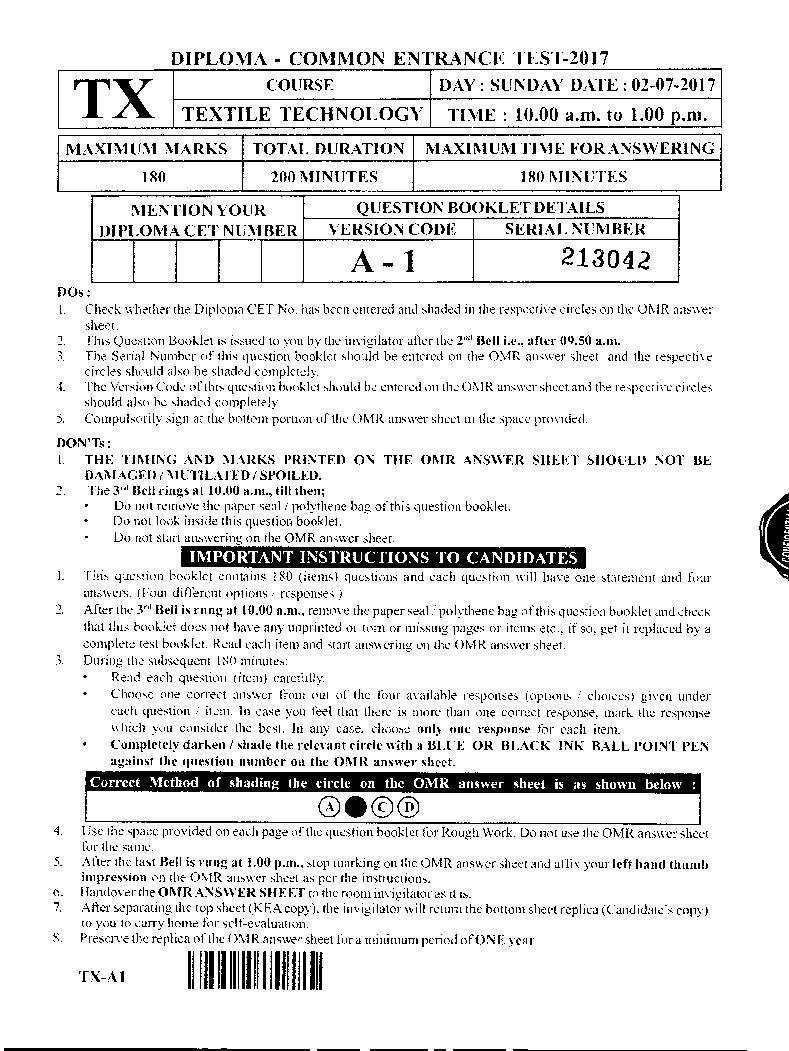
COURSE DAY : SUNDAY DATE:02-07-2017
TX TEXTILE TECHNOLOGY TIME : 10.00 a.m. to 1.00 p.m.
MAXIMUM MARKS TOTAL DURATION MAXIMUM TIME FOR ANSWERING
180 200 MINUTES 180 MINUTES
MENTION YOUR QUESTION BOOKLET DETAILS
DIPLOMA CET NUMBER VERSION CODE SERIAL NUMBER
A-1 213042
DOs :
1. Check whether the Diploma CET No. has been entered and shaded in the respective circles on the OMR answer
sheet.
2. This Question Booklet is issued to you by the invigilator after the 2' Bell i.e., after 09.50 a.m.
3. The Serial Number of this question booklet should be entered on the OMR answer sheet and the respective
circles should also be shaded completely.
4. The Version Code of this question booklet should be entered on the ON-IR answer sheet and the respective circles
should also he shaded completely.
5. Compulsorily sign at the bottom portion of the OMR answer sheet in the space provided.
DON'Ts :
I. THE TIMING AND MARKS PRINTED ON THE OMR ANSWER SHEET SHOULD NOT BE
DAMAGED / MUTILATED / SPOILED.
2. The 3" Bell rings at 10.00 a.m., till then;
• Do not remove the paper seal / polythene bag of this question booklet.
• Do not look inside this question booklet.
• Do not start answering on the OMR answer sheet.
IMPORTANT INSTRUCTIONS TO CANDIDATES
1. This question booklet contains 180 (items) questions and each question will have one statement and four
answers. (Four different options responses.)
2. After the 3r" Bell is rung at 10.00 a.m., remove the paper seal / polythene bag of this question booklet and check
that this booklet does not have any unprinted or torn or missing pages or items etc., if so, get it replaced by a
complete test booklet. Read each item and start answering on the OMR answer sheet.
3. During the subsequent 180 minutes:
• Read each question (item) carefully.
• Choose one correct answer from out of the four available responses (options 1 choices) given under
each question / item. In case you feel that there is more than one correct response, mark the response
which you consider the best. In any case, choose only one response for each item.
• Completely darken / shade the relevant circle with a BLUE OR BLACK INK BALL POINT PEN
against the question number on the OMR answer sheet.
Correct Method of shading the circle on the OMR answer sheet is as shown below :
4. Use the space provided on each page of the question booklet for Rough Work. Do not use the OMR answer sheet
for the same.
5. After the last Bell is rung at 1.00 p.m., stop marking on the OMR answer sheet and affix your left hand thumb
impression on the OMR answer sheet as per the instructions.
6. Handover the ONIR ANSWER SHEET to the room invigilator as it is.
7. After separating the top sheet (KEA copy), the invigilator will return the bottom sheet replica (Candidate's copy)
to you to carry home for self-evaluation.
8. Preserve the replica of the OMR answer sheet for a minimum period of ONE year.
TX-Al 11 iii 111111111
Page 2
APPLIED SCIENCE
1. The S.I. unit of Coefficient of Viscosity is
(A) Poise (B) NSin-2
(C) NS-11112 (D) NS - I M-2
2. The prefix used for 10+9 is
(A) Mega (B) Tera
(C) Giga (D) Hecta
3. The physical quantity which has the dimensional formula [MOT-2] is
(A) Force (B) Surface tension
(C) Viscosity (D) Work
4. The least count of slide callipers is given by
(A) I MSD + 1 VSD (B) 1 MSD x 1 VSD
1 MSD
(C) 1 MSD - 1 VSD (D)
1 VSD
5. The product of force and time is
(A) Momentum (B) Moment
(C) Impulse (D) Acceleration
6. The change in position of a particle in a particular direction is referred to as
(A) Speed (B) Displacement
(C) Velocity (D) Acceleration
A-1 2 TX
Page 3
a
(A) = u + —(2n —1) (B) S„ = u (2n —1)
a a
(C) Sn = u + — (2n +1) (D) S„ = u — — 2n +1)
8. A bullet of mass 0.01 kg is fired with a velocity of 960 ms-i from a rifle of mass 3 kg. the
velocity of recoil of rifle is
(A) —320 ins-I (B) — 0.32 ms-1
(C) —3.2 ms 1 (D) —32 ms-1
9. One of the following is not a scalar quantity :
(A) Mass (B) Density
(C) Force (D) Speed
10. If a body fixed about a point rotates in clockwise direction, the moment of force is measured
as
(A) Positive (B) Negative
(C) Zero (D) Equal
11. The resultant magnitude of two forces P and Q acting in same line and in same direction is
(A) P — Q (B) P+Q
(C) Q — P (D)
Q
TX 3 A-1
Page 4
(A) 100N (B) 10 N
(C) 48N (D) 14 N
13. The value of resultant magnitude of two forces acting at a point is maximum, when the
angle between the two forces is
(A) 0° (B) 90°
(C) 180° (D) 45°
14. Rise of liquid in a capillary tube is due to
(A) Energy (B) Viscosity
(C) Surface tension (D) Pressure
15. The ratio of volume stress to volume strain is called
(A) Bulk modulus (B) Young's modulus
(C) Rigidity modulus (D) Poisson's ratio
16. The reciprocal of bulk modulus of elasticity is called
(A) Compressibility (B) Rigidity
(C) Plasticity (D) Modulus of elasticity
17. The force of cohesion is maximum in
(A) Solids (B) Gases
(C) Liquids (D) Plasma
A-1 4 TX
Page 5
(A) 8 x 10² Nm-1 (B) 80 Nm-'
(C) 8 x10⁻² Nm -I (D) 8 x10³ Nm I
19. Pressure at the bottom of a container having base area of 10 m2 filled with water to a height
of 10 m is
(A) 9.8 x 10⁴ Pa (B) 980 x 104 Pa
(C) 9.8 x 10⁻⁴ Pa (D) 980 x 10-4 Pa
20. 100 °C when expressed in absolute scale is
(A) 100 K (B) 0 K
(C) 273 K (D) 373 K
21. Gas law which gives the relation between pressure and volume changes is
(A) Boyle's law (B) Charles' law
(C) Gay-Lussac's law (D) Hooke's law
22. Amount of heat required to raise the temperature of one gram of water through 1 °C is
(A) Heat capacity (B) Conductivity
(C) Calorie (D) Joule
23. An example of longitudinal wave is
(A) Sound waves (B) Waves on the surface of water
(C) Light waves (D) Electromagnetic waves
TX 5 A-1
Page 6
(A) v T (B) v —
T
(C) v (D) v x T2
25. The distance between a node and the next antinode in a stationary wave is equal to
(A) one wavelength (B) half wavelength
(C) twice wavelength (D) one fourth wavelength
26. Damage caused by marching military columns to the suspension bridge is due to
(A) Echo (B) Resonance
(C) Beats (D) Interference
27. During forced vibrations, if the forced frequency is F1 and natural frequency is F, , the body
resonates if
(A) Fi > F, (B) F, >
(C) Fi = 2.5 F, (D)
28. The fundamental frequency of transverse vibrations of the stretched string is inversely
proportional to
(A) tension (B) length of string
(C) square root of tension (D) square root of length of string
29. Minimum length of a hall to produce an echo is
(A) 50 in (B) 34 m
(C) 25 m (D) 17 m
A-1 6 TX
Page 7
(A) Polarisation (B) Photoelectric effect
(C) Interference (D) Compton effect
31. The spectrum of black body radiation is successfully explained by
(A) Newton's corpuscular theory of light
(B) I luygen's wave theory of light
(C) Maxwell's electromatmetic theory of light
(D) Planck's quantum theory of light
32. For constructive interference of light, the path difference should be
(A) (B) (2n +1) I.
(C) (2n +1) -2± (D) (2n +1)
3 4
33. Two very close objects are just resolved if the central maximum of one object is on
(A) central maximum of another
(B) first minimum of another
(C) beyond second minimum of another
(D) between central maximum and first minimum of another
34. The light is incident at polarising angle Op and the angle of refraction is r, then
(A) Op+ r = 0° (B) 04,+ r = 90°
(C) 0p+ r = 180° (D) 0 + r = 360°
TX 7 A-1
Page 8
(A) Kinetic energy (B) Potential energy
(C) Work function (D) Energy function
36. When the size of the scattering particle is small, the intensity of scattered light is inversely
proportional to
(A) fourth power of wavelength (B) square of wavelength
(C) square root of wavelength (D) cube of wavelength
37. Time for which an atom stays in metastable state is of the order of
(A) Seconds (B) Milli-seconds
(C) Micro-seconds (D) Nano-seconds
38. If an element emits I3-ray then its atomic number
(A) increases by one (B) decreases by one
(C) remains same (D) decreases by two
39. If the concentration of I-1+ ions is more than 10-7 gmion per litre, the solution is
(A) Base (B) Acid
(C) Neutral (D) Both Acid and Base
40. A galvanic cell is one in which
(A) chemical energy produce electric energy
(B) electric energy produce chemical energy
(C) chemical energy will not produce electric energy
(D) electric energy will not produce chemical energy
A-1 8 TX
Page 9
APPLIED MATHEMATICS
1 2 3
41. The value of x if 2 x 3 = 0 is
3 4 3
(A) 0
(C) 3
42. The value of x, if 4x + y = 7, 3y + 4: = 5 and 3z + 5x - 2 is
(A) 0 (B) 1
(C) 3 (D) -1
2 —1
43. If A= , then A-1 is
3 -4
1 -4 -3 [- 4 1
(A) - (B) -
5 1 2 5 -3 2
1 -4 -4
(C) -- (D) -—
11 1 1 1 - 3 2]
2 -1
44. The characteristic equation of the matrix A = is
5 -6
(A) A2 + 8A - 71 =0 (B) A2 + 4A -1 71 = 0
(C) A2 + 4A + 71= 0 (D) A2 + 4A - 71= 0
TX 9 A-1
Page 10
45. If +A , then A is
1 3
3 21 3 —2
(A) (B)
oi 2 0
3 0 3
(C) (D)
2 0 ?
( ,))24
46. The middle term of the expansion of x -- is
x)
(A) 14 C102 1 0x (B) 14 Cii 2 x12
24 10 I() (D)Cp 2 P X12
24
(C) 0132 X
47. 1
The term independent of x in x- 4 Is
_._ •
3x,
(A) 9 C6 (4)6 (B) 9 (3)-6
.6 (3 6
4
(C) 6(- (D) 9C
3 4}
48. If 3i — 2j + k, i — 3j + 5k, 2i + j — 4k are the sides of a triangle, then the triangle is
(A) Right angled triangle (B) Equilateral triangle
(C) Isosceles triangle (D) Isosceles right angled triangle
49. If a = (2, —1. 4) and b = 2, —3, 4), then projection of --a' on I; is
23
(A) (B)
V21 V29
—23 —23
(C), (D)
V29 V21
A-1 10 TX
Page 11
V65 V65
(A) (B)
3
(C) -Vr-63
(D) i65
9
tan2 45+ cot230
51. If x sin 45 — then the value of x is
sin245 + cos245
(A) 4 (B) 2
(C) 6 (D) 8
4 it it 7E
52. The value of --sec- --cosec- + — tan - -- 2 sin- — is
3 3 6 4 4 3
I1 53
(A) (B)
12
7 7
(C) (D) — —
12
53. The value of
( 3it
sec
sin (90-0) 2 +0} tan (180-0)
is
cos (360-0) cosec (it +0) tan (-0)
(A) 1 (B) —I
(C) 3 (D)
54. The value of cosec 43 cot 43 cot 47 cos 47
(B) 0
(D) 2
TX 11 A-1
Page 12
55. The value of
I- tan 69° tan 66°
(A) 1 (B) -1
(C) 0 (D) cc
A
56. If tan --- =- x then sin A + tan A is
4.v 4.v
(A) (B)
- x- 1 + x2
4x 4x
(C) (D) x4
1+x4
57. The value of sin 70° - sin 50° - sin10° is
(A) 1 (B) 0
(C) -1 (D)
58. sin-1 x is also equal to
(A) cosec --I( 1 (B) cosecs
x)
(C) cosec-1 x (D)
sin x
59. Centroid divides the median in the ratio
(A) 2 : 1 (B) 1:2
(C) I : 1 (D) 1:4
60. The co-ordinates of a point which divides the line join of the points (a + b, a - b) and
(a - b, a + b) in the ratio 2 : 3 is
5a +5b 5a - 5b a+b a—h
(A) (B)
5 5 5 5
5a+b 5a —b 5a—b a+5b
(C) (D)
5 5 5 5
A-1 12 TX
Page 13
(A) 5.v — 3y = 15 (B) 5x+ 3y= 15
(C) 5x + 3y = 1 (D) 15x + 15y = 1
62. The angle between the lines whose slopes are -13 and r_ respectively is
VJ
it
(A)
6
(C)
4
63. The equation of the straight line passing through (2, 3) and x intercept is twice its y intercept
is
(A) x + 2y = 8 (B) — 2y = 8
(C) x + y = 4 (D) 2x + 2y = 8
64. The equation to the line passing through the point (-6, 7) and parallel to the line joining
(3, 4) and (6, —8) is
(A) 4x + y + 31 =0 (B) x + 4y — 1 =0
(C) x — 4y + 1 = 0 (D) 4x + y + 17 = 0
65. inn (sec e — tan 0) is equal to
0 7/2
(A) 0 (B) 1
(C) (D) it
v —4
66. lirn is equal to
x—,4 3 _.03_ x
(A) 3 (B) 9
(C) 6 (D) 0
TX 13 A-1
Page 14
67. If y = (1+ log x)5 , then --- is
dx
5
(A) 5(logx)4 (B) —(1+ log x)4
(C) 5(1 + log x)4 (D) 5x4 log x
dy
68. If x = cos-1 t and y = sin-1 t, then is
(A) —1 (B) 1
1
(C) (D)
— t2
dy
69. If y x log y, then - is
dx
log x' log yx
(A) (B)
—y x— y
log y' log yY
(C) (D)
x —y y— x
dy i
70. If y = x +1 then s
x+2' dx
I 2x +3
(A) (B)
(x+ 2)2 (x + 2)2
I 7.A7 —3
(C) (D)
(x+2)2 (x+2)`'
71. The equation of tangent to the curve y2 = 4x at (1, 2) is
(A) x y — 3 = 0 (B) x—y+1 =0
(C) 2x — y = 0 (D) 2x + y — 4 = 0
A-1 14 TX
Page 15
(A) 15 (B) —4
(C) —2 (D) 31
73. The value of f log 2.v dx is
(A) x log 2.v + x + C (B) x log 2x x + C
1
(C) 1 +C (D) — + C
74. The value of f see4 x • tan x dx
sec4x
(A) +C (B) 4 sec4x + C
4
tan-tx
(C) 3 sec2.v + C (D) +C
4
75. The value of f x log x dx is
(A) 2 log x +C (B) +C
2 2
X
(C) log x— +C (D) - logx + +C
2 4 2 4
n/4
Jtan`x dix s equal to
76.
(A) —it —1 (B) 1 —
4 4
7t 7I 2
(C) (D) 1
16 16
TX 15 A-1
Page 16
(A)— 3 (B) 0
(C) c1 (D) 3
78. The volume generated by revolving the line y = x + 1 about the x-axis between the ordinates
x = 0 and x = 2
267C 0
(A) units (B) units
3
26
(C) - units (D) 4 units
3
l ;3
2y
79. The degree and order of the differential equation 1+ are
dx
(A) 2 and 1 (B) 1 and 2
(C) 3 and 2 (D) 2 and 3
d
80. The solution of differential equation + y tan x — sec xis
(tV
(A) y sec x = tan x + C
(B) y sin x sec x + C
(C) log(sec = tan x + C
(D) y sec x = —cot x + C
A-1 16 TX
Page 17
TEXTILE TECHNOLOGY
It consists of 81 to 180 questions :
81. The fibres produced by addition polymerisation are
(A) Polyethylene and PAN (B) Polyester and Nylon 6
(C) Nylon 66 and viscose (D) Polyethylene and Polyester
82. The majority of cellulose deposited in
(A) Cuticle (B) Lumen
(C) Primary wall (D) Secondary wall
83. Extent of amorphous region in cotton is
(A) 40% (B) 33%
(C) 67% (D) 75%
84. The suitable condition for jute cultivation are
(A) High level and black soil (B) Acidic and black soil
(C) High level, Basic and loaming soil (D) Low lying, acidic and alluvial soil.
85. Scroopy feel is associated with
(A) Cotton (B) Silk
(C) Wool (D) Viscose
86. The Sulphur containing fiber is
(A) Cotton (B) Silk
(C) Wool (D) Viscose
TX 17 A-1
Page 18
(A) Acrylic (B) Nylon
(C) Viscose (D) Polyester
88. In Xanthation process of viscose manufacture the chemical used is
(A) Carbon monoxide (B) Carbon dioxide
(C) Carbon disulphide (D) Carboxylic acid
89. Diacetate is soluble in
(A) Acetone (B) Chloroform
(C) Formic Acid (D) Water
90. The specific gravity of Nylon 66 filament is
(A) 1.38 g/cc (B) 1.14 g/cc
(C) 1.52 g/cc (D) 1.33 g/cc
91. The fiber produced by solution spinning is
(A) Polyester (B) Polypropylene
(C) Polyethylene (D) Acrylic
92. Graphatisation process is associated with
(A) Carbon (B) Kevlar
(C) Nomex (D) Spectra
93. The weight of Kapas is 3 grams. The weight of seeds is 2 grams. The ginning % of cotton
is
(A) 23% (B) 33%
(C) 67% (D) 75%
A-1 18 TX
Page 19
(A) to increase parallelization of fibers
(B) to remove short fibers
(C) to improve uniformity
(D) doubling of slivers
95. Automixer is used in
(A) Blow room (B) Card
(C) Drawing (D) Winding
96. The sequence of operations in spinning :
(A) Blowroom --> Card —> Drawing Roving --> Spinning
(B) Blowroom --> DraWing Card —> Roving ---> Spinning
(C) Blowroom -+ Drawing -> Roving —> Card --> Spinning
(D) Blowroom —> Roving —> Spinning ---> Drawing --> Card
97. Simplex machine is
(A) Opening machine (B) Card
(C) Roving frame (D) Ring frame
98. Lap is formed in
(A) Chute feed machine (B) Card
(C) Scutcher (D) Draw frame
99. 200 kg of Bale consisting of 20% trash is processed in Blowroom with cleaning efficiency
of 60. The amount of trash in the lap is
(A) 16 kg (B) 20 kg
(C) 24 kg (D) 30 kg
TX 19 A-1
Page 20
(A) Blowroom (B) Card
(C) Both Blowroom and Card (D) Neither Blowroom nor Card
101. Differential motion is used in
(A) Draw frame (B) Speed frame
(C) Card (D) Comber
102. The draft in Back zone, Middle zone and Front zone are 1.5, 2 and 3 respectively. The total
draft is
(A) 6.5 (B) 9.0
(C) 2.1 (D) 7.5
103. A 64s yarn has twist factor 4, then tpi of yarn is :
(A) 16 (B) 24
(C) 32 (D) 60
104. The limitation of rotor spinning is :
(A) It produces irregular yarn (B) Yarn cost is high
(C) It cannot produce finer yarns (D) It's production is less
105. The standard diameter dater is
(A) 50 inches (B) 27 inches
(C) 9 inches (D) 7 inches
106. Gilling process is used for
(A) Cotton (B) Polyester
(C) Wool (D) Viscose
A-1 20 TX
Page 21
(A) To remove the objectionable yarn faults.
(B) To produce a continuous long length of yarn.
(C) To remove the objectionable and non objectionable yarn faults.
(D) To produce a compact package which unwinds smoothly.
108. The normal range of angle of wind is from
(A) 40 — 45° (B) 30 — 35°
(C) 10 — 15° (D) 45 — 60°
109. Automatic Creel is essentially
(A) Magazine Creel modification (B) Truck Creel modification
(C) V-Creel modification (D) Mobile Creel modification
110. The adhesive used in sizing is
(A) CMC (B) Soap
(C) Paraffin wax (D) Glycerol
111. The device used for shedding is
(A) Tappet (B) Dobby
(C) Jacquard (D) All of these
112. The crank shaft runs at 600 rpm, then the speed of bottom shaft is
(A) 200 rpm (B) 300 rpm
(C) 600 rpm (D) 1200 rpm
113. Anti crack device is used to prevent
(A) Warp break (B) Weft break
(C) Thin place (D) Jack missing
TX 21 A-1
Page 22
(A) Tandem nozzle (B) Main nozzle
(C) Sub nozzle (D) Relay nozzle
115. Midget feeler mechanism is found in
(A) Air jet loom (B) Sulzer loom
•(C) Automatic loom (D) Water jet loom
116. The diameter of jet in water jet loom is approximately
(A) 0.001 cm (B) 0.01 mm
(C) 0.1 mm (D) 1 mm
117. Torsion bar is used for
(A) Shedding (B) Picking
(C) Beat up (D) Let off
118. The weft exchange occurs between weft carriers in
(A) Rapier loom (B) Sulzer loom
(C) Air jet loom (D) Water jet loom
119. The loom speed is limited by use of
(A) Box motion (B) Gripper
(C) Cop change mechanism (D) Rapier
120. Dobbies are used to produce
(A) Plain weave (B) 3/4 Drill weave
(C) 12 End Honey Comb (D) Stripe design
A-1 22 TX
Page 23
(A) Colour of water (B) Smell of water
(C) Hardness of water (D) Dissolved gases
122. Singeing process is must for fabric going to
(A) Scouring (B) Bleaching
(C) Dyeing (D) Printing
123. The yellowness of hypochlorite bleached fabric is due to presence of
(A) Chloramine (B) Sulphamine
(C) Acetaldehyde (D) Ester
124. The dye pickup is maximum in cotton fabric with
(A) Slack mercerised (B) Stretch mercerised
(C) Slack washed (D) Slack dried
125. In.desizing, starch is removed by
(A) Rot desizing (B) Acid desizing
(C) Enzyme desizing (D) All of these
126. The reaction between oil and caustic soda is
(A) Saponification (B) Emulsification
(C) Esterification (D) Naphtholation
127. The desizing agent suitable for wool is
(A) Hydrogen peroxide (B) Sodium hypochlorite
(C) Calcium hypochlorite (D) Sodium chloride
TX 23 A-1
Page 24
(A) Basic dye (B) Disperse dye
(C) Acid dyes (D) Metal complex dyes
129. Procian H type dyes are dyed at
(A) 10 — 20 °C (B) 20 — 30 °C
(C) 30 — 40 °C (D) 60 -- 80 °C
130. The diazotisation process is related with
(A) Acid dyes (B) Azoic dyes
(C) Basic dyes (D) Disperse dyes
131. The most essential ingredient of printing paste is
(A) Wetting agent (B) Thickner
(C) Oxidising agent (D) Acid
132. The acid liberating salt is
(A) Ammonium sulphate (B) Sodium sulphate
(C) Calcium carbonate (D) Magnesium sulphate
133. The example of permanent finish is
(A) Calendering (B) Raising
(C) Damping (D) Back filling
134. The HT HP dyeing machines work on principle
(A) PV = RT (B) PE = mgh
(C) KE = mv2 (D) n1 = n,
A-1 24 TX
Page 25
included in it is
(A) Biased sample (B) Random sample
(C) Extent bias sample (D) Individual
136. The excluded part of sample of fabric is
(A) Warp threads (B) Weft threads
(C) Sclvedge (D) Color
137. The moisture regain of wool is 18%. Its moisture content is
(A) 18% (B) 18.5%
(C) 17% (D) 15.25%
138. The 2.5% span length is 2", the meaning is
(A) 2.5% of Fibres length is equal to exactly 2".
(B) 2.5% of Fibres will have less than 2" or equal to 2"
(C) 2.5% of Fibres will have less than 2"
(D) 2.5% of Fibres will have 2" length or more than 2"
139. The specific surface is inversely proportional to fibre
(A) Length (B) Strength
(C) Diameter (D) F Q
140. The expression of maturity coefficient with usual notations is
N +0.6H + 0.4D (B) N-0.6D+ 0.8H
(A)
100 100
H +0.7N + 0.2D N+ H + D
(C) (D)
100 100
TX 25 A-1
Page 26
(A) 9 (B) 10
(C) 90 (D) 120
142. The helix angle of yarn depends on
(A) Yarn length and twist length (B) Yarn diameter and twist length
(C) Yarn diameter and yarn length (D) Yarn twist /inch and yarn hariness
143. The limit irregularity is attributed to
(A) Machine irregularity (B) Fibre irregularity
(C) Human irregularity (D) Processing irregularity
144. Abrasion resistance is used to assess
(A) Air permeability (B) Crease recovery
(C) Dimensional stability (D) Serviceability
145. The bursting strength usually carried out for assessing strength of
(A) Plain woven fabric (B) Twill woven fabric
(C) Plain jersey fabric (D) Matt woven fabric
146. The standard deviation of standard normal distribution is
(A) 0 (B) 1
(C) 1.5 (D) 3
147. The significant test suitable for testing of small sample mean strength is
(A) z-test (B) 'r-test
(C) F-test (D) z2-test
A-1 26 TX
Page 27
(A) Wool (B) Viscose
(C) Cotton (D) Jute
149. Which of the following is a warp faced fabric ?
(A) Casement. (B) Cotton canvas
(C) Cotton limbric (D) All of these
150. A 30S cotton count yarn has
(A) 25,200 yds/lb (B) 20,000 yds/lb
(C) 22,200 yds/lb (D) 24,200 yds/lb
151. The uses of Damask are
(A) Furnishings (B) Table cloths
(C) Bed sheets (D) All of these
152. To produce 6 pick terry weave how many picks are required ?
(A) 3 (B) 4
(C) 6 (D) 5
153. Which of the following is not a double cloth ?
(A) Self stitched (B) Cloth interchange
(C) Centre stitch (D) Warp wadded weft backed
154. Disposal of extra threads are associated with
(A) Terry piles (B) Self stitched double cloths
(C) Extra thread figuring (D) Warp backed cloths
TX 27 A-1
Page 28
(A) Gauze & leno (B) Extra thread figuring
(C) Backed cloths (D) Double cloths
156. Which of the following Basic weave is used to construct Dog's tooth design ?
(A) Plain (B) 2/2 twill
(C) 2/2 matt (D) 5 end sateen
157. Which Sateen are not having possible move numbers '?
(A) 4 & 6 end (B) 3 & 5 end
(C) 5 & 8 end (D) 8 & 10 end
158. If the crossing end is drawn on right side of the standard end. then the shed formed during
Len° manufacturing is
(A) Cross (B) Open
(C) Plain (D) All of these
159. Long stapled fibres are used in which of the following to prevent fibre shedding during
use ?
(A) Double cloth (B) Backed cloth
(C) Terry piles (D) Damasks
160. For producing plain weave using skip draft, the number of heald shafts required are
(A) 2 (B) 3
(C) 4 (D) 5
161. The productivity is highest for
(A) Latch needle (B) Bearded needle
(C) Compound needle (D) Double hook needle
A-1 28 TX
Page 29
(A) Courses (B) Wales
(C) Warp (D) Weft
163. Weft knit structure is
(A) Plain jersey (B) Rib
(C) Inter lock (D) All of these
164. The cams imparts motion to the needle via
(A) Hook (B) Stem
(C) Butt (D) Latch
165. The new loop is drawn through the old loop the process is known as
(A) Running (B) Clearing
(C) Knock off (D) Purling
166. Chain links are used in the machine
(A) Tricot (B) Single jersey
(C) Rib (D) Inter lock
167. Tricot structure is
(A) Satin (B) Le coste
(C) Derby rib (D) Accordian
168. Tuck is formed when
(A) Needle is raised to full height (B) Needle is partially raised
(C) When needle is not raised (D) When needle is lowered
TX 29 A-1
Page 30
(A) 10 point system (B) 4 point system
(C) 6 point system (D) 8 point system
170. Model or replica of various components of a garment is
(A) Pattern (B) Drafting
(C) Garmenting (D) Grading
171. Which of the following is not the requirement of cutting ?
(A) Precision cut (B) Clean edges
(C) Correct ply direction (D) Consistent cutting
172. Which of the fbllowing sewing threads have increased luster and higher tenacity ?
(A) Cotton sewing threads (B) Mercerised cotton sewing threads
(C) Scoured cotton sewing threads (D) Bleached cotton sewing threads
173. Which of the following is not a sewing work aid ?
(A) Edge guides (B) Folders
(C) Stitching jig (D) Shank
174. Which of the following are alternative methods of joining materials ?
(A) Fusing (B) Welding and adhesives
(C) Moulding (D) All of these
175. In care labelling 'A' represents
(A) Dry cleaning instructions (B) Drying instructions
(C) Bleaching instructions (D) Washing instructions
A-1 30 TX
Page 31
(A) Seam pucker (B) Hole in fabric
(C) Gout (D) Thin place
177. To select samples for inspection from a given lot in AQL is given by
Number of defective units
(A) Percent Defective — x 100
No of units inspected
Percent Defective — Number of units inspected
(B) x 100
No of defects
(C) Percent Defective — Number of lot sizex 100
No of defects
(D) Percent Defective — Number of defectsx 100
Total no. of lot size
178. Which of the following is a Embroidery stitch ?
(A) Decorative stitch (B) Edge neating stitch
(C) Flat stitch (D) Feather stitch
179. DMAI & DMADV are associated with
(A) Kaizen technique (B) Poka-Yoka
(C) AQL (D) six sigma
180. In carton drop test, the drop height standard for 1-20 lbs package weight is
(A) 8 inches (B) 30 inches
(C) 18 inches (D) 24 inches
TX 31 A-1
Page 32
Document Details
| Board / Org | KEA |
| Exam | Karnataka Diploma Common Entrance Test |
| Type | Question Paper |
| Pages | 32 |
| Language | english |
| Updated | 22 Jul 2026 |