Karnataka Diploma CET 2017 Question Paper Biotechnology
Finished viewing? Save it for later —
Download Karnataka Diploma CET 2017 Question Paper Biotechnology (PDF · 32 pages)About Karnataka Diploma CET 2017 Question Paper Biotechnology
Karnataka Diploma CET 2017 Question Paper Biotechnology is available here for free download. Published by KEA for Karnataka DCET, this question paper can be viewed online or downloaded as a PDF (32 pages). Candidates preparing for Karnataka DCET can use Karnataka Diploma CET 2017 Question Paper Biotechnology to understand the exam pattern, the type of questions asked, and the overall difficulty level.
Frequently Asked Questions
How can I download Karnataka Diploma CET 2017 Question Paper Biotechnology?
Open this page and click the Download button to save Karnataka Diploma CET 2017 Question Paper Biotechnology as a PDF. It is completely free on AglaSem Docs.
Is Karnataka Diploma CET 2017 Question Paper Biotechnology free to download?
Yes. Karnataka Diploma CET 2017 Question Paper Biotechnology can be viewed online and downloaded as a PDF free of cost on AglaSem Docs.
How many pages does Karnataka Diploma CET 2017 Question Paper Biotechnology have?
Karnataka Diploma CET 2017 Question Paper Biotechnology contains 32 pages, which you can read online or download together as a single PDF.
Where can I find more Karnataka DCET study material?
You can find more Karnataka DCET question papers, sample papers, syllabus, and answer keys on AglaSem Docs.
Karnataka Diploma CET 2017 Question Paper Biotechnology – Text
Read the full text of this question paper below — useful to quickly search, copy and reference the content online without downloading the PDF.
📄 View text version (32 pages)
Page 1
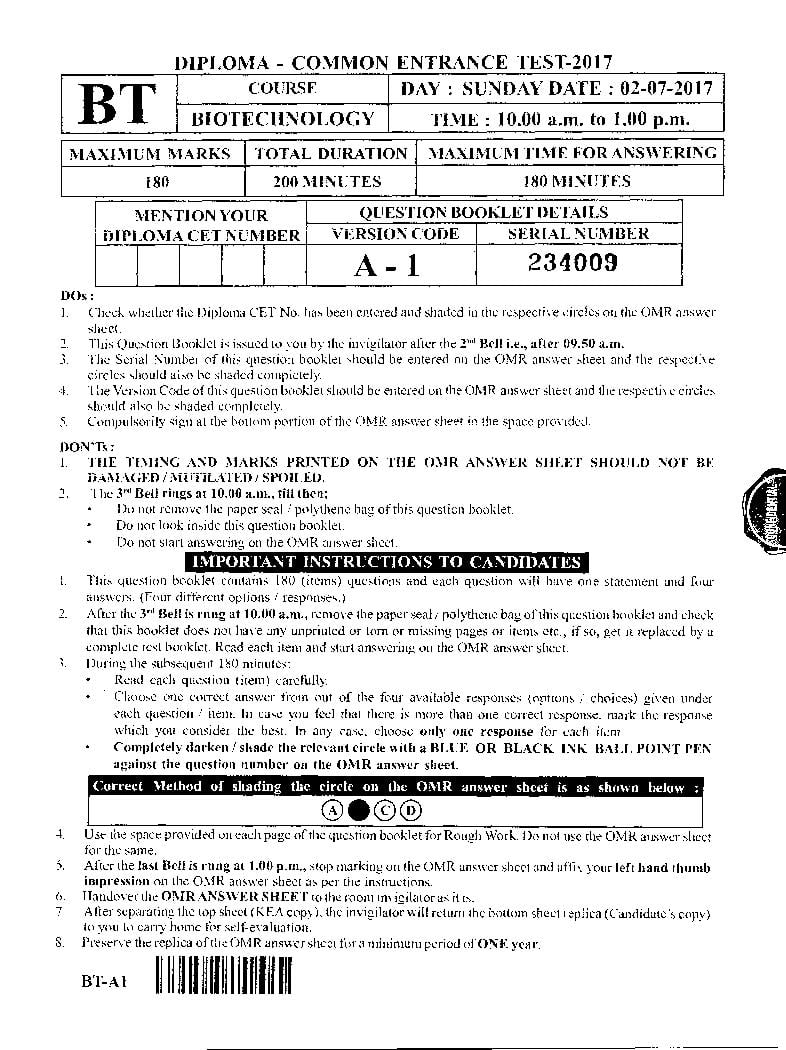
COURSE DAY : SUNDAY DATE : 02-07-2017
B BIOTECHNOLOGY TIME : 10.00 a.m. to 1.00 p.m.
MAXIMUM MARKS TOTAL DURATION MAXIMUM TIME FOR ANSWERING
180 200 MINUTES 180 MINUTES
MENTION YOUR QUESTION BOOKLET DETAILS
DIPLOMA CET NUMBER VERSION CODE SERIAL NUMBER
A- 1 234009
DOs :
1. Check whether the Diploma CET No. has been entered and shaded in the respective circles on the OMR answer
sheet.
2. This Question Booklet is issued to you by the invigilator after the 2"" Bell i.e., after 09.50 a.m.
3. The Serial Number of this question booklet should be entered on the OMR answer sheet and the respectiv e
circles should also be shaded completely.
4. The Version Code of this question booklet should be entered on the OMR answer sheet and the respective circles
should also be shaded completely.
5. Compulsorily sign at the bottom portion of the OMR answer sheet in the space provided.
DON'Ts :
1. THE TIMING AND MARKS PRINTED ON THE OMR ANSWER SHEET SHOULD NOT BE
DAMAGED / MUTILATED / SPOILED.
2. The 3i Bell rings at 10.00 a.m., till then;
• Do not remove the paper seal i polythene bag of this question booklet.
• Do not look inside this question booklet.
• Do not start answering on the OMR answer sheet.
IMPORTANT INSTRUCTIONS TO CANDIDATES
1. This question booklet contains 180 (items) questions and each question will have one statement and four
answers. (Four different options responses.)
2. After the 3rd Bell is rung at 10.00 a.m., remove the paper seal / polythene bag of this question booklet and check
that this booklet does not have any unprinted or torn or missing pages or items etc., if so, get it replaced by a
complete test booklet. Read each item and start answering on the OMR answer sheet.
3. During. the subsequent 180 minutes:
Read each question (item) carefully.
Choose one correct answer from out of the four available responses (options / choices) given under
each question / item. In case you feel that there is more than one correct response, mark the response
which you consider the best. In any case, choose only one response for each item.
Completely darken / shade the relevant circle with a BLUE OR BLACK INK BALL POINT PEN
against the question number on the OMR answer sheet.
Correct Method of shading the circle on the OMR answer sheet is as shown below :
011k)(1)
4. Use the space provided on each page of the question booklet for Rough Work. Do not use the OMR answer sheet
for the same.
5. After the last Bell is rung at 1.00 p.m., stop marking on the OMR answer sheet and affix your left hand thumb
impression on the OMR answer sheet as per the instructions.
6. Handover the OMR ANSWER SHEET to the room invigilator as it is.
7. After separating the top sheet (KEA copy), the invigilator will return the bottom sheet replica (Candidate's copy)
to you to carry home for self-evaluation.
8. Preserve the replica of the OMR answer sheet for a minimum period of ONE year.
BT-A 1 11111111111111111111
Page 2
APPLIED SCIENCE
1. The S.I. unit of Coefficient of Viscosity is
(A) Poise (B) NSm-'2
(C) NS-I m2 (D) NS - I m-2
The prefix used for I09 is
(A) Mega (B) Tera
(C) Giga (D) Hecta
3. The physical quantity which has the dimensional formula [ML()T-2] is
(A) Force (B) Surface tension
(C) Viscosity (D) Work
4. The least count of slide callipers is given by
(A) 1 MSD + I VSD (B) 1 MSD x I VSD
1 MSD
(C) 1 MSD - 1 VSD (D)
1 VSD
5. The product of force and time is
(A) Momentum (B) Moment
(C) Impulse (D) Acceleration
6. The change in position of a particle in a particular direction is referred to as
(A) Speed (B) Displacement
(C) Velocity (D) Acceleration
2 BT
Page 3
a
(A) = u + - (2n -1) (B) St, = u -1)
(C) St, = u +(2n +1) (D) Sn = u - ay-2n +1)
8. A bullet of mass 0.01 kg is fired with a velocity of 960 ms-1 from a rifle of mass 3 kg, the
velocity of recoil of rifle is
(A) -3?0 ms-1 (B) - 0.32 ms-1
(C) ms 1 (D) -32 ms-1
9. One of the following is not a scalar quantity :
/A1 /iass (B) Density
(C) Force (D) Speed
10. If a body fixed about a point rotates in clockwise direction, the moment of force is measured
as
(A) Positive (B) Negative
(C) Zero (D) Equal
11. The resultant magnitude of two forces P and Q acting in same line and in same direction is
(A) P - Q (B) P + Q
) P
(C) Q-P (D —
BT 3 A-1
Page 4
(A) 100 N (B) 10 N
(C) 48 N (D) 14 N
13. The value of resultant magnitude of two forces acting at a point is maximum, when the
angle between the two forces is
(A) 0° (B) 90°
(C) 180° (D) 45°
14. Rise of liquid in a capillary tube is due to
(A) Energy (B) Viscosity
(C) Surface tension (D) Pressure
15. The ratio of volume stress to volume strain is called
(A) Bulk modulus (B) Young's modulus
(C) Rigidity modulus (D) Poisson's ratio
16. The reciprocal of bulk modulus of elasticity is called
(A) Compressibility (B) Rigidity
(C) Plasticity (D) Modulus of elasticity
17. The force of cohesion is maximum in
(A) Solids (B) Gases
(C) Liquids (D) Plasma
A-1 4 BT
Page 5
(A) 8 x10² Nm-1 (B) 80 Nin-I
(C) 8 x 10⁻² Nm-1 (D) 8 x10³ Mit - I
19. Pressure at the bottom of a container having base area of 10 in2 filled with water to a height
of 10 m is
(A) 9.8 x 10⁴ Pa (B) 980 x 104 Pa
(C) 9.8 x 10⁻⁴ Pa (D) 980 x 10-4 Pa
20. 100 °C when expressed in absolute scale is
(A) 100 K (B) 0 K
(C) 273 K (D) 373 K
21. Gas law which gives the relation between pressure and volume changes is
(A) Boyle's law (B) Charles' law
(C) Gay-Lussac's law (D) Hooke's law
22. Amount of heat required to raise the temperature of one gram of water through 1 °C is
(A) Heat capacity (B) Conductivity
(C) Calorie (D) Joule
23. An example of longitudinal wave is
(A) Sound waves (B) Waves on the surface of water
(C) Light waves (D) Electromagnetic waves
BT 5 A-1
Page 6
(A) v T (B) v ---
T
(C) v (D) v T
25. The distance between a node and the next antinode in a stationary wave is equal to
(A) one wavelength (B) half wavelength
(C) twice wavelength (D) one fourth wavelength
26. Damage caused by marching military columns to the suspension bridge is due to
(A) Echo (B) Resonance
(C) Beats (D) Interference
27. During forced vibrations, if the forced frequency is F1 and natural frequency is F, , the body
resonates if
(A) F1 > F, (B) F, >
(C) = 2.5 F, (D)
28. The fundamental frequency of transverse vibrations of the stretched string is inversely
proportional to
(A) tension (B) length of string
(C) square root of tension (D) square root of length of string
29. Minimum length of a hall to produce an echo is
(A) 50 m (B) 34 m
(C) 25 m (D) 17 m
A-1 6 BT
Page 7
(A) Polarisation (B) Photoelectric effect
(C) Interference (D) Compton effect
31. The spectrum of black body radiation is successfully explained by
(A) Newton's corpuscular theory of light
(B) Huygen's wave theory of light
(C) Maxwell's electromagnetic theory of light
(D) Planck's quantum theory of light
32. For constructive interference of light, the path difference should be
?nk
(A) (B) (211+ 1) 3-
2_
(C) (2n + I ) (D) (2n+1)
3 4
33. Two very close objects are just resolved if the central maximum of one object is on
(A) central maximum of another
(B) first minimum of another
(C) beyond second minimum of another
(D) between central maximum and first minimum of another
34. The light is incident at polarising angle 0 and the angle of refraction is r, then
(A) Op+ r = 0° (B) 0 + r = 90°
(C) 0 + r = 1800 (D) 0p+ r = 360°
BT 7 A-1
Page 8
(A) Kinetic energy (B) Potential energy
(C) Work function (D) Energy function
36. When the size of the scattering particle is small, the intensity of scattered light is inversely
proportional to
(A) fourth power of wavelength (B) square of wavelenuth
(C) square root of wavelength (D) cube of wavelength
37. Time for which an atom stays in metastable state is of the order of
(A) Seconds (B) Milli-seconds
(C) Micro-seconds (D) Nano-seconds
38. If an element emits n-ray then its atomic number
(A) i ncronQpc: by one (B) decreases by one
(C) remains same (D) decreases by two
39. If the concentration of H i- ions is more than 10-7 gm ion per litre, the solution is
(A) Base (B) Acid
(C) Neutral (D) Both Acid and Base
40. A galvanic cell is one in which
(A) chemical energy produce electric energy
(B) electric energy produce chemical energy
(C) chemical energy will not produce electric energy
(D) electric energy will not produce chemical energy
A-1 8 BT
Page 9
APPLIED MATHEMATICS
1 2 3
41. The value of x if 2 x 3 = 0 is
3 4 3
(A) 0 (B) -3
(C) 3 (D) 18
42. The value of x, if 4x + y = 7, 3y + 4z, = 5 and 3z + 5x = 2 is
(A) 0 (B) 1
(C) 3 (D) -1
r.
43. If A= , then A-1 is
3 -4
1 -4 - 3 1 -4 11
(A) -- (B) --
5 1 5 L-3 2 J
-4 -4
(C) - (D) -1
Il 1 2 11 -3 2
2 -1-
44. The characteristic equation of the matrix A = is
5 -6
(A) A2 +SA-7I=0 (B) A2 + 4A - 1 71= 0
(C) A2 +4A+71= 0 (D) A2 + 4A - 71 = 0
BT 9 A-1
Page 10
45. If +A , then A is
1 2 3 ")
3 3 _
(A) (B)
0
0 -
r_ 2 3 0
(D)
L - 0
24
- )
46. The middle term of the expansion of x -- is
x,
(A) 24ciol iox12 24 1 11
(B) C] 1 x
(C) 24011210 3:10 (D) 24 01, -)1212
47. The term independent of x inl v2 - is
I-
(A) 9 C6 (4)6
(4
\ 3/
48. If 3i - 2j + k, i - 3j + 5k, 2i + j - 4k arc the sides of a triangle, then the triangle is
(A) Right angled triangle (B) Equilateral triangle
(C) Isosceles triangle (D) Isosceles right angled triangle
-- -3 -3 ->
49. If a - (2, -1, 4) and b = (2, -3, 4), then projection of a on b is
2_ -,
(A) 23 (B) 3
-\/21 -vc29
13
(C) (D)
129 ' Nill
A-1 10 BT
Page 11
I65 , V65
(A) (B)
3 VT;
V65
(C) (D) Nr6- .
9
tan245 + cot-1710
51. If x sin- 45 = then the value of x is
sin-45 + cos-45
(A) 4 (B) 2
(C) 6 (D) 8
4 7, 7c 3 II .
52. The value of —sec`
— --cosec- -+— tan" -- 2 — is
3 3 6 4 4 3
11
(A) (B) 53
12 12
7 7
(C) (D)
12 12
53. The value of
( "irt
sec +0
sin (90 —0) \2 tan (180-0) is
cos (360-0) cosec (7r +0) tan (-0)
(A) 1 (B) —1
(C) 3 (D)
54. The value of cosec 43 cot 43 cot 47 cos 47
(B) 0
(D) 2
11 A-1
Page 12
55. The value of
1- tan 69° tan 66°
(A) 1 (B) -1
(C) 0 (D) cc
56. If tan A = x then sin A + tan A is
7
4x 4x
(A) (B)
1- ,- +x2
4x 4x
(C) (D)
± 1- .1.4
57. The value of sin 70° - sin 50° - sin 10° is
(A) 1 (B) 0
1
(C) -1 , (D) -
58. sin-1 .v is also equal to
(A) cosec--1( 7 (B) cosec x
1
(C) cosec I x (D) —
sin x
59. Centroid divides the median in the ratio
(A) 2 : 1 (B) 1 : 2
(C) 1 : 1 (D) 1 : 4
60. The co-ordinates of a point which divides the line join of the points (a + b, a - b) and
(a - b, a + b) in the ratio 2 : 3 is
5a + 5b 5a - 5b a +b a - b
(A) (B)
5 5 5
5a + b 5a - b 5a - b a + 5b
(C) (D)
5 5 5 5
A-1 12 BT
Page 13
(A) 5x — 3y = 15 (B) 5x + 3y = 15
(C) 5x + 3y I (D) 15x + 15y = 1
62. The angle between the lines whose slopes are V3 and respectively is
NF3
1
(D)
63. The equation of the straight line passing through (2. 3) and x intercept is twice its y intercept
is
(A) + 2y = 8 (B) — 2y = 8
(C) +y4 (D) 2x + 2y = 8
64. The equation to the line passing through the point (-6, 7) and parallel to the line joining
(3, 4) and (6, —8) is
(A) 4x + y + 31 = 0 (B) + 4y,, — 1 = 0
(C) x— 4y+ 1 =0 (D) 4x + y + 17 = 0
65. lim (sec 0 — tan 0) is equal to
O -*
(A) 0 (B) 1
(C) 2 (D)
—4
66. lim is equal to
4 3 _ 3 _x
(A) 3 (B) 9
(C) 6 (D) 0
BT 13 A-1
Page 14
(Ix
(A) 5(logx)4 (B) 5 (1+ logx
(C) 5(1 + log x)4 (D) 5x4 logx
68. — ens- t and y = sin t, then dy rs
dx
(A) (B) 1
1
(C) (D) 2
2-V1 -
69. If y =xlog y, thendy
-- is
dl
log x log y'
(B)
x—y x—y
log y" log yY
(C) (D)
x—y Yx
70. If y = x +1 , then d--3-1-is
x+2 dx
2x +3
(A) (B)
(x + 2)2 (x + 2)2
lx —3
(C) (D)
(x + 2)2 (x + 2)2
71. The equation of tangent to the curve y2 — 4x at (1, 2) is
(A) x + y 3 = 0 (B) x — y + 1 =0
(C) 2x — y = 0 (D) 2.v + y — 4 = 0
A-1 14 BT
Page 15
(A) 15 (B) —4
(C) —2 (D) 31
73. The value of flog 2x di is
(A) x log 2x + x + C (B) x log 2x
I
(C) -- + C (D) — +C
2x
74. The value of fsec4 x • tan x clx
see4x
(A) +C (B) 4 scc4x + C
4
tan4X C
(C) 'sec2x +C (D)
4
75. The value of x log x dx is
(A) log x +C (B) log x + +C
2
X X X
(C) logx +C (D) log x + +C
4 4
a/4
I
76. tan -x dx is equal to
7c rc
(A) — —1 (B) 1 —
4 4
7/ -
(C) (D) 16 — 1
16
HT 15 A-1
Page 16
77. The value of — dx is
0
(A) — (B) 0
3
(C) (D)
3
78. The volume generated by revolving the line y = x + 1 about the x-axis between the ordinates
x = 0 and x = 2
26 10 7t
(A) units (B) units
3 3
, 26
-- units (D) 4 units
3
2 dy
79. The degree and order of the differential equation d y = 1+ are
dx dx )
(A) 2 and 1 (B) 1 and 2
(C) 3 and 2 (D) 2 and 3
dy
80. The solution of differential equation — + y tan x = see x is
dx
(A) y sec x = tan x + C
(B) y sin x = sec x + C
(C) log(sec x) = tan x + C
(D) y sec x = —cot x + C
A-1 16 BT
Page 17
BIOTECHNOLOGY
81. An example for a neutral buffer is
(A) ammonium hydroxide and ammonium chloride
(B) acetic acid and ammonium hydroxide
(C) acetic acid and sodium acetate
(D) citric acid and sodium citrate
82. Noble gases are generally unreactive because they
(A) have stable outer electron shells (B) are not abundant
(C) have large atomic size (D) are monatomic
83. Chemical bond implies
(A) attraction
(B) attraction or repulsion
(C) repulsion
(D) attraction or repulsion balanced at a particular distance
84. The maximum number of electrons that can be accommodated in a quantum shell is
(A) n (B) n
(C) 2n2 (D) n(n + 1)
85. Which of the following organic compounds answers to both iodoforni test and Fehling's
test ?
(A) Ethanol (B) Methanol
(C) Propanone (D) None
BT 17 A-1
Page 18
(A) Serine (B) Valine
(C) Alanine (D) Methionine
87. a-maltose consists of
(A) one a-D-glucopyranose unit and one P-D-glucopyranose unit with 1-2 glycosidic
linkage
(B) two a-D-glucopyranose units with 1-2 glycosidic linkage
(C) two P-D-glucopyranose units with 1-4 glycosidic linkage
(D) two a-D glucopyranose units with 1-4 glycosidic linkage
88. If position of functional group varies in each of its isomer then it is
(A) position isomerism (B) functional group isomerism
(C) chain isomerism (D) All of them
89, A chemical substance that acts ac an immediate source of energy for ninny biological
reactions is
(A) Protein (B) Glucose
(C) Adenosine triphosphate (D) Adenosine monophosphate
90. A Kinase is an enzyme that
(A) removes phosphate groups of substrates
(B) uses ATP to add a phosphate group to the substrate
(C) uses NADH to change the oxidation state of the substrate
(D) removes water from double bond
91. Globular proteins is present in
(A) Blood (B) Milk
(C) Eggs (D) All of these
A-1 18 BT
Page 19
(A) Ribosome (B) Lysosome
(C) Mitochondria (D) Golgi complex
93. During meiosis, chiasmata are observed at
(A) Pachytene (B) Diplotene
(C) Leptotene (D) Diakinesis
94. Gene mutation occurs at the time of
(A) DNA repair (B) DNA replication
(C) Cell division (D) RNA transcription
95. Downs syndrome is characterised by
(A) 19 trisomy (B) 21 trisomy
(C) only one X chromosome (D) two X and one Y chromosome
96. The membrane bound organell present in both Eukaryotes and Prokaryotes is/are
(A) Endoplasmic reticulum (B) Ribosome
(C) Nucleus (D) Golgi apparatus
97. Corn flour-sugar solutions are example for type of fluids.
(A) Pseudoplastic (B) Thixotropic
(C) Dilatent (D) Rheopectic
98. If the vapour pressure of benzene is 108.12 kPa and vapour pressure of toluene is
41.863 kPa at 355.9 K, then relative volatility is
(A) 2.18 (B) 2.38
(C) 2.58 (D) 2.78
BT 19 A-1
Page 20
as
(A) flooding (B) weeping
(C) channeling (D) condensing
100. Colburn analogy shows the relation between
(A) heat transfer; mass transfer (B) heat transfer; fluid friction
(C) mass transfer; fluid friction (D) heat transfer; momentum transfer
101. Water enters the heat exchanger at 328 K & leaves at 358 K. Hot gases enter at 578 K &
leave at 433 K. If the total heat transfer area is 500 m' and the overall heat transfer co-
efficient is 700 W/m- K, total heat transfered for counter current flow of two fluids is
(A) 60 x W (B) 58.7 x 10' W
r'\ c„r no All
vy in\An
-Tv._ „ n6 \1/
vv
102. Introduction of DNA into cells by exposing to high voltage electric pulse is
(A) electrofusion (B) electrofission
(C) electrolysis (D) electroporation
103. Among the two strands of DNA, the one that contains gene is called the coding strand. The
other one, which is complementary to the coding strand is called the template strand. The
template strand directs the synthesis of complementary strand of RNA, called the messenger
RNA. This process is called
(A) translation (B) transcription
(C) replication (D) mutation
104. Which of the following is a thermostable DNA polymerase ?
(A) Taq polymerase (B) Vent polymerase
(C) Pfu polymerase (D) All of these
A-1 20 BT
Page 21
(A) Conjugation
(B) Transduction of a chromosomal gene
(C) Transposition of a mobile genetic element
(D) Integration of a temperate bacteriophage
106. Which of the following biomolecule has self repair mechanism ?
(A) DNA, RNA and Protein (B) DNA and RNA
(C) DNA only (D) DNA and proteins
107. Which of the following bacterium is considered as a `natural genetic engineer' ?
(A) Agrobacterium tumefaciens (B) Agrobacterium radiobactor
(C) Pseudomonas putida (D) Thermus aquaticus
108. The role of a metabolite that controls a repressible operon is to
(A) bind to the promoter region and decrease the affinity of RNA polymerase for the
promoter.
(B) bind to the operator region and block the attachment of RNA polymerase to the
promoter.
(C) bind to the repressor protein and inactive it.
(D) bind to the repressor protein and activate it.
109. This protein is produced by a regulatory gene :
(A) Inducer (B) Promoter
(C) Repressor (D) Corepressor
110. Components with small -'k' value have greater affinity towards
(A) mobile phase (B) stationary phase
(C) no phase (D) both mobile & stationary phase
BT 21 A-1
Page 22
(A) Molecular weight (B) Shape
(C) Charge (D) All of these
112. Technique electrophoresis for the separation of charged particles was developed by
(A) Tswett (B) Svedberg
(C) Tiselius (D) Sanger
113. Common type of gel used for DNA separation is
(A) Agar (B) Polyacrylamide
(C) Agarose (D) All of these
114. Electrophoresis of histones and myoglohin under denaturing conditions (pH-7) results in
(A) both proteins migrate to the anode.
(B) histories migrate to the anode & myoglobin migrates to the cathode.
(C) histones migrate to the cathode & the myoglohin migrates to the anode.
(D) both proteins migrate to the cathode.
115. Bacterial chromosome is
(A) single stranded and circular (B) double stranded and circular
(C) single stranded and linear (D) double stranded and linear
116. Which of the following methods will not sterilize ?
(A) Aqueous glutaraldehyde for 10 hours
(B) Dry heat at 171 °C for 1 to 2 hrs.
(C) 121 °C at 15 lb/in pressure for 15 to 20 minutes.
(D) 100 °C boiling water for 30 minutes
117. Fungi are virtually the only organisms capable of breaking down
(A) Cellulose (B) Lignin
(C) Chitin (D) Starch
A-1 22 BT
Page 23
(A) Semi permeability (B) Complete permeability
(C) Differential permeability (D) Impermeability
119. The formation of mating pair during the process of conjugation in E. coli requires
(A) Transfer of both strands of DNA (B) Sex pilus
(C) Restriction endonuclease (D) Lysis of the donor
120. Fungi are different from plants because fungi
(A) are heterotrophs (B) have cellwall made of chitin
(C) have filamentous bodies (D) All of these
121. Most light microscope contain a/an that converges the light beam so that it passes
through the specimen.
(A) ocular lens (B) objective lens
(C) condenser (D) iris diaphragm
122. Blue Green algae are used as biofertilizer in
(A) rice field (B) sugarcane field
(C) wheat field (D) coconut plants
123. The process of converting environmental pollutants into harmless products by naturally
occurring microbes is called
(A) exsitu bioremediation (B) intrinsic bioremediation
(C) extrinsic bioremediation (D) None of these
124. Chemical substances used to destroy weeds in crops
(A) herbicides (B) monoxides
(C) carbo-oxides (D) pesticides
BT 23 A-1
Page 24
(A) Nitrate (B) Nitrite
(C) Molecular nitrogen (D) Ammonia
126. All the following are examples of negative symbiosis except
(A) amensalism (B) competition
(C) predation (D) commensalism
127. Fluoride is also added to water, which helps prevent
(A) infection (B) sickness
(C) fever (D) tooth decay
128. Azolla is used as biofcrtilizer as it has
(A) Rhizobium (B) Cyanobacteria
(C) Mycorrhiza (D) Large quantity of humus
129. Mast cells have receptor for
(A) Ig E (B) Ig A
(C) Ig G (D) Ig M
130. Which antibody is known to responsible for allergic reaction ?
(A) Ig M (B) Ig A
(C) Ig E (D) Ig D
131. Haematopoietic stem cells are found in
(A) skin (B) spleen
(C) bone marrow (D) payers patches
132. Innate immunity involves all except
(A) Anatomic barriers (B) Phagocytic
(C) Inflammatory mechanism (D) Antibody production
A-1 24 BT
Page 25
(A) Lungs (B) Bones
(C) Nephrons (D) Liver
134. The bonds involved in Antigen-antibody reaction are
(A) weak hydrogen bonds and van der Waals forces
(B) strong covalent bonds
(C) strong disulphide bonds
(D) All of these
135. When energy depleted elements associated with a proton are accepted by an organic
molecule, the process is known as
(A) Fermentation (B) Respiration
(C) Anabolism (D) Catabolism
136. Final electron acceptor .in lactic acid fermentation is
(A) Oxygen (B) Lactic acid
(C) Pyruvate (D) NAD
137. Biomass determination methods includes
(A) Turbidometric method (B) Measurement of dry weight
(C) Estimation of cell constituents (D) All of these
138. Growth rate is the reciprocal of
(A) generation time (B) number of generations per time
(C) doubling rate (D) All of these
139. Erythromycin is produced by a strain of
(A) Streptomyces lincolensis (B) Streptomyces erythreus
(C) Streptococcus pyogenes (D) Streptococcus aureus
RT 25 A-1
Page 26
(A) stress (B) strain
(C) weight (D) velocity
141. Rate constant of a first order reaction depends on
(A) time ( B) temperature
/ concentration of reactant (D) concentration of product
142. Food spoilage is due to
(A) Growth of micro organisms like bacteria, fungus or insects
(B) Autolysis
(C) Oxidation by air that causes rancidity or colour changes
(D) All of these
143. Before drying, vegetables should be
(A) blanched (B) salted
(C) sulfured (D) autoclaved
144. Food additive that prevents colour and flavour loss
(A) enzyme (B) ascorbic acid
(C) yeast (D) fruit butter
145. Most spoilage bacteria grows at
(A) Acidic pH (B) Alkaline pH
(C) Neutral pH (D) Any of the pH
146. Yoghurt is made from
(A) Lactobacillus bulgaricus (B) Streptococcus thermophillus
(C) S. Cremoris (D) Mixed culture of (A) 8z, (B)
A-1 26
Page 27
milk solid ?
(A) Protein (B) Water
(C) Carbohydrate (D) Milk fat
148. Primary milk carbohydrate is
(A) Leiicine (B) Sucrose
(C) Arginine (D) Lactose
149. Ocular administration involves the treatment of
(A) Skin (B) Eyes
(C) Ears (D) Lungs
150. Lactose is used as
(A) Diluent (B) Glidant
(C) Lubricant (D) Disintegrant
151. Name two different types of inhaler.
(A) MDI & API (B) IV & SC
(C) DPI & MDI (D) GIT & ATP
152. Nasal Administration is commonly used for the relief of
(A) Head ache (B) Cough
(C) Sore throat (D) Congestion
153. Which of the following polymer is widely used in film coating of tablets ?
(A) Acacia (B) Syrup
(C) HPMC (D) Starch
BT 27 A-1
Page 28
(A) Sucrose (B) Mannitol
(C) Lactose (D) Saccharin Sodium
155. Lamination is
(A) separation of a tablet into two or more distinct layers
(B) process of sub-coating of tablets
(C) Both separation of a tablet into two or more distinct layers & process of sub-coating
of tablets
(D) None of these
156. In sugar coating of tablets, sealcoat is done
(A) to prevent moisture deposition
(B) to round the edge & build tablet size
(C) to smoothen the surface
(D) to prevent the tablet from breaking due to vibration
157. Pure carbon monoxide with 100% excess air is completely burned at constant pressure.
Reactants was initially at 400 K. Standard heat of reaction at 298 K is 283.028 kJ per mole
carbon dioxide burned. Mean specific heats applicable in the temperature range are 29.1,
29.7, 29.1 & 41.45 Jimol K for CO, O, , N, and CO, . If the products leave at 600 K,
difference in the heat is
(A) + 240.15 kJ (B) — 240.15 kJ
(C) + 250.14 kJ (D) — 250.14 kJ
158. A reactor is supplied with 10 moles of CH 4 and 10 moles of 0„ if the extent of reaction is
3, what is the moles of CO2 produced ?
(A) 3 (B) 6
(C) 8 (D) 12
A-1 28 BT
Page 29
hydroxide is
(A) 1% (B) 0.5%
(C) 0.89% (D) 0.7%
160. Assuming that carbon dioxide obeys the perfect gas law, density of carbon dioxide in
kg; m3 at 536 K & 202.6 kPa is
(A) I (B) 2
(C) 3 (D) 4
161. Ideal gas law is applicable at
(A) low T, low P (B) high T, high P
(C) low T, high P (D) high T, low P
162. Cell lysis is an important operation if product is
(A) Extracellular (B) Heat labile
(C) Toxic (D) Intracellular
163. In case of mammalian cell culture, transformation means
(A) uptake of new genetic material
(B) phenotypic modifications of cells in culture
(C) both uptake of new genetic material & phenotypic modifications of cells in culture
(D) release of genetic information
164. Application of extraction in bioprocessing
(A) Purification of antibodies (B) Lipids
(C) DNA (D) All of these
165. Ethanol is oxidized to acetic acid aerobically by
(A) Acetobacter
(B) Gluconobacter
(C) Both Acetobacter & Gluconobacter
(D) Lactobacillus
BT 29 A-1
Page 30
(A) Angular velocity (B) Linear velocity
(C) Downward velocity (D) None of these
167. Product enrichment techniques includes
(A) Use of salts (B) Organic solvents
(C) Polyelectrolytes (D) All of these
168. Purification and recovery of product after fermentation is by
(A) upstream processing (B) downstream processing
(C) surface fermentation (D) submerged fermentation
169. Methods of precipitation follows
(A) Polyethylene glycol (B) Triazine dyes
(C) Ammonium & sodium sulphate (D) All of these
170, Enzyme that joins the ends of two strands of nucleic acid is
(A) Polymerase (B) Ligase
(C) Synthetase (D) Helicase
171. Which of the following is employed for the repeated use of enzymes in bioprocess '?
(A) Polymerization (B) Immobilization
(C) Ligation (D) Isomerization
172. After electrophoresis, protein or peptide bonds are visualized using
(A) Coomassive Brilliant blue (B) FC reagent
(C) DNS reagent (D) All of these
173. Adsorption of cell or enzyme on supporting medium is due to
(A) Electrostatic force (B) Hydrophobic interactions
(C) Bonding to specific ligand (D) All of these
A-1 30 ST
Page 31
(A) 10 °C (B) 20 °C
(C) 30 °C (D) 40 °C
175. Enzymes are
(A) Thermophile (B) Thermolabile
(C) Thennostable (D) All of these
176. Specificity of protein in enzyme action depends on
(A) active site (B) Km constant
(C) linear sequence of amino acids (D) turn over number
177. Factors affecting velocity of enzymatic reactions
(A) Enzyme concentration (B) Temperature & pH
(C) Viscosity (D) All of these
178. The first published completed gene sequence was of
(A) M,, phage (B) Ta phage
(C) x 174 (D) Lambda phage
179. BLAST programme is used in
(A) DNA sequencing (B) Amino acid sequencing
(C) DNA barcoding (D) Bioinfonnatics
180. Which of the following is a nucleotide sequence data base ?
(A) EMBL (B) SWISS PROT
(C) PROSITE (D) TREMOL
BT 31 A-1
Page 32
Document Details
| Board / Org | KEA |
| Exam | Karnataka DCET |
| Type | Question Paper |
| Pages | 32 |
| Language | english |
| Updated | 22 Jul 2026 |