HBSE Class 12 Syllabus 2027 Bio- Technology
Finished viewing? Save it for later —
Download HBSE Class 12 Syllabus 2027 Bio- Technology (PDF · 10 pages)About HBSE Class 12 Syllabus 2027 Bio- Technology
HBSE Class 12 Syllabus 2027 Bio- Technology is available here for free download. Published by Haryana Board for Class 12, this syllabus can be viewed online or downloaded as a PDF (10 pages). Candidates preparing for Class 12 can use HBSE Class 12 Syllabus 2027 Bio- Technology to understand the exam pattern, the type of questions asked, and the overall difficulty level.
Frequently Asked Questions
How can I download HBSE Class 12 Syllabus 2027 Bio- Technology?
Open this page and click the Download button to save HBSE Class 12 Syllabus 2027 Bio- Technology as a PDF. It is completely free on AglaSem Docs.
Is HBSE Class 12 Syllabus 2027 Bio- Technology free to download?
Yes. HBSE Class 12 Syllabus 2027 Bio- Technology can be viewed online and downloaded as a PDF free of cost on AglaSem Docs.
How many pages does HBSE Class 12 Syllabus 2027 Bio- Technology have?
HBSE Class 12 Syllabus 2027 Bio- Technology contains 10 pages, which you can read online or download together as a single PDF.
Where can I find more Class 12 study material?
You can find more Class 12 question papers, sample papers, syllabus, and answer keys on AglaSem Docs.
HBSE Class 12 Syllabus 2027 Bio- Technology – Text
Read the full text of this syllabus below — useful to quickly search, copy and reference the content online without downloading the PDF.
📄 View text version (11 pages)
Page 1
HBSE Class 12 Syllabus
2027 Bio- Technology
EXAM YEAR TYPE SUBJECT
Haryana Class 12 2027 Syllabus Biotechnology
Notes · Sample Papers · Previous Year Papers · Mock Tests
Page 2
.co s e m
s em l a
a ag
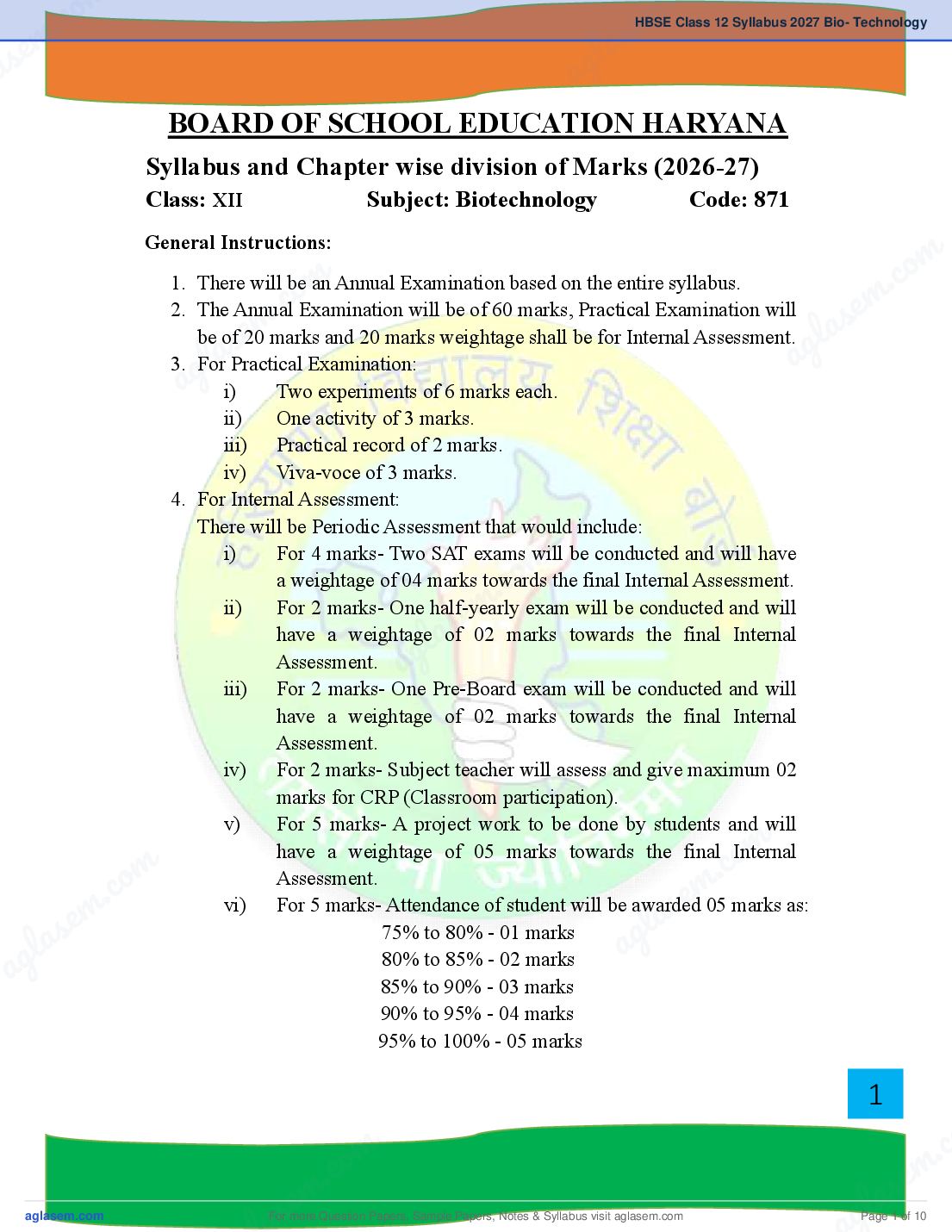
BOARD OF SCHOOL EDUCATION HARYANA
Syllabus and Chapter wise division of Marks (2026-27)
Class: XII Subject: Biotechnology Code: 871
General Instructions:
m
om
1. There will be an Annual Examination based on the entire syllabus. . co
. c e m
2. The Annual Examination will be of 60 marks, Practical Examination will
e m l as
l as
be of 20 marks and 20 marks weightage shall be for Internal Assessment.
ag
ag
3. For Practical Examination:
i) Two experiments of 6 marks each.
ii) One activity of 3 marks.
iii) Practical record of 2 marks.
iv) Viva-voce of 3 marks.
4. For Internal Assessment:
There will be Periodic Assessment that would include:
i) For 4 marks- Two SAT exams will be conducted and will have
m
.co
a weightage of 04 marks towards the final Internal Assessment.
m
ii)
e
For 2 marks- One half-yearly exam will be conducted and will
s
l a
have a weightage of 02 marks towards the final Internal
Assessment. ag
iii) For 2 marks- One Pre-Board exam will be conducted and will
have a weightage of 02 marks towards the final Internal
Assessment.
iv) For 2 marks- Subject teacher will assess and give maximum 02
marks for CRP (Classroom participation).
v) For 5 marks- A project work to be done by students and will
m
.co
have a weightage of 05 marks towards the final Internal
m
.co m
Assessment.
m vi) For 5 marks- Attendance of student will be awarded 05 marks as: s e
s e g la
la
75% to 80% - 01 marks
g 80% to 85% - 02 marks a
a 85% to 90% - 03 marks
90% to 95% - 04 marks
95% to 100% - 05 marks
1
m . c
c. o s e m
s em
For more Question Papers, Sample Papers, Notes & Syllabus visit
gl a
Page 1 of 10
Page 3
Class- XII Subject-Biotechnology Code:871
Sr. No. Unit Chapter Marks
Recombinant DNA Technology
1
Protein and Gene
Manipulation Protein Structure and Engineering 30
Genomics and Bioinformatics
Cell Structure and Genetic Microbial Cell Culture and its
Manipulation Application
2
Plant Cell Culture and Application 30
Animal Cell Culture and
Application
Total 60
Practical Examination 20
Internal Assessment 20
Grand Total 100
2
For more Question Papers, Sample Papers, Notes & Syllabus visit Page 2 of 10
Page 4
.co s e m
s em l a
a ag
Unit V: PROTEIN AND GENE MANIPULATION
Chapter 1: Recombinant DNA Technology
Introduction; Tools of rDNA Technology: Restriction
enzymes, Restriction Fragment Length Polymorphism (RFLP),
m
Other enzymes used in cloning, Vectors: Plasmids, vector based
om . co
. c
on bacteriophages, cosmids, YAC vectors, BAC vectors, Animal
e m
em and plant viral vectors, Host cells; Marking rDNA;
l as
l as Introduction of rDNA to Host Cells: Transformation,
ag
ag Transfection, Electroporation, Microinjection, Biolistics;
Identification of Recombinants; Polymerase Chain Reaction
(PCR); Hybridisation Techniques: Southern Hybridisation
Technique; DNA Library: DNA Sequencing:
Dideoxynucleotide chain termination method; Site-directed
Mutagenesis
Unit V: PROTEIN AND GENE MANIPULATION
m
Chapter 2: Protein Structure and Engineering
m .co
e
Introduction to the World of Proteins; 3-D Shape of
s
l a
Proteins: Non-covalent bonds: ionic bonds, hydrogen bonds,
ag
Vander Wals forces, hydrophobic interactions; Structure-
Function relationship in Proteins: Chymotrypsin - a
proteolytic enzyme, Molecular Disease- Sickle cell anaemia,
Protein Finger printing- Peptide Mapping, 2-D Gel
Electrophoresis; Purification of Proteins: Calculation of
amount of bacterial ferment required, Downstream Processing,
Aqueous two-phase partition, Industrial scale production of
proteins, Special techniques for therapeutic /diagnostic proteins;
m
.co
Characterization of Proteins: Mass spectrometry; Protein
m
.co
Based Products: Blood products and vaccines, Therapeutic
antibodies and enzymes, Therapeutic hormones and growth e m
e m factors, Regulatory factors, Analytical applications, Industrial
las
las enzymes, Functional non-catalytic proteins, Nutraceutical ag
ag Proteins; Designing Proteins (Protein Engineering):
Improving laundry detergent Subtilisin, Creation of Novel
Proteins, Improving nutritional value of cereals and legumes.
3
m . c
c. o s e m
s em
For more Question Papers, Sample Papers, Notes & Syllabus visit
gl a
Page 3 of 10
Page 5
Chapter 3: Genomics and Bioinformatics
Introduction: Progress in stages, Evolving approaches, Structural
genomics, Functional genomics; Genome Sequencing Projects:
Directed sequencing of Bacterial Artificial Chromosome (BAC)
contigs, Random shotgun sequencing; Gene prediction and
counting; Genome Similarity, SNPs and Comparative
Genomics; Functional Genomics: Fluorescence in situ
hybridization, Microarray Technology: principle, procedure,
interpretation; Proteomics: Types of Proteomics: Expression
proteomics, Structural proteomics, Functional proteomics, Genes
and Proteins: Number of genes vs Number of proteins; History of
Bioinformatics; Sequences and nomenclature: DNA and protein
sequences, The concept of directionality, Different types of
sequences; Information Sources: Major databases: NCBI,
Database retrieval tools, BLAST family of search tools, Resources
for gene level sequences, Analysis using Bioinformatics tools.
Unit VI: CELL CULTURE AND GENETIC MANIPULATION
Chapter 1: Microbial Cell Culture and Its Applications
Introduction; Microbial culture techniques: Nutrients for microbial
culture, Culture Procedures, Equipment for microbial culture, Types of
microbial culture: Batch culture, Fed-batch culture, continuous culture;
Measurement and kinetics of microbial growth: Measurement of
microbial growth, Growth kinetics and specific growth rate; Scale-up of
microbial processes; Isolation of microbial products; Strain isolation,
improvement and preservation: Strain isolation, Strain improvement:
Mutation Selection, Genetic Engineering Techniques, Metagenomics,
Strain preservation, Culture Collections Centers; Applications of
microbial culture technology; Biosafety issues in Microbial
Technology.
Unit VI: CELL CULTURE AND GENETIC MANIPULATION
Chapter 2: Plant Cell Culture and Applications
Introduction; Cell and Tissue Culture Techniques: Basic
Technique, Nutrient Media, Types of cultures: organ culture,
explant culture, callus culture, cell suspension culture, mass cell
culture, protoplast culture, protoplast fusion, Plant Regeneration
pathways; Applications of Cell and Tissue Culture: 4
For more Question Papers, Sample Papers, Notes & Syllabus visit Page 4 of 10
Page 6
.co s e m
s em l a
a ag
Micropropagation, Virus-free plants, Artificial seeds, Embryo
rescue, Haploids and triploids, Somatic hybrids and cybrids,
Production of secondary metabolites, Somaclonal variation, In
vitro plant germplasm conservation; Gene transfer methods in
plants: Vector-mediated or indirect gene transfer, Vectorless or
direct gene transfer, Transgene analysis; Transgenic plants with
m
co
beneficial traits: Stress tolerance, Biotic stress tolerance:
. c om
Herbicide tolerance, Pest resistance, Disease resistance, Virus
resistance, Fungi and bacteria, Abiotic stress tolerance: Delayed e m .
e m fruit ripening, Male sterility, Transgenic plants as bioreactors,
l as
l as Nutrient quality, Diagnostic and therapeutic proteins, Edible ag
ag vaccines, Biodegradable plastics, Metabolic engineering and
secondary products, Other applications; Biosafety in Plant
Genetic Engineering.
Unit VI: CELL CULTURE AND GENETIC MANIPULATION
Chapter 3: Animal Cell Culture and Applications
Introduction; Animal Cell Culture Techniques: Features of
animal cell growth in culture, Primary Cell Cultures, Secondary
m
m .co
Cell Cultures and Cell Lines, Types of Cell Lines: Finite Cell
Lines, Continuous Cell Lines, Physical environment for
s e
culturing Animal Cells: temperature, pH, osmolality, Medium,
l a
ag
serum and antibiotics, vessels and equipment’s required for
animal cell culture, tissue culture hood, CO2 incubator,
centrifuge, inverted microscope; Characterization of Cell
Lines: storage and revival of cells; Methods of Gene Delivery
into Cells; Scale-up of Animal Culture Process; Applications
of Animal Cell culture: Erythropoietin, Factor VIII, Factor IX,
Tissue Plasminogen Activator (tPA), Hybridoma Technology for
Monoclonal Antibody Production, Therapeutic mAb - OKT3,
Therapeutic mAb – Herceptin; Stem Cell Technology: ES Cell
m
m
c. o Practicals:
culture and its applications; Tissue engineering.
.co
m s em
s e g la
1. Use of special equipment in biotechnology experiments
g la 2. Isolation of bacterial plasmid DNA a
a 3. Detection of DNA by gel electrophoresis
4. Estimation of DNA by UV spectroscopy
5. Isolation of bacteria from curd & staining of bacteria
6. Cell viability assay using Evan’s blue dye exclusion method
5
m . c
c. o s e m
s em
For more Question Papers, Sample Papers, Notes & Syllabus visit
gl a
Page 5 of 10
Page 7
download a DNA and protein sequence from internet, analyse it and
comment on it
8. Reading of a DNA sequencing gel to arrive at the sequence
9. Project work. (Any topic from theory syllabus)
Month wise Syllabus Teaching Plan (2026-27)
Class: XII Subject: Biotechnology Code: 871
Month Subject-content Teaching Revision Practical
Periods Periods Work
April Unit V 22 2
Chapter 1:
Recombinant DNA
Technology
Practical: Use of
special equipment 6
in biotechnology
experiments
Practical: Isolation
of bacterial plasmid 2
DNA
Practical: Detection 2
of DNA by gel
electrophoresis
Practical: 2
Estimation of DNA
by UV
spectroscopy
May Unit V 22 2
Chapter 2: Protein 6
For more Question Papers, Sample Papers, Notes & Syllabus visit Page 6 of 10
Page 8
.co s e m
s em l a
a ag
Structure and
Engineering
Practical: Isolation
of bacteria from 2
curd & staining of m
om
bacteria . co
. c e m
em l as
June
l as ag
ag Summer Vacation (Project Work)
July Unit V
Chapter 3:
Genomics,
Proteomics and
Bioinformatics
(Introduction, 18 2
m
Genome c. o
Sequencing
e m
Projects, Gene
l as
prediction and ag
counting)
Practical: Cell
viability assay
using Evan’s blue 2
dye exclusion
m
.co
method
m August
.co m
Unit V 20 4
m Chapter 3: s e
s e g la
la
Genomics,
g Proteomics and a
a Bioinformatics
(Genome
Similarity, SNPs
and Comparative
Genomics, 7
m . c
c. o s e m
s em
For more Question Papers, Sample Papers, Notes & Syllabus visit
gl a
Page 7 of 10
Page 9
Genomics,
Proteomics,
History of
Bioinformatics;
Sequences and
nomenclature,
Information
Sources)
Practical: Data
retrieval and
database search
using internet site 6
NCBI and
download a DNA
and protein
sequence from
internet, analyse it
and comment on it.
Practical: Reading
of a DNA 4
sequencing gel to
arrive at the
sequence.
September Revision for Half- 16
Yearly Exam
Half-Yearly Exam
October Unit VI 20 4
Chapter 1:
Microbial Cell
Culture and its
Applications.
November Unit VI 22 2 8
For more Question Papers, Sample Papers, Notes & Syllabus visit Page 8 of 10
Page 10
.co s e m
s em l a
a ag
Chapter 2: Plant
Cell Culture and
Applications.
December Unit VI m
om
Chapter 3: Animal 22 2 . co
. c e m
em Cell Culture and
l as
l as Applications.
ag
a g
January
Revision
16
February Revision
12
Annual Practical
m
Exam
m .co
March Annual Exam
s e
l a
Note: ag
Subject teachers are advised to direct the students to prepare
notebook of the Terminology/Definitional Words used in the chapters
for enhancement of vocabulary or clarity of the concept.
Prescribed Books: m
m 1. Biotechnology - Text book for Class XII, CBSE Publication m .co
m .co s e
s e 2. Laboratory Manual-Biotechnology-Class XII, CBSE l a
Publication
g
g la a
a
9
m . c
c. o s e m
s em
For more Question Papers, Sample Papers, Notes & Syllabus visit
gl a
Page 9 of 10
Page 11
Class: XII Subject: Biotechnology Code: 871
Time 2½ Hours
Competencies Marks Percentage
Knowledge 24 40%
Understanding 18 30%
Application 12 20%
Skill 6 10%
Total 60 100%
Types Of Marks Number Description Total
Questions Marks
Objective 1 15 06 Multiple Choice 15
Questions Questions,
03 Fill in the Blanks
Questions,
03 One Word Answer Type
Questions,
0 3 Assertion Reason
Questions
Very Short 2 6 Internal choice will be 12
Answer Type given in any 2 questions
Question
Short Answer 3 6 Internal choice will be 18
Type given in any 2 questions
Question
Essay Answer 5 3 Internal choice will be 15
Type given in all the questions
Question
Total 30 60
10
For more Question Papers, Sample Papers, Notes & Syllabus visit Page 10 of 10
Document Details
| Board / Org | Haryana Board |
| Exam | Class 12 |
| Type | Syllabus |
| Pages | 10 |
| Updated | 04 Nov 2026 |