HBSE Class 12 Sample Paper 2026 Answers Psychology
Finished viewing? Save it for later —
Download HBSE Class 12 Sample Paper 2026 Answers Psychology (PDF · 25 pages)About HBSE Class 12 Sample Paper 2026 Answers Psychology
HBSE Class 12 Sample Paper 2026 Answers Psychology is available here for free download. Published by Haryana Board for Class 12, this answer key can be viewed online or downloaded as a PDF (25 pages). Candidates preparing for Class 12 can use HBSE Class 12 Sample Paper 2026 Answers Psychology to understand the exam pattern, the type of questions asked, and the overall difficulty level.
Frequently Asked Questions
How can I download HBSE Class 12 Sample Paper 2026 Answers Psychology?
Open this page and click the Download button to save HBSE Class 12 Sample Paper 2026 Answers Psychology as a PDF. It is completely free on AglaSem Docs.
Is HBSE Class 12 Sample Paper 2026 Answers Psychology free to download?
Yes. HBSE Class 12 Sample Paper 2026 Answers Psychology can be viewed online and downloaded as a PDF free of cost on AglaSem Docs.
How many pages does HBSE Class 12 Sample Paper 2026 Answers Psychology have?
HBSE Class 12 Sample Paper 2026 Answers Psychology contains 25 pages, which you can read online or download together as a single PDF.
Where can I find more Class 12 study material?
You can find more Class 12 question papers, sample papers, syllabus, and answer keys on AglaSem Docs.
HBSE Class 12 Sample Paper 2026 Answers Psychology – Text
Read the full text of this answer key below — useful to quickly search, copy and reference the content online without downloading the PDF.
📄 View text version (25 pages)
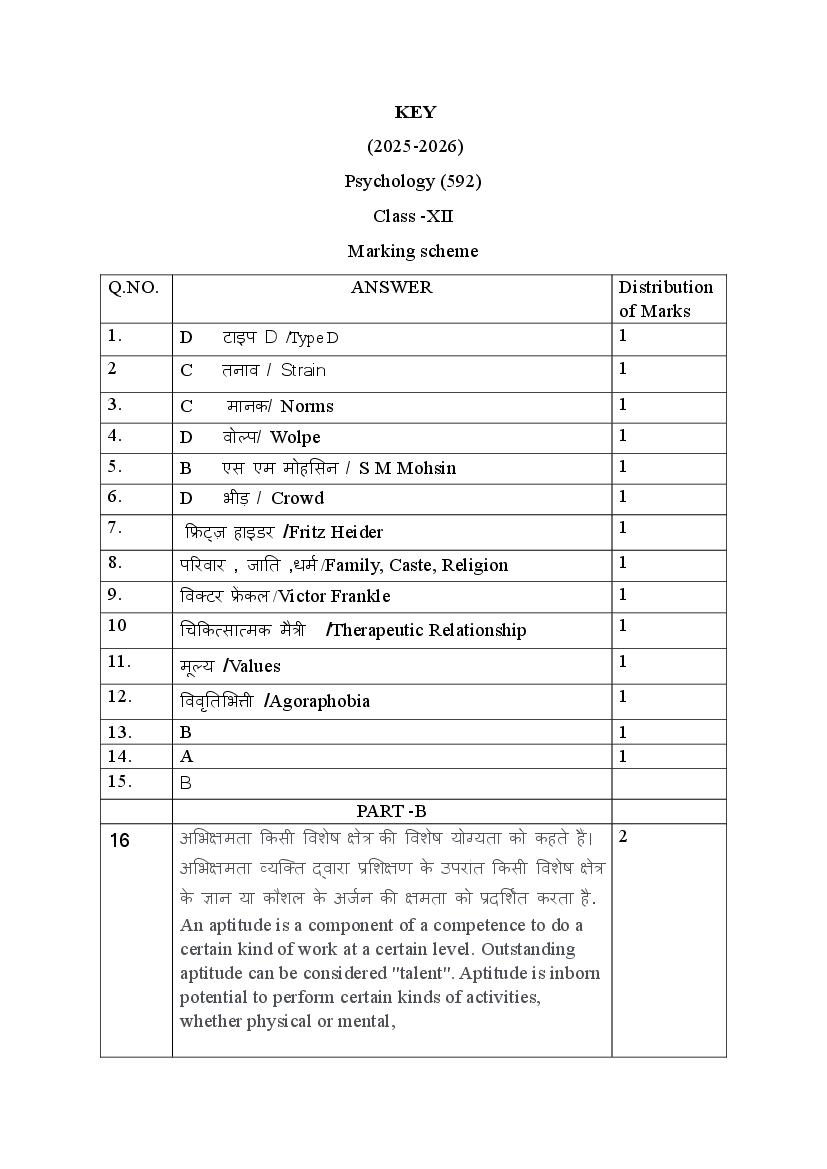
Page 1
(2025-2026)
Psychology (592)
Class -XII
Marking scheme
Q.NO. ANSWER Distribution
of Marks
1. D टाइप D /Type D 1
2 C तनाव / Strain 1
3. C मानक/ Norms 1
4. D वोल्प/ Wolpe 1
5. B एस एम मोहससन / S M Mohsin 1
6. D भीड़ / Crowd 1
7. फ्रिट्ज़ हाइडर /Fritz Heider 1
8. पररवार , जातत ,धमम /Family, Caste, Religion 1
9. ववक्टर िेंकल /Victor Frankle 1
10 चिफ्रकत्सात्मक मैत्री /Therapeutic Relationship 1
11. मूल्य /Values 1
12. वववतृ तसभत्ती /Agoraphobia 1
13. B 1
14. A 1
15. B
PART -B
16 असभक्षमता फ्रकसी ववशेष क्षेत्र की ववशेष योग्यता को कहते हैं। 2
असभक्षमता व्यक्क्त द्वारा प्रसशक्षण के उपराांत फ्रकसी ववशेष क्षेत्र
के ज्ञान या कौशल के अजमन की क्षमता को प्रदसशमत करता है .
An aptitude is a component of a competence to do a
certain kind of work at a certain level. Outstanding
aptitude can be considered "talent". Aptitude is inborn
potential to perform certain kinds of activities,
whether physical or mental,
Page 2
फ्रकया:
िेतन, पव
ू ि
म त
े ना और अिेतन।
Sigmund Freud divided human consciousness into
three levels of awareness:
the conscious, preconscious, and unconscious
18 असभघातज घटनाओां के अांतगमत ववसभन्न प्रकार की गांभीर 2
घटनाएँ जैसे अक्ग्नकाांड, रे लगाडी या सड़क दघ
ु ट
म ना, लट
ू , भक
ू ां प
इत्यादद सक्ममसलत होती हैं। इस प्रकार की घटनाओां का प्रभाव
कुछ समय बीत जाने के बाद ददखाई दे ता है तथा कभी कभी
यह प्रभाव दक्ु ्िांता, स्वप्न वविार इत्यादद के रूप में सतत रूप
से बने रहते हैं।
अथवा
कृत्य अभिविन्यस्त युक्तत
दबावपूणम क्स्थतत के सांबांध में सूिना एकत्रत्रत करना उनके प्रतत
क्या क्या वैकक्ल्पक फ्रियाएां हो सकती हैं तथा उनके सांभाववत
पररणाम क्या हो सकते हैं, यह सब इसके अांतगमत आते हैं।
इसके अांतगमत प्राथसमकताओां तथा फ्रियाओां के सांबांध में तनणमय
करना भी सक्ममसलत होता है ताफ्रक दबावपण
ू म क्स्थतत का
प्रत्यक्ष रूप से सामना फ्रकया जा सके।
Traumatic events include being involved in a variety
of extreme events such as a fire, train or road
accidents, robbery earthquake etc. The effect of these
events may occur after some lapse of time and
sometimes persists as symptoms of dreams and
thought etc.
OR
Task oriented strategy involves obtaining information
about the stressful situation and about alternative
courses of action and their probable outcome, it also
Page 3
with the stressful situation directly.
19 आतांक ववकार में दक्ु ्िांता के दौरे लगातार पड़ते हैं और व्यक्क्त 2
अत्यांत दहशत का अनुभव करता है । इसके लक्षणों में िक्कर
आना, ददल धडकना, जी समिलाना, छाती में ददम आदद प्रमुख
हैं।
Panic disorder consists of recurrent anxiety attacks in
which the person experiences intense terror. The
clinical features include shortness of breath,
palpitation, chest pain, nausea etc.
20 व्यवहार सांबांधी समस्याओां वाले व्यक्क्तयों को हर बार वाांतछत 2
व्यवहार होने पर इनाम के रूप में टोकन ददया जा सकता है ।
टोकन एकत्र फ्रकए जाते हैं और इनाम के सलए आदान-प्रदान
फ्रकए जाते हैं, जैसे फ्रक रोगी के सलए आउदटांग या बच्िे को
बाहर खाना खखलाना । इसे टोकन अथमव्यवस्था के रूप में
जाना जाता है ।
Persons with behavioural problems can
be given a token as a reward every time a wanted
behaviour occurs. The tokens are collected and
exchanged for a reward such as an outing for the
patient or a treat for the child. This is known as token
economy.
21 सामान्यतः लोग तनमन कारणों से समह
ू में सक्ममसलत होते 1+1
हैं:
सुरक्षा: जब हम अकेले होते हैं तो असुरक्षक्षत अनभ
ु व करते हैं।
समह
ू इस असरु क्षा को कम करता है । व्यक्क्तयों के साथ रहना
आराम की अनुभूतत और सांरक्षण प्रदान करता है ।
प्रततष्ठा या है भसयत - जब हम फ्रकसी ऐसे समह
ू के सदस्य
होते हैं जो दस
ू रे लोगों द्वारा महत्वपूणम समझे जाते हैं तो हम
सममातनत महसूस करते हैं तथा शक्क्त बोध का अनुभव करते
हैं।
Page 4
अथवा
प्राथभिक सिूह: ये समूह पूवम ववद्यमान तनमामण होते हैं जो
प्रायः व्यक्क्त को प्रदत्त फ्रकया जाता है । पररवार, जातत इसके
उदाहरण हैं.
These are the factors which motivated people to join
that group:
(i) Security: When we are alone, we feel insecure.
Groups reduce this insecurity. Being with people
gives a sense of comfort, and protection.
(ii) Status: When we are members of a group that is
perceived to be important by others, we feel
recognized and experience a sense of power. Suppose
our school wins in an inter-institutional debate
competition, we feel proud and think that we are
better than others.
(Any two reasons, 1 mark for each)
OR
Primary groups are pre-existing formations which are
usually given to the individual. Family and caste are
example of primary group.
PART-C
22 बुद्चध का त्रत्रिापीय ससद्धाांत : रॉबटम स्टनमबगम (1985) ने बुचध 1+1+1
के त्रत्रकोणीय ससद्धाांत का प्रस्ताव रखा। स्टनमबगम बुद्चधमत्ता को
"फ्रकसी के लक्ष्यों और फ्रकसी के समाज और सांस्कृतत को पूरा
करने के सलए पयामवरण को अनक
ु ू सलत करने, आकार दे ने और
िन
ु ने की क्षमता" के रूप में दे खते हैं। इस ससद्धाांत के अनुसार,
बुद्चध के तीन बुतनयादी प्रकार हैं: घटकीय बुद्चध , आनुभववक
बद्
ु चध और सांदसभमक बद्
ु चध ।
घटकीय बुद्धि: इस बुद्चधमत्ता में तीन घटक हैं, प्रत्येक एक
अलग कायम करता है । सबसे पहले ज्ञान अचधग्रहण घटक है ,
Page 5
सलए क्जममेदार है । दस
ू रा मेटा या एक उच्ि िम घटक है ,
क्जसमें क्या करना है और कैसे करना है , इसके बारे में योजना
बनाना शासमल है । तीसरा तनष्पादन घटक है , क्जसमें वास्तव
में िीजें करना शासमल है ।
आनुिविक बुद्धि : आनुभववक बुद्चध या रिनात्मक बुद्चध
समस्याओां को हल करने के सलए रिनात्मक रूप से वपछले
अनुभवों का उपयोग करने में शासमल है । इस पहलू पर व्यक्क्त
नई खोजों और आववष्कारों को बनाने के सलए ववसभन्न अनुभवों
को मूल तरीके से एकीकृत करते हैं। वे जल्दी से पता लगाते हैं
फ्रक फ्रकसी ददए गए क्स्थतत में कौन सी जानकारी महत्वपूणम है ।
साांदभििक बद्
ु धि: साांदसभमक या व्यावहाररक बद्
ु चधमत्ता में
दै तनक आधार पर आने वाली पयामवरणीय माांगों से तनपटने की
क्षमता शासमल है । इस बद्
ु चध की अचधकता रखने वाले लोग
अपनी आव्यकताओां के अनरू
ु प पयामवरण को सांशोचधत करते
हैं। इससलए, वे जीवन में सफल हो जाते हैं।
Triarchic Theory of Intelligence: Robert Sternberg
(1985) proposed the triarchic theory of intelligence.
Sternberg views intelligence as “the ability to adapt, to
shape and select environment to accomplish one’s
goals and those of one’s society and culture”.
According to this theory, there are three basic types of
intelligence: Componential, Experiential, and
Contextual.
Componential: This intelligence has three
components, each serving a different function. First is
the knowledge acquisition component, which is
responsible for learning and acquisition of the ways of
doing things. The second is the meta or a higher order
component, which involves planning concerning what
to do and how to do. The third is the performance
component, which involves actually doing things.
Experiential Intelligence: Experiential or creative
intelligence is involved in using past experiences
creatively to solve novel problems. It is reflected in
creative performance. Persons high on this aspect
Page 6
make new discoveries and inventions. They quickly
find out which information is crucial in a given
situation
Contextual Intelligence: Contextual or practical
intelligence involves the ability to deal with
environmental demands encountered on a daily basis.
Persons high on this aspect easily adapt to their present
environment or select a more favourable environment
than the existing one, or modify the environment to fit
their needs. Therefore, they turn out to be successful in
life.
23 आत्म फ्रकसी व्यक्क्त के स्वयां के सांबांध में उसके जागरूक 3
अनुभवों, वविारों, वविारों और भावनाओां की समग्रता को
सांदसभमत करता है ।
भारतीय और पक््िमी वविारों के बीि सबसे महत्वपूणम अांतर
यह है फ्रक क्जस तरह से स्वयां और दस
ू रे के बीि सीमा खीांिी
जाती है । पक््िमी दृक्ष्टकोण में , यह सीमा अपेक्षाकृत तनक््ित
प्रतीत होती है । दस
ू री ओर, स्वयां के बारे में भारतीय
दृक्ष्टकोण, इस सीमा की बदलती प्रकृतत की ववशेषता है ।
पक््िमी दृक्ष्टकोण स्वयां और अन्य, मनुष्य और प्रकृतत,
व्यक्क्तपरक और उद्दे ्य के बीि स्पष्ट अांतर रखता है ।
भारतीय दृक्ष्टकोण इस तरह के स्पष्ट मतभेद नहीां करता है ।
पक््िमी सांस्कृतत में , स्वयां और समूह स्पष्ट रूप से पररभावषत
सीमाओां के साथ दो अलग-अलग सांस्थाओां के रूप में मौजद
ू
हैं। समूह के व्यक्क्तगत सदस्य अपने व्यक्क्तत्व को बनाए
रखते हैं। भारतीय सांस्कृतत में , स्वयां को आम तौर पर अपने
स्वयां के समह
ू से अलग नहीां फ्रकया जाता है ; बक्ल्क दोनों
सामांजस्यपूणम सह-अक्स्तत्व की क्स्थतत में रहते हैं। दस
ू री ओर,
पक््िमी सांस्कृतत में , वे अक्सर दरू ी पर रहते हैं। यही कारण है
फ्रक कई पक््िमी सांस्कृततयों को व्यक्क्तवादी के रूप में जाना
जाता है , जबफ्रक कई एसशयाई सांस्कृततयों को सामूदहकता के
रूप में जाना जाता है ।
Page 7
experiences, ideas, thoughts and feelings with regard to
herself or himself
The most important distinction between the Indian and
the Western views is the way the boundary is drawn
between the self and the other. In the Western view, this
boundary appears to be relatively fixed. The Indian
view of self, on the other hand, is characterised by the
shifting nature of this boundary. The Western view
seems to hold clear dichotomies between self and other,
man and nature, subjective and objective. The Indian
view does not make such clear dichotomies. In the
Western culture, the self and the group exist as two
different entities with clearly defined boundaries.
Individual members of the group maintain their
individuality. In the Indian culture, the self is generally
not separated from one’s own group; rather both
remain in a state of harmonious co-existence. In the
Western culture, on the other hand, they often remain
at a distance. That is why many Western cultures are
characterised as individualistic, whereas many Asian
cultures are characterised as collectivistic.
24 दबाव के कारण प्रततरक्षा तांत्र की कायमप्रणाली दब
ु ल
म हो जाती है 3
क्जसके कारण बीमारी उत्पन्न हो सकती है । प्रततरक्षा तांत्र शरीर
के भीतर तथा बाहर से होने वाले हमलों से शरीर की रक्षा करता
है । प्रततरक्षा तांत्र में ्वेत रक्त कोसशकाएां बाह्य तत्व जैसे वायरस
को पहिान कर नष्ट करता है और रोग प्रततकारकों का तनमामण
भी करता है । प्रततरक्षा तांत्र में ही टी कोसशकाए, बी कोसशकाएां -
तथा प्राकृततक रूप से नष्ट करने वाली कोसशकाओां सदहत कई
प्रकार के शवेताणु होते हैं। टी कोसशकाएां हमला करने वालों को
नष्ट करती हैं तथा सहायक कोसशकाएां प्रततरक्षातमक फ्रियाओां में
वद्
ृ चध करती है । प्राकृततक रूप से नष्ट करने वाली कोसशकाएां
वायरस तथा ट्यूमर दोनों के ववरुद्ध लड़ाई करती हैं।
Page 8
the immune system. The immune system guards the
body against attackers, both from within and outside.
The white blood cells within the immune system
identify and destroy foreign bodies (antigens) such as
viruses. It also leads to the production of antibodies.
There are several kinds of white blood cells or
leucocytes within the immune system, including T
cells, B cells and natural killer cells. T cells destroy
invaders, and T-helper cells increase immunological
activity cells produce antibodies. Natural killer cells
are involved in the fight against both viruses and
tumours.
Stress can affect natural killer cell cytotoxicity, which
is of major importance in the defence against various
infections and cancer. Studies reveal that immune
functioning is better in individuals receiving social
support. Also, changes in the immune system will have
more effect on health among those whose immune
systems are already weakened.
OR
क्जस तरह से हम तनाव का सामना करते हैं, वह अक्सर अनुभव
के आधार पर कठोर गहरी मान्यताओां पर तनभमर करता है ,
उदाहरण के सलए जब हम ट्रै फ्रफक जाम में फांस जाते है तो
हम गुस्सा महसूस करते हैं, क्योंफ्रक हम मानते हैं फ्रक यातायात
'तेज़ी से आगे बढ़ना िादहए'। तनाव का प्रबांधन करने के सलए
हमें अक्सर हमारे सोिने और मुकाबला करने की रणनीततयों को
सीखने के तरीके का पुनमल्
ूम याांकन करने की आव्यकता होती
है । एांडलर और पाकमर द्वारा दी गई तीन मुकाबला रणनीततयाां
हैं:
कायि-उन्िुख रणनीतत: इसमें तनावपूणम क्स्थतत और कारम वाई के
वैकक्ल्पक पाठ्यिमों और उनके सांभाववत पररणाम के बारे में
जानकारी प्राप्त करना शासमल है ; इसमें प्राथसमकताएां तय
करना और तनावपूणम क्स्थतत से सीधे तनपटने के सलए कायम
करना भी शासमल है । उदाहरण के सलए, अपना समय बेहतर
Page 9
समस्याओां को कैसे हल फ्रकया है ।
िािना-उन्िख
ु रणनीतत: इसमें आशा बनाए रखने और फ्रकसी
की भावनाओां को तनयांत्रत्रत करने के प्रयास शासमल हो सकते हैं ;
इसमें िोध और हताशा की भावनाओां को बाहर तनकालना या
यह तय करना भी शासमल हो सकता है फ्रक िीजों को बदलने
के सलए कुछ भी नहीां फ्रकया जा सकता है । उदाहरण के सलए,
अपने आप को बताएां फ्रक यह वास्तव में मेरे साथ नहीां हो रहा
है , या इस बारे में चिांता करें फ्रक मैं क्या करने जा रहा हूां।
पररहार-उन्िुख रणनीतत: इसमें क्स्थतत की गांभीरता को
नकारना या कम करना शासमल है ; इसमें तनावपण
ू म वविारों का
सिेत दमन और आत्म-सुरक्षात्मक वविारों द्वारा उनका
प्रततस्थापन भी शासमल है ।
Coping is a dynamic situation-specific reaction to
stress. It is a set of concrete responses to stressful
situations or events that are intended to resolve the
problem and reduce stress. The way we cope with
stress often depends on rigid deep-seated beliefs, based
on experience, e.g. when caught in a traffic jam we feel
angry, because we believe that the traffic ‘should’ move
faster. To manage stress we often need to reassess the
way we think and learn coping strategies
The three coping strategies given by Endler and Parker
are: Task-oriented Strategy: This involves obtaining
information about the stressful situation and about
alternative courses of action and their probable
outcome; it also involves deciding priorities and acting
so as to deal directly with the stressful situation. For
example, schedule my time better, or think about how
I have solved similar problems. Emotion-oriented
Strategy: This can involve efforts to maintain hope and
to control one’s emotions; it can also involve venting
feelings of anger and frustration, or deciding that
nothing can be done to change things. For example, tell
myself that it is not really happening to me, or worry
about what I am going to do. Avoidance-oriented
Strategy: This involves denying or minimising the
Page 10
suppression of stressful thoughts and their replacement
by self -protective thoughts.
25 दसु भमतत में ववसशष्ट वस्तुओ,ां लोगों या क्स्थततयों से सांबांचधत 1+1+1
तकमहीन भय होते हैं। दसु भमतत अक्सर धीरे -धीरे ववकससत होते हैं
या एक सामान्यीकृत चिांता ववकार से शुरू होते हैं। दसु भमतत को
तीन मख्
ु य प्रकारों में वगीकृत फ्रकया जा सकता है , अथामत ्,
ववसशष्ट दसु भमतत, सामाक्जक भय और एगोराफोत्रबया।
विभिष्ट दभु िितत
दसु भमतत का सबसे अचधक होने वाला प्रकार है । इस समह
ू में
तकमहीन भय शासमल हैं जैसे फ्रक एक तनक््ित प्रकार के जानवर
का तीव्र डर, या एक सांलग्न स्थान में होना।
सािाक्िक िय
दस
ू रों के साथ व्यवहार करते समय तीव्र और अक्षम भय और
शसमिंदगी सामाक्जक चिांता ववकार (सामाक्जक भय) की ववशेषता
है ।
विित
ृ -िीतत
यह शब्द तब उपयोग फ्रकया जाता है जब लोग मनोवैज्ञातनक
ववकार अपररचित क्स्थततयों में प्रवेश करने का डर ववकससत
करते हैं। एगोराफोत्रबया वाले कई लोग अपने घर से तनकलने
से डरते हैं। इससलए, सामान्य जीवन गततववचधयों को करने की
उनकी क्षमता गांभीर रूप से सीसमत है ।
Phobias have irrational fears related to specific objects,
people, or situations. Phobias often develop gradually
or begin with a generalised anxiety disorder. Phobias
can be grouped into three main types, i.e., specific
phobias, social phobias, and agoraphobia.
Specific phobias
These are the most commonly occurring type of
phobia. This group includes irrational fears such as
intense fear of a certain type of animal, or of being in
an enclosed space. Social phobia
Page 11
when dealing with others characterises social anxiety
disorder (social phobia).
Agoraphobia is the term used when people develop a
fear of entering unfamiliar situations. Many people
with agoraphobia are afraid of leaving their home. So,
their ability to carry out normal life activities is
severely limited.
26 व्यिहार तकनीक 1+1+1
व्यवहार बदलने के सलए तकनीकों की एक श्ख
ां ृ ला उपलब्ध है ।
नकारात्िक प्रबलन और वििुखी अनुबांिन व्यवहार सांशोधन की
दो प्रमुख तकनीकें हैं। नकारात्िक प्रबलन एक अवाांतछत
प्रततफ्रिया का पालन करने को सांदसभमत करता है जो ददम नाक है
या पसांद नहीां फ्रकया जाता है । उदाहरण के सलए, सशक्षक कक्षा
में चिल्लाने वाले बच्िे को फटकार लगाता है। वििुखी अनुबांिन
एक प्रततकूल पररणाम के साथ अवाांतछत प्रततफ्रिया के बार-बार
जुड़ाव को सांदसभमत करता है । उदाहरण के सलए, एक शराबी को
हल्का त्रबजली का झटका ददया जाता है और शराब को सांघ
ू ने के
सलए कहा जाता है । बार-बार जोड़ी के साथ शराब की गांध प्रततकूल
होती है क्योंफ्रक सदमे का ददम इसके साथ जुड़ा होता है और
व्यक्क्त शराब छोड़ दे गा। उदाहरण के सलए, यदद कोई बच्िा
तनयसमत रूप से होमवकम नहीां करता है , तो बच्िे की माां द्वारा
बच्िे के पसांदीदा पकवान को तैयार करके सकारात्मक सुदृढीकरण
का उपयोग फ्रकया जा सकता है जब भी वह तनयत समय पर
होमवकम करता है , सकारात्मक प्रबलन ददया जाता है ।
टोकन अथिव्यिस्था व्यवहरात्मक समस्याओां वाले लोगों को कोई
वाांतछत व्यवहार करने पर हर बार एक टोकन ददया जाता है ,ये
टोकन एकत्रत्रत फ्रकए जाते हैं और फ्रकसी पुरस्कार से उनका
आदान प्रदान फ्रकया जाता है ।
क्रभिक विसांिेदनीकरण फोत्रबया या तकमहीन भय के इलाज के
सलए वोल्प द्वारा पेश की गई एक तकनीक है ।
Behavioural Techniques
Page 12
behaviour. The principles of these techniques are to
reduce the arousal level of the client, alter behaviour
through classical conditioning operant or conditioning
with different contingencies of reinforcements, as well
as to use vicarious learning procedures, if necessary.
Negative reinforcement and aversive conditioning are
the two major techniques of behaviour modification.
Negative reinforcement
It refers to following an undesired response with an
outcome that is painful or not liked. For example, the
teacher reprimands a child who shouts in class. This is
negative reinforcement.
Aversive conditioning refers to repeated association of
undesired response with an aversive consequence. For
example, an alcoholic is given a mild electric shock and
asked to smell the alcohol. With repeated pairings the
smell of alcohol is aversive as the pain of the shock is
associated with it and the person will give up alcohol.
If an adaptive behaviour occurs rarely, positive
reinforcement is given to increase the deficit. For
example, if a child does not do homework regularly
Positive reinforcement may be used by the child's
mother by preparing the child's favourite dish
whenever s/he does homework at the appointed time.
The positive reinforcement of food will increase the
behaviour of doing homework at the appointed time.
(Persons with behavioural problems can be given a
token as a reward every time a wanted behaviour
occurs. The tokens are collected and exchanged for a
reward such as an outing for the patient or a treat for
the child. This is known as token economy.
Systematic desensitization is a technique introduced
by Wolpe for treating phobias or irrational fears.
27 असभवतृ त मन की एक अवस्था है । यह फ्रकसी ववषय के सांबांध 1+1+1
वविारों का एक पुांज है क्जसमें एक मूल्याांकन परक ववशेषता पाई
जाती । असभवतृ त के तीन घटक है -
वविारपरक घटक को सांज्ञानात्मक पक्ष कहा जाता है ।
Page 13
फ्रिया करने की प्रववृ त्त को व्यवहारपरक या फ्रियात्मक घटक कहा
जाता है ।
अथवा
असभवतृ त तनमामण को प्रभाववत करने वाले कारक
पररिार एिां विद्यालय का पररिेि
जीवन के प्रारां सभक वषों में असभवतृ त तनमामण में माता वपता एवां
पररवार के अन्य सदस्य महत्वपूणम भूसमका तनभाते हैं बाद में
ववद्यालय का पररवेश असभवतृ त तनमामण के सलए महत्वपूणम बन
जाता है ।
सांदिि सिूह
सांदभम समह
ू एक व्यक्क्त को सोिने एवां व्यवहार करने के मानकों
को बताते हैं।
व्यक्ततगत अनुिि
अनेक असभववृ त्तयों का तनमामण लोगों के तथा स्वयां के जीवन
के प्रतत हमारे व्यक्क्तगत अनुभवों से होता है ।
सांचार िाध्यि प्रिाि
वतममान समय में दृ्य श्व्य माध्यम तथा इांटरनेट शक्क्तशाली
सूिना का माध्यम बन गया है जो असभव्यक्क्तयों का तनमामण
एवां पररवतमन करता है।
Attitude is a state of mind which have an evaluative
feature. Attitude have 3 components.
The thought component is referred to as the cognitive
aspect.
The emotional component is known as the affective
aspect and the tendency to act is called the behavioural
aspect.
OR
The following factors provide the context for the
learning of attitudes through the processes described
above
Family and school environment
In the early years of life parents and other family
members play a significant role In shaping attitude
Page 14
important background for attitude formation.
Reference groups
Reference groups indicate to an individual the norms
regarding acceptable behaviour and ways of thinking.
Personal experiences
Many attitudes are formed not in the family
environment but through the direct personal
experiences.
Media related influences
Technological advances in recent times have made
audio visual media and the Internet very powerful
source of information that lead to attitude formation
and change.
28 ु ां या समस्या समाधानों को 5
रिनात्मकता उन वविारों, वस्तओ
उत्पन्न करने की क्षमता है जो नवीन, उपयुक्त और उपयोगी
हों। रिनात्मक होने के सलए एक तनक््ित स्तर की बुद्चध
आव्यक है , लेफ्रकन उच्ि स्तर की बुद्चध यह सुतनक््ित नहीां
करती है फ्रक कोई व्यक्क्त तनक््ित रूप से रिनात्मक होगा।
1920 के दशक में टममन ने पाया फ्रक उच्ि बद्
ु चध वाले व्यक्क्त
आव्यक रूप से रिनात्मक नहीां होते। साथ ही, रिनात्मक
वविार ऐसे व्यक्क्तयों से भी आ सकते हैं क्जनका आईक्यू बहुत
अचधक नहीां है । अन्य शोधों से पता िला है फ्रक क्जन लोगों की
पहिान प्रततभाशाली के रूप में की गई, उनमें से एक भी अपने
वयस्क जीवन के दौरान फ्रकसी क्षेत्र में रिनात्मकता के सलए
प्रससद्ध नहीां हुआ। शोधकतामओां ने यह भी पाया है फ्रक उच्ि और
तनमन दोनों स्तर की रिनात्मकता अत्यचधक बुद्चधमान बच्िों
और औसत बद्
ु चध वाले बच्िों में भी पाई जा सकती है । इस
प्रकार, एक ही व्यक्क्त रिनात्मक होने के साथ-साथ बुद्चधमान
भी हो सकता है लेफ्रकन यह आव्यक नहीां है फ्रक पारां पररक अथों
में बद्
ु चधमान व्यक्क्त रिनात्मक ही हो। इससलए, बद्
ु चधमत्ता
अपने आप में रिनात्मकता सुतनक््ित नहीां करती है ।
शोधकतामओां ने पाया है फ्रक रिनात्मकता और बुद्चधमत्ता के बीि
सांबांध सकारात्मक है । सभी रिनात्मक कायों के सलए ज्ञान प्राप्त
Page 15
पुनः प्राप्त करने की क्षमता की आव्यकता होती है ।
अथवा
बद्
ु धि परीक्षणों के प्रकार
बुद्चध परीक्षण कई प्रकार के होते हैं। परीक्षणों को दे ने की
प्रफ्रिया के आधार पर उन्हें व्यक्क्त परीक्षण तथा समूह परीक्षण
में वगीकृत फ्रकया जा सकता है । परीक्षण के एकाांश के स्वरूप के
आधार पर भी उन्हें शाक्ब्दक तथा अशाक्ब्दक परीक्षण तथा
तनष्पादन परीक्षण में वगीकृत फ्रकया जा सकता है ।
व्यक्तत तथा सिूह बुद्धि परीक्षण
व्यक्क्त बुद्चध परीक्षण वह परीक्षण होता है क्जसके द्वारा एक
समय में एक ही व्यक्क्त का बद्
ु चध परीक्षण फ्रकया जा सकता है ।
समूह बुद्चध परीक्षण को एक साथ बहुत से व्यक्क्तयों को समूह
में ददया जा सकता है ।
िाक्ददक, अिाक्ददक तथा तनष्पादन परीक्षण
एक बुद्चध परीक्षण पूरी तरह शाक्ब्दक, अवाचिक या तनष्पादन
परीक्षण हो सकता है । इसके अततररक्त कोई बुद्चध परीक्षण
इनका समचश्त रूप भी हो सकता है । शाक्ब्दक परीक्षण मे शाक्ब्दक
अनुफ्रियाएां करनी होती । अशाक्ब्दक परीक्षणों में चित्रों का प्रयोग
फ्रकया जाता है । तनष्पादन परीक्षण में परीक्षाथी को कोई कायम
करने के सलए कुछ वस्तुओां या सामग्री का प्रहस्तन करना होता
है ।
सांस्कृतत तनष्पक्ष तथा सांस्कृतत अभिनत परीक्षण
बुद्चध परीक्षण सांस्कृतत तनष्पक्ष अथवा सांस्कृतत असभनत हो
सकते हैं। बहुत से बुद्चध परीक्षण उस सांस्कृतत के प्रतत असभनतत
प्रदसशमत करते हैं क्जसमें वे बुद्चध परीक्षण ववकससत फ्रकए जाते
हैं।
Creativity is the ability to produce ideas, objects, or
problem solutions that are novel, appropriate and
useful. Certain level of intelligence is necessary to be
creative, but a high level of intelligence, however, does
not ensure that a person would certainly be creative.
Page 16
were not necessarily creative. At the same time,
creative ideas could come from persons who did not
have a very high IQ. Other researches have shown that
not even one of those identified as gifted, followed up
throughout their adult life, had become well-known for
creativity in some field. Researchers have also found
that both high and low level of creativity can be found
in highly intelligent children and also children of
average intelligence. The same person, thus, can be
creative as well as intelligent but it is not necessary that
intelligent ones, in the conventional sense, must be
creative. Intelligence, therefore, by itself does not
ensure creativity.
Researchers have found that the relationship between
creativity and intelligence is positive. All creative acts
require some minimum ability to acquire knowledge
and capacity to comprehend, retain, and retrieve.
OR
Intelligence tests are of several types on the basis of
their administration procedure, they can be categorised
as individual or group test they can also be classified
as either verbal or performance tests on the basis of
items used.
Individual or group tests
An individual intelligence test is one which can be
administered one person at a time. A group intelligence
test can be administered to several persons
simultaneously.
Verbal, nonverbal and performance tests
An intelligence test may be fully verbal, fully
nonverbal or fully performance based or it may consist
of a mixture of items from each category. Verbal tests
are required subject to give verbal responses. The
nonverbal tests use picture or illustration as test items.
Performance tests require subjects to manipulate object
and other material to perform a task.
Culture fair or culture based tests
Intelligence tests can be culture fair or culture based.
Many intelligence tests show a bias to the culture in
Page 17
discriminate against individuals belonging to different
cultures.
29 िानितािादी दृक्ष्टकोण 5
ससद्धाांत मुख्य रूप से िायड के ससद्धाांत के जवाब में ववकससत
फ्रकए गए हैं। कालम रोजसम और अब्राहम मैस्लो ने व्यक्क्तत्व पर
मानवतावादी दृक्ष्टकोण के ववकास में ववशेष रूप से योगदान
ददया है ।
रोजसम द्वारा प्रस्ताववत सबसे महत्वपूणम वविार एक पूणत
म ः
कायमशील व्यक्क्त का है। उनका मानना है फ्रक सांतुक्ष्ट व्यक्क्तत्व
ववकास के सलए प्रेरक शक्क्त है। लोग अपनी क्षमताओां,
सांभाव्यताओां और प्रततभाओां को यथासांभव पूणम रूप से व्यक्त
करने का प्रयास करते हैं। व्यक्क्तयों में एक जन्मजात प्रववृ त्त
होती है जो उन्हें अपने ववरासत में समले स्वभाव को साकार करने
के सलए तनदे सशत करती है ।
रोजसम मानव व्यवहार के बारे में दो बतु नयादी धारणाएँ बनाते हैं।
एक तो यह फ्रक व्यवहार लक्ष्य-तनदे सशत और साथमक हो। दस
ू रा
यह है फ्रक लोग (जो स्वाभाववक रूप से अच्छे हैं) लगभग हमेशा
अनक
ु ू ली, आत्म-वास्तववक व्यवहार िन
ु ें गे।
रोजसम का ससद्धाांत उनके क्क्लतनक में मरीजों को सुनने के
अनुभवों से ववकससत हुआ। उन्होंने कहा फ्रक उनके ग्राहकों के
अनुभव में स्वयां एक महत्वपूणम तत्व था। इस प्रकार, उनका
ससद्धाांत स्वयां की अवधारणा के इदम -चगदम सांरचित है । ससद्धाांत
मानता है फ्रक लोग लगातार अपने वास्तववक स्वरूप को साकार
करने की प्रफ्रिया में लगे रहते हैं।
रोजसम का सुझाव है फ्रक प्रत्येक व्यक्क्त के पास आदशम आत्म
की अवधारणा भी होती है । एक आदशम आत्म वह आत्म है जो
एक व्यक्क्त बनना िाहता है । जब वास्तववक स्व और आदशम
स्व के बीि पत्रािार होता है , तो व्यक्क्त आमतौर पर खश
ु होता
है । वास्तववक स्व और आदशम स्व के बीि ववसांगतत का पररणाम
अक्सर दःु ख और असांतोष होता है । रोजसम का मल
ू ससद्धाांत यह
Page 18
अचधकतम करने की प्रववृ त्त होती है । इस प्रफ्रिया में , स्वयां बढ़ता
है , फैलता है और अचधक सामाक्जक बनता है ।
रोजसम व्यक्क्तत्व ववकास को एक सतत प्रफ्रिया मानते हैं। इसमें
स्वयां का मूल्याांकन करने और आत्म-साक्षात्कार की प्रफ्रिया में
महारत हाससल करना सीखना शासमल है । वह आत्म-अवधारणा
के ववकास में सामाक्जक प्रभावों की भसू मका को पहिानते हैं।
जब सामाक्जक पररक्स्थततयाँ सकारात्मक होती हैं , तो आत्म-
अवधारणा और आत्म-सममान ऊँिा होता है । इसके ववपरीत, जब
पररक्स्थततयाँ नकारात्मक होती हैं, तो आत्म-अवधारणा और
आत्म-सममान कम होता है । उच्ि आत्म-अवधारणा और आत्म-
सममान वाले लोग आम तौर पर लिीले होते हैं और नए अनभ
ु वों
के सलए खल
ु े होते हैं, ताफ्रक वे आगे बढ़ सकें और आत्म-
साक्षात्कार कर सकें।
यह क्स्थतत इस बात की गारां टी दे ती है फ्रक लोगों की आत्म-
अवधारणा की वद्
ृ चध सुतनक््ित करने के सलए त्रबना शतम
सकारात्मक सममान का माहौल बनाया जाना िादहए। रोजसम
द्वारा ववकससत ग्राहक-केंदित थेरेपी मूल रूप से इस क्स्थतत को
बनाने का प्रयास करती है ।
मैस्लो ने आत्म-साक्षात्कार की प्राक्प्त के सांदभम में मनोवैज्ञातनक
रूप से स्वस्थ लोगों का एक ववस्तत
ृ वववरण ददया है , एक ऐसी
अवस्था क्जसमें लोग अपनी पूरी क्षमता तक पहुँि िक
ु े होते हैं।
मास्लो का उस व्यक्क्त के प्रतत आशावादी और सकारात्मक
दृक्ष्टकोण था क्जसमें प्रेम, आनांद और रिनात्मक कायम करने की
क्षमता है । मनुष्य को अपने जीवन को आकार दे ने और आत्म-
साक्षात्कार के सलए स्वतांत्र माना जाता है । हमारे जीवन को
सांिासलत करने वाली प्रेरणाओां का वव्लेषण करने से आत्म-
साक्षात्कार सांभव हो जाता है । हम जानते हैं फ्रक जैववक. सरु क्षा
और अपनेपन की ज़रूरतें (क्जन्हें उत्तरजीववता ज़रूरतें कहा जाता
है ) आमतौर पर जानवरों और मनुष्यों में पाई जाती हैं। इस
प्रकार, फ्रकसी व्यक्क्त की इन आव्यकताओां की सांतक्ु ष्ट की
एकमात्र चिांता उसे जानवरों के स्तर तक चगरा दे ती है । मानव
Page 19
जरूरतों की खोज से शुरू होती है । मानवतावादी दृक्ष्टकोण जीवन
के सकारात्मक पहलुओां के महत्व पर जोर दे ता है
अथवा
व्यक्क्तत्व के प्रतत ववशेषक दृक्ष्टकोण यह सुझाव दे ता है फ्रक
व्यक्क्तत्व व्यापक, क्स्थर और सुसांगत ववशेषताओां से बने होते
हैं क्जन्हें ववशेषक कहा जाता है । ये ववशेषक समय और
पररक्स्थततयों के साथ अपेक्षाकृत स्थायी होते हैं, जो व्यक्क्त के
वविारों, भावनाओां और व्यवहारों को प्रभाववत करते हैं
ऑलपोटम ने कहा फ्रक व्यक्क्तयों में अनेक ववशेषताएां होती हैं जो
गततशील होती हैं तथा उनके व्यवहार को इस प्रकार तनधामररत
करती हैं फ्रक लोग सभन्न-सभन्न समस्याओां के प्रतत समान
योजना बनाते हैं।
ऑलपोटम ने लोगों में दे खे जाने वाले ववसभन्न लक्षणों को तीन
श्ेखणयों में वगीकृत फ्रकया और वे हैं प्रमख
ु लक्षण, केंिीय
लक्षण और द्ववतीयक लक्षण।
प्रिुख लक्षण अत्यचधक सामान्यीकृत स्वभाव हैं जो उस लक्ष्य
को इांचगत करते हैं क्जसके िारों ओर व्यक्क्त का पूरा जीवन
घूमता हुआ प्रतीत होता है । महात्मा गाांधी की अदहांसा और
दहटलर का नाजीवाद प्रमुख लक्षणों के उदाहरण हैं।
प्रभाव में कम व्यापक, लेफ्रकन फ्रफर भी काफी सामान्यीकृत
स्वभावों को केंद्रीय लक्षण कहा जाता है । इन लक्षणों का
उपयोग फ्रकसी व्यक्क्त के सलए प्रशांसापत्र और नौकरी की
ससफाररशें सलखने के सलए फ्रकया जाता है ।
फ्रकसी व्यक्क्त के सबसे कम सामान्यीकृत स्वभाव को
द्वितीयक लक्षण कहा जाता है । वे व्यक्क्त के सलए बहुत ही
व्यक्क्तगत होते हैं। 'आम पसांद करना' या ' कपड़े पसांद करना'
जैसे लक्षण द्ववतीयक लक्षणों के उदाहरण हैं।
Humanistic Approach
The theories are mainly developed in response to
Freud's theory. Carl Rogers and Abraham Maslow have
particularly contributed to the development of
Page 20
examine their theories.
The most important idea proposed by Rogers is that of
a fully functioning person. He believes that fulfilment
is the motivating force for personality development.
People try to express their capabilities, potentials and
talents to the fullest extent possible. There is an inborn
tendency among persons that directs them to actualise
their inherited nature.
Rogers makes two basic assumptions about human
behaviour. One is that behaviour is goal-directed and
worthwhile. The second is that people (who are
innately good) will almost always choose adaptive,
self-actualising behaviour.
Rogers' theory grew out of his experiences of listening
to patients in his clinic. He noted that self was an
important element in the experience of his clients.
Thus, his theory is structured around the concept of
self. The theory assumes that people are constantly
engaged in the process of actualising their true self.
Rogers suggests that each person also has a concept of
ideal self. An ideal self is the self that a person would
like to be. When there is a correspondence between the
real self and ideal self, a person is generally happy.
Discrepancy between the real self and ideal self often
results in unhappiness and dissatisfaction. Rogers basic
principle is that people have a tendency to maximise
self-concept through self-actualisation. In this process,
the self grows, expands and becomes more social.
Rogers views personality development as a continuous
process. It involves learning to mastering evaluate
oneself and the process of self- actualisation. He
recognises the role of social influences in the
development of self-concept. When social conditions
are positive, the self-concept and self-esteem are high.
In contrast, when the conditions are negative, the self-
concept and self- esteem are low. People with high self-
concept and self-esteem are generally flexible and open
to new experiences, so that they can continue to grow
and self- actualise.
Page 21
unconditional positive regard must be created in order
to ensure enhancement of people's self-concept. The
client-centred therapy that Rogers developed basically
attempts to create this condition.
Maslow has given a detailed account of
psychologically healthy people in terms of their
attainment of self-actualisation, a state in which people
have reached their own fullest potential. Maslow had
an optimistic and positive view of man who has the
potentialities for love, joy and to do creative work.
Human beings are considered free to shape their lives
and to self-actualise. Self-actualisation becomes
possible by analysing the motivations that govern our
life. We know that biological. security, and
belongingness needs (called survival needs) are
commonly found among animals and human beings.
Thus, an individual's sole concern with the satisfaction
of these needs reduces her/ him to the level of animals.
The real journey of human life begins with the pursuit
of self-esteem and self- actualisation needs. The
humanistic approach emphasises the significance of
positive aspects of life.
OR
The trait approach to personality suggests that
individual personalities are made up of broad, stable,
and consistent characteristics called traits. These traits
are relatively enduring over time and across situations,
influencing an individual's thoughts, feelings, and
behaviours.
Allport said that individuals possess a number of traits
which are dynamic and that determine their behaviour
in such a way that people approach different problems
with similar plans.
Allport classified the different traits seen in people into
three categories and they are cardinal traits, central
traits and secondary traits.
The cardinal traits are highly generalized disposition
that indicate the goal around which the person’s entire
Page 22
and Hitler’s Nazism are examples of cardinal traits.
Less pervasive in effect, but yet quite generalized
dispositions are called central traits. These traits are
used to write testimonials and job recommendations for
a person.
The least generalized dispositions of a person are called
secondary traits. They are very personal and unique
to the person. Traits such as ‘likes mangoes’ or ‘prefers
ethnic clothes’ are examples of secondary traits.
30 ववच्छे दन को वविारों और भावनाओां के बीि सांबांधों के ववच्छे द 2+3
के रूप में दे खा जा सकता है । पथ
ृ क्करण में अवास्तववकता,
अलगाव, प्रततरूपण और कभी-कभी पहिान की हातन या बदलाव
की भावनाएँ शासमल होती हैं।
विच्छे दी स्ितृ तलोप ियनात्मक स्मतृ त हातन की ववशेषता है
क्जसका कोई ज्ञात जैववक कारण नहीां है (उदाहरण के सलए, ससर
की िोट)। कुछ लोगों को अपने अतीत के बारे में कुछ भी याद
नहीां रहता। अन्य लोग अब ववसशष्ट घटनाओां, लोगों, स्थानों या
वस्तुओां को याद नहीां कर सकते हैं, जबफ्रक अन्य घटनाओां के
सलए उनकी स्मतृ त बरकरार रहती है । यह ववकार अक्सर
अत्यचधक तनाव से जड़
ु ा होता है ।
विच्छे दी आत्ि विस्ितृ त का आव्यक लक्षण है - घर और
कायमस्थल से दरू एक अप्रत्यासशत यात्रा, एक नई पहिान की
धारणा और वपछली पहिान को याद करने में असमथमता है । यह
आमतौर पर तब समाप्त होता है जब व्यक्क्त अिानक 'जाग
जाता है ' और उसे इस समय के दौरान हुई घटनाओां की कोई
याद नहीां रहती है ।
विच्छे दी पहचान विकार
क्जसे अक्सर बहु-व्यक्क्तत्व के रूप में जाना जाता है ,
ववघटनकारी ववकारों में सबसे नाटकीय है । यह अक्सर बिपन
में ददम नाक अनुभवों से जुड़ा होता है । इस ववकार में , व्यक्क्त
वैकक्ल्पक व्यक्क्तत्व धारण करता है जो एक-दस
ू रे के बारे में
जानते भी हो सकते हैं और नहीां भी।
Page 23
इसमें एक स्वप्न जैसी क्स्थतत शासमल होती है क्जसमें व्यक्क्त
को स्वयां और वास्तववकता दोनों से अलग होने का एहसास होता
है । प्रततरूपण में , आत्म-धारणा में पररवतमन होता है , और व्यक्क्त
की वास्तववकता की भावना अस्थायी रूप से खो जाती है या
बदल जाती है ।
अथिा
मादक िव्यों से सांबांचधत और नशे की लत ववकार नशे की लत
व्यवहार, िाहे इसमें अत्यचधक कैलोरी भोजन का अत्यचधक सेवन
शासमल हो क्जसके पररणामस्वरूप अत्यचधक मोटापा होता है या
शराब या कोकीन जैसे पदाथों का दरु
ु पयोग शासमल होता है , आज
समाज द्वारा सामना की जा रही सबसे गांभीर समस्याओां में से
एक है । इसमें शासमल पदाथम का लगातार उपयोग पदाथम से
सांबांचधत और नशे की लत ववकारों के तहत शासमल है । इन
ववकारों में शराब, कोकीन, तांबाकू और हे रोइन के उपयोग और
दरु
ु पयोग से जुड़ी समस्याएां शासमल हैं, जो लोगों के सोिने,
महसूस करने और व्यवहार करने के तरीके को बदल दे ती हैं।
शराब जो लोग शराब का दरु
ु पयोग करते हैं वे तनयसमत रूप से
बड़ी मात्रा में पीते हैं और कदठन पररक्स्थततयों का सामना करने
में मदद करने के सलए इस पर भरोसा करते हैं। आखखरकार
शराब पीना उनके सामाक्जक व्यवहार और सोिने और काम
करने की क्षमता में हस्तक्षेप करता है । उनके शरीर तब शराब
के सलए सदहष्णत
ु ा का तनमामण करते हैं और उन्हें इस प्रभावों को
महसूस करने के सलए और भी अचधक मात्रा में पीने की
आव्यकता होती है । जब वे पीना बांद कर दे ते हैं तो वे वापसी
प्रततफ्रियाओां का भी अनुभव करते हैं। शराब लाखों पररवारों,
सामाक्जक सांबांधों और कररयर को नष्ट कर दे ती है। नशे में धत
ु
वाहन िालक कई सड़क दघ
ु ट
म नाओां के सलए क्जममेदार होते हैं।
इस ववकार वाले व्यक्क्तयों के बच्िों पर भी इसका गांभीर प्रभाव
पड़ता है । इन बच्िों में मनोवैज्ञातनक समस्याओां, ववशेष रूप से
चिांता, अवसाद, फोत्रबया और पदाथों से सांबांचधत ववकारों की उच्ि
Page 24
रूप से नुकसान पहुांिा सकता है ।
Dissociative Disorders
Dissociation can be viewed as severance of the
connections between ideas and emotions. Dissociation
involves feelings of unreality, estrangement,
depersonalization, and sometimes a loss or shift of
identity.. Four conditions are included in this group:
dissociative amnesia, dissociative fugue, dissociative
identity disorder, and depersonalization.
Dissociative amnesia is characterized by extensive but
selective memory loss that has no known organic cause
(e.g., head injury). Some people cannot remember
anything about their past. Others can no longer recall
specific events, people, places, or objects, while their
memory for other events remains intact. This disorder
is often associated with an overwhelming stress.
Dissociative fugue has, as its essential feature, an
unexpected travel away from home and workplace, the
assumption of a new identity, and the inability to recall
the previous identity. The fugue usually ends when the
person suddenly 'wakes up' with no memory of the
events that occurred during the fugue.
Dissociative identity disorder, often referred to as
multiple personality, is the most dramatic of the
dissociative disorders. It is often associated with
traumatic experiences in childhood. In this disorder, the
person assumes alternate personalities that may or may
not be aware of each other.
Depersonalisation
Involves a dreamlike state in which the person has a
sense of being separated both from self and from
reality. In depersonalisation, there is a change of self-
perception, and the person's sense of reality is
temporarily lost or changed.
OR
Page 25
behaviour, whether it involves excessive intake of high
calorie food resulting in extreme obesity or involving
the abuse of substances such as alcohol or cocaine, is
one of the most severe problems being faced by society
today. Consistent use of the substance involved are
included under substance related and addictive
disorders. These disorders include problems associated
with the use and abuse of alcohol, cocaine, tobacco and
opioids among others, which alter the way people
think, feel and behave.
Alcohol People who abuse alcohol drink large
amounts regularly and rely on it to help them face
difficult situations. Eventually the drinking interferes
with their social behaviour and ability to think and
work. Their bodies then build up a tolerance for alcohol
and they need to drink even greater amounts to feel its
effects. They also experience withdrawal responses
when they stop drinking. Alcoholism destroys millions
of families, social relationships and careers.
Intoxicated drivers are responsible for many road
accidents. It also has serious effects on the children of
persons with this disorder. These children have higher
rates of psychological problems, particularly anxiety,
depression, phobias and substance-related disorders.
Excessive drinking can seriously damage physical
health.
Document Details
| Board / Org | Haryana Board |
| Exam | Class 12 |
| Type | Sample Paper |
| Pages | 25 |
| Updated | 24 Sep 2026 |