GPAT 2022 Question Paper
Finished viewing? Save it for later —
Download GPAT 2022 Question Paper (PDF · 33 pages)About GPAT 2022 Question Paper
GPAT 2022 Question Paper is available here for free download. Published by NTA for Graduate Pharmacy Aptitude Test, this question paper can be viewed online or downloaded as a PDF (33 pages). Candidates preparing for Graduate Pharmacy Aptitude Test can use GPAT 2022 Question Paper to understand the exam pattern, the type of questions asked, and the overall difficulty level.
Frequently Asked Questions
How can I download GPAT 2022 Question Paper?
Open this page and click the Download button to save GPAT 2022 Question Paper as a PDF. It is completely free on AglaSem Docs.
Is GPAT 2022 Question Paper free to download?
Yes. GPAT 2022 Question Paper can be viewed online and downloaded as a PDF free of cost on AglaSem Docs.
How many pages does GPAT 2022 Question Paper have?
GPAT 2022 Question Paper contains 33 pages, which you can read online or download together as a single PDF.
Where can I find more Graduate Pharmacy Aptitude Test study material?
You can find more Graduate Pharmacy Aptitude Test question papers, sample papers, syllabus, and answer keys on AglaSem Docs.
GPAT 2022 Question Paper – Text
Read the full text of this question paper below — useful to quickly search, copy and reference the content online without downloading the PDF.
📄 View text version (33 pages)
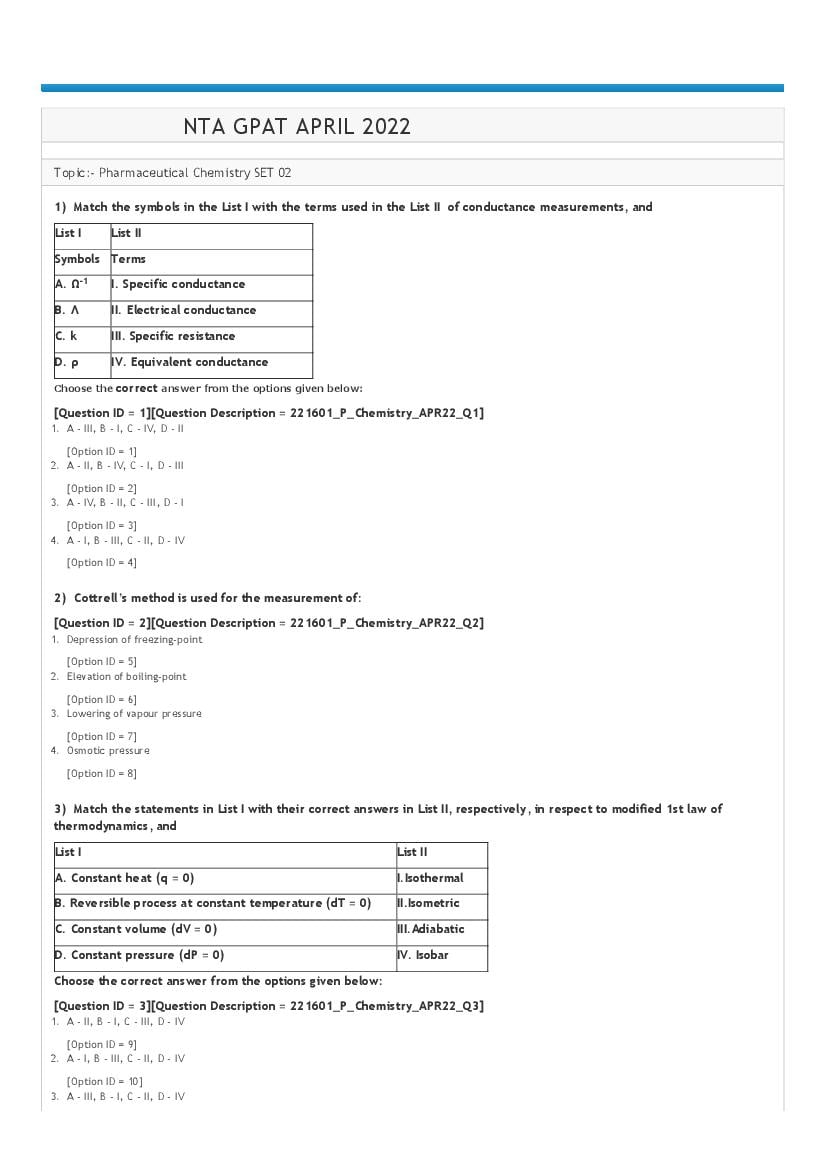
Page 1
Topic:‐ Pharmaceutical Chemistry SET 02
1) Match the symbols in the List I with the terms used in the List II of conductance measurements, and
List I List II
Symbols Terms
A. Ω‐1 I. Specific conductance
B. Λ II. Electrical conductance
C. k III. Specific resistance
D. ρ IV. Equivalent conductance
Choose the correct answer from the options given below:
[Question ID = 1][Question Description = 221601_P_Chemistry_APR22_Q1]
1. A ‐ III, B ‐ I, C ‐ IV, D ‐ II
[Option ID = 1]
2. A ‐ II, B ‐ IV, C ‐ I, D ‐ III
[Option ID = 2]
3. A ‐ IV, B ‐ II, C ‐ III, D ‐ I
[Option ID = 3]
4. A ‐ I, B ‐ III, C ‐ II, D ‐ IV
[Option ID = 4]
2) Cottrell’s method is used for the measurement of:
[Question ID = 2][Question Description = 221601_P_Chemistry_APR22_Q2]
1. Depression of freezing‐point
[Option ID = 5]
2. Elevation of boiling‐point
[Option ID = 6]
3. Lowering of vapour pressure
[Option ID = 7]
4. Osmotic pressure
[Option ID = 8]
3) Match the statements in List I with their correct answers in List II, respectively, in respect to modified 1st law of
thermodynamics, and
List I List II
A. Constant heat (q = 0) I.Isothermal
B. Reversible process at constant temperature (dT = 0) II.Isometric
C. Constant volume (dV = 0) III.Adiabatic
D. Constant pressure (dP = 0) IV. Isobar
Choose the correct answer from the options given below:
[Question ID = 3][Question Description = 221601_P_Chemistry_APR22_Q3]
1. A ‐ II, B ‐ I, C ‐ III, D ‐ IV
[Option ID = 9]
2. A ‐ I, B ‐ III, C ‐ II, D ‐ IV
[Option ID = 10]
3. A ‐ III, B ‐ I, C ‐ II, D ‐ IV
Page 2
4. A ‐ IV, B ‐ I, C ‐ II, D ‐ III
[Option ID = 12]
4) Boric acid with molecular weight 61.83 was partitioned between water and amyl alcohol at 25 °C. The amount of boric
acid was determined to be 0.24 g in 250 ml of amyl alcohol and 0.32 g in 100 ml water. The partition coefficient of boric
acid between water and amyl alcohol, when calculated at molar concentration for each of the solution, is:
[Question ID = 4][Question Description = 221601_P_Chemistry_APR22_Q4]
1. 1.33
[Option ID = 13]
2. 0.75
[Option ID = 14]
3. 0.30
[Option ID = 15]
4. 3.33
[Option ID = 16]
5) Drugs ‘A’, ‘B’ and ‘C’ follow zero order, first order and second order degradation kinetics, respectively, but have the
same rate constant. Which of the following statement is true in this respect:
[Question ID = 5][Question Description = 221601_P_Chemistry_APR22_Q5]
1. Drug ‘A’ will be the first to degrade by 50%
[Option ID = 17]
2. Drug ‘B’ will be the first to degrade by 50%
[Option ID = 18]
3. Drug ‘C’ will be the first to degrade by 50%
[Option ID = 19]
4. Drugs ‘B’ and ‘C’ will degrade by 50% at the same time
[Option ID = 20]
6) Heme is ________ .
[Question ID = 6][Question Description = 221601_P_Chemistry_APR22_Q6]
1. iron containing tetrapyrrole
[Option ID = 21]
2. iron containing polypeptide
[Option ID = 22]
3. copper or magnesium containing tetrapyrrole
[Option ID = 23]
4. iron containing imidazole
[Option ID = 24]
7) All enzymes accelerate the reaction rates by ______________ .
[Question ID = 7][Question Description = 221601_P_Chemistry_APR22_Q7]
1. lowering activation energy barrier (ΔGf) for a reaction
[Option ID = 25]
2. denaturing the substate
[Option ID = 26]
3. increasing the temperature
[Option ID = 27]
4. changing the pH
[Option ID = 28]
8) Citric acid cycle is the final pathway during the oxidation of _______ .
[Question ID = 8][Question Description = 221601_P_Chemistry_APR22_Q8]
1. Carbohydrates
[Option ID = 29]
Page 3
[Option ID = 30]
3. Proteins
[Option ID = 31]
4. All of these
[Option ID = 32]
9) Which one of the following is NOT a phospholipid?
[Question ID = 9][Question Description = 221601_P_Chemistry_APR22_Q9]
1. Sphingomyelin
[Option ID = 33]
2. Lysolecithin
[Option ID = 34]
3. Cardiolipin
[Option ID = 35]
4. Galactosylceramide
[Option ID = 36]
10) Given below are the two statements
Statement I: Glucose‐6‐phosphate can be formed from glucose, but not from
glycogen.
Statement II: Glucose‐1‐phosphate may be hydrolyzed to yield free glucose in
liver.
Choose the most appropriate answer from the options given below:
[Question ID = 10][Question Description = 221601_P_Chemistry_APR22_Q10]
1. Both Statement I and Statement II are correct
[Option ID = 37]
2. Both Statement I and Statement II are incorrect
[Option ID = 38]
3. Statement I is correct but Statement II is incorrect
[Option ID = 39]
4. Statement I is incorrect but Statement II is correct
[Option ID = 40]
11) Optically active mandelic acid can be synthesized from benzaldehyde in the presence of the enzyme:
[Question ID = 11][Question Description = 221601_P_Chemistry_APR22_Q11]
1. Invertin
[Option ID = 41]
2. Myrosin
[Option ID = 42]
3. Emulsin
[Option ID = 43]
4. Zymase
[Option ID = 44]
12) Isobutane upon bromination under the influence of ultraviolet light at 127 °C affords the following major product:
[Question ID = 12][Question Description = 221601_P_Chemistry_APR22_Q12]
1. N‐Butyl bromide
[Option ID = 45]
2. Isobutyl bromide
[Option ID = 46]
3. sec‐Butyl bromide
[Option ID = 47]
Page 4
[Option ID = 48]
13) Identify the functional groups from the below mentioned options that lead to weakening of benzoic acid:
A. –OH
B. –Cl
C. –NH2
D. –NO2
[Question ID = 13][Question Description = 221601_P_Chemistry_APR22_Q13]
1. A and B
[Option ID = 49]
2. A and C
[Option ID = 50]
3. B and C
[Option ID = 51]
4. A and D
[Option ID = 52]
14) Phenol upon treatment with bromine in the presence of carbondisulphide at 0 °C yields:
[Question ID = 14][Question Description = 221601_P_Chemistry_APR22_Q14]
1. 4‐Bromophenol
[Option ID = 53]
2. 2‐Bromophenol
[Option ID = 54]
3. 2,4‐Dibromophenol
[Option ID = 55]
4. 2,4,6‐Triibromophenol
[Option ID = 56]
15) In the determination of configuration of glucose, Fischer subjected (‐) arabinose to Ruff’s degradation. The four‐carbon
sugar obtained by the degradation process was:
[Question ID = 15][Question Description = 221601_P_Chemistry_APR22_Q15]
1. (‐) Threose
[Option ID = 57]
2. (+) Threose
[Option ID = 58]
3. (‐) Erythrose
[Option ID = 59]
4. (+) Erythrose
[Option ID = 60]
16) Insertion of a oxygen in a carbonyl compound to form an ester is known as:
[Question ID = 16][Question Description = 221601_P_Chemistry_APR22_Q16]
1. Baeyer Villiger oxidation
[Option ID = 61]
2. Sharpless epoxidation
[Option ID = 62]
3. Prevost oxidation
[Option ID = 63]
4. Lossen rearrangement
[Option ID = 64]
17) Controlled alkylation of a ketone via an enamine intermediate is named as:
Page 5
1. Mannich reaction
[Option ID = 65]
2. Robinson annulation
[Option ID = 66]
3. Stork reaction
[Option ID = 67]
4. Bamford Stevens reaction
[Option ID = 68]
18) Among the following organic compounds, the one that is non‐aromatic is:
[Question ID = 18][Question Description = 221601_P_Chemistry_APR22_Q18]
1.
[Option ID = 69]
2.
[Option ID = 70]
3.
[Option ID = 71]
4.
[Option ID = 72]
19)
The major product formed in the above reaction is:
[Question ID = 19][Question Description = 221601_P_Chemistry_APR22_Q19]
1.
[Option ID = 73]
2.
[Option ID = 74]
3.
[Option ID = 75]
4.
[Option ID = 76]
20)
Page 6
[Question ID = 20][Question Description = 221601_P_Chemistry_APR22_Q20]
1.
[Option ID = 77]
2.
[Option ID = 78]
3.
[Option ID = 79]
4.
[Option ID = 80]
21)
The set of specific reagents used in the above‐mentioned synthesis of m‐(n‐Butyl)toluene from n‐propyl m‐tolyl ketone is:
[Question ID = 21][Question Description = 221601_P_Chemistry_APR22_Q21]
1. Zn(Hg), HCl
[Option ID = 81]
2. NaBH4, CH3OH
[Option ID = 82]
3. NH2NH2, NaOH
[Option ID = 83]
4. SnCl2, CH3OH
[Option ID = 84]
22)
The major product formed in the above‐given Knorr synthesis is:
[Question ID = 22][Question Description = 221601_P_Chemistry_APR22_Q22]
1.
[Option ID = 85]
2.
[Option ID = 86]
Page 7
[Option ID = 87]
4.
[Option ID = 88]
23) Identify the product formed when 2‐cholestene is treated with Br2:
[Question ID = 23][Question Description = 221601_P_Chemistry_APR22_Q23]
1. 5β, 6α‐dibromocholestane
[Option ID = 89]
2. 2β, 3α‐dibromocholestane
[Option ID = 90]
3. 5α, 6β‐dibromocholestane
[Option ID = 91]
4. 5α, 6β‐dibromo 3β‐hydroxy cholestane
[Option ID = 92]
24)
Identify the major product formed in the above reaction from the four choices listed below:
[Question ID = 24][Question Description = 221601_P_Chemistry_APR22_Q24]
1. (S)‐(+)‐2‐methylbutanoic acid
[Option ID = 93]
2. (S)‐(‐)‐2‐methylbutanoic acid
[Option ID = 94]
3. (S)‐(+)‐2‐methylbutanol
[Option ID = 95]
4. (S)‐(‐)‐2‐methylbutanol
[Option ID = 96]
25) Identify the correct descending order of strength of nucleophilic solvents from the below‐given options:
[Question ID = 25][Question Description = 221601_P_Chemistry_APR22_Q25]
1. Trifluroethyl alcohol; methanol; formic acid; acetic acid
[Option ID = 97]
2. Formic acid; acetic acid; methanol; trifluroethyl alcohol
[Option ID = 98]
3. Methanol; formic acid; acetic acid; trifluroethyl alcohol
[Option ID = 99]
4. Methanol; acetic acid; formic acid; trifluoroethyl alcohol
[Option ID = 100]
26) Identify which statement among the following is true in case of E2 and SN2:
[Question ID = 26][Question Description = 221601_P_Chemistry_APR22_Q26]
1. Secondary substitution undergoes slow elimination and fast substitution
[Option ID = 101]
2. Primary substitution undergoes slow elimination and fast substitution
[Option ID = 102]
3. Tertiary substitution undergoes slow elimination and fast substitution
Page 8
4. Primary substitution does not undergo elimination and substitution reactions
[Option ID = 104]
27)
The above structure is of:
[Question ID = 27][Question Description = 221601_P_Chemistry_APR22_Q27]
1. Norephedrine
[Option ID = 105]
2. Pseudoephedrine
[Option ID = 106]
3. Ephedrine
[Option ID = 107]
4. Norpseudoephedrine
[Option ID = 108]
28) Ethylketazocine is a 6,7‐benzomorphan derivative with ________ receptor selectivity.
[Question ID = 28][Question Description = 221601_P_Chemistry_APR22_Q28]
1. Mu–opioid
[Option ID = 109]
2. Delta–opioid
[Option ID = 110]
3. Kappa–opioid
[Option ID = 111]
4. NOP
[Option ID = 112]
29) In the case of halogenation reaction of alkanes, abstract of primary hydrogen yields a primary radical, and abstract of
secondary hydrogen yields a secondary radical.
The above example is of:
[Question ID = 29][Question Description = 221601_P_Chemistry_APR22_Q29]
1. High reactivity and low selectivity
[Option ID = 113]
2. Low reactivity and high selectivity
[Option ID = 114]
3. High reactivity and high selectivity
[Option ID = 115]
4. Low reactivity and low selectivity
[Option ID = 116]
30) When alkenes are epoxidised with optically active peracids, optically active epoxides are formed. Under the same
defined conditions, epoxidation of E‐but‐2‐ene by peroxycamphoric acid affords unequal yields of enantiomeric epoxides.
However, a similar epoxidation of Z‐but‐2‐ene can only afford ________ .
[Question ID = 30][Question Description = 221601_P_Chemistry_APR22_Q30]
1. Z‐epoxide
[Option ID = 117]
2. Meso epoxide
Page 9
3. E‐epoxide
[Option ID = 119]
4. None of these
[Option ID = 120]
31) When 100 mL of 0.1 M sodium hydroxide solution is added to 100 mL of 0.1 M acetic acid (Ka = 1.82 x 10‐5), pH of the
solution will be _____ .
[Question ID = 31][Question Description = 221601_P_Chemistry_APR22_Q31]
1. 8.3
[Option ID = 121]
2. 7.0
[Option ID = 122]
3. 3.8
[Option ID = 123]
4. 8.7
[Option ID = 124]
32) Match List I with List II, and
List I List II
Volumetric Solution Primary Standard
A. 0.1 M Iodine I. Potassium iodate
B. 0.1M Sodium thiosulphate II. Potassium bromate
C. 0.1M Sodium hydroxide III. Potassium hydrogen phthalate
D. 0.1M Perchloric acid IV. Arsenic trioxide
V. Potassium hydrogen phthalate
Choose the correct answer from the options given below:
[Question ID = 32][Question Description = 221601_P_Chemistry_APR22_Q32]
1. A ‐ IV, B ‐ II, C ‐ III, D ‐ V
[Option ID = 125]
2. A ‐ IV, B ‐ II, C ‐ III, D ‐ I
[Option ID = 126]
3. A ‐ I, B ‐ IV, C ‐ II, D ‐ III
[Option ID = 127]
4. A ‐ III, B ‐ II, C ‐ IV, D ‐ I
[Option ID = 128]
33) Potential at the equivalence point for a redox reaction
aOX1 + bRED2 bOX2 + aRED1
is given by the equation:
[Question ID = 33][Question Description = 221601_P_Chemistry_APR22_Q33]
1. E = (bE10 + aE20)/(a+b)
[Option ID = 129]
2. E = E0 + (0.0592/n) X log Q
[Option ID = 130]
3. E = E0 + (0.0592/n) X log (Red/Ox)
[Option ID = 131]
4. E = E10 + E20/2
[Option ID = 132]
Page 10
[Question ID = 34][Question Description = 221601_P_Chemistry_APR22_Q34]
1. 30
[Option ID = 133]
2. 15
[Option ID = 134]
3. 6
[Option ID = 135]
4. 0
[Option ID = 136]
35) Back‐titration method is used for
A. Volatile substances
B. Insoluble substances
C. Substances for which a quantitative reaction proceeds rapidly only in the presence of excess of the
reagent
D. Substances that require heating with a volumetric reagent during the determination, in which
decomposition or loss of the reactants would occur in the process
Choose the correct answer from the options given below:
[Question ID = 35][Question Description = 221601_P_Chemistry_APR22_Q35]
1. A only
[Option ID = 137]
2. A and C
[Option ID = 138]
3. A, B and D
[Option ID = 139]
4. A, B, C and D
[Option ID = 140]
36) The titration of a strong acid with a strong base is represented by plot _____ .
[Question ID = 36][Question Description = 221601_P_Chemistry_APR22_Q36]
1.
[Option ID = 141]
2.
[Option ID = 142]
3.
[Option ID = 143]
Page 11
[Option ID = 144]
37) According to Mohr method, the silver nitrate solution can be standardized against primary‐ standard grade:
[Question ID = 37][Question Description = 221601_P_Chemistry_APR22_Q37]
1. Sodium carbonate
[Option ID = 145]
2. Sodium chloride
[Option ID = 146]
3. Sodium hydrogen carbonate
[Option ID = 147]
4. Sodium metabisulfite
[Option ID = 148]
38) According to the n + 1 rule, what would be the multiplicities of the signals in the proton NMR spectrum of 1,1‐
dibromoethane?
[Question ID = 38][Question Description = 221601_P_Chemistry_APR22_Q38]
1. Triplet and doublet
[Option ID = 149]
2. Quartet and doublet
[Option ID = 150]
3. Triplet and quartet
[Option ID = 151]
4. Triplet and triplet
[Option ID = 152]
Topic:‐ Pharmaceutics SET 02
1) Which of the following is an example of a thermosetting plastic material?
[Question ID = 39][Question Description = 221601_Pharmaceutics_APR22_Q1]
1. PVC
[Option ID = 153]
2. Polyester
[Option ID = 154]
3. Polypropylene
[Option ID = 155]
4. Urethanes
[Option ID = 156]
2) Which of the following vehicles (not required to be sterile, but must be pyrogen free) is intended to be used in the
manufacture of injectable products to be sterilized after preparation?
[Question ID = 40][Question Description = 221601_Pharmaceutics_APR22_Q2]
1. Purified Water
[Option ID = 157]
2. Water for Injection USP
[Option ID = 158]
3. Sterile Water for Injection USP
[Option ID = 159]
4. Bacteriostatic Water for Injection USP
[Option ID = 160]
Page 12
preservative and perfume, would be commonly known as:
[Question ID = 41][Question Description = 221601_Pharmaceutics_APR22_Q3]
1. Cold cream
[Option ID = 161]
2. Vanishing cream
[Option ID = 162]
3. Foundation cream
[Option ID = 163]
4. All purpose cream
[Option ID = 164]
4) Which of the following DRYERS is a "static bed dryer"?
[Question ID = 42][Question Description = 221601_Pharmaceutics_APR22_Q4]
1. Freeze dryer
[Option ID = 165]
2. Fluid bed dryer
[Option ID = 166]
3. Spray dryer
[Option ID = 167]
4. Flash dryer
[Option ID = 168]
5) Stability index, determined for evaluating the stability of oil–water viscous emulsions, based on
electric conductivity changes during non‐destructive short heating–cooling–heating cycles,
A. is defined as Δ/h, where h is the change in the conductivity between 35°C and 45°C and Δ is
the conductivity interval within the two heating curves at 35°C
B. indicates the relative change in enthalpy between two cycles
C. is defined as 2Δ/h, where h is the change in the conductivity between 35°C and 45°C and Δ is
the conductivity interval within the two heating curves at 35°C
D. indicates the relative change in conductivity between two cycles
Choose the correct answer from the options given below:
[Question ID = 43][Question Description = 221601_Pharmaceutics_APR22_Q5]
1. A and B only
[Option ID = 169]
2. B and C only
[Option ID = 170]
3. C and D only
[Option ID = 171]
4. D and A only
[Option ID = 172]
6) Given below are two statements, one is labelled as Assertion A and the other is labelled as
Reason R
Assertion A: The pressure filling method for filling pharmaceutical aerosol is usually preferred
over cold filling method
Reason R: Because with pressure filling method high production speed can be achieved and less
propellant is lost.
In light of the above statements, choose the correct answer from the options given below
Page 13
1. Both A and R are true and R is the correct explanation of A
[Option ID = 173]
2. Both A and R are true but R is NOT the correct explanation of A
[Option ID = 174]
3. A is true but R is false
[Option ID = 175]
4. A is false but R is true
[Option ID = 176]
7) In the process of extraction, if maceration is accomplished by heating the drug and solvent in a
close vessel, then this modification is known as _______
[Question ID = 45][Question Description = 221601_Pharmaceutics_APR22_Q7]
1. Digestion
[Option ID = 177]
2. Refining
[Option ID = 178]
3. Expression
[Option ID = 179]
4. Rendering
[Option ID = 180]
8) ___________ is the practice of pharmacy in private and government‐owned hospitals, health
maintenance organizations (HMOs), clinics, walk‐in health centers, and nursing homes.
[Question ID = 46][Question Description = 221601_Pharmaceutics_APR22_Q8]
1. Community pharmacy
[Option ID = 181]
2. Government service
[Option ID = 182]
3. Health‐systems pharmacy
[Option ID = 183]
4. Organizational management
[Option ID = 184]
9) Given below are two statements, one is labelled as Assertion A and the other is labelled as
Reason R
Assertion A: In the manufacturing of glycero‐gelatin suppositories, overfilling of mould is
necessary.
Reason R: Glycero‐gelatin bases contract very little on cooling and the excess cannot be neatly
removed.
In light of the above statements, choose the correct answer from the options given below
[Question ID = 47][Question Description = 221601_Pharmaceutics_APR22_Q9]
1. Both A and R are true and R is the correct explanation of A
[Option ID = 185]
2. Both A and R are true and R is the correct explanation of A
[Option ID = 186]
3. A is true but R is false
[Option ID = 187]
4. A is false but R is true
[Option ID = 188]
10) In the process of sugar coating, to prevent moisture penetration into the tablet core, which one of
Page 14
[Question ID = 48][Question Description = 221601_Pharmaceutics_APR22_Q10]
1. Seal Coating
[Option ID = 189]
2. Subcoating
[Option ID = 190]
3. Syrup Coating
[Option ID = 191]
4. Polishing
[Option ID = 192]
11) Given below are two statements, one is labelled as Assertion A and the other is labelled as
Reason R
Assertion A: During the process of decompression in tablet manufacturing, expansion occurs in
some tablet.
Reason R: Expansion occurs in some tablet because of Plastic deformation that has occurred
during compression process.
In light of the above statements, choose the correct answer from the options given below
[Question ID = 49][Question Description = 221601_Pharmaceutics_APR22_Q11]
1. Both A and R are true and R is the correct explanation of A
[Option ID = 193]
2. Both A and R are true but R is NOT the correct explanation of A
[Option ID = 194]
3. A is true but R is false
[Option ID = 195]
4. A is false but R is true
[Option ID = 196]
12) Statement I: The problem of declining potency in an unstable preparation can be ameliorated by
the addition of an excess or overage of the active ingredient.
Statement II: Overages, are added to pharmaceutical formulations to keep the content of the
active ingredient well above the limit, compatible with therapeutic requirements, for a
predetermined period of time.
[Question ID = 50][Question Description = 221601_Pharmaceutics_APR22_Q12]
1. Both Statement I and Statement II are correct
[Option ID = 197]
2. Both Statement I and Statement II are incorrect
[Option ID = 198]
3. Statement I is correct but Statement II is incorrect
[Option ID = 199]
4. Statement I is incorrect but Statement II is correct
[Option ID = 200]
13) In thermoplastic materials, which are used as a container/packaging material, additives like
polyethylene and polypropylene are used as ___________
[Question ID = 51][Question Description = 221601_Pharmaceutics_APR22_Q13]
1. Plasticizer
[Option ID = 201]
2. Stabilizers
[Option ID = 202]
3. Surface treatment film
Page 15
4. Slip agent
[Option ID = 204]
14) Which one of the following is a rate equation for second order bimolecular reaction if, a and b
are the initial concentrations of A and B, respectively, and x is the concentration of each species
reacting in time t and k is second‐order reaction
[Question ID = 52][Question Description = 221601_Pharmaceutics_APR22_Q14]
1. k = [2.303/ t(a − b)] x [log a(a − x) / b(b − x) ]
[Option ID = 205]
2. k = [2.303/ t(a − b)] x [log b(a − x) / a(b − x) ]
[Option ID = 206]
3. k = [2.303/ t(a − b)] / [log b(a − x) / a(b − x) ]
[Option ID = 207]
4. k = [2.303/ t(a − b)] / [log a(a − x) / b(b − x) ]
[Option ID = 208]
15) Which one of the following manufacturing facility may not be required for oral solid dosage
form?
[Question ID = 53][Question Description = 221601_Pharmaceutics_APR22_Q15]
1. Material Handling
[Option ID = 209]
2. Chemical weighing
[Option ID = 210]
3. Blending
[Option ID = 211]
4. Aspectic filling
[Option ID = 212]
16) In the process of adding lubricant to a granulation, the lubricant is divided finely by passing it
through 60‐100 mesh nylon cloth on to the granulation, in production this process is called as
________ the lubricant
[Question ID = 54][Question Description = 221601_Pharmaceutics_APR22_Q16]
1. Bolting
[Option ID = 213]
2. Mixing
[Option ID = 214]
3. Tumbling
[Option ID = 215]
4. Grinding
[Option ID = 216]
17) Which of the following is NOT a cause for the drug undergoing nonlinear pharmacokinetics
[Question ID = 55][Question Description = 221601_Pharmaceutics_APR22_Q17]
1. Enzyme inhibition
[Option ID = 217]
2. Enzyme induction
[Option ID = 218]
3. Saturation of carrier molecules
[Option ID = 219]
4. Saturation of plasma protein binding
[Option ID = 220]
Page 16
dissolution rate, may happen due to which one of the following reasons?
[Question ID = 56][Question Description = 221601_Pharmaceutics_APR22_Q18]
1. Addition of cyclodextrin
[Option ID = 221]
2. Addition of surfactant to increase the surface tension
[Option ID = 222]
3. Addition of hydrophilic diluent
[Option ID = 223]
4. Surface charges due to extreme particle size reduction
[Option ID = 224]
19) Oral efficacy of Sabin Polio Vaccine can be adequately explained by which of the following
processes of absorption?
[Question ID = 57][Question Description = 221601_Pharmaceutics_APR22_Q19]
1. Passive diffusion
[Option ID = 225]
2. Active transport
[Option ID = 226]
3. Ion ‐ pair transport
[Option ID = 227]
4. Pinocytosis
[Option ID = 228]
20) Which one of the following statement holds true for Passive Diffusion?
[Question ID = 58][Question Description = 221601_Pharmaceutics_APR22_Q20]
1. Greater the area and greater the thickness, faster is the diffusion
[Option ID = 229]
2. Rate of drug transfer is directly proportional to the concentration gradient between GI fluids and the blood compartment
[Option ID = 230]
3. Rate of transfer of ionised drug species is 3‐4 times the rate for unionised drug species
[Option ID = 231]
4. Greater the membrane/water partition coefficient of drug, slower is the absorption
[Option ID = 232]
21) The intracellular fluid volume including those of the blood cells is approximately
[Question ID = 59][Question Description = 221601_Pharmaceutics_APR22_Q21]
1. 15 litres
[Option ID = 233]
2. 20 litres
[Option ID = 234]
3. 27 litres
[Option ID = 235]
4. 35 litres
[Option ID = 236]
22) Match List I with List II
List I List II
A. When two dosage forms have equal tmax I. When their total body clearance is constant.
B. AUC values of the two analogs can be compared to measure
II. Absorption rate constants are equal
relative bioavailability.
Page 17
C. Urinary data is valid to measure bioavailability.
constant.
IV. Excretion of drug and/or metabolite is related to the
D. Cmax is proportional to the rate of absorption.
bioavailable dose.
Choose the correct answer from the options given below:
[Question ID = 60][Question Description = 221601_Pharmaceutics_APR22_Q22]
1. A ‐ II, B ‐I , C ‐IV‐ , D ‐ III
[Option ID = 237]
2. A ‐I , B ‐II , C ‐III , D ‐IV
[Option ID = 238]
3. A ‐I, B ‐IV, C ‐III, D ‐II
[Option ID = 239]
4. A ‐III , B ‐I , C ‐II , D ‐IV
[Option ID = 240]
23) Which of the following conjugation reactions DOES NOT REQUIRE reaction with an activated
conjugating agent?
[Question ID = 61][Question Description = 221601_Pharmaceutics_APR22_Q23]
1. Glucouronidation
[Option ID = 241]
2. Sulfation
[Option ID = 242]
3. Methylation
[Option ID = 243]
4. Glutathione conjugation
[Option ID = 244]
24) The below mentioned complex is not the type of inclusion compounds
[Question ID = 62][Question Description = 221601_Pharmaceutics_APR22_Q24]
1. Channel‐Lattice type
[Option ID = 245]
2. Quinhydrone complex
[Option ID = 246]
3. Layer type
[Option ID = 247]
4. Clathrates
[Option ID = 248]
25) In human body ‐‐‐‐‐ system operates to maintain pH of blood plasma.
[Question ID = 63][Question Description = 221601_Pharmaceutics_APR22_Q25]
1. The acetate buffer
[Option ID = 249]
2. The lysis buffer
[Option ID = 250]
3. The potassium citrate
[Option ID = 251]
4. The carbonic acid
[Option ID = 252]
26) Which of the following is most appropriate to crystalline solid?
[Question ID = 64][Question Description = 221601_Pharmaceutics_APR22_Q26]
1. Give diffraction bands
[Option ID = 253]
Page 18
[Option ID = 254]
3. Sharp melting point
[Option ID = 255]
4. All of these
[Option ID = 256]
27) The temperature at which the solubility of the surfactant is equal to the CMC, is called as
[Question ID = 65][Question Description = 221601_Pharmaceutics_APR22_Q27]
1. Critical micellar concentration
[Option ID = 257]
2. Kraft point
[Option ID = 258]
3. Cloud point
[Option ID = 259]
4. Solubilization
[Option ID = 260]
28) Match List I with List II
List I List II
Buffers pH Value
A. HCl and KCl I. 8 to 10
B. HCl and Potassium Hydrogen Phthalate II. 2.2 to 4.0
C. NaOH and Potassium Hydrogen Phthalate III. 1.2 to 2.2
D. H3BO3, NaOH, and KCl IV. 4.2 to 5.8
Choose the correct answer from the options given below:
[Question ID = 66][Question Description = 221601_Pharmaceutics_APR22_Q28]
1. A ‐II , B ‐III , C ‐IV , D ‐I
[Option ID = 261]
2. A ‐III , B ‐II , C ‐IV , D ‐I
[Option ID = 262]
3. A ‐II , B ‐IV , C ‐I , D ‐II
[Option ID = 263]
4. A ‐III , B ‐IV , C ‐II , D ‐I
[Option ID = 264]
29) Select correct option for miscible solvents?
A. Water and alcohol
B. Acetone and alcohol
C. Water and benzene
D. Carbon tetrachloride and benzene
Choose the correct answer from the options given below:
[Question ID = 67][Question Description = 221601_Pharmaceutics_APR22_Q29]
1. A and B only
[Option ID = 265]
2. A, B and C only
[Option ID = 266]
3. A, B and D only
[Option ID = 267]
Page 19
[Option ID = 268]
30) Which of the following instrument is used to determine surface area and pore structure of
pharmaceutical powders?
[Question ID = 68][Question Description = 221601_Pharmaceutics_APR22_Q30]
1. Coulter counter
[Option ID = 269]
2. Andrerson apparatus
[Option ID = 270]
3. Quantasorb
[Option ID = 271]
4. Optical microscopy
[Option ID = 272]
31) Which of the following materials are specified as a suitable diluent for powdered opium
A. Powdered grass
B. Powdered cocoa husk
C. Lactose colored with burnt sugar
D. Powdered digitalis
Choose the correct answer from the options given below:
[Question ID = 69][Question Description = 221601_Pharmaceutics_APR22_Q31]
1. A and D only
[Option ID = 273]
2. B and D only
[Option ID = 274]
3. B and C only
[Option ID = 275]
4. A and C only
[Option ID = 276]
32) Prescription price consists of
[Question ID = 70][Question Description = 221601_Pharmaceutics_APR22_Q32]
1. Cost of ingredients only
[Option ID = 277]
2. Cost of professional fee only
[Option ID = 278]
3. Cost of ingredients and cost of dispensing only
[Option ID = 279]
4. Cost of ingredients and professional fee only
[Option ID = 280]
33) Hospital Formulary contains information on the following parameters except
[Question ID = 71][Question Description = 221601_Pharmaceutics_APR22_Q33]
1. Composition
[Option ID = 281]
2. Indication
[Option ID = 282]
3. Pricing
[Option ID = 283]
4. Dosage and administration
[Option ID = 284]
Page 20
[Question ID = 72][Question Description = 221601_Pharmaceutics_APR22_Q34]
1. Reducing agents often cause fading of dyes
[Option ID = 285]
2. Anionic dyes are the most stable at acid pHs
[Option ID = 286]
3. Basic dyes are not sensitive to alkalies
[Option ID = 287]
4. Cationic dyes may be precipitated by soaps and clays
[Option ID = 288]
35) Which of the following statements are true about Prions
A. Prion is a type of infectious protein
B. Prions contain single stranded RNA
C. Creutzfeldt‐Jakob disease (CJD) is not caused by Prion
D. Prions are even more difficult to destroy than bacterial spores
Choose the correct answer from the options given below:
[Question ID = 73][Question Description = 221601_Pharmaceutics_APR22_Q35]
1. A, B and D only
[Option ID = 289]
2. A only
[Option ID = 290]
3. A and D only
[Option ID = 291]
4. A, C and D only
[Option ID = 292]
36) Which of the following statements are true
A. Bacteria are categorized underneath the Kingdom Monera.
B. Protista are unicellular and eukaryotic organisms.
C. Yeasts and molds are under kingdom Fungi
D. Multinucleated higher fungi are under Animalia
Choose the correct answer from the options given below:
[Question ID = 74][Question Description = 221601_Pharmaceutics_APR22_Q36]
1. A, B and C only
[Option ID = 293]
2. B, C and D only
[Option ID = 294]
3. A and B only
[Option ID = 295]
4. C and D only
[Option ID = 296]
37) Match List I with List II
List I List II
Classification of Bacteria Example
A. Gram positive spherical shaped nonmotile bacteria I. Clostridium tetani
B. Gram positive sporulating obligate anaerobic bacteriaII. Bacillus anthracis
C. Gram positive rod shaped nonsporulating bacteria III. Streptococcus sp..
Page 21
V. E.coli
Choose the correct answer from the options given below:
[Question ID = 75][Question Description = 221601_Pharmaceutics_APR22_Q37]
1. A ‐III , B ‐IV , C ‐I , D ‐ V
[Option ID = 297]
2. A IV, B ‐I , C ‐II , D ‐ III
[Option ID = 298]
3. A ‐III , B ‐ I, C ‐IV , D ‐II
[Option ID = 299]
4. A ‐I , B ‐IV , C ‐II , D ‐III
[Option ID = 300]
38) Match List I with List II
List I List II
Antigen‐ antibody reaction types Application
A. Precipitin test I. Screening for Rubella and Type2 Herpes viruses
B. Agglutination (Haemagglutination)II. Streptococcal differentiation into serological groups
C. Complement Fixation reaction III. Serological diagnosis of influenza & mumps viruses
D. ELISA IV. Treponema pallidum identification
V. Mycobacterium identification
Choose the correct answer from the options given below:
[Question ID = 76][Question Description = 221601_Pharmaceutics_APR22_Q38]
1. A ‐III , B ‐V , C ‐II, D ‐I
[Option ID = 301]
2. A ‐II , B ‐IV , C ‐I , D ‐III
[Option ID = 302]
3. A ‐IV , B ‐II , C ‐III , D ‐I
[Option ID = 303]
4. A ‐I , B ‐III , C ‐II , D ‐IV
[Option ID = 304]
Topic:‐ Pharmacognosy SET 02
1) HPTLC analysis is useful for following types of analysis of herbal drugs
A. Quantitative estimation of marker compound
B. Authentication of extracts
C. Detection of pesticides
D. Standardization of herbal drugs
Choose the correct answer from the options given below:
[Question ID = 77][Question Description = 221601_Pharmacognosy_APR22_Q1]
1. A, B and D only
[Option ID = 305]
2. D only
[Option ID = 306]
3. A and D only
[Option ID = 307]
4. A, B, C and D
[Option ID = 308]
Page 22
[Question ID = 78][Question Description = 221601_Pharmacognosy_APR22_Q2]
1. Tyrosine
[Option ID = 309]
2. Tryptophan
[Option ID = 310]
3. Ornithine
[Option ID = 311]
4. Methidine
[Option ID = 312]
3) Tropane nucleus is combination of
[Question ID = 79][Question Description = 221601_Pharmacognosy_APR22_Q3]
1. Pyrolidine & piperidine
[Option ID = 313]
2. Pyrolidine & pyridine
[Option ID = 314]
3. Pyrolidine & oscine
[Option ID = 315]
4. Piperidine & oscine
[Option ID = 316]
4) Type of alkaloids present in Colchicum
[Question ID = 80][Question Description = 221601_Pharmacognosy_APR22_Q4]
1. Tropane alkaloids
[Option ID = 317]
2. Steroidal glycoalkaloids
[Option ID = 318]
3. Amino alkaloids
[Option ID = 319]
4. Quinoline alkaloids
[Option ID = 320]
5) One of the following is an example of chemical method of evaluation
[Question ID = 81][Question Description = 221601_Pharmacognosy_APR22_Q5]
1. Determination of volatile oil
[Option ID = 321]
2. Determination of refractive index
[Option ID = 322]
3. Detection of alkaloids
[Option ID = 323]
4. Determination of vascular bundles
[Option ID = 324]
6) Rancidity in the fixed oils generally show ‐
[Question ID = 82][Question Description = 221601_Pharmacognosy_APR22_Q6]
1. Higher Iodine value as compared to the standards
[Option ID = 325]
2. Higher Acid value as compared to the standards
[Option ID = 326]
3. Higher Peroxide value as compared to the standards
[Option ID = 327]
4. Higher level of Unsaponifiable matter
[Option ID = 328]
Page 23
B. Rutin is a flavonol glycosides
C. Rutin is used in Capillary bleeding
D. Rutin is used as Vitamin P
Which of the above are true for Rutin?
[Question ID = 83][Question Description = 221601_Pharmacognosy_APR22_Q7]
1. A and B only
[Option ID = 329]
2. A, B and C only
[Option ID = 330]
3. A, B and D only
[Option ID = 331]
4. All of these
[Option ID = 332]
8) ‘Star spots’ present in the transverse section of decorticated Rhubarb rhizomes are‐
[Question ID = 84][Question Description = 221601_Pharmacognosy_APR22_Q8]
1. Lignified cells
[Option ID = 333]
2. Pericyclic fibres
[Option ID = 334]
3. Concentric vascular bundles
[Option ID = 335]
4. Crystals of calcium oxalate
[Option ID = 336]
9) The best quality of the Lemon oil is obtained by using‐
[Question ID = 85][Question Description = 221601_Pharmacognosy_APR22_Q9]
1. Hydrodistillation method
[Option ID = 337]
2. Extraction method
[Option ID = 338]
3. Enfleurage method
[Option ID = 339]
4. Hand press method
[Option ID = 340]
10) Dioscin, a steroidal saponin glycoside of Dioscorea tubers after hydrolysis gives‐
[Question ID = 86][Question Description = 221601_Pharmacognosy_APR22_Q10]
1. Diosgenin + 3 Glucose
[Option ID = 341]
2. Diosgenin + 3 Rhamnose
[Option ID = 342]
3. Diosgenin + 2 Glucose + 1 Rhamnose
[Option ID = 343]
4. Diosgenin + 1 Glucose + 2 Rhamnose
[Option ID = 344]
Topic:‐ Pharmacology SET 02
1) Match List I with List II Match the following drugs with their classes.
List I List II
Page 24
A. Anakinra I. IL‐2 receptor antagonist
B. Basiliximab II. TNFα inhibitors
C. Infliximab III. Calcineurin inhibitors
D. Tacrolimus IV. mTOR inhibitors
V. IL‐1 receptor antagonist
More text goes here.
Choose the correct answer from the options given below:
[Question ID = 87][Question Description = 221601_Pharmacolgy_APR22_Q1]
1. A ‐III , B ‐II , C ‐I , D ‐ IV
[Option ID = 345]
2. A ‐V, B ‐II , C ‐III, D ‐ I
[Option ID = 346]
3. A ‐I , B ‐III , C ‐V , D ‐II
[Option ID = 347]
4. A ‐V , B ‐I , C ‐II , D ‐ III
[Option ID = 348]
2) Match List I with List II Match the following with their mechanism of action
List I List II
Mechanism of action Drugs
A. DPP4 inhibitors I. Metformin
B. KATP Channel blocker II. Pioglitazone
C. PPARγ activator III. Glimepiride
D. AMPK Activator IV. Teneligliptin
V. α glucosidase inhibitors
Choose the correct answer from the options given below:
[Question ID = 88][Question Description = 221601_Pharmacolgy_APR22_Q2]
1. A ‐II , B ‐V , C ‐III , D ‐IV
[Option ID = 349]
2. A ‐ II, B ‐ III, C ‐IV , D ‐I
[Option ID = 350]
3. A ‐IV , B ‐III , C ‐II , D ‐I
[Option ID = 351]
4. A ‐IV, B ‐ I, C ‐V , D ‐III
[Option ID = 352]
3) Reason for the combination of Diphenoxylate (2.5 mg) + Atropine (0.025 mg) is to
[Question ID = 89][Question Description = 221601_Pharmacolgy_APR22_Q3]
1. Inhibits the side effects of Diphenoxylate
[Option ID = 353]
2. Discourage abuse of Diphenoxylate
[Option ID = 354]
3. Augment the anti‐motility action of Diphenoxylate
[Option ID = 355]
4. Suppress gastroenteritis‐related vomiting
[Option ID = 356]
4) Regarding Bromocriptine, which of the following statement is TRUE‐
It is a relatively selective dopamine D2 agonist with prominent action
A. on pituitary lactotrophs (inhibit prolactin release)
B. in striatum (antiparkinsonian)
C. in CTZ (antiemetic)
Page 25
Choose the correct answer from the options given below:
[Question ID = 90][Question Description = 221601_Pharmacolgy_APR22_Q4]
1. A, B and D only
[Option ID = 357]
2. A, B and C only
[Option ID = 358]
3. B and D only
[Option ID = 359]
4. A and B only
[Option ID = 360]
5) The ‘Up‐and‐Down’ method for a projected LD50 determination is described in the…..
[Question ID = 91][Question Description = 221601_Pharmacolgy_APR22_Q5]
1. OECD Guideline 401
[Option ID = 361]
2. OECD Guideline 420
[Option ID = 362]
3. OECD Guideline 423
[Option ID = 363]
4. OECD Guideline 425
[Option ID = 364]
6) Match List I with List II
List I List II
(Poisoning) (Treatment)
1. Warfarin P. Pralidoxime
2. Carbon monoxide Q. Oxygen
3. Cyanide R. Vitamin K
4. Nitrites S. Dicobalt edatate
5. Organophosphates T. Methylene blue
Choose the correct answer from the options given below:More text goes here.
[Question ID = 92][Question Description = 221601_Pharmacolgy_APR22_Q6]
1. 1:R, 2:Q, 3: S, 4: T, 5: P
[Option ID = 365]
2. 1:P, 2:Q, 3: T, 4: S, 5: R
[Option ID = 366]
3. 1:Q, 2:S, 3:P, 4:R, 5: T
[Option ID = 367]
4. 1:T, 2:Q, 3: R, 4:P, 5:S
[Option ID = 368]
7) A patient with pheochromcytoma is undergoing surgery and has not been administered with alpha receptor blocker. If he
is administered with intravenous propranolol, then which of the following effects will be evident?
[Question ID = 93][Question Description = 221601_Pharmacolgy_APR22_Q7]
1. There will be a rise in the blood pressure
[Option ID = 369]
2. There will be a fall in the blood pressure
[Option ID = 370]
3. The blood pressure will remain unchanged
[Option ID = 371]
Page 26
[Option ID = 372]
8) A neonate suffering from icterus is intravenously administered with phenobarbital. The justification for this therapy is:
[Question ID = 94][Question Description = 221601_Pharmacolgy_APR22_Q8]
1. Phenobarbital is a short acting barbiturate and hence safe to induce sleep in neonates
[Option ID = 373]
2. Phenobarbital suppresses the bilirubin synthesis in neonates
[Option ID = 374]
3. Phenobarbital suppresses hepatic glucuronyl transferase and increases clearance of bilirubin
[Option ID = 375]
4. Phenoarbital induces hepatic glucuronyl transferase and increases clearance of bilirubin
[Option ID = 376]
9) Tendon rupture or tendonitis of Achilles tendon is an adverse reaction of
[Question ID = 95][Question Description = 221601_Pharmacolgy_APR22_Q9]
1. Fluoroquinolones
[Option ID = 377]
2. Tetracyclines
[Option ID = 378]
3. Cephalosporins
[Option ID = 379]
4. Aminoglycosides
[Option ID = 380]
10) The quadruple therapy of Helicobacter pylori infection includes
[Question ID = 96][Question Description = 221601_Pharmacolgy_APR22_Q10]
1. Bismuth subsalicylate, metronidazole, tetracycline and a proton pump inhibitor
[Option ID = 381]
2. Streptomycin, metronidazole, tetracycline and a proton pump inhibitor
[Option ID = 382]
3. Sulfasalazine, metronidazole, tetracycline and a proton pump inhibitor
[Option ID = 383]
4. Bismuth subsalicylate, metronidazole, azithromycin and a proton pump inhibitor
[Option ID = 384]
11) Which of the following statement/s are correct regarding the alkylating agents as anticancer agents:
A. They get converted into highly nucleophilic anions and bind to the nitrogen atom of guanine intercalating the DNA
strands
B. Cyclophosphamide and busulfan belong to this class
C. They inhibit the DNA synthesis by inhibiting the DNA polymerase enzyme
D. They inhibit the DNA supercoiling by irreversibly inhibiting the DNA topoisomerase enzyme
Choose the correct answer from the options given below:
[Question ID = 97][Question Description = 221601_Pharmacolgy_APR22_Q11]
1. A, B and D only are correct
[Option ID = 385]
2. Only B is correct
[Option ID = 386]
3. Only A and B are correct
[Option ID = 387]
4. All A, B, C and D are correct
[Option ID = 388]
Page 27
[Question ID = 98][Question Description = 221601_Pharmacolgy_APR22_Q12]
1. Two isoforms
[Option ID = 389]
2. Three isoforms
[Option ID = 390]
3. Four isoforms
[Option ID = 391]
4. Five isoforms
[Option ID = 392]
13) Which of the following is/are not true about Parkinson’s disease?
A. Parkinson’s disease is caused by the degeneration of the substantia nigra in the midbrain.
B. Parkinson's disease is caused by the degenerative loss of nigrostriatal dopaminergic neurons.
C. Bradykinesia, rigidity and tremor are the main symptoms in Parkinson’s disease.
D. Parkinson's disease is caused by the degenerative loss of nigrostriatal cholinergic neurons.
Choose the correct answer from the options given below:
[Question ID = 99][Question Description = 221601_Pharmacolgy_APR22_Q13]
1. A, B and D only
[Option ID = 393]
2. A, B and D only
[Option ID = 394]
3. C only
[Option ID = 395]
4. D only
[Option ID = 396]
14) Which statements are not true about the grafts?
A. Isografts are grafts in which the donor and recipient is the same individual.
B. Autografts are grafts between the donor and recipient of the same genotype.
C. Allografts are those in which the donor is of the same species but of a different genotype
D. Xenografts are those in which the donor is of a different species from that of the recipient.
Choose the correct answer from the options given below:
[Question ID = 100][Question Description = 221601_Pharmacolgy_APR22_Q14]
1. A, B and D only
[Option ID = 397]
2. A and B
[Option ID = 398]
3. B and C
[Option ID = 399]
4. C and D
[Option ID = 400]
15) Which of the following type is a reversible cell injury?
[Question ID = 101][Question Description = 221601_Pharmacolgy_APR22_Q15]
1. Karyolysis
[Option ID = 401]
2. Nuclear clumping
[Option ID = 402]
3. Phagocytosis
[Option ID = 403]
4. Cytoskeletal damage
[Option ID = 404]
Page 28
[Question ID = 102][Question Description = 221601_Pharmacolgy_APR22_Q16]
1. Creatine Kinase‐MB
[Option ID = 405]
2. Aspartate aminotransferase
[Option ID = 406]
3. Lactate dehydrogenase
[Option ID = 407]
4. Cardiac troponin
[Option ID = 408]
17) Which of the following is a malignant type of tumor?
[Question ID = 103][Question Description = 221601_Pharmacolgy_APR22_Q17]
1. Lipoma
[Option ID = 409]
2. Adenoma
[Option ID = 410]
3. Melanoma
[Option ID = 411]
4. Osteoma
[Option ID = 412]
18) Which of the following clinical feature is not responsible for insulin resistance in type 2 diabetes?
[Question ID = 104][Question Description = 221601_Pharmacolgy_APR22_Q18]
1. Increased LDL
[Option ID = 413]
2. Increased HDL
[Option ID = 414]
3. Reduced HDL
[Option ID = 415]
4. Increased triglycerides
[Option ID = 416]
19) Formation and maintenance of myelin sheath around CNS axons are done by
[Question ID = 105][Question Description = 221601_Pharmacolgy_APR22_Q19]
1. Schwann cells
[Option ID = 417]
2. Oligodendrocytes
[Option ID = 418]
3. Microglia
[Option ID = 419]
4. Astrocytes
[Option ID = 420]
20) At the site of tissue injury, the activated platelet releases ADP and activates surrounding platelets to form platelet‐
plug, but this process will not continue to activate whole platelets in the body to form a massive ball of platelets because
[Question ID = 106][Question Description = 221601_Pharmacolgy_APR22_Q20]
1. The adjacent normal endothelial cells physiologically release ‘NO’ which is a platelet inhibitor
[Option ID = 421]
2. There will be plasminogen activators in the plasma
[Option ID = 422]
3. There will be plasminogen activator inhibitors in plasma
[Option ID = 423]
4. There will be a tissue plasminogen activator (tPA) which inhibits the platelets
Page 29
21) When RBCs are kept in isotonic NaCl solution
[Question ID = 107][Question Description = 221601_Pharmacolgy_APR22_Q21]
1. There will not be any movement of solutes across the RBC membrane
[Option ID = 425]
2. The RBC shape and size will not change
[Option ID = 426]
3. Because the osmotic pressure across the membrane is same the solutes will not cross across the RBC membrane
[Option ID = 427]
4. All of these
[Option ID = 428]
22) Which of the following statement is true for the periosteum of bone
[Question ID = 108][Question Description = 221601_Pharmacolgy_APR22_Q22]
1. Protects the bone by assisting in fracture repair
[Option ID = 429]
2. Has osteogenic cells which enable bone to grow in thickness, but not in length
[Option ID = 430]
3. It is composed of an outer fibrous layer of dense irregular connective tissue and an inner osteogenic layer that consists of cells
[Option ID = 431]
4. All of these
[Option ID = 432]
23) Blood grouping is basically possible because of the presence of following:
[Question ID = 109][Question Description = 221601_Pharmacolgy_APR22_Q23]
1. Antigens on RBCs
[Option ID = 433]
2. MHCs on WBCs
[Option ID = 434]
3. MHCs on RBCs
[Option ID = 435]
4. Antigens on WBCs
[Option ID = 436]
24) Which of the statement is true in geriatrics practice?
[Question ID = 110][Question Description = 221601_Pharmacolgy_APR22_Q24]
1. The incidence of Adverse Drug Reactions diminishs with advancement of age.
[Option ID = 437]
2. Dose reduction is inevitable for each and every drug used in geriatric patients.
[Option ID = 438]
3. Patient compliance is highest in geriatric patients.
[Option ID = 439]
4. Polypharmacy is often a problem in elderly.
[Option ID = 440]
25) Which of the following could be the reason(s) for Pharmacokinetic Drug Interactions?
A. Interference with absorption
B. Changes in protein binding
C. Competition at receptor sites
D. Interference with renal excretion
Choose the correct answer from the options given below:
[Question ID = 111][Question Description = 221601_Pharmacolgy_APR22_Q25]
Page 30
[Option ID = 441]
2. A, B and D only
[Option ID = 442]
3. A, C and D only
[Option ID = 443]
4. C only
[Option ID = 444]
26) Which of the following statements are true with the Adverse Drug Reactions?
A. Any response to a drug which is noxious and unintended.
B. Which occurs at doses normally used in man for prophylaxis, diagnosis or therapy of a disease.
C. Adverse drug event is same as that of Adverse Drug Reaction.
D. Which occurs at normal dose or overdose when used for prophylaxis, diagnosis or therapy of a disease.
Choose the correct answer from the options given below:
[Question ID = 112][Question Description = 221601_Pharmacolgy_APR22_Q26]
1. A and B are true while C and D are false.
[Option ID = 445]
2. A and C are true while B and D are false.
[Option ID = 446]
3. B, C and D are false, Only A is true.
[Option ID = 447]
4. A, B and C are false, Only D is true.
[Option ID = 448]
27) Match the following phases of clinical trial with their significance
List I List II
A. Phase‐I P. Post marketing surveillance
B. Phase‐0 Q. Microdosing
C. Phase‐3 R. First in human dose
D. Phase‐4 S. Multicentric trials
Choose the correct answer from the options given below:
[Question ID = 113][Question Description = 221601_Pharmacolgy_APR22_Q27]
1. A‐R, B‐Q, C‐P, D‐S
[Option ID = 449]
2. A‐R, B‐Q, C‐S, D‐P
[Option ID = 450]
3. A‐Q, B‐S, C‐P, D‐R
[Option ID = 451]
4. A‐S, B‐P, C‐Q, D‐R
[Option ID = 452]
28) The objective of the Abbreviated New Drug Application is to …
[Question ID = 114][Question Description = 221601_Pharmacolgy_APR22_Q28]
1. get approval to conduct clinical trials
[Option ID = 453]
2. get market approval of new chemical entities
[Option ID = 454]
3. get market approval of generics
[Option ID = 455]
4. get approval for animal studies of new chemical entities
[Option ID = 456]
Page 31
1) India’s first Central Drug Laboratory was established at
[Question ID = 115][Question Description = 221601_Other_APR22_Q1]
1. Mumbai
[Option ID = 457]
2. Lucknow
[Option ID = 458]
3. Kolkata
[Option ID = 459]
4. Hyderabad
[Option ID = 460]
2) As per the Pharmacy Act, in the composition of Pharmacy Council of India, the total number of Ex‐officio members is
[Question ID = 116][Question Description = 221601_Other_APR22_Q2]
1. THREE
[Option ID = 461]
2. FOUR
[Option ID = 462]
3. SIX
[Option ID = 463]
4. EIGHT
[Option ID = 464]
3) Given below are two statements
Statement I: Drugs Controller General of India is the Chairman of Drugs Technical Advisory Board (DTAB)
Statement II: In DTAB, there will be eight ex‐officio members, five nominated and five elected members
In light of the above statements, choose the most appropriate answer from the options given below
[Question ID = 117][Question Description = 221601_Other_APR22_Q3]
1. Both Statement I and Statement II are correct
[Option ID = 465]
2. Both Statement I and Statement II are incorrect
[Option ID = 466]
3. Statement I is correct but Statement II is incorrect
[Option ID = 467]
4. Statement I is incorrect but Statement II is correct
[Option ID = 468]
4) Of the following, which one is exempted from importing into India without the requirement of a license?
[Question ID = 118][Question Description = 221601_Other_APR22_Q4]
1. Insulin
[Option ID = 469]
2. Etoposide
[Option ID = 470]
3. Lactose
[Option ID = 471]
4. Glutethimide
[Option ID = 472]
5) Viable cells (viability assay) are assayed by all of the following methods except
[Question ID = 119][Question Description = 221601_Other_APR22_Q5]
1. MTT/MTS/Resazurin assay
[Option ID = 473]
Page 32
[Option ID = 474]
3. ATP assay
[Option ID = 475]
4. Protease marker assay
[Option ID = 476]
6) Given below are two statements
Statement I: Sequencing of DNA is much easier than RNA sequencing due to greater stability
Statement II: The chemical method of DNA sequencing (Maxam & Gilbert) works for only single stranded DNA
In light of the above statements, choose the correct answer from the options given below
[Question ID = 120][Question Description = 221601_Other_APR22_Q6]
1. Both Statement I and Statement II are true
[Option ID = 477]
2. Both Statement I and Statement II are false
[Option ID = 478]
3. Statement I is true but Statement II is false
[Option ID = 479]
4. Statement I is false but Statement II is true
[Option ID = 480]
7) Match List I of Unit operations of crystallizers with List II of principle/characteristics properties of crystallizer
Crystallizer Principle/Characteristics
Unit operations Properties
A. Swenson‐walker crystallizer I. Adiabatic evaporative cooling
B.Krystal crystallizer II. Cooling alone
C. Vacuum crystallizer III. Evaporation
D. Forced circulation type crystallizerIV. Heat exchange, separation, circulation
Choose the correct answer from the options given below:
[Question ID = 121][Question Description = 221601_Other_APR22_Q7]
1. A ‐I , B ‐II , C ‐IV , D ‐III
[Option ID = 481]
2. A ‐III , B ‐I , C ‐IV , D ‐II
[Option ID = 482]
3. A ‐I , B ‐IV , C ‐III , D ‐II
[Option ID = 483]
4. A ‐II , B ‐III , C ‐I , D ‐IV
[Option ID = 484]
8) Given below are two statements
Statement I: Vertical long tube evaporator is also called as Rising film evaporator
Statement II: Falling film evaporator is also called as Forced circulation type evaporator
In light of the above statements, choose the most appropriate answer from the options given below
[Question ID = 122][Question Description = 221601_Other_APR22_Q8]
1. Both Statement I and Statement II are correct
[Option ID = 485]
2. Both Statement I and Statement II are incorrect
[Option ID = 486]
3. Statement I is correct but Statement II is incorrect
[Option ID = 487]
Page 33
[Option ID = 488]
9) Water for injection is prepared by using_________distillation.
[Question ID = 123][Question Description = 221601_Other_APR22_Q9]
1. Fractional
[Option ID = 489]
2. Molecular
[Option ID = 490]
3. Simple
[Option ID = 491]
4. Steam
[Option ID = 492]
10) Boston Consulting Group (BCG) Matrix is used for
[Question ID = 124][Question Description = 221601_Other_APR22_Q10]
1. Product life cycle management
[Option ID = 493]
2. SWOT analysis
[Option ID = 494]
3. Product portfolio management
[Option ID = 495]
4. Gap analysis
[Option ID = 496]
11) The process of establishing a product in the minds of target customer is called as
[Question ID = 125][Question Description = 221601_Other_APR22_Q11]
1. Product positioning
[Option ID = 497]
2. Product differentiation
[Option ID = 498]
3. Product targeting
[Option ID = 499]
4. Market segmentation
[Option ID = 500]
Document Details
| Board / Org | NTA |
| Exam | Graduate Pharmacy Aptitude Test |
| Type | Question Paper |
| Pages | 33 |
| Updated | 22 Jul 2026 |