GPAT 2025 Question Paper
Finished viewing? Save it for later —
Download GPAT 2025 Question Paper (PDF · 99 pages)About GPAT 2025 Question Paper
GPAT 2025 Question Paper is available here for free download. Published by NTA for Graduate Pharmacy Aptitude Test, this question paper can be viewed online or downloaded as a PDF (99 pages). Candidates preparing for Graduate Pharmacy Aptitude Test can use GPAT 2025 Question Paper to understand the exam pattern, the type of questions asked, and the overall difficulty level.
Frequently Asked Questions
How can I download GPAT 2025 Question Paper?
Open this page and click the Download button to save GPAT 2025 Question Paper as a PDF. It is completely free on AglaSem Docs.
Is GPAT 2025 Question Paper free to download?
Yes. GPAT 2025 Question Paper can be viewed online and downloaded as a PDF free of cost on AglaSem Docs.
How many pages does GPAT 2025 Question Paper have?
GPAT 2025 Question Paper contains 99 pages, which you can read online or download together as a single PDF.
Where can I find more Graduate Pharmacy Aptitude Test study material?
You can find more Graduate Pharmacy Aptitude Test question papers, sample papers, syllabus, and answer keys on AglaSem Docs.
GPAT 2025 Question Paper – Text
Read the full text of this question paper below — useful to quickly search, copy and reference the content online without downloading the PDF.
📄 View text version (60 pages)
Page 1
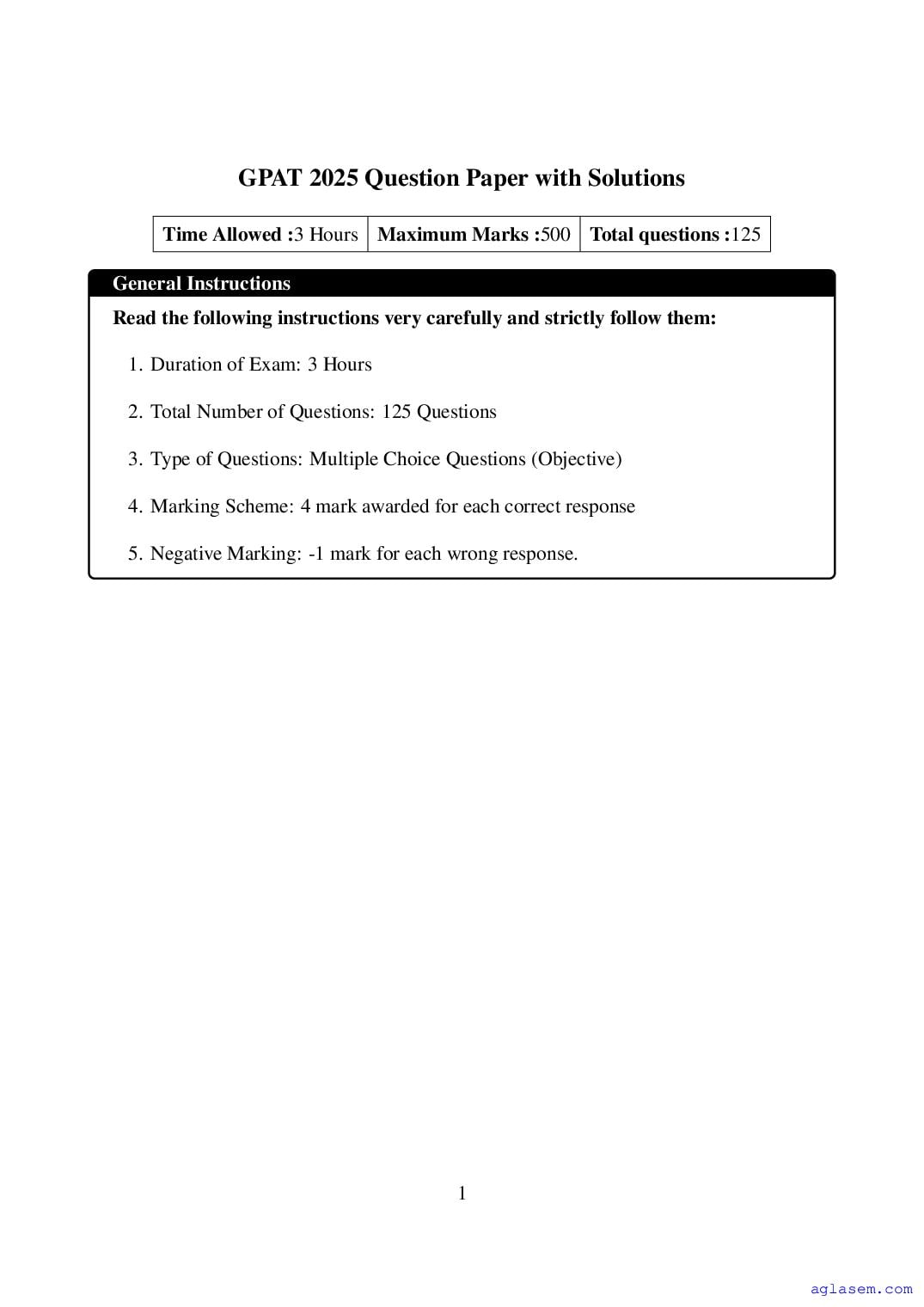
Time Allowed :3 Hours Maximum Marks :500 Total questions :125
General Instructions
Read the following instructions very carefully and strictly follow them:
1. Duration of Exam: 3 Hours
2. Total Number of Questions: 125 Questions
3. Type of Questions: Multiple Choice Questions (Objective)
4. Marking Scheme: 4 mark awarded for each correct response
5. Negative Marking: -1 mark for each wrong response.
1
Page 2
(P) Schedule H
(Q) Schedule G
(R) Schedule P
(S) Schedule F2
Descriptions:
(I) Life period of drugs
(II) Drugs used under RMP
(III) List of Prescription Drugs
(IV) Standards for surgical dressing
(A) P-I, Q-II, R-IV, S-III
(B) P-III, Q-IV, R-I, S-II
(C) P-III, Q-II, R-I, S-IV
(D) P-IV, Q-III, R-II, S-I
Correct Answer: (C) P-III, Q-II, R-I, S-IV
- Schedule H: Contains drugs that must be sold only on prescription of a Registered Medical
Practitioner (RMP).
⇒ (III) List of Prescription Drugs
- Schedule G: Drugs that must be used under medical supervision. Label must display
caution.
⇒ (II) Drugs used under RMP
- Schedule P: Specifies the life period (shelf-life) and storage conditions of drugs.
⇒ (I) Life period of drugs
- Schedule F2: Contains standards for surgical dressings like sterile gauze and bandages.
⇒ (IV) Standards for surgical dressing
2
Page 3
and manufacturing standards. Knowing these is crucial for GPAT.
2. Match the following:
(1) Schedule FF
(2) Schedule F3
(3) Schedule V
(4) Schedule Y
Descriptions:
(P) Standards of patent and proprietary medicines
(Q) Requirements and guidelines for clinical trials
(R) Standards for sterilized umbilical tapes
(S) Standards for Ophthalmic preparations
(A) 1-[P], 2-[Q], 3-[S], 4-[R]
(B) 1-[Q], 2-[R], 3-[P], 4-[S]
(C) 1-[S], 2-[R], 3-[P], 4-[Q]
(D) 1-[R], 2-[P], 3-[Q], 4-[S]
Correct Answer: (C) 1-[S], 2-[R], 3-[P], 4-[Q]
- Schedule FF: Lays down standards for ophthalmic preparations.
⇒ [S]
- Schedule F3: Contains standards for sterilized umbilical tapes.
⇒ [R]
- Schedule V: Deals with the standards for patent and proprietary medicines.
⇒ [P]
- Schedule Y: Provides requirements and guidelines for conducting clinical trials in India.
⇒ [Q]
3
Page 4
Schedule Y is especially important for regulatory aspects of clinical trials.
3. If the label or the container bears the name of an individual or company purporting
to be the manufacturer of the drug, which individual or company is fictitious or does
not exist, it is:
(A) Misbranded Drug
(B) Adulterated Drug
(C) Spurious Drug
(D) Not of Standard Quality
Correct Answer: (C) Spurious Drug
- According to the Drugs and Cosmetics Act, a Spurious Drug includes any drug whose
labeling falsely claims it to be manufactured by a non-existent or fictitious person or
company.
- This ensures protection against counterfeit or fraudulent manufacturers.
Spurious drugs misrepresent origin or identity — often involving fake or non-
existent manufacturers.
4. ISO for quality assurance of Design, Development, Processing, Installation, and
Servicing is:
(A) ISO 9000
(B) ISO 9001
(C) ISO 9002
(D) ISO 9003
4
Page 5
- ISO 9001 outlines requirements for a quality management system (QMS) where an
organization needs to demonstrate its ability in design, development, installation, and
servicing.
- It is the most comprehensive and widely adopted ISO standard.
ISO 9001 is key for end-to-end quality assurance in pharmaceutical manufacturing
systems.
5. According to the ICH guidelines for stability studies, Climatic Zone II temperature
and relative humidity are respectively:
(A) 25◦ C and RH 60%
(B) 30◦ C and RH 65%
(C) 40◦ C and RH 75%
(D) 25◦ C and RH 75%
Correct Answer: (A) 25◦ C and RH 60%
- As per ICH (International Council for Harmonisation) guidelines: - Climatic Zone II
(Subtropical and Mediterranean) conditions:
25◦ C ± 2◦ C and 60% ± 5% RH
- These are standard long-term storage conditions for pharmaceutical stability studies.
Zone II is applicable to Europe, Japan, and parts of India — important for multina-
tional drug stability protocols.
5
Page 6
(A) One sample of 200 ml
(B) Two samples of 150 ml each
(C) Three samples of same batch, each not more than 100 ml
(D) One sample of 500 ml
Correct Answer: (C) Three samples of same batch, each not more than 100 ml
- As per Excise Rules and Drugs and Cosmetics Act, for raw spirit used in pharmaceuticals,
an excise officer is authorized to collect 3 samples, with each sample not exceeding 100 ml.
- This ensures adequate quantity for testing, retesting, and legal proceedings.
Always remember: excise officers collect 3 samples × 100 ml for record, analysis,
and counter-verification.
7. Minimum manufacturing space for ’Habb-Unani medicine’ as per Schedule of D and
C Act?
(A) 50 Sq. Ft.
(B) 75 Sq. Ft.
(C) 100 Sq. Ft.
(D) 150 Sq. Ft.
Correct Answer: (C) 100 Sq. Ft.
- According to Schedule T of the Drugs and Cosmetics Act, the minimum area required for
manufacturing of Habb (Unani medicine) is:
100 Sq. Ft.
- This is applicable under traditional systems of medicine for GMP compliance.
6
Page 7
Siddha, and Unani dosage forms.
8. Manufacturing Specification for tooling has been standardized by?
(A) USFDA
(B) CDSCO
(C) Indian Pharmacopoeial Commission
(D) WHO
Correct Answer: (C) Indian Pharmacopoeial Commission
- The Indian Pharmacopoeial Commission (IPC) is the official body responsible for setting
standards of drugs in India under the Ministry of Health and Family Welfare.
- It also standardizes manufacturing specifications for tooling — particularly the punches and
dies used in tablet compression.
- This ensures interchangeability, efficiency, and quality control across different tablet
manufacturing lines.
IPC not only sets monographs but also standardizes equipment specs like punches,
dies, and tooling in tablet manufacturing.
9. Match the pair of drugs and their family:
Column A (Drugs):
1. Snake root
2. Artemisia
3. Bitter almond
4. Myrrh
7
Page 8
(P) Compositae
(Q) Rosaceae
(R) Apocynaceae
(S) Burseraceae
(A) 1-[R], 2-[P], 3-[Q], 4-[S]
(B) 1-[Q], 2-[R], 3-[P], 4-[S]
(C) 1-[P], 2-[Q], 3-[S], 4-[R]
(D) 1-[S], 2-[P], 3-[R], 4-[Q]
Correct Answer: (A) 1-[R], 2-[P], 3-[Q], 4-[S]
- 1. Snake root → Rauwolfia serpentina, belongs to Apocynaceae family. ⇒ [R]
- 2. Artemisia → Source of drugs like artemisinin, belongs to Compositae (Asteraceae)
family. ⇒ [P]
- 3. Bitter almond → From Prunus amygdalus, belongs to Rosaceae family. ⇒ [Q]
- 4. Myrrh → Oleo-gum resin from Commiphora species, belongs to Burseraceae family. ⇒
[S]
Learn botanical sources and families for crude drugs — frequently tested in Phar-
macognosy GPAT questions.
10. Which of the following alkaloids are found as salts of meconic acid?
(A) Rauwolfia Alkaloid
(B) Tropane Alkaloid
(C) Ergot Alkaloid
(D) Opium Alkaloid
Correct Answer: (D) Opium Alkaloid
8
Page 9
salts of meconic acid.
- Meconic acid is a non-nitrogenous organic acid unique to opium (Papaver somniferum).
- The presence of meconic acid is used to identify opium alkaloids using Ferric chloride test,
which gives a deep red color.
Meconic acid is a key marker of natural opium — forming stable salts with its alka-
loids.
11. Choose the correct statement from the following:
(P) Anthraquinone derivatives are generally detected by Borntrager’s test
(Q) Anthrone is yellow colored and soluble in alkali
(R) Anthranol is insoluble in alkali and shows strong red fluorescence
(S) Borntrager’s test gives negative result with Anthranol (Reduced form)
(A) P and S Only
(B) R Only
(C) Q and R Only
(D) P Only
Correct Answer: (A) P and S Only
- [P]: True. Borntrager’s test is a qualitative test to detect free anthraquinone glycosides,
giving a pink to red color in the ammoniacal layer.
- [Q]: False. Anthrone is typically greenish in color and used as a reagent, not a yellow
compound.
- [R]: False. Anthranol, being a reduced form, is soluble in alkali and generally does not
show red fluorescence.
- [S]: True. The reduced form (like anthranol or anthranone) gives a negative Borntrager’s
9
Page 10
Borntrager’s test is positive for free anthraquinone glycosides, not their reduced
forms like anthranol.
12. Choose the correct statement from the following:
(A) Tannin solution precipitate alkaloid
(B) Hydrolysable tannin produce gallic and ellagic acid by enzymatic and acid hydrolysis
(C) Condensed tannin converted into red color substance known as phlobaphene on acid and
enzymatic hydrolysis
(D) Tannin are insoluble in water
(A) A and C Only
(B) B Only D Only
(C) C Only
(D) A, B and C are correct
Correct Answer: (D) A, B and C are correct
- [A]: True. Tannins precipitate alkaloids, gelatin, and heavy metals due to their astringent
and protein-binding properties. - [B]: True. Hydrolysable tannins are broken down by
enzymatic or acidic hydrolysis to yield gallic acid and ellagic acid.
- [C]: True. Condensed tannins (catechol-type) are polymerized to form phlobaphenes,
which are red-brown insoluble substances.
- [D]: False. Tannins are highly water-soluble, and aqueous extracts are commonly used in
phytochemical tests.
Tannins are classified into hydrolysable and condensed types—both have character-
istic reactions important in crude drug analysis.
10
Page 11
(A) Black mustard, Long pepper, Ginger
(B) Black pepper, Long pepper, Betal
(C) Black pepper, Long pepper, Ginger
(D) Black pepper, Small pepper, Ginger
Correct Answer: (C) Black pepper, Long pepper, Ginger
- Trikatu is a classical Ayurvedic formulation composed of:
- Black pepper (Piper nigrum)
- Long pepper (Piper longum)
- Ginger (Zingiber officinale)
- It is used to enhance bioavailability and aid in digestion and metabolism.
- Known as ”three pungents”, Trikatu balances Kapha and Vata doshas in Ayurvedic
medicine.
Trikatu is commonly used as a bioenhancer in Ayurveda and is made from three
pungent ingredients.
14. Glycogenic amino acids enter TCA cycle except:
(A) Alanine
(B) Glycine
(C) Glutamate
(D) Aspartate
Correct Answer: (B) Glycine
- Glycogenic amino acids are converted into intermediates of the TCA cycle, which
ultimately lead to glucose formation via gluconeogenesis.
11
Page 12
intermediate without further conversion, making it an exception in this context.
Memorize amino acid catabolic fates — important for Biochemistry questions in
GPAT.
15. Match the following:
(P) Tuberculosis
(Q) Diphtheria
(R) Yellow fever
(S) Malaria
Descriptions:
(1) Bacterial
(2) Viral
(3) Toxoids
(4) Protozoal
(A) P-1, Q-3, R-2, S-4
(B) P-3, Q-1, R-4, S-2
(C) P-1, Q-2, R-3, S-4
(D) P-4, Q-1, R-2, S-3
Correct Answer: (A) P-1, Q-3, R-2, S-4
- (P) Tuberculosis — (1) Bacterial: Caused by Mycobacterium tuberculosis, it is a chronic
bacterial infection affecting lungs and other organs.
- (Q) Diphtheria — (3) Toxoids: Caused by Corynebacterium diphtheriae. Vaccination
involves toxoid (inactivated toxin) used in DPT vaccine.
- (R) Yellow fever — (2) Viral: Caused by Flavivirus, transmitted by mosquitoes (Aedes
aegypti). It is a viral hemorrhagic disease.
12
Page 13
transmitted by Anopheles mosquitoes. It is a protozoal infection.
Memorize disease classifications by pathogen type (bacterial, viral, protozoal,
etc.)—commonly asked in GPAT exams.
16. Which of the following is used to evaluate disinfectant?
(A) Widal test
(B) VRDL test
(C) Chick Martin test
(D) None of these
Correct Answer: (C) Chick Martin test
- The Chick Martin test is a classical method used to evaluate the efficacy of disinfectants in
the presence of organic matter (e.g., yeast, proteins). - It improves upon the Rideal–Walker
test by simulating more realistic conditions found in clinical and environmental settings. -
This test involves the comparison of phenol coefficient of a disinfectant in the presence of
organic load.
- Widal test — Used for serological diagnosis of typhoid fever, not for disinfectants. -
VRDL test — Refers to Viral Research and Diagnostic Laboratory tests for viral infections
like HIV, hepatitis, etc. - Hence, both (A) and (B) are unrelated to disinfectant evaluation.
Remember: Chick Martin test evaluates disinfectants under real-use conditions;
Widal test is for typhoid.
17. Oral vaccine such as Dukoral® and Shanchol™ is used for prevention of:
13
Page 14
(B) Ebola virus
(C) Cholera
(D) Polio
Correct Answer: (C) Cholera
- Dukoral® and Shanchol™ are oral cholera vaccines designed to prevent cholera infection
caused by Vibrio cholerae. - These vaccines stimulate mucosal immunity by inducing
secretory IgA antibodies in the intestine, providing protection against cholera toxin. -
Dukoral® contains inactivated whole-cell Vibrio cholerae and recombinant cholera toxin B
subunit. - Shanchol™ is a bivalent whole-cell oral vaccine without the toxin component. -
These vaccines are effective in controlling cholera outbreaks, especially in endemic areas.
- Other options: - Pneumonia vaccines target bacterial or viral causes like Streptococcus
pneumoniae. - Ebola virus vaccine is different and not oral. - Polio vaccines (OPV) are oral
but distinct from Dukoral/Shanchol.
Remember that Dukoral® and Shanchol™ are the primary oral vaccines against
cholera, critical for public health in endemic regions.
18. Which parasitic worm is responsible for causing lymphatic filariasis?
(A) Wuchereria bancrofti
(B) Brugia malayi
(C) Onchocerca volvulus
(D) Ancylostoma duodenale
Correct Answer: (A) Wuchereria bancrofti
14
Page 15
commonly known as elephantiasis. - It is transmitted to humans through the bite of infected
mosquitoes (e.g., Culex, Anopheles, Aedes).
- The adult worms live in the lymphatic system and block lymphatic vessels, causing severe
swelling, especially in the legs, genitals, and breasts.
- The disease is characterized by lymphedema, chronic inflammation, and gross enlargement
of affected body parts.
- Other options: - (B) Brugia malayi — Also causes lymphatic filariasis but is less prevalent
than W. bancrofti.
- (C) Onchocerca volvulus — Causes onchocerciasis or “river blindness”.
- (D) Ancylostoma duodenale — A hookworm causing iron-deficiency anemia, not
filariasis.
Wuchereria bancrofti is the primary causative organism for lymphatic filariasis —
focus on mosquito-borne helminths for GPAT.
19. Which statistical test is used to compare mean of two identical group?
(A) ANOVA
(B) Sample t test
(C) Paired t test
(D) Pooled t test
Correct Answer: (C) Paired t test
The paired t-test is a statistical method used to compare the means of two related (i.e.,
identical or matched) groups.It is used when the same subjects are measured twice.for
example, before and after a treatment, or under two different conditions.The test determines
whether the average difference between paired observations is significantly different from
zero.
15
Page 16
evaluating crossover study designs in biostatistics and clinical trials.
Other options:
- (A) ANOVA (Analysis of Variance) — Used when comparing means of more than two
groups.
- (B) Sample t test (Unpaired/Independent t test) — Used to compare the means of two
independent groups.
- (D) Pooled t test — A form of unpaired t-test that assumes equal variances in two
independent samples.
Use the paired t-test when comparing two related measurements (same group, dif-
ferent times or conditions) — crucial for bioequivalence and clinical trial designs in
GPAT.
20. Which enzyme is responsible for albinism?
(a) Beta-hydroxylase
(b) Pyruvate dehydrogenase
(c) Hydroxylase
(d) Tyrosinase
Correct Answer: (d) Tyrosinase
- Albinism is a congenital disorder characterized by the partial or complete absence of
melanin pigment in the skin, hair, and eyes.
- The biosynthesis of melanin occurs via the tyrosine metabolic pathway, in which the
enzyme tyrosinase plays a central role.
- Tyrosinase catalyzes the conversion of tyrosine to DOPA (dihydroxyphenylalanine) and
then to dopaquinone, which are key steps in melanin production.
- Mutations in the tyrosinase gene (TYR) result in defective or absent enzyme activity,
16
Page 17
- This enzyme is copper-dependent and is found in melanocytes.
- Other options:
- (a) Beta-hydroxylase — Involved in catecholamine biosynthesis (e.g., norepinephrine
production).
- (b) Pyruvate dehydrogenase — Part of carbohydrate metabolism; links glycolysis to the
Krebs cycle.
- (c) Hydroxylase — General term for enzymes adding hydroxyl groups, but not specific to
melanin synthesis.
Remember: Albinism is due to a tyrosinase deficiency — an enzyme vital for
melanin biosynthesis. It’s a classic GPAT question from the Biochemistry section.
21. Which anemia is caused due to Microcytic, hypochromic red blood cells?
(a) Pernicious anemia
(b) Aplastic anemia
(c) Iron deficiency anemia
(d) Hemolytic anemia
Correct Answer: (c) Iron deficiency anemia
- Microcytic, hypochromic anemia refers to red blood cells (RBCs) that are smaller than
normal (microcytic) and have reduced hemoglobin content (hypochromic), which appears
pale under a microscope.
- The most common cause of this type of anemia is Iron deficiency anemia, which results
from insufficient iron for hemoglobin synthesis.
- Iron is essential for the formation of hemoglobin, and its deficiency leads to impaired
hemoglobin production, producing smaller, less pigmented RBCs.
Analysis of other options:
17
Page 18
to intrinsic factor absence.
- (b) Aplastic anemia: A normocytic normochromic anemia caused by bone marrow failure,
not related to cell size or color.
- (d) Hemolytic anemia: Characterized by increased RBC destruction, often with
normocytic cells; not microcytic-hypochromic.
Always associate microcytic, hypochromic RBCs with iron deficiency. It’s a classic
feature asked frequently in GPAT’s Pharmacology and Pathophysiology sections.
22. Which of the following is the differential test i.e. it does not require the need to
make assumption of population following normal or differential distributed?
(a) ANOVA
(b) Student T test
(c) Fisher LSD test
(d) Kruskal-Wallis test
Correct Answer: (d) Kruskal-Wallis test
The Kruskal-Wallis test is a non-parametric statistical test used to compare three or more
independent groups. Unlike parametric tests like ANOVA or t-tests, it does not assume
normal distribution of the data. Instead, it ranks the data and compares the mean ranks
between the groups.
Key Characteristics:
- It is an extension of the Mann–Whitney U test to more than two groups.
- Useful when data is ordinal or not normally distributed.
- It compares medians rather than means.
Analysis of Other Options:
- (a) ANOVA: Assumes data is normally distributed and groups have equal variances.
18
Page 19
- (c) Fisher LSD test: A post-hoc test following ANOVA, also assumes normal distribution.
In GPAT, remember: Parametric = Normality assumed, Non-parametric = No nor-
mality assumption. Kruskal-Wallis is a non-parametric alternative to one-way
ANOVA.
ORGANIC CHEMISTRY & PHYSICAL CHEMISTRY
23. Which of the following is correct stability order of alkenes?
(a) Trans-2-butene > Cis-2-Butene > Isobutene > but-1-ene
(b) Cis-2-Butene > Trans-2-butene > Isobutene > but-1-ene
(c) Isobutene > but-1-ene > Cis-2-Butene > Trans-2-butene
(d) Isobutene > Trans-2-butene > Cis-2-Butene > but-1-ene
Correct Answer: (d) Isobutene > Trans-2-butene > Cis-2-Butene > but-1-ene
The stability of alkenes is influenced primarily by:
• Hyperconjugation
• Alkyl substitution (more substituted alkenes are more stable)
• Steric hindrance (cis isomers are usually less stable than trans)
Let’s analyze each alkene:
1. Isobutene (2-methylpropene): A highly substituted (trisubstituted) alkene. It benefits
from both +I effect and extensive hyperconjugation.
Highest stability
2. Trans-2-butene: Disubstituted alkene with groups on opposite sides — less steric
hindrance than cis. More stable than cis-2-butene.
19
Page 20
Less stable than trans.
4. But-1-ene: Monosubstituted alkene, minimal hyperconjugation and substitution.
Least stable among the given
Correct Stability Order:
Isobutene > Trans-2-butene > Cis-2-butene > But-1-ene
In alkene stability questions, always rank based on: (1) degree of substitution, (2)
trans > cis (due to less steric hindrance), and (3) hyperconjugation effects.
24. Cis-trans (E/Z) Isomers, EXCEPT
(a) 1-butene
(b) 2-butene-1-ol
(c) 2-chloro-3-hexene
(d) 4-chloro-2-pentene
Correct Answer: (d) 4-chloro-2-pentene
Cis-trans (E/Z) isomerism is a type of geometrical isomerism seen in alkenes. It occurs only
when:
1. There is a C=C double bond, and
2. Each of the double bonded carbon atoms is attached to two different groups (i.e., different
priority substituents).
Let’s evaluate the options one by one based on this rule:
(a) 1-butene: Structure: CH2 =CH–CH2 –CH3
Here, one of the double-bonded carbon atoms (CH2 ) is attached to two identical hydrogen
atoms.
Hence, cis-trans isomerism is not possible in 1-butene.
20
Page 21
The double bond is between C2 and C3. C2 is attached to H and CH2 OH; C3 is attached to H
and CH3 .
Since both double bonded carbons have two different groups, cis-trans (E/Z) isomerism is
possible.
(c) 2-chloro-3-hexene: Structure: CH3 –CH(Cl)–CH=CH–CH2 –CH3
C3 (CH=) is bonded to C2 (which bears a Cl) and to C4; C4 is attached to two different
groups (CH2 CH3 and H), and similarly for C3.
Hence, E/Z isomerism is possible.
(d) 4-chloro-2-pentene: Structure: CH3 –CH=CH–CH(Cl)–CH3
The double bond is between C2 and C3. Check the groups attached:
– C2 is attached to CH3 and H (fine), but
– C3 is attached to CH(Cl) and H. Here, CH(Cl) and CH3 may seem different, but the
priority order fails due to symmetry on further expansion, making it ambiguous.
However, due to the similar environment and branching, geometrical isomerism is
restricted or not well-defined.
Hence, E/Z isomerism is not reliably possible here.
For a compound to show cis-trans (E/Z) isomerism, both double bonded carbon
atoms must have two different groups attached. If either carbon has two identical
groups, cis-trans isomerism is not possible.
25. Number of stereoisomers of 3-bromo-2-butanol:
(A) 2
(B) 4
(C) 6
(D) 8
Correct Answer: (B) 4
21
Page 22
CH3 -CH(OH)-CH(Br)-CH3
- In this molecule: - The carbon at position 2 (attached to OH) is a chiral center. - The carbon
at position 3 (attached to Br) is also a chiral center.
- Since there are two chiral centers, the maximum number of stereoisomers is:
2n = 22 = 4
where n = number of chiral centers.
- These 4 stereoisomers include:
- A pair of enantiomers (non-superimposable mirror images).
- Another pair of enantiomers.
- No meso compound exists in this case, as there is no internal plane of symmetry due to the
different substituents (OH and Br).
Use the formula 2n for maximum number of stereoisomers, where n is the number
of chiral centers. Check for meso forms if symmetry is possible.
26. In Friedel-Crafts reaction, benzene reacts with isopropyl bromide in the presence of
aluminium trichloride to give:
(A) Benzophenone
(B) Acetophenone
(C) Isopropyl benzene
(D) n-Propyl benzene
Correct Answer: (C) Isopropyl benzene
- The Friedel–Crafts alkylation reaction involves the alkylation of an aromatic ring with an
alkyl halide in the presence of a Lewis acid such as AlCl3 .
22
Page 23
- The AlCl( 3) catalyst helps generate a carbocation (or a carbocation-like species) from
isopropyl bromide:
(CH3 )2 CH–Br + AlCl3 → (CH3 )2 C+ + AlCl3 Br−
- This isopropyl carbocation then reacts with benzene to form isopropyl benzene (cumene)
via electrophilic aromatic substitution.
- Other options:
- (A) Benzophenone and (B) Acetophenone are products of Friedel–Crafts acylation, not
alkylation.
- (D) n-Propyl benzene is not formed here because n-propyl carbocation is unstable and
rearranges to isopropyl carbocation.
bigskip
In Friedel–Crafts alkylation, secondary carbocations like isopropyl are stable and
commonly formed. Always consider carbocation stability and rearrangement.
27. Number of conformational isomers of n-butane:
(A) One-anti & one-gauche
(B) One-anti & two-gauche
(C) Two-anti & one-gauche
(D) Two-anti & two-gauche
Correct Answer: (B) One-anti & two-gauche
- n-Butane has the structural formula:
CH3 − CH2 − CH2 − CH3
- When viewed along the central C–C bond (C2–C3), different conformations arise due to
rotation about this bond.
23
Page 24
Gauche: The methyl groups are 60◦ apart (less stable). - Eclipsed: The methyls and/or
hydrogens are aligned (least stable — not counted here as stable conformers).
- In n-butane, due to symmetry: - There is 1 anti conformer. - There are 2 equivalent
gauche conformers (mirror images of each other).
- Hence, the molecule has 3 significant conformational isomers: - 1 anti + 2 gauche
Conformational isomers differ by rotation around single bonds. For alkanes like n-
butane, analyze using Newman projections for anti and gauche forms.
28. Debye is a unit of:
(A) Dipole moment
(B) Field effect
(C) Dissociation constant
(D) Bond energy
Correct Answer: (A) Dipole moment
- The Debye (D) is a unit used to express the dipole moment of a molecule. Dipole moment
is a measure of the separation of positive and negative charges in a molecule.
It is a vector quantity given by:
µ=q×d
where µ is the dipole moment, q is the magnitude of the charge, and d is the distance between
the charges.
- 1 Debye (D) is equal to:
1 D = 3.336 × 10⁻³⁰ Coulomb-meter
- Dipole moments are important for understanding molecular polarity, solubility, and
intermolecular interactions.
24
Page 25
- (B) Field effect relates to electron withdrawal through space, not measured in Debye.
- (C) Dissociation constant is expressed in terms of concentration (mol/L).
- (D) Bond energy is measured in kcal/mol or kJ/mol.
Dipole moment reflects the polarity of a molecule and is commonly expressed
in Debye. Polar molecules like H2 O have a higher dipole moment than nonpolar
molecules like CO2 .
29. Which is considered an exception to Markovnikov’s rule EXCEPT:
(A) Addition of HI in an alkene
(B) Addition of HCl in an alkene
(C) Addition of HBr in the presence of peroxide in an alkene
(D) Addition of H2 O in the presence of acid
Correct Answer: (C) Addition of HBr in the presence of peroxide in an alkene
- Markovnikov’s Rule states that in the addition of HX to an unsymmetrical alkene, the
hydrogen (H) attaches to the carbon with more hydrogen atoms, and the halide (X) attaches
to the carbon with fewer hydrogen atoms.
- This rule applies to: - (A) Addition of HI
- (B) Addition of HCl
- (D) Addition of H2 O in acid (hydration follows Markovnikov’s rule)
- Exception: - (C) Addition of HBr in the presence of peroxide is an exception due to the
peroxide effect or Kharasch effect.
- This reaction proceeds via a free radical mechanism, leading to anti-Markovnikov
addition where Br adds to the carbon with more hydrogen atoms.
- Hence, all options follow Markovnikov’s rule except option (C), which is the correct
answer in this case since the question asks for the one that is NOT an exception.
25
Page 26
via a free radical mechanism — a common GPAT favorite question!
30. In Baeyer strain theory, which cycloalkane is more stable?
(A) Cyclopropane
(B) Cyclobutane
(C) Cyclopentane
(D) Cyclooctane
Correct Answer: (C) Cyclopentane
- Baeyer Strain Theory (proposed by Adolf von Baeyer) explains the relative stability of
cycloalkanes based on angle strain. According to this theory, the most stable ring systems are
those in which the bond angles are closest to the tetrahedral angle of 109.5◦ .
- The ideal bond angle in a tetrahedral molecule is 109.5◦ , and any deviation from this causes
angle strain.
Let’s analyze the ring strain in each option:
- (A) Cyclopropane: Bond angle = 60◦ → High strain
- (B) Cyclobutane: Bond angle = 90◦ → Considerable strain
- (C) Cyclopentane: Bond angle = 108◦ → Closest to 109.5° → Least strain and most stable
- (D) Cyclooctane: Angle strain is reduced, but suffers from torsional strain due to its flexible
ring, making it less stable than cyclopentane
- Hence, Cyclopentane is considered the most stable cycloalkane as per Baeyer strain theory.
Remember: Cyclopentane has minimal angle strain and is considered most stable
according to Baeyer’s angle strain theory — important for understanding ring stabil-
ity in GPAT.
26
Page 27
(A) SN1
(B) SN2
(C) Both SN1 and SN2
(D) Elimination
Correct Answer: (B) SN2
- Walden inversion refers to the inversion of configuration (chirality) that occurs during a
nucleophilic substitution reaction.
- This phenomenon is characteristic of SN2 bimolecular nucleophilic substitution reactions,
where the nucleophile attacks the carbon from the side opposite to the leaving group.
- As a result, the spatial arrangement of atoms around the chiral center gets inverted — this is
what we call a Walden inversion.
- SN1 reactions proceed through a planar carbocation intermediate and often lead to
racemization rather than inversion.
- Elimination reactions (E1 or E2) do not involve inversion of configuration, as they lead to
the formation of alkenes.
- Therefore, only SN2 reactions exhibit Walden inversion.
In SN2 reactions, the backside attack by the nucleophile causes Walden inversion —
key for chirality-based GPAT questions!
32. Diels-Alder reaction is:
(A) Cyclo addition
(B) Elimination
(C) Nucleophilic addition
(D) Electrophilic substitution
27
Page 28
- The Diels-Alder reaction is a [4+2] cycloaddition reaction between a conjugated diene and
a dienophile.
- It is a pericyclic reaction that results in the formation of a six-membered ring.
- The reaction occurs via a concerted mechanism without intermediates, making it
stereospecific.
- This reaction does not involve elimination, nucleophilic addition, or electrophilic
substitution mechanisms.
- It is widely used in organic synthesis for constructing complex cyclic structures with high
stereoselectivity.
- Therefore, Diels-Alder is classified as a cycloaddition reaction.
Diels-Alder is a classic example of a [4+2] cycloaddition — remember this for
quick identification in reaction mechanism questions!
33. Alkyl halide is converted to alkane:
(A) Wurtz Reaction
(B) Birch reaction
(C) Sabatier-Senderens reaction
(D) Grignard reaction
Correct Answer: (A) Wurtz Reaction
- The Wurtz reaction involves the coupling of two alkyl halides using sodium metal in dry
ether, producing a higher alkane.
- General reaction:
dry ether
2R − X + 2N a −−−−−→ R − R + 2N aX
where R is an alkyl group and X is a halide.
28
Page 29
- The Birch reaction is a type of reduction reaction of aromatic rings using sodium and
alcohol in liquid ammonia.
- The Sabatier-Senderens reaction is a hydrogenation of alkenes/alkynes using nickel
catalysts.
- The Grignard reaction involves formation of C–C bonds using Grignard reagents, not direct
conversion of alkyl halides to alkanes.
- Therefore, the correct reaction for converting alkyl halides to alkanes is the Wurtz Reaction.
Wurtz Reaction = Alkyl halide + Na (dry ether) → Alkane. Useful for synthesizing
symmetrical alkanes in organic chemistry.
34. Aryl diazonium reacts with fluoroborate to give aryl fluoride:
(A) Balz-Schiemann reaction
(B) Stephen reaction
(C) Gattermann reaction
(D) Gomberg reaction
Correct Answer: (A) Balz-Schiemann reaction
- The Balz-Schiemann reaction involves the conversion of an aryl diazonium salt into an aryl
fluoride by thermal decomposition of the corresponding aryl diazonium tetrafluoroborate salt.
- General reaction:
∆
Ar-N+ −
2 BF4 −
→ Ar-F + N2 + BF3
where Ar = aryl group.
- This reaction is widely used to introduce fluorine atoms into aromatic rings, which is
important in the synthesis of fluorinated aromatic compounds.
- Other options: - Stephen reaction reduces nitriles to aldehydes.
- Gattermann reaction introduces formyl groups into aromatic rings.
29
Page 30
- Therefore, the correct reaction that produces aryl fluoride from aryldiazonium salts using
fluoroborate is the Balz-Schiemann reaction.
Remember: Balz-Schiemann reaction is the key method to prepare aryl fluorides
from aryl diazonium salts — an important named reaction for GPAT organic chem-
istry.
36. Pyridine is a base with Kb value:
(A) 1.7 × 10⁻⁹
(B) 2.3 × 10⁻¹²
(C) 3.2 × 10⁻⁶
(D) 3.8 × 10⁻⁷
Correct Answer: (A) 1.7 × 10⁻⁹
- Pyridine is a heterocyclic aromatic organic compound with the molecular formula C5H5N.
It consists of a six-membered ring with five carbon atoms and one nitrogen atom.
- The nitrogen in pyridine is sp2 -hybridized and its lone pair of electrons is not involved in
the aromatic π -system. This makes the lone pair available for protonation, hence making
pyridine act as a Lewis base.
- The basicity of a compound is often expressed using the base dissociation constant (Kb ),
which measures the extent to which a base can accept a proton.
- Pyridine has a Kb value of 1.7 × 10⁻⁹ , indicating it is a weak base. This low Kb corresponds
to a pKb of approximately 8.77.
- The low basicity compared to aliphatic amines is due to the electron-withdrawing effect of
the aromatic ring, which reduces electron density on the nitrogen atom.
- Among the options, the correct Kb value of pyridine is 1.7 × 10⁻⁹ .
30
Page 31
basic than aliphatic amines due to aromatic delocalization effects.
37. Naturally occurring pilocarpine is:
(A) 2R,4R (+) Pilocarpine
(B) 3S,5R () Pilocarpine
(C) 2S,4R () Pilocarpine
(D) 3R,4S (+) Pilocarpine
Correct Answer: (D) 3R,4S (+) Pilocarpine
Solution: - Pilocarpine is a naturally occurring alkaloid obtained from the leaves of the plant
Pilocarpus jaborandi.
- It is a parasympathomimetic alkaloid that acts as a muscarinic receptor agonist, primarily
used in the treatment of glaucoma and xerostomia (dry mouth).
- The natural configuration of pilocarpine is stereospecific and biologically active in the form
of 3R,4S enantiomer. This is the (+) isomer of pilocarpine, which exhibits the desired
pharmacological activity.
- Stereochemistry is important in alkaloids, especially those that interact with chiral
biological targets like receptors or enzymes. The 3R,4S configuration ensures proper binding
affinity and efficacy.
- Thus, the naturally occurring pilocarpine is the 3R,4S (+) form.
Remember: Natural pilocarpine is the 3R,4S (+) enantiomer, derived from Pilocar-
pus species and used for glaucoma management.
38. In a drug discovery process:
1. Lead optimization
31
Page 32
3. Lead findings
(A) 3-2-1
(B) 1-2-3
(C) 2-3-1
(D) 3-1-2
Correct Answer: (C) 2-3-1
Solution: - Drug discovery is a step-wise process that begins with identifying the biological
origin of the disease, followed by screening and optimizing chemical candidates.
- The first step is Target Selection, where a biological molecule (usually a protein) involved
in a disease is chosen as a potential site for drug action. This target should be validated to
confirm its role in the disease.
- The next step is Lead Finding, which involves screening of chemical libraries or natural
sources to identify compounds (leads) that show biological activity against the selected
target.
- The final step in this sequence is Lead Optimization, where the chemical structure of lead
compounds is modified to enhance potency, selectivity, pharmacokinetics, and reduce
toxicity.
- Hence, the correct order in the drug discovery process is:
Target Selection → Lead Finding → Lead Optimization = 2-3-1
In drug discovery: Identify the target (2), find a lead compound (3), and optimize it
(1) for better activity and safety.
39. Methotrexate, used as an antimetabolite, is a product of N-methylation of
para-aminobenzoic acid and pyridine hydroxyl. The isosteric group is
(A) SH
(B) CH3
32
Page 33
(D) CF3
Correct Answer: (B) CH3
- Methotrexate is a folic acid analog and acts as a competitive inhibitor of the enzyme
dihydrofolate reductase (DHFR), which is essential for DNA synthesis.
- In structure-activity relationships (SAR), bioisosteric replacement is a concept where
functional groups with similar physical or chemical properties are substituted without
significantly altering the biological activity.
- The N-methyl group (CH3 ) acts as a classical isosteric group in methotrexate, mimicking
structural features of naturally occurring folates to retain binding affinity and metabolic
stability.
- Among the given options, CH3 serves as a non-polar, small group that can mimic hydrogen
or methyl moieties in bioisosterism.
- Therefore, the correct isosteric group relevant to methotrexate’s activity is CH3 .
Isosteres are useful in drug design for improving activity or metabolic stability by
structural mimicry.
40. A/B Trans steroidal hydrogen in the 5th position
(A) Beta configuration
(B) Eclipsed conformation
(C) Alpha configuration
(D) Gauche conformation
Correct Answer: (C) Alpha configuration
Solution: - Steroids consist of four fused rings labeled A, B, C, and D. The configuration of
hydrogen at the 5th carbon (C-5) determines the stereochemistry of the junction between
rings A and B.
33
Page 34
the A/B ring junction is in trans configuration. This is typical for many biologically active
steroids.
- In contrast, if the hydrogen is in the beta configuration (above the plane), the A/B junction
is cis.
- Trans junctions generally offer more thermodynamic stability due to less steric strain
compared to cis junctions.
- Hence, A/B trans steroidal configuration involves hydrogen at C-5 in the alpha position.
Remember: Trans A/B junction = H at C-5 in alpha position; Cis A/B junction = H
at C-5 in beta position.
41. Total Number of Carbon atoms in pregnane is
(A) 18
(B) 19
(C) 21
(D) 27
Correct Answer: (C) 21
Solution: - Pregnane is a C-21 steroid nucleus. It consists of the basic steroid four-ring
structure (cyclopentanoperhydrophenanthrene nucleus) with two additional carbon atoms in
the side chain.
- The core steroid structure has 17 carbon atoms: 3 six-membered rings (A, B, and C) and 1
five-membered ring (D).
- In pregnane, a two-carbon side chain is attached at C-17, making the total carbon count: 17
(rings) + 2 (side chain) + 2 (additional substituents) = 21 carbon atoms.
- Pregnane serves as the parent structure for important hormones like progesterone and
corticosteroids.
34
Page 35
trane = 18-carbon.
42. Hypnotics and sedative barbiturate pKa value
(A) 4–6
(B) 5–8
(C) 9–11
(D) 7–9
Correct Answer: (D) 7–9
- Barbiturates are derivatives of barbituric acid and act as central nervous system depressants.
- They are weak acids due to the presence of acidic hydrogen at the 5-position of the
barbituric acid ring.
- The pKa value of hypnotic and sedative barbiturates generally lies in the range of 7–9,
making them weak acids that are mostly unionized at acidic pH and ionized at basic pH.
- This property affects their solubility and ability to cross the blood-brain barrier, thus
influencing onset and duration of action.
- Examples include phenobarbital (pKa 7.3) and pentobarbital (pKa 8.1).
Barbiturate activity is influenced by lipid solubility and ionization, which are pH-
dependent due to their pKa .
43. Structure of hybrid in methadone and meperidine
(A) Pentazocine
(B) Tramadol
(C) Methotrexate
35
Page 36
Correct Answer: (B) Tramadol
Solution: - Tramadol is a centrally acting analgesic with a dual mechanism of action: weak
µ-opioid receptor agonist and inhibition of serotonin and norepinephrine reuptake.
- Structurally, it is considered a hybrid of methadone and meperidine.
- Methadone is a synthetic opioid with a phenylpropylamine backbone, while meperidine
contains a piperidine ring structure.
- Tramadol contains a methadone-like side chain with a meperidine-like structure in its basic
amine and ether functionality.
- This hybrid structure contributes to its analgesic efficacy and unique pharmacological
profile.
Tramadol’s structure combines features of both methadone and meperidine, giving it
opioid and non-opioid analgesic properties.
44. Steroidal cholestane ring fused with
(A) 5, 6, 7, 9, 10, 13
(B) 5, 6, 8, 9, 10, 11
(C) 5, 6, 8, 9, 10, 13
(D) 5, 6, 8, 9, 10, 14
Correct Answer: (C) 5, 6, 8, 9, 10, 13
Solution: - Cholestane is a saturated derivative of cholesterol and serves as the parent
compound for many steroids.
- It consists of a perhydrocyclopentanophenanthrene nucleus, which includes three
six-membered rings (A, B, and C) and one five-membered ring (D).
- These four rings are fused together at the carbon positions 5, 6, 8, 9, 10, and 13, forming a
tetracyclic skeleton.
36
Page 37
stereochemistry and biological activity of steroid molecules.
Remember the tetracyclic steroid nucleus involves key fusion points at carbons 5, 6,
8, 9, 10, and 13 — important for structural identification in medicinal chemistry.
45. UV absorbance value of Morphine
(A) 266 nm
(B) 276 nm
(C) 256 nm
(D) 286 nm
Correct Answer: (D) 286 nm
Solution: - Morphine is an opiate alkaloid with a characteristic UV absorption spectrum.
- The maximum UV absorbance ( max) for morphine is approximately 286 nm due to the
conjugated aromatic ring system in its structure.
- This absorbance is used in qualitative and quantitative analysis of morphine in
pharmaceutical preparations using UV-visible spectrophotometry.
- Understanding the UV absorbance helps in drug identification and purity analysis in
pharmaceutical quality control.
UV absorbance maxima provide valuable information for drug analysis; morphine’s
peak at 286 nm is a key identifier.
46. Complexometric titration indicators Except
(A) Mordant black - II
(B) Ferroin
37
Page 38
(D) Xylene orange
Correct Answer: (B) Ferroin
Solution: - Complexometric titrations involve the use of indicators that form colored
complexes with metal ions, helping to visually detect the endpoint.
- Common complexometric indicators include Mordant Black II, Catechol Violet, and
Xylene Orange, all of which change color upon binding with metal ions such as Ca2+ or
Mg2+ .
- Ferroin, however, is primarily a redox indicator used in redox titrations, especially with
iron(II) and iron(III) ions, and does not act as a complexometric indicator.
- Therefore, Ferroin is an exception and is not used as an indicator in complexometric
titrations.
Remember, indicators for complexometric titrations form metal complexes; Ferroin
is a redox indicator, not suitable for this purpose.
47. In complexometric titration, the masking agent used to mask Iron (II) ion
(A) KCN
(B) Thio glycerol
(C) Tri ethanol amine
(D) Ammonium Fluoride
Correct Answer: (A) KCN
Solution: - In complexometric titrations, masking agents are substances that selectively bind
to certain metal ions to prevent them from interfering with the titration of other metal ions.
- Potassium cyanide (KCN) is commonly used as a masking agent for Iron (II) ions because
it forms a very stable complex with Fe2+ , effectively ”masking” it.
- This prevents Fe2+ from reacting with the titrant, allowing accurate determination of other
metal ions in the solution.
38
Page 39
properties for different ions but are not typically used for Fe2+ .
KCN is an effective masking agent for Iron (II) ions in complexometric titrations
due to stable complex formation.
48. Which is used as Fajan’s method indicator
(A) Dichlorofluorescein
(B) Methyl red
(C) Phenolphthalein
(D) Xylene orange
Correct Answer: (A) Dichlorofluorescein
Solution: - Fajan’s method is a type of adsorption indicator method used in precipitation
titrations, particularly for determining halides by titration with silver nitrate.
- Dichlorofluorescein is commonly used as the indicator in Fajan’s method because it
adsorbs onto the surface of the precipitate, changing color at the endpoint.
- This color change indicates the completion of the reaction, enabling accurate determination
of the endpoint.
- Other indicators like methyl red, phenolphthalein, and xylene orange are used in different
types of titrations and are not suitable for Fajan’s method.
Dichlorofluorescein acts as an adsorption indicator in Fajan’s method by color
change at the precipitate surface.
49. Cyanide used in nepheloturbidometry as a salt of
(A) Ag
39
Page 40
(C) Na
(D) K
Correct Answer: (A) Ag
Solution: - Nepheloturbidometry is an analytical technique used to measure the turbidity or
cloudiness of a solution, often due to suspended particles.
- In nepheloturbidometry, cyanide ions are commonly used as silver cyanide (AgCN) salt.
- Silver cyanide forms a precipitate that scatters light, which is measured to determine the
concentration of analytes.
- The salt of silver (Ag) is preferred because of its stable complex formation with cyanide
and well-defined turbidity properties.
- Salts of gold (Au), sodium (Na), or potassium (K) cyanide are not typically used for this
purpose in nepheloturbidometry.
In nepheloturbidometry, silver cyanide (AgCN) is the common cyanide salt due to
its precipitate formation causing turbidity.
50. How to prepare 200 mL of a 0.15 M sodium hydroxide solution?
(A) 1.0 g
(B) 1.2 g
(C) 1.5 g
(D) 1.8 g
Correct Answer: (B) 1.2 g
Solution: - Given: Volume V = 200 mL = 0.2 L, Molarity M = 0.15 mol/L
- Molar mass of sodium hydroxide (NaOH) = 23 + 16 + 1 = 40 g/mol
- Number of moles required:
n = M × V = 0.15 × 0.2 = 0.03 mol
40
Page 41
m = n × Molar mass = 0.03 × 40 = 1.2 g
- Therefore, to prepare 200 mL of 0.15 M NaOH solution, dissolve 1.2 g of sodium
hydroxide in water and make up the volume to 200 mL.
Use the formula mass = M × V × molar mass to prepare molar solutions accurately.
51. Stationary phase for steroidal chromatography is:
(A) Acylated paper
(B) Carboxy Paper
(C) Kieselguhr paper
(D) Silica Paper
Correct Answer: (A) Acylated paper
Solution: - In chromatography, the stationary phase is the phase that does not move and with
which the compounds interact.
- Steroidal compounds are generally non-polar and require a stationary phase that can
interact effectively to allow separation.
- Acylated paper is paper chemically modified with acyl groups, making it more hydrophobic
and suitable for separating steroidal compounds due to better interaction with the non-polar
steroids.
- Other options like carboxy paper, kieselguhr paper, and silica paper are typically used for
different types of chromatography, such as polar compounds or different analytical purposes.
- Hence, acylated paper is the preferred stationary phase in steroidal chromatography to
achieve efficient separation.
41
Page 42
lyte to ensure optimal separation.
52. Choose the correct statement in a potentiometric titration: Salt bridge is used as
(i) Prevent contamination of reference electrode to test solution
(ii) No use of design reference electrode of salt bridge
(iii) No effect in test solution
(iv) Solidified with 3% agar
(a) Only I
(b) I and III
(c) I and IV
(d) III and IV
Correct Answer: (c) I and IV
- In potentiometric titration, the salt bridge plays a crucial role in maintaining the electrical
neutrality between the reference and the indicator electrodes without allowing mixing of
their respective solutions.
- Statement (i) is correct: The salt bridge prevents contamination between the reference
electrode (such as calomel or silver-silver chloride) and the test (analyte) solution by
providing an ionic connection.
- Statement (iv) is also correct: Salt bridges are often prepared using electrolytes such as KCl
or KNO3 , and are solidified with 3% agar or gelatin to prevent flow and mixing of liquids
while maintaining conductivity.
- Statement (ii) is incorrect: Reference electrodes require a salt bridge for proper functioning
in many setups.
- Statement (iii) is incorrect: Although the salt bridge minimizes the effect on test solution
composition, it still contributes ions and hence has some effect.
42
Page 43
tecting the test solution from contamination.
53. Which of the following is not a Karl Fischer reagent
(a) Iodine
(b) Pyridine
(c) Pyrimidine
(d) Sulphur dioxide
Correct Answer: (c) Pyrimidine
Karl Fischer titration is a widely used analytical technique for the determination of water
content in pharmaceutical substances. The classical Karl Fischer reagent consists of:
- Iodine (I2 ): Acts as an oxidizing agent.
- Sulphur dioxide (SO2 ): Serves as a reducing agent.
- Pyridine: Functions as a base to neutralize the acid formed during the reaction and to
stabilize the intermediate complex.
- Methanol or other alcohols are used as solvents.
Pyrimidine, on the other hand, is a heterocyclic compound and is not a component of the
Karl Fischer reagent. It is not involved in the reaction mechanism or stabilization of the
intermediates in water determination, and hence, is not part of the reagent composition.
Remember: Karl Fischer reagent = Iodine + SO2 + Base (e.g., Pyridine) + Alcohol
(e.g., Methanol)
54. In Ilkovic equation, m determines
(a) Determine mass of analyte
(b) Determine mass of electron transfer
43
Page 44
(d) Determine drop time
Correct Answer: (c) Determine mass of mercury flow transfer
The Ilkovic equation is used in polarography to relate the diffusion current (id ) to the
concentration of electroactive species in solution. The equation is given as:
id = 607 nD1/2 m2/3 t1/6 C
Where: - id = diffusion current (in microamperes)
- n = number of electrons transferred
- D = diffusion coefficient of the analyte
- m = rate of mercury flow (mass flow rate)
- t = drop time of mercury from DME (dropping mercury electrode)
- C = concentration of the analyte
Here, m (sometimes represented as m′ ) specifically denotes the mass flow rate of mercury,
which determines how much mercury is flowing out of the capillary per unit time during the
polarographic analysis. This parameter affects the size and frequency of mercury drops and
influences the current measured.
Ilkovic equation is central to classical polarography and is applied when using DME
for quantitative electrochemical analysis.
55. Enzyme activation energy (Ea ) for thermal decomposition of glucose in a first-order
reaction is calculated by
(a) The x-axis intercept of the Arrhenius plot
(b) The y-axis intercept of the Arrhenius plot
(c) Slope of the Arrhenius plot
(d) Rate constant at room temperature
Correct Answer: (c) Slope of the Arrhenius plot
44
Page 45
indicates the minimum energy required for reactants to undergo a successful transformation
into products. It can be calculated using the Arrhenius equation:
k = Ae−Ea /RT
Taking the natural logarithm of both sides:
Ea 1
ln k = ln A − ·
R T
This is the equation of a straight line:
y = mx + c
Where: - y = ln k
- x = T1
- Slope m = − ERa
- R = gas constant (8.314 J/mol·K)
Hence, the activation energy is calculated from the slope of the Arrhenius plot (which is a
plot of ln k versus T1 ). The slope gives − ERa , and multiplying this by −R yields the value of
Ea .
Arrhenius plot is a valuable tool to determine kinetic parameters such as activation
energy and frequency factor from temperature-dependent rate constant data.
56. In conductometric titration of acetic acid with 0.1 N sodium hydroxide, complete
neutralization occurs. Further addition of titrant results in
(a) Increase the conductance
(b) Decrease the conductance
(c) No change in the conductance
(d) Colour change (orange to red)
Correct Answer: (a) Increase the conductance
45
Page 46
chemical reaction. When titrating a weak acid like acetic acid (CH3 COOH) with a strong
base like sodium hydroxide (NaOH), the neutralization reaction is:
CH3 COOH + NaOH → CH3 COONa + H2 O
Initially, conductance is low due to partial ionization of acetic acid. As NaOH is added, H+
ions are replaced by highly mobile Na+ ions, slightly increasing conductance. At the
equivalence point, the solution contains sodium acetate, which is a salt of a weak acid and
contributes moderately to conductance.
Beyond the equivalence point, excess NaOH adds OH ions, which are very mobile and
significantly increase the conductance. Thus, further addition of titrant (NaOH) after
neutralization leads to a noticeable increase in conductance.
In weak acid–strong base conductometric titrations, conductance increases sharply
after the equivalence point due to the presence of excess hydroxide ions.
57. Vincristine in ultraviolet spectrophotometry λmax value
(a) 217 nm
(b) 245 nm
(c) 290 nm
(d) 360 nm
Correct Answer (c) 290 nm
Vincristine is a vinca alkaloid used in cancer chemotherapy and exhibits characteristic
absorbance in the ultraviolet region due to its conjugated double bond system and aromatic
rings. In UV-Visible spectrophotometry, the compound shows a maximum absorbance
(λmax ) at around 290 nm, which corresponds to the π → π ∗ electronic transition.
This wavelength is significant for qualitative and quantitative analysis of vincristine in
46
Page 47
spectroscopy.
Vincristine’s λmax value is a result of its molecular structure, including indole and
catharanthine-like moieties that absorb in the UV range. UV absorbance at 290 nm ensures
accurate monitoring during analytical and quality control procedures.
Always use the compound’s known λmax for most accurate quantitative UV analy-
sis, as this gives the highest molar absorptivity.
58. Which of the following liquids has the highest surface tension at 20°C?
(a) Carbon tetrachloride
(b) Mercury
(c) Oleic acid
(d) Octane
Correct Answer: (c) Oleic acid
Surface tension is the force that causes the molecules on the surface of a liquid to be pushed
together and form a layer. It is measured in dynes/cm or mN/m. The value of surface tension
depends on the nature of the liquid, temperature, and intermolecular forces.
At 20°C:
- Carbon tetrachloride has surface tension around 26 dynes/cm.
- Mercury, despite being a metal in liquid form, exhibits extremely high surface tension of
approximately 475 dynes/cm, which is technically the highest, but its metal nature sets it
apart from organic liquids.
- Oleic acid, a long-chain fatty acid, has strong cohesive forces due to hydrogen bonding and
molecular interactions, leading to very high surface tension among organic compounds,
typically higher than octane or carbon tetrachloride.
- Octane has a surface tension around 21.8 dynes/cm.
Given that the question pertains to organic or general liquid compounds, and based on
47
Page 48
oleic acid is considered to have the highest surface tension among the given organic options.
Surface tension affects droplet formation, spreading behavior, and emulsification,
and is key in formulation and drug delivery systems.
59. Which diluent is incompatible with primary amines?
(a) Lactose
(b) Mannitol
(c) Microcrystalline cellulose
(d) Dextrose
Correct Answer: (a) Lactose
Lactose is a reducing sugar commonly used as a diluent in pharmaceutical formulations. It
contains a free aldehyde group capable of reacting with primary amines through the Maillard
reaction, leading to the formation of brown-colored products and potentially affecting the
stability and efficacy of the drug. This incompatibility is particularly significant when the
active pharmaceutical ingredient contains primary amine groups.
Other diluents such as mannitol, microcrystalline cellulose, and dextrose do not have the
same reducing properties or reactivity with primary amines, making them generally
compatible with such drugs.
Therefore, lactose is considered incompatible with primary amines due to its reducing nature
and potential to cause chemical interaction.
When formulating drugs with primary amines, avoid using reducing sugars like lac-
tose as diluents to prevent instability caused by Maillard reactions.
48
Page 49
should not exceed
(a) 15 PPM
(b) 20 PPM
(c) 25 PPM
(d) 50 PPM
Correct Answer: (a) 15 PPM
Gelatin is a key raw material used in the manufacture of soft gelatin capsules, acting as the
primary film-forming agent. The quality and purity of gelatin are critical to ensure the safety
and stability of the final pharmaceutical product. One important parameter is the maximum
allowable limit of heavy metals such as iron in gelatin.
Iron content in gelatin should be kept minimal to avoid oxidative degradation and
discoloration of the capsule shells, which can affect both the appearance and shelf life of the
product. According to pharmacopeial standards and pharmaceutical guidelines, the
maximum permissible limit of iron in gelatin used for soft gelatin capsules is typically set at
15 parts per million (PPM).
Exceeding this limit can lead to catalytic oxidation of capsule contents and impact the
mechanical properties of the shell. Therefore, manufacturers strictly monitor and control iron
content during gelatin processing and quality testing.
Maintaining low heavy metal content, including iron, in gelatin ensures the physical
integrity and chemical stability of soft gelatin capsules.
61. If the log of microorganisms is plotted against time, an initially straight line results.
The inverse slope of this line is called
(a) Thermal death line
(b) D value
(c) Z value
49
Page 50
Correct Answer: (b) D value
In microbiology and sterilization kinetics, when the logarithm of the number of surviving
microorganisms is plotted against time during a thermal death process, the plot often yields a
straight line initially. This linear portion represents a first-order kinetics death rate.
The slope of this line represents the rate of microbial death, and the inverse of the slope is
termed the D value (decimal reduction time). The D value is defined as the time required at a
specific temperature to reduce the microbial population by 90
Other terms: - Thermal death line represents the graphical representation of thermal death
times at various temperatures. - Z value is the temperature change needed to change the D
value by a factor of 10. - Half-life is the time needed for half the microbial population to be
killed, different from the decimal reduction time.
Thus, the D value is crucial in designing sterilization processes to ensure effective microbial
kill in pharmaceutical and food industries.
D value helps in assessing the heat resistance of microorganisms and in establishing
sterilization parameters.
62. Sedimentation volume is measured by
(a) Ultimate volume of sediment / initial volume of total suspension
(b) Flocculation of sedimentation
(c) Initial volume of total suspension / ultimate volume of sediment
(d) Volume of flocculated suspension
Correct Answer: (a) Ultimate volume of sediment / initial volume of total suspension
Sedimentation volume (F) is an important parameter in evaluating the stability of
suspensions. It is defined as the ratio of the ultimate volume of sediment (Vu) to the original
50
Page 51
Vu
F =
V0
Where: - Vu = Ultimate volume of sediment after complete settling
- V0 = Initial volume of the total suspension before sedimentation
This ratio gives an indication of the extent of sedimentation and the nature of sediment
formed. A higher sedimentation volume (close to 1) indicates a well-dispersed suspension
with loosely packed sediment, while a lower value indicates dense sediment with poor
redispersibility.
Other terms in the options: - Flocculation of sedimentation refers to the aggregation of
particles forming loose sediment but is not a measurement. - Volume of flocculated
suspension refers to volume after flocculation, not the sedimentation volume itself.
Sedimentation volume is a crucial parameter for formulating stable suspensions in
pharmaceutical dosage forms.
Sedimentation volume helps in assessing the physical stability of suspensions and
their redispersibility.
63. According to USP, the range of sparingly solubility required to dissolve 1 part of
solute should be
(a) 1 - 10
(b) 10 - 30
(c) 30 - 100
(d) 100 - 1000
Correct Answer: (c) 30 - 100
Solubility is classified based on the amount of solvent required to dissolve one part of solute,
often expressed as parts of solvent per part of solute. According to the United States
Pharmacopeia (USP), the solubility ranges are categorized as follows:
51
Page 52
- Freely soluble: 1 - 10 parts solvent
- Sparingly soluble: 30 - 100 parts solvent
- Slightly soluble: 100 - 1000 parts solvent
- Very slightly soluble: 1000 - 10,000 parts solvent
- Practically insoluble or insoluble: more than 10,000 parts solvent
Thus, the range for sparingly soluble substances corresponds to dissolving 1 part of solute in
30 to 100 parts of solvent. This classification is crucial for pharmaceutical formulation and
drug delivery as it influences dissolution rate and bioavailability.
Understanding solubility classification aids in selecting proper solvents and design-
ing appropriate dosage forms.
64. Rheogram of which type of flow does not start from the origin
(a) Plastic Flow
(b) Dilatant Flow
(c) Pseudoplastic Flow
(d) Newtonian
Correct Answer: (a) Plastic Flow
A rheogram is a graph of shear stress versus shear rate used to describe the flow behavior of
fluids.
- Plastic flow is characterized by the presence of a yield stress that must be overcome before
flow begins. This means the rheogram does not start from the origin; instead, it has a positive
intercept on the shear stress axis. The fluid behaves like a solid until this yield stress is
exceeded. Examples include toothpaste and ketchup.
- Dilatant flow (shear-thickening) fluids show an increase in viscosity with increasing shear
rate, but their rheograms start from the origin.
- Pseudoplastic flow (shear-thinning) fluids have decreasing viscosity with increasing shear
52
Page 53
- Newtonian fluids exhibit a linear relationship between shear stress and shear rate with zero
intercept, thus their rheogram always starts from the origin.
Therefore, only plastic flow shows a rheogram that does not start from the origin due to the
yield value that must be exceeded for flow to commence.
Understanding flow behavior is critical in pharmaceutical formulation, especially
for suspensions, emulsions, and ointments to ensure proper processing and patient
compliance.
65. A powder has a Carr’s compressibility index in the range of 12-16. The flowability
of the powder will be
(a) Fair
(b) Excellent
(c) Good
(d) Very poor
Correct Answer: (c) Good
Carr’s Compressibility Index (CCI) is an indirect measure of powder flowability and packing
ability. It is calculated using bulk density and tapped density of the powder as:
Tapped density − Bulk density
CCI = × 100
Tapped density
The flowability categories based on CCI values are:
- 5-10: Excellent flow
- 11-15: Good flow
- 16-20: Fair flow
- 21-25: Poor flow
- ¿25: Very poor flow
53
Page 54
indicating the powder will flow well enough for typical pharmaceutical processing but is not
excellent. This parameter is critical in tablet formulation and capsule filling to ensure
uniformity and ease of processing.
Lower Carr’s index indicates better flowability, which reduces problems like segre-
gation and inconsistent dosing during manufacturing.
66. As per USP, the maximum concentration of benzalkonium chloride used as a
preservative in parenteral formulations is
(a) 0.01%
(b) 0.001%
(c) 0.05%
(d) 0.005%
Correct Answer: (a) 0.01%
Benzalkonium chloride is a quaternary ammonium compound widely used as a preservative
due to its antimicrobial properties. In parenteral formulations, preservatives are required to
prevent microbial contamination during storage and use.
According to the United States Pharmacopeia (USP) guidelines, the maximum permissible
concentration of benzalkonium chloride in parenteral (injectable) formulations is 0.01%.
Higher concentrations may pose toxicity risks such as irritation or sensitization. Therefore,
strict limits ensure safety while maintaining effective antimicrobial activity.
Using benzalkonium chloride within this concentration helps maintain sterility without
compromising patient safety, which is crucial for injectable drug products.
Always adhere to USP limits for preservatives in parenteral formulations to balance
antimicrobial efficacy and patient safety.
54
Page 55
pharmaceutical formulations?
(a) Benzoic acid
(b) Benzalkonium chloride
(c) Ascorbic acid
(d) Vitamin C
Correct Answer: (b) Benzalkonium chloride
Benzalkonium chloride is a quaternary ammonium compound widely used as a
broad-spectrum antimicrobial preservative in various pharmaceutical formulations, including
ophthalmic solutions, nasal sprays, and topical preparations.
It is effective against bacteria, fungi, and some viruses, making it a preferred preservative for
multi-dose formulations. Its mechanism of action involves disruption of microbial cell
membranes, leading to leakage of cellular contents and cell death.
In contrast:
- Benzoic acid is used primarily as a preservative in acidic preparations such as syrups and
beverages but has a narrower spectrum of activity.
- Ascorbic acid and Vitamin C are antioxidants, not primarily used as antimicrobial
preservatives.
Due to its broad efficacy and relatively low toxicity at recommended concentrations,
benzalkonium chloride remains a common choice for preservation in pharmaceutical
products.
Benzalkonium chloride provides broad antimicrobial protection, especially useful in
aqueous multi-dose formulations.
68. Statement of deflocculated suspension
(a) Sedimentation for rapidly
55
Page 56
(c) Easy to redisperse
(d) Unpleasant in appearance
Correct Answer: (b) Sedimentation for slowly
A deflocculated suspension is one in which the particles remain as individual entities rather
than forming loose aggregates or flocs. As a result, the particles settle slowly due to their
small size and high surface area, causing sedimentation to occur slowly.
Characteristics of deflocculated suspensions include:
- Sedimentation occurs slowly because individual particles settle independently, often
forming a compact, hard cake that is difficult to redisperse.
- They tend to have poor physical stability as sedimented particles pack tightly, leading to
difficult redispersion.
- Appearance may be clear initially but becomes problematic upon settling.
In contrast, flocculated suspensions form loose aggregates (flocs) that settle rapidly but are
easier to redisperse, preventing hard caking.
Deflocculated suspensions have slow sedimentation but may cause caking, affecting
formulation stability and patient acceptability.
69. Common name of convective transport
(a) Pore transport
(b) Active transport
(c) Passive transport
(d) Endocytosis transport
Correct Answer: (a) Pore transport
56
Page 57
a bulk flow, such as pressure or solvent movement. This process is typically characterized by
the flow of solutes through channels or pores in a membrane along with the solvent.
- In pharmaceutical and biological contexts, convective transport is commonly known as
”pore transport” because solutes are carried through pores or channels by the movement of
the solvent (bulk flow).
- Unlike passive diffusion (movement down a concentration gradient) or active transport
(energy-dependent transport), convective transport depends on fluid flow, often influenced by
pressure gradients.
- It is important in drug absorption and distribution, especially for large molecules or
particulate matter that cannot easily diffuse through membranes.
Hence, convective transport is synonymously called pore transport.
Understanding different transport mechanisms is essential in drug delivery system
design to optimize drug absorption and bioavailability.
70. Particle size range of optical microscopy
(a) 500–1000 µ
(b) 0.001–0.1 µ
(c) 200–500 µ
(d) 0.5–1.50 µ
Correct Answer: (d) 0.5–1.50 µ
Optical microscopy (light microscopy) uses visible light and lenses to magnify particles. Its
resolution limit is governed by the wavelength of visible light, typically around 0.2
micrometers (µ).
- The smallest particle size that can be effectively visualized and measured using optical
microscopy generally ranges from about 0.5 m to 1.5 µ
57
Page 58
and commonly used for particles within this micrometer range.
- Particles smaller than 0.2
µcannotberesolvedclearlybyopticalmicroscopesandrequireelectronmicroscopytechniquessuchasSEM orT
- The options with very large sizes like 500–1000 m correspond to sizes easily visible to the
naked eye or low magnification and are not the typical particle size range used for optical
microscopy particle size analysis.
Hence, the correct particle size range for optical microscopy is 0.5–1.50 µ.
The resolving power of optical microscopes limits particle size measurement to
about 0.2 m and above, making it suitable for microparticles but not nanoparticles.
71. Select the statement of Smectic liquid crystal
(a) Mobility in two directions or no rotation
(b) Three directions or no rotation
(c) Mobility in two directions or rotation in one axis
(d) Mobility in three directions or rotation in one axis
Correct Answer: (c) Mobility in two directions or rotation in one axis
Liquid crystals are a state of matter that possess properties between those of conventional
liquids and solid crystals. The smectic phase is one of the most ordered liquid crystalline
phases.
- Smectic liquid crystals are characterized by their molecules being arranged in distinct
layers. Within each layer, the molecules are free to move (flow) in two directions (within the
layer), and they exhibit rotational motion around their long axis.
- This contrasts with nematic liquid crystals, where molecules are oriented in the same
direction but do not form layers.
- In smectic phases, molecular mobility is restricted compared to nematic phases but still
allows some fluidity. The molecular arrangement leads to anisotropic properties, which are
58
Page 59
Thus, smectic liquid crystals show mobility in two directions and rotation around one axis,
which corresponds to option (c).
Liquid crystals are crucial in pharmaceutical applications, especially in transdermal
and controlled drug delivery systems, due to their unique alignment and mobility
characteristics.
72. The flow of viscosity increases when the substance is sheared. This is known as
(a) Dilatant
(b) Plastic
(c) Pseudoplastic
(d) Newtonian
Correct Answer: (b) Plastic
Plastic flow behavior is a type of non-Newtonian flow where the material behaves as a solid
under low shear stress but begins to flow like a viscous liquid once a certain yield stress is
exceeded.
- Plastic substances resist flow until a critical stress (yield value) is applied. Once this stress
is exceeded, the substance flows, and its viscosity may appear to increase under further shear
due to internal structural resistance.
- A typical example is Bingham plastic flow, where the flow does not start until the yield
value is reached. Examples include toothpaste, ointments, and some suspensions.
- In contrast: - Dilatant systems (option a) show an increase in viscosity with increasing
shear rate (opposite of shear-thinning). - Pseudoplastic systems (option c) show a decrease in
viscosity with increasing shear rate (shear-thinning behavior). - Newtonian fluids (option d)
have constant viscosity regardless of the shear rate.
Therefore, an increase in viscosity upon shearing after surpassing a threshold is best
described by plastic flow behavior.
59
Page 60
where controlled application and spreadability are desired after a certain pressure is
applied.
73. Equipment used in structured breakdown of thixotropy
(a) Viscometer
(b) Planimeters
(c) Rotameters
(d) Orifice meter
Correct Answer: (a) Viscometer
Thixotropy is a time-dependent shear-thinning property. A thixotropic material becomes less
viscous over time when shear is applied and recovers its viscosity when the shear is removed.
- This behavior is common in colloidal systems, gels, and suspensions, where structural
breakdown occurs under stress and rebuilds when at rest.
- A viscometer is an instrument used to measure the viscosity of a fluid. In the study of
thixotropy, viscometers help observe how viscosity decreases over time under constant
shear—indicating structural breakdown.
- Brookfield viscometer and rotational viscometers are widely used for studying thixotropic
flow behavior in pharmaceuticals.
Other options: - Planimeters (option b) are used to measure the area on a two-dimensional
plane and are not relevant to rheology.
- Rotameters (option c) measure fluid flow rate, not viscosity.
- Orifice meters (option d) are also flow-measuring devices used in process industries.
Hence, the correct equipment for measuring the structural breakdown in thixotropy is the
viscometer.
60
Document Details
| Board / Org | NTA |
| Exam | Graduate Pharmacy Aptitude Test |
| Type | Question Paper |
| Pages | 99 |
| Updated | 24 Sep 2026 |