GPAT 2023 Question Paper Shift 1
Finished viewing? Save it for later —
Download GPAT 2023 Question Paper Shift 1 (PDF · 42 pages)About GPAT 2023 Question Paper Shift 1
GPAT 2023 Question Paper Shift 1 is available here for free download. Published by NTA for Graduate Pharmacy Aptitude Test, this question paper can be viewed online or downloaded as a PDF (42 pages). Candidates preparing for Graduate Pharmacy Aptitude Test can use GPAT 2023 Question Paper Shift 1 to understand the exam pattern, the type of questions asked, and the overall difficulty level.
Frequently Asked Questions
How can I download GPAT 2023 Question Paper Shift 1?
Open this page and click the Download button to save GPAT 2023 Question Paper Shift 1 as a PDF. It is completely free on AglaSem Docs.
Is GPAT 2023 Question Paper Shift 1 free to download?
Yes. GPAT 2023 Question Paper Shift 1 can be viewed online and downloaded as a PDF free of cost on AglaSem Docs.
How many pages does GPAT 2023 Question Paper Shift 1 have?
GPAT 2023 Question Paper Shift 1 contains 42 pages, which you can read online or download together as a single PDF.
Where can I find more Graduate Pharmacy Aptitude Test study material?
You can find more Graduate Pharmacy Aptitude Test question papers, sample papers, syllabus, and answer keys on AglaSem Docs.
GPAT 2023 Question Paper Shift 1 – Text
Read the full text of this question paper below — useful to quickly search, copy and reference the content online without downloading the PDF.
📄 View text version (42 pages)
Page 1
COMPLETE QUESTION PAPER WITH ANSWER KEY
(Officially According to NTA)
Pharma Chem and Allied Subjects
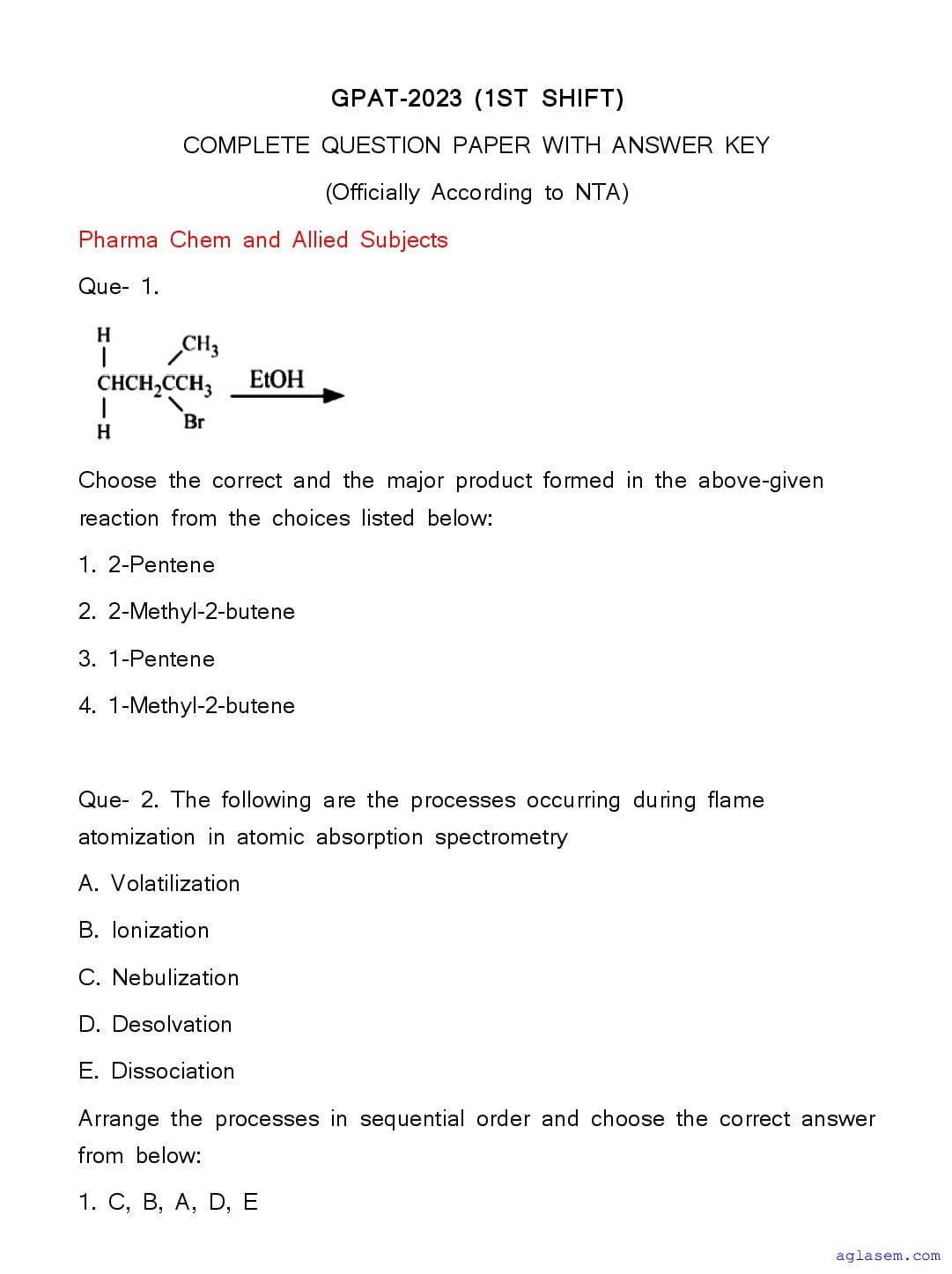
Que- 1.
Choose the correct and the major product formed in the above-given
reaction from the choices listed below:
1. 2-Pentene
2. 2-Methyl-2-butene
3. 1-Pentene
4. 1-Methyl-2-butene
Que- 2. The following are the processes occurring during flame
atomization in atomic absorption spectrometry
A. Volatilization
B. Ionization
C. Nebulization
D. Desolvation
E. Dissociation
Arrange the processes in sequential order and choose the correct answer
from below:
1. C, B, A, D, E
Page 2
3. A. C. D. B. E
4. C, D, A, E, B
Que- 3. A mixture of p-anisaldehyde and formaldehyde in the presence
of concentrated sodium hydroxide results in:
1. p-Methoxy sodium benzoate
2. Sodium-p-methoxy benzene
3. P-Methoxy benzyl alcohol
4. p-Methoxy benzoyl alcohol
Que- 4. Which one of the following compound is a precursor for the
biosynthesis of cholesterol?
1. Progesterone
2. Lanosterol
3. Cholic acid
4. Coprostanol
Que- 5 Which one among the following drugs has the IUPAC name,
𝑎, 𝑎, 𝑎, 𝑎 - tetramethyl 5- (1 H-1,2,4-triazole- 1-ylmethyl)-1,3-
benzenediacetonitrile :
1. Letrozole
2. Anastrozole
3. Exemestane
4. Aminoglutethimide
Page 3
presence of glacial acetic yields :
1. Naphthalene-1,4-dione
2. 4-Hydroxynaphthalen-1(4H)-one
3. Naphthalene-1,2-dione
4. 1-Hydroxynaphthalen-2(1H)-one
Que- 7. Platinum electrode surrounded by an outer tube, in which
hydrogen passes entering through side inlet and escaping at the bottom
through the test solution, is called as :
1. Silver electrode
2. Calomel electrode
3. Standard hydrogen electrode
4. Indicator electrode
Que- 8. Which of the following gives correct rank order from fastest to
slowest of the relative rates in SN2 reaction of methyl bromide, tert-butyl
bromide, isopropyl bromide and ethyl bromide :
1. Methyl bromide > Ethyl Bromide > Isopropyl bromide > tert-Butyl
bromide
2. tert-Butyl bromide > Isopropyl bromide > Ethyl Bromide > Methyl
bromide
3. Ethyl bromide > Methyl Bromide > Isopropyl bromide > tert-Butyl
bromide
4. Methyl bromide > Ethyl Bromide > tert-Butyl bromide > Isopropyl
bromide
Page 4
"pyrimidine and related compounds"
1. 5-Flurouracil, Tegafur, Decitabine, 5-Azacytidine
2. 5-Flurouracil, Tegafur, Decitabine, Clofarabine
3. Tegafur, Decitabine, 5-Azacytidine, Clofarabine
4. Tegafur, Decitabine, 5-Azacytidine, Pentostatin
Que- 10. E2 elimination converts neomenthyl chloride into a mixture of
the following compounds:
1. 3-menthene (75%) and 2-menthene (25%)
2. 4-menthene (75%) and 2-menthene (25%)
3. 3-menthene (25%) and 5-menthene (75%)
4. 1-menthene (50%) and 3-menthene (50%)
Que- 11. Ethyl-2 (p-chlorophenoxy)-2-methyl propionate is IUPAC name
of :
1. Fenofibrate
2. Colestipol
3. Clofibrate
4. Colesevelam
Que- 12. Identify the vibrational modes shown by sulfur dioxide molecule
in IR spectroscopy:
1. Symmetric stretching and asymmetric stretching
2. Symmetric stretching and scissoring
Page 5
4. Symmetric stretching, asymmetric stretching and scissoring
Que- 13. Establishing a complete structure of _____ is more complex
problem than others.
1. polysaccharide
2. protein
3. nucleic acid
4. peptide
Que- 14. Which one is not the characteristics of the Hexose
Monophosphate Pathway?
1. It produces CO2
2. It requires ATP for phosphorylation
3. It is controlled by inhibition of glucose-6 phosphate dehydrogenase by
NADPH
4. It produces ribose-5-phosphate
Que- 15
Select the correct product A of the above-given reaction from the four
choices given below :
Page 6
1. Raoult
2. Ostwald
3. Henry
4. Van't Hoff
Que- 17. Dipole-dipole weak interactions are also called as :
1. London forces
2. Debye interactions
Page 7
4. Keesom forces
Que- 18. The perfect orientation for a Diels-Alder reaction between the
reactants is:
1. Diene should be S-cis and reaction endo facing
2. Diene should be S-cis and reaction exo facing
3. Diene should be S-trans and reaction endo facing
4. Diene should be S-trans and reaction exo facing
Que- 19. How would you prepare 2000 mL of 0.15 M NaOH aqueous
solution?
1. Dissolve 12 g of NaOH in distilled water and dilute to 2000 mL
2. Dissolve 15 g of NaOH in distilled water and dilute to 2000 mL
3. Dissolve 10 g of NaOH in distilled water and dilute to 2000 mL
4. Dissolve 7.5 g of NaOH in distilled water and dilute to 2000 mL
Que- 20. Given below are two statements, one is labelled as Assertion
and the other is labelled as Reason
Assertion (A): The disadvantage of atomic absorption spectroscopy is the
need for each element to be analysed. https://www.pyqonline.com
Reason (R): As atomic absorption spectrophotometer uses different
halocathode lamp for each element, it is very specific for an individual
element under test.
In light of the above statements, choose the correct answer from the
options given below :
Page 8
2. Both A and R are true but R is NOT the correct explanation of A
3. A is true but R is false
4. A is false but R is true
Que- 21. In context to voltametry, which of the following statement is
false?
1. Technique can be used to analyse organic compounds containing
carbonyl groups
2. Organic solvents cannot be used as aqueous organic mixture in this
technique
3. Immuno sensors are available in voltametry
4. Triangular waveform is used for excitation of solution in cyclic
voltametry
Que- 22. Choose the correct order of decreasing dielectric constant :
1. Water > Formamide > Methanol > Acetone
2. Water > Methanol > Acetone > Formamide
3. Formamide > Acetone > Methanol > Water
4. Formamide > Water > Methanol > Acetone
Que- 23. How many optical isomers are possible for lactic acid?
1. 2
2. 4
3. 6
4. 8
Page 9
1. Haloperidol
2. Clozapine
3. Thioridazine
4. Fluphenazine
Que- 25.
Predict the wavelength of absorption band in the UV spectrum of the
above shown structure:
1. 252 nm
2. 248 nm
3. 244 nm
4. 240 nm
Que- 26. Identify what is not a continuum source of radiation for use in
absorption and fluorescence spectrophotometers
1. Argon arc lamp
2. Hollow-cathode lamp
3. Deuterium lamp
4. Xenon arc lamp
Que- 27. The molecular formula of purine is:
1. C5H4N4
Page 10
3. C7H6N2
4. C4H3N5
Que- 28. Match List I with List II
LIST I LIST II
Name of Vitamin Functions of Vitamins
A. Riboflavin I. The electron acceptor for isocitrate
dehydrogenase
B. Niacin II. Decarboxylation of alpha-ketoglutarate
dehydrogenase
C. Thiamine III. Part of coenzyme A
D. Pantothenic acid IV. Cofactor for succinate dehydrogenase
V. Enzyme activity regulator, such as for
protein kinase C
Choose the correct answer from the options given below:
1. A-IV, B-I, C-II, D-III
2. A-III, B-II, C-IV, D-V
3. A-I, B-III, C-IV, D-II
4. A-II, B-V, C-I, D-IV
Que- 29. Electrophilic substitution reaction of pyridine, when carried out
in the presence of KNO3 and conc. H2SO4 at 300°C, leads to the
formation of:
1. 4-Nitropyridine
2. 3-Nitropyridine
Page 11
4. N-nitro pyridinium salt
Que- 30. A reagent may attach itself to a conjugated diene to the
carbons at the two ends of the conjugated system. Identify the reaction
involved from the following:
1. 1.2-addition
2. 1,4-addition
3. 1.3-addition
4. 2.4-addition
Que- 31. Invert sugar is a product obtained by the hydrolysis of:
1. Maltose
2. Sucrose
3. Lactose
4. Dextrin
Que- 32. Following groups exert anyone of the effects on electrophilic
aromatic substitution
Identify whether all three are :
1. Weakly activating
2. Deactivating
3. Moderately activating
4. Strongly activating
Page 12
1. Guanine and cytosine
2. Adenine and guanine
3. Thymine and uracil
4. Adenine and uracil
Que- 34. The correct rank order of orientation of sulfonation in toluene
is:
1. 4-methylbenzenesulfonic acid > 2-methylbenzenesulfonic acid > 3-
methylbenzenesulfonic acid
2. 2-methylbenzenesulfonic acid > 3-methylbenzenesulfonic acid > 4-
methylbenzenesulfonic acid
3. 3-methylbenzenesulfonic acid > 4-methylbenzenesulfonic acid > 2-
methylbenzenesulfonic acid
4. 3-methylbenzenesulfonic acid > 2-methylbenzenesulfonic acid > 4-
methylbenzenesulfonic acid
Que- 35. Lucas test is very rapid with :
1. 10 alcohol
2. 20 alcohol
3. 30 alcohol
4. Phenol
Que- 36. Following is not an example of carbapenem
1. Thienamycin
2. Imipenem
Page 13
4. Meropenem
Que- 37. As the solution of a strong electrolyte is diluted, the following
phenomenon is observed:
1. The specific conductance decreases and equivalent conductance
increases
2. The specific conductance increases and equivalent conductance
decreases
3. Both specific conductance and equivalent conductance increase
4. Both specific conductance and equivalent conductance decrease
Que- 38. The molecule having zero dipole moment is
1. BF3
2. HF
3. NH3
4. CH3Cl
Pharmaceutics and Allied Subjects -
Que- 1. The time taken at a fixed temperature or the radiation dose
required to achieve a 90% reduction in viable bacterial cells is called:
1. F value
2. Z value
3. D value
4. T value
Page 14
1. Blood
2. Individual organ
3. Extracellular fluid
4. Hypothetical pool of tissue
Que- 3. Which of the following pharmaceutical solvent has the highest
dielectric constant, at 25 degree C ?
1. Glycerin
2. Ethanol
3. Acetone
4. Phenol
Que- 4. Kozeny Carmen equation is used to determine the
1. surface area of the powder
2. viscosity of a liquid
3. surface tension of a liquid
4. density of a liquid
Que- 5. Which of the following emulsifiers has the highest HLB value?
1. Span 80
2. Acacia
3. Tween 80
4. Sodium lauryl sulfate
Page 15
in emulsions?
1. Propylene glycol
2. Sorbitol
3. Tocopherol
4. Glycerol
Que- 7. Under which of the following conditions in-vitro-in-vivo correlation
for a drug fails?
1. When the drug is highly soluble
2. When the drug's absorption takes place by a complex process
3. When the dissolution medium is adequately simulated
4. When the drug is highly permeable but poorly soluble
Que- 8. A crystalline powder that contains water of crystallization or
hydration; this water can be liberated either during manipulations or an
exposure to a low - humidity environment -- then the powder will
become sticky and pasty, or it may even liquefy. Such a powder is
called:
1. Eutectic
2. Hygroscopic
3. Deliquescent
4. Efflorescent
Que- 9. Out of the following solvents which one is not a polar solvent?
1. Ethanol
2. Methanol
Page 16
4. Water
Que- 10. Which of the following Urinary Tract Anti-Infective agents
requires an acidic pH of urine for optimum action?
1. Gentamicin
2. Erythromycin
3. Carbenicillin
4. Streptomycin
Que- 11. Which of the following molecular properties can be determined
by Thermogravimetric Analysis?
1. Solubility
2. Hygroscopicity
3. Colour stability
4. Hydrolysis
Que- 12. Which of the following levels of IVIVC is represented by "the
relationship between one dissolution time point (e.g. t 50%) and one
mean pharmacokinetic parameter, such as AUC, Tmax or Cmax" ?
1. Level A
2. Level B
3. Level C
4. Level D
Page 17
parental packaging?
1. Type I
2. Type II
3. Type III
4. Type IV
Que- 14. The difference in velocity between two planes of liquids
separated / infinitesimal distance is called
1. Rate of shear
2. Rate of flow
3. Rate of force
4. Shearing stress
Que- 15. The required amount of adjusting substance required to make a
hypotonic solution, isotonic is given by the (where, W = adjusting
substance, a = freezing point depression of unadjusted solution and b =
freezing point depression of water):
1. 𝑊 =
𝑎−0.52
𝑏
2. 𝑊 =
0.52−𝑎
𝑏
3. 𝑊 =
0.52−𝑏
𝑎
4. 𝑊 =
𝑏−0.52
𝑎
Que- 16. Which of the following is the common chemical name for
Propellant 11?
1. Trichloromonofluoromethane
2. Dichlorodifluoromethane
Page 18
4. Chloropentafluoroethane
Que- 17. A component of film-coating solution to make film more pliable,
enhance spread over tablets, beads and granules, is called :
1. Adsorbent
2. Humectant
3. Stiffening agent
4. Plasticizer
Que- 18. Match the following List I with List II with respect to most
specific Activity / Property in formulation of disperse system
LIST I LIST II
Formulation Ingredient Activity/Property
A. Salts of d-glucuronic acid I. Are pseudoplastic and plastic in
polypeptides and amino acids nature
B. Surfactants, both ionic and II. Form a multimolecular film around
nonionic the dispersed droplets of oil in an o/w
emulsion
C. Magnesium aluminium III. Emulsifier belonging to the class of
silicate solid particles forms w/o emulsion
D. Structured vehicles IV. Emulsifier belonging to the class
of IV. solid particles and forms o/w
emulsion
V. Have been used to bring about
flocculation of suspended particles
Page 19
1. A-II, B-V, C-IV, D-I
2. A-V, B-IV, C-II, D-I
3. A-V, B-IV, C-III, D-I
4. A-IV, B-III, C-II, D-I
Que- 19. Match the process of reproduction and genetic exchange under
column I with the explanation under column II
Match List I with List II
LIST I LIST II
Process of reproduction and genetic Explanation
exchange
A. Binary Fision I. Transfer of genetic material from
the donor to recipient bacterium
through cell contact
B. Transformation II. Common vegetative reproduction
C. Transduction III. Transfer of genetic material in
bacteria through virus
D. Conjugation IV. Horizontal gene transfer by
taking up of foreign genetic material
(naked DNA)
Choose the correct answer from the options given below:
1. A-I, B-III, C-IV, D-II
2. A-III, B-I, C-IV, D-II
3. A-II, B-IV, C-I, D-III
4. A-II, B-IV, C-III, D-I
Page 20
usually flavoured to enhance their palatability, are called :
1. Aromatic waters
2. Elixirs
3. Syrups
4. Tinctures
Que- 21. Which of the following Climatic Zones (as per WHO Criteria)
refers to "hot and humid climate"?
1. Zone I
2. Zone II
3. Zone III
4. Zone IV
Que- 22. Given below are two statements, one is labelled as Assertion A
and the other is labelled as Reason R
Assertion A: Exotoxins diffuse freely through the bacterial cell wall into
the medium in which the organisms are growing
Reason R: They are water soluble and can pass into the surrounding
medium
In the light of the above statements, choose the correct answer from the
options given below:
1. Both A and R are true and R is the correct explanation of A
2. Both A and R are true but R is NOT the correct explanation of A
3. A is true but R is false
4. A is false but R is true
Page 21
mixing 5 L of 25%, 3 L of 40% and 2 L of 15% alcohol?
1. 27.5% v/v
2. 30.5% v/v
3. 25.5% v/v
4. 26.5% v/v
Que- 24. For disguising the astringent and metallic taste of iron salts in
children's mixture, the following flavoring agent in used
1. Orange syrup and compound orange syrup
2. Lemon syrup
3. Liquorice liquid extract
4. Aromatic water
Que- 25. A tablet excipient, whose function is to ensure that tablet
formulation and ejection can occur with low friction between the solid
and the die wall, is called:
1. Glidant
2. Lubricant
3. Anti-adhesive
4. Binder
Que- 26. Clatharates crystallize in the form of
1. channel type structure
2. tetragonal type structure
3. cubic type lattice
4. cage like lattice
Page 22
1. Yellow ointment, USP
2. Hydrophilic petrolatum USP
3. Hydrophilic ointment USP
4. PEG ointment NF
Que- 28. Which of the following drugs has an apparent volume of
distribution approximately 6500 litres?
1. Amoxicillin
2. Ibuprofen
3. Chloroquine
4. Diazepam
Que- 29. Which of the following surfactants is an ANIONIC surfactant?
1. Lecithin
2. Sorbitan esters
3. Benzalkonium chloride
4. Soaps
Que- 30. Match the following concept in List I with parameters in List II
LIST II LIST I
Concept Parameters
A. Volume of Distribution I. Measure volume of real physiological plasma
B. Evans Blue II. Human serum albumin
C. 3.5-5% III. Volume of blood
Page 23
concentration
V. Protein present in kidney to bind metal
Choose the correct answer from the options given below:
1. A-I. B-II, C-III, D-IV
2. A-V, B-IV, C-III, D-II
3. A-IV, B-I, C-II, D-V
4. A-III, B-II, C-IV. D-V
Que- 31. Basic dyes are used in microbiological staining. Which of the
following statement is wrong about mechanism of staining?
1. The positive ions on the surface of bacteria form a colored complex
with the dye
2. Ionic exchange between the negative charge on the bacteria and
positive charge of dye takes place
3. Ionic exchange between the positive charge on the bacteria and
negative charge of dye takes place
4. The neutral charge on the surface of bacteria forms a colored
complex with the basic dye
Que- 32. Which of the following terms is used to describe the "partial or
complete separation of the top or body crowns of a tablet from the main
body of the tablet"?
1. Lamination
2. Capping
3. Picking
4. Mottling
Page 24
equivalent" ?
Match List I with List II
Tablet Tablet Tablet Tablet
Ingredient Function
A B C D
A. Acetaminophen I. Drug 300 mg --- 300 mg 300 mg
B. Aspirin II. Drug --- 300 mg --- ---
C. Loctose III. Filler 100 mg 100 mg --- 100 mg
D. Avicel IV. Filler --- --- 100 mg ---
Starch Disintegrant 50 mg 50 mg --- 50 mg
Avicel Disintegrant --- --- 50 mg ---
Mag stearate Lubricant 2 mg 2 mg 2 mg 2 mg
Gelatin Binder 10 mg 10 mg 10 mg 10 mg
Choose the correct answer from the options given below:
1. A and B
2. B and C
3. A and C
4. B and D
Que- 34. What is the approximate amount of Powder (in mg) that can
be filled in empty gelatin capsules of size 00?
1. 1040 mg
2. 650 mg
3. 325 mg
4. 162 mg
Page 25
1. Nernst Equation
2. Stoke's Equation
3. Young's Equation
4. Laplace Equation
Que- 36. In the Langmuir Isotherm, following statements are true except
one:
1. The layer of the gas adsorbed on the solid adsorbent is one molecule
thick
2. Adsorbed layer is uniform all over adsorbent
3. No desorption takes place when gas strikes solid surface
4. No interaction between the adjacent adsorbed molecules takes place
Que- 37. In absence of instruction by the prescriber, unless otherwise
directed, the dose given for the mixture preparation should be stated on
the label as https://www.pyqonline.com
1. One five ml spoonful to be taken three times a day in water
2. Two five ml spoonful to be taken three times a day in water
3. Two five ml spoonful to be taken two times a day in water
4. One five ml spoonful to be taken two times a day in water
Que- 38. Suspensions containing a high percentage (about 50% or
greater) of small, deflocculated particles would show which of the
following flow properties?
1. Plastic flow
Page 26
3. Newtonian flow
4. Pseudoplastic flow
Pharmacognosy and Allied Subjects -
Que- 1. Which one is the right sequence of the intermediates in the
biosynthesis of opium alkaloids-
A. Tyrosine
B. Reticuline
C. Codeine
D. Morphine
E. Thebaine
Choose the correct answer from the options given below:
1. A. B. C. D. E
2. A. B. E. C. D
3. A. B. E. D. C
4. A, B, D, E, C
Que- 2. Arrange the following intermediates in the synthesis of
isoprenoids in the right sequence
A. Squalene
B. Farnesyl PP
C. Geranyl PP
D. Acetyl CoA
E. Mevalonate
Page 27
1. D. B. C. A. E
2. D, E, C, B, A
3. B, C, D, A. E
4. E. B. C. A. D
Que- 3. If the resins contain benzoic acids or cinnamic acids they are
called:
1. Colophony
2. Balsams
3. Glucoresins
4. Resene
Que- 4. Lycopodium spores are used in quantitative microscopy for the
following:
A. Determine % purity of drugs
B. Estimation of percentage of foreign organic matter
C. Determination of palisade ratio
D. Measurement of area of single layered tissue
Choose the correct answer from the options given below:
1. A. B and C only
2. A, B and D only
3. A only
4. B and D only
Page 28
1. Indole
2. Purine
3. Phenanthrene
4. Imidazole
Que- 6. Isabgol belongs to family
1. Apocynaceae
2. Plantaginaceae
3. Solanaceae
4. Golaceae
Que- 7. Lignin is a complex polymer which can be stained pink in the
tissue using the following chemicals
1. Chloral Hydrate and Phloroglucinol
2. Chlor-Zinc-Iodine
3. Phloroglucinol and hydrochloric acid
4. Chloral Hydrate, Zinc and Ammonia
Que- 8. Match the following Ayurvedic formulations under Column I with
the process/properties under Column II and choose the correct options.
LIST I LIST II
Ayurvedic formulations Process or Property
A. Bhasma I. Semisolid
B. Arista II. Calcination
C. Churna III. Alcohol generation
Page 29
V. Decoction
Choose the correct answer from the options given below:
1. A-I. B-III. C-IV. D-V
2. A-III. B-II. C-I. D-IV
3. A-III. B-V, C-I, D-II
4. A-II, B-III, C-IV, D-I
Que- 9. Match the types of glycosides under Column I with their
respective examples under Column II and choose the correct option
Column I Column II
Glycosides Examples
A. Anthracene I. Digitalis
B. Cardiac II. Licorice
C. Saponin III. Senna
D. Cyanogenetic IV. Ashwagandha
V. Bitter Almond
Choose the correct answer from the options given below:
1. A-III, B-I, C-II, D-V
2. A-V, B-I. C-II, D-III
3. A-IV. B-II. C-I, D-III
4. A-II, B-III, C-IV, D-I
Que- 10. Quinine and quinidine differs in
1. Chemical nature
Page 30
3. Rotating the plane of polarized light
4. Precusors of biosynthesis
Pharmacology and Allied Subjects -
Que- 1. Trastuzumab is a/an
1. EGFR/HER2 inhibitor
2. Angiogenesis inhibitor
3. EGF receptor (HER 1) inhibitor
4. BCR-ABL tyrosine kinase inhibitor
Que- 2. When is a New Drug Application (NDA) made?
1. Once the animal studies are done and drug is declared safe in
animals
2. Once the animal studies are done and drug is declared safe and
effective in animal studies
3. After the phase III clinical trials
4. After the phase IV clinical trials
Que- 3. Identify the drug that is not among the drugs recommended as
first time drug in the treatment of Partial seizers with or without
generalization.
1. Carbamazepine
2. Valproate
3. Diazepam
4. Lamotrigine
Page 31
1. Nicotinic acid
2. Fenofibrate
3. Atorvastatin
4. Ezetimibe
Que- 5. All the following are TNF-a Inhibitors except
1. Etanercept
2. Infliximab
3. Adalizumab
4. Basiliximab
Que- 6. Match the following cells of immune system List I with their
functions List II.
LIST I LIST II
Immune system Functions
A. Mast cells I. Master of Immune system
B. Lymphocytes II. Allergic reactions
C. T-cells III. Cell mediated immune reactions
D. Monocytes-Macrophages IV. Antigen recognition, Phagocytosis
Choose the correct answer from the options given below:
1. A-I, B-II, C-III, D-IV
2. A-II, B-I, C-III, D-IV
3. A-III, B-I, C-II, D-IV
4. A-I, B-III, C-II, D-IV
Page 32
cycloplegia?
1. Atropine
2. Tropicamide
3. Homatropine
4. Ephedrine
Que- 8. What do you mean by Orphan Drug?
1. A drug meant to be distributed among the orphans who can not afford
the cost of the drug
2. A drug for a disease which is not having any other treatment options
at all
3. A drug which is useful for rare disease
4. A drug that is available in abundance
Que- 9. Normal value of HbA1c falls in the range of:
1. 0.1% to 0.8%
2. 6.5% to 7.5%
3. 21.5% to 24.5%
4. 51.5% to 53.5%
Que- 10. A 70 kg woman was administered 1000 mg of the drug as i.v
bolus. After its uniform distribution in the body, the plasma concentration
of the drug was found to be 50 mg/L. What is its volume of distribution?
1. 70L
2. 500L
Page 33
4. 0.1L
Que- 11. A hypertensive patient receiving a drug 'Y' for managing BP
was prescribed a tricyclic antidepressant. As a result, there was an
abolition of the antihypertensive action of 'Y'. Which of the following drug
could be 'Y'?
1. Atenolol
2. Captopril
3. Clonidine
4. Diltiazem
Que- 12. Put the events of acute inflammation in proper sequence.
1. Accumulation of fluid and plasma at the affected site, intravascular
activation of platelets, polymorphonuclear neutrophils, followed by healing
2. Polymorphonuclear neutrophils, accumulation of fluid and plasma at
the affected site, intravascular activation of platelets, followed by healing
3. Accumulation of fluid and plasma at the affected site,
polymorphonuclear neutrophils, intravascular activation of platelets,
followed by healing https://www.pyqonline.com
4. Intravascular activation of platelets, polymorphonuclear neutrophils,
accumulation of fluid and plasma at the affected site, followed by healing
Que- 13. Which of the following is NOT an example of an mTOR
inhibitor?
1. Everolimus
2. Tacrolimus
Page 34
4. Sirolimus
Que- 14. Alzheimer's disease is mainly because of the neurodegeneration
of the following part of the brain
1. Hypothalamus
2. Midbrain
3. Hippocampus
4. Cerebellum
Que- 15. Which of the following has been found to act as a male
contraceptive without affecting libido and potency?
1. Cyproterone
2. Gossypol
3. Centchroman
4. Goserelin
Que- 16. Choose the most appropriate statement for the Peptic ulcer
disease caused by NSAIDs.
1. H2 antagonists offer rapid healing of ulcer provided the NSAID is
discontinued.
2. H2 antagonists offer rapid healing.
3. Proton Pump Inhibitor is to be given only if the NSAID is
discontinued.
4. NSAIDs are strictly contraindicated with Proton Pump Inhibitors.
Page 35
1. Vision
2. Hearing
3. Olfaction
4. Gustation
Que- 18. Which of the following drug used in the chemotherapy of some
types of leukemia, satisfies the statements -
Statement I : It is effective orally.
Statement II : It has near 100% oral bioavailability.
In light of the above statements, choose the correct answer from the
options given below:
1. Asparaginase
2. Doxorubicin
3. Mitomycin
4. Hydroxyurea
Que- 19. Given below are two statements:
Statement I : In vasospastic angina, the imbalance occurs when the
myocardinal oxygen requirement increases, as during exercise, and
coronary blood flow does not increase proportionately.
Statement II : In Prinzmetal's angina, oxygen delivery decreases as a
result of reversible coronary vasospasm. https://www.pyqonline.com
In light of the above statements, choose the most appropriate answer
from the options given below:
1. Both Statement I and Statement II are correct
2. Both Statement I and Statement II are incorrect
Page 36
4. Statement I is incorrect but Statement II is correct
Que- 20. In ECG, the P wave corresponds to the following event
1. Atrial depolarisation
2. Ventricular depolarisation
3. Atrial repolarisation
4. Ventricular repolarisation
Que- 21. Which of the following is a tetracyclic antidepressant that has
additional dopamine D2 receptor blocking and neuroleptic properties, as
well as a greater tendency to cause seizures in overdose?
1. Dothiepin
2. Doxepin
3. Trazodone
Dropped
4. Amoxapine
Que- 22. Which of the following cranial nerve helps in accommodating
the eye for near vision?
1. Oculomotor
2. Optic
3. Trochlear
4. Facial
Que- 23. Which of the following is true for bone tissue cell differentiation
and maturation?
1. Osteogenic → Osteoblasts → Osteocytes
2. Osteogenic → Osteoblasts → Osteoclasts
Page 37
4. Osteoclasts → Osteoblasts → Osteocytes
Que- 24. A drug 'X' is more selective for the al subunit of BZD
receptors. It lacks effect on slow-wave sleep, minimum residual daytime
sedation, no rebound insomnia on discontinuation, low abuse potential.
Which of the following can be 'X'? https://www.pyqonline.com
1. Flurazepam
2. Flumazenil
3. Melatonin
4. Zolpidem
Que- 25. Which of the following is a fourth-generation cephalosporin?
1. Ceftriaxone
2. Cefaclor
3. Cefuroxime
4. Cefepime
Que- 26. Which of the following metabolite is used to inactivate the
vasicotoxic metabolites leading to hemorrhagic cystitis by alkylating
agents used in the treatment of cancer?
1. Acroline
2. Aldophosphamide
3. Cyclophosphamide
4. Mesna
Que- 27. All the following are true with Metoclopramide except:
1. 5-HT1 receptor antagonist
Page 38
3. 5-HT3 receptor antagonist
4. 5-HT4 receptor agonist
Que- 28. Given below are two statements.
Statement I : Levodopa is metabolized peripherally but capable of
crossing Blood Brain Barrier, thus a best drug in treating Parkinsonism.
Statement II : Carbidopa crosses Blood Brain Barrier, thus a best
combination for protecting levodopa in CNS.
In light of the above statements, choose the correct answer from the
options given below:
1. Both Statement I and Statement II are true
2. Both Statement I and Statement II are false
3. Statement I is true but Statement II is false
4. Statement I is false but Statement II is true
Other Subjects -
Que- 1. Match List I with List II
LIST I LIST II
Fermentation Products Strain used
A. Dextran I. Clostridium tetani
B. Bacterial amylase II. Brevibacterium sp.
C. Glutamic acid III. Leuconostoc mesenteroides
D. Vitamin B12 IV. Bacillus subtilis
V. Streptomyces olivaceus
Page 39
1. A-V, B-I, C-IV, D-III
2. A-I. B-IV, C-II, D-III
3. A-II. B-III, C-V, D-IV
4. A-III, B-IV, C-II, D-V
Que- 2. The formula to calculate liquid pressure is
1. P = mgh
2. P = wgh
3. P = pgh
4. P = Fgh
Que- 3. Drugs covered under this schedule are not permitted for
repacking license. Identify the correct schedule.
1. Schedule H
2. Schedule G
3. Schedule O
4. Schedule C and C1
Que- 4. Requirements of factory premises for the manufacture of
cosmetics are mentioned, in the Drugs and Cosmetics Rules, 1945 under
1. Schedule M
2. Schedule M-1
3. Schedule M-2
4. Schedule M-3
Page 40
LIST I Schedule LIST II Covers the
A. Schedule Y I. Shelf life of drugs
B. Schedule FF II. Requirements for clinical trials
C. Schedule O III. Disinfectant liquids
D. Schedule P IV. Ophthalmic ointments
Choose the correct answer from the options given below:
1. A-I, B-II, C-III, D-IV
2. A-II, B-III, C-IV, D-I
3. A-IV, B-III, C-II, D-I
4. A-II, B-IV, C-III, D-I
Que- 6. Which of the following represents a complete list of products
that are offered by a company for Sale?
1. Product Variety
2. Product Mix
3. Product Item
4. Product Line
Que- 7. Shift from 'try my product' to 'prefer my brand' marketing
strategy is done at what stage of product life cycle?
1. Introduction
2. Growth
3. Maturity
4. Decline
Page 41
1. Subunit vaccine
2. Toxoid vaccine
3. Recombinant protein vaccine
4. Conjugate vaccine
Que- 9. The most efficient heat exchange between the particles and
flowing air occurs in the ______
1. Tray dryer
2. Vaccum Dryer
3. Fluidized bed dryer
4. Rotary dryer
Que- 10. The drug price control order (DPCO) is an order issued by the
Government under the ______ which enables it to fix the prices of some
essential bulk and their formulations
1. Essential Commodities Act
2. Essential Commodities Amendment
3. Essential Commodities Accessories
4. Ethical Commodities Act
Que- 11. According to IP and BP very fine powder is one in which.......
1. All particles pass through 120# sieve
2. 90% particles pass through 350# sieve
3. All particles pass through 350# sieve
4. 90% particles are of size < 10um
Page 42
Pharma Chem and Pharmaceutics and Pharmacognosy and Pharmacology and Other Subjects
Allied Subjects Allied Subjects Allied Subjects Allied Subjects
1. (2) 1. (3) 1. (4) 1. (1) 1. (4)
2. (4) 2. (4) 2. (2) 2. (3) 2. (3)
3. (3) 3. (1) 3. (2) 3. (3) 3. (4)
4. (2) 4. (1) 4. (3) 4. (1) 4. (3)
5. (2) 5. (4) 5. (1) 5. (4) 5. (4)
6. (1) 6. (3) 6. (2) 6. (2) 6. (4)
7. (3) 7. (1) 7. (3) 7. (4) 7. (2)
8. (1) 8. (4) 8. (4) 8. (3) 8. (4)
9. (1) 9. (3) 9. (1) 9. (2) 9. (3)
10. (1) 10. (3) 10. (3) 10. (3) 10. (1)
11. (3) 11. (2) 11. (3) 11. (1)
12. (1) 12. (3) 12. (1)
13. (1) 13. (4) 13. (2)
14. (2) 14. (1) 14. (3)
15. (4) 15. (2) 15. (2)
16. (1) 16. (1) 16. (2)
17. (4) 17. (3) 17. (1)
18. (1) 18. (2) 18. (4)
19. (1) 19. (4) 19. (2)
20. (3) 20. (2) 20. (1)
21. (2) 21. (4) 21. ( )
22. (2) 22. (1) 22. (1)
23. (2) 23. (1) 23. (1)
24. (2) 24. (1) 24. (4)
25. (4) 25. (2) 25. (4)
26. (2) 26. (4) 26. (4)
27. (1) 27. (2) 27. (1)
28. (1) 28. (3) 28. (3)
29. (2) 29. (4)
30. (2) 30. (3)
31. (2) 31. (4)
32. (3) 32. (2)
33. (2) 33. (3)
34. (1) 34. (2)
35. (3) 35. (3)
36. (3) 36. (3)
37. (1) 37. (2)
38. (1) 38. (2)
Document Details
| Board / Org | NTA |
| Exam | Graduate Pharmacy Aptitude Test |
| Type | Question Paper |
| Pages | 42 |
| Updated | 24 Sep 2026 |