GPAT 2023 Question Paper Shift 2
Finished viewing? Save it for later —
Download GPAT 2023 Question Paper Shift 2 (PDF · 39 pages)About GPAT 2023 Question Paper Shift 2
GPAT 2023 Question Paper Shift 2 is available here for free download. Published by NTA for Graduate Pharmacy Aptitude Test, this question paper can be viewed online or downloaded as a PDF (39 pages). Candidates preparing for Graduate Pharmacy Aptitude Test can use GPAT 2023 Question Paper Shift 2 to understand the exam pattern, the type of questions asked, and the overall difficulty level.
Frequently Asked Questions
How can I download GPAT 2023 Question Paper Shift 2?
Open this page and click the Download button to save GPAT 2023 Question Paper Shift 2 as a PDF. It is completely free on AglaSem Docs.
Is GPAT 2023 Question Paper Shift 2 free to download?
Yes. GPAT 2023 Question Paper Shift 2 can be viewed online and downloaded as a PDF free of cost on AglaSem Docs.
How many pages does GPAT 2023 Question Paper Shift 2 have?
GPAT 2023 Question Paper Shift 2 contains 39 pages, which you can read online or download together as a single PDF.
Where can I find more Graduate Pharmacy Aptitude Test study material?
You can find more Graduate Pharmacy Aptitude Test question papers, sample papers, syllabus, and answer keys on AglaSem Docs.
GPAT 2023 Question Paper Shift 2 – Text
Read the full text of this question paper below — useful to quickly search, copy and reference the content online without downloading the PDF.
📄 View text version (39 pages)
Page 1
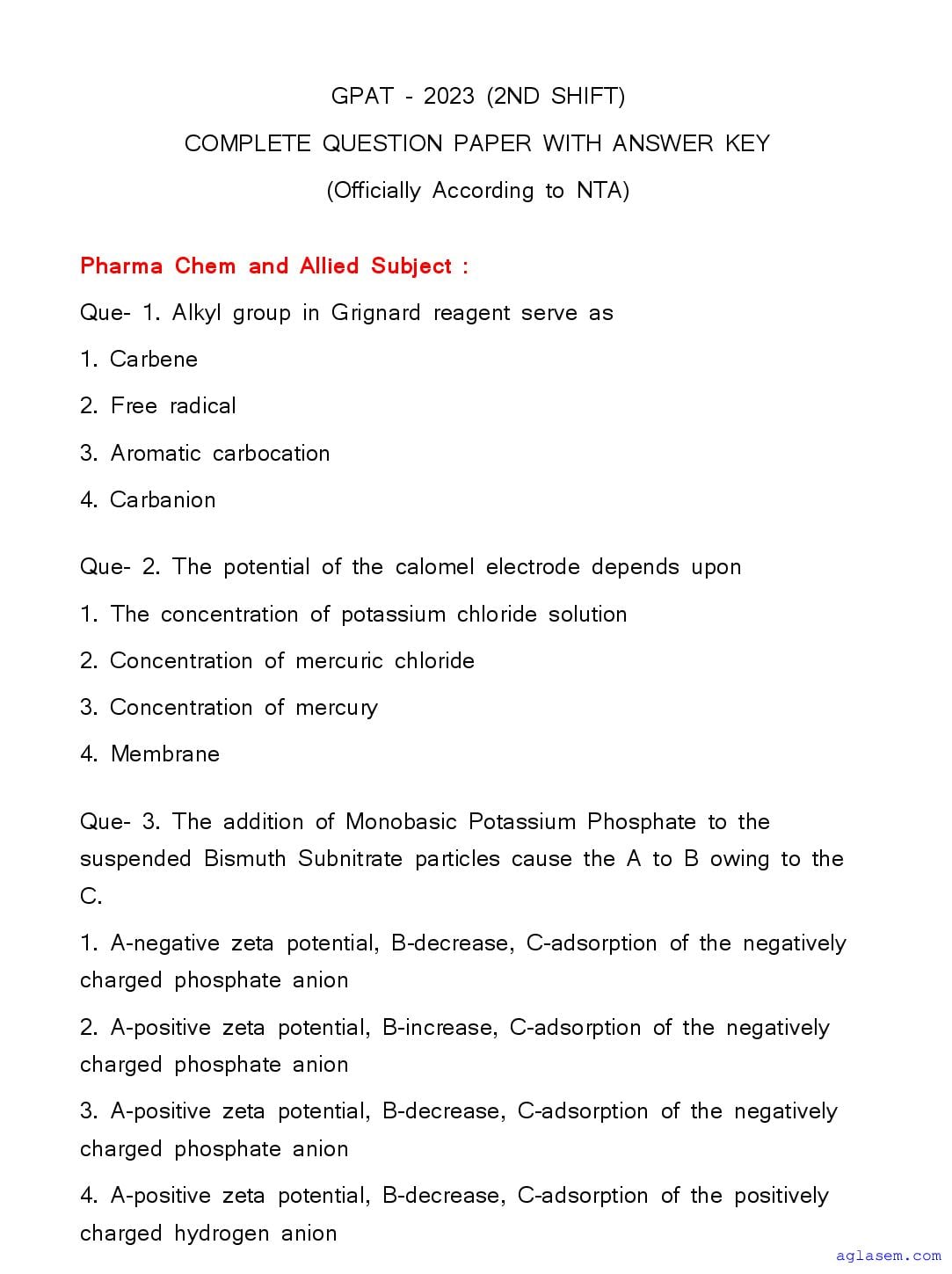
COMPLETE QUESTION PAPER WITH ANSWER KEY
(Officially According to NTA)
Pharma Chem and Allied Subject :
Que- 1. Alkyl group in Grignard reagent serve as
1. Carbene
2. Free radical
3. Aromatic carbocation
4. Carbanion
Que- 2. The potential of the calomel electrode depends upon
1. The concentration of potassium chloride solution
2. Concentration of mercuric chloride
3. Concentration of mercury
4. Membrane
Que- 3. The addition of Monobasic Potassium Phosphate to the
suspended Bismuth Subnitrate particles cause the A to B owing to the
C.
1. A-negative zeta potential, B-decrease, C-adsorption of the negatively
charged phosphate anion
2. A-positive zeta potential, B-increase, C-adsorption of the negatively
charged phosphate anion
3. A-positive zeta potential, B-decrease, C-adsorption of the negatively
charged phosphate anion
4. A-positive zeta potential, B-decrease, C-adsorption of the positively
charged hydrogen anion
Page 2
greatest florescence?
Que- 5. Conversion of cyclic ketone to ring expended cyclic ester takes
place by
1. willgerodt rearrangement
2. Michael rearrangement
3. lossen rearrangement
4. Baeyer villager rearrangement
Que- 6. Which of the following is not a sulphonamide derivative?
1. Almotriptan
2. Sumatriptan
3. Rizatriptan
4. Naratriptan
Page 3
cytochromes P enzymes absorb light at
1. 450 nm
2. 370 nm
3. 254 nm
4. 600 run
Que- 8. Carbohydrates have hydrogen oxygen atom ratio of
1. 1:2
2. 3:1
3. 1:3
4. 2:1
Que- 9. Identify A, B and C in below reaction
1. A = Br2, B = KOH, C = NANH2
2. A = Br2, B = HCl, C = NaNH2
3. A = Br2, B = HCl, C = NaBH4
4. A = Br2, B = KOH, C = NABH4
Que- 10. Identify intermediate forms in following substitution reaction.
Page 4
2. Cyclohexa-1,3-dien-5-yne
3. Cyclohexa-1,4-dien-5-yne
4. Cyclohexa-1.5-dien-3-yne
Que- 11. Match List I with List II
LIST I LIST II
(name of the drug) (Chemical class)
A. Zolpidem I. Cyclopyrrolone
B. Zaleplon II. Benzodiazepine
C. Zopiclone III. Imidazopyridine
D. Triazolam IV. Pyrazolopyrimidine
Choose the correct answer from the options given below:
1. (A)-(IV); (B)-(III); (C)-(II); (D)-(I)
2. (A)-(II); (B)-(IV); (C)-(III); (D)-(I)
3. (A)-(III); (B)-(IV); (C)-(I); (D)-(II)
4. (A)-(I); (B)-(III); (C)-(IV); (D)-(II)
Que- 12. Addition of HBr to 1,3-butadiene at 40°C yields
1. 80% 1,4-addition product and 20% 1,2-addition product
2. 80% 1,2-addition product and 20% 1,4-addition product
3. 80% 1,2-addition product and 20% 1,3-addition product
4. 80% 1,2-addition product and 20% 1,3-addition product
Que- 13. Which heterocyclic ring is fused to a steroidal nucleus in
Danazol?
Page 5
2. Isoxazole
3. Imidazole
4. Pyrazole
Que- 14. Which of the following factor make carbonyl group in acyl
compounds. too, susceptible to nucleophilic attack?
1. The tendency of oxygen to acquire electrons even at the expense of
gaining positive charge
2. The tendency of oxygen to acquire electrons even at the expense of
gaining negative charge
3. The tendency of carbon to loose electrons even at the expense of
gaining negative charge https://www.pyqonline.com
4. The tendency of carbon to loose electrons even at the expense of
gaining positive charge
Que- 15. In atomic absorption spectroscopy, back ground correction
performed using a single hollow cathode lamp pulsed first with a low
current and then with a high current is called
1. Smith hieftje background correction
2. Continuous source background correction
3. Zeeman effect background connection
4. Hollow cathode background correction
Que- 16. Phenol reacts with chloroform in presence of aqueous sodium
hydroxide to give chief product?
1. 2-Chloro Benzaldehyde
2. 2-Hydroxy Benzaldehyde
Page 6
4. 3-Chloro Benzaldehyde
Que- 17. Replacement of the diazonium group by halogen in presence of
copper powder is
1. Sandmeyer reaction
2. Gattermann reaction
3. Hofmann reaction
4. Gabriel reaction
Que- 18. Which of the following ICH Harmonized Tripartite Guidelines
related to stability, provides the general requirements for stability, testing
of new drug substances and products?
1. Q1A (R2)
2. Q1B
3. Q1D
4. Q1E
Que- 19. All the following about back titration are true, EXCEPT
1. It is performed when the rate of reaction between the analyte and
reagent is fast.
2. It is performed when the rate of reaction between the analyte and
reagent is slow.
3. It is performed when the standard solution lacks stability.
4. It is the process in which excess of standard solution used to react
with an analyte is determined by titration with a second standard
solution.
Page 7
1. D-glucose and D-galactose
2. D-glucose and D-fructose
3. D-glucose and D-mannose
4. D-glucose and D-xylulose
Que- 21. ___ is an example of aromatic nucleophilic substitution reaction.
1. Chichibabin
2. Gatterman Koch reaction
3. Kolbes reaction
4. Friedel-Crafts reaction
Que- 22. Amphetamine undergoes one of the following metabolic reaction
to convert to 1-phenyl-2-propanol metabolite Via ketone formation
1. hydrolysis
2. oxidation
3. reduction
4. hydroxylation
Que- 23. What is the popular common name for a bioactive compound
with chemical name of (m-hydroxyphenyl)- trimethyl ammonium methyl
sulphate dimethyl carbamate?
1. Neostigmine
2. Pyridostigmine
3. Physostigmine
4. Metastigmine
Page 8
minutes and 0.41 base width of the peak. The number of plates or the
peak obtained is
1. 210.7
2. 173.5
3. 78.4
4. 2775.5
Que- 25. Which among the following cephalosporins has an unusual 5-
thio-1,2,3,4-tetrazole substituent attached to core heterocyclic nucleus
through a Methylene bridge?
1. Cefazolin
2. Cefamandole
3. Cefoxitin
4. Cefadroxil
Que- 26. Which one of the following molecules h as a dipole moment?
1. CS2
2. CHCl3
3. CH4
4. CO2
Que- 27. In UV spectrophotometer, lamp used to generate UV spectrum
is
1. Tungsten
2. Sodium vapor
Page 9
4. Deuterium
Que- 28. Which one of the following is an example of a chelate?
1. Cisplatin
2. Hemoglobin
3. Iodine
4. Ferrocene
Que- 29. A 2.0% saline solution is
1. Hypotonic
2. Hypertonic
3. Isotonic
4. Iso-osmotic
Que- 30. The C––2 epimer of D-glucose is
1. D—Mannose
2. L—Fructose
3. D—Gluco pyranose
4. L—Arabinose
Que- 31. Which of the following factors affect the heat of reaction based
on Kirchoff equation?
1. Molecularity
2. Temperature
Page 10
4. Volume
Que- 32. Which of the following is correct order of stability of free
radicals?
1. 3° > 2° > 1° > CH3° > allyl
2. 3° > 2° > 1° > allyl > CH3°
3. CH3° > 3° > 2° > 1° > allyl
4. allyl > 3° > 2° > 1° > CH3°
Que- 33. Following statement is correct with respect to voltage sensitive
calcium channels :
1. L-type Blocker : Nifedipine
2. T-type Blocker: Verapamil
3. N-type Blocker : Mibefradil
4. R-type Blocker : Diltiazem
Que- 34. Predict the theoretical max value for the following compound
using Woodward-Fieser rules. Base value for the compound is 2 15 nm.
1. 240 nm
2. 220 nm
3. 225 nm
4. 235 nm
Page 11
1. Unidentate Ligand
2. Bidenatate Ligand
3. Tridentate Ligand
4. Hexadentate Ligand
Que- 36. Isoquinoline on treatment with oleum at 90°C yields majorly
1. Isoquinoline-3-sulfonic acid
2. Isoquinoline-5-sulfonic acid
3. Isoquinoline-6-sulfonic acid
4. Isoquinoline-7-sulfonic acid
Que- 37. Eicosanoids are polyunsaturated fatty acids of ––––––––––– carbons.
1. 30
2. 25
3. 15
4. 20
Que- 38. Efficiency of an reversible engine is given by
1. Clapeyron equation
2. Claussius Clapeyron equation
3. Gibbs-Helmholtz equation
4. carnot theorem
Page 12
Que- 1. Noye-Whitney's equation predicts:
1. an increase of dissolution rate if the particle size is reduced by
micronization because of an increase in area
2. relationship between the radius of the diffusing molecule and its
diffusion coefficient
3. the influence of electrolyte on the rate constant
4. an equilibrium between the surfactant and the drug molecules at the
surface of the solution and in the bulk of the solution
Que- 2. One of the following drugs is not meant for systemic use
1. Netilmycin
2. Sisomicin
3. Neomycin
4. Paramomycin
Que- 3. Indicate which of the following molecular characte1istics will be
expected to increase the solubility of a simple solute in an aqueous
solution
1. A high melting point
2. The presence of polar group
3. A high molecular surface area
4. A high boiling point
Que- 4. Which type of in-vitro-in-vivo correlation compares % drug
released Vs % drug absorbed?
Page 13
2. Level A
3. Multiple level C
4. Level B
Que- 5. Which of the following characteristics is most likely to be
associated with a high apparent volume of distribution?
1. Penetration across the blood brain and blood testis barriers
2. Extensive binding to plasma protein
3. Distribution into total body water
4. Extensive binding to tissue constituents
Que- 6. Ostwald's dilution law is applicable to
1. weak electrolytes
2. strong electrolytes
3. non-electrolytes
4. all electrolytes
Que- 7. Which among the following is not used as NSAID?
1. Indomethacin extended release 75 mg
2. Aspirin 75 mg
3. Naproxen 500 mg
4. Mefenamic acid 500 mg
Que- 8. Autoimmunity refers to
1. an automatic trigger of the immune system directed against a specific
pathogen
Page 14
3. An automatic segregation of T and B cells
4. Failure of B-cells to interact with T-cells
Que- 9. Ideally BA studies should be carried on ––––––––––––––– volunteers,
1. aged
2. children
3. healthy
4. patient
Que- 10. Which of the following is acellular?
1. Bacteria
2. Fungus
3. Virus
4. Amoeba
Que- 11.Given below are two statements, one labelled as Assertion (A)
and the other labelled as Reason (R) :
Assettion (A) In case of Salicylic Acid Ointment BP Wool Alcohol
Ointment made with white soft paraffin is used.
Reason (R) Wool Alcohol Ointment made with white soft paraffin is used
because the medicament is coloured.
In the light of the above statements, choose the most appropriate answer
from the options given below :
1. Both (A) and (R) are true and (R) is the correct explanation of (A)
2. Both (A) and (R) are true but (R) is not the correct explanation of (A)
Page 15
4. (A) is false but (R) is true
Que- 12. Recombination process in a cell occurring through the
mediation of phages is called
1. transfection
2. transduction
3. conjugation
4. transformation
Que- 13. In a mechanical model of a viscoelastic material, showing both
viscosity of liquid state and elasticity of solid-state combined in series is
termed as
1. Voigt Element
2. Creep Element
3. Maxwell Element
4. Retardation Element
Que- 14. If S is the solubility of small particles of radius r. is the normal
solubility (i.e., of a solid consisting of fairly large particles). is the
interfacial energy, M is the molecular weight of the solid, ρ is the density
of the bulk solid, R is the gas constant and T is the thermodynamic
temperature, then which of the following equation indicates the changes
in interfacial free energy that accompany the dissolution of particles of
varying sizes causing the solubility of substance to increase with
decreasing particle size?
1. Log(S0 / S) = 2γMr / 2.303RTρ
Page 16
3. Log(S0 / S) = 2γMr / 2.303 RTρr
4. Log(S / S0) = 2γM / 2.303 RTρr
Que- 15. Match List I with List II
List-I List II
(Dissolution apparatus) (Name)
A. Type 1 I. Reciprocating holder
B. Type 5 II. Paddled overdisk
C. USP App 6 III. Basket type
D. USP App 7 IV. cylinder apparatus
Choose the correct answer from the options given below:
1. (A)-(III); (B)-(II); (C)-(IV); (D)-(I)
2. (A)-(IV); (B)-(I); (C)-(II); (D)-(III)
3. (A)-(II); (B)-(III); (C)-(I); (D)-(II)
4. (A)-(I); (B)-(II); (C)-(III); (D)-(IV)
Que- 16. A clear, sweetened hydroalcoholic liquid containing medicament,
is known as
1. Elixir
2. Syrup
3. Tincture
4. Decoction
Que- 17. The Schick test is used to determine susceptibility to
1. Measles
Page 17
3. Polio
4. Typhoid
Que- 18. Absorption of Vitamin B12 is facilitated by
1. Hydrogel
2. Glycoprotein
3. Lipoprotein
4. Mucoprotein
Que- 19. A sample of glucose was decomposed at 140° C in a solution
containing 0.030 M HCl. The velocity constant, k. was found to be
0.0080 hr-1. If the spontaneous rate constant, is 0.0010 hr-1, and the
catalysis due to hydroxyl ions in this acidic solution is considered as
negligible, then the catalytic coefficient. kH is
1. 0.22 per mole per hour
2. 0.233 per mole per hour
3. 0.27 per mole per hour
4. 0.29 per mole per hour
Que- 20. Match List I with List II
List- I List- II
(Name of Emulsifier) (Remark)
A. Triethanolamine oleate I. Surface-active agent (non-ionic)
B. N-cethyl N-ethy morpholinium II Hydrophilic colloid
ethosulfate (Atlas G-263)
Page 18
oleate (Atlas Tween 80)
D Gelatin IV. w/o Emulsifier (HLB = 4.3)
V Surface active agent (cationic)
Choose the correct answer from the options given below:
1. (A)-(II); (B)-(IV); (C)-(V); (D)-(III)
2. (A)-(III); (B)-(V); (C)-(I); (D)-(II)
3. (A)-(V); (B)-(IV); (C)-(II); (D)-(III)
4. (A)-(IV); (B)-(III); (C)-(V); (D)-(I)
Que- 21. Which of the following equipment is based on the principle of
Pohlman liquid whistle? https://www.pyqonline.com
1. Ultrasonifier
2. Mechanical stirrer
3. Silverson homogeniser
4. Colloid mill
Que- 22. Which of the following is the correct choice of particle size
measurement technique in scoring order of size?
a. Sieve
b. Anderson Pipette
c. Coulter counter
d. Light scattering
1. a. b. c, d
2. b, d, c, a
Page 19
4. d, a. c, b
Que- 23. Which one of the following is an example of ointment prepared
by trituration and containing liquids and solids?
1. Salicylic and Sulphur Ointment BPC
2. Whitfield's Oitnment BPC
3. Hamamelis Ointment BPC
4. Resorcinol Ointment Compound BPC
Que- 24. Which of the following drugs does not bind to haemoglobin?
A. Chlorpromazine
B. Phenobarbital
C. Phenothizine
D. Phenytoin
Choose the most appropriate answer from the options given below :
l. B, C and D only
2. B and C only
3. C and D only
4. A only
Que- 25. 'Picking' is a term used to describe
1. Separation of tablet into two or more layers
2. The situation when the surface material from a tablet that is sticking
to and being removed from the tablet's surface by a punch
Page 20
4. Partial or complete separation of the top and bottom crowns of a
tablet from the main body of the tablet
Que- 26. Enzyme asparaginase is obtained from
1. Clostridium histolyticum
2. Bacillus subtilis
3. Erwinia caratovora
4. Kluyveromycas lactis
Que- 27. Which of these is not a colligative property?
1. Osmotic pressure
2. Depression of freezing point
3. Elevation in boiling point
4. Polymorphism
Que- 28. Sarong SpA semiautomatic equipment is used for the
1. Filling and packaging line for topical pharmaceutical aerosols
2. Filling of hard gelatin capsule
3. Production of suppositories
4. Inserting rubber closure in vials
Que- 29. Ri Hingers hypothesis relates
(a) energy used in size reduction
(b) new surface area produced
Page 21
(d) Reynold's number
1. a and b
2. b and c
3. a and c
4. a and d
Que- 30. Given below are two statements :
Statement I : Rubber stoppers cannot Withstand pyrogen-destructive
temperatures.
Statement II : In case of rubber stopper for injections reliance must be
on an effective sequence of washing, thorough rinsing with WFI prompt
sterilization. and protective storage to ensure adequate pyrogen control.
In the light of the above statements, choose the most appropriate answer
from the options given below:
1. Statement I and Statement II are correct
2. Statement I and Statement II are incorrect
3. Statement I is correct but Statement II is incorrect.
4. Statement I is incorrect but Statement II is correct
Que- 31. In 1798 Edward Jenner published his work on –––––––––––––.
1. Vaccination
2. Prescription writing
3. Isolation of morphine
4. Isolation of codeine
Page 22
List-I (Parts of the valve assembly) List- II (purpose of parts)
A. Gasket I. Links the dip tube and the
stem and the actuator
B. Spring II. Prevents the leakage
C. mounting cup III. Holds the Gasket in place
D. Housing IV. Holds the valve in place
Choose the correct answer from the options given below:
l. (A)-(III); (B)-(II); (C)-(IV); (D)-(I)
2. (A)-(II); (B)-(III); (C)-(IV); (D)-(I)
3. (A)-(IV); (B)-(I); (C)-(II); (D)-(III)
4. (A)-(III); (B)-(I); (C)-(IV); (D)-(II)
Que- 33. Conjugation of a drug includes the following except :
1. Glucuronidation
2. Sulfate formation
3. Hydrolysis
4. Methylation
Que- 34. Absolute solubility does not rely on standard condition of
1. pH
2. pressure
3. temperature
4. volume
Page 23
1. Protein-Content in allergen product
2. Protein profile in allergen product
3. Potency of allergen product
4. Storage condition of allergen product
Que- 36. Vanishing cream is an ointment that may be classified as
1. water soluble base
2. oleaginous base
3. absorption base
4. emulsion base
Que- 37. In terms of the kinetics. degradation in suspension is
1. first order
2. second order
3. pseudo zero order
4. zero order
Que- 38. While preparing the following:
Rx
Salicylic acid : 3g
Sulfur ppt: 7g
Lanolin : 10 g
White petroleum : 10 g
The pharmacist should :
1. use a rubber spatula to weigh and levigate the salicylic acid
Page 24
3. place on an ointment tile and levigate the ingredients using geometric
dilution
4. All of the above
Pharmacognosy and Allied Subjects-
Que- 1. The following are adulterants of clove except one, choose the
most appropriate option :
1. Mother Clove
2. Clove Stalk
3. Blown Clove
4. Clove Bud
Que- 2. Unicellular conical, warty trichomes, paracytic stomata, xylem
vessels with annular thickening are important microscopical features of
which plant
1. Datura metel
2. Cassia angustifolia
3. Digitalis purpurea
4. Atropa belladonna
Que- 3. Sesquiterpenes are biosynthesised from ––––––––––––– in plants.
1. Farnesyl-pyrophosphate
2. Geranyl farnesyl pyrophosphate
3. Terpenes
4. Degraded products of terpenes
Page 25
reagents used for identification of following type of secondary metabolites
1. resins
2. alkaloids
3. fixed oils
4. volatile oils
Que- 5. Aloe contains _____ type of glycosides.
1. C-glycosides
2. O-glycosides
3. S-glycosides
4. N-glycosides
Que- 6. Ayurvedic fermented preparation includes
1. Churnas
2. Tailas
3. Bhasmas
4. Aristas and Asavas
Que- 7. Modified borntrager's test is used to detect the presence of
which type of glycosides
1. O-type of glycosides
2. C-type of glycosides
3. S-type of glycosides
4. N-type of glycosides
Page 26
secologanin is
1. Morphine
2. Codeine
3. Ajamalicine
4. Thebaine
Que- 9. Chemically volatile oils differ from fixed oils in one of the
following characters
1. mixtures of eleoptenes and steroptenes
2. presence of flavonoids
3. presence of plant acids
4. hydrophilic in nature
Que- 10. Which one of the following drug is skeletal muscle relaxant?
1. Datura stramonium
2. Atropa belladonna
3. Hyoscyamus niger
4. Chondrodendron tomentosum
Pharmacology and Allied Subjects –
Que- 1. Fight or flight responses are mediated by
1. Parasympathetic division of Autonomous nervous system
2. Sympathetic division of Autonomous nervous system
Page 27
4. Histaminergic nervous system
Que- 2. Which one of the following is an autosomal dominant syndrome
in its inheritance?
1. Gilbert's syndrome
2. Crigler-Naijar syndrome Type-I
3. Dubin-Johnson syndrome
4. Rotor syndrome
Que- 3. One of the following match is correct choose it :
1. M1 Acetylcholine receptors confined to brain M2 Acetylcholine receptors
neural M3 Acetylcholine receptors are cardiac M4 Acetylcholine receptors
glandular
2. M1 Acetylcholine receptors neural M2 Acetylcholine receptors confined
to brain M3 Acetylcholine receptors are cardiac M4 Acetylcholine
receptors glandular
3. M1 Acetylcholine receptors neural M2 Acetylcholine receptors cardiac
M3 Acetylcholine receptors are confined to glandular M4 Acetylcholine
receptors confined to brain
4. M1 Acetylcholine receptors glandular M2 Acetylcholine receptors neural
M3 Acetylcholine receptors are confined to brain M4 Acetylcholine
receptors cardiac
Que- 4. ––––––––––––– is a protein marker Which can be detected within three
hours of acute ischemic kidney injury from patient's urine.
1. N-acetyl- β-D-glncose aminidase
Page 28
3. Neutrophil gelatinase associated lipocalin
4. γ-glutamyl transpeptidase
Que- 5. which of the following genes responsible for graft rejection in
humans?
1. Highly polymorphic HLA genes
2. APP genes
3. hMSH2 gene
4. FMR1 gene
Que- 6. Match List I with List II
LIST I LIST II
A. Vibrations in skeletal muscles of I. Facial contractions
larynx
B. Involuntary contraction of skeletal II. Regulate voice
muscles that is regulated by the
brain
C. Contraction of skeletal muscles in III. Shivering
the legs
D. Pull of skeletal muscles on IV Assists return of blood to the
attachments to skin of face heart
V Causes facial expressions
Choose the correct answer from the options given below:
1. (A)-(II); (B)-(Ill); (C)-(IV); (D)-(I)
2. (A)-(III); (B)-(IV); (C)-(I); (D)-(V)
Page 29
4. (A)-(III); (B)-(IV); (C)-(V); (D)-(I)
Que- 7. Most common type of megaloblastic anemia caused by
malabsorption of vitamin B12 and characterized by decreased production
of hydrochloric acid in the stomach and a deficiency of intrinsic factor is
1. Iron deficiency anemia
2. Sideroblastic anemia
3. Pernicious anemia
4. Aplastic anemia
Que- 8. Which of the following is not an ACE inhibitor?
1. Captopril
2. Tarandopril
3. Verapamil
4. lisinopril
Que- 9. Which of the following combination is correct?
1. Nucleoside reverse transcriptase inhibitors (NRTIs)- Ritonavir
2. Protease inhibitors - Indinavir
3. lntegrase inhibitors - Saquinavir
4. Non-nucleoside reverse transcriptase inhibitors (NNRTis)-Tenofovir
Que- 10. Choose the most appropriate answer:
A. Enterobius vermicularis-pin worm
B. Strongyloids stercoralis-Thread worm
Page 30
D. Dracunculus medinensis-Guinea worm
1. Only B and C are correct
2. Only A and B are correct
3. A, B, C and D are correct
4. Only B, C and D are correct
Que- 11. ____ activates G-protein gated potassium channel resulting in
membrane hyperpolarization.
1. α1 adrenergic receptor
2. α2 adrenergic receptor
3. β1 adrenergic receptor
4. β2 adrenergic receptor
Que- 12. Which among the following statement is correct with respect to
their mechanism of antidiabetic action? https://www.pyqonline.com
1. Dapagliflozin/Canagliflozin-Sodium glucose cotranspoti-2 inhibitors
2. Glipizide/Gliclazide-Dipeptidyl peptidase-4 inhibitors
3. Linaglitin/Alogliptin-AMPK activators
4. Acarbose/voglibose-K+ATP channel blockers
Que- 13. Prominent biochemical features of Gran's disease are
1. Decreased ionized calcium in body fluids
2. Decreased T4 and T3 in circulation
3. Increased ionized calcium in body fluids
4. Increased T4 and T3 in circulation
Page 31
include markedly elevated serum amylase levels during the first 24 hours
followed by rising serum lipase levels Within 72-96 hours?
1. Acute pancreatitis
2. Cirrhosis of liver
3. Jaundice
4. Cystic fibrosis of lungs
Que- 15. Exenatide is a
1. Glucagon like peptide 1 (GLP1) receptor agonist
2. Diphenyl Peptidase-4 (DPP4) inhibitors
3. Facilitator of glucose transport across the cell
4. Inhibitor of glucose absorption in the GIT
Que- 16. Which of the following is a third generation cephalosporin?
1. Cefazoline
2. Cefuroxime
3. Cefotaxime
4. Cefepime
Que- 17. Deficiency of –––––––––––– enzyme is found in Hers' disease.
1. muscle glycogen phosphorylase
2. Iiver glycogen phosphorylase
3. phosphofructokinase
4. glucose-6-phosphatase
Page 32
1. Methotrexate-Inhibition of microtubules, Vinca alkaloids -Inhibition of
Purine synthesis, Bleomycin-Inhibition of RNA, 5-Fluoro Uracil-DNA
damage
2. Methotrexate-Inhibition of Purine synthesis, Vinca alkaloids-Inhibition of
Microtubules, Bleomycin-DNA damage, 5-fluoro Uracil-inhibition of 2-
deoxythymidylate
3. Methotrexate-DNA damage, Vinca alkaloids-Inhibition of microtubules,
Bleomycin-Inhibition of 2-deoxythymidylate, 5-Fluoro Uracil-RNA damage
4. Methotrexate-DNA damage, Vinca alkaloids-RNA damage, Bleomycin-
Inhibition of Purine synthesis, 5- Fluoro Uracil-Inhibition of 2-
deoxythymidylate
Que- 19. Para aminohippuric acid (PAH) clearance test is employed to
measure
1. Renal blood flow
2. Liver blood flow
3. Cerebral blood flow
4. Venous blood flow
Que- 20. The β-adrenergic antagonist propranolol (20-120 mg/kg) is
prescribed to around 50% of maniac patients receiving Lithium is to
mitigate the side effect
1. Anxiety
2. Tremor
3. Hypertension
4. Bradycardia
Page 33
through two different pathways?
1. immunoglobulin G (IgG)
2. Immunoglobulin M (IgM)
3. Immunoglobulin A (IgA)
4. Immunoglobulin E (IgE)
Que- 22. Anti-rheumatoid drug which is contraindicated in patients with
renal and hepa6c impairment
1. Sulfasalazine
2. Methotrexate
3. Corticosteroids
4. Azathoprine
Que- 23. Which among the following is an amino-alcohol analogue that
has weak visceral anticholinergic activity but is a strong nicotinolytic
drug?
1. Biperiden
2. Orphenadrine
3. Poldine
4. Propantheline
Que- 24. Which one of the following interferes with the release of
cholinergic neurotransmitter, acetylcholine by the neurons of autonomic
nervous system'?
1. Reserpine
2. Guanethidine
Page 34
4. Botulinum toxin
Que- 25. Which one of the following types of hepatitis can lead to
fulminant hepatitis causing massive hepatic cell death more frequently
among infected pregnant women, showing third trimester mortality as
high as 30%?
1. Hepatitis A
2. Hepatitis B
3. Hepatitis C
4. Hepatitis E
Que- 26. Phocomelia is caused by
1. Glibenclamide
2. Indapamide
3. Xipamide
4. Thalidomide
Que- 27. Valproate and Carbamazepine can be used as first line drugs
for the management of following type of seizure.
1. Both partial seizure and Tonic-clonic seizure
2. Both Tonic-clonic seizure and Status epilepticus
3. Only Febrile seizures
4. Both Febrile seizures and Status epilepticus
Que- 28. Which phase of cell cycle is the shortest phase in terms of
time?
Page 35
2. S
3. M
4. G2
Other Subjects -
Que- 1. Identify the schedule for which the following cautionary labelling
is mandatory as per Drugs and Cosmetics Act.
1. Use within one month of opening
2. Name and concentration of preservative DROPPED
3. Not for injection
4. If irritation persists or increases, discontinue use and consult
physician. Keep container tightly closed.
Que- 2. The more appropriate purpose of spiral scrapper in Swenson-
Walker crystalliser is https://www.pyqonline.com
1. agitation of sample (solution)
2. conveying the crystals
3. prevent an accumulation of crystals on the cooling surface
4. provides desired temperature to the sample (solution)
Que- 3. If u is velocity of fluid, ρ is density of fluid, L is length of the
pipe, D is diameter of the pipe, f is friction factor and ∆P1 is pressure
drop, then the equation ∆P1 = (2fu2 Lρ) ÷ D represents.
1. Hagen Poiseuille equation
2. Bernoulli equation
Page 36
4. Reynolds equation
Que- 4. Match List I with List II
LIST I LIST II
A. Penicillin I. Single cell protein
B. Pruteen II. Ion exchange chromatography for recovery
C. Streptomycin III. Primary metabolite
D. Amino acids IV. Phenyl acetic acid as precursor
Choose the correct answer from the options given below:
1. (A)-(II); (B)-(I): (C)-(IV); (D)-(III)
2. (A)-(IV); (B)-(I): (C)-(II); (D)-(III)
3. (A)-(III); (B)-(II): (C)-(I); (D)-(IV)
4. (A)-(II); (B)-(III): (C)-(IV); (D)-(I)
Que- 5. Who is the primary source of information for doctors' prescribing
behaviour? https://www.pyqonline.com
1. Competitor
2. wholesaler
3. Fellow doctor
4. Retailer
Que- 6. Schedule 'O' governs the standards for
1. Disinfectant fluids
2. List of equipment to run a pharmacy
Page 37
4. Manufacturing and analytical records of drugs
Que- 7. The number of persons elected as the member of the Pharmacy
Council of India from the teaching profession is:
1. five
2. Six
3. Seven
4. Eight
Que- 8. The fluid flows through the filter medium by virtue of
1. pressure difference across the filter
2. temperature difference across the filter
3. Volume difference across the filter
4. potential difference across the filter
Que- 9. Match the photopharmaceutical with the plant species from
which they are produced :
LIST I (Compound) LISTTI (Plant species)
A. Cardinolides I. Ruta graveolens
B. Rutin II. Catharanthus roseus
C. Ajamalicine III. Papaver somnifera
D Codeine IV Digitalis lanata
Choose the correct answer from the options given below:
1. (A)-(IV); (B)-(I): (C)- (II); (D)-(III)
2. (A)-(I); (B)-(III): (C)-(II); (D)-(IV)
Page 38
4. (A)-(II): (B)-(IV); (C)- (I); (D)-(III)
Que- 10. Specific requirements for manufacture of sterile products and
parenteral preparations are prescribed in Which of the following. part of
the Schedule-M?
1. PART-IV
2. PART-IB
3. PART-IC
DROPPED
4. PART-ID
Que- 11. The good management principle revolves around the three R's
these are
1. Ration, Rotation and Responsibility
2. Reward, Recognition and Responsibility
3. Research, Recreation and Responsibility
4. Reverse engineering, Research and Responsibility
Page 39
Pharma Chem and Pharmaceutics and Pharmacognosy and Pharmacology and Other Subjects
Allied Subjects Allied Subjects Allied Subjects Allied Subjects
1. (4) 1. (1) 1. (4) 1. (2) 1. ( )
2. (1) 2. (3) 2. (2) 2. (1) 2. (1)
3. (3) 3. (2) 3. (1) 3. (3) 3. (3)
4. (3) 4. (2) 4. (4) 4. (1) 4. (2)
5. (4) 5. (4) 5. (1) 5. (1) 5. (4)
6. (3) 6. (1) 6. (4) 6. (1) 6. (1)
7. (1) 7. (2) 7. (2) 7. (3) 7. (2)
8. (4) 8. (2) 8. (3) 8. (3) 8. (1)
9. (1) 9. (3) 9. (1) 9. (2) 9. (1)
10. (2) 10. (3) 10. (4) 10. (3) 10. ( )
11. (3) 11. (3) 11. (2) 11. (2)
12. (1) 12. (3) 12. (1)
13. (2) 13. (3) 13. (4)
14. (2) 14. (4) 14. (1)
15. (1) 15. (1) 15. (2)
16. (2) 16. (1) 16. (3)
17. (1) 17. (2) 17. (2)
18. (1) 18. (2) 18. (2)
19. (1) 19. (2) 19. (1)
20. (1) 20. (2) 20. (2)
21. (1) 21. (1) 21. (1)
22. (3) 22. (1) 22. (2)
23. (1) 23. (4) 23. (1)
24. (2) 24. (1) 24. (4)
25. (2) 25. (2) 25. (2)
26. (2) 26. (3) 26. (4)
27. (4) 27. (4) 27. (1)
28. (2) 28. (3) 28. (3)
29. (2) 29. (1)
30. (1) 30. (1)
31. (2) 31. (1)
32. (4) 32. (2)
33. (1) 33. (3)
34. (1) 34. (1)
35. (4) 35. (1)
36. (2) 36. (4)
37. (4) 37. (4)
38. (4) 38. (3)
Document Details
| Board / Org | NTA |
| Exam | Graduate Pharmacy Aptitude Test |
| Type | Question Paper |
| Pages | 39 |
| Updated | 24 Sep 2026 |