NIOS Class 12 Question Paper 2021 (Jan Feb) Economics
Finished viewing? Save it for later —
Download NIOS Class 12 Question Paper 2021 (Jan Feb) Economics (PDF · 8 pages)About NIOS Class 12 Question Paper 2021 (Jan Feb) Economics
NIOS Class 12 Question Paper 2021 (Jan Feb) Economics is available here for free download. Published by NIOS for National Institute of Open Schooling Class 12, this question paper can be viewed online or downloaded as a PDF (8 pages). Candidates preparing for National Institute of Open Schooling Class 12 can use NIOS Class 12 Question Paper 2021 (Jan Feb) Economics to understand the exam pattern, the type of questions asked, and the overall difficulty level.
Frequently Asked Questions
How can I download NIOS Class 12 Question Paper 2021 (Jan Feb) Economics?
Open this page and click the Download button to save NIOS Class 12 Question Paper 2021 (Jan Feb) Economics as a PDF. It is completely free on AglaSem Docs.
Is NIOS Class 12 Question Paper 2021 (Jan Feb) Economics free to download?
Yes. NIOS Class 12 Question Paper 2021 (Jan Feb) Economics can be viewed online and downloaded as a PDF free of cost on AglaSem Docs.
How many pages does NIOS Class 12 Question Paper 2021 (Jan Feb) Economics have?
NIOS Class 12 Question Paper 2021 (Jan Feb) Economics contains 8 pages, which you can read online or download together as a single PDF.
Where can I find more National Institute of Open Schooling Class 12 study material?
You can find more National Institute of Open Schooling Class 12 question papers, sample papers, syllabus, and answer keys on AglaSem Docs.
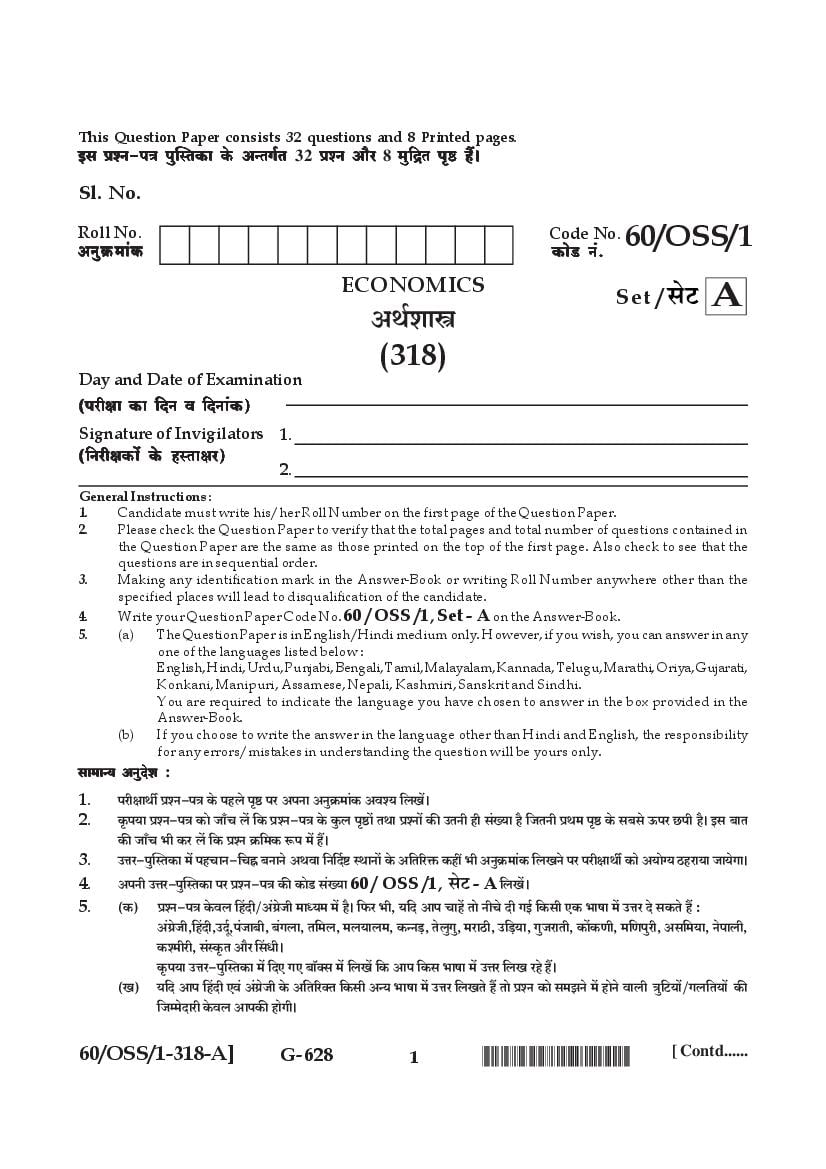
NIOS Class 12 Question Paper 2021 (Jan Feb) Economics – Text
Read the full text of this question paper below — useful to quickly search, copy and reference the content online without downloading the PDF.
📄 View text version (8 pages)
Page 1
Bg àíZ-nÌ nw p ñVH$m Ho $ AÝVJ© V 32 àíZ Am¡ a 8 ‘w { ÐV n¥ ð > h¢ &
Sl. No.
Roll No.
AZw H « $ _m§ H $
Code No.
H$mo S > Z§ .
60/OSS/1
ECONOMICS
Set / go Q > A
AW©emó
(318)
Day and Date of Examination
(narjm H$m {XZ d {XZm§ H $)
Signature of Invigilators 1.
({ZarjH$m| Ho $ hñVmja)
2.
General Instructions :
1. Candidate must write his/her Roll Number on the first page of the Question Paper.
2. Please check the Question Paper to verify that the total pages and total number of questions contained in
the Question Paper are the same as those printed on the top of the first page. Also check to see that the
questions are in sequential order.
3. Making any identification mark in the Answer-Book or writing Roll Number anywhere other than the
specified places will lead to disqualification of the candidate.
4. Write your Question Paper Code No. 60 / OSS /1, Set - A on the Answer-Book.
5. (a) The Question Paper is in English/Hindi medium only. However, if you wish, you can answer in any
one of the languages listed below :
English, Hindi, Urdu, Punjabi, Bengali, Tamil, Malayalam, Kannada, Telugu, Marathi, Oriya, Gujarati,
Konkani, Manipuri, Assamese, Nepali, Kashmiri, Sanskrit and Sindhi.
You are required to indicate the language you have chosen to answer in the box provided in the
Answer-Book.
(b) If you choose to write the answer in the language other than Hindi and English, the responsibility
for any errors/mistakes in understanding the question will be yours only.
gm_mÝ` AZwXoe :
1. narjmWu àíZ-nÌ Ho$ nhbo n¥ð> na AnZm AZwH«$‘m§H$ Adí¶ {bI|&
2. H¥$n¶m àíZ-nÌ H$mo Om±M b| {H$ àíZ-nÌ Ho$ Hw$b n¥ð>m| VWm àíZm| H$s CVZr hr g§»¶m h¡ {OVZr àW‘ n¥ð> Ho$ g~go D$na N>nr h¡& Bg ~mV
H$s Om±M ^r H$a b| {H$ àíZ H«${‘H$ ê$n ‘| h¢&
3. CÎma-nwpñVH$m ‘| nhMmZ-{M• ~ZmZo AWdm {Z{X©ï> ñWmZm| Ho$ A{V[aº$ H$ht ^r AZwH«$‘m§H$ {bIZo na narjmWu H$mo A¶mo½¶ R>ham¶m Om¶oJm&
4. AnZr CÎma-nwpñVH$m na àíZ-nÌ H$s H$moS> g§»¶m 60 / OSS /1, goQ> - A {bI|&
5. (H$) àíZ-nÌ Ho$db qhXr/A§J«oOr ‘mܶ‘ ‘| h¡& {’$a ^r, ¶{X Amn Mmh| Vmo ZrMo Xr JB© {H$gr EH$ ^mfm ‘| CÎma Xo gH$Vo h¢ :
A§J«oOr,qhXr,CX©ÿ,n§Om~r, ~§Jbm, V{‘b, ‘b¶mb‘, H$ÝZ‹S>, VobwJw, ‘amR>r, C{‹S>¶m, JwOamVr, H$m|H$Ur, ‘{Unwar, Ag{‘¶m, Zonmbr,
H$í‘rar, g§ñH¥$V Am¡a qgYr&
H¥$n¶m CÎma-nwpñVH$m ‘| {XE JE ~m°³g ‘| {bI| {H$ Amn {H$g ^mfm ‘| CÎma {bI aho h¢&
(I) ¶{X Amn qhXr Ed§ A§J«oOr Ho$ A{V[a³V {H$gr Aݶ ^mfm ‘| CÎma {bIVo h¢ Vmo àíZ H$mo g‘PZo ‘| hmoZo dmbr Ìw{Q>¶m|/Jb{V¶m| H$s
{Oå‘oXmar Ho$db AmnH$s hmoJr&
60/OSS/1-318-A] G-628 1 [ Contd......
Page 2
AW©emó
(318)
Time : 3 Hours] [Maximum Marks : 100
g_` : 3 KÊQ>o] [nyUmªH$ : 100
Note : i) All questions are compulsory.
ii) Marks allotted to each question are indicated against it.
iii) Each question from Question Nos. 1 to 10 has four alternatives - (A), (B), (C) and
(D), out of which one is most appropriate. Choose the correct answer among the
four alternatives and write it in your answer-book against the number of the ques-
tion. No extra time is allotted for attempting multiple choice questions.
{ZX}e: i) g^r àíZm| Ho$ CÎma Xr{OE &
ii) à˶oH$ àíZ Ho$ gm‘Zo CgHo$ A§H$ {bIo JE h¢ &
iii) àíZ g§»¶m 1 go 10 VH$ Ho$ à˶oH$ àíZ ‘| Mma {dH$ën-(A), (B), (C) VWm (D) h¢, {OZ‘| go EH$ g~go Cn¶wº$ h¡ & Mmam|
{dH$ënm| ‘| go ghr CÎma MwZ| VWm AnZr CÎma-nwpñVH$m ‘| àíZ g§»¶m Ho$ gm‘Zo CÎma {bI| & ~hþ-{dH$ënr àíZm| Ho$ {bE A{V[aº$
g‘¶ Zht {X¶m OmEJm &
1. Sum of deviations from mean is equal to : [1]
(A) One (B) Zero
(C) Mean it self (D) None of the above
g‘m±Va ‘mܶ go {dMbZm| H$m Omo‹S> BgHo$ g‘mZ hmoVm h¡ :
(A) EH$ (B) eyݶ
(C) ñd¶§ ‘mܶ (D) Cnamo³V ‘| go H$moB© Zhr
2. When total utility is maximum, marginal utility is : [1]
(A) Increasing (B) Decreasing
(C) Negative (D) Zero
O~ Hw$b Cn¶mo{JVm A{YH$V‘ hmo, Vmo gr‘m±V Cn¶mo{JVm :
(A) ~‹T>Vr h¡> (B) KQ>Vr h¡
(C) G$UmË‘H$ hmoVr h¡ (D) eyݶ hmoVr h¡
60/OSS/1-318-A] G-628 2 [ Contd......
Page 3
line demand curve is : [1]
(A) Less than one (B) Greater than one
(C) Equal to one (D) Equal to zero
EH$ ZrMo H$s Amoa T>bdm± grYr aoIm ‘m±J dH«$ Ho$ ‘ܶ go ZrMo Ho$ ^mJ na ‘m±J H$s H$s‘V bmoM ¶h hmoVr h¡ :
(A) EH$ go H$‘ (B) EH$ go A{YH$
(C) EH$ Ho$ g‘mZ (D) eyݶ Ho$ g‘mZ
4. The shape of Total Fixed Cost curve is : [1]
(A) Parallel to the X - axis (B) Parallel to the Y - axis
(C) Upward sloping (D) Downward sloping
Hw$b pñWa bmJV dH«$ H$m AmH$ma ¶h hmoVm h¡ :
(A) X - Aj Ho$ g‘mZm§Va (B) Y - Aj Ho$ g‘mZm§Va
(C) Cna H$s Amoa T>bdm± (D) ZrMo H$s Amoa T>bdm±
5. 'Increase' in supply leads to : [1]
(A) Upward movement on the supply curve
(B) Downward movement on the supply curve
(C) Leftward shift of supply curve
(D) Rightward shift of supply curve
Amny{V© ‘| "d¥{Õ' go ¶h hmoVm h¡ :
(A) ny{V© dH«$ na Cna H$s Amoa OmZm
(B) ny{V© dH«$ na ZrMo H$s Amoa OmZm
(C) ny{V© dH«$ H$m ~m±¶ {IgH$Zm
(D) ny{V© dH«$ H$m Xm±¶ {IgH$Zm
60/OSS/1-318-A] G-628 3 [ Contd......
Page 4
(A) Parallel to X - axis (B) Upward sloping straight line
(C) Parallel to Y - axis (D) Downward sloping straight line
nyU©V¶m bmoMXma ny{V© dH«$ H$m AmH$ma ¶h hmoVm h¡ :
(A) X - Aj Ho$ g‘mZm§Va (B) Cna H$s Amoa T>bdm± grYr aoIm
(C) Y - Aj Ho$ g‘mZm§Va (D) ZrMo H$s Amoa T>bdm± grYr aoIm
7. The difference between gross domestic product and net domestic product is : [1]
(A) Indirect Tax (B) Depreciation
(C) Subsidy (D) Transfer Payment
gH$b Kaoby CËnmX Am¡a {Zdb Kaoby CËnmX Ho$ ~rM H$m A§Va ¶h hmoVm h¡ :
(A) Aà˶j H$a (B) ‘yë¶õmg
(C) Am{W©H$ ghm¶Vm (D) hñVm§VaU ^wJVmZ
8. When money value of goods and services included in Gross Domestic Product is
estimated on the prices of the base year, it is called : [1]
(A) Real GDP (B) Nominal GDP
(C) GDP at market price (D) GDP at factor cost
O~ "Hw$b Kaoby CËnmX' (GDP) ‘| em{‘b dñVwAm| Am¡a godmAm| H$m AZw‘mZ AmYma df© H$s H$s‘Vm| na bJm¶m
OmVm h¡, Vmo Cgo ¶h H$hVo h¡ :
(A) dmñV{dH$ GDP (B) ‘m¡{ÐH$ GDP
(C) ~mOma H$s‘V na GDP (D) gmYZ bmJV na GDP
9. Exchange of goods for goods is called : [1]
(A) Medium of exchange (B) Barter system of exchange
(C) Transfer of value exchange (D) None of the above
dñVw Ho$ ~Xbo dñVw H$m {d{Z‘¶ ¶h h¡ :
(A) {d{Z‘¶ H$m ‘mܶ‘ (B) dñVw H$s {d{Z‘¶ àUmbr
(C) ‘yë¶ hñVm§VaU {d{Z‘¶ (D) Cnamo³V ‘| go H$moB© Zht
10. Gift Tax is an example of : [1]
(A) Direct Tax (B) Indirect Tax
(C) Progressive Tax (D) Regressive Tax
Cnhma H$a BgH$m CXmhaU h¡ :
(A) à˶j H$a (B) Aà˶j H$a
(C) àJm‘r H$a (D) à{VJm‘r H$a
60/OSS/1-318-A] G-628 4 [ Contd......
Page 5
ghg§~§Y JwUm§H$$ H$s H$moB© VrZ {deofVmE± ~VmBE&
12. Calculate Range from the following data : [3]
40, 45, 105, 108, 406, 440, 300, 39
{ZåZ{b{IV Am±H$‹S>m| go "{dñVma' H$m n[aH$bZ H$s{OE&
40, 45, 105, 108, 406, 440, 300, 39
13. Name three types of measures of central tendency. [3]
Ho$ÝÐr¶ àd¥Vr ‘mnm| Ho$ VrZ àH$ma ~VmBE&
14. Why does an economic problem arise? Explain. [3]
Am{W©H$ g‘ñ¶m ³¶m| hmoVr h¡? g‘PmBE&
15. State the Law of Diminishing Marginal utility. Explain with an example. [3]
gr‘m±V Cn¶mo{JVm õmg {Z¶‘ ~VmBE& CXmhaU Ûmam g‘PmBE&
16. What do you mean by substitute good and complementary good? Give an example
of each. [3]
ñWmZmnÝZ dñVw Am¡a nyaH$ dñVw go ³¶m A{^àm¶ h¡? à˶oH$ H$m EH$-EH$ CXmhaU Xr{OE&
17. A farmer undertakes farming on the land owned by him with the help of labour
services provided by his family members. He purchases fertilizers and insecticide
and pays water charges and electricity charges. Identify implicit costs and explicit
costs of farming. [3]
EH$ {H$gmZ AnZr IwX H$s O‘rZ na AnZo n[adma Ho$ Ûmam Xr J¶r l{‘H$ godmAm| H$s ghm¶Vm go IoVr H$aVm h¡&
dh ImX Am¡a H$sQ>ZmeH$ IarXVm h¡ Am¡a nmZr Am¡a {~Obr Ho$ {bE ^wJVmZ H$aVm h¡& IoVr H$aZo H$s ñnï> bmJVm|
Am¡a Amamo{nV bmJVm| H$s nhMmZ H$s{OE&
18. Distinguish between private costs and social costs. [3]
{ZOr bmJVm| Am¡a gm‘m{OH$ bmJVm| Ho$ ~rM A§Va ~VmBE&
60/OSS/1-318-A] G-628 5 [ Contd......
Page 6
nyU© à{V¶mo{JVm ‘| ’$‘] Ho$db gm‘mݶ bm^ hr ³¶m| H$‘m nmVr h¡?
20. What do you mean by flow variable? Give two examples. [3]
àdmh Ma go Amn ³¶m AW© g‘PVo h¢? Xmo CXmhaU Xr{OE&
21. Calculate mean marks by the Direct Method : [4]
Marks 20 30 40 50 60 70
No. of Students 8 12 20 10 6 4
à˶j {d{Y Ûmam ‘mܶ A±H$ H$m n[aH$bZ H$s{OE :
A§H$ 20 30 40 50 60 70
{dÚm{W©¶m| H$s g§»¶m 8 12 20 10 6 4
22. Explain the economic problem 'How to produce'. [4]
"H¡$go CËnmXZ H$a|' Am{W©H$ g‘ñ¶m g‘PmBE&
23. Market for a good is in equilibrium. There is an 'increase' in demand for this good.
Explain the chain of effects of this change. [4]
EH$ dñVw H$m ~mOma g§VwbZ ‘| h¡& Bg dñVw H$s ‘m±J ‘| "d¥{Û' hmo OmVr h¡& Bg n[adV©Z go hmoZo dmbo à^mdm| H$s
l§¥Ibm g‘PmBE&
24. Explain the main precautions to be taken while calculating national income through
the Expenditure method. [4]
춶 {d{Y Ûmam amï´>r¶ Am¶ H$s JUZm ‘| br OmZo dmbr ‘w»¶ gmdYm{Z¶m± g‘PmBE&
25. Differentiate between average propensity to consume and marginal propensity to
consume. Value of which of the two can be greater than one and why? [4]
Am¡gV Cn^moJ àd¥{V Am¡a gr‘m±V Cn^moJ àd¥{V ‘| A§Va ~VmBE& BZ‘| go {H$g H$m ‘yë¶ EH$ go A{YH$ hmo gH$Vm
h¡ Am¡a ³¶m|&
26. Explain 'acceptance of deposits' function of commercial banks. [4]
dm{UÁ¶ ~¡H$m| H$s "O‘mAm| H$m ñdrH$maH$' H$m¶© g‘PmBE&
60/OSS/1-318-A] G-628 6 [ Contd......
Page 7
as base by the "Simple Average" of Price Relative method: [6]
Commodities A B C D E
Prices (2011) 50 40 80 100 20
Prices (2016) 70 60 100 120 20
{ZåZ{b{IV Am±H$‹S>m| go df© 2011 H$mo AmYma boH$a df© 2016 H$m ""gab Am¡gV ‘yë¶ AZwnmV'' {d{Y Ûmam EH$
gyMH$m±H$ ~ZmBE&
dñVwE± A B C D E
‘yë¶ (2011) 50 40 80 100 20
‘yë¶ (2016) 70 60 100 120 20
28. State any three properties of an indifference curve. What does each property imply?
[6]
AZ{Y‘mZ dH«$ H$s H$moB© VrZ {deofVmE± ~VmBE& à˶oH$ {deofVm go ³¶m nVm MbVm h¡?
29. a) State difference between "Change in supply" and "Change in quantity supplied".
[2]
b) A sellers sells 40 units of a good when price is Rs. 4 per unit. Price elasticity
of supply is 2. How much quantity will the seller supply when price rises to
Rs. 5 per unit. [4]
a) ""ny{V© ‘o§ n[adV©Z'' Am¡a ""ny{V© H$s ‘mÌm ‘| n[adV©Z'' Ho$ ~rM A§Va ~VmBE&
b) EH$ {dH«o$Vm EH$ dñVw H$s 4 ê$. à{V BH$mB© na 40 BH$mB© ~oMVm h¡& ny{V© H$s H$s‘V bmoM 2 h¡& H$s‘V ~‹T>
H$a 5 ê$. à{V BH$mB© hmoZo na dh dñVw H$s {H$VZr ‘mÌm ~oMoJm?>
30. Explain the role of (a) Bank rate and (b) Open Market Operations in controlling
excess demand in an economy. [6]
EH$ AW©ì¶dñWm ‘| ‘m±J Ho$ Am{Y³¶ H$mo {Z¶§ÌU H$aZo ‘| (a) ~¢H$ Xa VWm (b) Iwbo ~mOma H$s {H«$¶mE±± H$m
¶moJXmZ g‘PmBE&
31. a) Give meaning of fiscal deficit, revenue deficit and primary deficit. [3]
b) State any three ways by which central government can finance the fiscal deficit.
[3]
a) amOH$mofr¶ KmQ>m, amOñd KmQ>m Am¡a àmW{‘H$ KmQ>m Ho$ AW© ~VmBE&
b) ~VmBE {H$ {H$Z {H$Ýhr VrZ VarH$m| go Ho$ÝÐr¶ gaH$ma amOH$mofr¶ KmQ>o H$s ^anmB© H$a gH$Vr h¡&
60/OSS/1-318-A] G-628 7 [ Contd......
Page 8
given data below : [6]
(Rs. Crore)
i) Mixed income of self employed 2500
ii) Net factor income from abroad (–) 50
iii) Rent 500
iv) Consumption of fixed capital 400
v) Profits 300
vi) Compensation of employees 1600
vii) Net indirect tax 500
viii) Royalty 400
ix) Interest 500
x) Direct Tax 300
{ZåZ Am±H$‹S>m| go (a) amï´>r¶ Am¶ VWm (b) ~mOma H$s‘V na {Zdb amï´>r¶ CËnmX H$m n[aH$bZ H$s{OE :
(H$amo‹S> ê$.)
i) ñd¶‘ {Z¶mo{OVm| H$s {‘{lV Am¶ 2500
ii) {dXoem| go {Zdb H$maH$ Am¶ (–) 50
iii) {H$am¶m 500
iv) AMb ny±Or H$m Cn^moJ 400
v) bm^ 300
vi) H$‘©Mm[a¶m| H$m nm[al{‘H$ 1600
vii) {Zdb Aà˶j H$a 500
viii) am¶ëQ>r 400
ix) ã¶mO 500
x) à˶j H$a 300
60/OSS/1-318-A] G-628 8
Document Details
| Board / Org | NIOS |
| Exam | National Institute of Open Schooling Class 12 |
| Type | Question Paper |
| Pages | 8 |
| Updated | 22 Jul 2026 |